
How to Order Matcha Powder the Smart Way
You're ready to order matcha powder, but the product page gives you little more than a green tin, a premium-sounding label, and a price. The safest choice isn't automatically the most expensive one. It's the powder whose grade, origin, packaging, serving size, and intended use match what you'll do with it.
That matters in Australia, where more than 90% of domestic matcha demand is met through imports and combined green-tea-powder imports grew at an estimated 13–17% CAGR from 2020 to 2025, according to Australian matcha market analysis. Supply changes can affect availability, substitutions, and pricing, so a smart order starts with product information, not branding.
Why Ordering Matcha Powder Deserves More Thought Than a Cart Click
A large pouch can look economical until you open it weeks later and find faded colour, a stale aroma, or a bitter drink that needs plenty of sweetener. Matcha is finely ground, so air, moisture, light, and heat reach more of the tea than they do with intact loose-leaf tea. Buy more than you can use while it is fresh and the saving quickly loses its appeal.
Start with the job the powder must do: how will you use the matcha? A bowl whisked with water exposes its colour, aroma, texture, and aftertaste. A latte brings milk and perhaps syrup. Baking adds sugar, flour, butter, and heat. Each use calls for a different balance, so the highest grade is not automatically the best purchase.
Practical rule: Buy for the drink or recipe you make most often, not for the most impressive grade name on the label.
Origin matters, but “Japanese matcha” does not answer every useful question. A product page should explain whether the powder is genuine matcha made from shaded tea leaves or green-tea powder using matcha-style language. Check the listed origin, ingredients, batch details, and packaging. Those details help you judge the seller's supply chain and freshness before paying.
Australian buyers also need a continuity plan. Japanese green-tea imports to Australia rose nearly 20% year over year in 2024, per Australian matcha market reporting, while some Australian cafés reported matcha-latte prices of approximately AUD 6–8. If supply tightens, ask whether the seller will keep the stated origin and grade, substitute another source, reduce the serving size, or raise the price.
Compare cost per prepared serve, not just the tin price. A powder that suits your usual latte or recipe can offer better value than an expensive ceremonial powder whose finer flavours disappear under milk, syrup, or other ingredients.
A specialist such as The Matcha Bike Miami matcha service shows how a focused matcha business presents preparation and service. For an Australian order, check delivery, labelling, freshness, and provenance yourself.
Understanding Matcha Grades and What Each One Is Actually For
Matcha grades are best treated as use-case labels, not universal quality rankings. “Ceremonial” usually signals a powder designed to be enjoyed with water, while “culinary” points towards recipes where other ingredients share the stage. “Premium” can sit between those uses, but sellers don't apply these terms identically.
Ceremonial grade for a clean, direct drink
Ceremonial matcha is the choice for a whisked bowl where the powder's colour, aroma, texture, and aftertaste are obvious. Choose it when you enjoy matcha with water and don't want milk or sugar to carry the flavour.
A vivid green colour can be encouraging, but it isn't enough on its own. Look for 100% matcha, Japanese origin, a clear lot or batch reference where available, and packaging that protects the powder from oxygen and light. A good ceremonial powder should whisk smoothly after sifting and taste balanced rather than harshly bitter.
Premium or ceremonial-blend for everyday flexibility
Premium or ceremonial-blend matcha is often the most useful middle ground for a regular home drinker. It can work in a latte, iced matcha, smoothie, or a lighter bowl, without making every preparation feel like a special occasion.
Value becomes personal here. If you mostly add milk, fruit, or other strong flavours, a balanced mid-range powder may give you more satisfaction than an expensive powder whose subtle notes disappear in the recipe.
Culinary grade for baking and blended drinks
Culinary grade is made for recipes that need matcha's colour and distinctive tea character alongside other ingredients. It suits muffins, biscuits, brownies, cheesecake, ice cream, smoothies, and strongly flavoured lattes.
That doesn't mean culinary grade should taste rough or unpleasant. It should still be clearly identified, fresh, finely milled, and free from unnecessary additives. A culinary powder may bring a more assertive tea flavour that holds up better against chocolate, citrus, dairy, or plant-based milk.
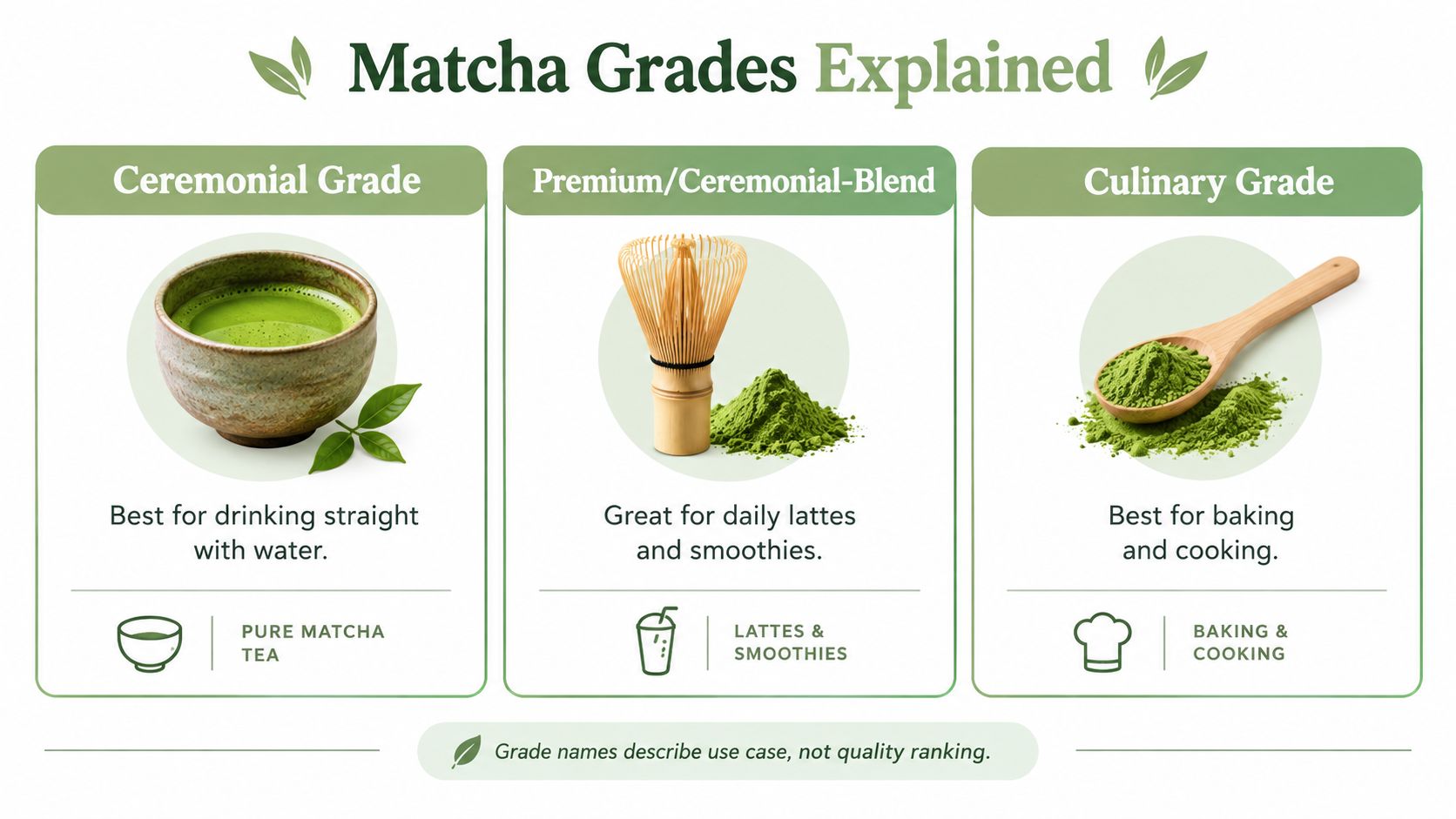
The practical distinction is simple: ceremonial is for drinking straight, premium is for flexible daily use, and culinary is for cooking and baking. Pep Tea's guide to different matcha grades is a useful reference when a product page uses several overlapping grade terms.
Don't pay for a high-grade powder because the label sounds luxurious. If the powder will disappear into a sweetened iced latte or a batch of baked goods, culinary or premium matcha can be the more sensible order.
Matching the Grade to Your Cup, Latte, or Recipe
The right matcha becomes much easier to choose once you name the preparation. A plain whisked bowl rewards smoothness and balance. A latte needs enough flavour to remain noticeable through milk. Baking needs colour and resilience rather than delicate tasting notes.
| Use case | Ceremonial grade | Premium grade | Culinary grade |
|---|---|---|---|
| Whisked bowl with water | Best fit for a clean, direct taste | Suitable for an everyday bowl | Usually too assertive or coarse-tasting |
| Hot matcha latte | Excellent, but may be more than needed | Strong everyday choice | Suitable when milk or sweetener dominates |
| Iced matcha | Smooth and refined | Practical balance of flavour and value | Works well with fruit, syrup, or bold milk |
| Smoothie | Often unnecessary | Versatile option | Good for stronger fruit or protein blends |
| Baking and desserts | Usually wasteful | Useful for lighter recipes | Best fit for colour and pronounced tea flavour |
A ceremonial powder earns its price when you can taste it directly. It's the logical choice for a small bowl of matcha and water, where there's nowhere for bitterness or stale notes to hide. It can also suit a minimalist iced drink with little more than water and ice.
Premium grade is the useful compromise for people who alternate between bowls, lattes, and smoothies. You'll get flexibility without building your entire routine around a powder that should be consumed quickly and treated carefully.
Culinary grade often delivers the best cost per prepared serve for a café-style latte, especially if you use milk, fruit, cocoa, vanilla, or sweetener. A cheaper powder isn't better if it tastes unpleasant, but a high-grade powder isn't better if its character is buried under several other ingredients.
The honest trade-off: Premium doesn't automatically mean better. It means the powder may be better suited to a particular preparation.
Before you order, write down your likely use in one sentence. “I want a plain morning bowl” points towards ceremonial. “I want iced lattes and smoothies” points towards premium. “I'm baking and making flavoured drinks” points towards culinary.
The Australian Ordering Checklist Before You Check Out
A good product page should answer your important questions without forcing you to search through vague marketing copy. Run these checks before adding matcha to your cart.
Check the product identity
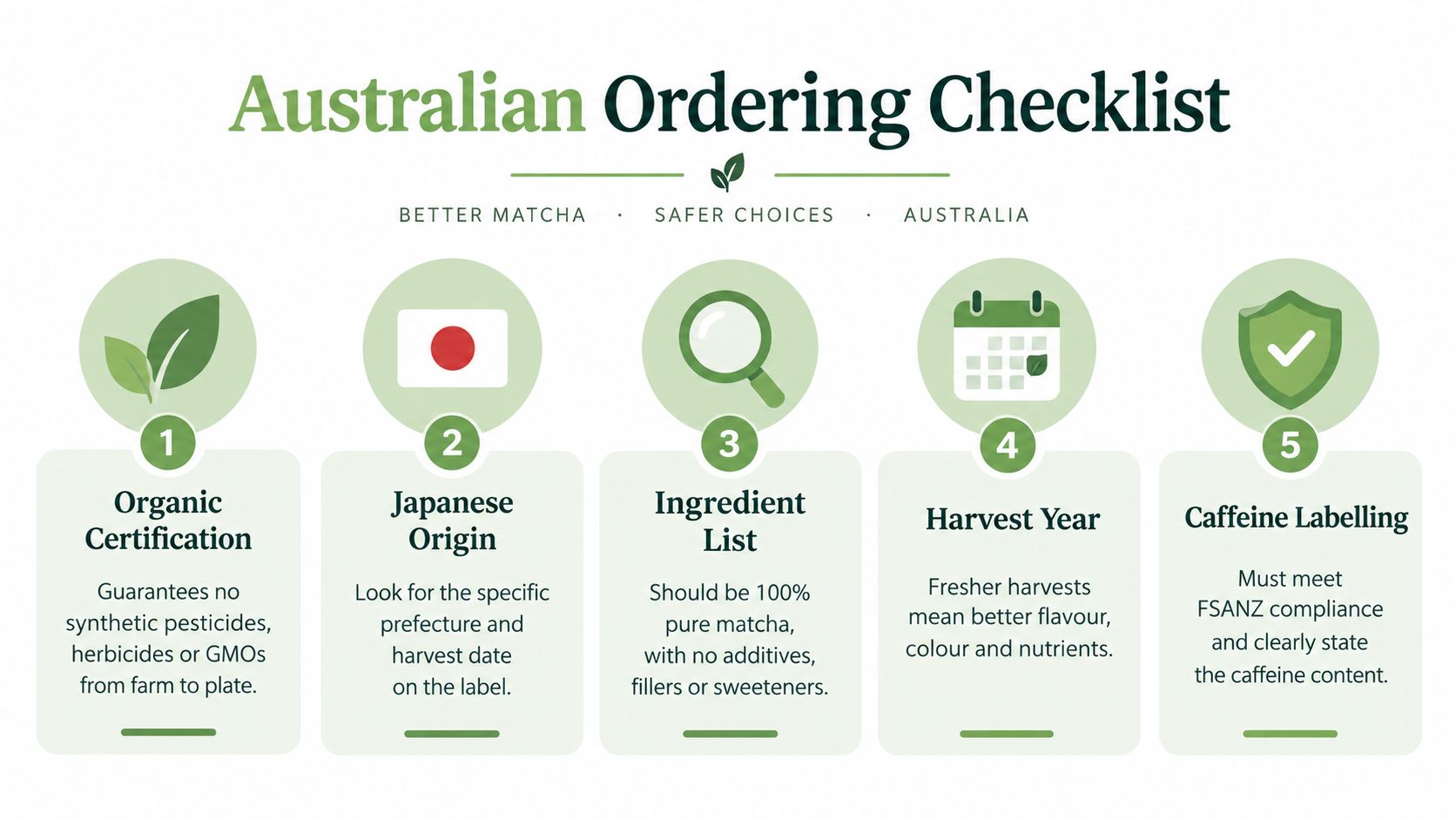
Look for 100% matcha in the ingredient list. Genuine matcha is powdered tea, not a blend padded with sugar, starch, flavouring, or anti-caking ingredients. “Green tea powder” can describe a broader category, so check whether the seller explains the tea's origin and production clearly.
Japanese origin is a useful starting point, but ask for more detail where possible. A prefecture, harvest information, cultivar, or producer reference gives you a clearer picture than a generic country label. Tencha is the leaf material traditionally associated with matcha production, whereas ordinary green-tea powder may be made from a different raw material and processed for a different purpose.
Check certification and traceability
Organic certification can matter if organic purchasing is part of your priorities, but the word should be supported by identifiable certification information. Also look for a lot or batch reference, best-before information, and a seller who can explain how the product is packed and restocked.
Harvest details are helpful because matcha is a fresh powdered tea, not a pantry ingredient that improves with age. A product page doesn't need to make dramatic freshness promises. It should give you enough information to judge whether the powder has been sitting in an uncertain supply chain.
Check the format and delivery
A metal tin can protect a small quantity from light and repeated handling. A resealable pouch may suit a larger quantity if it has a reliable barrier and you transfer or seal it carefully. Sachets are convenient for travel and portion control, but usually offer less flexibility when you want to adjust the recipe.
Shipping matters in Australia's warmer conditions. Ask how the seller protects the product from prolonged heat, whether it ships promptly, and how the powder is sealed before dispatch. For cafés or wholesale buyers, affordable courier cost advice can help when comparing delivery arrangements, but freight cost should be assessed alongside packaging quality and stock reliability.
Use the Australian matcha tea powder range as one example of the type of product information worth comparing. Then calculate value by prepared serve, not tin price. A larger pack only saves money if you can finish it while the flavour remains enjoyable.
Caffeine Awareness and How to Read a Matcha Label
Matcha is a caffeinated food, so the serving size deserves attention. The entire powdered leaf is consumed, unlike a conventional tea infusion where water is separated from the leaves. That means the amount of powder in your bowl or latte, along with the recipe and drink size, influences your caffeine intake.
Australian sports-nutrition guidance gives a useful comparison: a 250-millilitre serving of green tea generally contains about 30–50 milligrams of caffeine according to the Australian Institute of Sport. A matcha drink isn't automatically equivalent because preparation can use different quantities of powder.
Understand the food-safety distinction
Food Standards Australia New Zealand prohibits the retail sale of solid or semi-solid foods containing 5% or more caffeine, equivalent to at least 50 milligrams per gram, and liquid products containing 1% or more caffeine, according to FSANZ guidance on caffeine powders and high-caffeine foods. These rules target highly concentrated caffeine powders and similar products.
Traditional tea products are treated differently because tea, coffee, and cocoa have an established history of food use. For someone ordering matcha, the practical distinction is clear: choose a clearly identified, food-grade tea powder, not a product marketed as a concentrated caffeine supplement.
FSANZ also states that caffeine must be declared in the ingredient statement when it is present as an ingredient. Read the serving guidance, preparation instructions, and ingredient list together. If a product page emphasises stimulant strength but says little about tea origin or serving size, choose another listing.
Healthdirect describes 400 milligrams of caffeine per day as generally safe for healthy adults, with individual circumstances affecting what is appropriate, as explained in its caffeine guidance. Count caffeine from coffee, tea, energy drinks, and chocolate across the day. If you're pregnant, breastfeeding, sensitive to caffeine, or taking relevant medicines, seek individual medical advice rather than relying on a general benchmark.
For a closer look at tea comparisons, Pep Tea's guide to caffeine content in green tea provides useful preparation context. The sensible approach is portion awareness, not chasing the highest number on a label.
Packaging, Storage, and Beginner Brewing Without the Guesswork
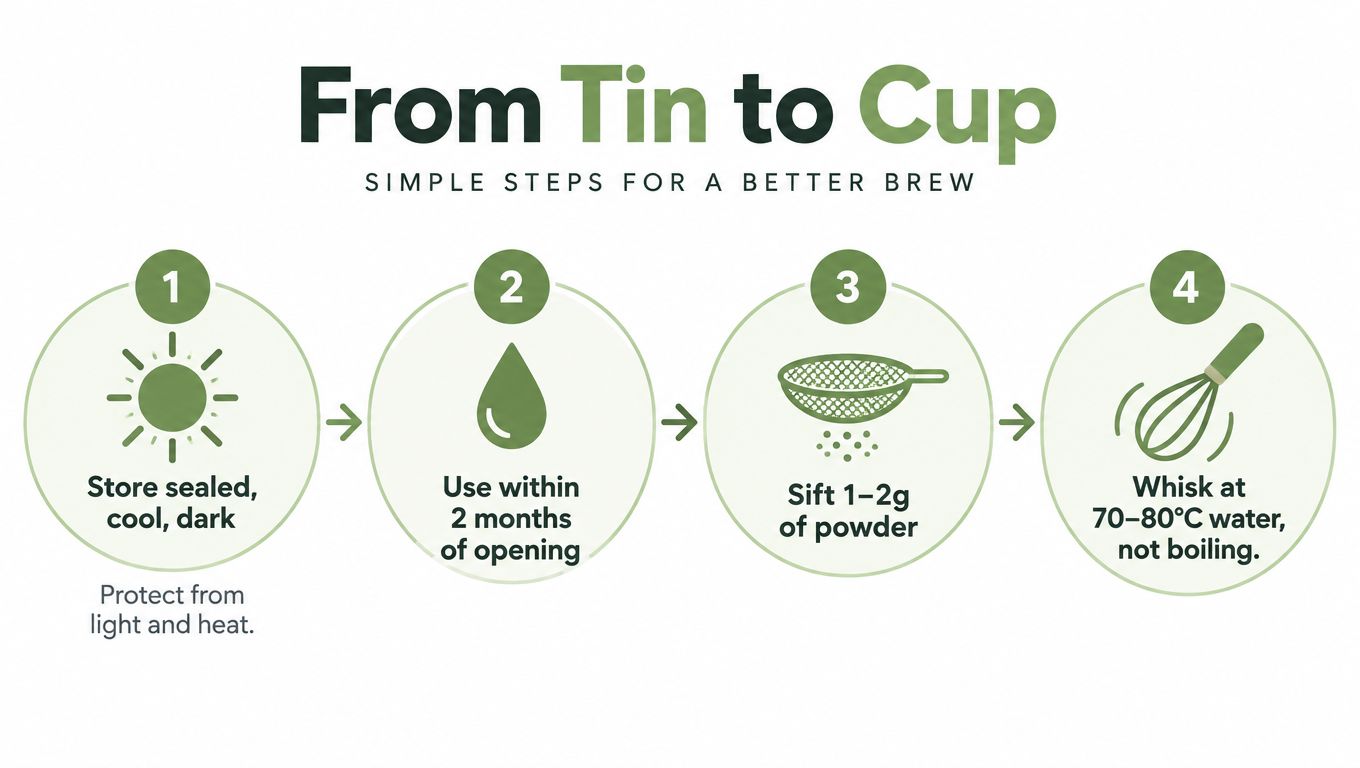
Your matcha can arrive in excellent condition and still disappoint if you leave the lid loose beside a sunny window. Light, oxygen, heat, and moisture are the enemies of fresh powdered tea. Store an unopened pack according to the seller's instructions, then keep an opened tin or pouch airtight, cool, and away from steam.
A tin is convenient for daily use and protects against light. A resealable pouch can work well for a larger quantity, provided you press out excess air and seal it properly. Single-serve sachets are useful for travel, work, and consistent portions, but they're less practical if you change the strength of your drink.
For most home drinkers, order a quantity you can use within roughly six to eight weeks of opening for peak flavour. Refrigeration can help, but avoid opening a cold container in a humid environment, where condensation may enter the powder. Let a sealed pack adjust before opening, and always use a dry spoon.
Three easy ways to prepare it
Whisked bowl: Sift around 1–2 grams of matcha into a bowl. Add a small amount of warm water, whisk into a smooth paste, then add more water and whisk briskly until lightly foamy. Water around 70–80°C is a forgiving starting point, because boiling water can make the drink taste harsh.
Hot latte: Sift the powder, mix it with a small amount of warm water, and whisk until smooth. Add warmed milk and adjust the strength to taste. A handheld frother works if you don't own a bamboo whisk.
Iced matcha: Make a concentrated paste with sifted powder and warm water first. Add cold water or milk, then pour over ice. Mixing the powder directly into a full glass of cold liquid often leaves clumps.
A bowl, fine sieve, bamboo whisk, and temperature-controlled kettle make the process easier, but you don't need a ceremonial equipment collection to start. The basics are accurate measuring, water that isn't boiling, and powder protected from moisture.
If you're also choosing lower-sugar drinks, the Australian Bureau of Statistics reports that 28.9% of Australians consumed sweetened beverages in 2023, while 23.8% consumed soft drinks or flavoured mineral waters, as shown in its food and nutrition data. An unsweetened matcha can fit a sugar-reduction routine, but the final sugar content still depends on the milk, syrup, or flavoured ingredients you add.
Putting It Together and Ordering With Confidence
Two questions settle most matcha purchases: what will you make, and how quickly will you use it?
For plain whisked tea, choose a well-documented ceremonial powder in a pack size you can finish while it stays fresh. Daily lattes and iced drinks suit premium grade. For baking, smoothies, and strongly flavoured recipes, culinary grade often gives better value because other ingredients carry the flavour.
Check the product page for ingredients, Japanese origin or a clearly stated source, grade, batch information, packaging, serving guidance, and delivery conditions. Compare the price per prepared serve, not only the tin price. Choose a larger pack only if your routine will use it before freshness falls.
With grade, pack size, and freshness aligned to your routine, the final check should take minutes, not become a research project.
Pep Tea supplies organic Japanese matcha powder for whisked bowls, lattes, smoothies, baking, and café use, alongside Australian-brewed sugar-free organic kombucha from the Hunter Valley, NSW. Visit Pep Tea to compare ceremonial and culinary-style options, then order the grade and pack size that match your actual use.