
Tag: matcha benefits
Matcha Energy vs Coffee: An Australian Guide for 2026
You know the moment. The alarm goes off, you're half awake, and your hand reaches for the same first fix, coffee, before your brain has fully clocked in. For a lot of Australians, that ritual feels essential, but a key question is whether it's giving you the kind of energy you truly desire, fast, frantic, steady, or somewhere in between.
Matcha energy vs coffee isn't really a contest about which drink is “better” in the abstract. It's a practical choice about how you want to feel at 8 am, 3 pm, or before a long stretch of focus work. Coffee and matcha can both be part of a healthy routine, but they don't deliver energy in the same way, and that difference is more significant than commonly understood.
| Drink | Typical caffeine in Australia | Energy feel | Best fit |
|---|---|---|---|
| Coffee | About 95 mg per cup | Quicker, sharper lift | Fast starts, short bursts, when you want a stronger hit |
| Matcha | About 60 to 75 mg per similar serving | Smoother, steadier alertness | Calm focus, gentler energy, longer work blocks |
The Morning Ritual Reimagined
The coffee machine clicks on, the kettle boils, and before the day has even started, you've already decided what sort of pace you're setting. That's the power of habit, it's not just about caffeine, it's about identity, comfort, and routine. For many people, coffee says “wake up now”, while matcha says “start well”.
The Australian conversation around these drinks has shifted because people are asking better questions. They're not only asking how much stimulation they'll get, they're asking how it will feel, how long it will last, and whether it fits work, exercise, or a calmer morning rhythm. That's why matcha energy vs coffee has become such a useful comparison for health-conscious readers.
Coffee still has its place, especially if you want a quick jolt. But matcha has moved from a niche tea-culture product into a mainstream café ingredient, and that shift has been driven by Australians looking for a more considered kind of energy, one that feels useful rather than relentless.
Practical rule: If your morning needs speed, coffee is usually the simpler answer. If you want steadier focus without feeling wired, matcha deserves a look.
That's the basic frame for the rest of the discussion. It's not about crowning a winner. It's about matching the drink to the moment.
The Caffeine Showdown How They Deliver Energy

The numbers matter, but so does the format
Australian reporting puts a typical coffee at about 95 mg of caffeine per cup, while matcha generally lands at about 60 to 75 mg per similar serving ABC News Australia. That sounds like a simple win for coffee if you only care about raw dose, but the serving format changes the experience a lot.
Matcha is also more variable than many people expect. One Australian explainer notes it can range from 38 to 176 mg of caffeine per cup depending on how it's prepared, while another Australian source still places it around 60 to 75 mg per serving Nine Kitchen. That's the key point, dose control matters. A café-style latte, a strong whisked serve, and a lighter home brew won't all feel the same.
Why the energy feels different
Coffee tends to feel like a quicker rise. Matcha tends to feel more measured because the caffeine comes packaged with other plant compounds, and Australian coverage says the leaves are shaded for three to four weeks before harvest, a step that raises caffeine and antioxidant levels and helps explain the steadier alertness people often describe ABC News Australia.
That's why people often describe coffee as a rocket launch and matcha as a steady climb. The base ingredient isn't the whole story. The way it's grown, processed, and served shapes the experience, and that's exactly why a standard caffeine chart doesn't tell the full story.
For readers comparing their own routines, a practical place to start is this internal guide on caffeine in matcha latte. It helps make the serving-size question less vague, which is where a lot of confusion starts.
Beyond Caffeine The L-Theanine Difference
What L-theanine changes
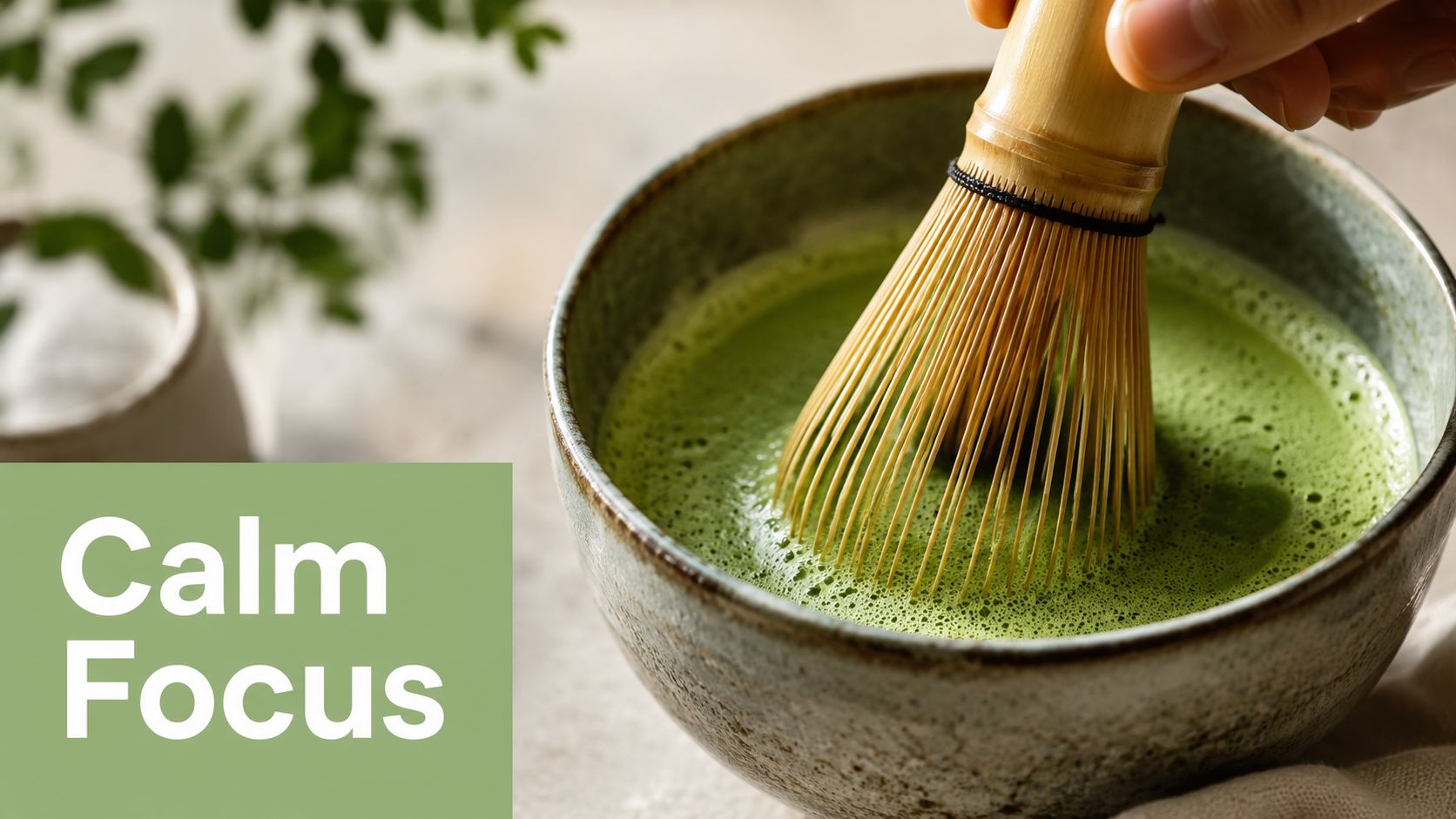
L-theanine is the reason matcha feels different from plain caffeine. Australian coverage increasingly frames matcha as a functional alternative to coffee because of its L-theanine content, which is associated with calm alertness and a slower-release energy that feels more sustained Matcha Society Australia. In simple terms, caffeine helps you switch on, while L-theanine helps the signal feel less jagged.
That doesn't mean matcha is sedating. It means the alertness can feel cleaner, with less of the edgy, buzzy quality some people get from stronger coffee. For professionals who need to stay mentally switched on without feeling scattered, a useful deep dive is the role of L-theanine for professionals, which explains why this compound gets so much attention in focus-oriented routines.
Why people describe it as calmer
The easiest way to think about it is this. Coffee can feel like a sudden push, while matcha often feels like a smoother lane change. The energy is still there, but it tends to suit tasks where you want attention, patience, and a steady temperament rather than a rapid surge.
Matcha is often chosen not because it is “stronger”, but because the kind of alertness feels more manageable.
For some people, that's the difference between powering through a meeting and feeling like the meeting is powering through them. If you're comparing product styles, the internal guide on Uji matcha powder is a useful reference point for understanding quality and flavour differences without getting lost in jargon.
A Comparison of Antioxidants and Nutrients
Whole leaf versus infusion
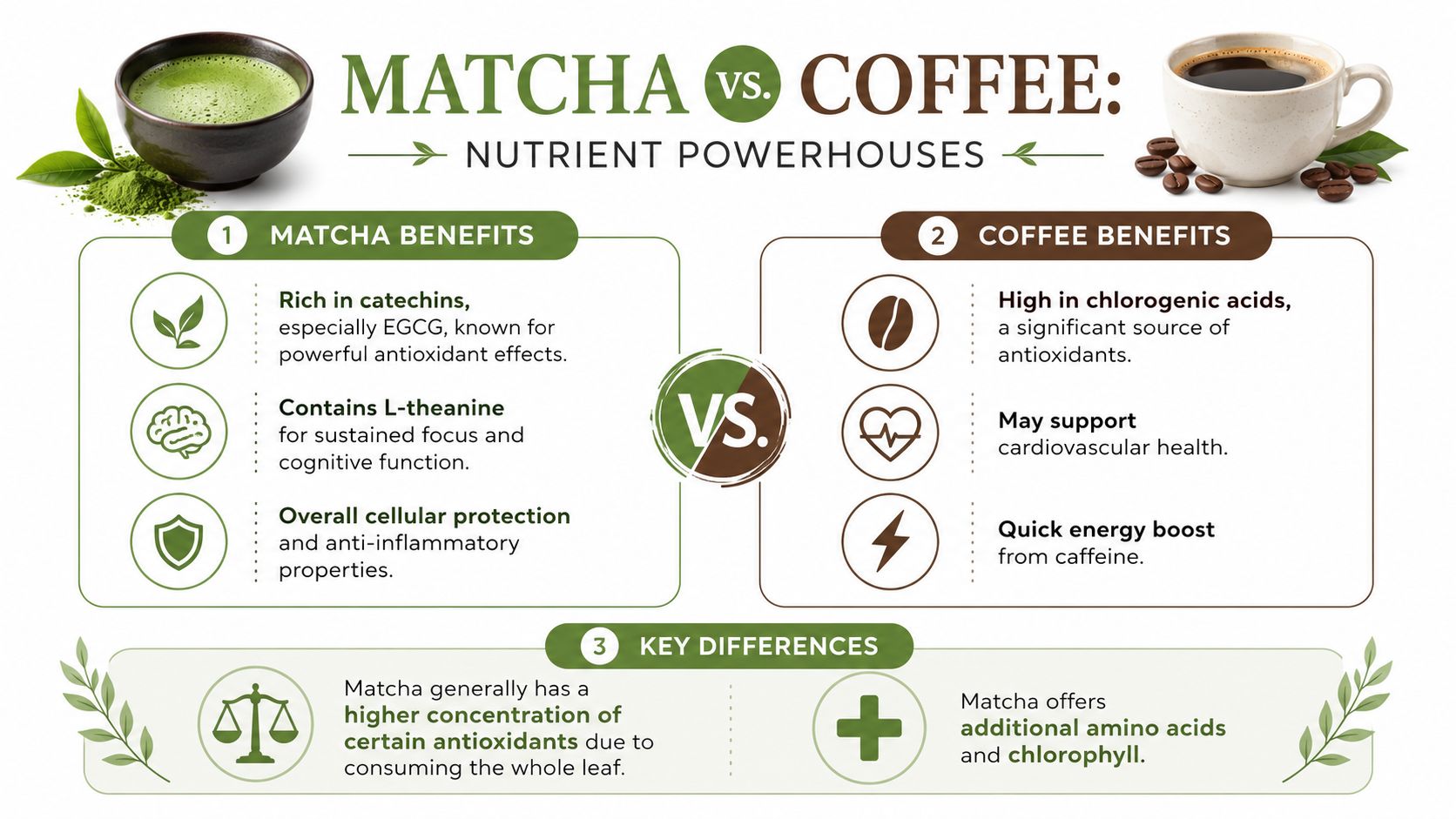
Matcha has a nutritional advantage that comes from a simple mechanism, you consume the whole tea leaf as powder rather than steeping and discarding it. Australian sources highlight its higher polyphenol and antioxidant density for that reason, and name compounds such as catechins, polyphenols, flavonoids, and EGCG as central to its functional profile Deakin University.
That whole-leaf approach is why matcha is often talked about as a concentrated source of functional compounds. A 2023 review found matcha contains a high concentration of bioactive compounds, especially polyphenols, flavonoids, phenolic acids, carotenoids, and vitamins, and another review concluded that matcha infusions have the highest antioxidant potential among tea types PMC review. A separate review also notes matcha's high catechin levels and strong antioxidant activity in experimental contexts PMC review.
What that means in plain English
This doesn't make matcha a miracle drink, and it shouldn't be treated like medicine. It does mean the drink carries more of the plant with it, so the cup is doing more than just delivering caffeine. That's why people interested in clean energy, gut-friendly routines, and antioxidant-rich beverages often gravitate towards it.
Coffee has its own strengths, and many Australians love it for flavour and a sharper lift. But if your idea of a good daily drink includes energy plus plant compounds, matcha fits that brief more naturally because the leaf itself is part of the drink.
Simple takeaway: coffee is mainly about the brewed bean, matcha is about the whole leaf. That difference shapes both the taste and the functional profile.
When to Choose Matcha and When to Choose Coffee
Match the drink to the job
The best choice depends on what your day needs. Australian commentary says coffee is often preferable for a fast caffeine hit, while matcha suits people who want smoother, sustained energy for calm-focus occasions, such as afternoon work or when they're more sensitive to caffeine AGFG.
That makes the decision easier if you stop asking “which is healthier?” and start asking “what am I trying to do right now?”. A hard training session, a sleepy school run, a creative block, a long spreadsheet session, and a late afternoon meeting all ask for different energy profiles.
A practical decision guide
- Choose coffee for speed: If you need to feel switched on quickly, coffee is the more direct option.
- Choose matcha for sustained focus: If the workday is long and you want fewer jagged peaks, matcha fits better.
- Choose matcha for afternoon use: If the 3 pm slump hits hard, matcha often feels more manageable than a stronger coffee.
- Choose coffee if you like intensity: Some people prefer the stronger, bolder lift and don't mind the sharper edges.
A useful way to think about it is quality of energy, not just quantity. Some tasks need a burst, others need consistency. If you're about to lift heavy at the gym, coffee may make sense. If you're settling in for writing, client work, or study, matcha often feels like the better tool.
The primary advantage here is strategic use. You don't have to pick a side forever. You can choose based on the moment, your caffeine tolerance, and how you want the rest of the day to unfold.
How to Choose and Prepare Quality Matcha
What quality looks like
Good matcha should taste vibrant, not dull or dusty. Ceremonial-grade matcha is usually the better choice for drinking straight or in a simple latte, while culinary-grade matcha is better suited to baking, smoothies, and recipes where other ingredients soften the flavour. That distinction matters because not all green powder behaves the same in the cup.
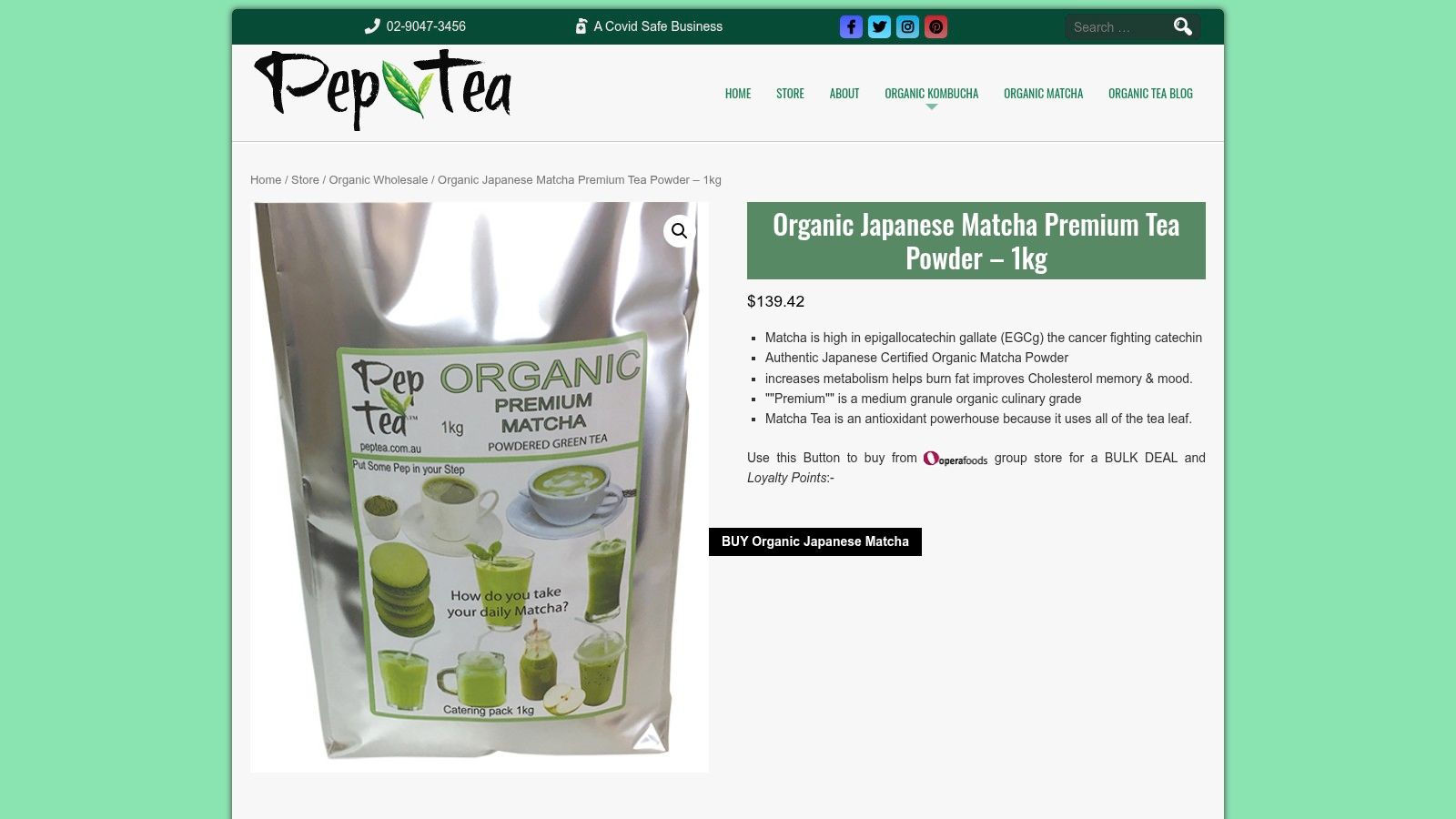
Pep Tea's premium Japanese matcha is certified organic by the Japanese Ministry of Agriculture and grown in southern Japan, which gives Australian buyers a clear provenance and certification claim to look for in an authentic product Pep Tea product page. If you want a straightforward brewing reference, the internal guide on making matcha tea is a handy starting point.
A simple home latte method
- Sift the matcha so it doesn't clump.
- Whisk with a small amount of hot, not boiling, water until smooth and frothy.
- Add milk of choice, then stir through.
- Taste before sweetening, because a good matcha should already have enough flavour to stand on its own.
A good latte doesn't need to be complicated. The fewer barriers there are, the more likely you are to use matcha consistently instead of treating it like a special-occasion ingredient.
A video can help make the whisking rhythm feel less intimidating.
The Verdict Your Personal Energy Prescription
The cleanest summary is simple. Coffee is the faster, sharper option. Matcha is the steadier, calmer option. Neither drink wins every situation, because your body, schedule, and sensitivity to caffeine all change the equation.
If you care most about speed, coffee makes sense. If you care most about feeling alert without a hard edge, matcha usually fits better. If you're trying to build a healthier routine around everyday choices, quality matters too, which is why it's worth checking labels and provenance the same way you might when you find pesticide-free food.
The most useful mindset is to treat energy like a tool, not a personality trait. Some days call for intensity, others call for steadiness. Once you start choosing with intention, the question stops being “coffee or matcha?” and becomes “what kind of energy does this moment need?”
A CTA for Pep Tea. If you're ready to explore calmer, cleaner energy for your own routine, take a look at Pep Tea's organic matcha range and see which style fits your mornings, your afternoons, and the way you like to feel.
Green Tea Energy Powder: A Guide to Matcha’s Calm Boost
You're probably reading this in one of two moments. It's either early morning and you want energy that won't leave you rattled by mid-morning, or it's the middle of the afternoon and your brain has gone foggy while your to-do list hasn't.
That's where green tea energy powder enters the conversation. For many Australians, the interest isn't just about caffeine anymore. It's about finding something steadier, gentler, and easier to build into a daily routine. Matcha often sits at the centre of that shift because it offers more than a quick jolt. It brings ritual, flavour, and a different kind of focus.
Tea is still a smaller part of everyday beverage intake than water and coffee in Australia, but it remains part of the daily mix. In 2023, Australians consumed an average of 1,926 grams of non-alcoholic beverages per day, with tea at 153 grams, coffee and substitutes at 191 grams, and water at 1,352 grams, according to the Australian Bureau of Statistics food and nutrition release.
What matters more than the headline trend is the reason people keep returning to matcha. It feels cleaner. It fits a smoothie, a latte, or a quiet tea bowl. And when it's high quality, it can become one of the easiest swaps in a wellness routine.
The Search for a Smarter Energy Boost
The true desire isn't for ‘more energy' in the abstract. Instead, individuals want to get through a meeting without zoning out. They want to train after work without reaching for a sugary can. They want morning focus without the shaky hands that can come with too much coffee.
That's why matcha has become such an appealing option in the green tea energy powder category. It sits in the middle ground between comfort and function. You still get a proper drink, not a pill or an artificial pre-workout. But you also get compounds that many people associate with focus, steadier alertness, and a more balanced lift.
The broader Australian market reflects that interest. The Australian green tea market was valued at USD 319.0 million in 2025 and is projected to reach USD 521.6 million by 2034, with a 5.41% compound annual growth rate from 2026 to 2034, according to IMARC Group's Australia green tea market analysis. That same analysis notes that powder forms remain highly relevant in the extract segment, and that green tea's functional benefits are helping drive demand across beverages, supplements, and café applications.
Why people move away from harsher energy options
Some people are tired of the crash. Others want fewer additives.
A good matcha can feel more grounded because it belongs to a familiar food culture. You whisk it with water, blend it with milk, or stir it into breakfast. That changes the whole experience. It becomes part of your day rather than a rescue mission.
Matcha suits people who want energy with a bit more control. Not flat. Not frantic. Just more even.
Where confusion starts
The phrase green tea energy powder sounds simple, but it covers very different products:
- Whole-leaf matcha used in drinks and recipes
- General green tea powders that may vary in quality and processing
- Concentrated green tea extracts sold in capsules or formulation powders
Those aren't interchangeable. The benefits, taste, use, and safety profile can differ quite a bit. That distinction matters more than most labels make clear.
What Exactly Is Green Tea Energy Powder
When people talk about premium green tea energy powder, they're usually talking about matcha. Matcha is a finely ground powder made from green tea leaves, traditionally shade-grown before harvest and then milled into a soft powder.
That whole-leaf format changes everything. Instead of steeping leaves in water and discarding them, you consume the leaf itself. The result is a drink with a fuller flavour, deeper colour, and a very different nutritional profile from standard tea bags.
Matcha isn't just “green tea in powder form”
Regular green tea and matcha come from the same plant, but they're not handled the same way. Matcha is grown and prepared for powder use. The leaf is selected, processed, and ground with drinking in mind.
That's why authentic matcha tends to have:
- A brighter green colour from careful growing and processing
- A finer texture that whisks into water rather than floating in gritty clumps
- A fuller taste with grassy, savoury, and sometimes creamy notes
If a powder looks dull, tastes flat, or feels sandy, you're usually dealing with lower quality leaf, rougher milling, or a product designed more for blending than for drinking straight.
Whole-leaf powder versus concentrated extract
This is the distinction many guides skip, and it's the one worth understanding clearly.
Whole-leaf matcha is a food. You prepare it as a drink or use it in recipes.
Green tea extract powder is a concentrated ingredient, often standardised for compounds such as EGCG. In the Australian nutraceutical market, green tea extract powder for energy formulations is typically standardised to 50% to 70% EGCG, while certified organic matcha contains about 5% to 10% total polyphenols. That means the extract can be 5 to 14 times more concentrated in bioactive catechins per gram, according to Elchemy's analysis of green tea extract powder.
That same source notes that standardised extracts can more strongly inhibit COMT and are associated with an increase in 24-hour energy expenditure by 4% to 5%. Useful in some formulation contexts, yes. But very different from whisking up a bowl of matcha at home.
A simple way to think about it
Use this rule of thumb:
| Product type | Best thought of as | Typical use |
|---|---|---|
| Matcha | A whole-food tea powder | Lattes, tea, smoothies, baking |
| Green tea extract | A concentrated functional ingredient | Supplements or specialised formulations |
Practical rule: If you want a daily green tea energy powder for drinking, start with whole-leaf matcha, not a concentrated extract.
The Science of Calm and Sustained Energy
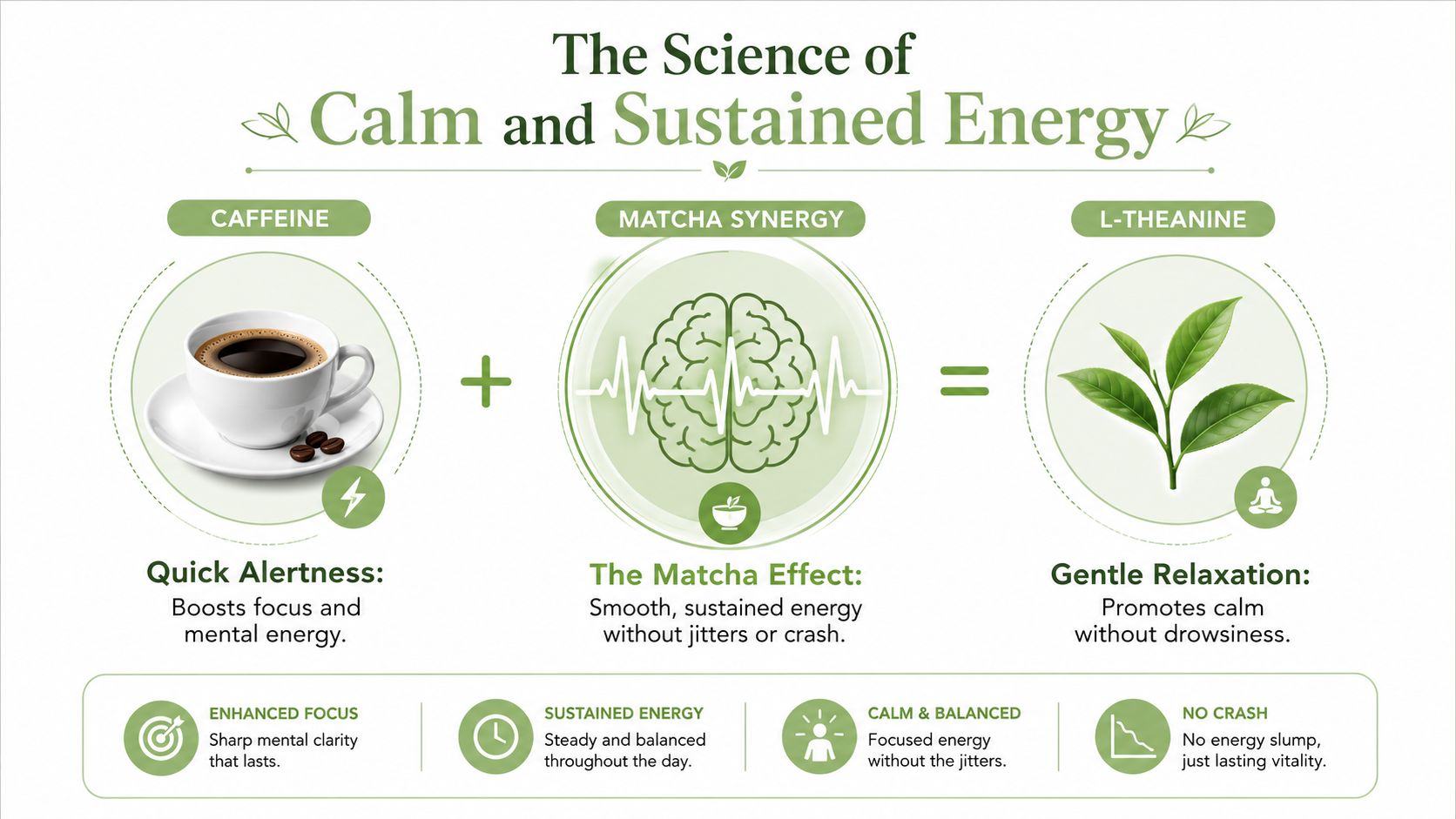
The reason matcha feels different from coffee isn't just marketing language. It comes down to the relationship between naturally occurring caffeine and L-theanine.
A single 2g serving of Australian-grade shade-grown matcha powder contains approximately 60 to 70 mg of caffeine, paired with L-theanine, according to Asian Pantry's matcha guide. That same source explains that L-theanine is linked with “calm alertness” through its effect on alpha-wave activity in the brain.
Why the pairing matters
Caffeine on its own often feels sharp. For some people, that's exactly what they want. For others, it can tip into jitteriness, tension, or a rapid rise and fall in energy.
Matcha behaves differently because the caffeine doesn't arrive alone. L-theanine changes the feel of the experience. Instead of a jagged spike, many drinkers describe a smoother curve. Focus comes on, but the body feels more settled.
Another source on matcha notes that L-theanine may modulate caffeine absorption to support a sustained energy release over 4 to 6 hours, while also supporting attention, reaction time, and memory in study settings, as described on Zen Green Tea's matcha information page.
Coffee versus matcha in plain language
This isn't about declaring one winner. It's about choosing the right tool.
- Coffee often suits moments when you want a quick, obvious lift.
- Matcha tends to suit work that needs steadiness, such as writing, study, long meetings, or travel days.
If coffee feels like a bright overhead light, matcha feels more like daylight through a window. You're awake, but not overwhelmed.
For readers who want a closer look at how this compares in a latte format, this guide on caffeine in a matcha latte is a helpful next step.
What “calm alertness” actually feels like
People sometimes expect matcha to hit like an energy drink and then assume it isn't working when it feels subtler. That's a misunderstanding.
The point isn't a dramatic rush. The point is usability.
It's the kind of energy that lets you keep going without feeling pushed around by it.
That makes matcha especially useful for mornings when you need concentration, or afternoons when you want to reset without wrecking your evening sleep rhythm.
More Than Just a Buzz Exploring the Health Benefits
A lot of people come to green tea energy powder for one simple reason. They want energy that feels usable. What often surprises them is that good matcha can offer more than that, because you are drinking finely ground whole tea leaf rather than a stripped-down stimulant or a concentrated extract.
That distinction matters. Whole-leaf matcha brings caffeine, L-theanine, catechins, and other plant compounds together in their natural mix. Extract products are different. They can be far more concentrated, and they do not always behave in the body the same way a traditional tea does. If we want an honest view of benefits, we have to keep those two categories separate.
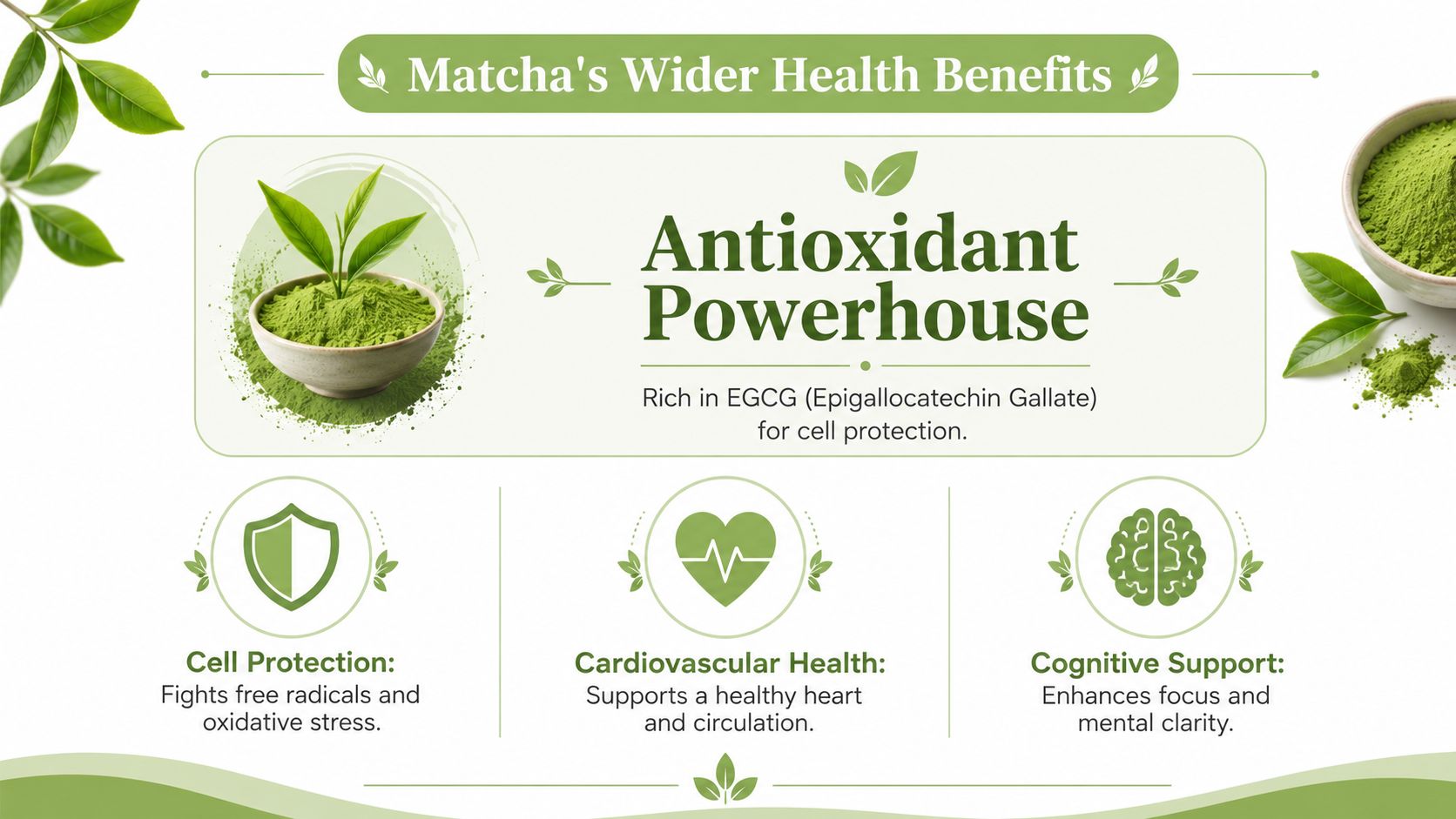
One of the compounds people talk about most is EGCG, a catechin found in green tea. According to Matcha Direct Kyoto's guide to EGCG and catechins in matcha, matcha is particularly rich in catechins because you consume the whole powdered leaf.
Antioxidant support
Catechins act a bit like the plant's built-in defence system, and when we drink matcha, we take in those compounds as part of the leaf itself. Researchers continue to study EGCG and related catechins for their role in helping the body manage oxidative stress, which is one reason matcha has earned its healthy reputation.
That said, matcha is still a food, not a cure-all.
The useful way to look at it is this. A daily cup can be part of a well-rounded routine, especially if it replaces drinks loaded with sugar or leaves you feeling rattled.
Benefits that may reach beyond energy
Green tea has also been studied for heart and metabolic health. A review published in Molecules on green tea catechins examines evidence linking these compounds with effects on lipid metabolism, glucose regulation, and cardiovascular function.
That does not mean every cup produces a dramatic result you can feel by lunchtime. It means regular green tea intake may support health in slower, background ways, much like exercise or sleep habits do. Subtle does not mean unimportant.
Why whole-leaf matcha deserves its own category
Wellness content often gets blurry. A headline about "green tea benefits" may be referring to brewed tea, whole-leaf matcha, or isolated green tea extract. Those are related, but they are not interchangeable.
Matcha works more like eating the whole orange instead of taking a heavily concentrated shot of one compound from the peel. You get the broader package, in a traditional food form, with effects that tend to be gentler and easier to use day to day. If you want help preparing it properly so taste and texture don't put you off, our guide to making matcha tea at home is a good place to start.
A better way to frame the benefits
Matcha can support health in a few layers at once:
- Immediate support: steady, workable energy for mornings or long focus blocks
- Nutritional support: catechins and other tea compounds that may contribute to long-term wellbeing
- Habit support: an easier swap for harsher, sweeter, or more processed energy options
That third layer is often the one people underestimate. Sometimes the benefit comes from the compounds in the cup. Sometimes it comes from what the cup replaces.
Your Practical Guide to Using Matcha Daily
The easiest way to make matcha stick is to stop treating it like a complicated wellness project. It's just a powder with a few very useful jobs. It can wake you up, slot into breakfast, or become your café-style afternoon drink at home.
Start small and pay attention
If you're new to green tea energy powder, begin with a modest serve and notice how you feel. Matcha is generally gentler than many energy products, but it still contains caffeine.
A simple approach works well:
- Begin with a small amount if you're caffeine-sensitive
- Use it earlier in the day while you learn your ideal timing
- Keep the rest of the recipe plain at first so you can taste the matcha itself
A simple hot matcha latte
This is the most accessible entry point.
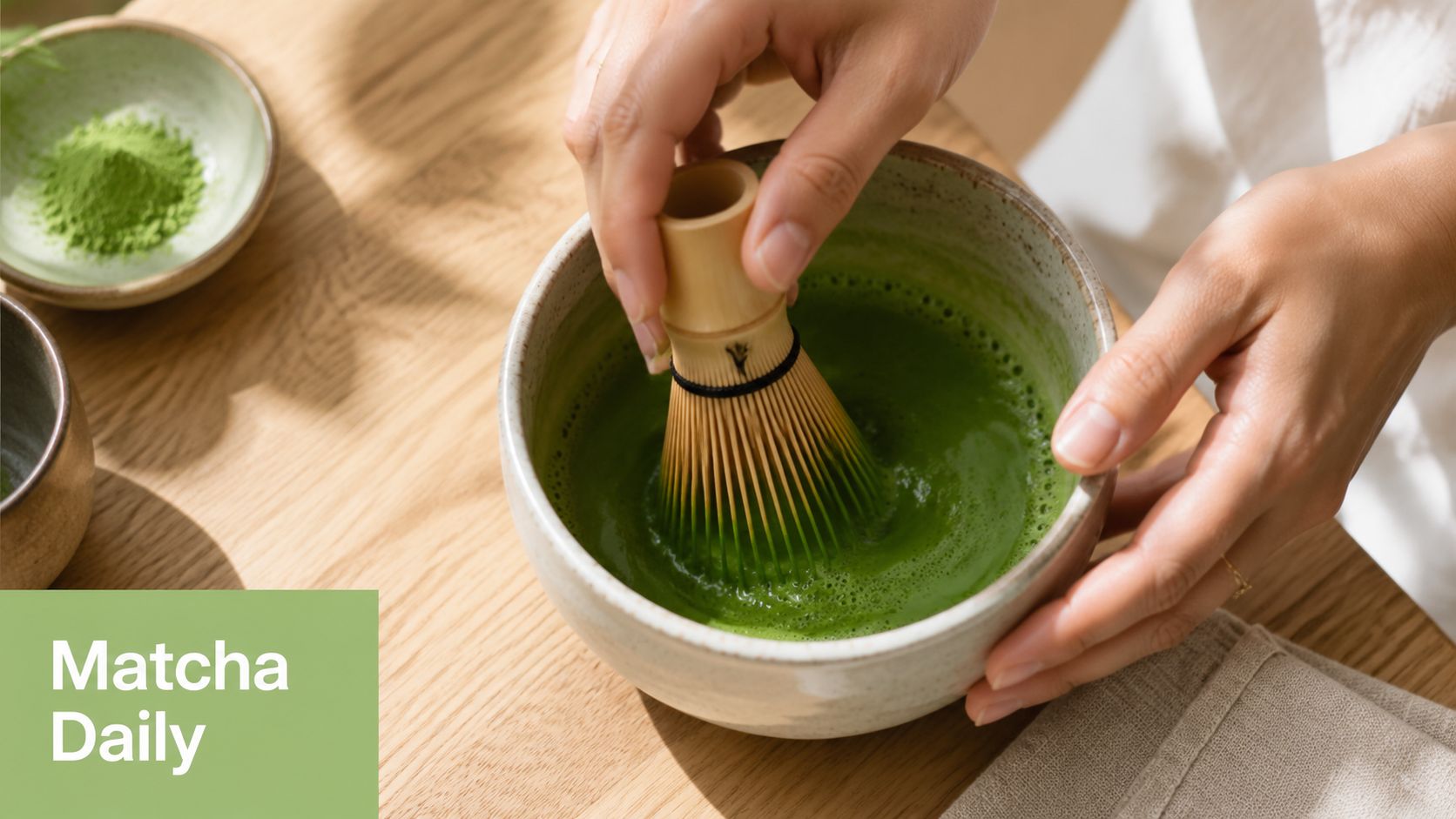
- Sift your matcha into a bowl or mug to avoid clumps.
- Add a small amount of warm water.
- Whisk until smooth and lightly frothy.
- Top with warmed milk of your choice.
- Leave it unsweetened at first, then adjust only if needed.
Ceremonial-style powders usually shine with fewer extras. If you're making a stronger latte or adding spices, a culinary-style powder often works better.
An iced version for warm Australian afternoons
Iced matcha is brilliant when you want refreshment as much as energy.
Try this method:
- Whisk matcha with a little water until smooth
- Fill a glass with ice
- Add cold milk
- Pour the matcha over the top
- Stir just before drinking
The colour alone makes it feel like a café order.
For a visual walkthrough, this guide on making matcha tea is useful if you want to refine your whisking and water technique.
Matcha in smoothies and baking
You don't have to drink it traditionally every day. Matcha works beautifully in food.
A few easy uses:
- Morning smoothie: Blend matcha with banana, yoghurt, oats, and milk.
- Yoghurt bowl: Stir a little through yoghurt for a grassy, creamy note.
- Baking: Add it to muffins, pancakes, or bliss balls for colour and earthiness.
Here's a quick video if you want to see the basics in action before trying your own routine.
Best times to use it
Matcha's personality suits certain moments better than others.
| Time of day | Why it works well |
|---|---|
| Morning | A gentler start than heavier caffeine options |
| Mid-afternoon | Useful when you want focus without feeling overcooked |
| Before quiet exercise | Often suits walking, yoga, or longer sessions that need steadiness |
A daily matcha habit works best when it feels easy. Pick one time, one recipe, and repeat it until it becomes automatic.
How to Choose a High Quality Green Tea Powder
Not all green tea energy powder deserves space in your pantry. Some powders are vibrant, smooth, and fresh. Others are bitter, dull, and disappointing before the first sip is finished.
The quickest way to buy better is to focus on a handful of quality markers rather than marketing noise.
Look at grade, colour, and texture
For drinking, many people prefer ceremonial-grade matcha because it's made to stand on its own with water or milk. Culinary-grade matcha is often the better fit for baking, smoothies, and stronger flavoured recipes.
Use your senses too:
- Colour matters: A lively green tone usually signals better handling and fresher leaf.
- Texture matters: Fine powder should feel soft, not gritty.
- Taste matters: Good matcha can be grassy and savoury, but it shouldn't taste harsh for the sake of it.
Origin and certification matter
Japan remains the benchmark many buyers look for, especially when they care about traditional production and consistency. Organic certification also matters because matcha is consumed as the whole leaf rather than infused and discarded.
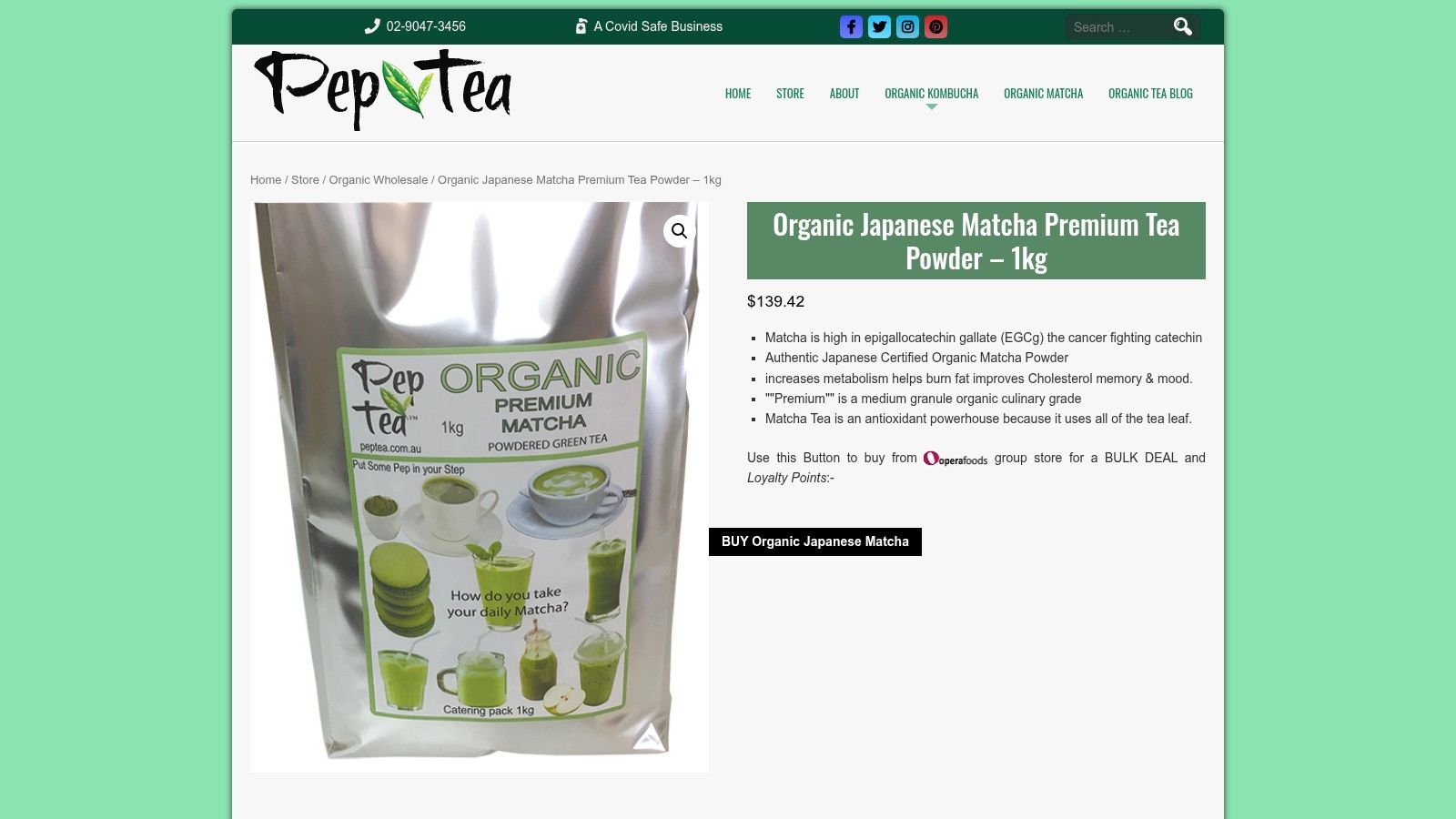
Pep Tea's organic Japanese Matcha is certified by the Japanese Ministry of Agriculture, which validates its organic status and confirms it is grown without synthetic pesticides or fertilisers in southern Japan's tea-growing regions, as shown on the Pep Tea Organic Japanese Matcha product page.
A buyer's checklist
If you're choosing for home or for a café, ask these questions:
- Is it from Japan? Specific origin tends to be a good sign.
- Is the intended use clear? Drinking matcha and cooking matcha don't have to be the same product.
- Is it certified organic? That's especially valuable with whole-leaf powders.
- Does the seller explain the grade? If the description is vague, quality often is too.
For a clearer breakdown of styles and uses, this guide to different grades of matcha can help you match the powder to the job.
Buy for purpose. If you want a clean daily drink, prioritise freshness, origin, and drinkability over flashy claims.
Common Questions on Matcha Safety and Efficacy
People often assume all green tea powders are equally safe because they're all “natural”. That's where things get murky.
Is matcha safe to drink every day
Drinking whole-leaf matcha as a beverage is a different situation from taking high-dose green tea extract supplements. That difference matters. Reporting covered by ABC Science on green tea extract and liver risk documents multiple cases in which green tea extract supplements were linked to acute liver damage and jaundice requiring hospitalisation. Brewed tea isn't typically associated with that same risk in the same way.
That doesn't mean more matcha is always better. It means whole-leaf matcha and concentrated extract pills shouldn't be treated as the same thing.
Is matcha good pre-workout
Sometimes. It depends on the workout.
If you want calm focus for walking, long sessions, yoga, or general training, matcha can fit beautifully. If you want a rapid, punchy lift for sprinting or heavy lifting, it may feel too gentle. Coverage on matcha green tea powder and caffeine timing points to the slower, steadier profile that many people like for focus, but that same profile may not suit fast-twitch performance demands.
What's the smartest takeaway
Use matcha as a beverage, not as a shortcut.
Choose high-quality whole-leaf powder. Start modestly. Notice how your body responds. And be cautious around concentrated extract products that promise a lot in very small servings.
If you'd like to try a cleaner daily tea ritual, explore Pep Tea for premium organic Japanese matcha and Australian-brewed sugar-free organic kombucha. Whether you're whisking a morning bowl, making a latte at home, or adding a functional option to your café menu, we're here to help you choose well and enjoy it properly.
Natural Focus Enhancers Your Guide to Better Concentration

It's 3 p.m. and your brain has gone missing. You've answered emails, jumped between tabs, maybe had one coffee too many, and now you're staring at your screen reading the same sentence over and over.
That moment is exactly why more Australians are looking for natural focus enhancers. Not magic pills. Not extreme hacks. Just practical ways to feel more alert, more steady, and less wrung out by the usual cycle of caffeine spikes and afternoon crashes.
For many people, better concentration starts with a simple shift in thinking. Focus isn't only about pushing harder. It's also about working with your body, your energy, your food, and your daily habits. Functional drinks like matcha and kombucha fit into that picture because they can support a calmer, more sustainable rhythm.
Beyond the Coffee Crash Why Natural Focus Is Trending
The appeal of natural focus is easy to understand. Individuals typically don't want more jitteriness. They want to feel switched on without feeling frazzled.
Coffee can absolutely have a place, but it's often used as a rescue tool instead of part of a balanced routine. That's when the pattern gets messy. One cup becomes two. Two becomes a late-afternoon top-up. Then sleep takes a hit, and the next morning starts with even less energy.

Why more Australians are looking for gentler support
This shift isn't just anecdotal. In 2025, the Australia cognitive health supplements market reached AUD 306.83 million and is projected to grow at a 7.70% CAGR to AUD 644.25 million by 2035, reflecting stronger demand for natural brain support and focus-enhancing ingredients such as Omega-3, Ginkgo Biloba, L-Theanine in matcha, and probiotic-rich kombucha, according to Expert Market Research's Australia cognitive health supplements market report.
That matters because it shows a broader behaviour change. People aren't only chasing stimulation. They're looking for support that feels more sustainable, more everyday, and easier to build into a normal routine.
A lot of that interest comes down to convenience. A morning matcha, an afternoon kombucha, a better lunch, a screen break, and a decent bedtime routine feel realistic. They also fit naturally into home life, café culture, and the way many Australians already think about wellness.
What natural focus enhancers really are
The phrase sounds more technical than it needs to be. In plain language, natural focus enhancers are foods, drinks, herbs, nutrients, and habits that may support concentration and mental clarity without relying on harsh quick fixes.
That can include:
- Functional beverages like matcha and kombucha
- Plant-based herbs often associated with focus support
- Daily habits such as hydration, sleep, movement, and mindfulness
- Nutrient-dense foods that help your brain do its job properly
Better focus usually isn't one dramatic change. It's a handful of smarter choices repeated often enough to matter.
That's also why the trend has staying power. It's not built on intensity. It's built on routines people can keep.
How Your Brain Finds and Loses Focus
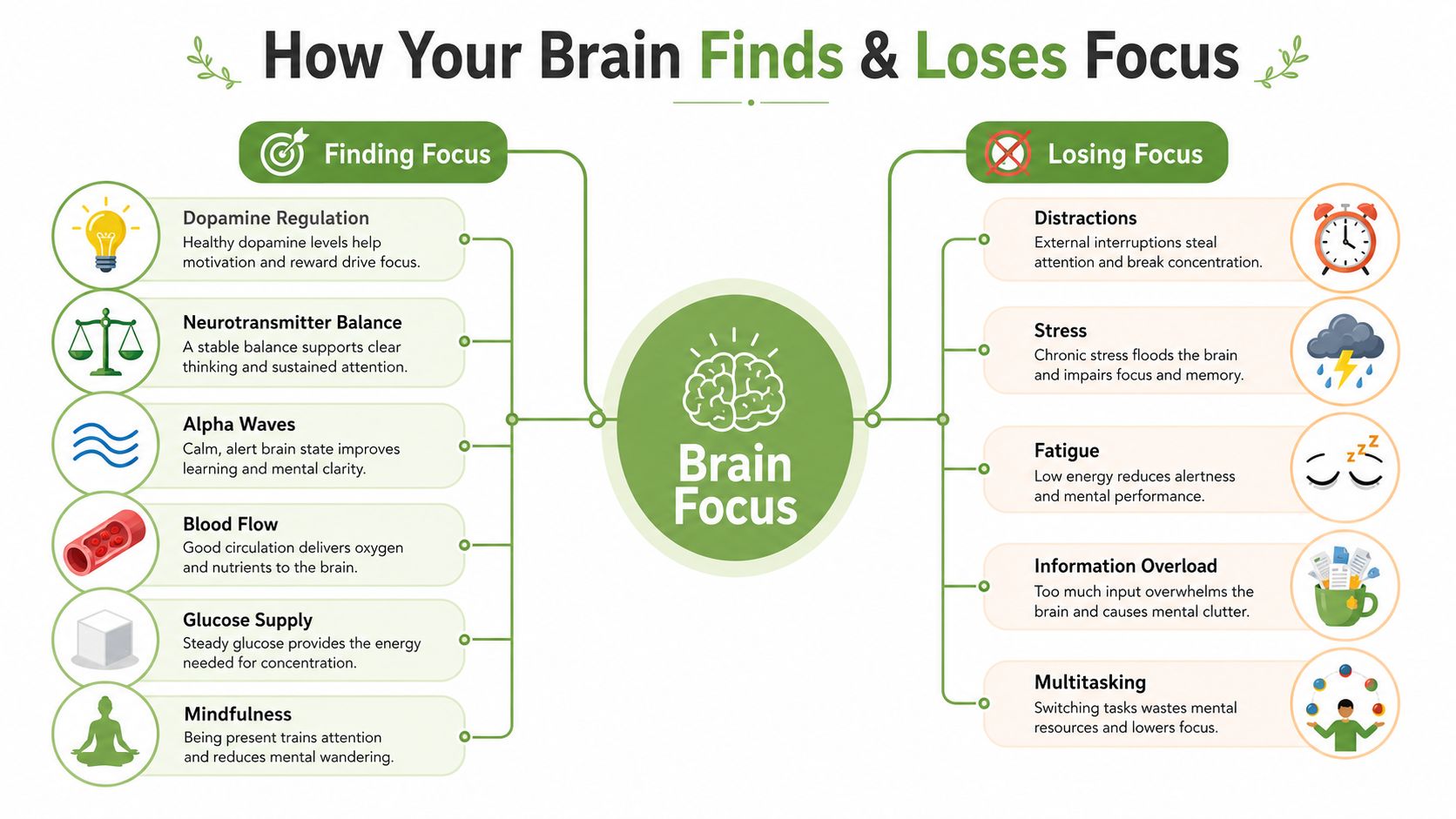
Focus can feel mysterious, but the basics are surprisingly straightforward. Your brain needs the right signals, enough fuel, and fewer interruptions.
When those pieces line up, concentrating feels smooth. When they don't, even simple tasks can feel oddly hard.
Your brain uses messengers and fuel
Think of attention like a worksite. Messages need to get to the right place, workers need energy, and too much noise slows everything down.
Some of that communication happens through neurotransmitters. You don't need to memorise the science names to understand the idea. These chemical messengers help your brain shift into alertness, motivation, learning, and memory. If the signals are steady, your mind feels more organised. If they're off, you may feel scattered or flat.
Your brain also needs a reliable energy supply. That doesn't mean sugar hits all day. It means consistent nourishment, enough fluids, and enough rest so your body isn't running in survival mode.
Why brain fog shows up
Brain fog isn't a formal diagnosis people use in everyday life, but it's a useful description. It often feels like mental static. You know what you want to do, but your thoughts don't quite click into gear.
Common triggers include:
- Poor sleep that leaves your attention blunted
- Stress overload that keeps your mind in reactive mode
- Constant switching between tasks, apps, and notifications
- Skipping meals or eating in a way that leaves energy uneven
- Mental fatigue after long stretches with no proper break
Quick check: if you're distracted all day, the problem isn't always lack of willpower. Sometimes your environment is set up to fragment your attention.
If distraction is a recurring issue, Chronoid's guide to focus is a useful read because it breaks down how everyday habits and digital interruptions can gradually drain concentration.
Focus is easier when friction is lower
People often assume concentration is just about discipline. Usually, it's also about design.
A few examples make this clearer:
- One tab open beats ten tabs open. Your brain handles fewer competing cues.
- A short walk can reset attention. Movement helps interrupt mental buildup.
- A calm drink ritual can improve transition. Preparing a matcha or pouring a kombucha can create a clear pause between tasks.
That last point matters more than it sounds. Rituals help the brain recognise context. When you repeat a simple pattern before focused work, your mind starts to associate that pattern with concentration.
The Pillars of Natural Focus Enhancement
Natural focus works best when you stop treating it like a single ingredient problem. Combining a few supports often yields better results than expecting one product to do everything.
Three pillars matter most. Nutrients and herbs. Functional beverages. Lifestyle habits.
Pillar one includes nutrients and herbs
Supplement use is already mainstream in Australia. According to the Australian Bureau of Statistics, 33.6% of Australians aged 2 years and over took a dietary supplement in 2023, representing 8.5 million people. Herbal supplements made up 4.5% of all supplement use, and adult females were more likely than males to take dietary supplements, at 43.7% versus 30.8%, according to the ABS dietary supplements release.
That doesn't mean every supplement is right for every person. It does show that many Australians already include some form of nutritional support in their routine.
Here's a simple comparison of common herbs often mentioned in conversations about natural focus enhancers.
| Herb | Primary Benefit | Best For |
|---|---|---|
| Bacopa monnieri | Traditionally used in wellness routines linked with memory and learning support | People looking for a plant-based option as part of a broader routine |
| Ginkgo biloba | Commonly used in brain-health product categories for mental clarity support | People interested in classic herbal formulations |
| L-Theanine from matcha | Often associated with calm alertness | People who want focus without a wired feeling |
The best takeaway here is caution plus context. Herbs may have a place, but they make more sense when paired with consistent sleep, good food, and sensible daily habits.
Pillar two is functional beverages
Drinks are often the easiest place to start because they slot into routines you already have. You're already reaching for something in the morning and again in the afternoon.
Matcha brings a more deliberate kind of energy than many people expect. Kombucha offers a refreshing alternative when you want something light, grown-up, and less sugary than many mainstream drinks. If you want a deeper look at how fermented tea fits into a wellness routine, this guide on the benefits of kombucha is a practical starting point.
Pillar three is lifestyle strategy
This pillar gets less hype, but it's often the one that changes the most.
- Sleep first: Deep focus is much harder when you're chronically tired.
- Hydrate early: Mild dehydration can leave you feeling dull and unfocused.
- Reduce switching: Batch similar tasks instead of bouncing between everything.
- Add a reset habit: A brief breathing practice or walk can help more than another snack.
- Use mindfulness well: If you're curious about making attention training more practical, this article on transform your focus with meditation offers useful ideas without making it feel abstract.
A strong focus routine is usually simple enough to repeat on a busy Wednesday, not just on a perfect Sunday.
Spotlight on Matcha and Kombucha for Focus
Some functional drinks get attention because they're trendy. Matcha and kombucha stand out because they're practical, versatile, and easy to build into real life.
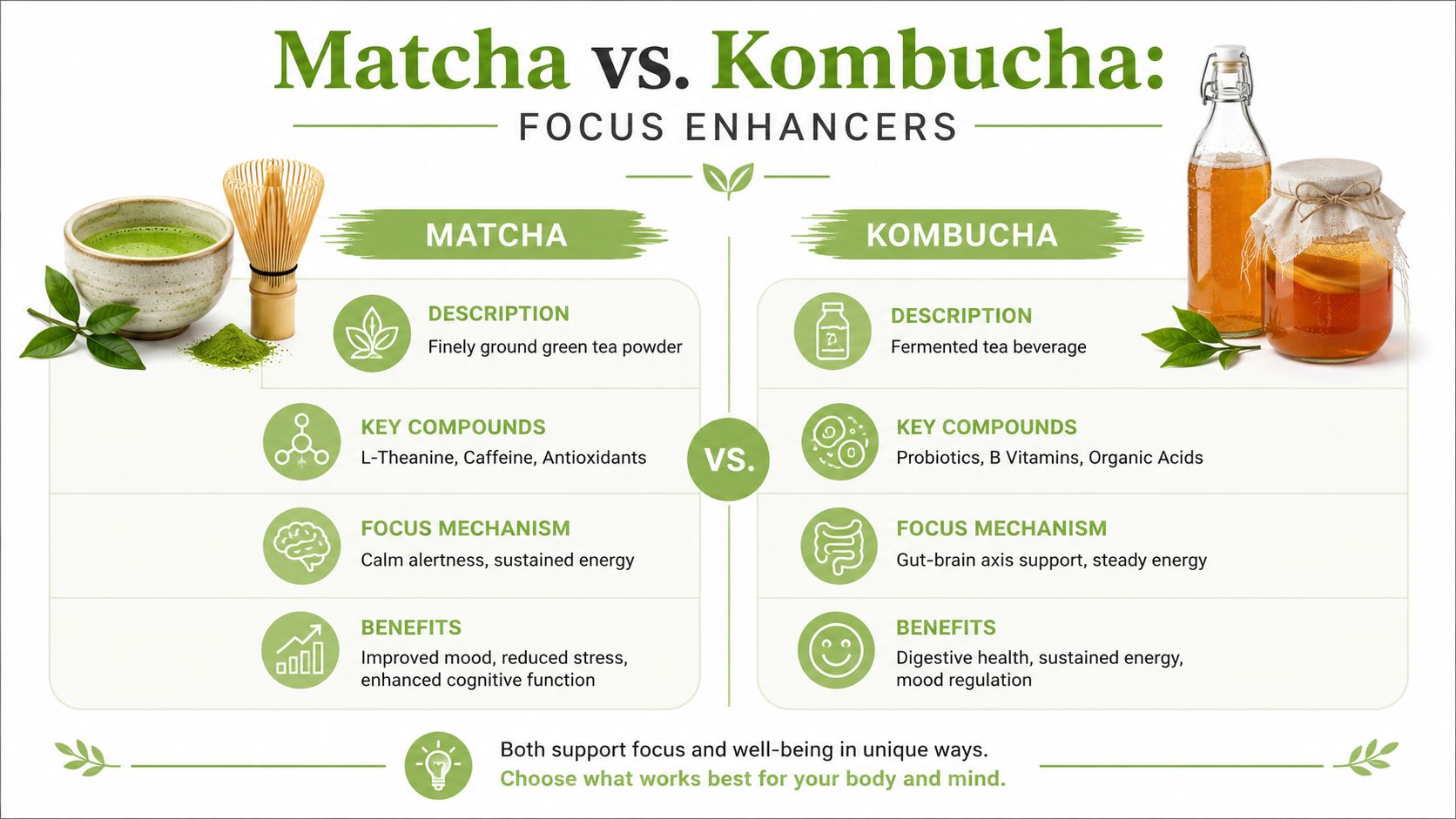
They also support focus in different ways. Matcha is about calm energy and mental steadiness. Kombucha is often part of a wider gut-friendly routine that can help you feel lighter and more balanced through the day.
Why matcha feels different from coffee
Matcha is finely ground green tea, so you're consuming the leaf rather than steeping it and discarding it. That gives it a distinctive nutritional profile and a more layered effect.
One reason people like it for focus is the pairing of naturally occurring caffeine with L-Theanine. In everyday terms, that combination is often associated with alertness that feels smoother and less abrupt than coffee alone. Many people describe it as calm focus rather than nervous energy.
There's also the antioxidant side. Matcha contains 137 times more EGCG than standard steeped green tea, with a typical cup providing 100 to 200 mg of EGCG depending on quality and preparation, according to Tea Vision's overview of matcha health benefits.
That doesn't mean every green drink on the shelf is equal. Quality, preparation, and ingredient integrity all matter. If you've ever wondered why one matcha tastes smooth and another tastes harsh, the answer often comes back to grade, origin, and how it was handled.
For a closer look at how this compares with your usual café order, this guide to caffeine in matcha latte helps explain why the experience can feel steadier.
A short visual can help make that difference easier to picture:
How kombucha fits the focus conversation
Kombucha doesn't work like matcha, and that's exactly why it belongs in the same conversation.
It's a fermented tea beverage, and properly brewed kombucha contains live cultures and fermentation-derived compounds that many people enjoy as part of a gut-conscious lifestyle. When people talk about the gut-brain axis, they mean the ongoing relationship between digestive health and how you feel mentally and emotionally.
Kombucha isn't a caffeine substitute in the same way matcha can be. It's more useful as a reset drink. Something crisp, grown-up, and supportive when you want to move away from soft drinks, overly sweet options, or another heavy coffee.
Why quality changes the experience
A lot of confusion often stems from such details. Not all matcha is vibrant, fresh, or pleasant to drink. Not all kombucha is properly fermented, balanced, or low in sugar.
If you're using these drinks for focus support, quality matters because the goal isn't just to consume a category. It's to choose something you'll enjoy enough to use consistently.
A few practical signs to look for:
- For matcha: bright colour, fine texture, clean taste, and no stale smell
- For kombucha: proper fermentation, balanced flavour, and an ingredient list without unnecessary extras
- For both: organic sourcing and transparency around how the product is made
The best functional drink is the one that fits your day, tastes good, and doesn't leave you feeling worse an hour later.
A Practical Guide to Your Daily Focus Ritual
Knowing what supports focus is one thing. Using it well is another.
The easiest approach is to match the drink or habit to the type of work and energy dip you're dealing with. You don't need a complicated protocol. You need a rhythm you can repeat.
A simple day that supports concentration
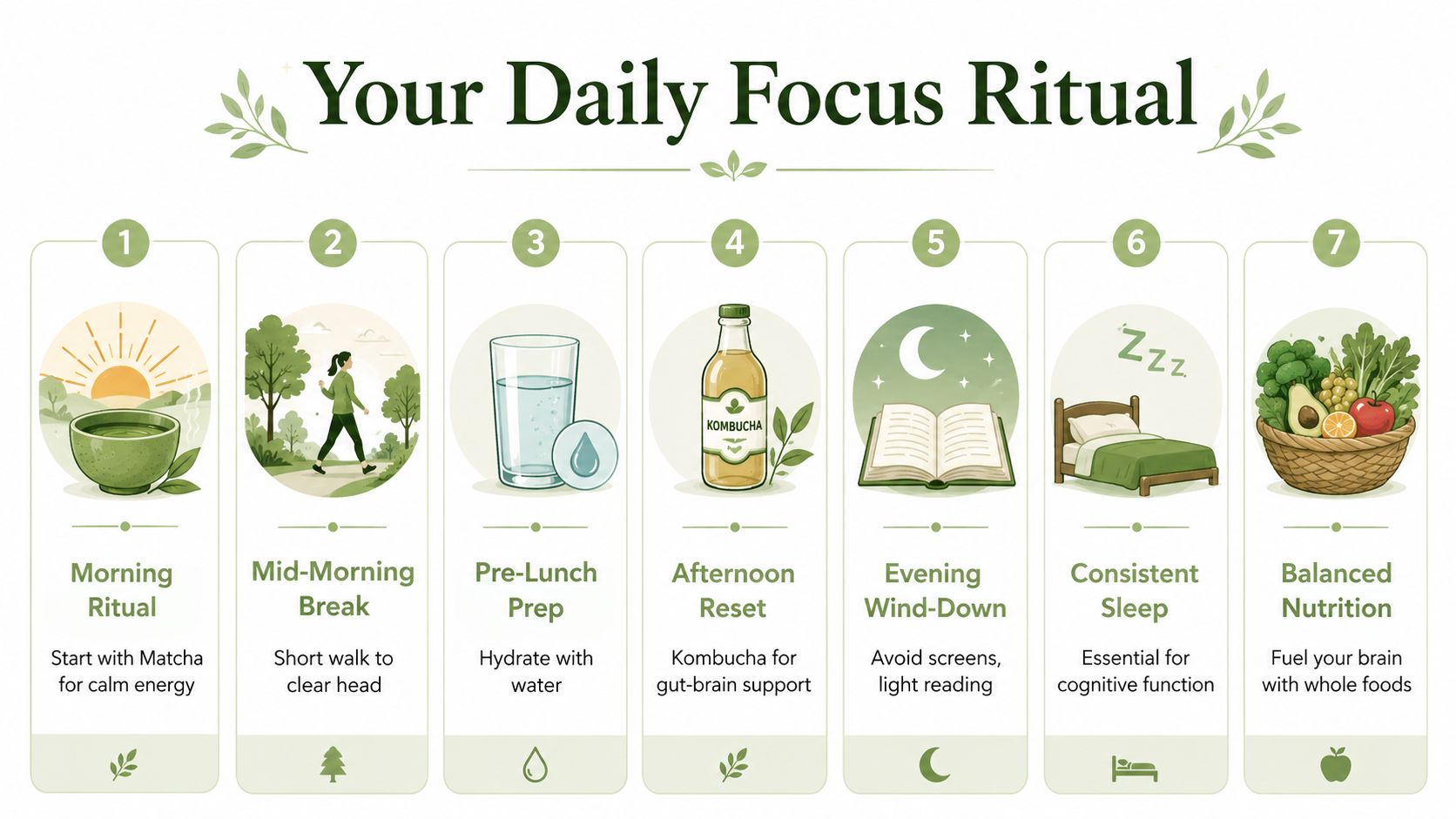
A practical routine might look like this:
Morning deep work
Have matcha before writing, planning, studying, or creative work. Many people find it suits tasks that need steady concentration rather than frantic speed.Mid-morning reset
Step away from the screen. Even a brief walk or stretch can cut through mental stickiness.Lunch that doesn't flatten you
Aim for a balanced meal instead of something that leaves you sleepy and searching for sugar.Afternoon support
Reach for kombucha when the slump hits and you want something refreshing without going back into the coffee loop.Evening wind-down
Protect sleep. Better focus tomorrow starts tonight.
Two easy drink ideas to try
You don't need barista-level skill to make this work at home.
Quick ceremonial-style matcha
- Use quality powder: Start with a small spoonful of matcha in a bowl or mug.
- Add a little water first: Use warm, not boiling, water.
- Whisk until smooth: A bamboo whisk is ideal, but any small whisk helps.
- Top up and drink straight: This is great when you want a cleaner, more direct matcha experience.
Simple kombucha spritzer
- Pour over ice: Start with chilled kombucha.
- Add sparkling water: This lightens the flavour and makes it extra refreshing.
- Finish with citrus or mint: A slice of lime or a few mint leaves lifts it nicely.
- Serve in a wine glass if you like: It feels more special and works well for non-alcoholic entertaining.
A practical matcha latte approach
If straight matcha feels too intense at first, a latte is often the easiest entry point.
- Whisk the matcha first: Get rid of clumps before adding milk.
- Choose your milk well: Dairy, oat, almond, and soy all create slightly different textures.
- Keep sweeteners modest: If you add sweetness, use just enough to round out the flavour.
- Use it intentionally: A matcha latte works well before a long meeting block or focused admin session.
Good menu ideas for cafés and hospitality venues
For cafés, bars, and wellness-led venues, these drinks make sense because they meet several customer needs at once. They feel premium, non-alcoholic, and functional without being preachy.
Offerings that fit well include:
- Ceremonial matcha serve: For customers who want a traditional tea moment
- Iced matcha latte: A familiar gateway drink
- Kombucha by the bottle or glass: Easy, low-fuss, and versatile
- Kombucha spritzers: Great for brunch and alcohol-free menus
- Matcha baking and smoothie additions: Useful for broader café menu development
A drink doesn't need to promise everything. It just needs to earn a regular place in someone's day.
Building a Smarter and More Sustainable Focus
Often, what's required isn't more stimulation. It's better structure.
That's the core value of natural focus enhancers. They shift the conversation away from chasing instant intensity and towards creating conditions where concentration comes more easily. Better drinks help. Better sleep helps. Better timing helps. Together, they're more useful than any single shortcut.
A realistic first week
If you're new to this, keep the first step small.
Try this for one week:
- Swap your second coffee for matcha on the days you need clear, steady work time
- Use kombucha in the afternoon instead of reaching for a sugary soft drink
- Create one screen-free break during the middle of your day
- Keep your evening calmer so the next day starts with more in the tank
That's enough to notice patterns. You may realise your energy drop is really a hydration issue. Or that your best thinking happens when you front-load focused work and stop treating every notification like an emergency.
Think in routines, not rescues
The smartest focus plan is the one you can maintain when life is busy, the kids are loud, and your inbox is feral.
Natural support works best when it becomes ordinary. A morning ritual. A better afternoon option. A few habits that lower mental friction. If you're interested in the wider shift towards drinks that do more than just taste good, this piece on functional beverage trends adds useful context.
Better concentration rarely arrives all at once. It builds when your daily choices stop fighting your brain.
If you'd like to explore functional drinks that fit naturally into a more focused routine, Pep Tea offers premium organic Japanese matcha and Australian-brewed sugar-free organic kombucha. Browse the range, read the education guides, and find a calm, practical way to support your day.
Antioxidant Tea Benefits: Boost Wellness with PepTea

That 3 pm moment is familiar. You've had lunch, your focus has drifted, and you want something that feels better than another coffee or a sugary drink. You're not chasing a miracle. You just want a daily habit that tastes good, supports your health, and fits real life in Australia.
Tea often enters that conversation because people know it contains antioxidants. The problem is that most advice stops there. It says tea is “good for you” without explaining what antioxidants do, why Matcha keeps coming up in wellness circles, or why your brewing method can change what ends up in your cup.
That's where antioxidant tea benefits become much more practical than they first sound. Its value isn't just that tea contains protective compounds. It's that some teas deliver them more reliably, some preparation methods protect them better, and some compounds work together in ways that help you feel the difference day to day.
For many people, that means two standout options. Matcha gives you a concentrated whole-leaf green tea experience, while Kombucha offers a different path, combining tea's natural compounds with fermentation and live cultures. They're not the same drink, and they don't play the same role. That's exactly why understanding both can help you build a smarter routine.
Your Daily Wellness Upgrade Starts Here
A lot of healthy habits fail because they ask too much. Complicated meal plans, expensive powders, rigid routines are often abandoned. A cup of tea is different because it's already part of everyday life. You're not adding a whole new identity. You're making a better choice inside a habit you already have.
That's why antioxidant tea benefits matter in such a practical way. If you already reach for something warm in the morning or something refreshing in the afternoon, tea can turn that moment into a small act of support for your body. Not with hype, and not with extreme promises. Just with compounds that help protect your cells from everyday stress.
Why people start looking for better drinks
Usually it begins with one of these moments:
- The coffee crash: You want energy, but not the shaky feeling that can come with overdoing caffeine.
- The sugar rethink: Soft drinks and sweet café options don't feel great when you're trying to clean up your routine.
- The wellness upgrade: You want something simple that may support immunity, focus, and long-term health.
That's where tea earns its place. Green tea, Matcha, and Kombucha all bring something useful to the table, but they don't all work in the same way.
Some drinks give you a quick hit. Tea tends to reward consistency instead.
A more useful way to think about tea
Instead of asking, “Is tea healthy?”, ask better questions:
- Which tea gives me the most antioxidants in a normal serve?
- How much does preparation affect the result?
- Do I want calm focus, gut support, or both at different times of day?
Those questions lead to better choices than generic wellness claims ever will. They also clear up a lot of confusion. Matcha isn't just green tea with better marketing. Kombucha isn't just fizzy tea in a pretty bottle. Each has a different role, and once you understand that, it becomes much easier to use them well.
Understanding Antioxidants and Free Radicals
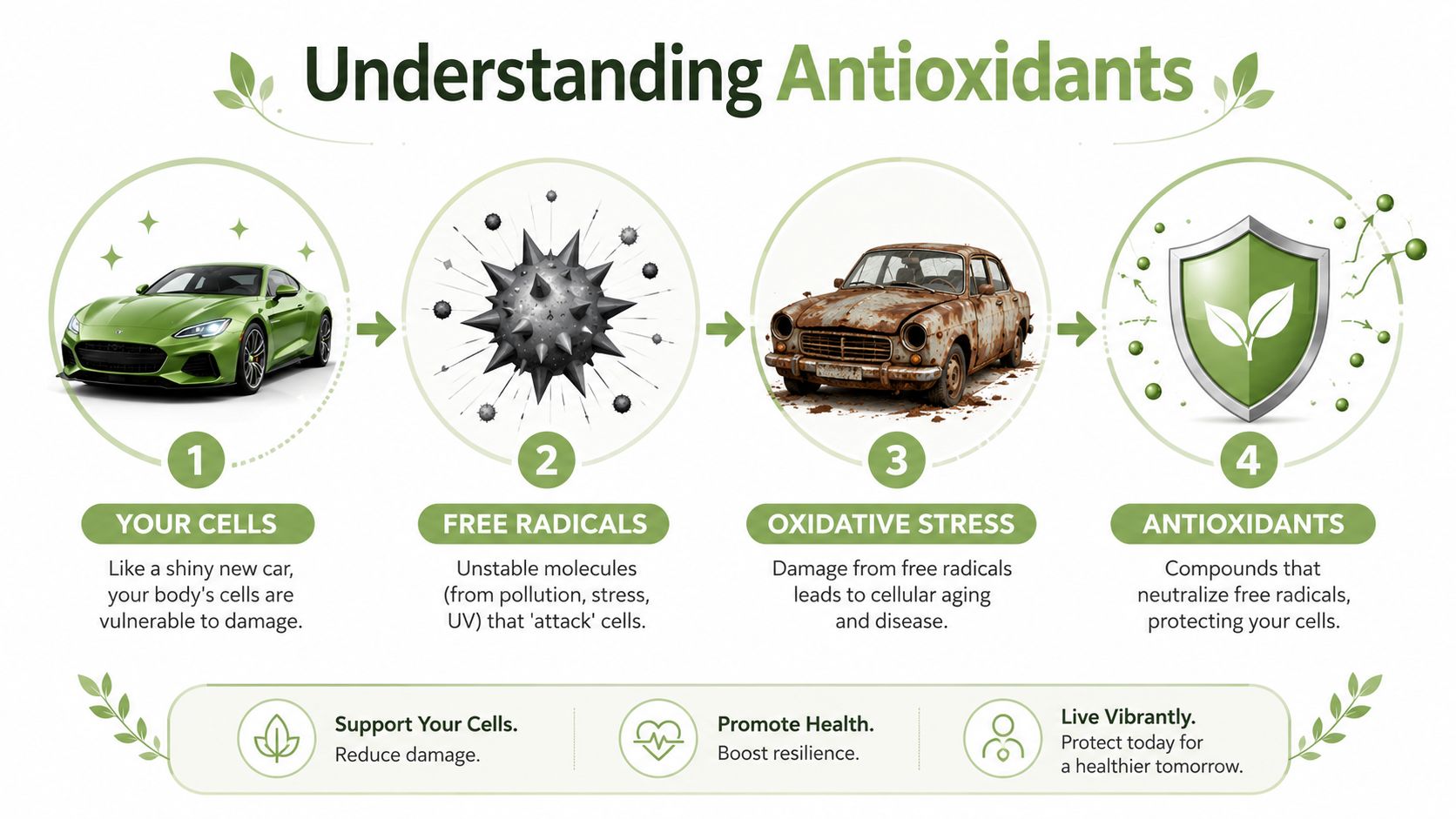
Your body is constantly dealing with wear and tear. Pollution, UV exposure, stress, and normal metabolism all create unstable molecules called free radicals. When too many of them build up, they can damage cells. That process is called oxidative stress.
A simple way to picture it is a car left out in the weather. Over time, metal starts to rust. Your cells don't rust, of course, but oxidative stress creates a similar kind of gradual damage. That's why people often connect antioxidants with healthy ageing and general resilience.
What antioxidants actually do
Antioxidants help neutralise free radicals before they can cause as much damage. You can think of them as part of your body's defence team. They don't make you invincible, and they don't replace the basics like sleep, food, and exercise, but they can support the system.
Tea is especially known for a group of antioxidants called polyphenols. In green tea and Matcha, one of the best-known is EGCG, short for epigallocatechin gallate. It's the compound that gets a lot of attention because it's strongly associated with many of tea's protective qualities.
Why EGCG gets so much attention
EGCG matters because it's one of the standout catechins in green tea. In organic Matcha green tea, EGCG accounts for 60% of all catechins, which is part of what gives Matcha its unusually concentrated antioxidant profile, as noted by Pep Tea's explanation of Matcha catechins.
That's also why people often get confused when they compare “green tea” as a broad category with Matcha specifically. Not all green tea experiences are equal. The type of tea, the grade, and the way you prepare it all affect what you consume.
Practical rule: Antioxidants are only useful if they survive the trip from the leaf into your cup.
Where this matters in daily life
Antioxidants aren't just an abstract science topic. They're part of why people choose tea when they want to support:
- Cell protection: helpful when everyday life includes stress, sun, and pollution
- Skin support: especially relevant in Australia, where UV exposure is part of life
- General wellness: a daily drink can become one small, repeatable habit that supports the bigger picture
Once you understand the free radical versus antioxidant story, tea starts making more sense. The next step is looking at why Matcha sits in a category of its own.
Matcha The Ultimate Antioxidant Powerhouse
Most green tea is brewed, then the leaves are discarded. Matcha works differently. The leaf is ground into a fine powder, whisked into water, and consumed whole. That single difference changes everything.
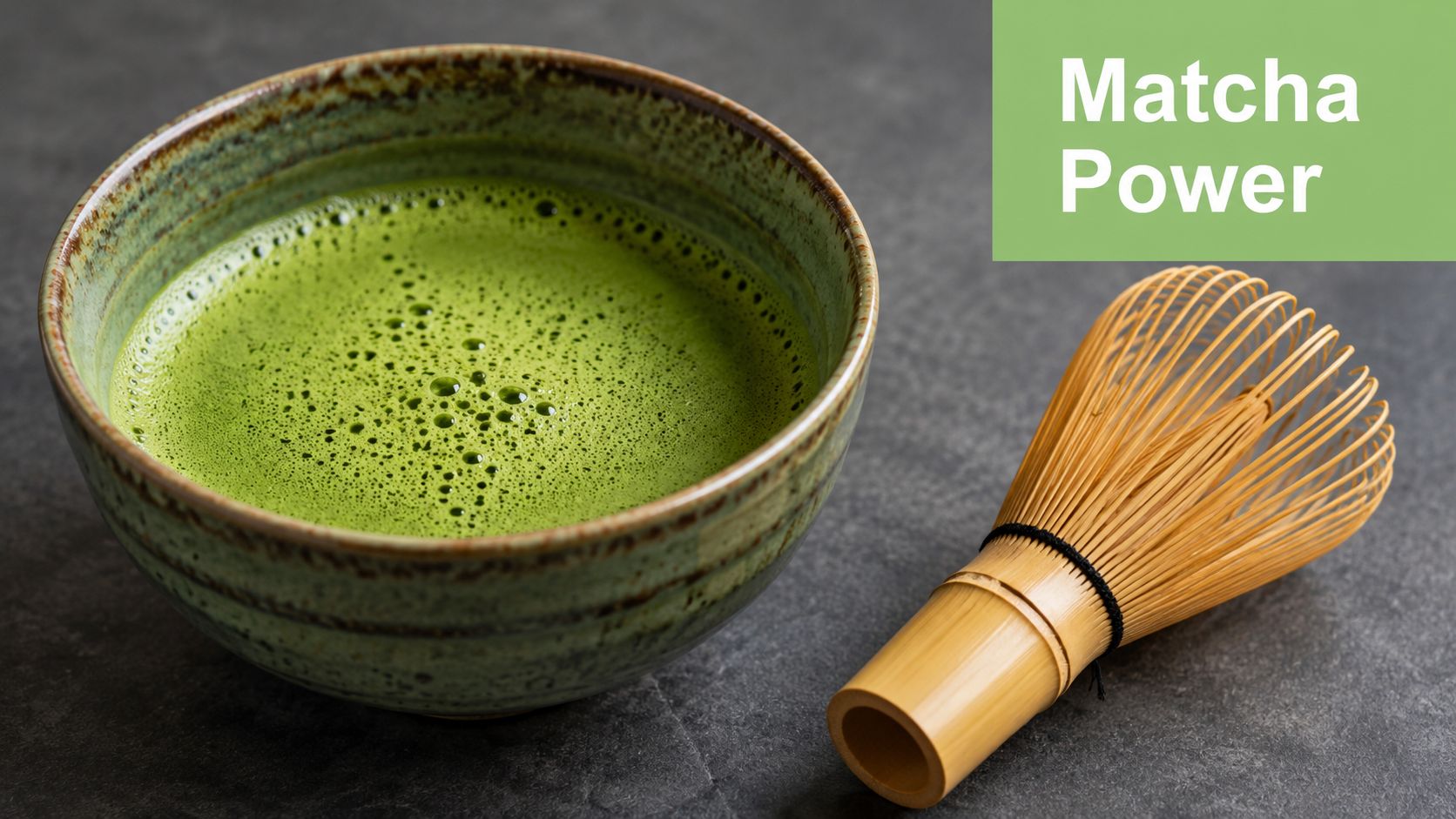
Because you're drinking the whole leaf, Matcha delivers a far more concentrated intake of tea compounds than a standard infusion. That's why it has such a strong reputation among people looking for antioxidant tea benefits that feel substantial rather than token.
Why Matcha delivers more per serve
The most direct comparison is this. Matcha tea powder possesses 137 times more antioxidant catechins than regularly brewed green tea, due to whole-leaf consumption, according to this Cleveland Clinic-cited social post on Matcha catechins.
That doesn't mean every cup of steeped green tea is worthless. It means Matcha is a much more concentrated delivery system.
Here's the practical difference:
- Steeped green tea: some compounds move from the leaf into the water
- Matcha: you consume the leaf itself
- Result: less is left behind, and more reaches you
The antioxidant profile people are really chasing
One reason Matcha is so popular is its high EGCG concentration. Beyond general antioxidant support, the verified data around Matcha points to several areas people care about in real life, including immune support, protection from oxidative stress, and support for metabolism.
A related detail helps make that more concrete. One gram of premium stone-ground organic Matcha contains approximately 30–35 mg of EGCG, according to Matcha.com's overview of catechins and EGCG. That gives you a sense of why even a small serve can feel meaningful within a daily routine.
For a deeper look at the whole antioxidant story, this overview of Matcha as an antioxidant powerhouse is a useful reference.
Why quality and preparation still matter
Not all Matcha is used the same way. Ceremonial styles are usually chosen for straight drinking, while culinary styles suit lattes, smoothies, and baking. Both can be antioxidant-rich, but flavour and texture shape how you will enjoy them.
This quick visual guide is helpful if you're still learning the ritual side of Matcha preparation.
Good Matcha should make healthy habits easier to repeat. If it's unpleasant, most people won't stick with it.
That's the hidden reason Matcha works so well for many Australians. It can slot into a morning ritual, an afternoon reset, or a café order without needing a full lifestyle overhaul.
Kombucha A Fermented Twist on Antioxidant Benefits
Kombucha starts in a very different place. Instead of offering the concentrated whole-leaf intensity of Matcha, it begins as brewed tea and then goes through fermentation. That process changes the drink's character completely.
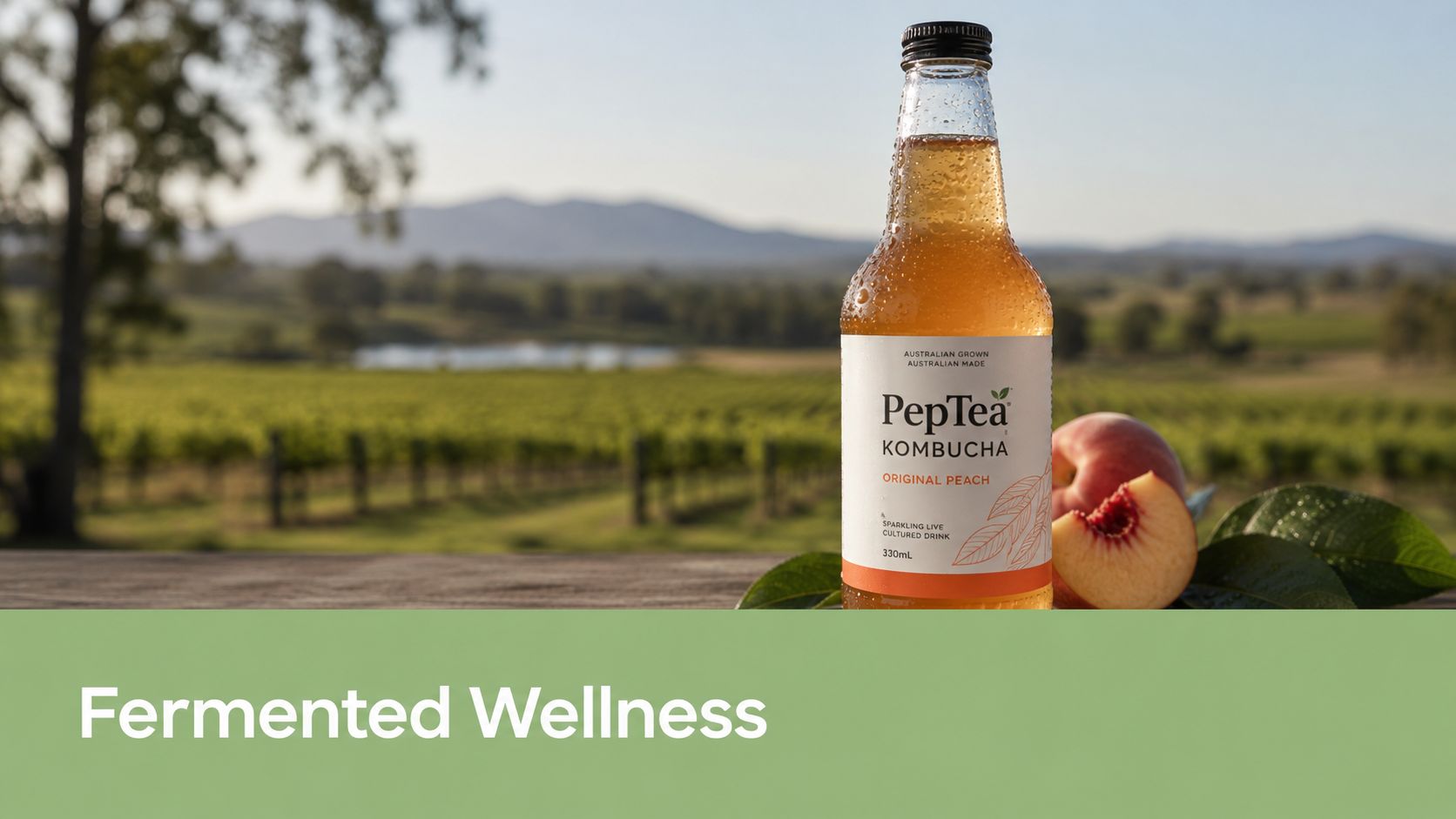
What you get at the end is less about delivering the biggest possible antioxidant hit and more about creating a functional drink with a different set of strengths. For people trying to move away from sugary soft drinks or alcohol-heavy routines, that matters.
Matcha and Kombucha serve different jobs
The easiest way to compare them is by role.
| Drink | Best known for | Practical use |
|---|---|---|
| Matcha | Concentrated tea antioxidants and calm energy | Morning focus, lattes, smoothies, mindful rituals |
| Kombucha | Fermented tea with live cultures and refreshing acidity | Soft drink swap, alcohol alternative, gut-friendly refreshment |
Kombucha still starts with tea, so it carries some of tea's original antioxidant heritage. Fermentation then adds another layer through live cultures and the tangy, complex flavour people either fall in love with immediately or learn to appreciate over time.
Why Kombucha appeals to health-conscious drinkers
Many people don't need every drink to be a super-concentrated wellness tool. Sometimes they need a better replacement for what they'd otherwise drink.
That's where Kombucha shines:
- It feels social: served cold, fizzy, and satisfying
- It can support gut-friendly routines: because live fermentation is part of the appeal
- It helps with sugar reduction: especially for people trying to replace sweet beverages with something cleaner
For Australian households and cafés, that makes Kombucha practical. It works in the fridge at home, on a café menu, or as a non-alcoholic option that still feels grown-up.
Kombucha isn't trying to be Matcha. Its strength is that it solves a different problem.
If you want a deeper look at fermentation, live cultures, and what separates properly brewed Kombucha from gimmicky versions, this guide to the benefits of Kombucha is worth reading.
How to Maximise Your Antioxidant Intake from Tea
A common assumption trips people up. If tea contains antioxidants, then any green tea, brewed any old way, should deliver roughly the same benefit. It doesn't work like that.
With steeped tea, the result in your mug depends on preparation. Water that's too hot, steeping that runs too long, or inconsistent home brewing can change how much of those delicate compounds you get. That's one reason there's often a gap between tea's potential on paper and the cup people drink every day.
Brewing method changes the outcome
One of the most useful reminders comes from population-level data. A PeerJ analysis of 410,000 people found tea reduces dementia risk by up to 29%, but only when consumed optimally, at 2–4 cups per day and the correct temperature, as summarised in Tea Esk's discussion of antioxidant-rich teas.
The big lesson isn't just the dementia finding. It's that how you drink tea matters.
Matcha vs Steeped Green Tea Antioxidant Delivery
| Attribute | Matcha (e.g., PepTea Organic Matcha) | Standard Steeped Green Tea |
|---|---|---|
| How you consume it | Whole leaf in powdered form | Water infused with leaves |
| Antioxidant delivery | More direct and consistent | More dependent on brewing variables |
| Preparation risk | Lower loss from leaf disposal | Greater chance of reduced catechin retention if brewed poorly |
| Best use case | Reliable daily antioxidant intake | Lighter tea ritual with more variation cup to cup |
How to get more from your tea routine
If your goal is antioxidant tea benefits, a few habits help:
- Choose the right tea for the job. Matcha is the more reliable option when you want concentrated delivery.
- Respect temperature. Very hot water can work against delicate compounds in steeped green tea.
- Don't overbrew. Stronger doesn't always mean better.
- Build repeatable habits. The best tea routine is the one you can maintain.
That reliability is part of Matcha's appeal. Because the powder stays in the bowl and then in the drink, you remove much of the guesswork that comes with brewing leaves.
The hidden gap most people miss
People often read about the benefits of green tea and assume they're automatically getting them. In reality, there can be a big difference between “contains antioxidants” and “delivers antioxidants well in everyday use”.
That's why a carefully prepared Matcha can be such a smart choice for home baristas, busy professionals, and café drinkers who want fewer variables and more consistency.
The Secret Synergy of L-Theanine and Clean Energy
Matcha's appeal isn't only about antioxidants. The experience people love most is often the way it helps them feel. Alert, but not frantic. Focused, but not edgy. That's where L-theanine enters the picture.
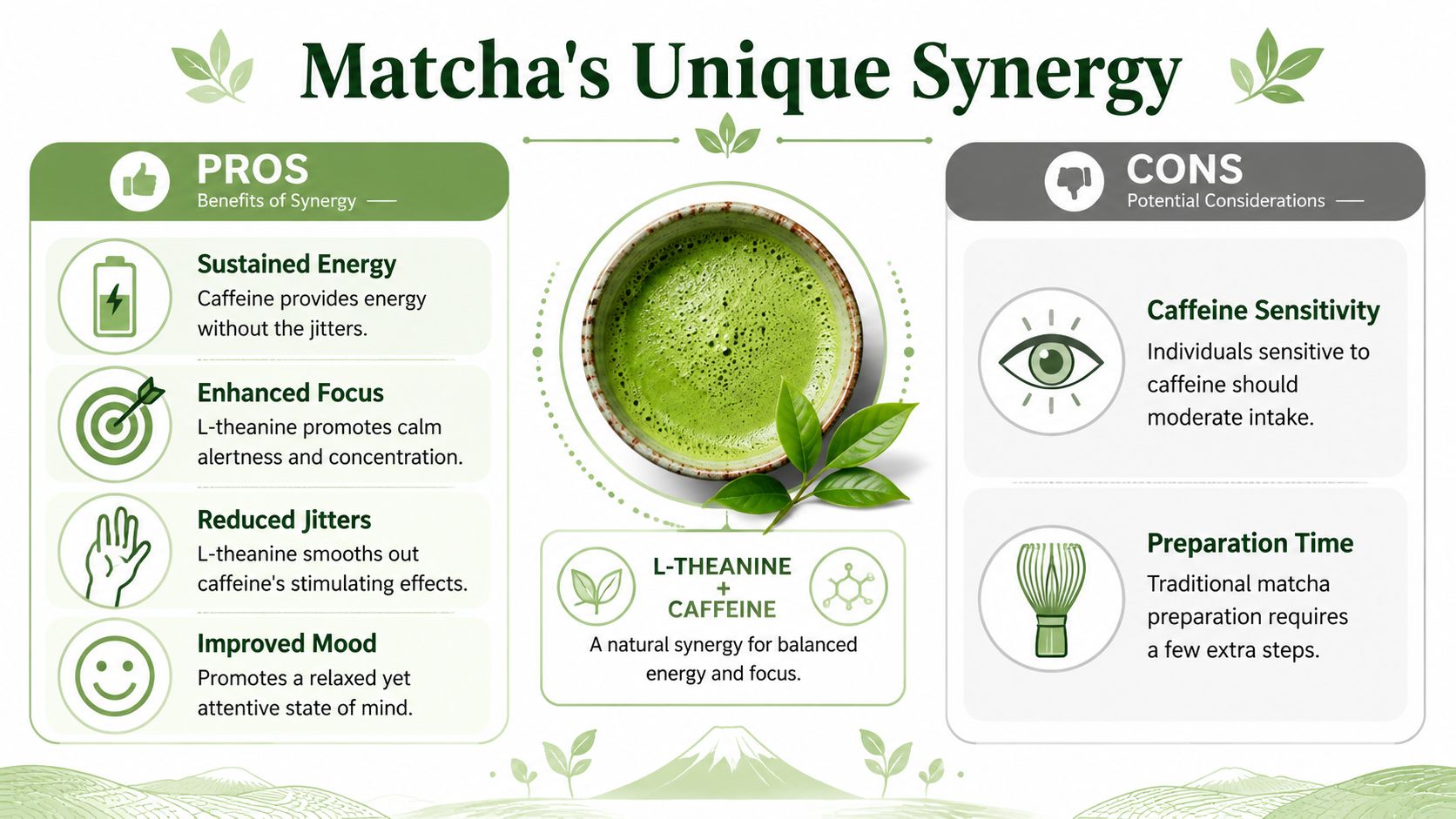
L-theanine is a naturally occurring compound in tea. In Matcha, it works alongside caffeine in a way that many people find smoother than coffee. Instead of a sharp spike, the effect is often described as calm alertness.
What L-theanine contributes
According to Australian Tea Masters' discussion of tea's health benefits, research shows L-theanine boosts GABA, serotonin, and dopamine, reducing anxiety and improving concentration, and its neuroprotective effects complement catechins to protect against cognitive decline.
That sentence explains a lot of the Matcha experience in one go. You're not only getting tea antioxidants. You're also getting a compound that helps smooth the mental side of stimulation.
For many people, that means:
- Steadier focus for desk work or study
- A calmer energy curve than they get from coffee
- A more balanced drink for busy mornings
Why this synergy matters more than caffeine alone
Caffeine on its own can be useful, but it isn't always kind. Some people get the jitters, some get a fast rise and crash, and others feel tense rather than productive. Matcha has a different reputation because of the way its compounds work together.
That synergy is one reason many people prefer a bowl of Matcha before:
- work that needs sustained concentration
- a slower start to the morning
- an afternoon reset that doesn't wreck sleep as badly as a late coffee might
If you're curious about a high-quality option designed for this kind of everyday ritual, Uji Matcha powder is a relevant place to explore.
The most interesting thing about Matcha isn't just that it contains caffeine. It's that the rest of the leaf changes how that caffeine feels.
A smarter way to think about energy
Plenty of drinks promise energy. Fewer help you stay organised, settled, and mentally clear. That's the difference people often notice when they switch from quick-fix beverages to Matcha.
It turns “energy” from a buzzword into something more useful. You can still get a lift, but it's paired with compounds that support composure and attention, which is exactly what many health-conscious Australians are after.
Your Daily Guide to Antioxidant-Rich Teas
The best antioxidant routine is one you'll keep. It doesn't need to be elaborate. It needs to suit your schedule, your taste, and the kind of support you want from a drink.
Simple ways to use Matcha across the day
If you enjoy a slower morning, whisk Matcha with warm water and drink it plain. If you prefer something creamier, use it in a latte. If you're making smoothies or baking, a stronger culinary style usually makes more sense than using your nicest ceremonial powder.
That distinction is practical, not precious. Culinary-grade organic Matcha contains an average EGCG concentration of 50.53 ± 2.41 mg/g, while ceremonial-grade organic Matcha contains 56.57 ± 2.19 mg/g, according to this published comparison of organic Matcha grades. Both are potent. The right choice depends more on how you'll use it than on chasing tiny differences.
A realistic routine for home and café life
Try this approach:
- Morning: plain Matcha for a focused start
- Midday: iced Matcha latte if you want something more substantial
- Afternoon: Kombucha instead of a soft drink or overly sweet café option
- Weekend: use culinary Matcha in smoothies, pancakes, or yoghurt bowls
For cafés, the same logic applies. Keep straight Matcha for customers who enjoy the ritual, use culinary Matcha for lattes and recipes, and offer Kombucha as a polished non-alcoholic fridge or menu option.
Keep it easy enough to repeat
You don't need to optimise every sip. You just need to avoid the obvious mistakes and choose drinks that fit your actual life. Matcha is ideal when you want concentrated antioxidant support and cleaner focus. Kombucha makes sense when you want something cold, fermented, and more social.
Both can help replace habits that don't serve you well.
A healthy drink earns its place when it becomes the option you reach for without having to think twice.
Tea works best this way. Not as a miracle cure, but as a steady, enjoyable part of a better routine.
If you're ready to turn these ideas into something practical, explore Pep Tea for premium organic Japanese Matcha and Australian-brewed sugar-free organic Kombucha. It's a great place to compare ceremonial and culinary Matcha, discover Kombucha flavours for everyday drinking, and find options suited to home routines, cafés, and wholesale needs.
Tea for Digestion: A Guide to Soothing Your Gut Naturally

Lunch was lovely. Then half an hour later, you're unbuttoning your jeans, wondering why a normal meal has left you feeling heavy, puffy, and weirdly tired.
I hear this all the time. Sometimes it's the long café lunch with something rich and delicious. Sometimes it's a rushed desk meal wolfed down between emails. Sometimes it's not even a “bad” meal at all. It's just your body saying, “I need a bit of support here.”
That's why so many of us reach for tea for digestion. Not because tea is a magic fix. It isn't. But a well-chosen tea can be a gentle, comforting ritual that helps your body settle after food, especially when you feel bloated, crampy, or just off.
As someone who lives and breathes tea in Australia, I love this part of tea culture most. It's practical. It's calming. And it makes sense. You boil the kettle, slow down for a minute, and give your gut something warm and easy to work with.
Some teas are soothing and soft. Some feel bright and lifting. Some are better after a heavy meal, while others suit a sensitive stomach or a stressful day. And then there are the modern stars, like high-quality Matcha and properly brewed kombucha, which bring a different kind of digestive support to the table.
That Post-Meal Slump Is Not Your Fault
A lot of people assume digestive discomfort means they ate “wrong”. That's usually too simple.
You can feel ordinary one minute, then sluggish and bloated the next, even after a meal that looked perfectly sensible. A quick sandwich eaten standing up. Fish and chips by the water. A rich pasta at dinner because it's Friday and you felt like it. Your digestive system doesn't only respond to food. It also responds to pace, stress, temperature, caffeine, sleep, and how much your body is juggling that day.
I think that matters, because shame is a terrible wellness strategy. If you're searching for tea for digestion, you probably don't need more discipline. You probably need something gentler.
A warm cup of tea works well here because it invites you to pause. You sit down. You sip slowly. You breathe. For plenty of people, that little shift alone can help the stomach feel less clenched and the whole body feel more settled.
Tea for digestion works best when you treat it as support, not punishment.
I've seen this with customers, family, and in my own routine. After a big lunch, peppermint can feel like a reset. If dinner was rich, green tea can feel cleaner and lighter afterwards. If the day has been frantic, chamomile sometimes helps because the stomach often mirrors the nervous system.
The best approach isn't to memorise a giant list of “good” and “bad” foods. It's to learn the feel of different teas and keep a few dependable options nearby. Once you know which tea suits which kind of discomfort, your cupboard becomes a pretty handy little toolkit.
How Tea Actually Helps Your Digestion
Tea helps digestion in a few different ways, and it's easier to understand when you stop thinking of “digestive tea” as one single category. Different teas do different jobs.
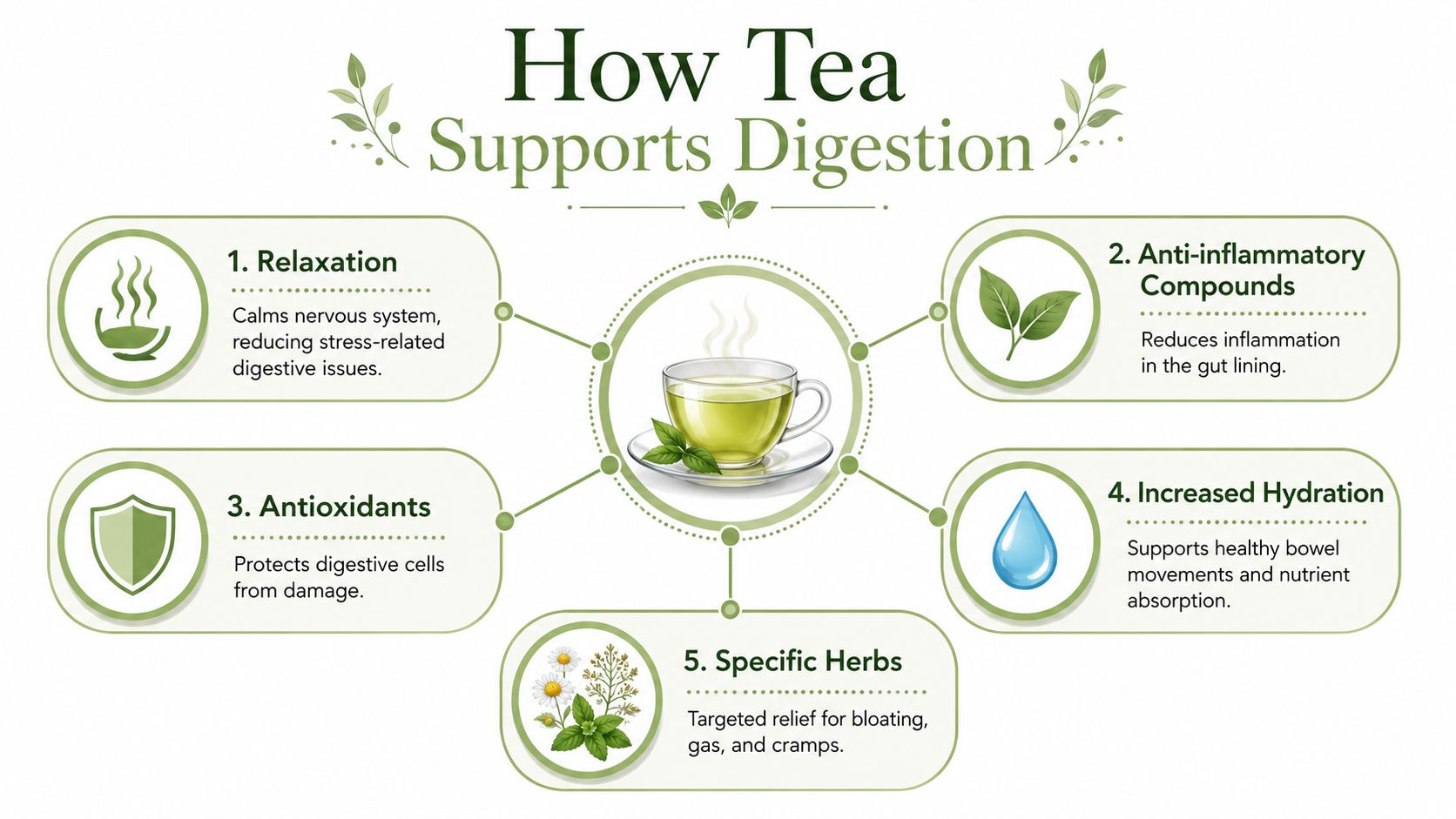
Four simple ways tea can support the gut
Here's the plain-English version:
- Carminative support helps move trapped gas along. This action is similar to gently releasing pressure in a distended abdomen.
- Antispasmodic support helps calm tight, twitchy digestive muscles. That's useful when your belly feels crampy or unsettled.
- Prokinetic support means encouraging movement through the digestive tract. Not in a harsh way. More like helping things keep flowing.
- Probiotic support comes from fermented drinks such as kombucha, which can contribute live cultures to the gut environment.
Hydration matters too. Warm fluids can feel easier on the stomach than icy drinks, especially after a rich meal.
Why green tea feels different after food
Green tea has its own digestive personality. Experimental work summarised in a tea-and-digestion review suggests that green tea extracts can reduce intestinal digestion and absorption of fats and starch, while also increasing gastric secretion through local action on the stomach lining, which helps explain why many people like green tea after heavier meals instead of using it as a treatment for illness (tea and digestion review).
That's a useful distinction. Tea for digestion isn't a medicine replacement. It's more like choosing the right tool for the moment. If lunch was oily, creamy, or generally a bit much, green tea may feel more balancing than a sweet drink or another coffee.
Practical rule: Ask what your stomach needs right now. Less pressure, less cramping, more calm, or better overall gut support.
If you're fuzzy on the difference between feeding good bacteria and adding live cultures, Pep Tea has a helpful explainer on prebiotics and probiotics that breaks down the concepts.
Why the ritual matters as much as the leaves
People often get confused here and assume the benefit comes only from chemistry in the cup. That's only part of the story.
Tea slows the whole moment down. You sip instead of gulping. You warm the stomach instead of shocking it with something freezing. You often step away from whatever was stressing you out. That combination is one reason tea for digestion has stuck around in so many food cultures for so long.
A Guide to Classic Digestive Herbal Teas
When someone asks me where to start, I usually begin with the old favourites. They've stayed popular for a reason. Each one suits a slightly different kind of digestive complaint.
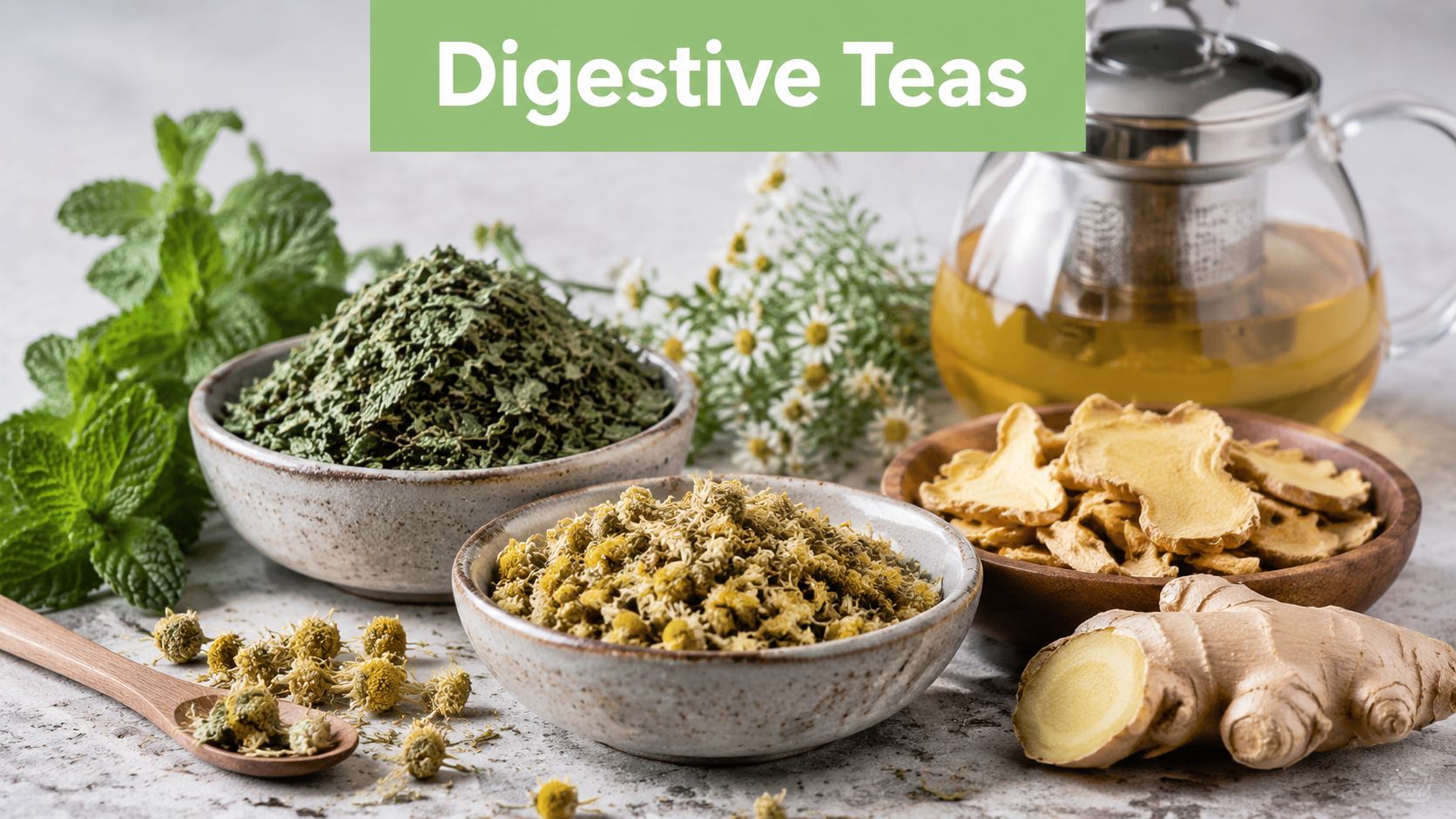
Which herbal tea suits which feeling
| Tea | Often chosen for | What it feels like | Taste |
|---|---|---|---|
| Peppermint | Bloating and heaviness | Cooling and clearing | Fresh, minty, brisk |
| Ginger | Queasiness and sluggish digestion | Warming and stimulating | Spicy, zesty, bright |
| Chamomile | Tension-related digestive discomfort | Soft and calming | Floral, gentle, slightly apple-like |
| Fennel | Gas and post-meal fullness | Light and easing | Sweet, aniseed-like |
Peppermint for bloating
Peppermint is the classic “I ate too much and now I regret it” tea. It's often the first thing people think of for bloating, and for good reason. It tends to feel fresh, cooling, and relieving after a heavy lunch or a meal that's sitting a bit too firmly.
If your tummy feels tight and gassy, peppermint is usually the first cupboard check.
Ginger for nausea and slow, heavy digestion
Ginger has more warmth to it. I think of it as the tea you choose when your stomach feels cold, sluggish, or slightly queasy. It has that clear, active feeling that can be very welcome after travelling, eating too quickly, or overdoing rich food.
It's also one of the easiest herbal teas to pair with food because the flavour is so lively.
If peppermint feels like opening a window, ginger feels like switching the lights back on.
Chamomile and fennel for a gentler approach
Chamomile is the one I reach for when stress is clearly part of the picture. Your gut and your mood are often tangled together. If the whole system feels tight, unsettled, or over-alert, chamomile can be a softer option than stronger-tasting herbs.
Fennel is underrated. It has that sweet, slightly liquorice-like note that people either love immediately or need a cup or two to appreciate. But for post-meal fullness and gas, it's a lovely traditional option.
A simple trick is to match the tea to the sensation:
- Tight and bloated: peppermint
- Heavy and queasy: ginger
- Nervous and crampy: chamomile
- Gassy and full: fennel
Food choices matter too. If you're building a digestion-friendly routine more broadly, it's worth reading about olive oil's digestive benefits, especially if you enjoy simple meals built around vegetables, grains, and good fats.
Why Matcha Is Your Gut Health Ally
Matcha deserves its own conversation because it isn't just “green tea in powder form”. It behaves differently in the cup and in your routine.
With Matcha, you're whisking finely ground tea leaf into water, so you consume the whole leaf rather than steeping it and removing it. That creates a fuller flavour, a richer texture, and a more immersive tea experience. When the Matcha is high quality, the difference is obvious. The colour is vivid, the aroma is clean and green, and the taste has that savoury sweetness that cheap powders just don't deliver.
As a tea person, I tend to get a bit excited. Real Matcha, especially organic Japanese Matcha that's been carefully stone-ground, has a depth and softness that makes it easy to drink regularly. That matters, because tea for digestion only becomes useful when you enjoy it enough to make it part of your day.
What the research says about green tea and the gut
A 2019 systematic review found that 24 publications met the inclusion criteria, including 6 human trials and 18 mechanistic studies, and reported that the strongest evidence was for green tea. In those green-tea studies, intake of up to 1,000 mL per day, roughly 4–5 cups, was associated with higher proportions of Bifidobacterium, and some studies also noted reductions in Firmicutes with improvements in Bacteroidetes (systematic review on tea and gut health).
That doesn't mean Matcha is a cure for digestive problems. It does mean green tea has a meaningful place in the gut-health conversation.
If you want a broader rundown of how green tea powder fits into energy, focus, and daily wellness, our guide to the benefits of Matcha green tea is a good next read.
Why quality matters more than people realise
Low-grade Matcha can taste harsh, dusty, or bitter enough that people drown it in sugar. That defeats the whole point if you're trying to support digestion and feel lighter after meals.
High-quality Matcha is different. It's smoother. It mixes better. It feels more like a ritual and less like a chore.
Here's a quick visual if you'd like to see how Matcha is prepared and used in everyday life:
If you're also dealing with food triggers, tea works best alongside practical eating choices. For readers who want a food-focused companion resource, it's useful to discover IBS fruit options on OrganizEat and build from there rather than expecting one drink to do everything.
Kombucha The Living Drink for Your Microbiome
Kombucha sits in a different category from herbal tea and Matcha. It's a fermented tea, which means it brings the conversation into microbiome territory.
I like to explain the microbiome as your gut garden. You've got a whole community living there. When that garden is well looked after, digestion tends to feel steadier. When it's out of balance, things can feel noisy, reactive, or unpredictable.
Kombucha appeals to people because it's a living drink. Properly fermented kombucha contains live cultures, and that makes it very different from a standard soft drink.
Not all kombucha helps in the same way
Many shoppers get caught out. A lot of products use kombucha-style branding, but they drink more like sweet fizzy beverages than genuine fermented tea. If a kombucha is heavily sweetened, the whole “gut health” message gets murky fast.
That's why I always tell people to think less about hype and more about what's in the bottle. Live culture. Real fermentation. A flavour profile that doesn't rely on sweetness to carry the drink.
A good kombucha should taste alive, not like soft drink wearing a wellness costume.
For people trying to move away from sugary beverages, it can help to discover better drink choices and compare what different options are really offering.
Why properly brewed kombucha stands out
At home or in cafés, kombucha works well when you want something cold, refreshing, and digestion-friendly without reaching for another juice or soft drink. Ginger-based flavours are especially popular after meals because they combine the bright lift of ginger with the tang of fermentation.
Pep Tea's guide to the benefits of kombucha covers the basics if you want to understand the drink more completely.
From a practical point of view, this is why I get enthusiastic about properly brewed, sugar-free kombucha. When fermentation is handled well, the drink tastes crisp, clean, and grown-up. It has structure. It has life. And in an Australian café setting, it gives people a smart non-alcoholic option that still feels interesting.
For home drinkers, the biggest win is simplicity. Keep a bottle chilled, pour a glass with lunch, and you've got a digestive ritual that feels more like a treat than a health task.
Your Daily Ritual for Better Digestion
Tea for digestion works best when it's matched to the moment. You don't need a complicated regime. You need a few reliable habits.
A simple sip plan
- Morning after a rough start: ginger tea if your stomach feels unsettled or heavy.
- After lunch: peppermint if you're bloated, or green tea if the meal was especially rich.
- Mid-afternoon: Matcha if you want steady energy without the hard edge some people get from coffee.
- Evening: chamomile when stress and digestion seem to be feeding each other.
A large evidence summary from Harvard notes that drinking 2–3 cups daily is associated with positive health outcomes, and it also highlights that tea consumed hotter than 55–60°C has been associated with higher health risks, so your tea for digestion is better warm, not scalding (Harvard Nutrition Source on tea).
Brewing tips that make a difference
Small details matter more than people think:
- Peppermint and chamomile: steep until the aroma opens up and the flavour tastes rounded, not watery.
- Ginger: slice it fresh if you want a bolder, more warming cup.
- Matcha: whisk with warm water rather than boiling water if you want a smoother, less harsh bowl.
- Kombucha: serve chilled, straight or over ice, especially with lunch or as an alcohol alternative.
For cafés and hospitality
This is such an easy win for modern menus.
A café can offer a small digestive tea list after meals, build a clean Matcha latte for customers who want calm focus, or pour kombucha as a grown-up non-alcoholic option. A ginger kombucha, a peppermint tea, and a proper Matcha can cover a surprising range of customer moods without making the menu feel crowded.
Frequently Asked Questions About Digestive Teas
Can I drink digestive teas if I have IBS or reflux
Generic advice often falls short. One common gap in Australian consumer content is clear guidance for people with existing conditions like reflux or IBS. Much of the advice stays broad, but the evidence is mixed and people need clearer help deciding which teas to try and which to avoid (Australian digestion tea guidance gap).
A sensible starting point is to go one tea at a time and pay attention to your own response. If reflux is your main issue, minty teas may not suit you. If stress and cramping are more your pattern, a gentler option may feel better.
Is Matcha okay if I'm sensitive to caffeine
Sometimes yes, sometimes no. It depends on your sensitivity, the serving size, and whether you drink it with food.
If coffee leaves you jittery, Matcha can feel smoother for some people as part of a meal or morning routine. But if you already know caffeine doesn't agree with you, start small and be honest with yourself. Digestive support shouldn't come at the cost of feeling wired.
Start with the mildest option that matches your symptoms, then adjust slowly.
Are digestive teas safe in pregnancy
This is one of those situations where “natural” doesn't automatically mean “fine for everyone”. If you're pregnant, managing a medical condition, or taking regular medication, it's smart to check with your health professional before making any tea or herbal drink a daily habit.
What's the safest way to use tea for digestion
Keep it simple:
- Match the tea to the symptom.
- Drink it warm, not piping hot.
- Choose quality over gimmicks.
- Treat tea as support, not a substitute for medical care.
If symptoms are frequent, severe, or changing, it's worth getting proper advice instead of trying to solve everything with your teapot.
If you'd like to build a simple digestive tea routine at home or add better functional drinks to your café menu, have a look at Pep Tea. We stock organic Matcha and sugar-free kombucha, and we share practical guides to help you choose, brew, and enjoy tea with a bit more confidence.
Uji Matcha Powder: A Definitive Explainer for Australians

The first time you whisk a proper bowl of Uji matcha, the aroma hits before the taste does. It smells green, soft, almost creamy, and you realise very quickly that this isn’t just “green tea powder”.
What is Uji Matcha Powder Really?
Uji matcha powder comes from Uji, near Kyoto in Japan, a place long associated with some of the country’s most prized tea. When people talk about Uji matcha with a bit of reverence, they’re usually responding to two things at once. The first is flavour. The second is history.
Matcha itself is powdered green tea, but uji matcha powder is a more specific category. It refers to matcha connected to the Uji region and its tea-making traditions. That matters because place affects taste, texture, aroma, and the way the tea feels in your daily routine.
A lot of confusion starts here. People often assume all matcha is basically the same, just sold at different prices. It isn’t.
Why it’s different from ordinary green tea powder
Regular green tea is usually steeped, then removed from the cup. With matcha, you consume the powdered leaf itself. That creates a fuller flavour and a more concentrated drinking experience.
Uji matcha also carries a very particular identity. It’s linked to long-established cultivation and processing methods, including shading and stone-grinding, which help create the vivid colour and smooth texture many tea drinkers look for.
A simple way to think about it: matcha is a category, but Uji is a place with a reputation. Not every matcha offers the same depth, softness, or finish in the bowl.
For Australians, this matters because matcha often sits at the crossroads of taste and wellness. Some people come to it for a café-style latte at home. Others want a cleaner-feeling ritual than their usual coffee. Others are curious about antioxidants, L-theanine, and calm focus.
If you’re new to the category, a helpful starting point is this guide on what matcha powder is. It clears up the basics before you start comparing grades, origins, and brewing styles.
What people usually get wrong
Three myths show up again and again:
- “All bright green powders are matcha.” Some powders are milled green tea, not true matcha in the traditional sense.
- “The stronger the bitterness, the better the tea.” Good matcha can have structure and character, but harsh bitterness usually isn’t the goal.
- “It’s only for tea ceremony.” Uji matcha can be whisked traditionally, but it also works beautifully in lattes, smoothies, and cooking.
At its best, uji matcha powder is both ancient and practical. It belongs in a tea bowl, but it also belongs in a modern Australian kitchen.
The 800-Year-Old Secret of Uji's Terroir
A tea region earns trust the way a family recipe earns loyalty. By getting the small things right for a very long time.
Uji’s name carries that kind of weight. Tea has been cultivated there since the late 12th century, and over hundreds of years growers refined methods that suited the area’s hills, rivers, mist, and seasonal rhythm. That long memory matters. It helps explain why Uji is still the benchmark many tea drinkers use when they want matcha with depth, softness, and a clean finish.

Why terroir matters in tea
Terroir is the taste of place.
In wine, people talk about soil, slope, sun, and climate. Tea works the same way, but with an added human layer. Farming knowledge passed down across generations shapes the result just as much as weather and geography do. In Uji, that means local conditions and local craft have grown together for roughly 800 years.
For matcha drinkers, terroir shows up in the bowl, not in an abstract concept. You notice it in aroma first. Fresh, green, slightly sweet. Then in texture. Fine, creamy, almost velvety if the powder is well made. Then in flavour, where good Uji matcha often brings a savoury umami note, gentle sweetness, and less of the rough edge that can make lower-grade powders feel aggressive.
That matters for Australians using matcha as part of a daily wellness routine. If you want sustained energy rather than a jittery spike, flavour is not separate from function. A smoother, more balanced matcha is easier to enjoy consistently, whether you whisk it traditionally or add it to your morning latte.
Why Uji became a name people trust
Uji’s prestige grew because tea growers, tea masters, and buyers kept returning to the same conclusion. Tea from this region tasted refined and reliable.
By the Edo period, Uji had become strongly associated with high-quality Japanese tea, especially for people seeking a more polished drinking experience. That reputation still shapes the market today. You can see it in how often Uji is used as the reference point for premium matcha, and in how carefully serious buyers check origin before they buy.
This is also where confusion can creep in. "Uji-style" and "matcha from Japan" do not always mean the same thing as authentic Uji matcha. If you want to understand how origin connects to production quality, this guide to how matcha tea is made helps link what happens in the field to what ends up in your cup.
The place behind the flavour
A good Uji matcha often shows its origin in a few clear ways:
- Umami that feels deep and savoury, not harsh
- A softer finish that leaves the palate clean
- A vivid green colour that reflects careful growing and handling
- A creamy mouthfeel that makes daily drinking more pleasurable
Those qualities are not just for tea ceremony. They matter in ordinary life. A smoother matcha is easier to drink straight, easier to blend into a clean breakfast routine, and easier to return to every day if you are replacing part of your coffee habit with something calmer.
For Australian buyers, that practical side is worth keeping in mind. The best Uji matcha brings together tradition and usefulness. It carries centuries of craft, but it also fits neatly into modern goals like better focus, less sugar, cleaner ingredients, and a morning ritual that feels grounding. Brands that clearly state origin and offer organic options, including carefully sourced selections such as Pep Tea’s, make that choice much easier.
From Shaded Leaf to Stone-Ground Powder
A bright bowl of Uji matcha can look simple on the breakfast bench. Water, powder, whisk, done. Yet that soft green foam begins weeks earlier in the field, then passes through a series of careful steps that shape how the tea smells, tastes, and feels in your mouth.
Authentic uji matcha powder is made with restraint at every stage. The goal is not speed. The goal is to protect what is delicate in the leaf so it reaches your cup with its sweetness, colour, and creamy texture intact.
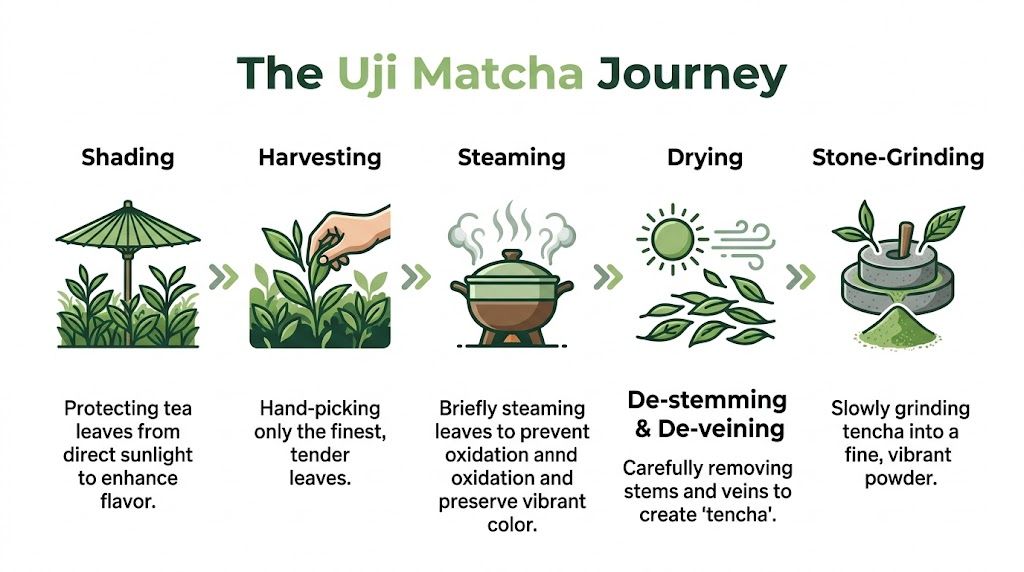
The craft in six practical steps
Price starts to make more sense once you see how much handling happens before the tea is ever packed into a tin.
The plants are shaded
Several weeks before harvest, growers reduce the amount of sunlight reaching the tea bushes. This slows photosynthesis and changes the leaf’s chemistry. The result is a leaf that tends to taste sweeter, more savoury, and less sharp.Tender leaves are harvested
The youngest, most suitable leaves are selected for matcha production. This is one reason fine matcha feels more refined than everyday green tea.The leaves are steamed
Steaming stops oxidation soon after picking. That helps hold onto the fresh green character and keeps the flavour from drifting into duller, flatter notes.The material is dried
For matcha, the leaves are dried without the rolling used for many other Japanese green teas. That difference matters because it prepares the leaf for the next stage.Stems and veins are removed
What remains is called tencha. Tencha is the clean, leafier material used to make matcha, and removing the tougher parts helps create a softer texture and cleaner finish.Tencha is stone-ground
The dried tencha is milled into an extremely fine powder. If you want a clear visual guide to the full process, this explanation of how matcha tea is made connects each production step to what you notice in the bowl.
Why stone-grinding changes the result
Stone-grinding works like using a very slow, careful hand in the kitchen instead of a fast industrial blade. The aim is a fine powder with a silky feel, not a rough grind that drinks chalky or hits the palate too hard.
This slower method also reflects a real supply constraint. As noted in the Sazen Tea discussion already cited, strong demand has put pressure on Uji’s tencha supply. That matters for Australian buyers because authentic Uji matcha is not an unlimited commodity. It is a specialised product built from skilled farming and limited raw material.
Traditional processing does not guarantee a wonderful matcha on its own. Poor leaf in a stone mill stays poor leaf. But careful shading, steaming, sorting, and grinding give excellent tea the best chance to show its full character.
What this means in the cup
Production choices become sensory clues once you start drinking matcha regularly.
- Colour looks brighter and fresher
- Aroma feels greener and sweeter, with less dull hay-like character
- Texture lands finer on the tongue, closer to cream than grit
- Foam whisks up more evenly
- Taste feels rounder, with umami and gentle sweetness instead of a hard, bitter edge
For anyone in Australia building a cleaner morning routine, those details are practical, not decorative. A smoother matcha is easier to drink with just water, easier to enjoy without loads of sugar, and easier to keep as a steady daily habit. That is where centuries of Uji craft meet modern wellness. You get a ritual that feels grounded, plus energy that arrives with more calm than a rushed second coffee.
Drink slowly and pay attention to the finish. Better matcha usually feels composed from first sip to last, with no dusty coarseness interrupting the experience.
Decoding the Grades Ceremonial vs Culinary Matcha
The most common matcha mistake is simple. People buy one tin and expect it to suit every use.
Then the results feel confusing. A beautiful drinking matcha disappears under milk and honey, while a stronger kitchen-grade powder can taste sharp if you whisk it with water on its own. The problem is not that one is “real” matcha and the other is inferior. The problem is fit.
Ceremonial grade is made for the bowl. Culinary grade is made for the recipe.
That distinction helps Australian buyers a lot, especially if your first experience with matcha came through a café latte. A latte can make almost any matcha seem pleasant. Plain matcha is less forgiving, so the grade matters more.
Ceremonial vs. Culinary Uji Matcha at a Glance
| Attribute | Ceremonial Grade Matcha | Culinary Grade Matcha |
|---|---|---|
| Best use | Whisked with water, minimal additions | Lattes, smoothies, baking, desserts, cooking |
| Flavour | Smoother, softer, more umami-led | Bolder, more assertive, better for blending |
| Colour | More vibrant green | Can be slightly deeper or less vivid |
| Texture | Silky and refined | Still fine, but made for mixing into recipes |
| Price logic | You’re paying for drinking quality | You’re paying for versatility and value |
How the difference shows up in real life
Ceremonial matcha aims for harmony. You notice sweetness, savoury depth, and a soft finish that invites slow sipping. It suits a quiet morning ritual, especially if you want a cleaner start to the day without loading your cup with sugar or syrups.
Culinary matcha has a different job. It needs enough presence to stay noticeable beside oat milk, banana, vanilla, cacao, or flour. In that setting, a firmer flavour is useful, much like a spice blend that still tastes vivid after cooking.
Neither grade is automatically the smarter buy. The better choice is the one that matches your routine.
How to choose without overthinking it
If you want one clear rule, start with how you drink it most often.
- Morning bowl with water only. Choose ceremonial.
- Daily latte at home. Choose culinary.
- Smoothies, baking, protein balls, or desserts. Choose culinary.
- Both pure tea and lattes. Keep one of each if your budget allows.
A practical guide to different grades of matcha can help you compare options before buying, especially if you are trying to balance flavour, budget, and wellness goals.
What to look for in each grade
For ceremonial grade, look for ease and composure in the cup. It should whisk well, smell fresh, and taste pleasant without milk covering roughness. If plain water leaves the matcha feeling flat, harsh, or overly astringent, it is probably not the right pick for sipping.
For culinary grade, strength is not a flaw. It is part of the design. You want a matcha that keeps its green tea character once it meets milk, fruit, or sweetener.
A helpful test is to ask one direct question. Does this powder taste good in the way I plan to use it?
That mindset saves money and disappointment. It also helps turn matcha into a steady daily habit, whether your goal is a traditional bowl before work or a clean afternoon latte that feels energising without the heaviness of a sugary café drink.
The Science of Calm Energy and Radiant Health
Many people start drinking uji matcha powder because they want energy. They stay with it because the feeling is different.
Coffee often arrives fast and loudly. Matcha tends to feel steadier. That doesn’t mean it’s magically better for everyone, but it does help explain why so many people describe it as clean, focused, and easier to live with day after day.
Why matcha feels different from a standard caffeine hit
A key reason is the combination of caffeine and L-theanine. According to this explanation of Uji matcha and L-theanine, Uji matcha’s shade-growing process can increase L-theanine concentration by up to 137% compared to sun-grown tea. The same source notes that this pairing is associated with improved physical performance and cognitive function by increasing alpha wave activity linked with calm alertness.
In plain language, that means matcha doesn’t deliver caffeine on its own. It brings it together with a compound that helps soften the edge.
What L-theanine actually does
L-theanine sounds technical, but the effect is easy to understand. It’s one reason many matcha drinkers say they feel more composed than buzzy.
Consider it this way:
- Caffeine helps you feel switched on
- L-theanine helps that alertness feel smoother
- Together they can create a more even experience
That’s especially appealing if regular coffee leaves you scattered, jittery, or flat later in the day.
Matcha’s appeal isn’t only about stimulation. It’s about the quality of attention it can support.
Where EGCg fits in
You’ll also hear about EGCg, one of matcha’s best-known antioxidant compounds. For many wellness-minded drinkers, that’s part of the draw. Matcha isn’t just a warm drink. It’s a whole-leaf tea that brings together plant compounds people actively seek out in a daily routine.
It’s best to stay realistic here. Matcha isn’t a cure-all, and it shouldn’t be treated like medicine. But as a regular beverage, it can fit neatly into a pattern of mindful choices around energy, focus, and less sugary drinking habits.
The benefits people notice in real life
Individuals typically don’t sit around thinking about alpha waves. They notice practical things instead.
Common reasons people keep matcha in the pantry include:
- A gentler start to the morning
- A focused afternoon ritual
- A café-style drink without relying on syrups
- A wellness habit that feels enjoyable rather than strict
For some, the ritual matters as much as the chemistry. Measuring, sifting, whisking, and drinking slowly can create a pause in the day that coffee sometimes doesn’t.
That combination of sensory pleasure and functional appeal is why Uji matcha has such staying power. It tastes good, it feels good, and it suits a lot of modern routines without asking you to become a tea purist.
Your Guide to Brewing the Perfect Cup
The first time many people make matcha at home, the result can be a surprise. You open a beautiful tin of Uji matcha, whisk it up, take a sip, and instead of sweet green depth, you get lumps, bitterness, or a flat latte that tastes more like warm milk than tea.
That usually comes down to method, not the matcha itself.
A good bowl of matcha is a bit like cooking with a premium olive oil. Small handling choices change what you taste. Water temperature, sifting, and whisking all shape whether the cup feels creamy, lively, and gently energising, or rough and disappointing.
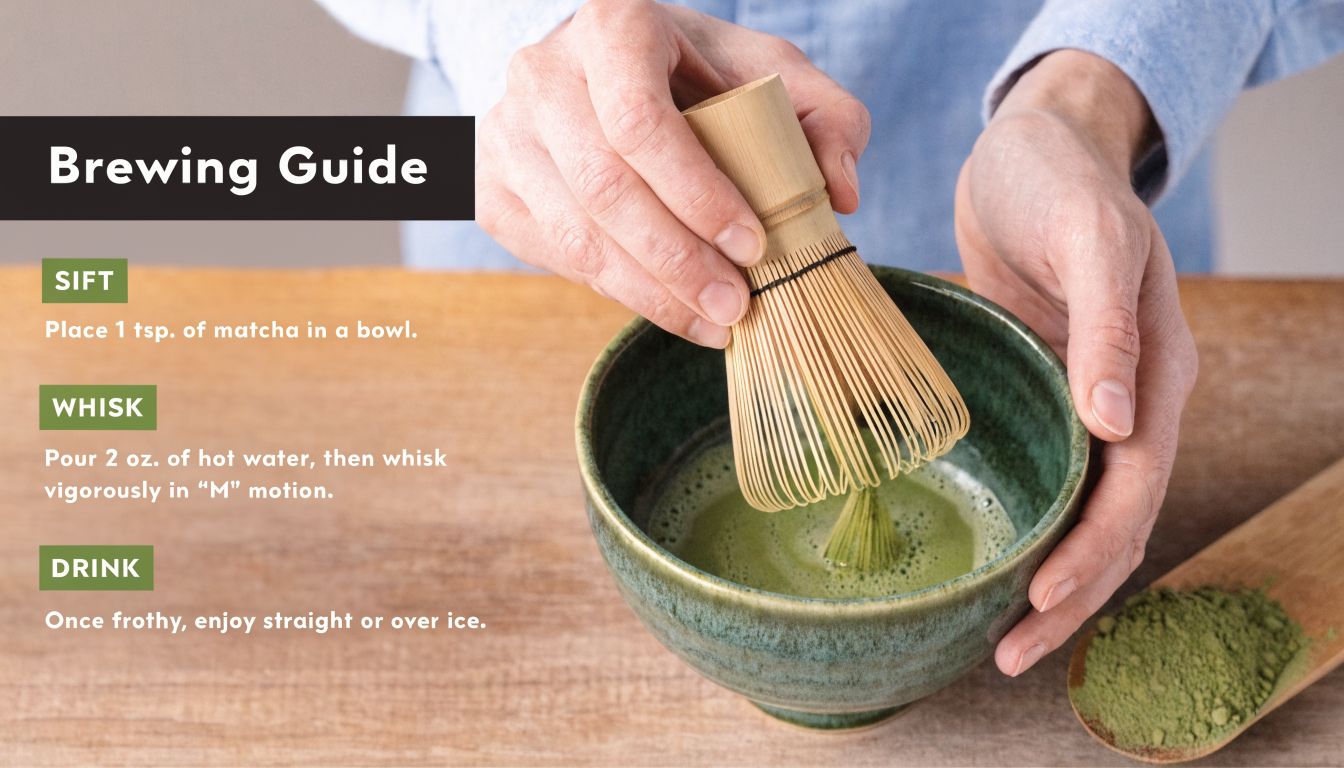
Traditional whisked matcha
If you want to understand Uji matcha properly, start with it on its own. This style lets you notice the creamy texture, the fresh aroma, and the gentle savoury sweetness that can get lost in milk.
What you’ll need
- A bowl large enough to whisk comfortably
- A bamboo whisk
- A small sieve
- Matcha powder
- Hot water, not boiling
Step by step
Warm the bowl
Swirl a little hot water in the bowl, then tip it out. This helps keep the temperature steady and makes whisking easier.Sift the powder
Matcha clumps easily because it is so fine. Sifting separates the powder so it blends more evenly with water.Add a small amount of water first
A splash is enough. Stir it into a smooth paste so you do not have dry pockets hiding at the bottom.Add more hot water
Water around 80°C usually gives a sweeter, rounder result. Boiling water can push the tea toward bitterness and bury the softer notes that make Uji matcha special.Whisk briskly
Use quick wrist movements until a light froth forms on the surface. You are aiming for a smooth suspension of tea in water, not heavy foam like a cappuccino.
Practical rule: If your matcha tastes harsh, check the water temperature first.
A simple home matcha latte
For plenty of Australians, a latte is the easiest way to turn matcha into a daily wellness habit. It fits the café rhythm many people already enjoy, but it can offer a steadier kind of lift for mornings and mid-afternoons.
Start with sifted matcha in a mug or bowl. Add a little hot water and whisk or stir until smooth. Then heat your milk separately and pour it in.
Dairy milk, oat milk, and soy can all work well. Oat milk is often the easiest starting point because its mild sweetness softens matcha’s savoury edge without covering up the tea completely.
If your latte tastes weak, the tea-to-milk ratio is usually the issue. Matcha should still be clearly present. You want harmony, not a green-coloured milk drink.
Here’s a visual guide if you like watching the whisking motion before trying it yourself:
Troubleshooting common problems
A disappointing cup does not always mean you bought the wrong matcha. Preparation errors are far more common, especially at the start.
Lumps in the drink
Sift the powder before adding water, and make a paste first.Too bitter
Let freshly boiled water cool a little before using it.Weak flavour in a latte
Add more matcha or reduce the amount of milk.No froth
Use a wider bowl and whisk with faster, lighter wrist movement.
A few habits that improve every cup
The ritual does not need to be formal to feel grounding. A few simple habits can turn matcha from an occasional experiment into a clean, enjoyable part of everyday life.
- Keep your tools dry before adding powder
- Use fresh matcha rather than a tin that has been open too long
- Start small and adjust the strength to your taste
- Drink it soon after whisking for the best aroma and texture
Once the method clicks, making matcha stops feeling fussy. It becomes a small daily reset, one that tastes good and sits neatly alongside a healthier, more intentional routine.
Exploring Matcha Beyond the Teacup
One of the best things about uji matcha powder is that it isn’t limited to a bowl and whisk. Once you understand its flavour, you start seeing it as an ingredient, not just a drink.
That opens up a lot of possibilities for Australian kitchens, especially if you enjoy café-style drinks, low-fuss baking, or simple ways to make everyday food feel more interesting.
Cold drinks for warm afternoons
On a hot day, matcha becomes something else entirely. Whisk it with a little warm water first, then pour it over ice and milk for an iced latte.
If you want something more breakfast-like, blend matcha into a smoothie with milk, yoghurt, banana, or a mild fruit that won’t drown out the tea. The key is balance. Matcha has a savoury side, so it usually works better with creamy ingredients than with very sharp citrus.
Baking that still tastes like matcha
Culinary matcha shines here. It brings colour, aroma, and a gentle bitterness that can stop sweets from feeling one-note.
Good starting points include:
- Shortbread or biscuits, where butter carries the tea flavour well
- Simple cakes or muffins, especially with vanilla or white chocolate
- Yoghurt bowls and chia puddings, where a spoonful can change the whole profile
- Ice cream or nice cream, for a softer dessert-style expression
A common mistake is using too little. If you want visible colour and a recognisable matcha flavour, be confident enough with the quantity that the tea doesn’t disappear behind sugar and flour.
Matcha works best in recipes where there’s room for its grassy, umami character to remain noticeable.
Savoury uses that surprise people
Matcha gets underrated in this aspect. Used carefully, it can add depth to savoury dishes.
Try whisking a small amount into a salad dressing with oil and a mild acid. Or stir a pinch into a sauce where you want a subtle green, savoury note. Some cooks also dust it lightly over vegetables or use it in seasoning blends.
The trick is restraint. Matcha is concentrated. A little can lift a dish, while too much can flatten it into bitterness.
A pantry ingredient, not just a wellness trend
When people only think of matcha as a health drink, they miss half the fun. It can become part of your broader food routine.
One day it’s a morning latte. Another day it’s folded through a biscuit dough. Another day it adds a fresh edge to a dressing for lunch. That kind of versatility is what makes culinary-grade matcha especially useful. It earns its place in the cupboard because it does more than one thing well.
How to Store and Buy Authentic Uji Matcha
Good matcha is delicate. Light, heat, air, and moisture all work against it. If you’ve ever opened an old tin and found the colour duller and the aroma flatter, that’s usually storage talking.
Buying well matters. Storing well matters just as much.
How to store it once opened
The goal is to protect freshness for as long as possible.
- Keep it sealed tightly after each use
- Store it away from heat and light
- Avoid moisture from steamy kitchens or wet scoops
- Use a clean, dry spoon every time
If you refrigerate matcha, keep it sealed well so it doesn’t absorb odours. Before opening a chilled tin, let it come to room temperature so condensation doesn’t settle into the powder.
What authenticity looks like in practice
You don’t need to be a tea judge to shop more confidently. You just need a few filters.
Look for:
- Clear origin information that names Uji or Kyoto, Japan
- A vibrant green colour rather than swampy or brownish tones
- A fresh aroma that smells lively, not stale
- Organic certification, if that matters to your buying standards
- A seller who explains grade and intended use clearly
If a product description is vague, that’s useful information in itself. Good tea usually comes with good traceability.
Buying for your actual routine
A lot of buyers overpay because they purchase the most premium-sounding option without thinking about use. If you mostly make lattes and smoothies, choose a matcha suited to that. If you love whisking plain tea, spend more on a finer drinking grade.
Cafés and retailers think this way too. If you work in hospitality and want to better understand how product quality, brand trust, and education influence buyer decisions, this Food & Beverage Marketing Guide offers a useful commercial lens.
A final buyer checklist
Before you click “add to cart”, pause and ask:
- Is the origin clearly stated?
- Is the grade appropriate for how I’ll use it?
- Does the colour suggest freshness?
- Does the brand explain the tea in plain, specific language?
- Will I realistically finish it while it’s still tasting its best?
Those questions protect you from a lot of disappointing purchases. They also help you appreciate why authentic uji matcha powder earns such loyalty among people who care about flavour, ritual, and a cleaner kind of daily energy.
If you’re ready to put this into practice, explore Pep Tea for organic matcha options suited to everyday whisking, café-style lattes, and creative kitchen use.
Top Healthy Soda Drinks in Australia 2026

The drinks fridge can feel like a quiz you did not study for.
You want something fizzy, refreshing, and a bit more exciting than plain water. But every can seems to promise something different. Low sugar. Natural. Gut-friendly. Botanical. Functional. Clean. Better-for-you. It is no wonder so many Australians stand there reading labels for far longer than they planned.
That confusion is why healthy soda drinks have become such a big topic. People are not just trying to cut back. They are trying to find drinks that fit how they want to live, whether that means less sugar, more natural ingredients, support for digestion, or a smarter alcohol-free option for home and café menus.
Some healthy soda drinks do live up to the name. Others are just regular soft drinks wearing wellness language. Knowing the difference matters.
The Search for Healthy Soda Drinks in Australia
A common scene goes like this. You pop into the supermarket for a few basics, wander past the beverage aisle, and spot a full shelf of colourful cans calling themselves healthier choices. One says it has botanicals. Another says it contains live cultures. A third shouts sugar-free in giant letters. You pick one up, turn it over, squint at the ingredients, and wonder if any of these drinks are good choices.
That moment says a lot about how Australian drinking habits are changing.
Sugary soft drinks are losing ground. In Australia, per capita sugary soft drink consumption has significantly declined over the past decade. At the same time, the healthy soda category grew 28% year-on-year in 2024 and captured 15% of the non-alcoholic beverage market, according to Mintel’s referenced market summary.
That shift makes sense. Australians still enjoy fizz. They just want more from it.
What people usually mean by healthy soda drinks
Most shoppers are not looking for a miracle drink. They are looking for a better swap.
They usually mean a fizzy drink that is:
- Lower in sugar than traditional soft drink
- Made with ingredients they recognise
- Less artificial in flavour and colour
- Possibly functional, with things like probiotics, tea compounds, herbs, or fruit-based ingredients
That sounds straightforward, but the category is broad. Kombucha sits in it. So do sparkling waters, modern low-sugar sodas, and newer tea-based sparkling drinks.
A healthy soda drink is not just “less bad”. The stronger options are built with a clear purpose, such as lower sugar, cleaner ingredients, or a functional benefit that makes sense.
Why the category feels so messy
The word “healthy” is not a regulated shortcut for quality. One brand may use it to mean low sugar. Another may use it to mean natural flavours. Another may use it to mean it contains a functional ingredient in small amounts.
That is where many people get stuck. Fizzy water with lemon essence is one thing. A live kombucha is another. A sweetened “better-for-you” cola is another again.
The good news is that once you know what to look for, the shelf gets much easier to read.
What Makes a Soda Drink Healthy
A healthy soda drink does not need to be perfect. It does need to be honest.
If you want a straightforward way to judge a drink, three markers help most. Start with sugar. Then check the ingredients. Then ask whether the drink offers any function beyond taste.
Start with sugar
Sugar is where the biggest difference usually sits between traditional soft drinks and better choices.
The Australian Dietary Guidelines recommend limiting free sugars, yet traditional soft drinks can contribute a significant number of calories daily. In contrast, a University of Sydney trial found that daily consumption of a low-sugar kombucha lowered fasting blood sugar by 12% over 8 weeks in prediabetic participants, according to the referenced source provided for this claim here.
That does not mean every low-sugar fizzy drink is automatically healthy. It does mean sugar deserves to be the first thing you check.
A drink can look fresh and modern on the front, but if it still relies on a heavy sugar load, it is not much of a step forward.
Look for clean, understandable ingredients
The second test is the ingredient list.
A stronger healthy soda drink tends to keep things relatively straightforward. Think brewed tea, fruit extracts, botanicals, juice in modest amounts, live cultures, or natural acids used for flavour and balance.
A weaker one often leans on a long list of flavour systems, colourings, and vague claims that sound wholesome without telling you much.
Ask what the drink is doing
Readers often get confused about this.
Not every healthy soda drink needs to deliver a functional benefit. Plain sparkling water can still be a good choice. But if a product presents itself as a wellness drink, it should give you a clear reason why.
That “why” usually falls into one of these buckets:
Supports sugar reduction
Some drinks help replace a regular soft drink habit with something lighter and less sweet.Offers a food-based function
Fermented drinks may contain live cultures. Tea-based drinks may bring plant compounds naturally found in tea.Fits a broader routine
A good healthy soda can work as an afternoon pick-me-up, an alcohol alternative, or a café option that feels grown-up rather than childish.
If the benefit is hard to explain in one plain sentence, the claim is probably doing more work than the drink itself.
A quick mental checklist
When you pick up a can or bottle, ask:
- Is the sugar level clearly lower than regular soft drink?
- Can I recognise most of the ingredients?
- Does the product make one clear, believable promise?
- Would I still drink it if the label design were less flashy?
Healthy does not have to mean joyless
This is worth saying because many people assume a “healthy” option must taste thin, medicinal, or disappointing.
It does not.
The best healthy soda drinks keep the pleasure of fizz. They just move away from the old formula of high sugar and artificial flavour. That can mean tart fermented notes, crisp citrus, ginger heat, herbal freshness, or the grassy brightness of green tea.
A healthy soda should feel like an upgrade, not a punishment.
Exploring the Best Healthy Soda Categories
Not all healthy soda drinks are trying to do the same job. Some are for hydration. Some are for flavour. Some are chosen for gut health interest. Others are there to replace a sweet soft drink habit without feeling boring.
That is why categories matter more than hype.
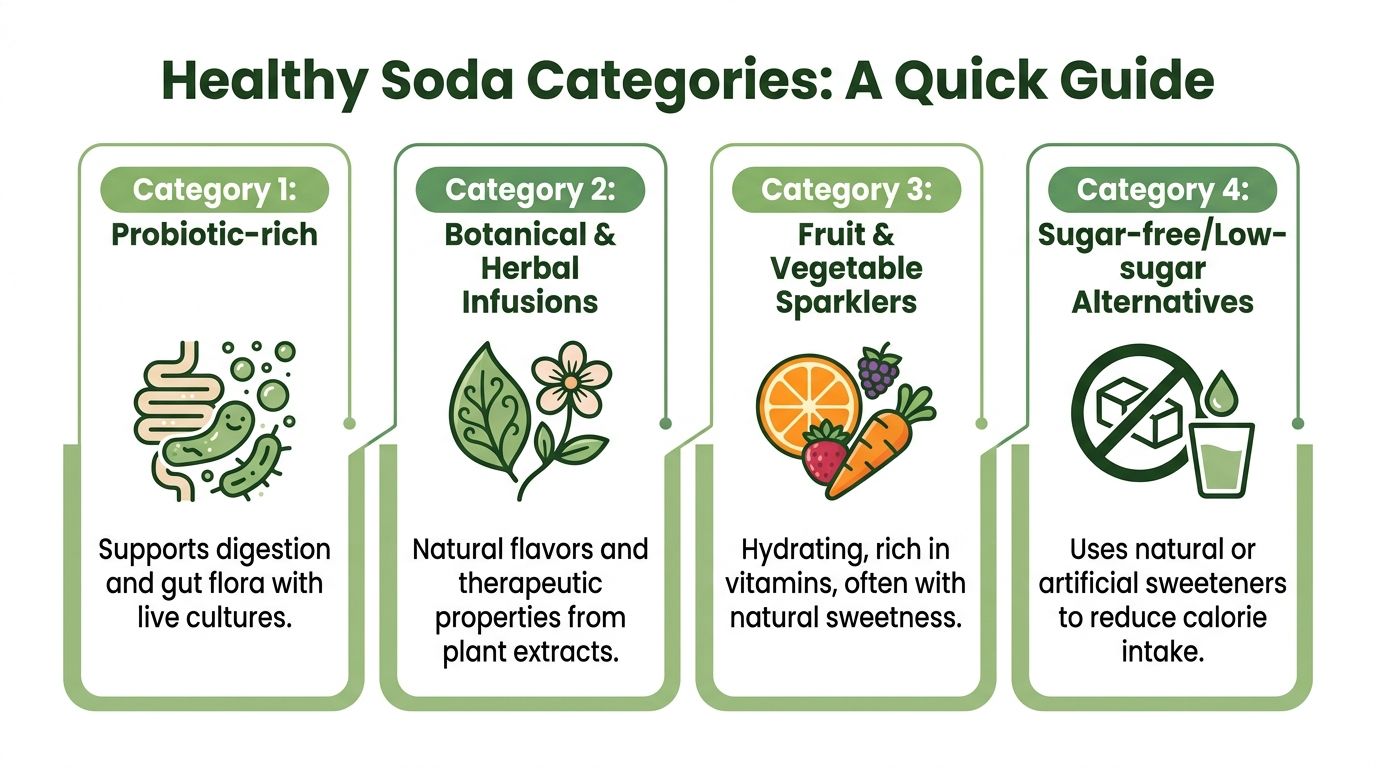
Kombucha
Kombucha sits closest to the “functional fizz” idea many people have in mind.
It is a fermented tea drink, usually lightly tart, lightly sparkling, and more layered in flavour than standard soft drink. Depending on how it is brewed, it can lean gingery, citrusy, appley, floral, or tea-forward.
People often get tripped up by one question. Is all kombucha the same? Not at all.
Some are clean and dry. Some are sweet and juicy. Some are raw and alive. Some are more like soft drink with a kombucha label attached.
Best for: people who want a grown-up soft drink alternative, an alcohol-free option with character, or a fermented drink with live culture interest.
Sparkling water and naturally infused sparkling water
This category is the most basic.
Plain sparkling water gives you fizz without sweetness. Naturally infused sparkling waters add a hint of citrus, berry, cucumber, or botanical flavour. They work well for people who mostly want refreshment and a break from sugary drinks.
The main thing to remember is that these drinks are often the least complex. That is not a flaw. It is the point.
They are ideal when you want:
- Clean refreshment
- No heavy sweetness
- A mixer for meals or mocktails
- An easy fridge staple
Modern low-sugar sodas
This category tries to recreate the fun of classic soft drink with a lighter nutritional profile.
You will often see flavours inspired by cola, lemon squash, ginger beer, orange, or creamy soda styles. Some use alternative sweeteners. Some use fruit and botanicals. Some sit somewhere in the middle.
This is often the easiest entry point for people who still want a familiar soft drink feel.
The challenge is quality variation. One low-sugar soda may taste balanced and clean. Another may have a strange aftertaste or rely too heavily on sweetener technology rather than ingredients.
If you enjoy ginger-led flavours, this no sugar ginger beer style option shows how a classic soft drink profile can be reworked in a lighter direction without losing personality.
Matcha and tea-based sparklers
This is still a smaller corner of the category, but it is one of the most interesting.
Tea-based sparkling drinks can offer:
- More adult flavour profiles
- Natural bitterness or tannin for structure
- A more refined alternative to sweet soft drink
- A bridge between café culture and functional beverages
Matcha sparklers, in particular, appeal to people who want something energising but not heavy. The flavour is fresh, grassy, and slightly creamy when prepared well. For some people, it is an instant favourite. For others, it takes a sip or two to understand.
A side-by-side view
| Category | What it tastes like | Why people choose it | Best moment |
|---|---|---|---|
| Kombucha | Tart, layered, lightly fermented | Interested in live cultures and complex flavour | Lunch, mocktails, alcohol-free evening drink |
| Sparkling water | Crisp, clean, minimal | Wants fizz without sweetness | All day, hydration, meal pairing |
| Low-sugar soda | Familiar soft drink style | Cutting back without giving up classic soda feel | Afternoon treat, family fridge |
| Tea-based sparkler | Botanical, bright, more adult | Wants flavour plus a tea-based identity | Morning, café menu, mindful energy |
Which category suits you best
If you love traditional soft drink and want the easiest swap, start with low-sugar soda.
If you are over sweet drinks altogether, sparkling water may suit you better.
If you enjoy bolder flavour and are curious about fermentation, kombucha is often the most rewarding category.
If you already love green tea, iced tea, or café-style drinks, tea-based sparklers can feel like a natural next step.
The best healthy soda drink is the one you will enjoy often enough to replace the habit you are trying to move away from.
Health Benefits of Probiotics and Antioxidants
Two words come up constantly in this space: probiotics and antioxidants. They sound scientific, and they are, but the basic ideas are straightforward.
One is about the living ecosystem in your gut. The other is about plant compounds that help protect cells from everyday stress.
Probiotics and gut health
Your digestive system is home to a huge community of microbes. People often call it the gut microbiome.
A clear way to think about it is as a garden. Different microbes play different roles. Some help maintain balance. Some help break down parts of food. Some are associated with a healthier gut environment when they are present in the right mix.
A 2023 CSIRO study on Australian adults found that daily consumption of organic kombucha with more than 10^8 CFU/ml probiotics led to a 28% increase in beneficial Bifidobacterium in the gut and improved markers of colonic barrier integrity after four weeks, compared to regular soda, according to the source provided here.
That is useful because it moves kombucha beyond vague wellness language. It points to a measurable difference in the gut environment when a properly brewed product is used instead of a regular soft drink.
People often mix up probiotics and prebiotics, so if you want a plain-English explainer, this guide on what are prebiotics and probiotics is a handy starting point.
Why “live cultures” is not just marketing language
A live fermented drink is different from a flavoured fizzy drink that borrows the kombucha aesthetic.
What matters is whether the product still contains viable cultures in a meaningful way. That depends on how it was brewed, handled, and packaged.
For everyday drinkers, the practical takeaway is clear. If you want probiotic interest, choose drinks that take fermentation seriously and are clear about what is in the bottle.
A fermented drink is not automatically useful just because it tastes tangy. The brewing and culture quality matter.
Antioxidants and matcha
Antioxidants are compounds found in many plant foods and drinks. Tea is one of the best-known examples.
Their job is often described as helping the body deal with oxidative stress. If that phrase sounds abstract, think of it as everyday wear and tear that happens as part of normal life. Plant compounds can help your body manage that background load.
Matcha is especially interesting because you consume the whole powdered tea leaf rather than just drinking an infusion and discarding the leaves. That gives matcha its dense flavour, vivid green colour, and strong identity compared with many other tea drinks.
Why matcha feels different from many energy drinks
People often ask whether tea-based fizzy drinks are meant to “wake you up” the way a standard energy drink does.
Usually, that is not the appeal.
Matcha-based drinks are often chosen because they feel steadier and more grounded. The experience is less about a jolt and more about alertness with a smoother edge. The taste also tends to signal something very different from mainstream energy drinks. It feels cleaner, less syrupy, and more connected to actual tea.
The antioxidant side of matcha adds to that appeal. It gives the drink a genuine food-based identity rather than just a laboratory-style formula.
Where these benefits fit in real life
For many, healthy soda drinks are not the whole answer to wellness. They are one small lever.
They can help when you want to:
- Replace a daily soft drink habit
- Choose a more interesting alcohol-free option
- Build a café or home fridge around smarter choices
- Pick drinks with ingredients that make sense
That is the value of probiotics and antioxidants in this category. They turn fizz from an empty extra into something with a clearer role.
How to Read Drink Labels Like an Expert
Front-of-pack wording is designed to catch your eye, not to answer your questions.
If you want to judge healthy soda drinks properly, the back of the can does the talking. The ingredient list and nutrition panel tell you far more than words like natural, wellness, functional, or guilt-free ever will.
What to look for first
Start with the shortest route to clarity.
Sugar position on the panel
Look at the sugar content early, before you read the brand story. If a product is pitched as a healthy swap, the sugar number should support that claim.Recognisable ingredients
Brewed tea, fruit juice, herbs, spices, botanical extracts, live cultures, and sparkling water are easier to understand than a long chain of additives.Specificity
Clear wording is a good sign. If a drink says fermented tea, matcha, ginger juice, or live cultures, you know more than if it hides behind broad flavour language.
Ingredients that deserve a second look
Some ingredients are not automatically bad. They deserve attention.
Traditional colas contain phosphoric acid at 300 to 400mg/L, and a long-term University of Sydney study linked higher intake to 14% lower bone mineral density in adolescents. The same study noted 9% higher bone density in consumers of matcha-based drinks, which contain EGCg, according to the provided source here.
That does not mean one occasional cola is a crisis. It does mean ingredient type matters, especially if a drink is part of your regular routine.
A simple label-reading checklist
Look for these signs
Low sugar intent
The product should clearly fit a lower-sugar approach, not just a smaller serve trick.A believable product identity
If it is a kombucha, you should see signs of fermentation and culture. If it is a tea sparkler, tea should feel central.Less clutter
A shorter, cleaner list often makes it easier to understand what you are drinking.
Be cautious about these
Halo words without detail
“Natural flavours” is common, but on its own it does not tell you much.Health language doing all the work
If every claim sits on the front and very little substance appears on the back, be sceptical.Products that imitate wellness branding
Pastel cans and botanical illustrations can make a drink look cleaner than it really is.
The best label readers do one thing differently. They ignore the front until the back has earned their trust.
What about certifications and compliance
For shoppers, certifications can help signal manufacturing standards or ingredient choices, but they are not a replacement for reading the panel.
For businesses launching their own beverage, label compliance gets much more technical. If that side interests you, this guide on mastering supplement label requirements is useful for understanding how detailed product labelling can become in adjacent wellness categories.
A quick aisle test you can use today
Pick up two drinks that both call themselves healthy. Compare only three things:
- The sugar panel
- The first five ingredients
- Whether the product benefit is clear and believable
That comparison usually tells you enough to make a smarter choice without overthinking it.
Easy DIY Healthy Sodas and Mixers to Make at Home
Making your own healthy soda drinks at home is one of the easiest ways to understand the category properly.
You start noticing what each ingredient contributes. Fizz gives lift. Citrus adds brightness. Tea brings structure. Kombucha adds tang and complexity. Once you play with that balance, ready-to-drink labels make much more sense too.
For a quick visual guide and a bit of inspiration, this video is a good place to start.
Matcha sparkler
This one is clean, lively, and ideal when plain sparkling water feels too plain.
You’ll need
- Culinary-grade matcha
- Cold water
- Sparkling water
- Fresh lime
- Ice
- Optional mint leaves
How to make it
- Sift a small spoonful of matcha into a glass or shaker.
- Add a little cold water and mix until smooth.
- Fill a glass with ice.
- Pour in the matcha mixture.
- Top with sparkling water.
- Finish with a squeeze of lime.
The flavour should be brisk and refreshing, not overly bitter. If it tastes sharp, use a bit more water next time. If it feels too plain, add extra lime or a bruised mint leaf.
Kombucha mocktail
A good kombucha makes an excellent mixer because it already brings acidity, fizz, and depth.
You’ll need
- A ginger-forward or citrusy kombucha
- Lots of ice
- Fresh cucumber or lime
- A sprig of rosemary or mint
- Optional splash of chilled soda water
How to make it
- Fill a tall glass with ice.
- Add a few slices of cucumber or a wedge of lime.
- Pour in the kombucha slowly.
- Add soda water if you want a lighter finish.
- Garnish with rosemary or mint.
If you enjoy vinegar-based flavour profiles in this category, apple cider vinegar soda ideas can give you another direction to explore.
Homemade healthy soda drinks work best when you keep them straightforward. One fizz element, one hero flavour, one fresh accent.
Small tweaks that make a big difference
If you like sweeter drinks
Use naturally sweeter ingredients such as ripe citrus, a little fruit purée, or a softer kombucha flavour. Avoid throwing everything in at once.
If you want more complexity
Add herbs. Mint, basil, and rosemary all change the drink without making it heavy.
If you are serving guests
Use proper glassware and plenty of ice. Healthy soda drinks feel more satisfying when they look intentional.
A Guide for Australian Cafés and Retailers
Healthy soda drinks are not just a home-fridge trend. They make strong commercial sense for cafés, delis, health food stores, and hospitality venues building out non-alcoholic options.
Customers now expect more than one token alcohol-free drink and a fridge full of standard soft drinks. They want options that feel current, thoughtful, and worth paying for.
Why careful sourcing matters
This category rewards quality, but it also punishments shortcuts.
With Australian kombucha sales up 28% in 2025, buyers have more options to choose from. At the same time, a 2025 Choice Australia test found 60% of supermarket kombuchas fail to meet probiotic claims, according to the provided source here.
That matters for cafés and retailers because your staff may describe a product as “good for gut health” because the packaging suggests it. If the live culture side is weak, the product can disappoint informed customers.
Strong menu fits for healthy soda drinks
Healthy soda drinks work especially well in venues that already care about coffee, tea, brunch, or wellness-led food.
Good placements include:
- Fridge retail near takeaway coffee
- Non-alcoholic pairing menus
- Mocktail lists
- Afternoon café pick-me-ups
- Health food and premium grocer shelves
What staff should be able to explain
Your team does not need to sound like food scientists. They do need to explain the difference between categories in plain language.
A staff member should be comfortable saying:
- This one is fermented and more tart
- This one is tea-based
- This one is low sugar and refreshing
- This one works well as a mixer
That kind of clarity builds trust.
The fastest way to lose credibility in this category is to treat every fizzy wellness drink as interchangeable.
Building the range with intention
A smart range usually balances three roles:
- Easy entry products for mainstream customers
- Functional options for ingredient-conscious shoppers
- Premium adult flavours for hospitality and gifting
If you are reviewing your broader merchandising and menu growth approach, these strategies for growing retail sales offer useful retail thinking that can be applied beyond beverages too.
For Australian businesses, local supply, consistent quality, and clear product education often matter as much as flavour. A healthy soda drink sells best when the person stocking it understands what makes it different.
Your Next Sip Can Be a Healthy One
Healthy soda drinks are easier to choose once you stop listening to front-label buzzwords and start looking for substance. Lower sugar matters. Clear ingredients matter. Function matters when a brand claims it.
The best option is not the trendiest can. It is the drink that fits your taste, supports your routine, and makes replacing old habits feel easy. Whether you lean towards kombucha, sparkling water, low-sugar soda, or a matcha-based sparkler, a better fizzy drink is absolutely possible.
If you want a good place to start, explore Pep Tea for Australian-made organic kombucha and premium matcha. We focus on clean flavour, low-sugar choices, and real tea craft, so your next fizzy ritual can feel both enjoyable and well chosen.