
Tag: tea for digestion
Tea for Digestion: A Guide to Soothing Your Gut Naturally

Lunch was lovely. Then half an hour later, you're unbuttoning your jeans, wondering why a normal meal has left you feeling heavy, puffy, and weirdly tired.
I hear this all the time. Sometimes it's the long café lunch with something rich and delicious. Sometimes it's a rushed desk meal wolfed down between emails. Sometimes it's not even a “bad” meal at all. It's just your body saying, “I need a bit of support here.”
That's why so many of us reach for tea for digestion. Not because tea is a magic fix. It isn't. But a well-chosen tea can be a gentle, comforting ritual that helps your body settle after food, especially when you feel bloated, crampy, or just off.
As someone who lives and breathes tea in Australia, I love this part of tea culture most. It's practical. It's calming. And it makes sense. You boil the kettle, slow down for a minute, and give your gut something warm and easy to work with.
Some teas are soothing and soft. Some feel bright and lifting. Some are better after a heavy meal, while others suit a sensitive stomach or a stressful day. And then there are the modern stars, like high-quality Matcha and properly brewed kombucha, which bring a different kind of digestive support to the table.
That Post-Meal Slump Is Not Your Fault
A lot of people assume digestive discomfort means they ate “wrong”. That's usually too simple.
You can feel ordinary one minute, then sluggish and bloated the next, even after a meal that looked perfectly sensible. A quick sandwich eaten standing up. Fish and chips by the water. A rich pasta at dinner because it's Friday and you felt like it. Your digestive system doesn't only respond to food. It also responds to pace, stress, temperature, caffeine, sleep, and how much your body is juggling that day.
I think that matters, because shame is a terrible wellness strategy. If you're searching for tea for digestion, you probably don't need more discipline. You probably need something gentler.
A warm cup of tea works well here because it invites you to pause. You sit down. You sip slowly. You breathe. For plenty of people, that little shift alone can help the stomach feel less clenched and the whole body feel more settled.
Tea for digestion works best when you treat it as support, not punishment.
I've seen this with customers, family, and in my own routine. After a big lunch, peppermint can feel like a reset. If dinner was rich, green tea can feel cleaner and lighter afterwards. If the day has been frantic, chamomile sometimes helps because the stomach often mirrors the nervous system.
The best approach isn't to memorise a giant list of “good” and “bad” foods. It's to learn the feel of different teas and keep a few dependable options nearby. Once you know which tea suits which kind of discomfort, your cupboard becomes a pretty handy little toolkit.
How Tea Actually Helps Your Digestion
Tea helps digestion in a few different ways, and it's easier to understand when you stop thinking of “digestive tea” as one single category. Different teas do different jobs.
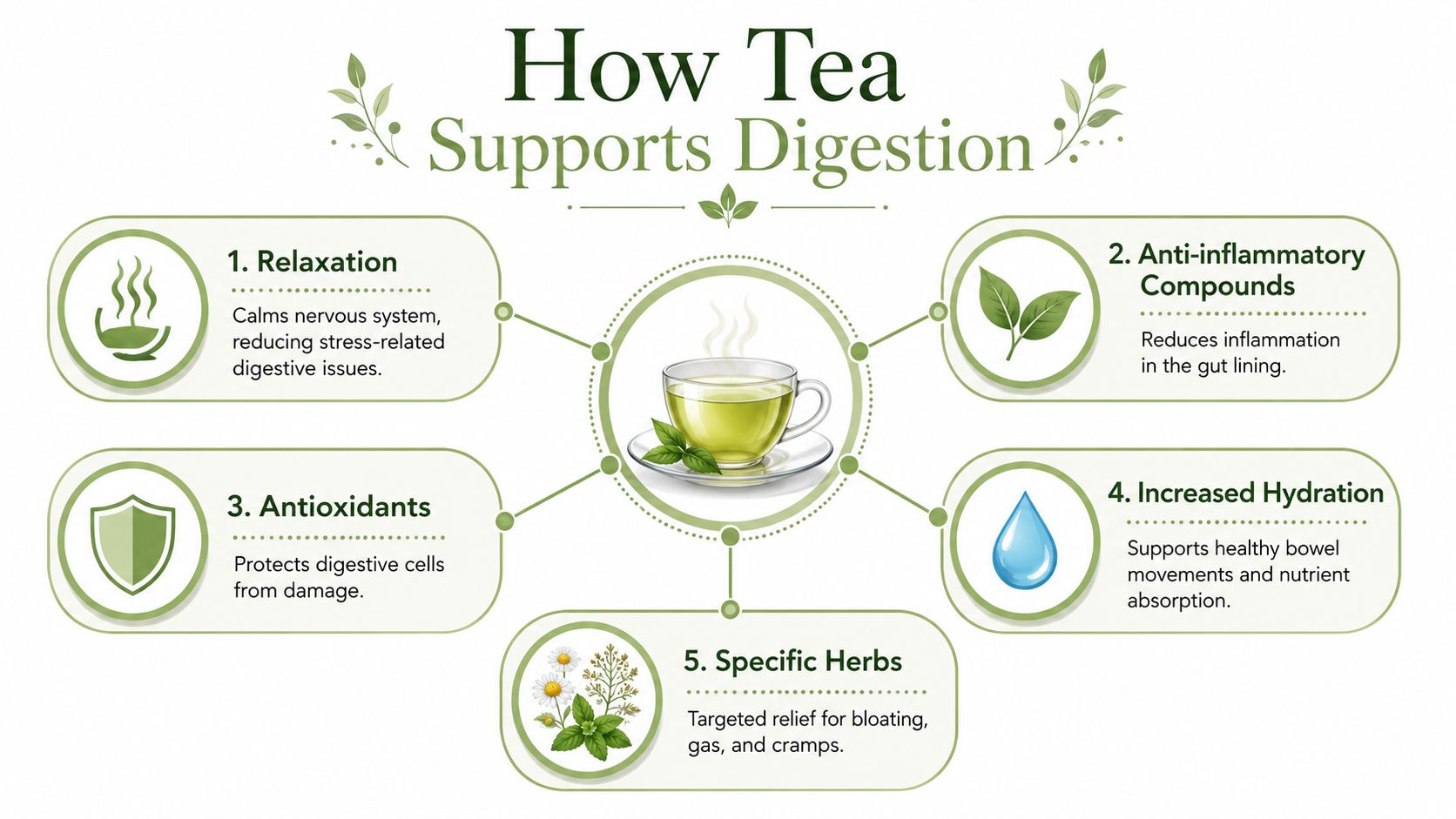
Four simple ways tea can support the gut
Here's the plain-English version:
- Carminative support helps move trapped gas along. This action is similar to gently releasing pressure in a distended abdomen.
- Antispasmodic support helps calm tight, twitchy digestive muscles. That's useful when your belly feels crampy or unsettled.
- Prokinetic support means encouraging movement through the digestive tract. Not in a harsh way. More like helping things keep flowing.
- Probiotic support comes from fermented drinks such as kombucha, which can contribute live cultures to the gut environment.
Hydration matters too. Warm fluids can feel easier on the stomach than icy drinks, especially after a rich meal.
Why green tea feels different after food
Green tea has its own digestive personality. Experimental work summarised in a tea-and-digestion review suggests that green tea extracts can reduce intestinal digestion and absorption of fats and starch, while also increasing gastric secretion through local action on the stomach lining, which helps explain why many people like green tea after heavier meals instead of using it as a treatment for illness (tea and digestion review).
That's a useful distinction. Tea for digestion isn't a medicine replacement. It's more like choosing the right tool for the moment. If lunch was oily, creamy, or generally a bit much, green tea may feel more balancing than a sweet drink or another coffee.
Practical rule: Ask what your stomach needs right now. Less pressure, less cramping, more calm, or better overall gut support.
If you're fuzzy on the difference between feeding good bacteria and adding live cultures, Pep Tea has a helpful explainer on prebiotics and probiotics that breaks down the concepts.
Why the ritual matters as much as the leaves
People often get confused here and assume the benefit comes only from chemistry in the cup. That's only part of the story.
Tea slows the whole moment down. You sip instead of gulping. You warm the stomach instead of shocking it with something freezing. You often step away from whatever was stressing you out. That combination is one reason tea for digestion has stuck around in so many food cultures for so long.
A Guide to Classic Digestive Herbal Teas
When someone asks me where to start, I usually begin with the old favourites. They've stayed popular for a reason. Each one suits a slightly different kind of digestive complaint.
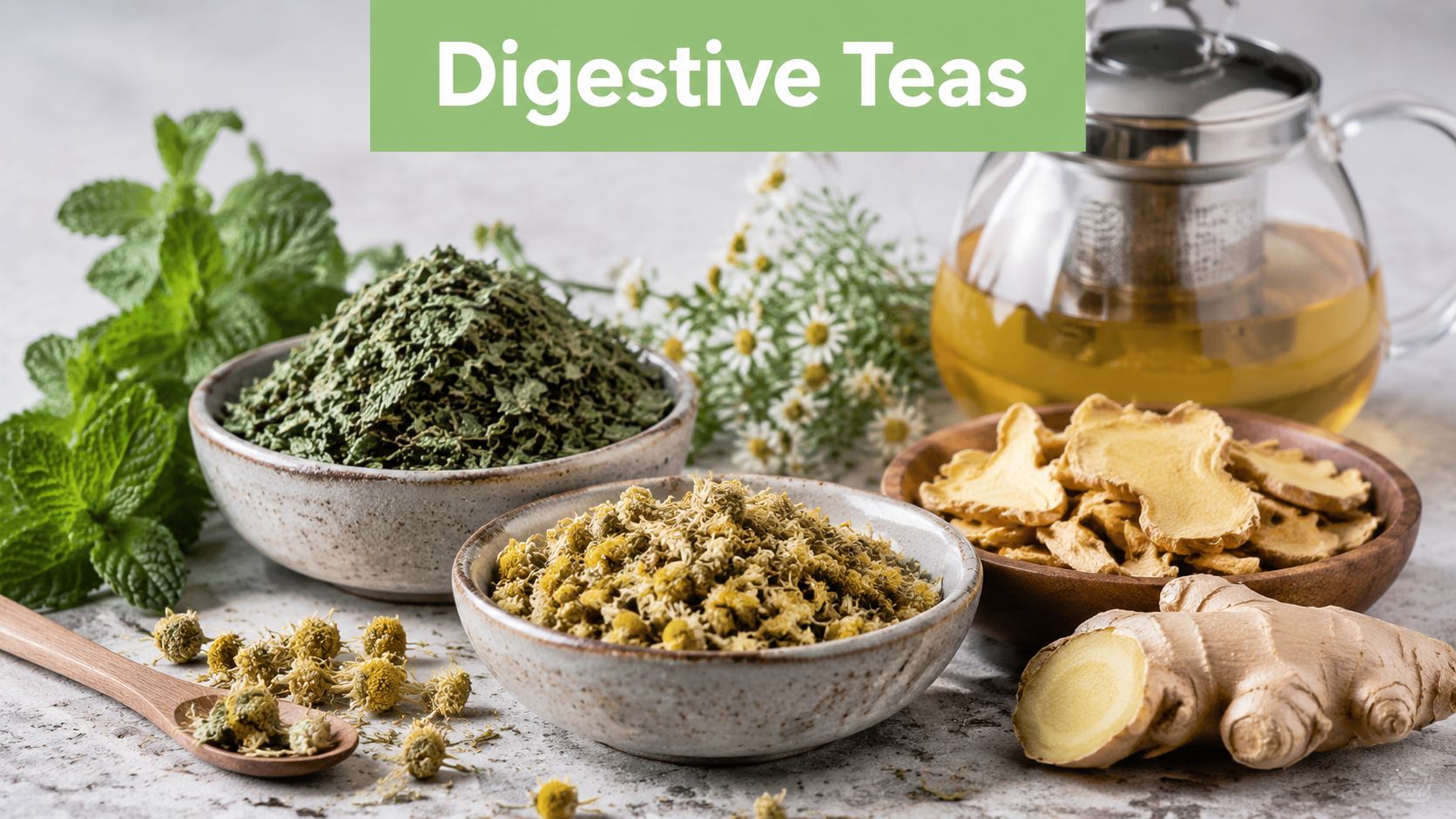
Which herbal tea suits which feeling
| Tea | Often chosen for | What it feels like | Taste |
|---|---|---|---|
| Peppermint | Bloating and heaviness | Cooling and clearing | Fresh, minty, brisk |
| Ginger | Queasiness and sluggish digestion | Warming and stimulating | Spicy, zesty, bright |
| Chamomile | Tension-related digestive discomfort | Soft and calming | Floral, gentle, slightly apple-like |
| Fennel | Gas and post-meal fullness | Light and easing | Sweet, aniseed-like |
Peppermint for bloating
Peppermint is the classic “I ate too much and now I regret it” tea. It's often the first thing people think of for bloating, and for good reason. It tends to feel fresh, cooling, and relieving after a heavy lunch or a meal that's sitting a bit too firmly.
If your tummy feels tight and gassy, peppermint is usually the first cupboard check.
Ginger for nausea and slow, heavy digestion
Ginger has more warmth to it. I think of it as the tea you choose when your stomach feels cold, sluggish, or slightly queasy. It has that clear, active feeling that can be very welcome after travelling, eating too quickly, or overdoing rich food.
It's also one of the easiest herbal teas to pair with food because the flavour is so lively.
If peppermint feels like opening a window, ginger feels like switching the lights back on.
Chamomile and fennel for a gentler approach
Chamomile is the one I reach for when stress is clearly part of the picture. Your gut and your mood are often tangled together. If the whole system feels tight, unsettled, or over-alert, chamomile can be a softer option than stronger-tasting herbs.
Fennel is underrated. It has that sweet, slightly liquorice-like note that people either love immediately or need a cup or two to appreciate. But for post-meal fullness and gas, it's a lovely traditional option.
A simple trick is to match the tea to the sensation:
- Tight and bloated: peppermint
- Heavy and queasy: ginger
- Nervous and crampy: chamomile
- Gassy and full: fennel
Food choices matter too. If you're building a digestion-friendly routine more broadly, it's worth reading about olive oil's digestive benefits, especially if you enjoy simple meals built around vegetables, grains, and good fats.
Why Matcha Is Your Gut Health Ally
Matcha deserves its own conversation because it isn't just “green tea in powder form”. It behaves differently in the cup and in your routine.

With Matcha, you're whisking finely ground tea leaf into water, so you consume the whole leaf rather than steeping it and removing it. That creates a fuller flavour, a richer texture, and a more immersive tea experience. When the Matcha is high quality, the difference is obvious. The colour is vivid, the aroma is clean and green, and the taste has that savoury sweetness that cheap powders just don't deliver.
As a tea person, I tend to get a bit excited. Real Matcha, especially organic Japanese Matcha that's been carefully stone-ground, has a depth and softness that makes it easy to drink regularly. That matters, because tea for digestion only becomes useful when you enjoy it enough to make it part of your day.
What the research says about green tea and the gut
A 2019 systematic review found that 24 publications met the inclusion criteria, including 6 human trials and 18 mechanistic studies, and reported that the strongest evidence was for green tea. In those green-tea studies, intake of up to 1,000 mL per day, roughly 4–5 cups, was associated with higher proportions of Bifidobacterium, and some studies also noted reductions in Firmicutes with improvements in Bacteroidetes (systematic review on tea and gut health).
That doesn't mean Matcha is a cure for digestive problems. It does mean green tea has a meaningful place in the gut-health conversation.
If you want a broader rundown of how green tea powder fits into energy, focus, and daily wellness, our guide to the benefits of Matcha green tea is a good next read.
Why quality matters more than people realise
Low-grade Matcha can taste harsh, dusty, or bitter enough that people drown it in sugar. That defeats the whole point if you're trying to support digestion and feel lighter after meals.
High-quality Matcha is different. It's smoother. It mixes better. It feels more like a ritual and less like a chore.
Here's a quick visual if you'd like to see how Matcha is prepared and used in everyday life:
If you're also dealing with food triggers, tea works best alongside practical eating choices. For readers who want a food-focused companion resource, it's useful to discover IBS fruit options on OrganizEat and build from there rather than expecting one drink to do everything.
Kombucha The Living Drink for Your Microbiome
Kombucha sits in a different category from herbal tea and Matcha. It's a fermented tea, which means it brings the conversation into microbiome territory.

I like to explain the microbiome as your gut garden. You've got a whole community living there. When that garden is well looked after, digestion tends to feel steadier. When it's out of balance, things can feel noisy, reactive, or unpredictable.
Kombucha appeals to people because it's a living drink. Properly fermented kombucha contains live cultures, and that makes it very different from a standard soft drink.
Not all kombucha helps in the same way
Many shoppers get caught out. A lot of products use kombucha-style branding, but they drink more like sweet fizzy beverages than genuine fermented tea. If a kombucha is heavily sweetened, the whole “gut health” message gets murky fast.
That's why I always tell people to think less about hype and more about what's in the bottle. Live culture. Real fermentation. A flavour profile that doesn't rely on sweetness to carry the drink.
A good kombucha should taste alive, not like soft drink wearing a wellness costume.
For people trying to move away from sugary beverages, it can help to discover better drink choices and compare what different options are really offering.
Why properly brewed kombucha stands out
At home or in cafés, kombucha works well when you want something cold, refreshing, and digestion-friendly without reaching for another juice or soft drink. Ginger-based flavours are especially popular after meals because they combine the bright lift of ginger with the tang of fermentation.
Pep Tea's guide to the benefits of kombucha covers the basics if you want to understand the drink more completely.
From a practical point of view, this is why I get enthusiastic about properly brewed, sugar-free kombucha. When fermentation is handled well, the drink tastes crisp, clean, and grown-up. It has structure. It has life. And in an Australian café setting, it gives people a smart non-alcoholic option that still feels interesting.
For home drinkers, the biggest win is simplicity. Keep a bottle chilled, pour a glass with lunch, and you've got a digestive ritual that feels more like a treat than a health task.
Your Daily Ritual for Better Digestion
Tea for digestion works best when it's matched to the moment. You don't need a complicated regime. You need a few reliable habits.
A simple sip plan
- Morning after a rough start: ginger tea if your stomach feels unsettled or heavy.
- After lunch: peppermint if you're bloated, or green tea if the meal was especially rich.
- Mid-afternoon: Matcha if you want steady energy without the hard edge some people get from coffee.
- Evening: chamomile when stress and digestion seem to be feeding each other.
A large evidence summary from Harvard notes that drinking 2–3 cups daily is associated with positive health outcomes, and it also highlights that tea consumed hotter than 55–60°C has been associated with higher health risks, so your tea for digestion is better warm, not scalding (Harvard Nutrition Source on tea).
Brewing tips that make a difference
Small details matter more than people think:
- Peppermint and chamomile: steep until the aroma opens up and the flavour tastes rounded, not watery.
- Ginger: slice it fresh if you want a bolder, more warming cup.
- Matcha: whisk with warm water rather than boiling water if you want a smoother, less harsh bowl.
- Kombucha: serve chilled, straight or over ice, especially with lunch or as an alcohol alternative.
For cafés and hospitality
This is such an easy win for modern menus.
A café can offer a small digestive tea list after meals, build a clean Matcha latte for customers who want calm focus, or pour kombucha as a grown-up non-alcoholic option. A ginger kombucha, a peppermint tea, and a proper Matcha can cover a surprising range of customer moods without making the menu feel crowded.
Frequently Asked Questions About Digestive Teas
Can I drink digestive teas if I have IBS or reflux
Generic advice often falls short. One common gap in Australian consumer content is clear guidance for people with existing conditions like reflux or IBS. Much of the advice stays broad, but the evidence is mixed and people need clearer help deciding which teas to try and which to avoid (Australian digestion tea guidance gap).
A sensible starting point is to go one tea at a time and pay attention to your own response. If reflux is your main issue, minty teas may not suit you. If stress and cramping are more your pattern, a gentler option may feel better.
Is Matcha okay if I'm sensitive to caffeine
Sometimes yes, sometimes no. It depends on your sensitivity, the serving size, and whether you drink it with food.
If coffee leaves you jittery, Matcha can feel smoother for some people as part of a meal or morning routine. But if you already know caffeine doesn't agree with you, start small and be honest with yourself. Digestive support shouldn't come at the cost of feeling wired.
Start with the mildest option that matches your symptoms, then adjust slowly.
Are digestive teas safe in pregnancy
This is one of those situations where “natural” doesn't automatically mean “fine for everyone”. If you're pregnant, managing a medical condition, or taking regular medication, it's smart to check with your health professional before making any tea or herbal drink a daily habit.
What's the safest way to use tea for digestion
Keep it simple:
- Match the tea to the symptom.
- Drink it warm, not piping hot.
- Choose quality over gimmicks.
- Treat tea as support, not a substitute for medical care.
If symptoms are frequent, severe, or changing, it's worth getting proper advice instead of trying to solve everything with your teapot.
If you'd like to build a simple digestive tea routine at home or add better functional drinks to your café menu, have a look at Pep Tea. We stock organic Matcha and sugar-free kombucha, and we share practical guides to help you choose, brew, and enjoy tea with a bit more confidence.