
Tag: natural focus enhancers
Natural Focus Enhancers Your Guide to Better Concentration

It's 3 p.m. and your brain has gone missing. You've answered emails, jumped between tabs, maybe had one coffee too many, and now you're staring at your screen reading the same sentence over and over.
That moment is exactly why more Australians are looking for natural focus enhancers. Not magic pills. Not extreme hacks. Just practical ways to feel more alert, more steady, and less wrung out by the usual cycle of caffeine spikes and afternoon crashes.
For many people, better concentration starts with a simple shift in thinking. Focus isn't only about pushing harder. It's also about working with your body, your energy, your food, and your daily habits. Functional drinks like matcha and kombucha fit into that picture because they can support a calmer, more sustainable rhythm.
Beyond the Coffee Crash Why Natural Focus Is Trending
The appeal of natural focus is easy to understand. Individuals typically don't want more jitteriness. They want to feel switched on without feeling frazzled.
Coffee can absolutely have a place, but it's often used as a rescue tool instead of part of a balanced routine. That's when the pattern gets messy. One cup becomes two. Two becomes a late-afternoon top-up. Then sleep takes a hit, and the next morning starts with even less energy.

Why more Australians are looking for gentler support
This shift isn't just anecdotal. In 2025, the Australia cognitive health supplements market reached AUD 306.83 million and is projected to grow at a 7.70% CAGR to AUD 644.25 million by 2035, reflecting stronger demand for natural brain support and focus-enhancing ingredients such as Omega-3, Ginkgo Biloba, L-Theanine in matcha, and probiotic-rich kombucha, according to Expert Market Research's Australia cognitive health supplements market report.
That matters because it shows a broader behaviour change. People aren't only chasing stimulation. They're looking for support that feels more sustainable, more everyday, and easier to build into a normal routine.
A lot of that interest comes down to convenience. A morning matcha, an afternoon kombucha, a better lunch, a screen break, and a decent bedtime routine feel realistic. They also fit naturally into home life, café culture, and the way many Australians already think about wellness.
What natural focus enhancers really are
The phrase sounds more technical than it needs to be. In plain language, natural focus enhancers are foods, drinks, herbs, nutrients, and habits that may support concentration and mental clarity without relying on harsh quick fixes.
That can include:
- Functional beverages like matcha and kombucha
- Plant-based herbs often associated with focus support
- Daily habits such as hydration, sleep, movement, and mindfulness
- Nutrient-dense foods that help your brain do its job properly
Better focus usually isn't one dramatic change. It's a handful of smarter choices repeated often enough to matter.
That's also why the trend has staying power. It's not built on intensity. It's built on routines people can keep.
How Your Brain Finds and Loses Focus
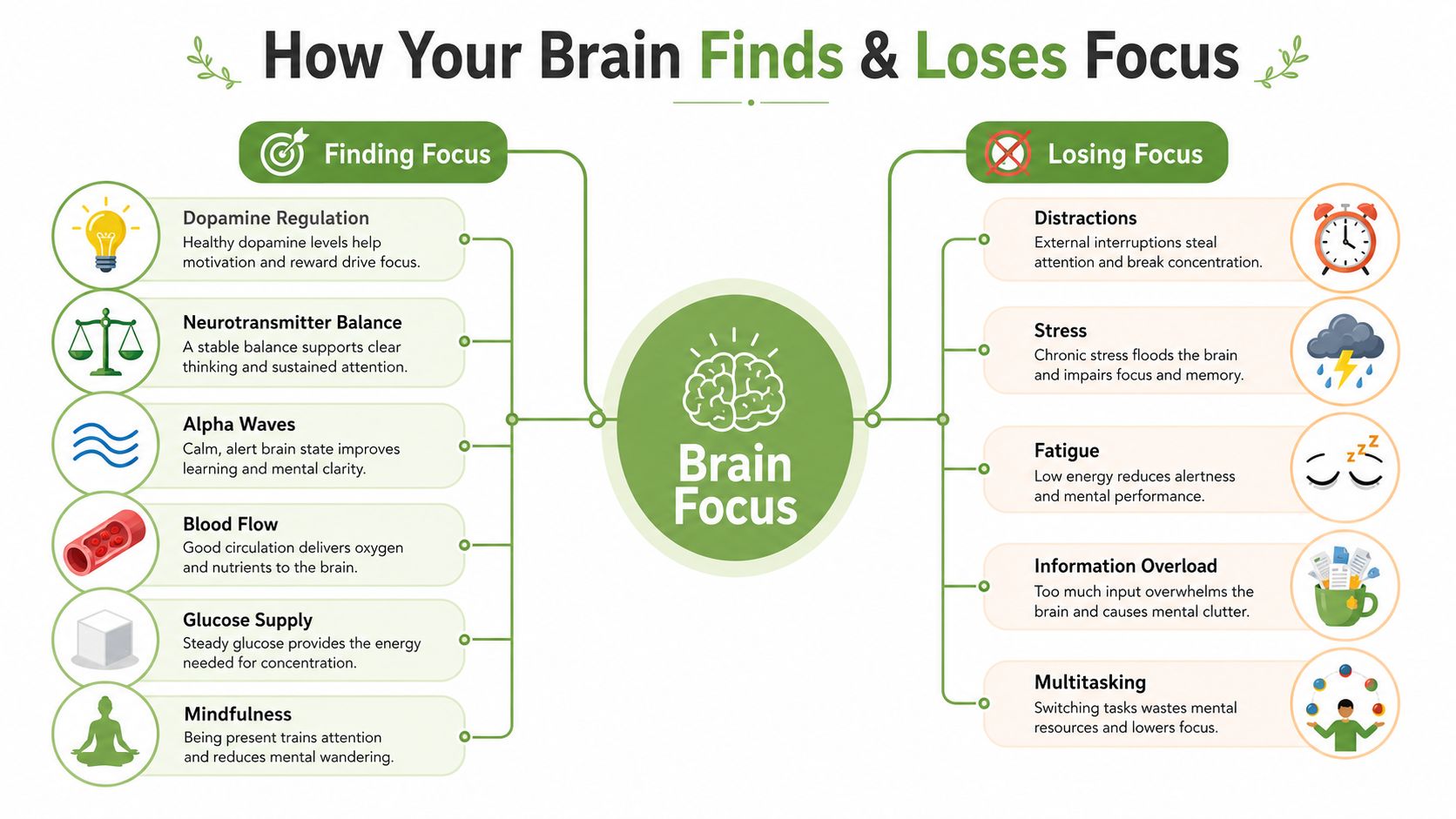
Focus can feel mysterious, but the basics are surprisingly straightforward. Your brain needs the right signals, enough fuel, and fewer interruptions.
When those pieces line up, concentrating feels smooth. When they don't, even simple tasks can feel oddly hard.
Your brain uses messengers and fuel
Think of attention like a worksite. Messages need to get to the right place, workers need energy, and too much noise slows everything down.
Some of that communication happens through neurotransmitters. You don't need to memorise the science names to understand the idea. These chemical messengers help your brain shift into alertness, motivation, learning, and memory. If the signals are steady, your mind feels more organised. If they're off, you may feel scattered or flat.
Your brain also needs a reliable energy supply. That doesn't mean sugar hits all day. It means consistent nourishment, enough fluids, and enough rest so your body isn't running in survival mode.
Why brain fog shows up
Brain fog isn't a formal diagnosis people use in everyday life, but it's a useful description. It often feels like mental static. You know what you want to do, but your thoughts don't quite click into gear.
Common triggers include:
- Poor sleep that leaves your attention blunted
- Stress overload that keeps your mind in reactive mode
- Constant switching between tasks, apps, and notifications
- Skipping meals or eating in a way that leaves energy uneven
- Mental fatigue after long stretches with no proper break
Quick check: if you're distracted all day, the problem isn't always lack of willpower. Sometimes your environment is set up to fragment your attention.
If distraction is a recurring issue, Chronoid's guide to focus is a useful read because it breaks down how everyday habits and digital interruptions can gradually drain concentration.
Focus is easier when friction is lower
People often assume concentration is just about discipline. Usually, it's also about design.
A few examples make this clearer:
- One tab open beats ten tabs open. Your brain handles fewer competing cues.
- A short walk can reset attention. Movement helps interrupt mental buildup.
- A calm drink ritual can improve transition. Preparing a matcha or pouring a kombucha can create a clear pause between tasks.
That last point matters more than it sounds. Rituals help the brain recognise context. When you repeat a simple pattern before focused work, your mind starts to associate that pattern with concentration.
The Pillars of Natural Focus Enhancement
Natural focus works best when you stop treating it like a single ingredient problem. Combining a few supports often yields better results than expecting one product to do everything.
Three pillars matter most. Nutrients and herbs. Functional beverages. Lifestyle habits.
Pillar one includes nutrients and herbs
Supplement use is already mainstream in Australia. According to the Australian Bureau of Statistics, 33.6% of Australians aged 2 years and over took a dietary supplement in 2023, representing 8.5 million people. Herbal supplements made up 4.5% of all supplement use, and adult females were more likely than males to take dietary supplements, at 43.7% versus 30.8%, according to the ABS dietary supplements release.
That doesn't mean every supplement is right for every person. It does show that many Australians already include some form of nutritional support in their routine.
Here's a simple comparison of common herbs often mentioned in conversations about natural focus enhancers.
| Herb | Primary Benefit | Best For |
|---|---|---|
| Bacopa monnieri | Traditionally used in wellness routines linked with memory and learning support | People looking for a plant-based option as part of a broader routine |
| Ginkgo biloba | Commonly used in brain-health product categories for mental clarity support | People interested in classic herbal formulations |
| L-Theanine from matcha | Often associated with calm alertness | People who want focus without a wired feeling |
The best takeaway here is caution plus context. Herbs may have a place, but they make more sense when paired with consistent sleep, good food, and sensible daily habits.
Pillar two is functional beverages
Drinks are often the easiest place to start because they slot into routines you already have. You're already reaching for something in the morning and again in the afternoon.
Matcha brings a more deliberate kind of energy than many people expect. Kombucha offers a refreshing alternative when you want something light, grown-up, and less sugary than many mainstream drinks. If you want a deeper look at how fermented tea fits into a wellness routine, this guide on the benefits of kombucha is a practical starting point.
Pillar three is lifestyle strategy
This pillar gets less hype, but it's often the one that changes the most.
- Sleep first: Deep focus is much harder when you're chronically tired.
- Hydrate early: Mild dehydration can leave you feeling dull and unfocused.
- Reduce switching: Batch similar tasks instead of bouncing between everything.
- Add a reset habit: A brief breathing practice or walk can help more than another snack.
- Use mindfulness well: If you're curious about making attention training more practical, this article on transform your focus with meditation offers useful ideas without making it feel abstract.
A strong focus routine is usually simple enough to repeat on a busy Wednesday, not just on a perfect Sunday.
Spotlight on Matcha and Kombucha for Focus
Some functional drinks get attention because they're trendy. Matcha and kombucha stand out because they're practical, versatile, and easy to build into real life.
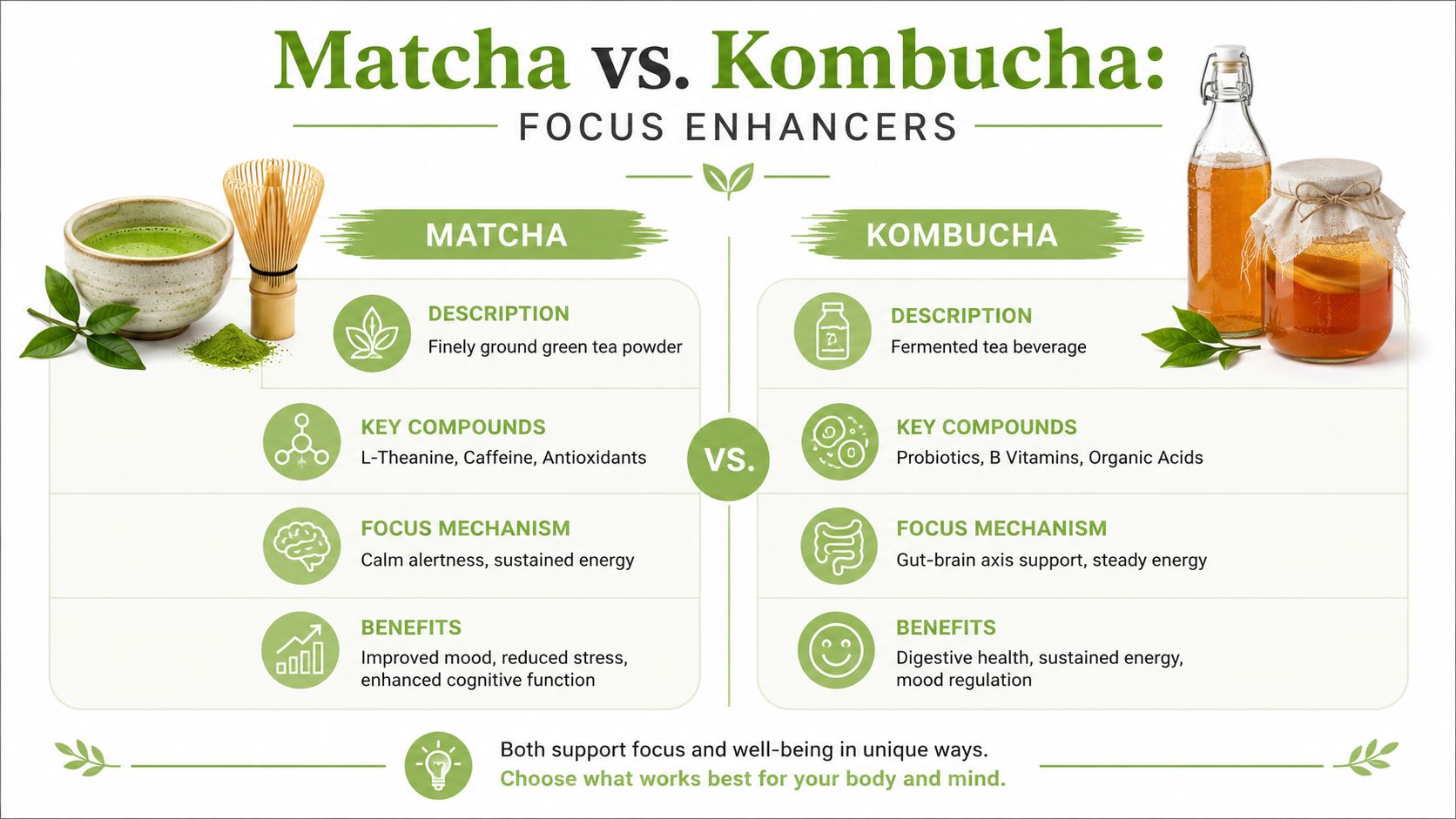
They also support focus in different ways. Matcha is about calm energy and mental steadiness. Kombucha is often part of a wider gut-friendly routine that can help you feel lighter and more balanced through the day.
Why matcha feels different from coffee
Matcha is finely ground green tea, so you're consuming the leaf rather than steeping it and discarding it. That gives it a distinctive nutritional profile and a more layered effect.
One reason people like it for focus is the pairing of naturally occurring caffeine with L-Theanine. In everyday terms, that combination is often associated with alertness that feels smoother and less abrupt than coffee alone. Many people describe it as calm focus rather than nervous energy.
There's also the antioxidant side. Matcha contains 137 times more EGCG than standard steeped green tea, with a typical cup providing 100 to 200 mg of EGCG depending on quality and preparation, according to Tea Vision's overview of matcha health benefits.
That doesn't mean every green drink on the shelf is equal. Quality, preparation, and ingredient integrity all matter. If you've ever wondered why one matcha tastes smooth and another tastes harsh, the answer often comes back to grade, origin, and how it was handled.
For a closer look at how this compares with your usual café order, this guide to caffeine in matcha latte helps explain why the experience can feel steadier.
A short visual can help make that difference easier to picture:
How kombucha fits the focus conversation
Kombucha doesn't work like matcha, and that's exactly why it belongs in the same conversation.
It's a fermented tea beverage, and properly brewed kombucha contains live cultures and fermentation-derived compounds that many people enjoy as part of a gut-conscious lifestyle. When people talk about the gut-brain axis, they mean the ongoing relationship between digestive health and how you feel mentally and emotionally.
Kombucha isn't a caffeine substitute in the same way matcha can be. It's more useful as a reset drink. Something crisp, grown-up, and supportive when you want to move away from soft drinks, overly sweet options, or another heavy coffee.
Why quality changes the experience
A lot of confusion often stems from such details. Not all matcha is vibrant, fresh, or pleasant to drink. Not all kombucha is properly fermented, balanced, or low in sugar.
If you're using these drinks for focus support, quality matters because the goal isn't just to consume a category. It's to choose something you'll enjoy enough to use consistently.
A few practical signs to look for:
- For matcha: bright colour, fine texture, clean taste, and no stale smell
- For kombucha: proper fermentation, balanced flavour, and an ingredient list without unnecessary extras
- For both: organic sourcing and transparency around how the product is made
The best functional drink is the one that fits your day, tastes good, and doesn't leave you feeling worse an hour later.
A Practical Guide to Your Daily Focus Ritual
Knowing what supports focus is one thing. Using it well is another.
The easiest approach is to match the drink or habit to the type of work and energy dip you're dealing with. You don't need a complicated protocol. You need a rhythm you can repeat.
A simple day that supports concentration
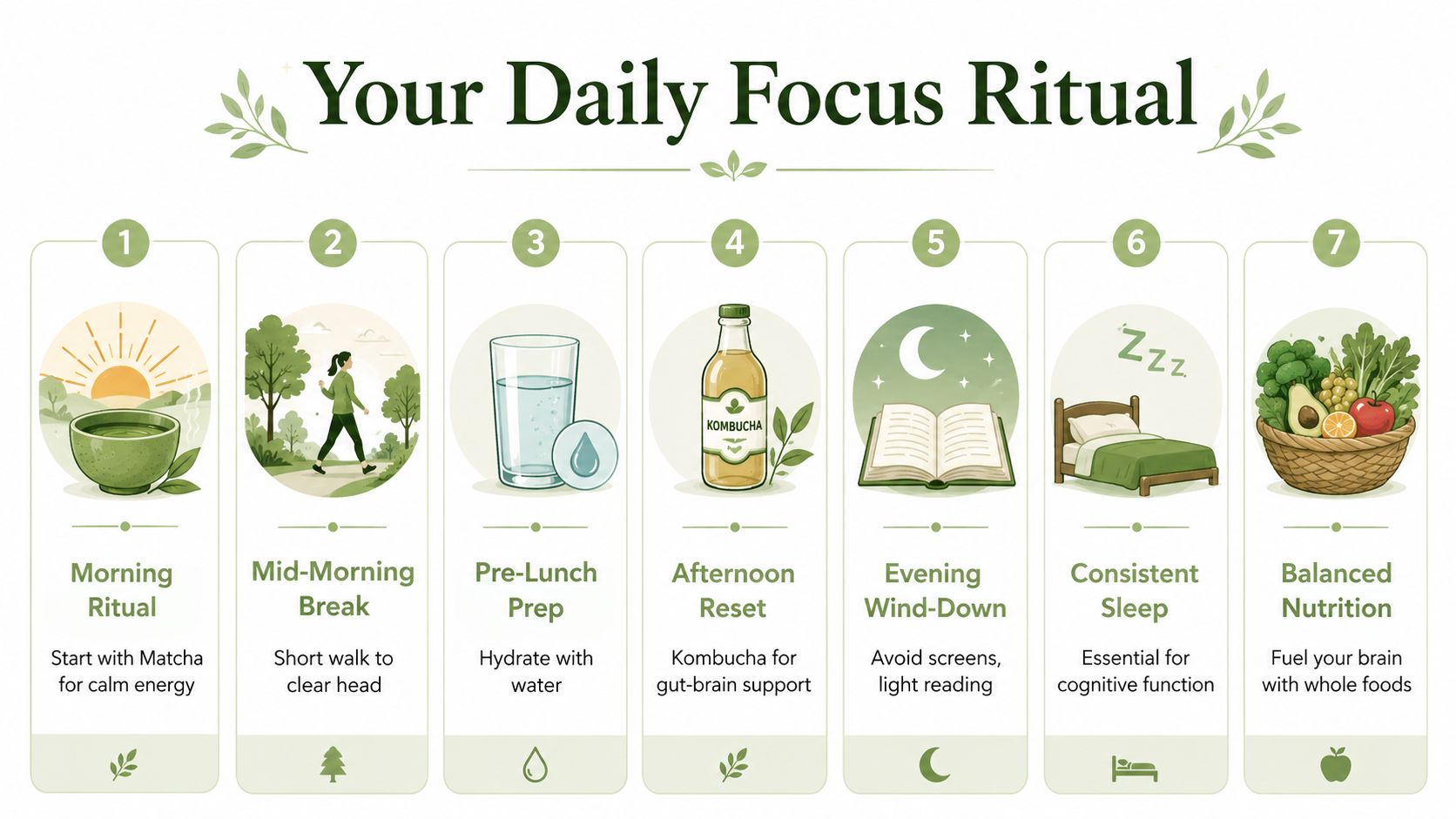
A practical routine might look like this:
Morning deep work
Have matcha before writing, planning, studying, or creative work. Many people find it suits tasks that need steady concentration rather than frantic speed.Mid-morning reset
Step away from the screen. Even a brief walk or stretch can cut through mental stickiness.Lunch that doesn't flatten you
Aim for a balanced meal instead of something that leaves you sleepy and searching for sugar.Afternoon support
Reach for kombucha when the slump hits and you want something refreshing without going back into the coffee loop.Evening wind-down
Protect sleep. Better focus tomorrow starts tonight.
Two easy drink ideas to try
You don't need barista-level skill to make this work at home.
Quick ceremonial-style matcha
- Use quality powder: Start with a small spoonful of matcha in a bowl or mug.
- Add a little water first: Use warm, not boiling, water.
- Whisk until smooth: A bamboo whisk is ideal, but any small whisk helps.
- Top up and drink straight: This is great when you want a cleaner, more direct matcha experience.
Simple kombucha spritzer
- Pour over ice: Start with chilled kombucha.
- Add sparkling water: This lightens the flavour and makes it extra refreshing.
- Finish with citrus or mint: A slice of lime or a few mint leaves lifts it nicely.
- Serve in a wine glass if you like: It feels more special and works well for non-alcoholic entertaining.
A practical matcha latte approach
If straight matcha feels too intense at first, a latte is often the easiest entry point.
- Whisk the matcha first: Get rid of clumps before adding milk.
- Choose your milk well: Dairy, oat, almond, and soy all create slightly different textures.
- Keep sweeteners modest: If you add sweetness, use just enough to round out the flavour.
- Use it intentionally: A matcha latte works well before a long meeting block or focused admin session.
Good menu ideas for cafés and hospitality venues
For cafés, bars, and wellness-led venues, these drinks make sense because they meet several customer needs at once. They feel premium, non-alcoholic, and functional without being preachy.
Offerings that fit well include:
- Ceremonial matcha serve: For customers who want a traditional tea moment
- Iced matcha latte: A familiar gateway drink
- Kombucha by the bottle or glass: Easy, low-fuss, and versatile
- Kombucha spritzers: Great for brunch and alcohol-free menus
- Matcha baking and smoothie additions: Useful for broader café menu development
A drink doesn't need to promise everything. It just needs to earn a regular place in someone's day.
Building a Smarter and More Sustainable Focus
Often, what's required isn't more stimulation. It's better structure.
That's the core value of natural focus enhancers. They shift the conversation away from chasing instant intensity and towards creating conditions where concentration comes more easily. Better drinks help. Better sleep helps. Better timing helps. Together, they're more useful than any single shortcut.
A realistic first week
If you're new to this, keep the first step small.
Try this for one week:
- Swap your second coffee for matcha on the days you need clear, steady work time
- Use kombucha in the afternoon instead of reaching for a sugary soft drink
- Create one screen-free break during the middle of your day
- Keep your evening calmer so the next day starts with more in the tank
That's enough to notice patterns. You may realise your energy drop is really a hydration issue. Or that your best thinking happens when you front-load focused work and stop treating every notification like an emergency.
Think in routines, not rescues
The smartest focus plan is the one you can maintain when life is busy, the kids are loud, and your inbox is feral.
Natural support works best when it becomes ordinary. A morning ritual. A better afternoon option. A few habits that lower mental friction. If you're interested in the wider shift towards drinks that do more than just taste good, this piece on functional beverage trends adds useful context.
Better concentration rarely arrives all at once. It builds when your daily choices stop fighting your brain.
If you'd like to explore functional drinks that fit naturally into a more focused routine, Pep Tea offers premium organic Japanese matcha and Australian-brewed sugar-free organic kombucha. Browse the range, read the education guides, and find a calm, practical way to support your day.