
Tag: live cultures kombucha
Live Cultures Kombucha: What They Are and Why They Matter

Live cultures in kombucha are the living bacteria and yeast from the SCOBY that survive into the bottle and may support gut health. In Australia, however, almost 65% of 132 tested kombucha samples contained more than 0.5% alcohol, so “live” on a label is a specific claim that deserves more attention than a wellness slogan.
The popular advice is simple: choose kombucha for your gut. The useful advice is more precise: learn what the bottle means by live cultures, whether fermentation has been stopped, how the drink has been stored, and whether the producer controls acidity, sugar and alcohol. A chilled bottle can contain a living fermentation ecosystem, but two products with similar front labels may deliver very different things.
For Australian shoppers, cafés and retailers, this matters beyond taste. Live-culture kombucha is a relatively young local category. Commercial production began in Australia in 2009, and the market has since moved from home-brew culture into mainstream retail and hospitality, as reported by the Sydney Morning Herald's account of kombucha's Australian development. That growth brings better access, but it also makes label literacy essential.
Why Live Cultures Are the Most Misunderstood Phrase in Kombucha
“Live cultures” is probably the most misunderstood phrase on a kombucha label. Some people read it as a guarantee of a defined probiotic dose. Others assume any fermented tea must contain living microbes. Neither assumption is reliable.
In plain English, live cultures are bacteria and yeast that remain viable when you drink the kombucha. They come from the SCOBY, the mixed culture used to ferment sweet tea. If the finished drink is pasteurised after fermentation, heat can remove that living microbial activity. If it's heavily filtered, the microbial content may also change. A refrigerated bottle labelled raw or unpasteurised points towards a different product from a shelf-stable bottle that has been heat-treated.
Why fermentation language gets blurred
Brewing reality is more complicated than front-of-pack marketing. Fermentation produces acids, carbon dioxide, flavour compounds and trace alcohol, while the exact balance changes with the tea, sugar, temperature, time and culture. A producer might describe a drink as naturally fermented, yet the finished product may later be filtered, heated or stabilised.
That's why two bottles with similar wording can carry different microbial payloads. One may contain a mixed community of bacteria and yeast. Another may retain the acids and flavour of fermentation but no longer contain viable cultures. The label needs to tell you which story applies.
Practical rule: “Fermented” describes how the drink was made. “Contains live cultures” describes what remains when you drink it.
A useful label-reading habit is to ask four questions:
- Was it heat-treated? Look for wording such as pasteurised after fermentation or heat-treated.
- Does it require refrigeration? Cold storage supports culture survival and slows continued fermentation, although refrigeration alone isn't proof of live cultures.
- Does the producer explain the culture claim? Clear language is more useful than broad terms such as wellness or detox.
- What does the nutrition panel show? Sugar and alcohol help you understand how far fermentation progressed.
The rest of the label story starts with the SCOBY itself. Once you understand that small ecosystem, “raw”, “unpasteurised”, “probiotic” and “live” become practical clues rather than interchangeable buzzwords.
What Live Cultures and SCOBYs Actually Are
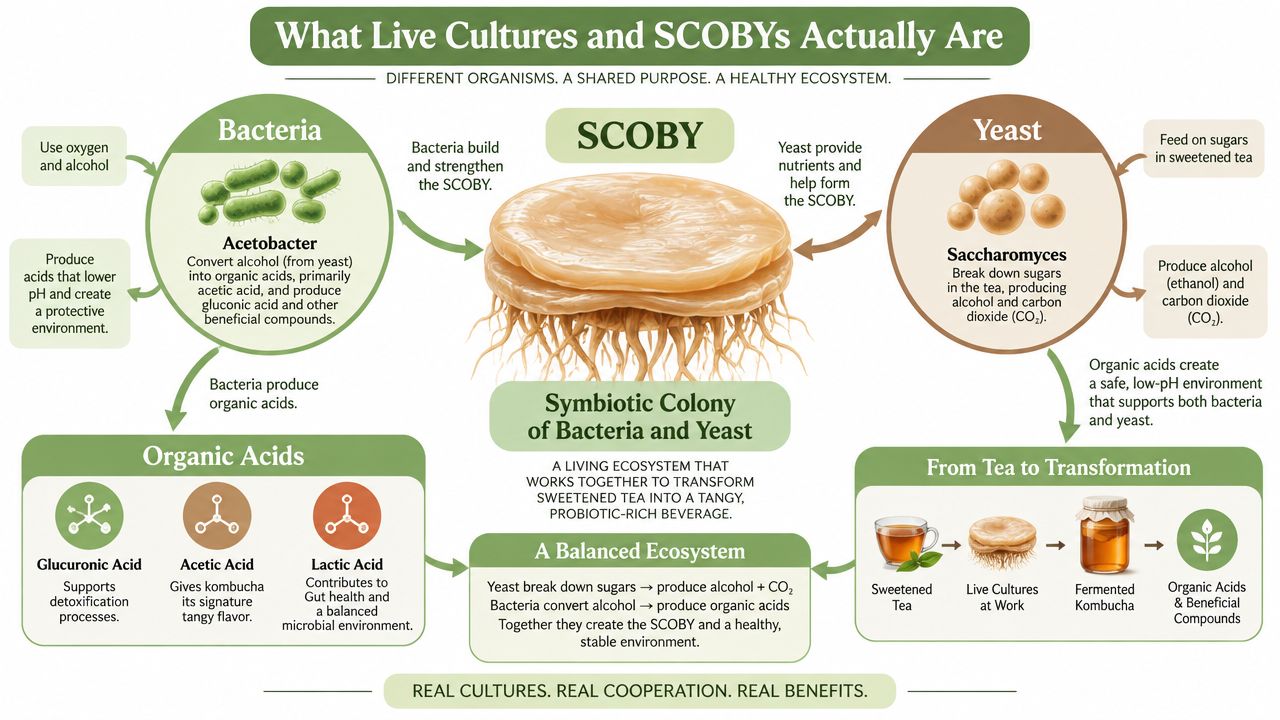
A SCOBY is a symbiotic culture of bacteria and yeast. It isn't one organism and it isn't a magic mushroom. It's a working community that lives in sweetened tea and transforms the liquid over time.
Yeast starts by using available sugars and producing alcohol and carbon dioxide. Acetic-acid bacteria then use oxygen and fermentation products to create organic acids, which give kombucha its sharp, refreshing character. Commonly discussed members of the ecosystem include Acetobacter, Gluconobacter, Brettanomyces and Saccharomyces, although the exact community varies between cultures and batches.
The pellicle isn't the whole culture
The rubbery cellulose layer floating at the top of a brew is often called the SCOBY. More accurately, it's a pellicle, a cellulose structure produced by some of the bacteria. It houses part of the community, but the liquid starter contains important bacteria, yeast, acids and metabolites too.
That distinction matters for home brewers. Throwing away the liquid and keeping only the pellicle removes much of the active fermentation environment. A healthy brew relies on both the culture and sufficiently acidic starter tea.
The finished drink contains more than microbes. It can include acetic acid, gluconic acid, residual sugar and trace ethanol, with tea compounds adding flavour and polyphenols. A laboratory count expressed as CFU, or colony-forming units, is only an approximation of a diverse community. It doesn't fully describe which organisms are present, whether they remain active, or how they behave in your gut.
Yeasts also deserve attention because they aren't automatically a fault. They help create alcohol and carbonation, while bacteria convert some fermentation products into acids. That relationship is why kombucha can taste bright and complex rather than just sweet or sour.
If you're curious about how yeast behaves in other traditional fermentations, the McLaren Vale indigenous yeast guide offers useful background on the difference between naturally occurring and selected cultures. Wine and kombucha aren't brewed in the same way, but the comparison helps explain why a living fermentation community doesn't behave like a single, perfectly uniform ingredient.
The key distinction is straightforward. Live means viable organisms remain. Pasteurised means heat has been used to stabilise the finished drink, usually changing or removing that living component. The acids may remain after treatment, but acids alone aren't live cultures.
Gut Health and Probiotic Benefits Without the Hype
Kombucha may support a varied diet, but it isn't a cure-all. Live cultures kombucha provides a mixed fermentation community alongside organic acids and tea compounds. That combination may support digestion for some people, but it shouldn't be presented as a guaranteed detox, weight-loss product or substitute for medical care.
The word probiotic also needs care. In strict use, a probiotic is a living microorganism shown to provide a health benefit when consumed in an adequate amount. Kombucha's microbial community varies between producers and batches, so it shouldn't automatically be treated like a clinically defined supplement containing a named strain at a guaranteed dose.
What the drink may contribute
Fermentation can make a beverage more acidic and change the tea's original compounds. The resulting drink may:
- Add microbial variety: A raw, refrigerated product can contain living bacteria and yeast when consumed.
- Support digestion: Acidity and fermentation products may suit some people as part of a meal or regular eating pattern.
- Complement plant-rich eating: Kombucha can sit alongside fibre-rich foods, which provide the substrate your existing gut microbes use.
- Offer a lower-sugar alternative: A well-fermented, sugar-free formulation can replace soft drink or other sweet beverages without turning the drink into a medical intervention.
Those are possible roles, not promises. Human research on kombucha remains less developed than the marketing often suggests, and results from one product can't automatically be applied to every bottle. The culture, tea, residual sugar, acidity and storage history all influence what reaches the glass.
You can read a more detailed breakdown of the question in PepTea's guide to how many probiotics are in kombucha. The practical lesson is to judge the product rather than assume that the category delivers one standard probiotic result.
When to take a cautious approach
New fermented drinks can cause bloating or digestive discomfort, particularly if you start with a large serving. Begin with a modest amount and pay attention to your response. People who are pregnant, immunocompromised or managing histamine issues should discuss fermented beverages with a qualified clinician before making them a regular habit.
Kombucha also contains fermentation-derived alcohol, even when it's sold as a non-alcoholic drink. People avoiding alcohol completely, including some pregnant consumers or those in recovery, may prefer not to rely on a “low” amount without checking the product information.
The most honest health claim is modest: live cultures kombucha may be a refreshing fermented food that supports a varied eating pattern. It isn't a shortcut around sleep, fibre, hydration, medical treatment or a balanced diet.
How Live Culture Kombucha Is Brewed Step by Step
A good bottle begins with controlled fermentation, not a flavour powder added to sweet tea. The brewer manages a living process from the first steep to the final refrigerated bottle.
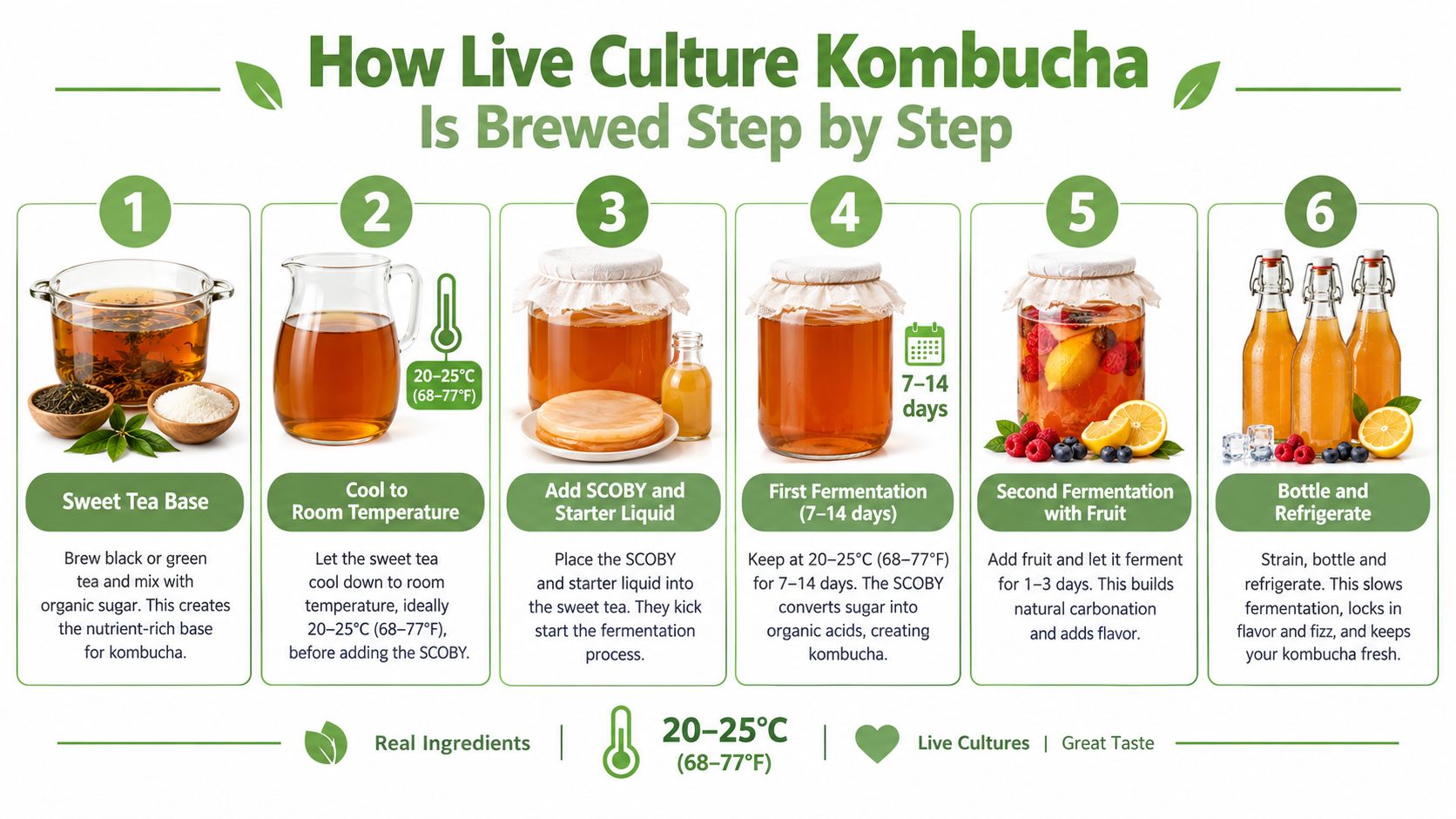
1. Build the sweet tea base
Black or green tea supplies the fermentation environment, flavour and plant compounds. Cane sugar feeds the yeast and bacteria. The brewer needs enough sugar to support the culture, but the finished drink shouldn't taste like sweet tea.
2. Cool before adding culture
Hot tea can damage the living culture. The sweetened tea is cooled to a suitable temperature before the brewer adds acidic starter liquid from a previous batch and the SCOBY. Starter liquid lowers the initial pH and helps the new batch begin in a safer, more stable environment.
3. Ferment the first stage
Primary fermentation commonly runs at 22 to 28°C for 5 to 14 days, depending on the recipe and conditions. During this stage, yeast and bacteria consume available sugars and generate organic acids, carbon dioxide and trace alcohol.
Taste and testing work together. A batch that's stopped too early may retain too much sugar and lack acidity. A batch left too long can become sharply sour, lose balance and continue changing in ways the brewer needs to monitor.
4. Flavour and bottle
The brewer adds ingredients such as ginger, lime or mango before bottling. Residual sugar gives yeast something to ferment in the sealed bottle, creating natural carbonation. This stage needs care because the same process that creates fizz can increase pressure and alter alcohol over time.
For a closer look at the first stage, PepTea's guide to kombucha first fermentation explains the role of tea, sugar, starter liquid and culture management.
A practical visual walkthrough can also help make the process easier to follow:
5. Refrigerate and monitor
Cold storage slows fermentation. It doesn't make a living drink static. Yeast and bacteria may continue working slowly, particularly when residual sugar remains, so temperature, distribution time and packaging all affect the final drink.
Small producers can often monitor these variables closely, especially when brewing for local cafés, retailers and direct customers. PepTea's kombucha is brewed in the Hunter Valley, NSW, where the brand describes its Australian-made range as organic, sugar-free and made with raw live cultures. That's one example of why production transparency matters more than a generic “fermented” claim.
Reading the Label on Live Culture Kombucha in Australia
Australian labels need to answer two separate questions: is the drink safe and legally described, and does it still contain viable cultures? Those questions overlap, but they aren't identical.
A drink can retain fermentation acids after treatment, while a live-culture claim depends on organisms surviving into the bottle. Likewise, refrigeration supports a live product but doesn't prove the claim by itself.
Four phrases with different meanings
- Raw: Usually signals that the product hasn't been heated in a way that would remove its living character, but check the producer's explanation.
- Unpasteurised: Indicates the drink hasn't undergone pasteurisation. It points more directly to the absence of post-fermentation heat treatment.
- Live cultures: Means the producer is claiming viable microorganisms remain in the product.
- Probiotic: Implies a health-related content claim that needs substantiation. Don't treat it as interchangeable with fermented.
The term “naturally fermented” describes a process, not necessarily the condition of the final bottle. If a brewer heat-treats the finished drink, the fermentation history remains true, but the live-culture story changes.
Alcohol and acidity are production controls
Australian food-safety information has highlighted alcohol variability in fermented drinks. In testing of 132 kombucha samples sold in 2017 and 2018, almost 65% contained more than 0.5% ABV and more than 22% exceeded 1.15% ABV, as reported in the Sydney Morning Herald coverage of kombucha and kefir alcohol content.
In Australia, drinks above 0.5% ABV must carry alcohol-content statements under the Australia New Zealand Food Standards Code. NSW treats products above 1.15% ABV as liquor, according to NSW Health guidance on fermented drinks and alcohol. Ongoing fermentation after packaging can contribute to alcohol drift, particularly when bottles are warm or contain residual sugar.
Acidity matters for safety too. Australian guidance uses pH controls to reduce contamination risk. Some guidance calls for a final pH below 3.0, while other state guidance uses a target below 4.2 within seven days. Queensland guidance also requires pH below 4.6 within 24 hours and recommends refrigeration to slow ongoing fermentation, as outlined in the Australian fermented beverages issues paper.
| Label claim | What it means | Live culture implication |
|---|---|---|
| Raw | The producer presents the drink as minimally heat-treated | Cultures may remain, but check the full process |
| Unpasteurised | No pasteurisation has been applied | Stronger indication that fermentation microbes may survive |
| Contains live cultures | Viable bacteria and yeast are claimed in the bottle | Look for refrigeration and clear storage guidance |
| Probiotic | A health-related microbial claim | Ask whether the claim is substantiated and specific |
| Shelf-stable | Designed to remain at room temperature | Treat as a warning sign if you're seeking living cultures |
Sugar-free claims also need context. A product described as sugar-free under the relevant food-labelling convention may contain less than 0.5 g per 100 mL, but the nutrition panel remains the most useful place to check the actual formulation. A bottle that sits warm on a shelf may have had its live-culture promise altered through filtration, heat treatment or continued fermentation.
Serving, Storage and Using Kombucha as a Mixer
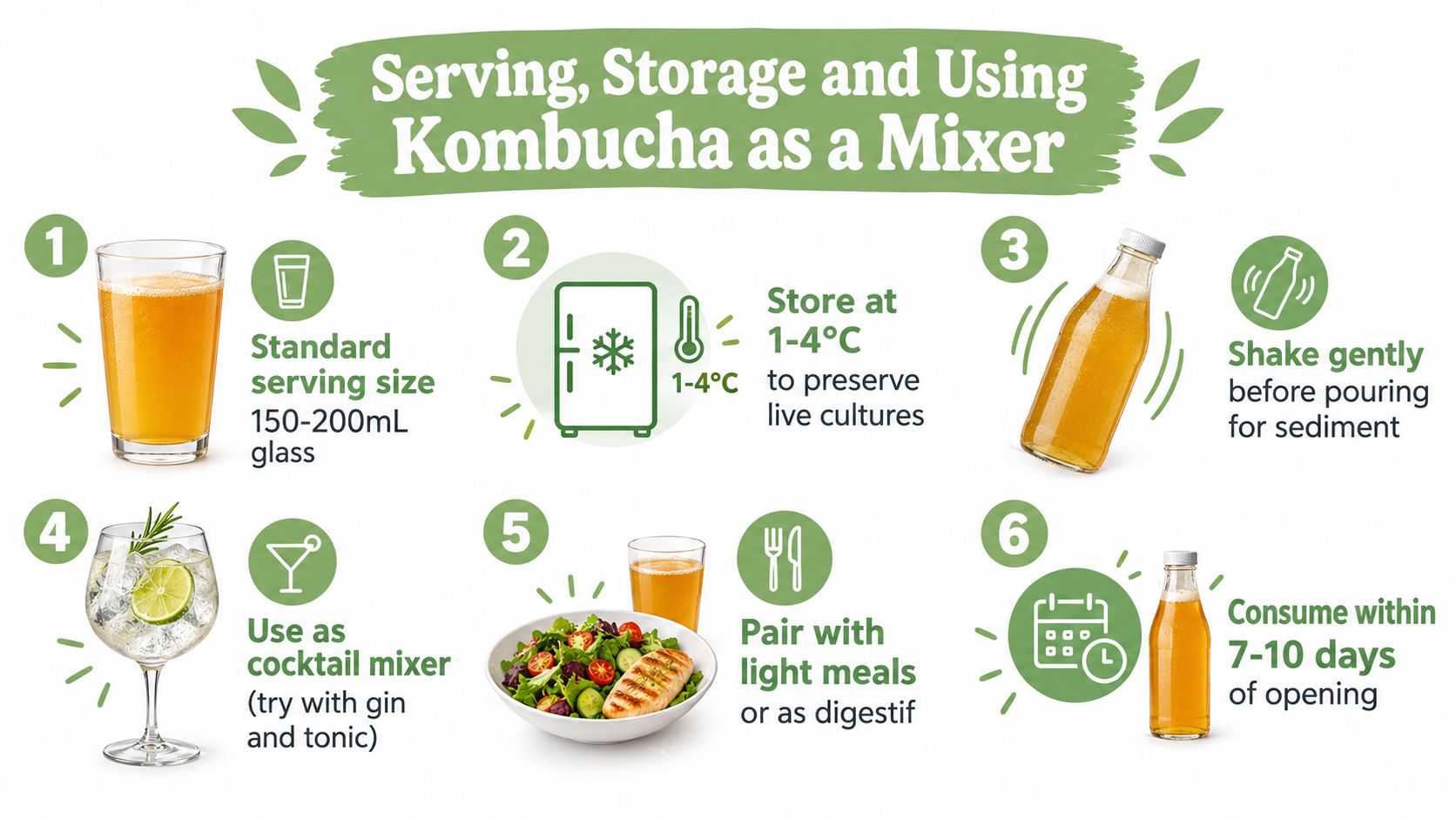
Kombucha works best when you treat it as a food and a flavour ingredient, not a shot. A 150 to 200 mL glass is a sensible standard serving, while people with sensitive stomachs may prefer to start smaller.
Pour it slowly into a glass rather than drinking straight from the bottle. The aroma opens up, carbonation softens and you can judge the balance of sweetness, acidity and spice.
Match the acidity to food
Kombucha's brightness can cut through rich or fatty foods. Try it with:
- Grilled meats: Ginger notes can lift smoky or savoury flavours.
- Spicy curries: Acidity and carbonation refresh the palate between bites.
- Cheese boards: Tart kombucha balances creamy textures.
- Rich brunches: Citrus or ginger flavours work well with eggs, avocado and buttery pastries.
Flavour choice changes the pairing. PepTea's examples include Ginger, Lime & Ginger and Mango, each offering a different route into food matching without adding a sugary soft drink to the table.
Use it in a café-style drink
Kombucha makes a useful base for a non-alcoholic spritz. Pour it over ice with citrus and herbs, or combine it with soda water for a longer drink. In a cocktail, carbonation lifts botanical notes from gin, citrus and aromatic bitters, although the finished alcohol level depends on the other ingredients.
Cold-chain handling affects the experience as well as culture survival. A warm trip from a distribution centre to a retail fridge can accelerate fermentation, alter flavour and increase pressure. Check the sell-by date and choose bottles stored below 4°C, following the practical advice in PepTea's kombucha storage guide.
At home, refrigerate unopened bottles immediately. Keep them away from direct sun and hot cars. Once opened, reseal the bottle and aim to finish it within 2 to 3 weeks, while remembering that flavour and carbonation may change sooner.
Choosing a Live Culture Kombucha Worth Your Fridge Space
You don't need to become a fermentation scientist to choose well. A quick scan can reveal whether a bottle's live-culture story is supported by its ingredients, storage and producer information.
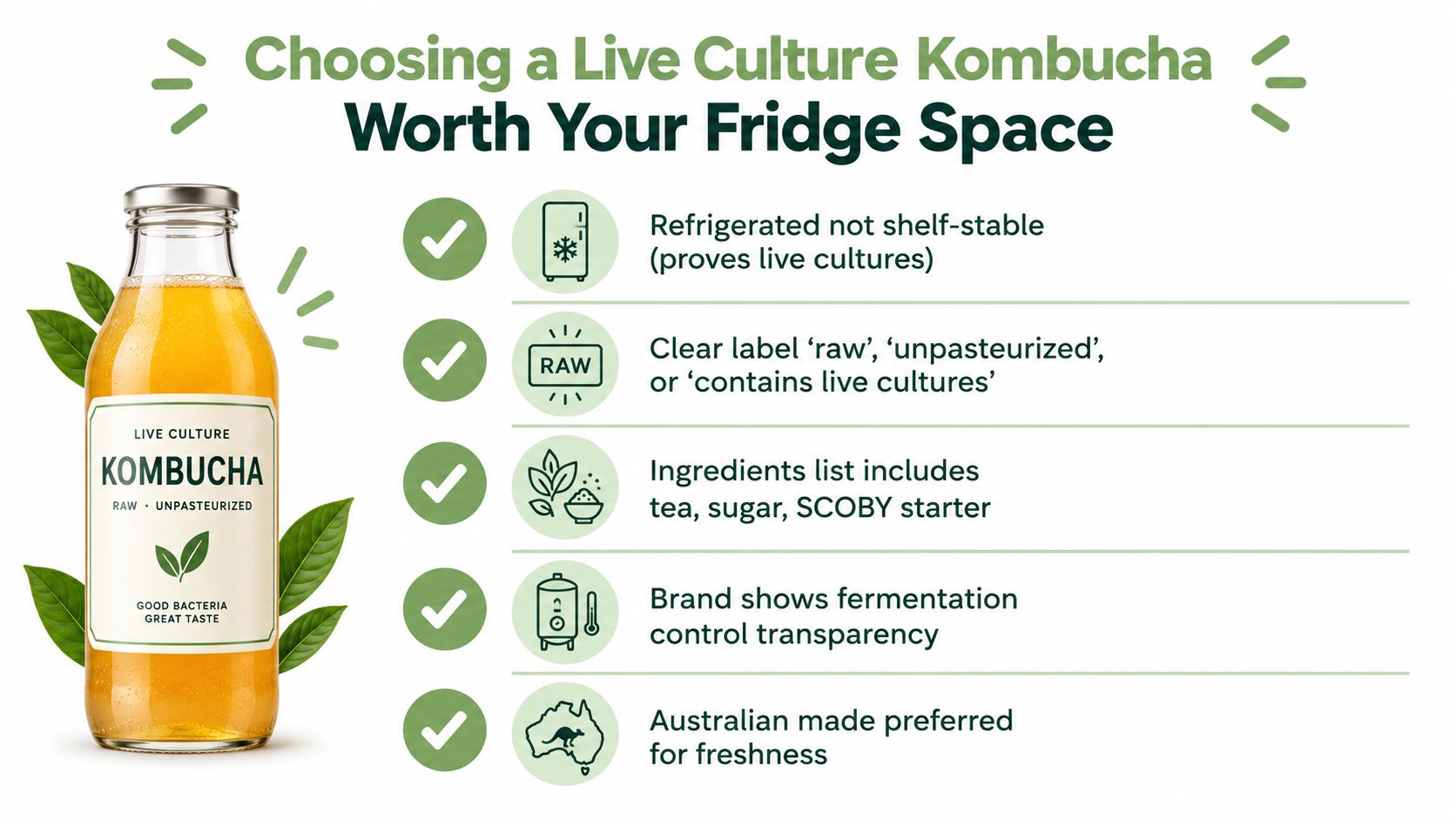
Start with the fridge. Refrigerated kombucha is generally a better sign for culture preservation than a shelf-stable bottle, though refrigeration alone isn't proof. Then inspect the wording and ingredients.
- Read the process language: Look for raw, unpasteurised or contains live cultures, and check for any statement about post-fermentation pasteurisation.
- Check the ingredients: Tea, sugar, starter culture and flavour ingredients are easier to understand than a long list of sweeteners, colours and stabilisers.
- Review sugar and alcohol: Sugar-free or low-sugar formulations may suit people reducing sweet drinks. Confirm the alcohol statement if you avoid alcohol or need a non-alcoholic option.
- Look for production transparency: A producer that discusses pH, refrigeration, batch control or fermentation gives you more useful information than one relying only on detox language.
- Notice the bottle condition: Natural sediment or activity can occur in a living drink, but absence of visible sediment doesn't prove that cultures are gone. Packaging material matters less than the process and storage record.
Glass can make a product feel more premium, but it doesn't guarantee viable cultures. A clear raw claim, a cold chain and sensible fermentation controls matter more than the container alone.
PepTea's sugar-free organic kombucha, brewed in the Hunter Valley, NSW, is one local example to compare against these criteria. The range includes flavours such as Ginger, Lime & Ginger and Mango, giving Australian shoppers a practical way to assess local live-culture kombucha by its label and handling rather than by wellness hype.
Explore Pep Tea's organic, Australian-brewed kombucha range to compare sugar-free flavours made with raw live cultures. Visit Pep Tea to shop online, learn more about fermentation, or enquire about supplying live-culture kombucha to your café or hospitality venue.
How Many Probiotics in Kombucha and What Counts

There's no single probiotic number for kombucha in Australia. Product claims can range from 500 million CFU per 100 mL to 39 billion live probiotics across a pack, because the category has no national mandated probiotic minimum.
So, how many probiotics are in kombucha? The honest answer depends on the brand, serving size, culture, fermentation method, processing and storage. A raw, refrigerated brew may contain a different live-culture profile from a pasteurised drink that has probiotics added later. Even two bottles made from similar ingredients can't automatically be treated as equivalent.
That uncertainty doesn't make kombucha meaningless. It means you need to read the label with a little more care than you might expect from a drink marketed as “probiotic”. This guide explains what CFU means, how Australian products present their counts, why live cultures change from brew to bottle, and what to look for when choosing a kombucha for everyday drinking or a café menu.
Pep Tea's own approach sits in that practical middle ground. Its kombucha is brewed in the Hunter Valley, NSW, using organic tea and live cultures, with a focus on a raw, sugar-free fermented drink rather than a promised clinical dose. For a broader look at what beneficial bacteria produce during fermentation, see postbiotics and the real benefit of beneficial bacteria.
Introduction Why There Is No Single Probiotic Number
Many shoppers assume “kombucha” comes with a standard probiotic serving, much like a supplement comes with a declared dose. In Australia, that assumption doesn't hold. Food Standards Australia New Zealand treats kombucha as a traditional food rather than a therapeutic good, so there's no Australia-wide mandated probiotic minimum for the category (CHOICE explains the regulatory position and variability).
The live microbes in a bottle can shift according to the culture used, how long the tea ferments, whether the finished drink is raw or pasteurised, and how it's transported and stored. Australian consumer guidance also notes that kombucha's potential depends on both the number and type of microbes, and that it's likely to contain fewer microbes than a commercial probiotic supplement (CHOICE discusses the difference between kombucha and concentrated supplements).
Why labels can look so different
One Australian ready-to-drink kombucha lists 1 billion CFU per serve and 500 million CFU per 100 mL (Australian product listing). Another Australian functional beverage claims 39 billion live probiotics across the full pack (Australian kombucha product example). Those statements may both be accurate as written, but they aren't directly comparable until you know the serving size and whether the figure refers to one bottle, a pack or a measured volume.
That's why the question “how many probiotics in kombucha?” needs a comparison method, not a magic answer. CFU per serve, CFU per 100 mL, raw or pasteurised processing, and refrigeration instructions tell you more than a large number printed on the front.
Practical rule: Treat a live-culture claim as a product-specific snapshot, not a guaranteed standard for every kombucha.
The rest of the answer is useful for both home shoppers and café buyers. You'll learn how to compare bottles fairly, recognise language that may blur “live” and “probiotic”, and set a realistic expectation: kombucha can be an enjoyable fermented tea with live cultures, but it isn't automatically a measured therapeutic dose.
What Probiotics and CFU Actually Mean in Kombucha
Start with the simplest distinction. Live cultures are microorganisms that remain alive in the drink at the time it's made or tested. Probiotics is a more specific term for live microorganisms that provide a health benefit when consumed in an appropriate amount. A drink can contain live microbes without proving a particular health outcome for every person.
Kombucha begins with sweetened tea and a SCOBY, short for a symbiotic culture of bacteria and yeast. The SCOBY is a mixed community, not one named organism. During fermentation, different bacteria and yeasts interact with the tea, sugar and acids, so the microbial profile can change as the brew develops.
CFU is a viability measure
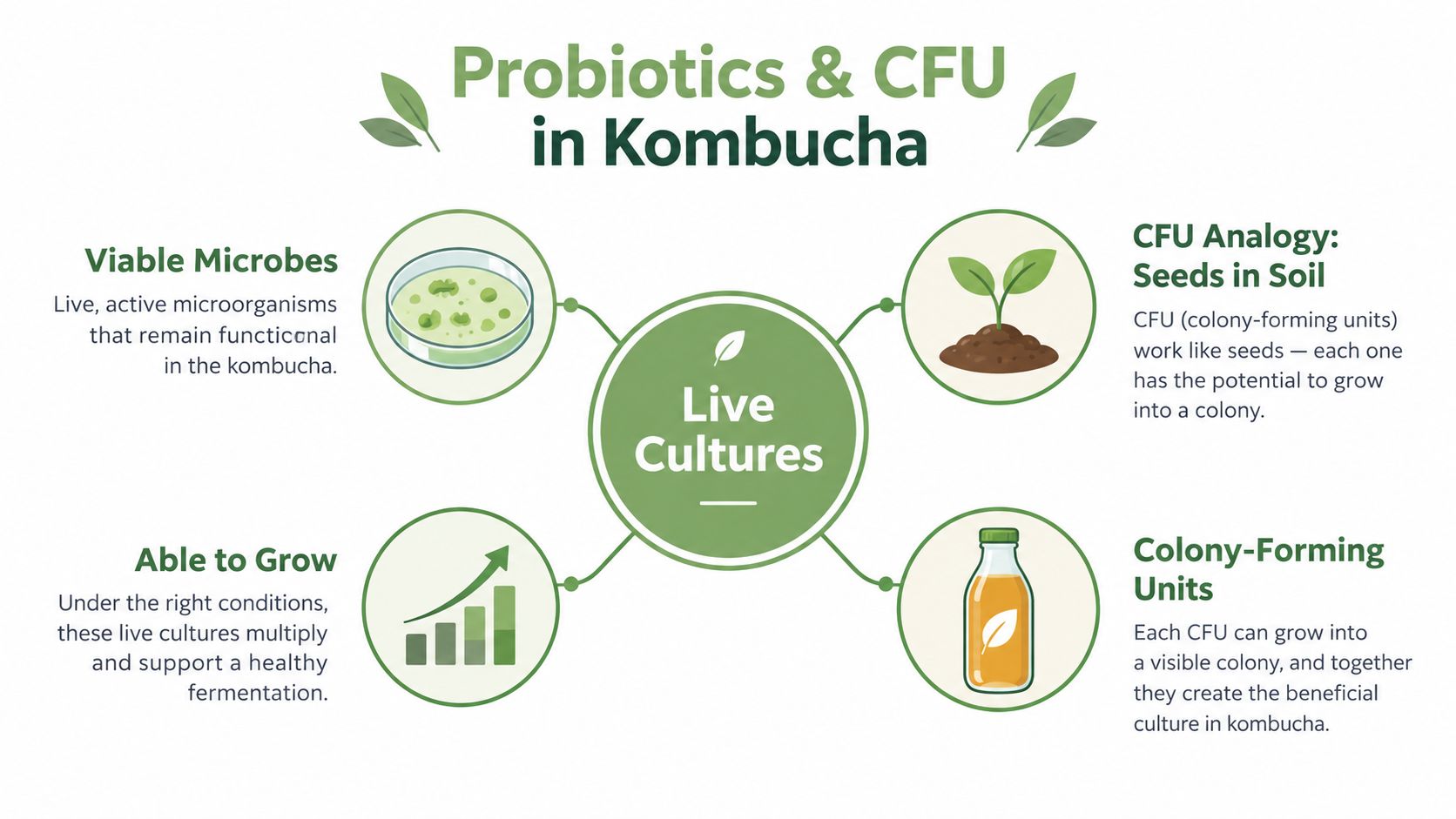
CFU means colony-forming units. It estimates how many viable microbes in a sample are capable of multiplying under the test conditions and forming a visible colony. It doesn't necessarily count every individual cell, and it doesn't tell you whether all the microbes belong to the same strain.
A useful analogy is a packet of seeds. The number printed on the packet suggests how many seeds are present, but the meaningful question is how many are viable and able to sprout. CFU is closer to the number of seeds that can grow than to the total number of seeds sitting in the packet.
Number and type both matter
A higher CFU figure isn't automatically a better product. The type of microbe, its ability to remain viable through storage, and the amount consumed all affect how meaningful the claim may be. Australian CSIRO researcher Dr Michael Conlon told CHOICE that probiotic effects depend on the number and type of microbes, while noting that kombucha generally contains fewer microbes than dedicated probiotic drinks (CHOICE's expert commentary).
Added strains create another layer of confusion. Some producers may add probiotic strains after processing, while a traditionally fermented drink gets its microbial community from the brewing process. Both may use words such as “live” or “probiotic”, but those words don't describe identical production methods.
For a plain-language foundation, Pep Tea's guide to what prebiotics and probiotics are can help separate these related terms. The key point is simple: a CFU number tells you about viable growth under testing conditions, not a universal promise of health benefit.
Typical Probiotic Counts You Will See on Australian Labels
Why can two Australian kombucha labels show such different probiotic counts? The answer often sits in the unit, serving size and product format, rather than in a simple difference in quality. One bottle may state its live-culture content per serve, another per 100 mL, and another across the entire pack. Comparing those figures directly is like comparing the price of one apple with the price of a whole crate.
Here are Australian examples that show how the wording changes:
| Product Format | Claimed Live Count | How It Is Expressed |
|---|---|---|
| Ready-to-drink kombucha | 1 billion CFU per serve | Also listed as 500 million CFU per 100 mL |
| Functional kombucha beverage | 39 billion live probiotics | Across the full product pack |
| Live bacterial ready-to-drink beverage | Over 500 million viable and living bacteria | Before consumption, with a stated 12-month shelf life |
The ready-to-drink example gives both measurements, making it useful for comparison. A label stating 1 billion CFU per serve and 500 million CFU per 100 mL is describing the same drink through two different lenses (Australian label example). The per-serve figure shows what you may consume in that portion. The per-100-mL figure creates a common measuring line for comparing products with different serving sizes.
A pack-level claim needs careful reading. 39 billion across a pack may include several servings or reflect a different product format. Without the pack volume, serving guidance and testing point, the headline figure cannot show whether one glass contains more live cultures than another product (Australian functional beverage example).
A practical Australian range
Across the examples above, claims range from hundreds of millions to tens of billions of CFU, depending on how each product is formulated and how the claim is expressed. This range is a description of the examples, not a recommended dose or a target that every kombucha should meet.
A high number might come from added strains, a full-pack calculation or a particular testing method. A lower declared number might be measured per 100 mL in a traditionally fermented drink. Check the unit first, then the serving size. After that, check whether the drink is raw or pasteurised, and follow the storage instructions, because handling affects how much of the claimed live culture may remain by the time you drink it.
Why Probiotic Numbers Vary So Much From Brew to Bottle
Kombucha is a living, changing beverage. The number printed on a label represents a product at a particular point in its journey, while the drink in your glass may have travelled through fermentation, bottling, transport and refrigeration before you open it.
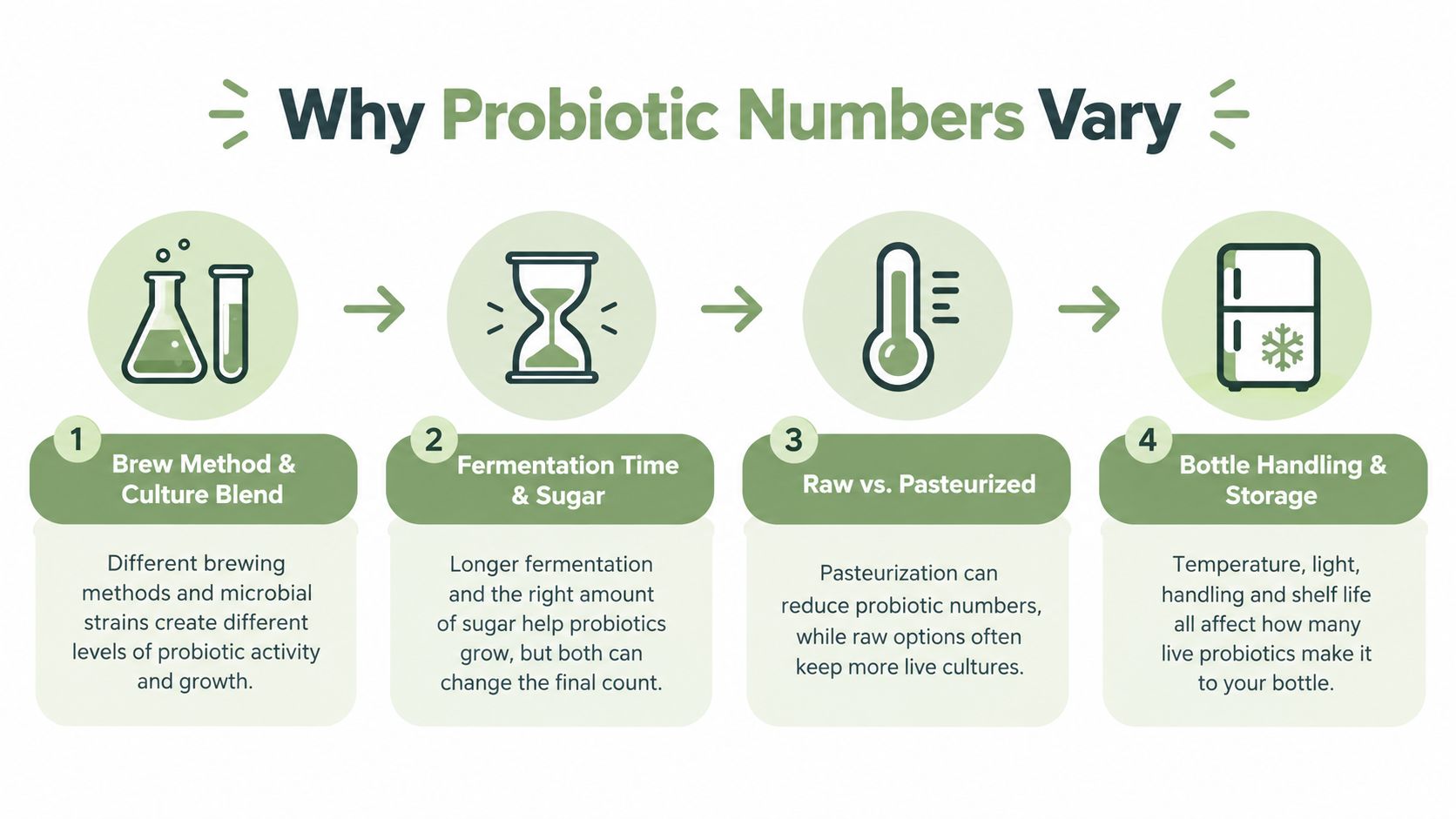
Brew method and culture blend
A SCOBY contains a mixed community of bacteria and yeast. Different culture blends can produce different microbial profiles, and the same broad recipe doesn't guarantee the same result from one producer to another. Brewing conditions also influence acidity, carbonation and the balance of organisms that remain in the finished drink.
Fermentation time matters because the culture uses sugar and changes the surrounding tea. A producer may stop fermentation at a particular point to achieve a preferred flavour and stability. The finished drink can therefore taste sweeter, sharper or more acidic without that flavour alone revealing its exact CFU content.
Raw, pasteurised or re-fortified
Raw or unpasteurised kombucha is processed to retain live cultures, although “raw” doesn't provide a standard CFU number by itself. Pasteurisation uses heat, which can reduce or remove viable microbes. Some products may then be re-fortified with probiotic strains after processing, creating a drink that contains an added culture rather than the original living fermentation community.
That distinction matters because “live” and “probiotic” aren't interchangeable words. Australian industry coverage has raised concerns about products that are pasteurised or re-fortified, particularly when shoppers interpret broad health language as proof of a naturally live brew (ABC News coverage of kombucha regulation concerns).
Bottle handling and storage
Cold storage helps preserve the characteristics of a raw fermented drink. Heat exposure, long periods outside refrigeration and continued fermentation can all change the product after bottling. The label's “keep refrigerated” instruction isn't decoration. It tells you how the producer expects the drink to be handled.
Shelf life can also complicate comparisons. One Australian live bacterial beverage record described over 500 million viable and living bacteria before consumption alongside a 12-month shelf life (Australian award record). That wording gives useful context, but it still doesn't establish what every bottle contains at the end of its shelf life.
A kombucha label is a snapshot. Storage is part of the recipe once the drink leaves the brewery.
How to Read a Kombucha Label and Spot Real Live Cultures
Use the label as a checklist rather than hunting for the biggest number. A transparent product should make it reasonably clear whether the drink is raw, how live cultures are described, how much you're expected to consume and how it should be stored.
Four checks for shoppers
Look for raw or unpasteurised wording. This suggests the producer intends to retain live fermentation cultures. It still isn't a guarantee of a particular count, so keep reading.
Find the live-culture statement. “Contains live cultures” tells you more than a vague wellness phrase. If the label names specific strains, note them, but don't assume a named strain makes the drink equivalent to a supplement.
Check the unit. Is the CFU figure listed per serve, per 100 mL or across a pack? The Australian examples show why this distinction changes the apparent size of the claim (Australian label comparison).
Read the storage instructions. Refrigeration, best-before information and handling guidance help you judge whether the product is intended to stay live through consumption. Pep Tea explains the practical reason behind refrigerating kombucha.
Questions for cafés and wholesale buyers
Hospitality buyers need to look beyond the front label. Ask the supplier how the drink is brewed, whether it's raw or pasteurised, how CFU is measured, and what cold-chain arrangements apply from production to delivery.
A café should also check flavour balance, residual sweetness, bottle or keg handling and the alcohol statement. NSW Health explains that kombucha is made by fermenting tea with sugar, yeast and bacteria, and that fermented drinks can retain residual alcohol. In Australia, drinks over 0.5% ABV must state alcohol content on the label, while in NSW products over 1.15% ABV are considered alcoholic drinks (NSW Health guidance).
For café menus: Describe the product as a fermented tea with live cultures unless the label supports a more specific statement. Don't turn a variable food into a guaranteed medical dose.
Kombucha Versus Probiotic Supplements and Other Fermented Drinks
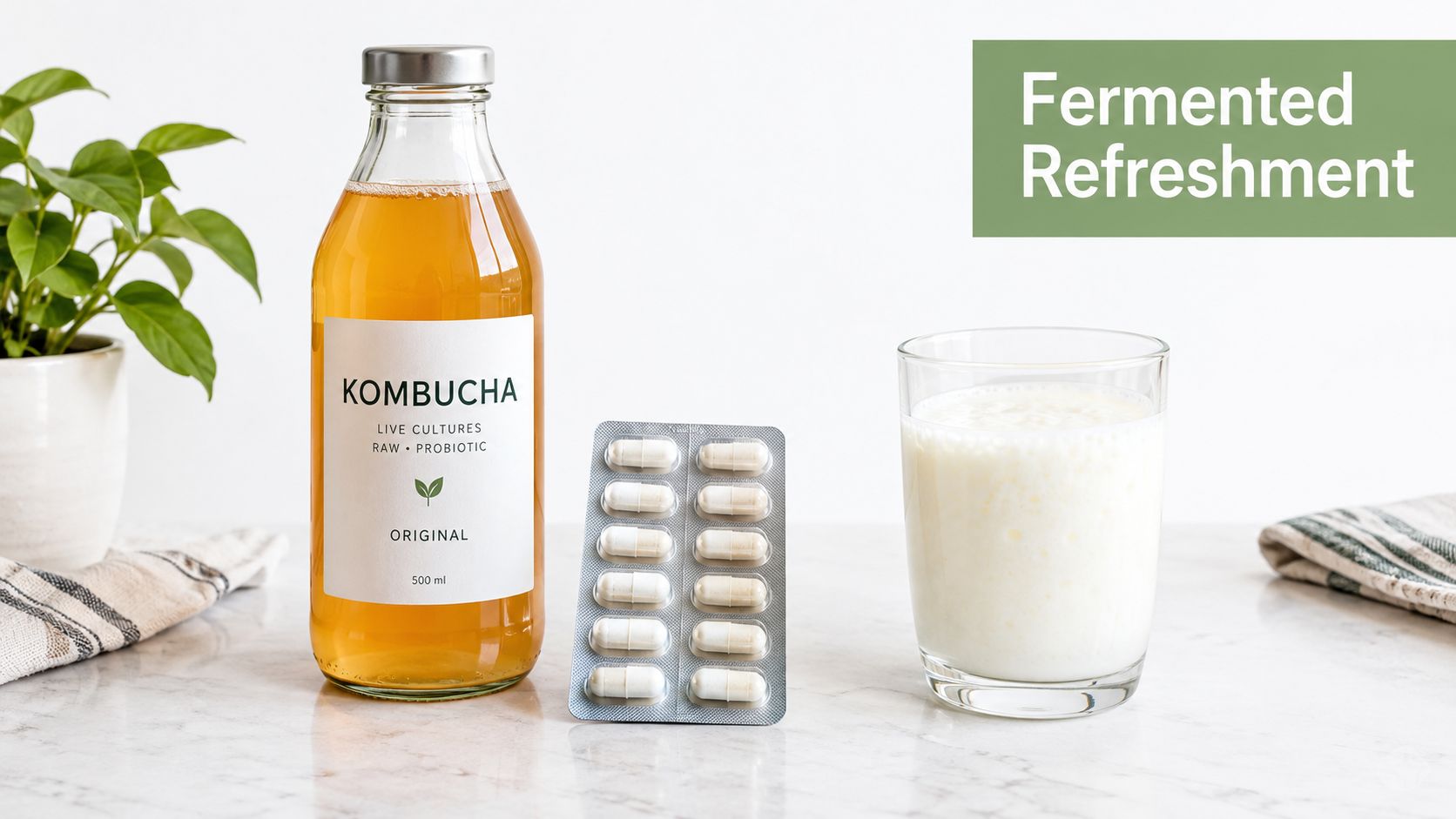
Kombucha and a probiotic supplement serve different purposes. A supplement is usually designed to deliver selected strains in a concentrated format, with the dose presented as a central product feature. Australian guidance notes that commercial probiotic supplements often contain far more concentrated strains than kombucha (CHOICE comparison of kombucha and probiotic supplements).
Kombucha is better understood as fermented tea that may contain live microbes. You drink it for its tart flavour, gentle fizz and place in a low-sugar routine, while the live-culture content is an added characteristic that varies between products. That makes it quite different from taking a supplement to target a particular strain or declared amount.
Tea itself contributes the starting material, but fermentation changes the drink. The culture transforms the sweetened tea and produces acids, carbonation and trace alcohol. A pasteurised product may no longer deliver the same live-culture experience, while a re-fortified beverage may contain added strains that weren't part of the original fermentation.
Live doesn't mean clinically proven
A live microbe is not automatically a proven probiotic for a specific health outcome. CSIRO describes kombucha as a food or drink containing live bacteria that may provide a health benefit, while also stating that research on gut benefits is limited and contradictory and that there are no human studies proving kombucha's claimed benefits (CSIRO's evidence overview).
That evidence gap matters for wellness menus. A café can offer kombucha as a refreshing fermented alternative to soft drink or alcohol, especially when the product has low or no added sugar. It shouldn't promise that a particular bottle will fix digestion, immunity or a diagnosed condition.
For anyone taking a probiotic supplement, kombucha can be an enjoyable food choice, but it shouldn't be used to replace professional advice or a product selected for a specific clinical purpose.
The comparison becomes clearer when you ask what you're buying:
- Kombucha: A fermented tea with a variable mixed culture.
- Probiotic supplement: A concentrated product with declared strains and a stated dose.
- Other fermented foods: Foods such as yoghurt, kefir or vegetables with their own cultures, ingredients and processing conditions.
A sensible approach is to choose the drink you enjoy and tolerate, then assess its label without borrowing the certainty of a supplement.
Before choosing any fermented product, this guide to how to improve gut health naturally offers broader lifestyle context beyond one beverage.
Choosing the Right Kombucha for Gut Health and Everyday Enjoyment
For most shoppers, three questions are enough to make a sensible comparison.
Is it raw and refrigerated? Look for clear raw or unpasteurised wording, then follow the storage instructions at home. A cold, properly handled bottle gives you a better chance of preserving the living character the producer intended.
What is the CFU per serve? Check whether the claim is per 100 mL, per serve or across a pack. If there's no number, don't assume the product has none. Just recognise that you don't have a standardised count to compare.
Does it suit daily drinking? Choose a flavour and sweetness level you'll enjoy. Sugar-free options can replace sweeter soft drinks, while flavours such as ginger or lime and ginger can work well with meals and café menus. Serve kombucha chilled, keep it away from unnecessary heat and don't treat a high headline number as proof of superior quality.
Kombucha also contains trace alcohol because fermentation produces it naturally. If alcohol matters for your household, read the label carefully and use the Australian guidance above as your reference point.
Pep Tea offers Australian-brewed, sugar-free organic kombucha made in the Hunter Valley, NSW, alongside organic Japanese matcha. It's one option for shoppers and hospitality venues looking for a live fermented tea with a low-sugar profile, provided the product's label and storage instructions suit their needs.
Explore the Pep Tea range of sugar-free organic kombucha and organic Japanese matcha, then contact the team about products for home, cafés or wholesale. Choose a chilled fermented tea you can enjoy regularly, and compare its live-culture information with the serving size and storage guidance rather than chasing one magic probiotic number.