
Tag: Australian kombucha
Kombucha Starter Liquid: What It Is and Why It Matters
You've brewed the tea, dissolved the sugar and waited for it to cool. The SCOBY is ready beside the jar, but one small detail can decide whether the batch starts cleanly or sits vulnerable for too long: kombucha starter liquid.
At a Hunter Valley café, this is the part of the process that's easy to overlook because it doesn't look dramatic. It's mature, tangy kombucha. Yet that liquid carries the established culture and acidity that help guide fresh sweet tea towards a safer fermentation. Treating it as leftover drink misses its most important job.
The Hidden Foundation of Every Successful Brew
A new brewer often spends plenty of time choosing black or green tea, measuring sugar and planning flavours such as ginger or mango. Then the tea cools, the SCOBY goes in, and the jar is covered. If the batch develops an odd smell or takes too long to turn tart, the starter liquid may have been the missing piece.
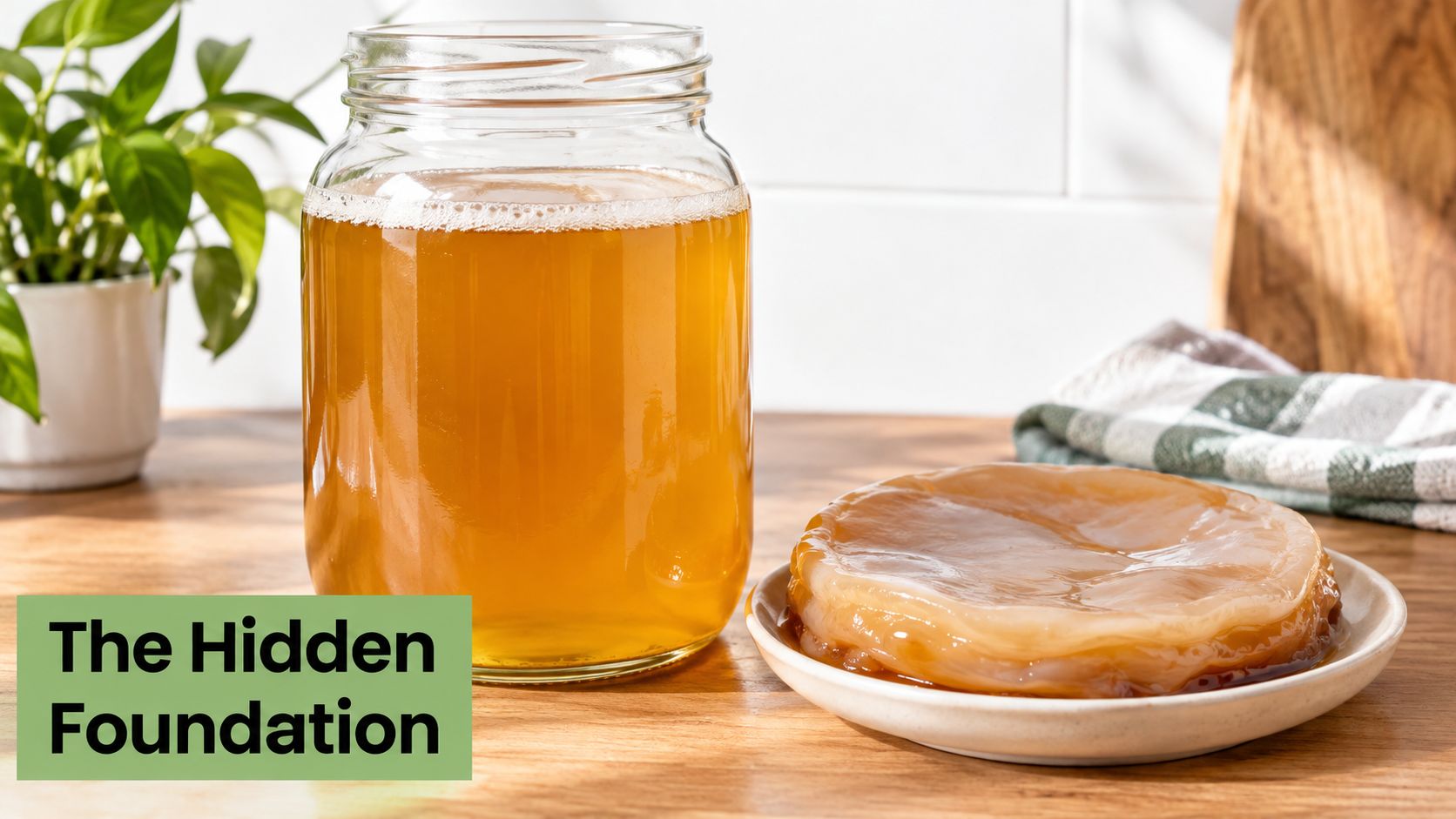
Starter liquid is the mature kombucha reserved from an active, successful batch. It brings an established community of yeasts and bacteria into the new tea, while its existing acidity changes the starting conditions straight away. The SCOBY matters too, but the liquid surrounding it is an active part of the fermentation system, not just a carrying medium.
Picture planting a garden bed. Fresh sweet tea is the prepared soil, the SCOBY is part of the living garden, and starter liquid brings an established population that can begin working immediately. Without that head start, the new batch has to develop its balance while the sweet tea remains in a condition where unwanted microorganisms may gain an opportunity.
Practical rule: A healthy-looking SCOBY without sufficiently active, acidic liquid isn't a complete fermentation plan.
This matters at home, but it matters even more in cafés and small production spaces. A hospitality team needs repeatable batches, predictable flavour and responsible control of a living drink after it leaves the brew vessel. The first pour of starter liquid influences all three.
Starter liquid also changes how you judge a recipe. Rather than measuring only by volume, you need to consider its acidity, smell, activity and history. A small amount of reliable mature kombucha can help a fresh batch move in the right direction, while weak, contaminated or poorly stored liquid can create uncertainty from the beginning.
What Kombucha Starter Liquid Actually Is
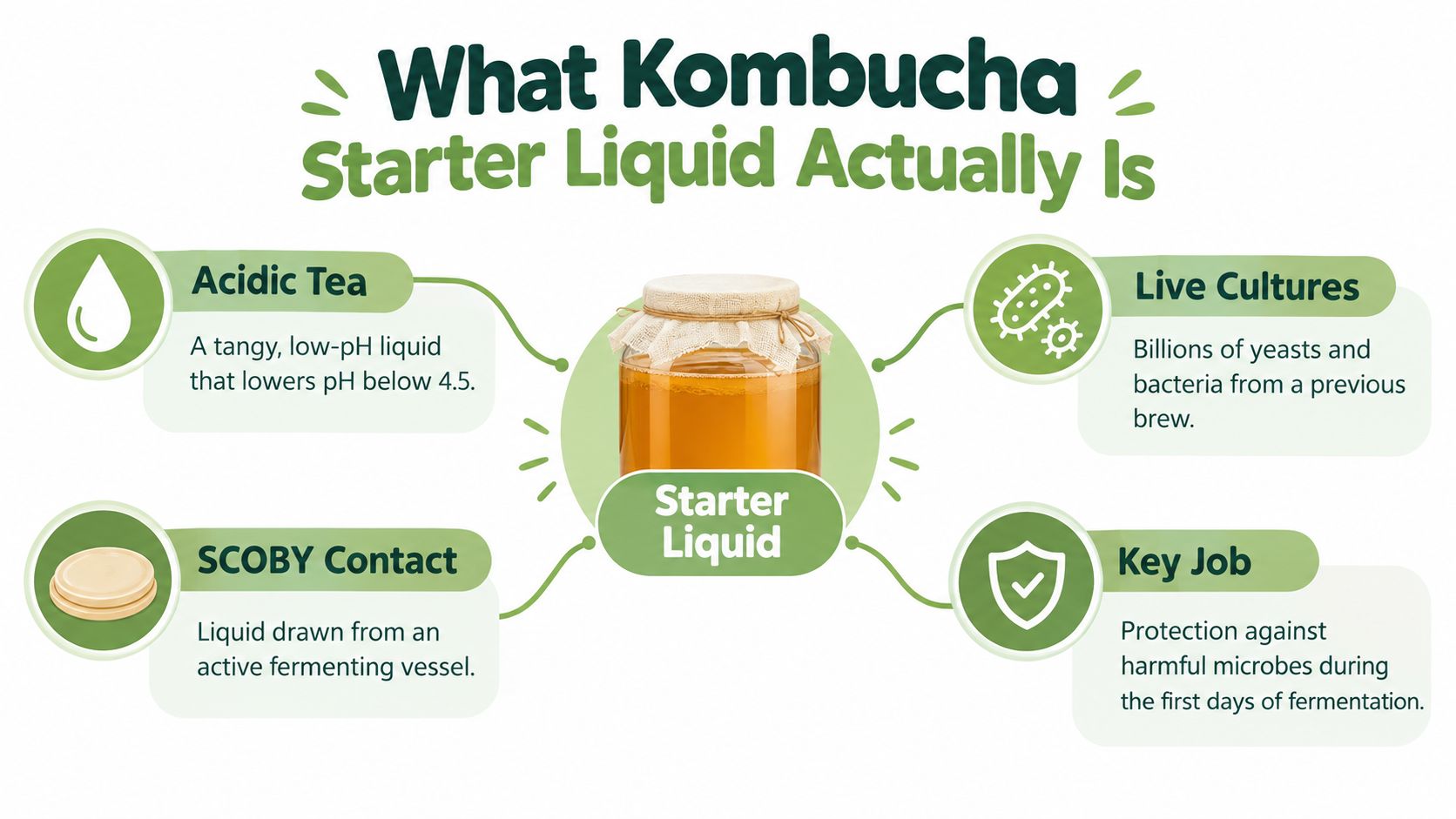
Kombucha starter liquid is finished, acidic kombucha from an active fermentation, usually taken from the vessel before flavouring or bottling. It contains the yeasts and acetic-acid bacteria that have already adapted to the tea environment. When added to fresh sweet tea, these organisms continue the sequence that creates kombucha's characteristic tartness.
The roles are complementary:
- Yeasts use available sugar and produce ethanol and carbon dioxide as part of fermentation.
- Acetic-acid bacteria use oxygen and convert yeast-produced ethanol into organic acids, including acetic acid.
- The liquid itself carries acidity and living culture into the next batch.
- The SCOBY is the visible cellulose-rich layer formed by the culture. It can support fermentation, but it isn't the only place where the active organisms live.
The simplest comparison is a sourdough starter. You wouldn't expect a dry piece of crust to ferment a fresh dough reliably. The living mixture around it carries much of the activity. Kombucha starter liquid plays a similar practical role, although the organisms and process are different.
Starter liquid and a SCOBY are not interchangeable
Adding a SCOBY alone can leave the new tea without enough acidity at the beginning. The liquid helps lower the starting pH and introduces organisms throughout the batch, rather than relying only on contact with a floating or sinking disc.
The liquid should come from a batch that smells pleasantly sour or tea-like, without fuzzy growth, rotten odours or unexplained discolouration. A SCOBY can naturally sink, float or sit at an angle, so its position isn't a reliable test of culture health. The condition of the liquid and the way the brew progresses matter more.
Why mature liquid is carried forward
Each successful batch leaves behind a portion of mature kombucha that can seed the next one. This creates continuity. You're not starting with a blank jar each time, but carrying forward a working culture that has already converted sweet tea into an acidic ferment.
That's why starter liquid deserves to be measured and protected. It is both an inoculum, meaning a source of living culture, and an early acidification control.
How pH Control Makes Starter Liquid a Safety Tool
Freshly brewed sweet tea begins at approximately pH 5, a range in which potential contaminants can grow. Food Standards Australia New Zealand advises cooling tea rapidly from 60°C to 20°C within 2 hours, then adding a proven, uncontaminated starter culture as soon as possible. You can review the broader fermentation context in Yuve's gut health guide, but kombucha brewing needs its own careful controls.
Starter liquid helps the culture begin producing acid sooner. The yeasts and acetic-acid bacteria work in sequence, and oxygen supports the bacteria as they oxidise yeast-produced ethanol into acetic acid. That gradual acidification lowers pH and changes the environment in favour of the intended culture.
The useful pH milestones
Australian guidance identifies pH 4.2 or below as the point at which kombucha becomes a non-potentially hazardous food that doesn't support pathogen growth or toxin production. The practical lesson is simple: the batch needs to reach that milestone promptly, not merely taste sour after a long wait.
A final pH of approximately 2.5 or higher is described as typical. Excessive acidification can produce an aggressively sharp drink and may create additional safety concerns, so lower isn't automatically better.
| Brewing question | Practical answer |
|---|---|
| Is taste enough? | No. Taste can help judge flavour, but it doesn't replace measurement. |
| Does oxygen matter? | Yes. Aerobic fermentation supports acetic-acid production. |
| What should be measured? | Track pH during fermentation with a calibrated meter. |
| Is the starting liquid important? | Yes. Its acidity and culture activity influence how quickly the new batch changes. |
A calibrated digital pH meter for kombucha brewing gives you a clearer view than elapsed time alone. Two jars brewed in different kitchens can move at different speeds because of temperature, tea, culture condition and handling. Recording pH gives a café team or home brewer evidence to work with.
Taste tells you what the drink is becoming. A pH meter tells you whether the process is moving into the intended safety range.
Use clean equipment, cool the tea before adding culture and keep the ferment exposed to suitable air circulation. If the pH doesn't move as expected, don't solve the problem by waiting indefinitely. Review the starter's condition, the temperature, the equipment and the possibility of contamination.
Where to Source or Make Your Starter Liquid
There are two sensible routes. You can obtain starter liquid from an established kombucha producer, or reserve it from your own healthy batch. The right choice depends on whether you're learning at home, restarting after a break or trying to keep café production consistent.
Buying from a reliable producer
A supplied starter should have a clear origin and handling information. Ask how it was brewed, whether it has been kept clean and whether the supplier can explain how to use it with your tea. A reputable source should be able to describe the culture rather than treating the liquid as a generic flavour additive.
For a first batch, a packaged option such as PepTea's starter tea kombucha product can be useful because it is presented specifically for establishing fermentation alongside a SCOBY. The important point isn't the packaging itself. It's knowing what the liquid is, where it came from and how it has been handled.
Reserving liquid from your own batch
Before flavouring or bottling a successful brew, decant clean mature kombucha into a sanitised container. Choose liquid from a batch with a pleasant acidic aroma and no visible mould. If the brew has an unusual smell, fuzzy growth or signs of spoilage, don't preserve it as your next starter.
A small café should label the container with the batch identity and date, then store it under the same controlled conditions used for the rest of the production process. Home brewers can use a simpler note on the jar, but the principle is identical: know which batch you're carrying forward.
How much is enough
PepTea's product guidance describes mature acidic kombucha at approximately 10% of a new batch as a way to lower initial pH and establish fermentation. The exact suitability depends on the acidity and activity of the liquid, so volume alone shouldn't be your only check.
If the starter is unusually mild, old, diluted or uncertain, adding more by guesswork won't guarantee a safe result. Measure pH, use a known culture and keep your process consistent. A starter liquid with strong acidity and healthy activity gives the new tea a more dependable beginning.
Storing and Maintaining Starter Liquid Correctly
Starter liquid is alive, so storage is about slowing change without treating it as a lifeless ingredient. A clean container, stable refrigeration and careful handling help preserve its useful acidity and culture activity between brews.
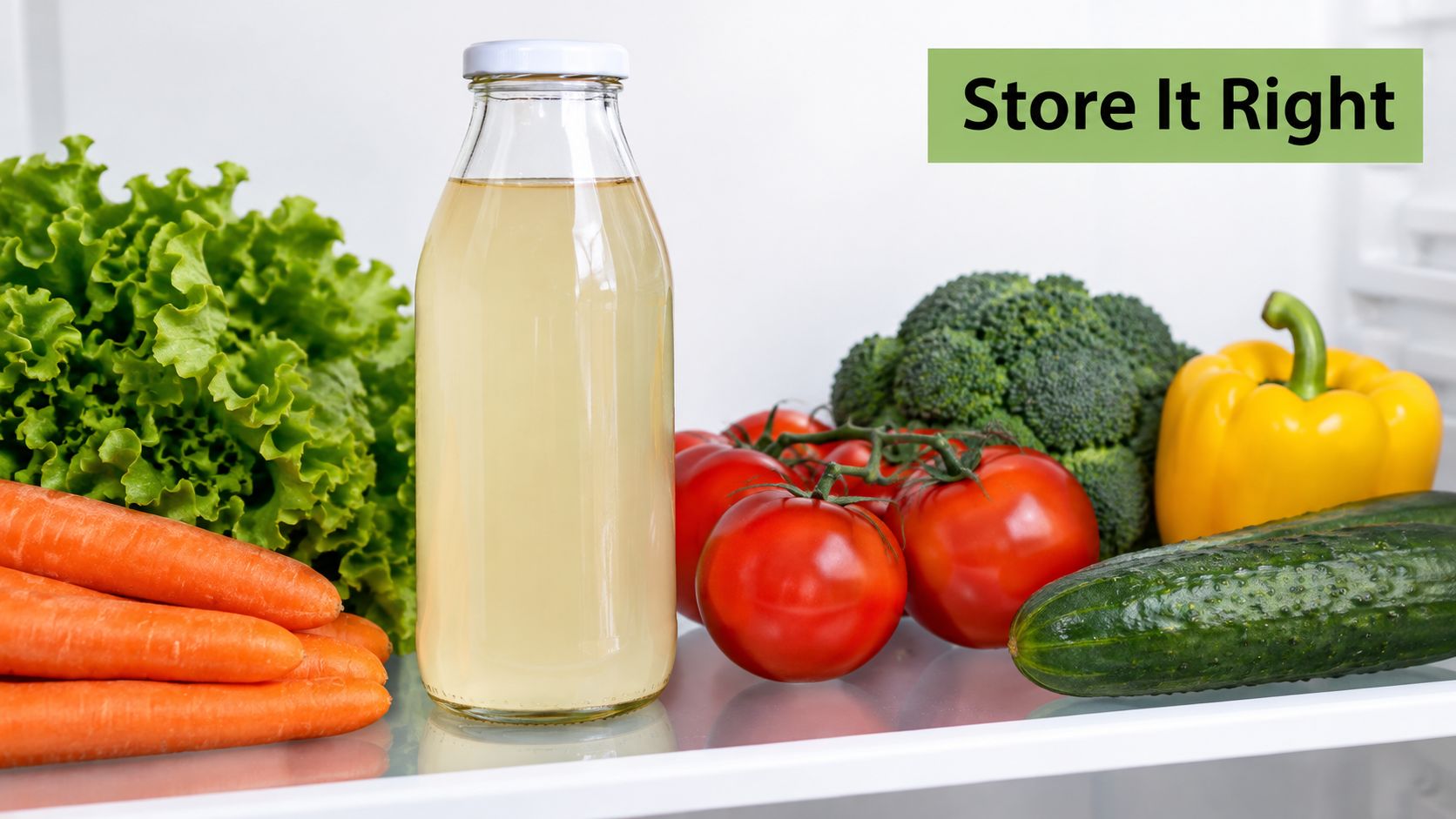
Use a clean glass container with enough room for safe handling. Keep the lid secure, but avoid repeatedly opening the jar just to smell it. Every opening creates another opportunity for dust, insects or accidental contact to enter.
A simple storage routine
- Label the jar: Record the batch source and storage date so nobody has to guess what it contains.
- Keep it cold: Refrigeration slows fermentation and helps maintain a more stable flavour and activity profile.
- Protect the liquid: If a SCOBY is stored with it, keep the culture covered so it doesn't dry out.
- Use clean utensils: Never dip a used spoon or tasting glass into the container.
- Inspect before use: Look for mould, unpleasant odours or a change that doesn't resemble normal acidic fermentation.
A refrigerated starter can become more sour over time, and its activity may change. “It still smells acidic” is useful information, but it isn't proof that the liquid is suitable for every new batch. Measure and observe rather than assuming that starter liquid never expires.
Freezing can also alter texture and culture activity, so it isn't automatically the best preservation method. For a short brewing pause, stable refrigeration is the more straightforward routine. If you're unsure about a stored culture, discard it rather than trying to rescue a questionable ferment.
The following video can help visualise practical SCOBY storage habits:
For a longer pause between batches, keep the culture submerged in mature kombucha and avoid repeated transfers. PepTea's guide to storing a SCOBY between brews offers a useful reference for maintaining the culture without letting it dry out.
Spotting Contamination and Managing Alcohol Risk
A healthy kombucha culture can look different from batch to batch. The SCOBY may float, sink or form an uneven new layer, and strands or sediment can appear as yeast activity continues. Those changes aren't automatically contamination.
Mould is different. Fuzzy or dry growth, especially with suspicious colours, is a reason to discard the affected batch and starter rather than skim the surface. A rotten, solvent-like or otherwise offensive smell also deserves caution. If the liquid has been exposed to dirty equipment, insects or questionable water, don't use it to seed another brew. For general background on checking water quality, how to test well water for E. coli is a useful resource, although a home water test doesn't replace good brewing hygiene.
Alcohol can change after bottling
Acidity is only half the control problem. Yeasts can remain active after the SCOBY is removed, particularly when residual sugar, warm storage, sealed bottles or a second fermentation give them favourable conditions.
A national survey of 239 fermented soft drink samples found that only 35.2 per cent of kombucha tested below 0.5 per cent alcohol by volume, while some products increased in alcohol during shelf life. The findings are reported in the Australian fermented-beverages issues paper.
In the same survey, 41.9 per cent of all sampled fermented drinks measured above 0.5 per cent and below 1.15 per cent ABV, while 22.9 per cent exceeded 1.15 per cent ABV. Kombucha represented 132 samples, or 55.2 per cent, of the total fermented-drink sample. These figures show why a bottle that tastes fine at filling can't automatically be treated as stable throughout its shelf life.
Practical controls for cafés and home brewers
- Reduce uncontrolled sugar: Residual fermentable sugar gives yeast more material to convert.
- Control warmth: Cold storage slows, but doesn't magically erase, ongoing fermentation.
- Treat sealed bottles carefully: Carbonation stages can trap gas and support continued yeast activity.
- Check the finished product: Commercial operators should validate alcohol at bottling and during shelf-life studies.
- Avoid blanket claims: Don't describe a living fermented drink as alcohol-free without appropriate testing and awareness of applicable Australian requirements.
In New South Wales, guidance states that kombucha sold as a non-alcoholic beverage must contain less than 0.5% ABV, as outlined by the NSW Food Authority. Requirements and classification can vary between states, so a café serving or selling kombucha should document its controls rather than rely on assumptions.
Best Practices for Home Brewers and Hospitality Use
The best process is the one you can repeat. Home brewers need a clean jar, reliable starter liquid and a way to check progress. Cafés need those same foundations, plus batch records, staff consistency and a clear approach to storage and product claims.
Keep the framework practical:
- Start with known liquid. Use mature starter from a healthy ferment or a traceable supplier.
- Cool before inoculating. Hot tea can damage the living culture.
- Measure pH. Don't rely on taste, smell or the calendar alone.
- Keep equipment hygienic. Clean jars, utensils, bottles and meter probes after use.
- Provide oxygen during primary fermentation. The acetic-acid bacteria need it for their work.
- Control the post-bottling stage. Residual sugar, active yeast and warm storage can keep fermentation moving.
- Record what happened. Note the starter source, pH observations, storage conditions and any alcohol testing.
A café doesn't need a laboratory bench beside the espresso machine, but commercial production does benefit from organised testing and suitable food-grade workspaces. Businesses planning more formal analysis can browse food testing lab benches for context on laboratory furniture and workflow design.
Home brewers can keep their notes in a notebook. Hospitality teams should make the process easy for every staff member to follow. In both settings, starter liquid should be treated as a safety control and fermentation tool, not an optional flavouring.
Pep Tea offers Australian-brewed, sugar-free organic kombucha from the Hunter Valley, along with organic Japanese matcha and practical guidance for mindful beverage routines. Visit Pep Tea to explore the range, learn more about kombucha culture care and enquire about options for home, café or wholesale use.
Live Cultures Kombucha: What They Are and Why They Matter

Live cultures in kombucha are the living bacteria and yeast from the SCOBY that survive into the bottle and may support gut health. In Australia, however, almost 65% of 132 tested kombucha samples contained more than 0.5% alcohol, so “live” on a label is a specific claim that deserves more attention than a wellness slogan.
The popular advice is simple: choose kombucha for your gut. The useful advice is more precise: learn what the bottle means by live cultures, whether fermentation has been stopped, how the drink has been stored, and whether the producer controls acidity, sugar and alcohol. A chilled bottle can contain a living fermentation ecosystem, but two products with similar front labels may deliver very different things.
For Australian shoppers, cafés and retailers, this matters beyond taste. Live-culture kombucha is a relatively young local category. Commercial production began in Australia in 2009, and the market has since moved from home-brew culture into mainstream retail and hospitality, as reported by the Sydney Morning Herald's account of kombucha's Australian development. That growth brings better access, but it also makes label literacy essential.
Why Live Cultures Are the Most Misunderstood Phrase in Kombucha
“Live cultures” is probably the most misunderstood phrase on a kombucha label. Some people read it as a guarantee of a defined probiotic dose. Others assume any fermented tea must contain living microbes. Neither assumption is reliable.
In plain English, live cultures are bacteria and yeast that remain viable when you drink the kombucha. They come from the SCOBY, the mixed culture used to ferment sweet tea. If the finished drink is pasteurised after fermentation, heat can remove that living microbial activity. If it's heavily filtered, the microbial content may also change. A refrigerated bottle labelled raw or unpasteurised points towards a different product from a shelf-stable bottle that has been heat-treated.
Why fermentation language gets blurred
Brewing reality is more complicated than front-of-pack marketing. Fermentation produces acids, carbon dioxide, flavour compounds and trace alcohol, while the exact balance changes with the tea, sugar, temperature, time and culture. A producer might describe a drink as naturally fermented, yet the finished product may later be filtered, heated or stabilised.
That's why two bottles with similar wording can carry different microbial payloads. One may contain a mixed community of bacteria and yeast. Another may retain the acids and flavour of fermentation but no longer contain viable cultures. The label needs to tell you which story applies.
Practical rule: “Fermented” describes how the drink was made. “Contains live cultures” describes what remains when you drink it.
A useful label-reading habit is to ask four questions:
- Was it heat-treated? Look for wording such as pasteurised after fermentation or heat-treated.
- Does it require refrigeration? Cold storage supports culture survival and slows continued fermentation, although refrigeration alone isn't proof of live cultures.
- Does the producer explain the culture claim? Clear language is more useful than broad terms such as wellness or detox.
- What does the nutrition panel show? Sugar and alcohol help you understand how far fermentation progressed.
The rest of the label story starts with the SCOBY itself. Once you understand that small ecosystem, “raw”, “unpasteurised”, “probiotic” and “live” become practical clues rather than interchangeable buzzwords.
What Live Cultures and SCOBYs Actually Are
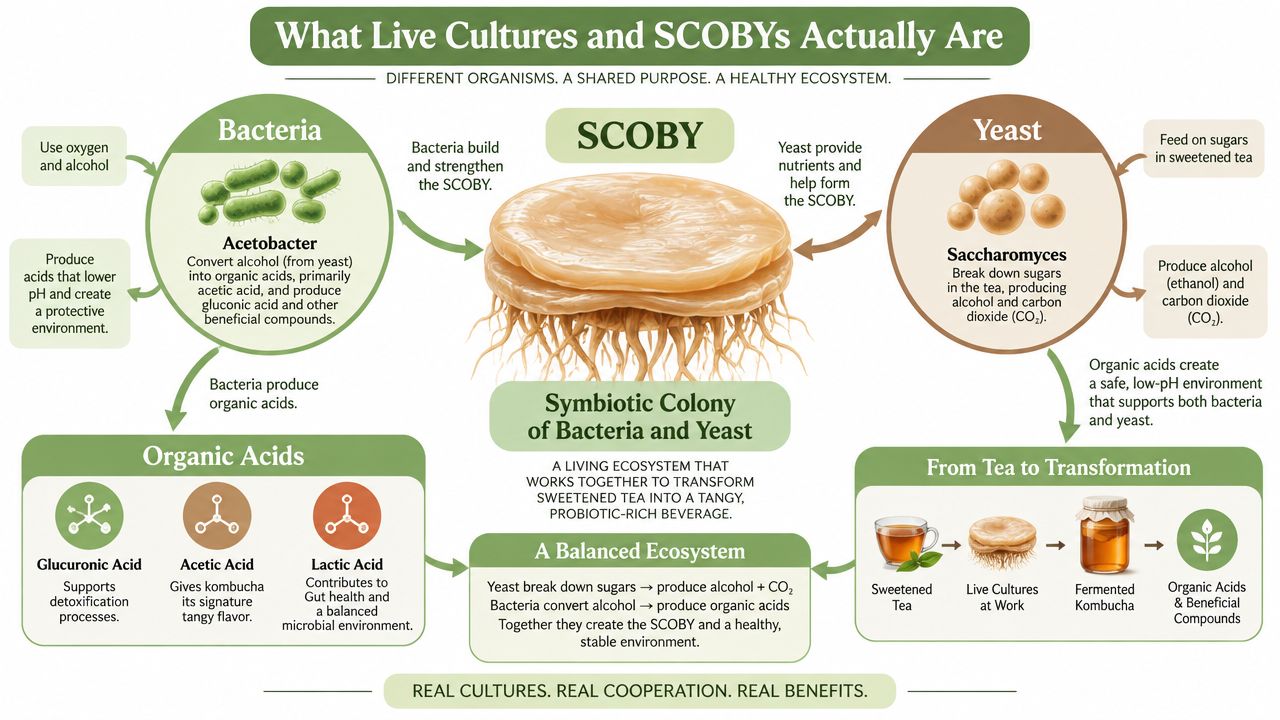
A SCOBY is a symbiotic culture of bacteria and yeast. It isn't one organism and it isn't a magic mushroom. It's a working community that lives in sweetened tea and transforms the liquid over time.
Yeast starts by using available sugars and producing alcohol and carbon dioxide. Acetic-acid bacteria then use oxygen and fermentation products to create organic acids, which give kombucha its sharp, refreshing character. Commonly discussed members of the ecosystem include Acetobacter, Gluconobacter, Brettanomyces and Saccharomyces, although the exact community varies between cultures and batches.
The pellicle isn't the whole culture
The rubbery cellulose layer floating at the top of a brew is often called the SCOBY. More accurately, it's a pellicle, a cellulose structure produced by some of the bacteria. It houses part of the community, but the liquid starter contains important bacteria, yeast, acids and metabolites too.
That distinction matters for home brewers. Throwing away the liquid and keeping only the pellicle removes much of the active fermentation environment. A healthy brew relies on both the culture and sufficiently acidic starter tea.
The finished drink contains more than microbes. It can include acetic acid, gluconic acid, residual sugar and trace ethanol, with tea compounds adding flavour and polyphenols. A laboratory count expressed as CFU, or colony-forming units, is only an approximation of a diverse community. It doesn't fully describe which organisms are present, whether they remain active, or how they behave in your gut.
Yeasts also deserve attention because they aren't automatically a fault. They help create alcohol and carbonation, while bacteria convert some fermentation products into acids. That relationship is why kombucha can taste bright and complex rather than just sweet or sour.
If you're curious about how yeast behaves in other traditional fermentations, the McLaren Vale indigenous yeast guide offers useful background on the difference between naturally occurring and selected cultures. Wine and kombucha aren't brewed in the same way, but the comparison helps explain why a living fermentation community doesn't behave like a single, perfectly uniform ingredient.
The key distinction is straightforward. Live means viable organisms remain. Pasteurised means heat has been used to stabilise the finished drink, usually changing or removing that living component. The acids may remain after treatment, but acids alone aren't live cultures.
Gut Health and Probiotic Benefits Without the Hype
Kombucha may support a varied diet, but it isn't a cure-all. Live cultures kombucha provides a mixed fermentation community alongside organic acids and tea compounds. That combination may support digestion for some people, but it shouldn't be presented as a guaranteed detox, weight-loss product or substitute for medical care.
The word probiotic also needs care. In strict use, a probiotic is a living microorganism shown to provide a health benefit when consumed in an adequate amount. Kombucha's microbial community varies between producers and batches, so it shouldn't automatically be treated like a clinically defined supplement containing a named strain at a guaranteed dose.
What the drink may contribute
Fermentation can make a beverage more acidic and change the tea's original compounds. The resulting drink may:
- Add microbial variety: A raw, refrigerated product can contain living bacteria and yeast when consumed.
- Support digestion: Acidity and fermentation products may suit some people as part of a meal or regular eating pattern.
- Complement plant-rich eating: Kombucha can sit alongside fibre-rich foods, which provide the substrate your existing gut microbes use.
- Offer a lower-sugar alternative: A well-fermented, sugar-free formulation can replace soft drink or other sweet beverages without turning the drink into a medical intervention.
Those are possible roles, not promises. Human research on kombucha remains less developed than the marketing often suggests, and results from one product can't automatically be applied to every bottle. The culture, tea, residual sugar, acidity and storage history all influence what reaches the glass.
You can read a more detailed breakdown of the question in PepTea's guide to how many probiotics are in kombucha. The practical lesson is to judge the product rather than assume that the category delivers one standard probiotic result.
When to take a cautious approach
New fermented drinks can cause bloating or digestive discomfort, particularly if you start with a large serving. Begin with a modest amount and pay attention to your response. People who are pregnant, immunocompromised or managing histamine issues should discuss fermented beverages with a qualified clinician before making them a regular habit.
Kombucha also contains fermentation-derived alcohol, even when it's sold as a non-alcoholic drink. People avoiding alcohol completely, including some pregnant consumers or those in recovery, may prefer not to rely on a “low” amount without checking the product information.
The most honest health claim is modest: live cultures kombucha may be a refreshing fermented food that supports a varied eating pattern. It isn't a shortcut around sleep, fibre, hydration, medical treatment or a balanced diet.
How Live Culture Kombucha Is Brewed Step by Step
A good bottle begins with controlled fermentation, not a flavour powder added to sweet tea. The brewer manages a living process from the first steep to the final refrigerated bottle.
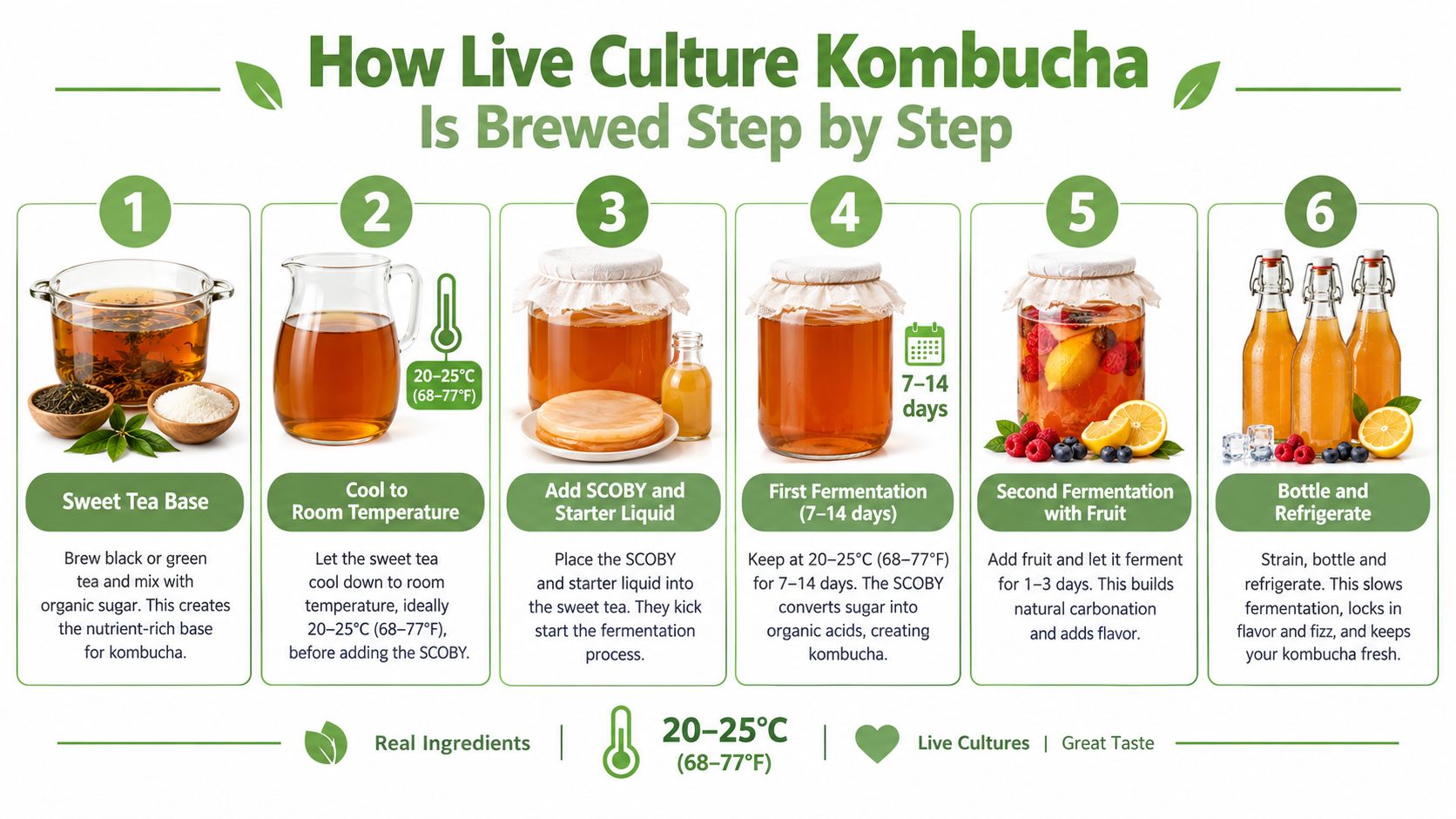
1. Build the sweet tea base
Black or green tea supplies the fermentation environment, flavour and plant compounds. Cane sugar feeds the yeast and bacteria. The brewer needs enough sugar to support the culture, but the finished drink shouldn't taste like sweet tea.
2. Cool before adding culture
Hot tea can damage the living culture. The sweetened tea is cooled to a suitable temperature before the brewer adds acidic starter liquid from a previous batch and the SCOBY. Starter liquid lowers the initial pH and helps the new batch begin in a safer, more stable environment.
3. Ferment the first stage
Primary fermentation commonly runs at 22 to 28°C for 5 to 14 days, depending on the recipe and conditions. During this stage, yeast and bacteria consume available sugars and generate organic acids, carbon dioxide and trace alcohol.
Taste and testing work together. A batch that's stopped too early may retain too much sugar and lack acidity. A batch left too long can become sharply sour, lose balance and continue changing in ways the brewer needs to monitor.
4. Flavour and bottle
The brewer adds ingredients such as ginger, lime or mango before bottling. Residual sugar gives yeast something to ferment in the sealed bottle, creating natural carbonation. This stage needs care because the same process that creates fizz can increase pressure and alter alcohol over time.
For a closer look at the first stage, PepTea's guide to kombucha first fermentation explains the role of tea, sugar, starter liquid and culture management.
A practical visual walkthrough can also help make the process easier to follow:
5. Refrigerate and monitor
Cold storage slows fermentation. It doesn't make a living drink static. Yeast and bacteria may continue working slowly, particularly when residual sugar remains, so temperature, distribution time and packaging all affect the final drink.
Small producers can often monitor these variables closely, especially when brewing for local cafés, retailers and direct customers. PepTea's kombucha is brewed in the Hunter Valley, NSW, where the brand describes its Australian-made range as organic, sugar-free and made with raw live cultures. That's one example of why production transparency matters more than a generic “fermented” claim.
Reading the Label on Live Culture Kombucha in Australia
Australian labels need to answer two separate questions: is the drink safe and legally described, and does it still contain viable cultures? Those questions overlap, but they aren't identical.
A drink can retain fermentation acids after treatment, while a live-culture claim depends on organisms surviving into the bottle. Likewise, refrigeration supports a live product but doesn't prove the claim by itself.
Four phrases with different meanings
- Raw: Usually signals that the product hasn't been heated in a way that would remove its living character, but check the producer's explanation.
- Unpasteurised: Indicates the drink hasn't undergone pasteurisation. It points more directly to the absence of post-fermentation heat treatment.
- Live cultures: Means the producer is claiming viable microorganisms remain in the product.
- Probiotic: Implies a health-related content claim that needs substantiation. Don't treat it as interchangeable with fermented.
The term “naturally fermented” describes a process, not necessarily the condition of the final bottle. If a brewer heat-treats the finished drink, the fermentation history remains true, but the live-culture story changes.
Alcohol and acidity are production controls
Australian food-safety information has highlighted alcohol variability in fermented drinks. In testing of 132 kombucha samples sold in 2017 and 2018, almost 65% contained more than 0.5% ABV and more than 22% exceeded 1.15% ABV, as reported in the Sydney Morning Herald coverage of kombucha and kefir alcohol content.
In Australia, drinks above 0.5% ABV must carry alcohol-content statements under the Australia New Zealand Food Standards Code. NSW treats products above 1.15% ABV as liquor, according to NSW Health guidance on fermented drinks and alcohol. Ongoing fermentation after packaging can contribute to alcohol drift, particularly when bottles are warm or contain residual sugar.
Acidity matters for safety too. Australian guidance uses pH controls to reduce contamination risk. Some guidance calls for a final pH below 3.0, while other state guidance uses a target below 4.2 within seven days. Queensland guidance also requires pH below 4.6 within 24 hours and recommends refrigeration to slow ongoing fermentation, as outlined in the Australian fermented beverages issues paper.
| Label claim | What it means | Live culture implication |
|---|---|---|
| Raw | The producer presents the drink as minimally heat-treated | Cultures may remain, but check the full process |
| Unpasteurised | No pasteurisation has been applied | Stronger indication that fermentation microbes may survive |
| Contains live cultures | Viable bacteria and yeast are claimed in the bottle | Look for refrigeration and clear storage guidance |
| Probiotic | A health-related microbial claim | Ask whether the claim is substantiated and specific |
| Shelf-stable | Designed to remain at room temperature | Treat as a warning sign if you're seeking living cultures |
Sugar-free claims also need context. A product described as sugar-free under the relevant food-labelling convention may contain less than 0.5 g per 100 mL, but the nutrition panel remains the most useful place to check the actual formulation. A bottle that sits warm on a shelf may have had its live-culture promise altered through filtration, heat treatment or continued fermentation.
Serving, Storage and Using Kombucha as a Mixer
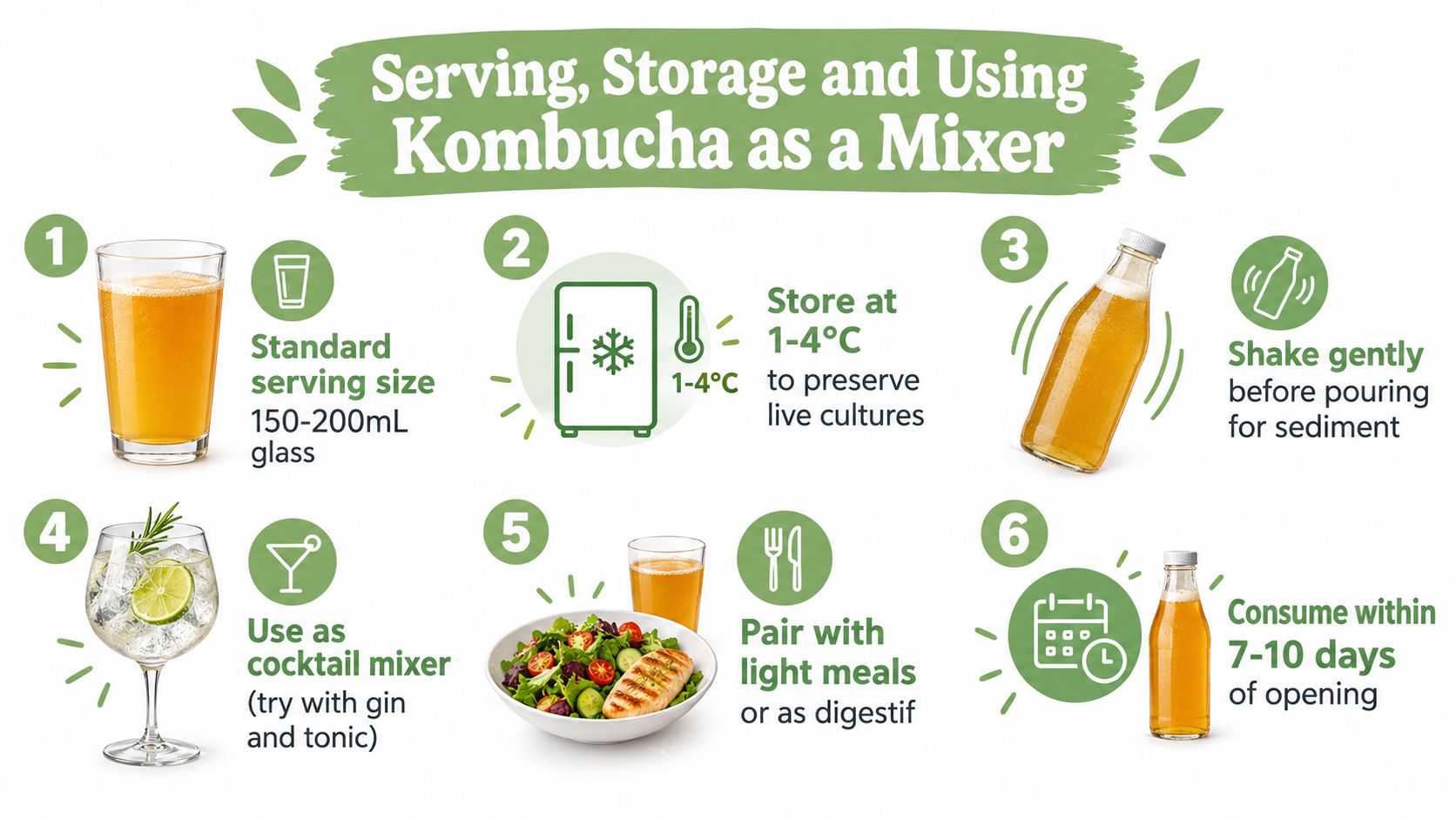
Kombucha works best when you treat it as a food and a flavour ingredient, not a shot. A 150 to 200 mL glass is a sensible standard serving, while people with sensitive stomachs may prefer to start smaller.
Pour it slowly into a glass rather than drinking straight from the bottle. The aroma opens up, carbonation softens and you can judge the balance of sweetness, acidity and spice.
Match the acidity to food
Kombucha's brightness can cut through rich or fatty foods. Try it with:
- Grilled meats: Ginger notes can lift smoky or savoury flavours.
- Spicy curries: Acidity and carbonation refresh the palate between bites.
- Cheese boards: Tart kombucha balances creamy textures.
- Rich brunches: Citrus or ginger flavours work well with eggs, avocado and buttery pastries.
Flavour choice changes the pairing. PepTea's examples include Ginger, Lime & Ginger and Mango, each offering a different route into food matching without adding a sugary soft drink to the table.
Use it in a café-style drink
Kombucha makes a useful base for a non-alcoholic spritz. Pour it over ice with citrus and herbs, or combine it with soda water for a longer drink. In a cocktail, carbonation lifts botanical notes from gin, citrus and aromatic bitters, although the finished alcohol level depends on the other ingredients.
Cold-chain handling affects the experience as well as culture survival. A warm trip from a distribution centre to a retail fridge can accelerate fermentation, alter flavour and increase pressure. Check the sell-by date and choose bottles stored below 4°C, following the practical advice in PepTea's kombucha storage guide.
At home, refrigerate unopened bottles immediately. Keep them away from direct sun and hot cars. Once opened, reseal the bottle and aim to finish it within 2 to 3 weeks, while remembering that flavour and carbonation may change sooner.
Choosing a Live Culture Kombucha Worth Your Fridge Space
You don't need to become a fermentation scientist to choose well. A quick scan can reveal whether a bottle's live-culture story is supported by its ingredients, storage and producer information.
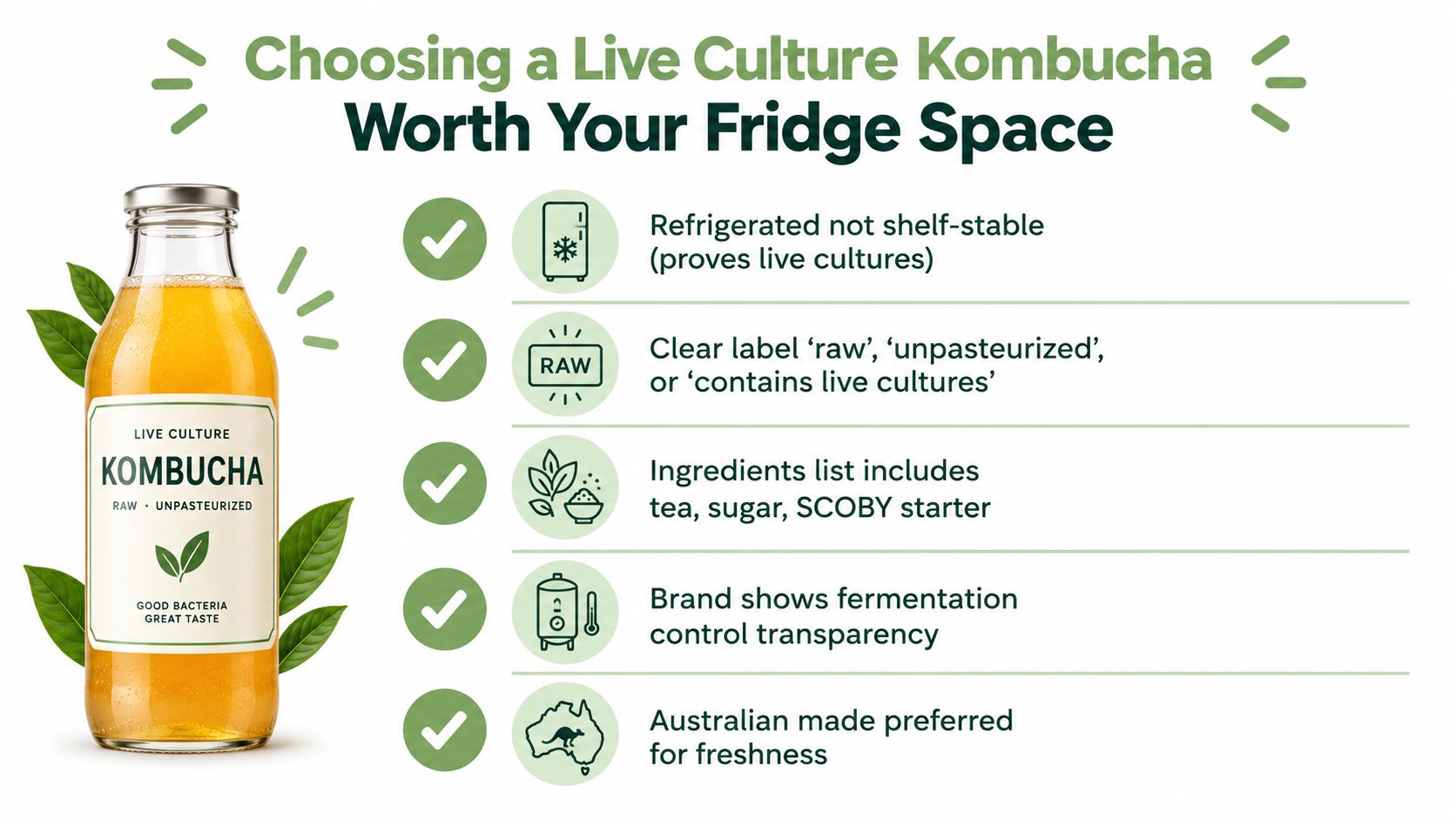
Start with the fridge. Refrigerated kombucha is generally a better sign for culture preservation than a shelf-stable bottle, though refrigeration alone isn't proof. Then inspect the wording and ingredients.
- Read the process language: Look for raw, unpasteurised or contains live cultures, and check for any statement about post-fermentation pasteurisation.
- Check the ingredients: Tea, sugar, starter culture and flavour ingredients are easier to understand than a long list of sweeteners, colours and stabilisers.
- Review sugar and alcohol: Sugar-free or low-sugar formulations may suit people reducing sweet drinks. Confirm the alcohol statement if you avoid alcohol or need a non-alcoholic option.
- Look for production transparency: A producer that discusses pH, refrigeration, batch control or fermentation gives you more useful information than one relying only on detox language.
- Notice the bottle condition: Natural sediment or activity can occur in a living drink, but absence of visible sediment doesn't prove that cultures are gone. Packaging material matters less than the process and storage record.
Glass can make a product feel more premium, but it doesn't guarantee viable cultures. A clear raw claim, a cold chain and sensible fermentation controls matter more than the container alone.
PepTea's sugar-free organic kombucha, brewed in the Hunter Valley, NSW, is one local example to compare against these criteria. The range includes flavours such as Ginger, Lime & Ginger and Mango, giving Australian shoppers a practical way to assess local live-culture kombucha by its label and handling rather than by wellness hype.
Explore Pep Tea's organic, Australian-brewed kombucha range to compare sugar-free flavours made with raw live cultures. Visit Pep Tea to shop online, learn more about fermentation, or enquire about supplying live-culture kombucha to your café or hospitality venue.
Kombucha First Fermentation: A Practical Aussie Guide

You've got a jar of sweet tea cooling on the bench, a SCOBY ready to go, and a vague instruction that says “leave it for ten days”. In Australia, that isn't enough to produce a reliable kombucha first fermentation. Room temperature changes, starter strength, acidity, oxygen exposure and alcohol formation all affect what happens inside the vessel.
After running first ferments in the Hunter Valley, I treat this stage as a food-safety control exercise first and a flavour exercise second. The taste matters, but pH, temperature and time decide whether the batch has developed the acidic barrier you need before flavouring, bottling or serving it.
Why First Fermentation Matters Most
In a Hunter Valley kitchen, the first ferment can look uneventful while the safety controls are already being decided. Sweet tea, a SCOBY and a covered vessel may produce a clean, tart drink, or leave a batch overly sweet, sharply acidic or unsuitable to keep. Temperature, starter strength, oxygen and time all affect that result.
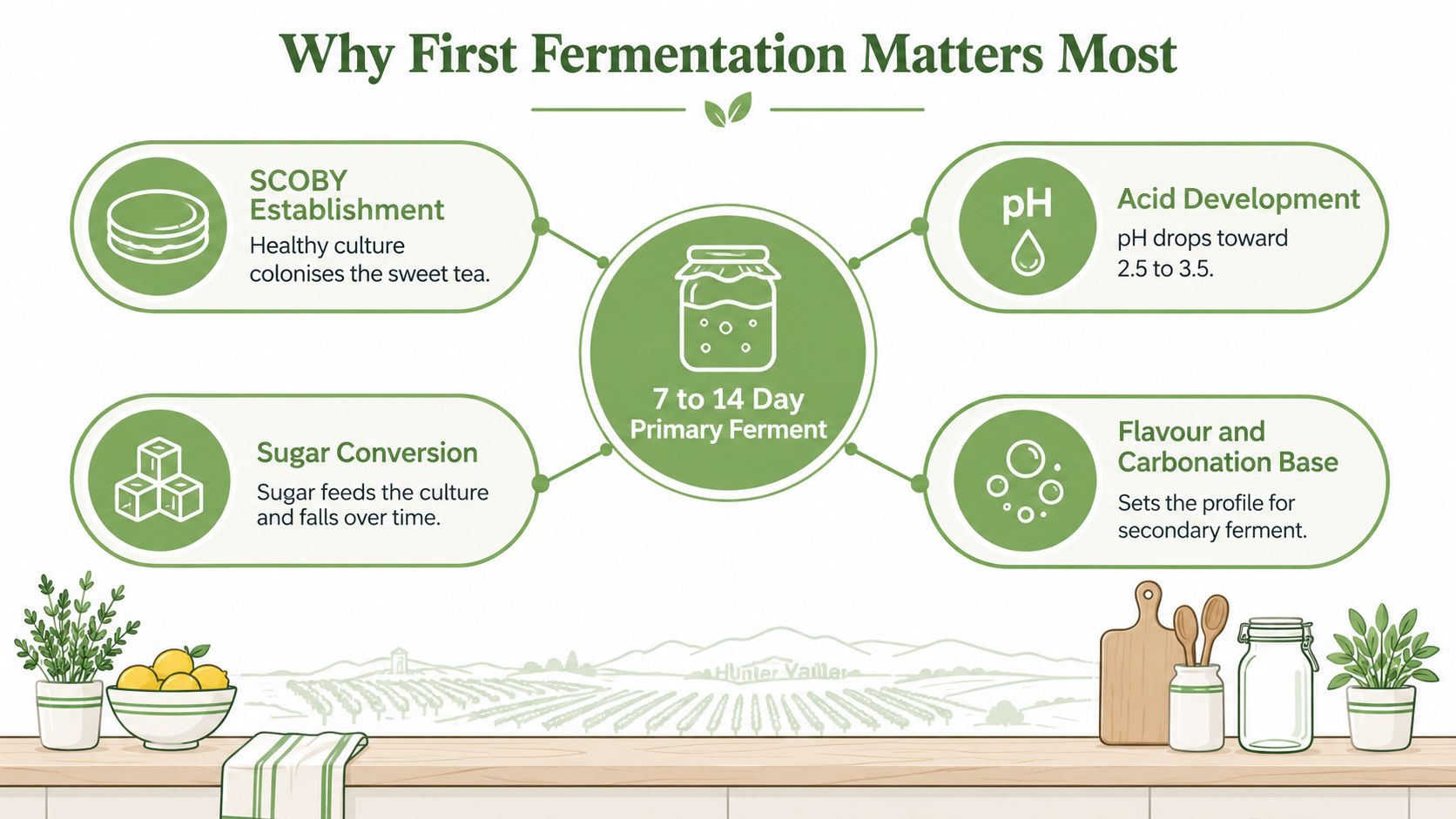
Treat first fermentation as a food-safety control exercise first and a flavour exercise second. The culture must establish itself in the tea, lower acidity and convert sugars before flavouring, bottling or serving. Yeasts use available sugars and produce compounds including alcohol. Bacteria use those products and oxygen to develop organic acids. The SCOBY is a living community, not merely the rubbery pellicle on the surface, so the starter liquid and brewing conditions matter.
Australian guidance describes first fermentation as an aerobic process, generally conducted in an open vessel. Add the SCOBY when the tea is between 22°C and 30°C, then allow roughly 7 to 10 days for fermentation to reach its intended endpoint, as outlined in Australian kombucha fermentation guidance.
What the first ferment builds
Four outcomes depend on this stage:
- Culture establishment: Yeast and bacteria colonise the sweet tea and compete with unwanted organisms.
- Acid development: The brew needs to reach pH below 4.2, identified in Australian fermented-beverage guidance as a key safety milestone.
- Sugar conversion: As the culture consumes sugar, the liquid moves from sweet tea towards a tart fermented drink.
- Flavour foundation: Tea tannin, acidity, residual sweetness and fermentation aroma set the base for later flavouring.
The calendar cannot confirm that the batch is ready. Australian food-safety material advises reaching pH below 3.0 by day 7, with batches discarded if they have not reached that level by day 10, as reported in the Australian fermented beverages issues paper.
Practical rule: A bottle cannot repair a weak or poorly acidified first ferment. Measure the base brew before adding fruit, herbs or carbonation.
Room temperature changes the risk. A warm Hunter Valley room can accelerate fermentation, while a cold garage can leave the culture sluggish. Rushing creates a sweet, less protected base. Leaving it unchecked can produce vinegar-like sharpness and increase alcohol risk. Time, temperature and measurement should guide flavour decisions, not the calendar alone.
Preparing Sweet Tea and Adding the SCOBY
Start with clean, low-chlorine water if possible. Strong chlorine can interfere with the culture, so filtered water is a sensible choice when your tap water has a noticeable swimming-pool smell. Use a tea that can support fermentation, such as a plain black or green tea, rather than a blend containing oils or strongly aromatic additives.
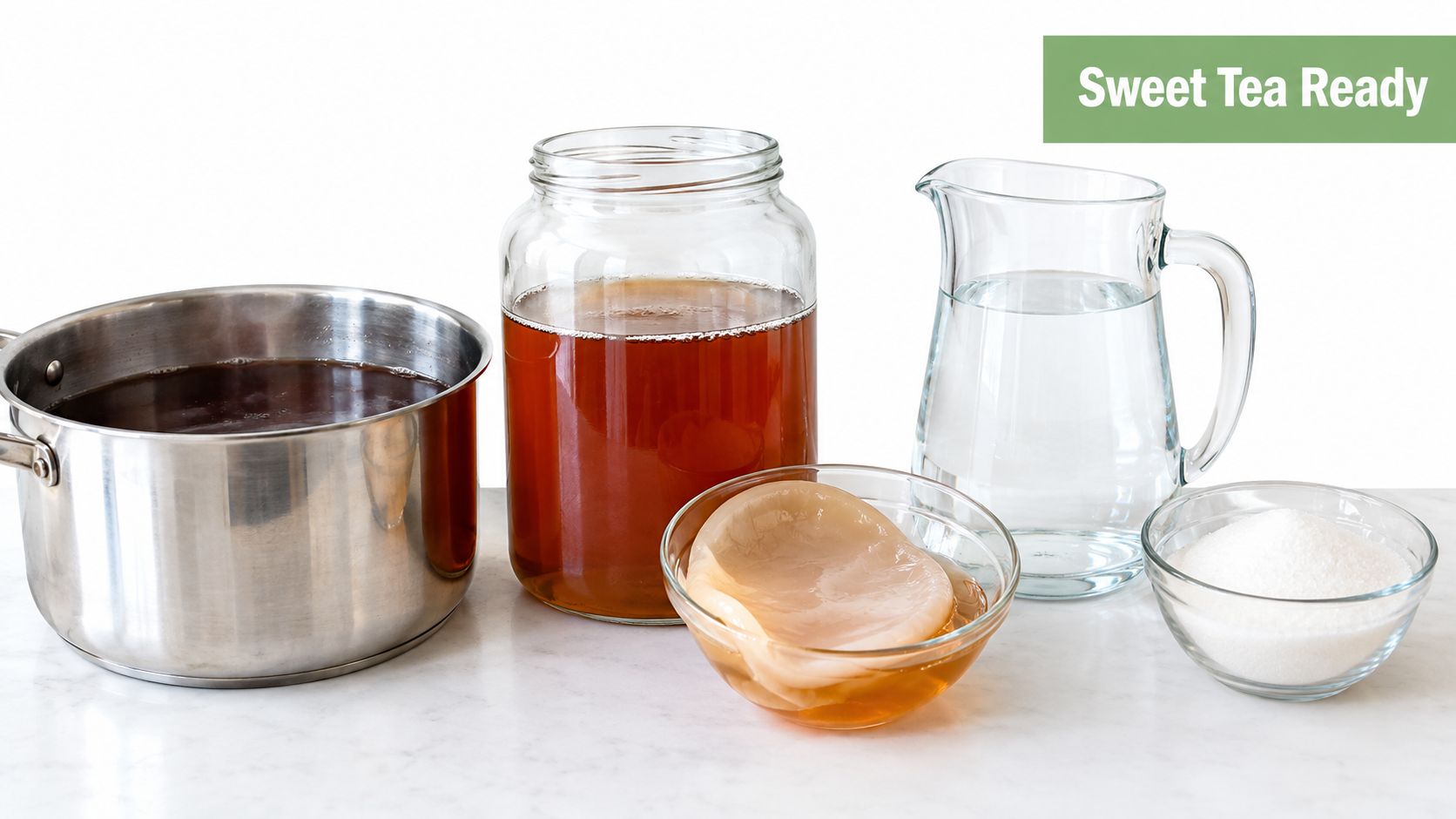
For a practical Australian home batch, dissolve about 200 grams of sugar per 4 litres of tea. This ratio appears in the Australian kombucha brewing guidance, and the sugar isn't there only to sweeten the finished drink. It gives the yeast and bacteria the food they need to develop acidity and the flavour backbone of kombucha.
Cool the tea before inoculation
Brew the tea, dissolve the sugar completely and remove the tea leaves before transferring the liquid to the fermentation vessel. Don't add the SCOBY or starter liquid while the tea is hot. Australian guidance says the tea should cool from about 60°C to 20°C within 2 hours, with the SCOBY added immediately once the temperature is suitable, as described in official Australian fermentation controls.
For home brewing, the practical checkpoint is room temperature, below 30°C before the culture goes in. A clean thermometer is more dependable than placing a finger against the pot. If you're brewing a large volume, divide the tea into shallow food-safe containers so it cools promptly, then combine it once the temperature is right.
Choose a wide-mouth food-grade glass jar, stainless-steel vessel or suitable food-safe plastic container. Avoid reactive metals and damaged ceramics. The wide opening gives the aerobic culture useful access to air and makes it easier to inspect the surface without disturbing the brew.
Add a healthy SCOBY with plenty of mature, unflavoured starter liquid. The pellicle may be pale, brown, uneven or stringy, and those appearances alone don't tell you whether the culture is active. What matters is a clean fermented aroma, sound starter liquid and early acidification. Pour gently, then let the culture float, sink or sit at an angle without trying to force it into position.
For equipment and starter supplies, the Pep Tea kombucha tea kit is one Australian option to consider. Cover the jar with a tightly secured breathable cotton cloth. It needs airflow, but the cover must keep out dust and the fruit flies that become a real nuisance during warm Australian weather.
The first ferment needs protection from contamination, not an airtight seal. Keep the vessel clean, labelled and easy to monitor.
Running the Ferment at the Right Temperature
In a Hunter Valley summer, a jar can move from balanced to sharply sour before you expect it. In winter, the same recipe may acidify slowly. Temperature controls the culture's pace, so treat the first ferment as a food-safety control exercise before adjusting it for flavour. I find 22°C to 28°C practical for a balanced brew, while broader room-temperature conditions and a SCOBY addition around 22°C to 30°C are also described in Australian fermentation research.
Keep the jar away from direct sun, ovens, hot-water systems and cold draughts. A stable shelf is safer than a windowsill, where daily temperature swings can be considerable. Gentle environmental warming may help in a cool room, but never place the vessel directly on a hot surface or push the brew beyond its workable range. The practical relationship between heat and microbial activity is explained in this overview of how temperature affects bacterial growth.
A warm batch can acidify quickly. A cool batch may take longer, so record room temperature rather than extending fermentation blindly.
What you should see and smell
Early changes can look untidy. Brown yeast strands may form, sediment may collect, and a thin surface film or uneven pellicle may develop. These observations help you follow the batch, but only pH testing confirms whether acidification is progressing safely.
| Day | Visual cues | Aroma and taste | Target pH |
|---|---|---|---|
| 2 | Yeast strands or sediment may appear | Sweet tea with a light fermented aroma | Confirm an early downward trend |
| 4 | Surface film or pellicle may begin developing | A mild acidic edge starts to appear | Check that acidification is progressing |
| 7 | Culture looks more established | Sweetness has receded and tartness is clearer | Australian guidance uses pH ≤4.2 as a key control point, with some advice aiming below 3.0 |
| 10 | Pellicle may be thicker and uneven | More pronounced acidity, possibly vinegar-like | Discard if the stricter day-10 pH endpoint hasn't been reached |
| 12 to 14 | Mature, settled surface | Stronger sourness and reduced sweetness | Judge with pH, aroma and taste together |
Taste a small sample with a clean utensil. Repeated dipping introduces contamination and makes the jar harder to manage. Once tartness is clear, check more often and stop the first ferment before the flavour overshoots your preference.
A cold winter batch should not be left indefinitely. Log the room temperature, inspect the vessel and confirm that pH is moving in the right direction. If acidification stalls, assess the batch against your discard criteria rather than assuming extra time will correct it.
Reading Acidity, pH and Carbonation Cues
A finished first ferment has a different character from the sweet tea you started with. The sweetness softens, acidity becomes obvious, and the aroma moves from brewed tea towards a clean tart fermentation note. A gentle hiss can indicate dissolved carbon dioxide, but carbonation is not the completion test.
Use a calibrated digital pH meter and take a small sample from the liquid, not from the pellicle. Rinse the probe between batches and calibrate it according to the instrument manufacturer's directions. Cheap strips can be difficult to read in a dark, strongly coloured tea, so they're better treated as a rough warning tool than as your only control.
The Pep Tea digital pH meter is one example of the kind of instrument a home brewer or café can use to make the endpoint less subjective. The useful habit is to log readings alongside temperature, aroma and taste rather than relying on a single number taken at the end.
What Australian samples tell you
Australian scientific testing gives a useful reality check. A study of six Australian-origin kombucha samples recorded pH values from 3.21 ± 0.01 to 3.90 ± 0.01, including two products at 3.54 ± 0.01 and 3.40 ± 0.01, with every sample below the widely used safety threshold of 4.6 (Australian kombucha sample data).
Those figures aren't a universal recipe or a permission to ignore your own batch. They show that properly fermented products are strongly acidic, while Australian guidance still uses its own process controls and endpoints. A reading below 4.2 is a critical milestone in official guidance, and some Australian advice sets a stricter target below 3.0 by day 7, as noted earlier.
The following table is a practical planning tool, not a substitute for measuring. The exact days and carbonation will vary with culture health, sugar availability, vessel shape and handling.
| Temperature range | Typical days to pH 3.3 | Taste profile | CO₂ level at day 7 |
|---|---|---|---|
| Below 18°C | May be delayed or stalled | Sweet, tea-forward and under-acidified | Usually low |
| 18°C to 22°C | Longer first ferment | Mild tartness with noticeable tea character | Developing |
| 22°C to 28°C | Often the most active working range | Balanced tartness and reduced sweetness | Noticeable but variable |
| 28°C to 30°C | Can move quickly | Sharper acidity and faster flavour change | More active but unpredictable |
Don't use a hypothetical temperature-to-day calculation as a release decision. A warm brew can acidify faster, but the same speed can make the flavour run past your target before you notice.
If you have no meter, acidity can be assessed more crudely with titration-style testing using sodium hydroxide drops, but that approach requires the correct food-testing materials, concentration and method. It shouldn't replace a calibrated meter in a café or commercial setting.
Alcohol also complicates the picture. Once the culture has consumed much of the available sugar, falling sweetness doesn't guarantee that alcohol formation has stopped. That is why a tart taste and a low pH are useful but incomplete indicators of compliance.
Food Safety, Alcohol Risk and Common Failures
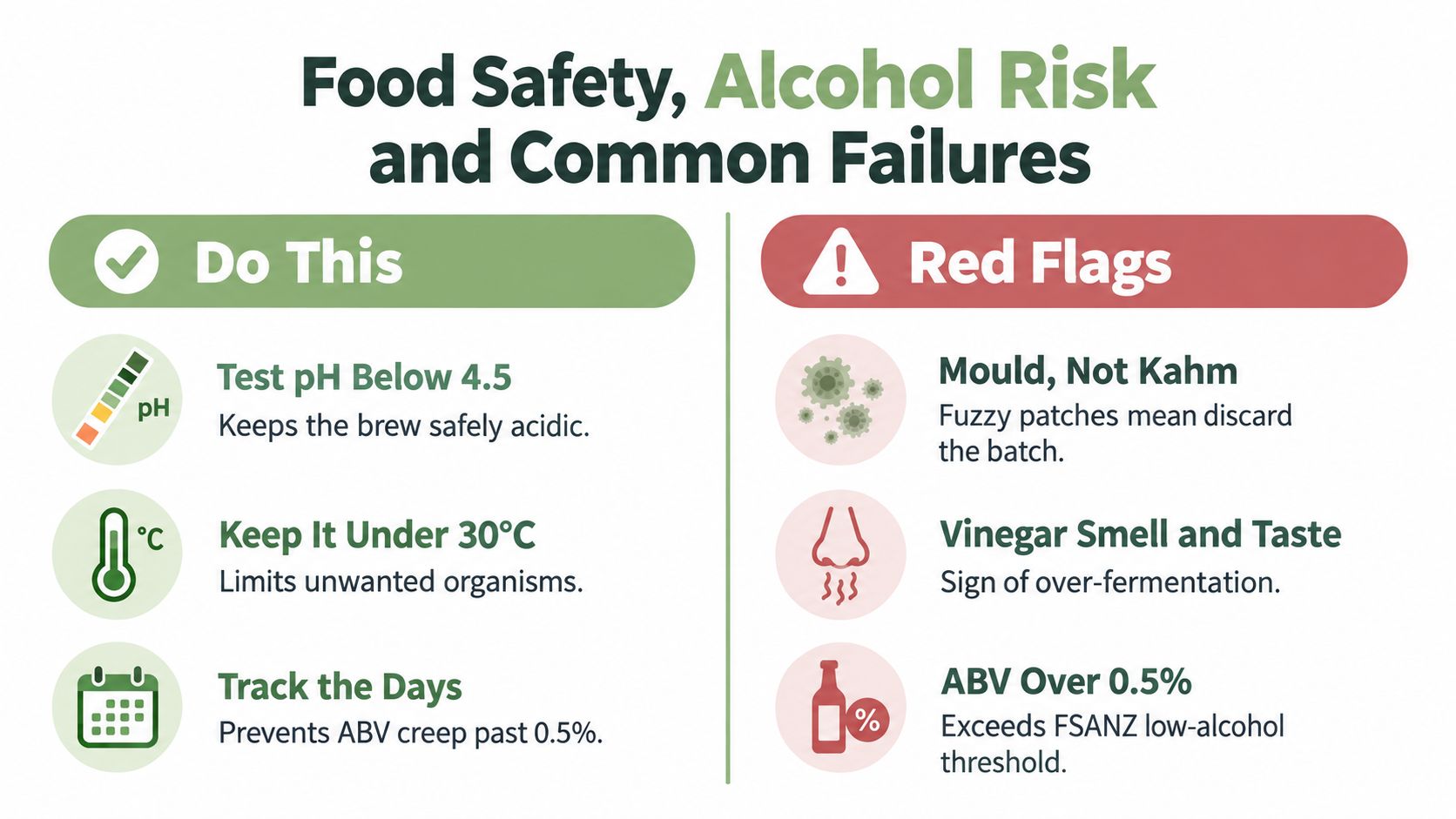
“Leave it for ten days and taste it” is not a food-safety plan. Australian guidance treats kombucha as a time- and temperature-sensitive aerobic process, with pH monitoring as the critical control point and pH ≤4.2 used as a key safety threshold (Australian food-safety guidance).
Australia also has an alcohol issue that casual home-brewing advice often skips. Testing reported in Australian retail fermented soft drinks found that, among 132 kombucha samples, almost 65% contained more than 0.5% alcohol, and more than 22% were above 1.15% ABV (Australian reporting on kombucha alcohol).
Queensland guidance says beverages containing 0.5% alcohol by volume or more require an alcohol-content declaration under Standard 2.7.1 of the Food Standards Code (Queensland fermented-food guidance). For cafés and retailers, “non-alcoholic” positioning can't rely on intention. Fermentation time, temperature, storage and secondary bottle fermentation can all affect the result.
Red flags mean discard
Discard the entire batch if you see fuzzy mould, especially coloured or raised patches, or smell something putrid, rotten or distinctly unlike clean fermentation. A smooth pellicle, yeast sediment and harmless surface variation can look odd, but fuzzy growth isn't a sign to skim and continue.
Other common failure patterns include:
- Stalled acidification: Chlorinated water, a weak starter or a cold room can leave the culture slow. Check the pH trend, temperature and starter quality rather than adding random ingredients.
- Over-fermented vinegar character: Excessive time or warmth can push the flavour towards harsh vinegar. Stop earlier next time, but don't dilute a questionable batch and present it as safe.
- Poor culture performance: Non-standard starters and “back-slopping” can reduce consistency and increase contamination risk. Australian food-safety sources recommend clean glass or food-grade plastic and warn against relying on unverified starter material.
- Alcohol creep: Longer fermentation and warmer conditions can raise alcohol formation. Keep a written batch record and arrange appropriate alcohol testing if you sell or serve the drink.
The first fermentation is also different from secondary bottle fermentation. Once the brew is sealed with flavouring, carbon dioxide and alcohol can continue changing during processing and storage. That makes careful first-ferment control necessary, but it doesn't make the first-ferment reading a guaranteed final ABV result.
For a cautious starting point, use the Pep Tea home-brew kombucha guide alongside your own pH and temperature records. If a batch doesn't meet the relevant endpoint, smells wrong or shows mould, don't taste-test your way to reassurance.
Your Australian First Ferment Checklist and Next Steps
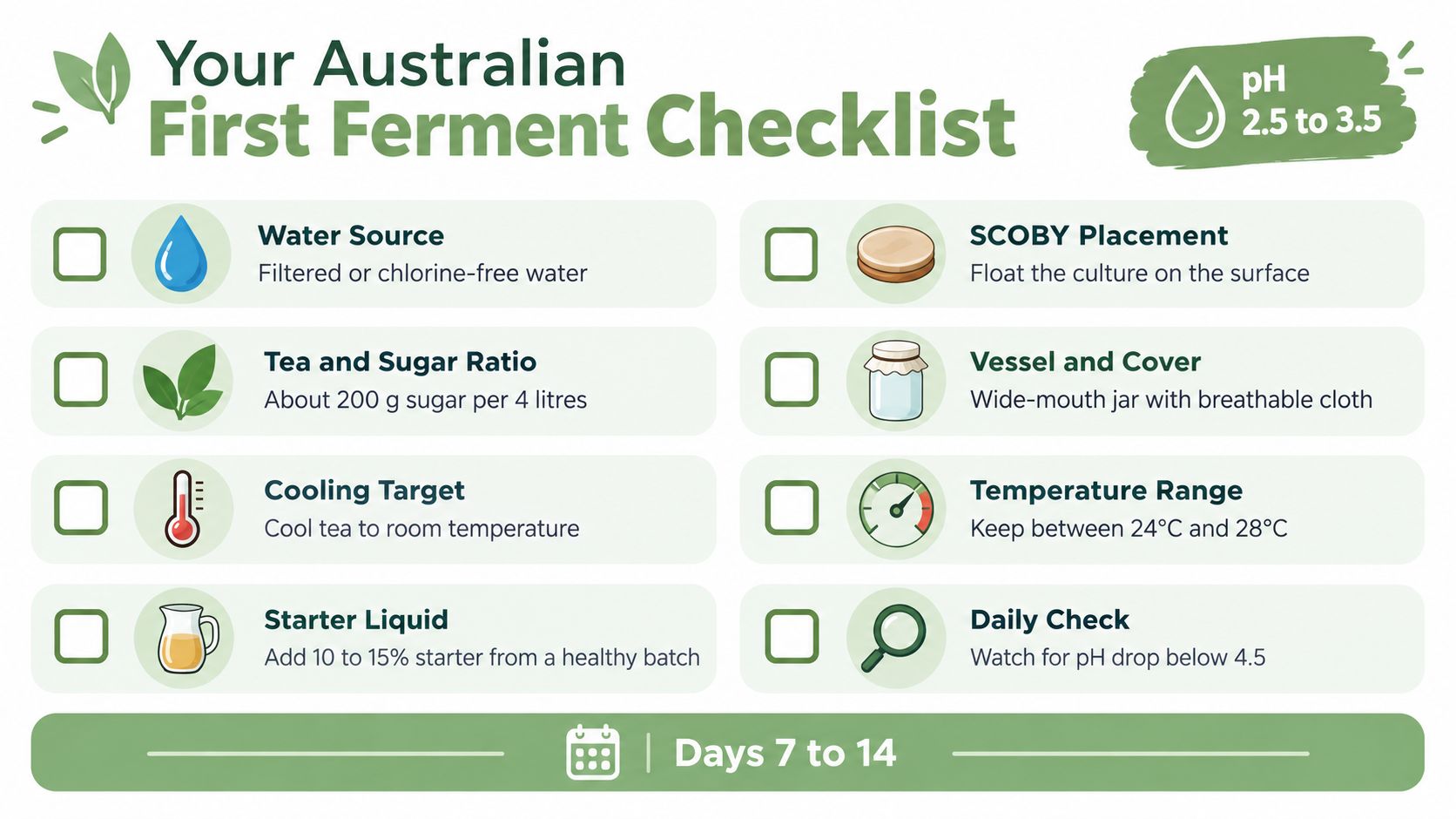
Print this checklist, photograph it and keep it above the brew bench. It turns kombucha first fermentation from a loose kitchen routine into a repeatable process that a household or café team can follow.
Setup
- Water source: Use filtered or chlorine-free water where practical.
- Tea and sugar: Work from about 200 grams of sugar per 4 litres, using a suitable plain tea.
- Cooling target: Cool the tea to room temperature, and add the culture below 30°C.
- Vessel: Choose clean glass, stainless steel or food-safe plastic. Avoid reactive metals and damaged ceramics.
- Starter liquid: Use a healthy, unflavoured starter from a reliable batch.
- SCOBY handling: Add the culture gently and allow it to remain exposed to air.
- Cover: Secure breathable cotton over a wide-mouth vessel so air can enter while insects stay out.
Active ferment
- Temperature: Keep the vessel stable, preferably within the practical 22°C to 28°C working range.
- Position: Store it away from sunlight, heaters, ovens and cold draughts.
- Daily log: Record room temperature, appearance, aroma and taste.
- pH checks: Monitor early acidification rather than waiting until the final day.
- Day window: Treat 7 to 10 days as an Australian process benchmark, not an automatic finish time.
- Discard rule: Follow the applicable Australian endpoint, including stricter guidance that calls for pH below 3.0 by day 7 and discarding a batch that hasn't reached that level by day 10.
Pre-bottling gate
Before you flavour or seal the brew, confirm that the pH is safely acidic, the aroma is clean, no mould is present and the taste suits your intended product. Remember that carbonation and alcohol can continue changing after bottling, so cafés and retailers need a broader verification process than a home brewer serving a small batch immediately.
Choose a batch system if you want clear start and finish dates and easier comparisons between recipes. A continuous-brew setup can reduce handling between batches, but it still needs disciplined cleaning, pH records and a reliable culture. For the next brew, record the starting tea, sugar, starter, room temperature and endpoint so you can adjust one variable at a time.
Pep Tea offers Australian-brewed sugar-free organic kombucha from the Hunter Valley, NSW, as well as organic tea products for people who want a professionally controlled option while learning what a sound first fermentation should deliver. Visit Pep Tea to explore the kombucha range, brewing resources and wholesale options for cafés and hospitality venues.