
Tag: kombucha ABV
Non Alcoholic Kombucha and the 0.5% Line
In Australia, non-alcoholic kombucha is a drink that stays at or below 0.5% alcohol by volume (ABV) throughout the bottle's shelf life, not merely when it is filled. A multi-state survey found that only 35.2% of samples were below 0.5% ABV.
That finding is a reason to look beyond wellness language on the label. Fermentation can leave alcohol in a drink that tastes refreshing and sits in the soft-drink fridge. The practical question is whether the brewer controls the packaged kombucha to its alcohol specification until the end of its shelf life.
What Counts as Non Alcoholic Kombucha
Non-alcoholic doesn't mean zero alcohol. For a shopper or café, the practical distinction is between a drink controlled to a low-alcohol specification and one confirmed to contain no alcohol. Those aren't interchangeable promises.
The Food Standards Australia New Zealand survey of fermented soft drinks tested 132 kombucha products collected across New South Wales, Victoria, Queensland, South Australia and Tasmania, finding the distribution shown below. Its guidance identifies an alcohol-statement requirement above 0.5% ABV and further declaration requirements above 1.15% ABV.
Australian kombucha alcohol bands and label consequences
| ABV band | Share of 132 products | Label consequence | Who needs this band |
|---|---|---|---|
| At or below 0.5% | 35.2%, measured below 0.5% in the survey | Can sit on the non-alcoholic side of the statement line if it stays there | Drivers and people considering pregnancy, adolescent, religious or recovery-related restrictions need further suitability checks |
| Above 0.5% and below 1.15% | 41.9% | Alcohol statement required | Anyone seeking a genuinely non-alcoholic drink needs to recognise this distinction |
| Above 1.15% | 22.9% | Further declaration rules under the Food Standards Code | Not a non-alcoholic serve |
The survey's lowest band was below, rather than explicitly at or below, the statement threshold. These are historical survey results, not a claim that every bottle currently on an Australian shelf has the same distribution.
More, the survey found that alcohol increased over product shelf life. A satisfactory result when a bottle is filled therefore doesn't establish what someone will drink near its best-before date.
A label category isn't personal clearance
The alcohol-statement threshold isn't a universal safety recommendation. A person avoiding alcohol completely may need a verified zero-alcohol alternative, even when a kombucha sits on the non-alcoholic side of the labelling line.
That distinction matters during pregnancy, for adolescents, for people taking certain medicines and for anyone in recovery. Drivers shouldn't treat a non-alcoholic description as a personal assurance about fitness to drive.
Religious suitability needs its own careful assessment, too. Our guide to whether kombucha is halal explores why fermentation, alcohol content and individual religious guidance all matter.
Ask the useful question: What is this product's alcohol specification, and has the brewer checked it through to the end of shelf life?
A café team doesn't need to become a testing laboratory. It does need a supplier who can answer that question clearly, with product information staff can use rather than a vague assurance that kombucha is healthy.
Check the alcohol band before treating any kombucha as alcohol-free. If complete avoidance is essential and the answer isn't clear, choose something else.
How Alcohol Forms and How Brewers Hold the Line
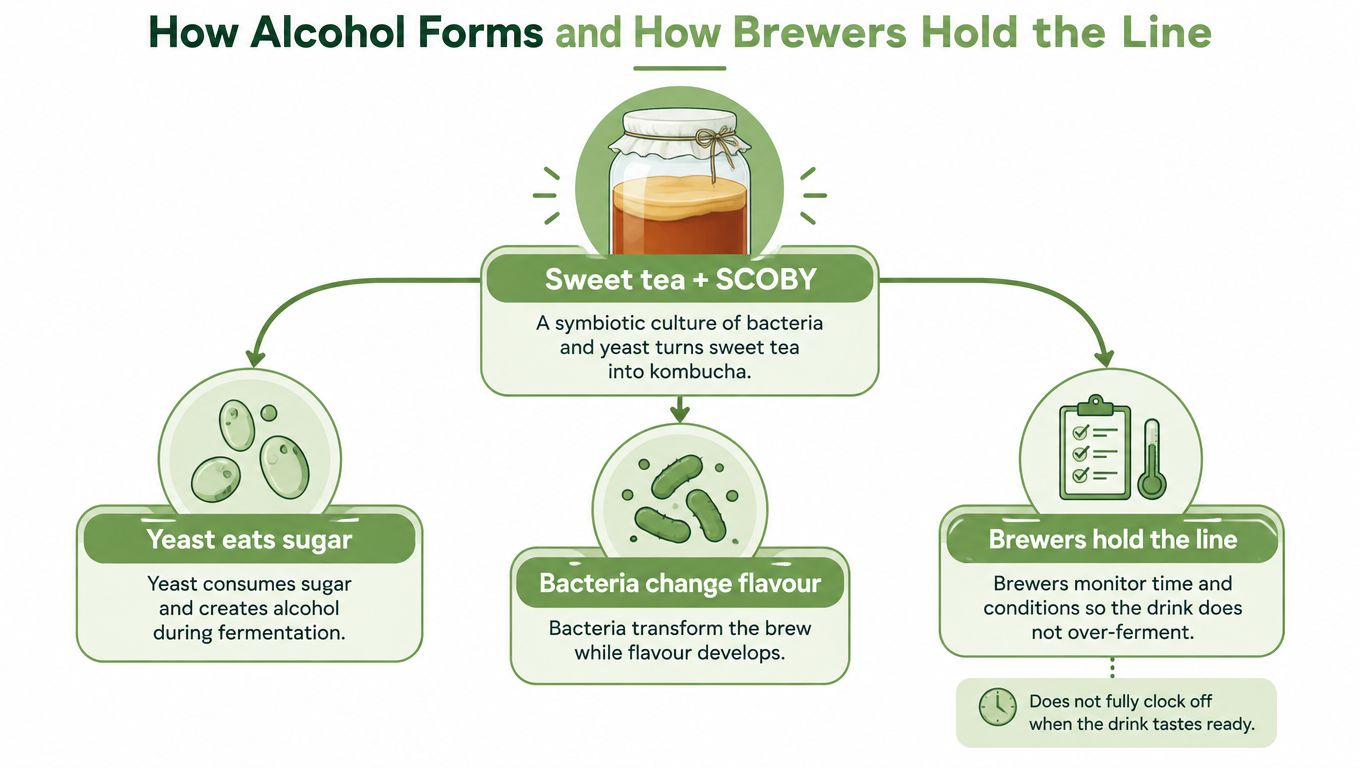
Sweet tea plus a SCOBY, a symbiotic culture of bacteria and yeast, is a tiny brewery that doesn't fully clock off when the drink tastes ready. The culture changes the tea, but different members of that culture do different jobs.
Yeast consumes sugar and produces ethanol and carbon dioxide. The carbon dioxide contributes fizz, while acetic-acid bacteria convert some ethanol into organic acids that give kombucha its tart character.
This process map shows why the brewer's monitoring matters as much as the ingredients.
What changes after bottling
Residual sugar can remain available to live yeast after packaging. Adding a sweet flavouring can also supply more fermentable material, so flavour development and product stability need to be considered together.
A sealed bottle isn't a guarantee that fermentation has ended. Warmth and time can allow the culture to keep changing the drink, including its alcohol content and internal pressure.
Pasteurisation and refrigeration do different jobs. Properly applied heat treatment inactivates fermenting organisms, but it doesn't remove alcohol already present and it changes the live-culture character. Refrigeration slows activity rather than turning a raw product into a permanently inactive one.
For a broader explanation of how brewers manage yeast, temperature and fermentation stages, the brewing insights from Carbon 6 Brewing offer useful context. Beer and kombucha have different production goals, so beer-brewing practices aren't a substitute for a validated kombucha process.
The controls a buyer can ask about
The FSANZ practical guidance for kombucha production describes an initial tea infusion around pH 5, recommends cooling from 60°C to 20°C within two hours, and discusses less than 1% alcohol as a typical target. That production guidance shouldn't be mistaken for the stricter non-alcoholic specification a supplier may need to meet.
A documented commercial process should address the following controls in order.
Cool the brewed tea promptly.
Record the cooling process with a suitable thermometer and a batch sheet. The starting tea hasn't yet developed the acidity of finished kombucha, so leaving it warm while waiting for fermentation isn't a sound contamination control.Start with clean equipment and a proven culture.
Clean vessels, taps, transfer lines and utensils before sanitising them. Use an uncontaminated starter with a known production history, rather than assuming that any culture forming a surface layer is suitable.Track fermentation conditions.
Log temperature and duration, and measure pH at defined production points using a calibrated pH meter. These records help the brewer recognise a batch behaving differently from the validated process.Protect flavouring and filling.
Ingredients, funnels, hoses and bottle closures can introduce contamination after the main ferment. A producer should control ingredient handling and cleaning at this stage, not treat the finished tea's acidity as protection against every mistake.Verify the packaged product.
Set a written alcohol specification, test representative batches with a fit-for-purpose analytical method and verify performance across shelf life. Include realistic storage conditions in the assessment rather than relying only on a freshly filled sample.
What those measurements can and can't tell you
A pH meter measures acidity, not alcohol. A pleasant sour taste doesn't establish ABV either, and a basic brewing hydrometer reading shouldn't be treated as proof of trace-alcohol compliance in a complex fermented drink.
For purchasing decisions, ask the supplier what method it uses and whether that method is suitable for its required alcohol range. The useful answer describes a testing programme, not just a piece of equipment.
A HACCP-accredited, purpose-built Hunter Valley brewery is an example of a documented production setting. Accreditation supports a systematic approach to hazards, but it isn't, by itself, a test result for every bottle or proof that every raw kombucha meets its specification.
Acidity can be one part of a controlled process. It cannot prove that a ferment is safe, uncontaminated or non-alcoholic.
Home brewers deserve the same clarity. A kitchen batch may look and taste excellent without having a verified alcohol result, so don't offer it as an assured non-alcoholic option to someone whose avoidance is essential.
Sugar Claims Probiotics and What You May Say
No added sugar, sugar-free and low sugar aren't interchangeable. Fermentation changes the sugar profile, but it doesn't automatically make the finished drink suitable for any of those claims.
The FSANZ nutrition and health-claims guidance explains that Standard 1.2.7 governs voluntary nutrition-content and health claims, which must meet specified criteria. It also states that health claims aren't permitted on foods high in saturated fat, sugar or salt.
What kombucha sugar phrases do and do not mean
| Phrase | What it can mean | What it does not prove | Alcohol link |
|---|---|---|---|
| No added sugar | No qualifying added sugars under the applicable claim rules; check the ingredients and production context | Residual sugar from the brew or flavouring is zero | None |
| Sugar-free | The finished drink meets the compositional criteria for that nutrition claim | Any fermented tea is automatically sugar-free | None |
| Low sugar | The product meets the applicable criteria for that claim | A wellness or probiotic health claim is allowed | None |
For kombucha, reading "no added sugar" as merely no extra sugar after fermentation is too loose. The claim must fit the product's ingredients and applicable rules, not just the brewer's description of the final mixing stage.
Read grams of sugar per serve, then check how much you'll pour. A larger glass or a splash of juice changes the comparison with the original bottled drink.
Live cultures aren't a medical promise
Unpasteurised kombucha can contain live cultures, organic acids and compounds from tea and fermentation, including amino acids, B vitamins and trace minerals. Their presence doesn't establish a meaningful nutritional dose or a proven health benefit.
A live-culture drink may support everyday gut comfort for some people as part of a varied diet, but that isn't a promise to fix digestion. The distinction between cultures being present and a demonstrated probiotic benefit matters, as our guide to how many probiotics are in kombucha explains.
- Compare the drink, not the slogan. A sugar-free organic kombucha can be a tart, lightly fizzy alternative to soft drink without needing a superfood story.
- Keep expectations realistic. Don't buy it on promises about immunity, weight loss or treatment of digestive conditions.
- Remember the tea base. Kombucha can contain caffeine, which is separate from its sugar and alcohol content.
Pregnant consumers and anyone managing a medical condition should check with their health professional before making kombucha a daily habit. Individual suitability matters more than a general wellness label.
Cafe Serves and Simple Home Recipes
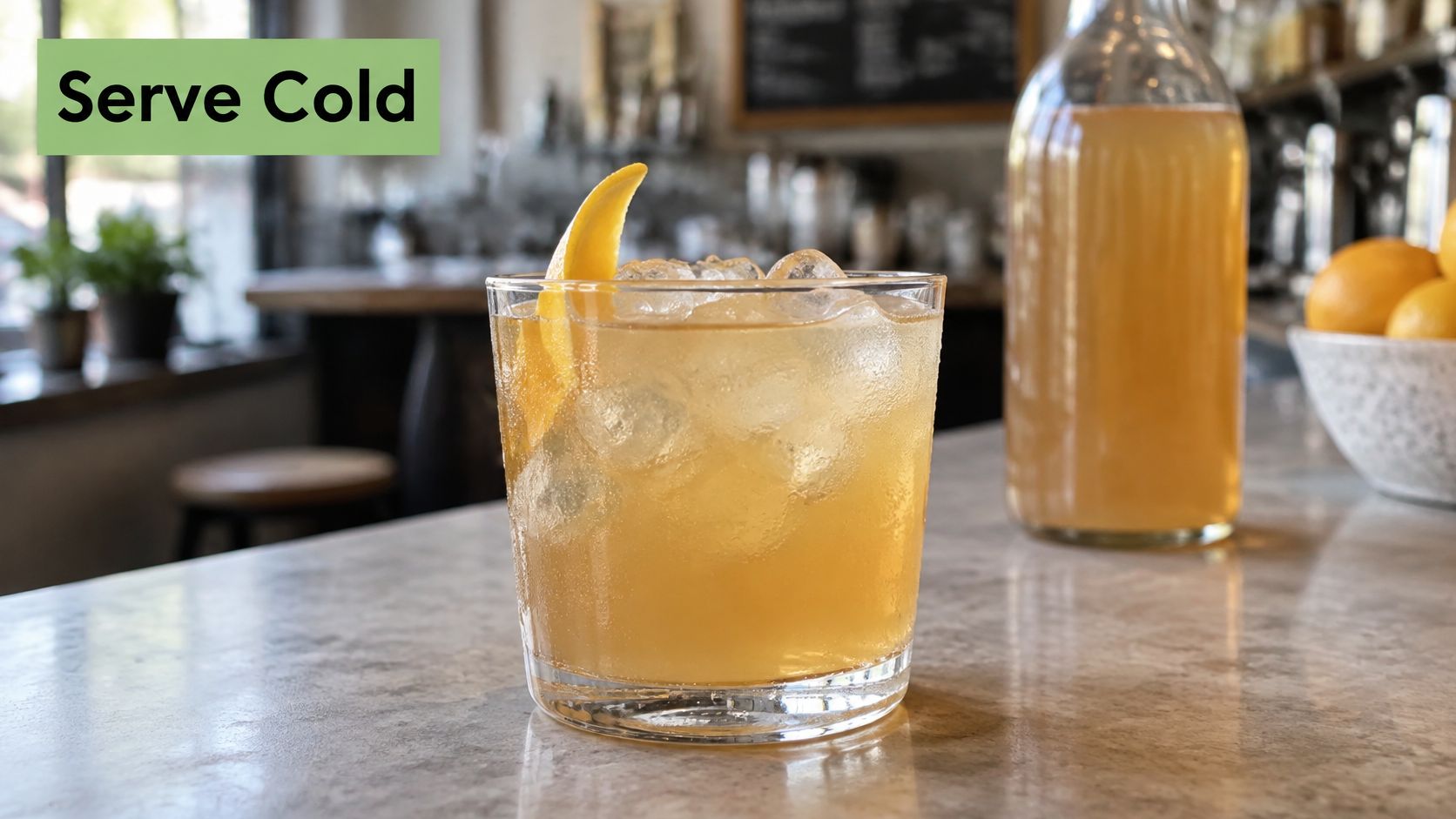
Kombucha can be served easily: chill it well, pour over ice and add citrus peel if you like. Start with a flavour you enjoy straight from the bottle, then use plain soda to make it lighter without masking the tea.
Easy serves to try
The quantities below are recipe suggestions, not product specifications or nutrition claims.
- Straight over ice. Pour 250 to 330 mL very cold kombucha over ice and add citrus peel. Ginger, Lime & Ginger, or Mango can provide plenty of flavour without cordial.
- A longer spritz. Mix two-thirds kombucha with one-third plain soda water in a tall glass. Skip tonic and sweetened mixers if you want to avoid adding sugar.
- A citrus granita. Allow about five minutes of preparation. Combine 350 mL kombucha with a teaspoon of citrus zest, taste, then add an optional tablespoon of caster sugar. Pour into a shallow freezer-safe tray and scrape with a fork every 30 minutes for two to three hours, until icy flakes form.
- A matcha café cooler. Whisk half a teaspoon of ceremonial-grade matcha with 30 mL water, then let it cool. Pour it gently over 150 mL cold kombucha and ice, leaving the green layer floating rather than stirring in sweet syrup.
The granita becomes a dessert rather than a sugar-free serve if you add caster sugar. Freezing also doesn't establish whether a drink meets an alcohol specification. The video below shows another serving idea.
Give café staff usable menu information
A clear menu line should name the flavour, verified sugar position and supplier-confirmed ABV band. That gives staff useful product information to share instead of leaving them to improvise a suitability claim. For kombucha, “non-alcoholic” depends on the relevant specification and the product's alcohol level over its shelf life, so use the supplier's confirmed information.
Confirm menu wording with your supplier before sending it to print. If you're comparing production options, cafe menu printing services from The Print Warehouse Ltd offer a reference for presenting details legibly.
NSW-brewed sugar-free organic flavours can make straightforward ready-to-pour options. Organic matcha gives the cooler a separate tea-based flavour; choose ceremonial-grade matcha when you want its taste to remain noticeable without sweetening.
The best simple serve tastes like the bottle, only colder.
Fruit juice and liqueur-style syrups can mask the kombucha's flavour and change the original sugar position. Avoid holding prepared kombucha drinks in a warm cabinet.
Fridge Storage and When Not to Serve It
Keep unopened raw kombucha refrigerated according to its label. A kitchen bench, hot car or café fridge that runs warm isn't suitable storage for a living fermented drink.
Stand bottles upright, keep them out of direct sunlight and respect the labelled date. Once opened, reseal the bottle promptly and finish it within a few days, unless the manufacturer gives a shorter instruction.
What's normal and what isn't
A little sediment or a light haze can be normal in a live drink. It doesn't automatically mean spoilage, and a perfectly clear appearance doesn't establish that a bottle is safe or within its alcohol specification.
Don't serve a bottle showing these warning signs:
- Abnormal pressure. The container is swollen, unusually hard, leaking or visibly damaged.
- Solvent-like odour. The smell is harshly reminiscent of nail-polish remover rather than fermented tea.
- Severely deteriorated flavour. An otherwise normal-looking bottle tastes only of harsh vinegar, with none of its expected tea character.
Don't taste a swollen or otherwise suspect bottle to investigate it. Isolate it, avoid shaking it and follow the supplier's disposal advice, particularly if pressure makes handling unsafe.
Adding juice won't rescue a questionable product. If a commercial bottle seems abnormal, retain its batch details and contact the supplier rather than serving it to guests.
A practical home check
- Fridge first. Put raw kombucha away promptly after shopping.
- Upright storage. Keep the closure secure and the bottle stable.
- Date check. Use it within the labelled period and storage conditions.
- Pour check. For an otherwise sound bottle, check the expected aroma and flavour before serving guests.
A home ferment needs the same respect for hygiene and cold storage, but it isn't equivalent to a commercially tested packaged specification. A warm bottle also doesn't become verified again just because you return it to the fridge.
Our guide to how to store kombucha offers more practical storage advice. A swollen, warm bottle is a reminder that a non-alcoholic specification must remain credible through storage, not merely at dispatch.
Choose a Bottle You Can Pour with Confidence
Choose kombucha by evidence first, flavour second. If someone's avoiding alcohol for driving, pregnancy, adolescent suitability, religious reasons or recovery, establish their actual requirement before offering a fermented drink, and choose a verified zero-alcohol alternative when necessary.
For a non-alcoholic kombucha purchase, ask the café or wholesaler how the alcohol specification was checked across shelf life. A supplier's clear answer is more useful than a front-label wellness slogan.
Put your buying criteria in order
- Alcohol specification and personal suitability. Confirm what the product contains and whether it fits the intended drinker's needs.
- Sugar information. Read the nutrition panel and choose a genuine sugar-free or clearly low-sugar option if sugar reduction is your aim.
- Product handling. If you want a raw, live-culture drink, choose a seller who maintains its required cold chain.
- Provenance and flavour. Look for organic certification, a named Australian brewery and a flavour you'd happily drink instead of soft drink.
The broader shift towards lower-sugar choices is substantial: Food Processing's account of Australian beverage sales reports that low- and no-sugar beverages rose from 30% of water-based, non-alcoholic beverage sales in 1997 to 65% in 2024. Those are whole-category figures, not kombucha's individual market share.
Buying rule: Choose a drink for what the brewer can substantiate, not for how healthy the packaging looks.
You don't need an elaborate ritual to enjoy fermented tea. You need a suitable product, clear information and a flavour that makes the choice enjoyable.
Pep Tea offers sugar-free organic kombucha brewed in the Hunter Valley, including Ginger, Lime & Ginger, and Mango, alongside Japanese organic matcha. Visit Pep Tea to explore the range or enquire about wholesale supply for your café, and ask about the product specification that fits your menu. Check the ABV band, then pour it cold.