
How Many Probiotics in Kombucha and What Counts

There's no single probiotic number for kombucha in Australia. Product claims can range from 500 million CFU per 100 mL to 39 billion live probiotics across a pack, because the category has no national mandated probiotic minimum.
So, how many probiotics are in kombucha? The honest answer depends on the brand, serving size, culture, fermentation method, processing and storage. A raw, refrigerated brew may contain a different live-culture profile from a pasteurised drink that has probiotics added later. Even two bottles made from similar ingredients can't automatically be treated as equivalent.
That uncertainty doesn't make kombucha meaningless. It means you need to read the label with a little more care than you might expect from a drink marketed as “probiotic”. This guide explains what CFU means, how Australian products present their counts, why live cultures change from brew to bottle, and what to look for when choosing a kombucha for everyday drinking or a café menu.
Pep Tea's own approach sits in that practical middle ground. Its kombucha is brewed in the Hunter Valley, NSW, using organic tea and live cultures, with a focus on a raw, sugar-free fermented drink rather than a promised clinical dose. For a broader look at what beneficial bacteria produce during fermentation, see postbiotics and the real benefit of beneficial bacteria.
Introduction Why There Is No Single Probiotic Number
Many shoppers assume “kombucha” comes with a standard probiotic serving, much like a supplement comes with a declared dose. In Australia, that assumption doesn't hold. Food Standards Australia New Zealand treats kombucha as a traditional food rather than a therapeutic good, so there's no Australia-wide mandated probiotic minimum for the category (CHOICE explains the regulatory position and variability).
The live microbes in a bottle can shift according to the culture used, how long the tea ferments, whether the finished drink is raw or pasteurised, and how it's transported and stored. Australian consumer guidance also notes that kombucha's potential depends on both the number and type of microbes, and that it's likely to contain fewer microbes than a commercial probiotic supplement (CHOICE discusses the difference between kombucha and concentrated supplements).
Why labels can look so different
One Australian ready-to-drink kombucha lists 1 billion CFU per serve and 500 million CFU per 100 mL (Australian product listing). Another Australian functional beverage claims 39 billion live probiotics across the full pack (Australian kombucha product example). Those statements may both be accurate as written, but they aren't directly comparable until you know the serving size and whether the figure refers to one bottle, a pack or a measured volume.
That's why the question “how many probiotics in kombucha?” needs a comparison method, not a magic answer. CFU per serve, CFU per 100 mL, raw or pasteurised processing, and refrigeration instructions tell you more than a large number printed on the front.
Practical rule: Treat a live-culture claim as a product-specific snapshot, not a guaranteed standard for every kombucha.
The rest of the answer is useful for both home shoppers and café buyers. You'll learn how to compare bottles fairly, recognise language that may blur “live” and “probiotic”, and set a realistic expectation: kombucha can be an enjoyable fermented tea with live cultures, but it isn't automatically a measured therapeutic dose.
What Probiotics and CFU Actually Mean in Kombucha
Start with the simplest distinction. Live cultures are microorganisms that remain alive in the drink at the time it's made or tested. Probiotics is a more specific term for live microorganisms that provide a health benefit when consumed in an appropriate amount. A drink can contain live microbes without proving a particular health outcome for every person.
Kombucha begins with sweetened tea and a SCOBY, short for a symbiotic culture of bacteria and yeast. The SCOBY is a mixed community, not one named organism. During fermentation, different bacteria and yeasts interact with the tea, sugar and acids, so the microbial profile can change as the brew develops.
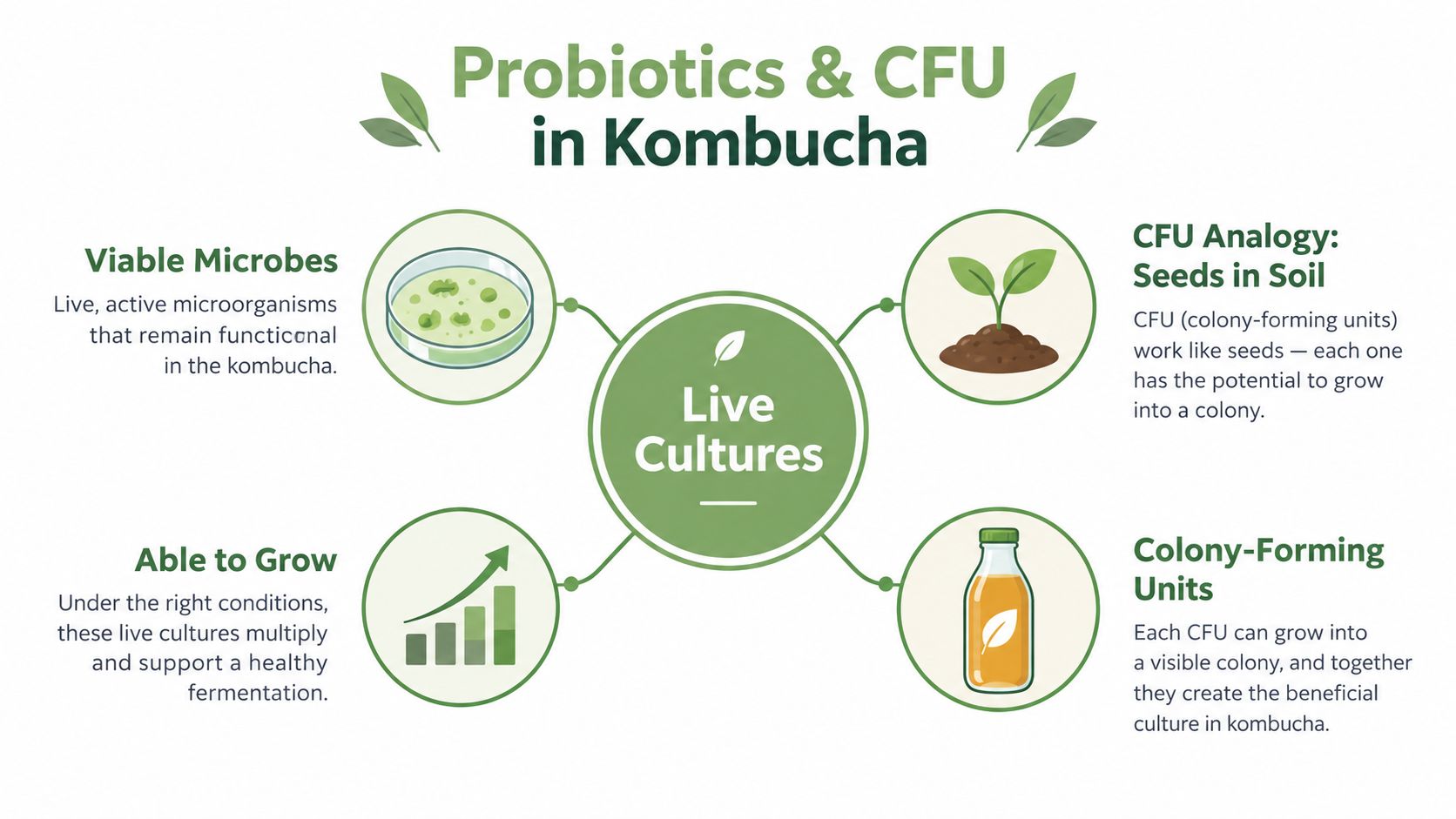
CFU is a viability measure
CFU means colony-forming units. It estimates how many viable microbes in a sample are capable of multiplying under the test conditions and forming a visible colony. It doesn't necessarily count every individual cell, and it doesn't tell you whether all the microbes belong to the same strain.
A useful analogy is a packet of seeds. The number printed on the packet suggests how many seeds are present, but the meaningful question is how many are viable and able to sprout. CFU is closer to the number of seeds that can grow than to the total number of seeds sitting in the packet.
Number and type both matter
A higher CFU figure isn't automatically a better product. The type of microbe, its ability to remain viable through storage, and the amount consumed all affect how meaningful the claim may be. Australian CSIRO researcher Dr Michael Conlon told CHOICE that probiotic effects depend on the number and type of microbes, while noting that kombucha generally contains fewer microbes than dedicated probiotic drinks (CHOICE's expert commentary).
Added strains create another layer of confusion. Some producers may add probiotic strains after processing, while a traditionally fermented drink gets its microbial community from the brewing process. Both may use words such as “live” or “probiotic”, but those words don't describe identical production methods.
For a plain-language foundation, Pep Tea's guide to what prebiotics and probiotics are can help separate these related terms. The key point is simple: a CFU number tells you about viable growth under testing conditions, not a universal promise of health benefit.
Typical Probiotic Counts You Will See on Australian Labels
Why can two Australian kombucha labels show such different probiotic counts? The answer often sits in the unit, serving size and product format, rather than in a simple difference in quality. One bottle may state its live-culture content per serve, another per 100 mL, and another across the entire pack. Comparing those figures directly is like comparing the price of one apple with the price of a whole crate.
Here are Australian examples that show how the wording changes:
| Product Format | Claimed Live Count | How It Is Expressed |
|---|---|---|
| Ready-to-drink kombucha | 1 billion CFU per serve | Also listed as 500 million CFU per 100 mL |
| Functional kombucha beverage | 39 billion live probiotics | Across the full product pack |
| Live bacterial ready-to-drink beverage | Over 500 million viable and living bacteria | Before consumption, with a stated 12-month shelf life |
The ready-to-drink example gives both measurements, making it useful for comparison. A label stating 1 billion CFU per serve and 500 million CFU per 100 mL is describing the same drink through two different lenses (Australian label example). The per-serve figure shows what you may consume in that portion. The per-100-mL figure creates a common measuring line for comparing products with different serving sizes.
A pack-level claim needs careful reading. 39 billion across a pack may include several servings or reflect a different product format. Without the pack volume, serving guidance and testing point, the headline figure cannot show whether one glass contains more live cultures than another product (Australian functional beverage example).
A practical Australian range
Across the examples above, claims range from hundreds of millions to tens of billions of CFU, depending on how each product is formulated and how the claim is expressed. This range is a description of the examples, not a recommended dose or a target that every kombucha should meet.
A high number might come from added strains, a full-pack calculation or a particular testing method. A lower declared number might be measured per 100 mL in a traditionally fermented drink. Check the unit first, then the serving size. After that, check whether the drink is raw or pasteurised, and follow the storage instructions, because handling affects how much of the claimed live culture may remain by the time you drink it.
Why Probiotic Numbers Vary So Much From Brew to Bottle
Kombucha is a living, changing beverage. The number printed on a label represents a product at a particular point in its journey, while the drink in your glass may have travelled through fermentation, bottling, transport and refrigeration before you open it.
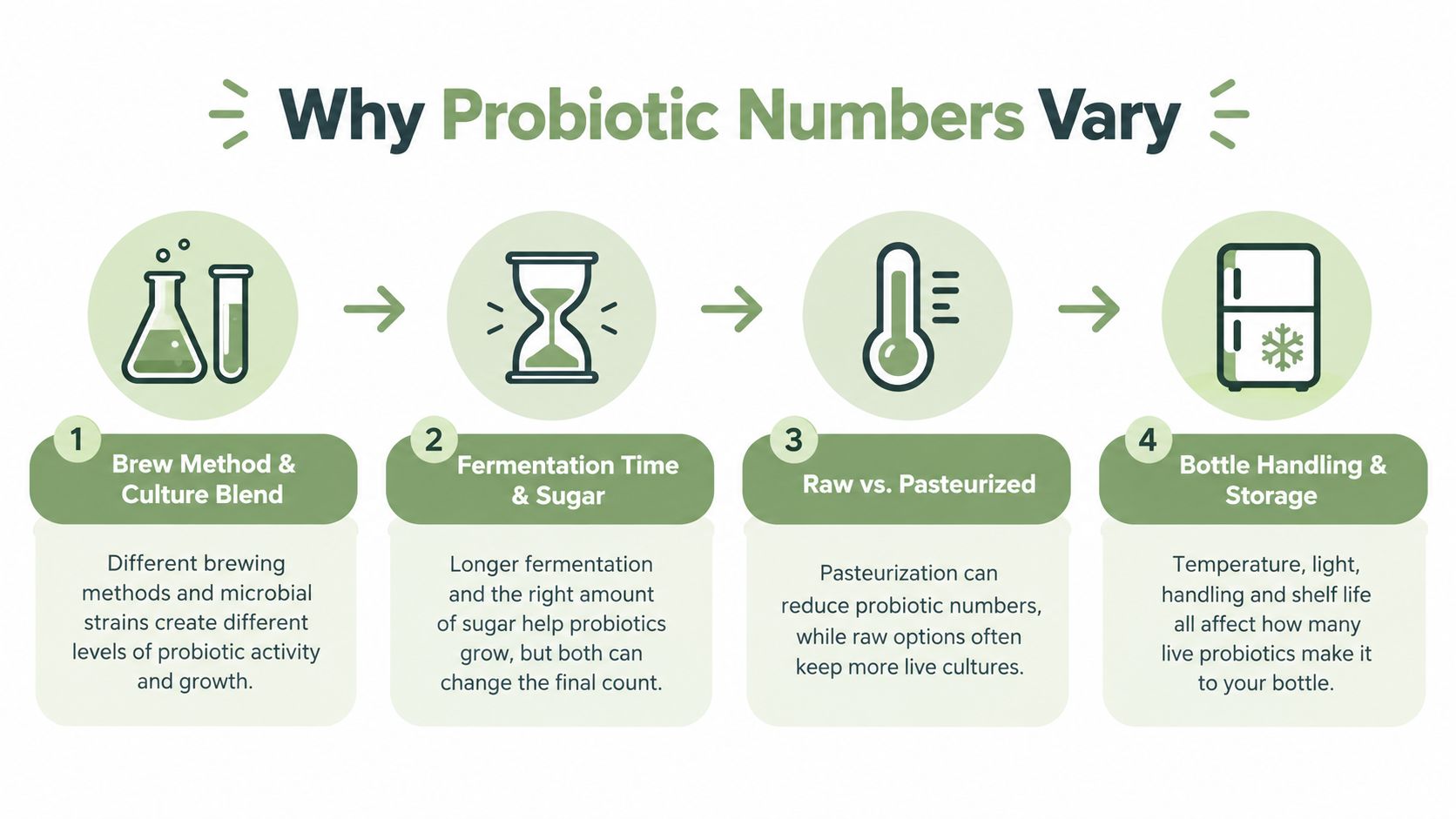
Brew method and culture blend
A SCOBY contains a mixed community of bacteria and yeast. Different culture blends can produce different microbial profiles, and the same broad recipe doesn't guarantee the same result from one producer to another. Brewing conditions also influence acidity, carbonation and the balance of organisms that remain in the finished drink.
Fermentation time matters because the culture uses sugar and changes the surrounding tea. A producer may stop fermentation at a particular point to achieve a preferred flavour and stability. The finished drink can therefore taste sweeter, sharper or more acidic without that flavour alone revealing its exact CFU content.
Raw, pasteurised or re-fortified
Raw or unpasteurised kombucha is processed to retain live cultures, although “raw” doesn't provide a standard CFU number by itself. Pasteurisation uses heat, which can reduce or remove viable microbes. Some products may then be re-fortified with probiotic strains after processing, creating a drink that contains an added culture rather than the original living fermentation community.
That distinction matters because “live” and “probiotic” aren't interchangeable words. Australian industry coverage has raised concerns about products that are pasteurised or re-fortified, particularly when shoppers interpret broad health language as proof of a naturally live brew (ABC News coverage of kombucha regulation concerns).
Bottle handling and storage
Cold storage helps preserve the characteristics of a raw fermented drink. Heat exposure, long periods outside refrigeration and continued fermentation can all change the product after bottling. The label's “keep refrigerated” instruction isn't decoration. It tells you how the producer expects the drink to be handled.
Shelf life can also complicate comparisons. One Australian live bacterial beverage record described over 500 million viable and living bacteria before consumption alongside a 12-month shelf life (Australian award record). That wording gives useful context, but it still doesn't establish what every bottle contains at the end of its shelf life.
A kombucha label is a snapshot. Storage is part of the recipe once the drink leaves the brewery.
How to Read a Kombucha Label and Spot Real Live Cultures
Use the label as a checklist rather than hunting for the biggest number. A transparent product should make it reasonably clear whether the drink is raw, how live cultures are described, how much you're expected to consume and how it should be stored.
Four checks for shoppers
Look for raw or unpasteurised wording. This suggests the producer intends to retain live fermentation cultures. It still isn't a guarantee of a particular count, so keep reading.
Find the live-culture statement. “Contains live cultures” tells you more than a vague wellness phrase. If the label names specific strains, note them, but don't assume a named strain makes the drink equivalent to a supplement.
Check the unit. Is the CFU figure listed per serve, per 100 mL or across a pack? The Australian examples show why this distinction changes the apparent size of the claim (Australian label comparison).
Read the storage instructions. Refrigeration, best-before information and handling guidance help you judge whether the product is intended to stay live through consumption. Pep Tea explains the practical reason behind refrigerating kombucha.
Questions for cafés and wholesale buyers
Hospitality buyers need to look beyond the front label. Ask the supplier how the drink is brewed, whether it's raw or pasteurised, how CFU is measured, and what cold-chain arrangements apply from production to delivery.
A café should also check flavour balance, residual sweetness, bottle or keg handling and the alcohol statement. NSW Health explains that kombucha is made by fermenting tea with sugar, yeast and bacteria, and that fermented drinks can retain residual alcohol. In Australia, drinks over 0.5% ABV must state alcohol content on the label, while in NSW products over 1.15% ABV are considered alcoholic drinks (NSW Health guidance).
For café menus: Describe the product as a fermented tea with live cultures unless the label supports a more specific statement. Don't turn a variable food into a guaranteed medical dose.
Kombucha Versus Probiotic Supplements and Other Fermented Drinks
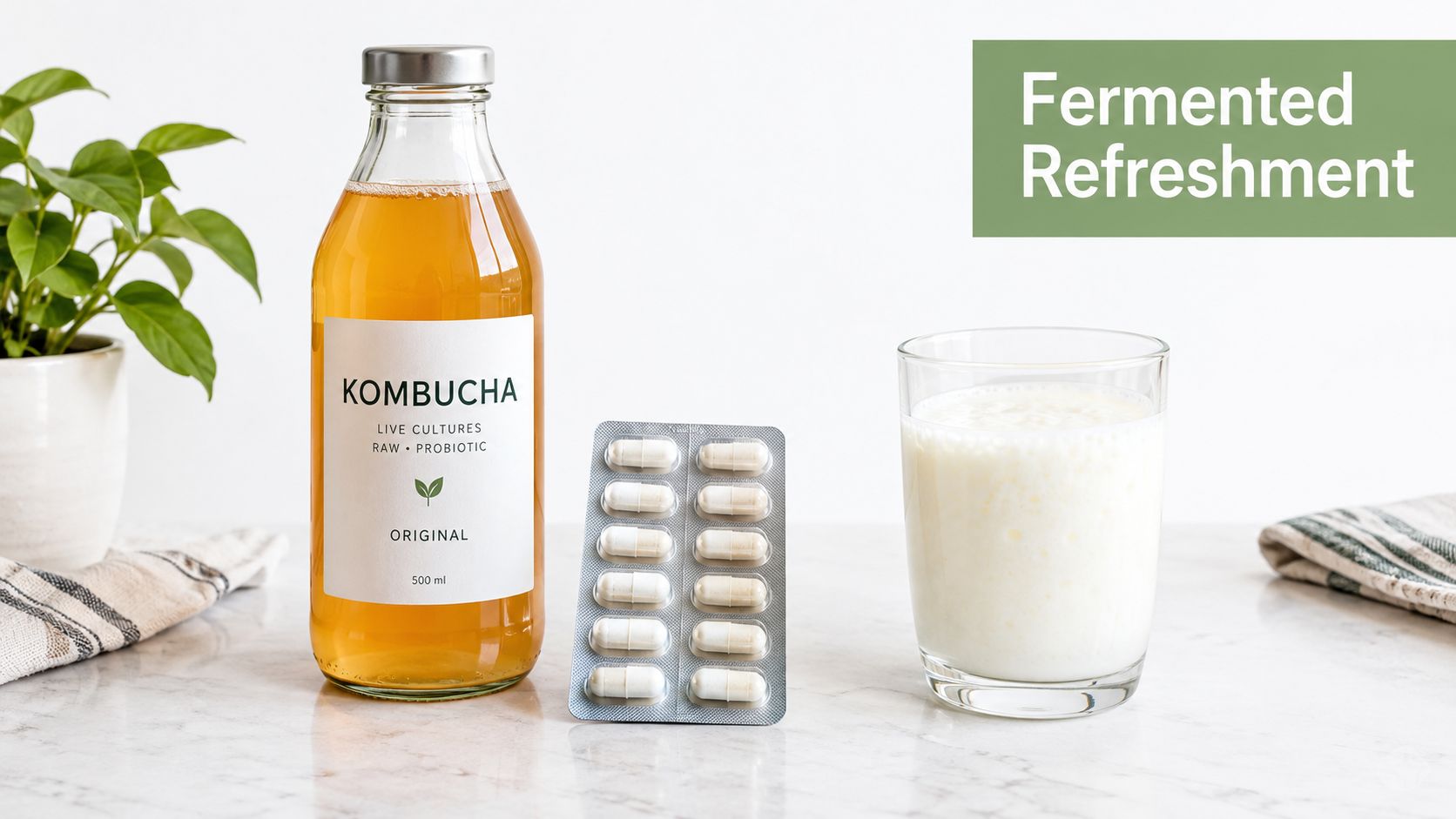
Kombucha and a probiotic supplement serve different purposes. A supplement is usually designed to deliver selected strains in a concentrated format, with the dose presented as a central product feature. Australian guidance notes that commercial probiotic supplements often contain far more concentrated strains than kombucha (CHOICE comparison of kombucha and probiotic supplements).
Kombucha is better understood as fermented tea that may contain live microbes. You drink it for its tart flavour, gentle fizz and place in a low-sugar routine, while the live-culture content is an added characteristic that varies between products. That makes it quite different from taking a supplement to target a particular strain or declared amount.
Tea itself contributes the starting material, but fermentation changes the drink. The culture transforms the sweetened tea and produces acids, carbonation and trace alcohol. A pasteurised product may no longer deliver the same live-culture experience, while a re-fortified beverage may contain added strains that weren't part of the original fermentation.
Live doesn't mean clinically proven
A live microbe is not automatically a proven probiotic for a specific health outcome. CSIRO describes kombucha as a food or drink containing live bacteria that may provide a health benefit, while also stating that research on gut benefits is limited and contradictory and that there are no human studies proving kombucha's claimed benefits (CSIRO's evidence overview).
That evidence gap matters for wellness menus. A café can offer kombucha as a refreshing fermented alternative to soft drink or alcohol, especially when the product has low or no added sugar. It shouldn't promise that a particular bottle will fix digestion, immunity or a diagnosed condition.
For anyone taking a probiotic supplement, kombucha can be an enjoyable food choice, but it shouldn't be used to replace professional advice or a product selected for a specific clinical purpose.
The comparison becomes clearer when you ask what you're buying:
- Kombucha: A fermented tea with a variable mixed culture.
- Probiotic supplement: A concentrated product with declared strains and a stated dose.
- Other fermented foods: Foods such as yoghurt, kefir or vegetables with their own cultures, ingredients and processing conditions.
A sensible approach is to choose the drink you enjoy and tolerate, then assess its label without borrowing the certainty of a supplement.
Before choosing any fermented product, this guide to how to improve gut health naturally offers broader lifestyle context beyond one beverage.
Choosing the Right Kombucha for Gut Health and Everyday Enjoyment
For most shoppers, three questions are enough to make a sensible comparison.
Is it raw and refrigerated? Look for clear raw or unpasteurised wording, then follow the storage instructions at home. A cold, properly handled bottle gives you a better chance of preserving the living character the producer intended.
What is the CFU per serve? Check whether the claim is per 100 mL, per serve or across a pack. If there's no number, don't assume the product has none. Just recognise that you don't have a standardised count to compare.
Does it suit daily drinking? Choose a flavour and sweetness level you'll enjoy. Sugar-free options can replace sweeter soft drinks, while flavours such as ginger or lime and ginger can work well with meals and café menus. Serve kombucha chilled, keep it away from unnecessary heat and don't treat a high headline number as proof of superior quality.
Kombucha also contains trace alcohol because fermentation produces it naturally. If alcohol matters for your household, read the label carefully and use the Australian guidance above as your reference point.
Pep Tea offers Australian-brewed, sugar-free organic kombucha made in the Hunter Valley, NSW, alongside organic Japanese matcha. It's one option for shoppers and hospitality venues looking for a live fermented tea with a low-sugar profile, provided the product's label and storage instructions suit their needs.
Explore the Pep Tea range of sugar-free organic kombucha and organic Japanese matcha, then contact the team about products for home, cafés or wholesale. Choose a chilled fermented tea you can enjoy regularly, and compare its live-culture information with the serving size and storage guidance rather than chasing one magic probiotic number.