
Where to Buy Matcha Whisk in Australia: Practical Guide

Australian specialty tea retailers and curated online marketplaces are usually the most reliable places to buy a matcha whisk today, with local listings ranging from A$18.80 for basic bamboo chasen styles to A$90.00 for a premium Takayama whisk. If you're in Australia, you'll generally find the widest choice by checking specialist tea shops first, then broader kitchenware and marketplace sellers.
Starting with a simple shopping question often leads to getting stuck on the wrong comparison. They look at price first, when the better question is: what kind of froth do you want every morning, and how often will you use the whisk?
That's the gap I see again and again. A matcha whisk isn't just a box to tick off with your powder and bowl. Prong count, material, and how the whisk is made all shape the texture in your cup. For traditional usucha, a bamboo chasen behaves very differently from a resin or stainless option. For a milk-heavy latte, the trade-off may change.
At Pep Tea, we spend a lot of time helping Australians understand the tools behind a good cup, not just the tea itself. If you've been wondering where to buy matcha whisk options in Australia, and which one is worth it for your routine, this guide will help you buy with more confidence and less guesswork.
Finding Your Matcha Whisk in Australia
Where should you buy a matcha whisk in Australia when ten product photos look nearly identical?

A useful starting point is the seller, not the price tag. The right shop helps you compare how a whisk will behave in daily use. That means looking at prong count, material, and intended drink style, instead of treating every whisk as the same tool with a different markup.
For many Australian buyers, specialty tea retailers are the clearest place to begin. They are more likely to explain whether a whisk suits thin traditional matcha or a thicker latte routine, and whether the shape is designed for fine foam or basic mixing. That matters because a 100-prong bamboo chasen and a stiffer resin whisk can sit in the same search results while producing very different texture in the bowl.
Broader kitchenware stores and larger marketplaces still have a place. They can be useful if you want to compare several tool types at once or need a quick local delivery option. The trade-off is that some listings focus on appearance, bundle size, or discount pricing while saying very little about the whisk itself.
Where most Australian buyers should look first
Three shopping channels tend to cover most needs:
- Specialist tea retailers: Usually the best option for bamboo chasen, clearer usage notes, and better detail on froth quality.
- Kitchenware stores: Handy if you are comparing tea tools with other home items and want Australian shipping.
- Large marketplaces: Good for range, but you need to read carefully because product descriptions can be thin or inconsistent.
A simple rule helps here. Buy from the kind of retailer that can explain what the whisk does in the cup, not only how fast it can post the parcel.
What a good product listing should tell you
A useful listing gives you enough detail to predict performance. If it skips the basics, comparison gets harder.
Look for these points:
- Material, such as bamboo, resin, or stainless steel
- Approximate prong count or tine style
- Intended use, such as usucha, thicker matcha, or lattes
- Whether stock ships from Australia
- Whether care instructions are included
- Whether it is sold on its own or in a set
Prong count is where many buyers miss value. More prongs often help create finer foam with lighter matcha preparations, much like a brush with more bristles leaves a smoother finish. Fewer or thicker tines can be more durable, but they may produce larger bubbles or need more effort to get a creamy surface. If you drink matcha most mornings, that difference shows up quickly.
Care advice is another quiet sign of a reliable seller. A shop that tells you how to rinse, dry, and store a bamboo whisk usually understands that the tool is meant to last longer than one gift season.
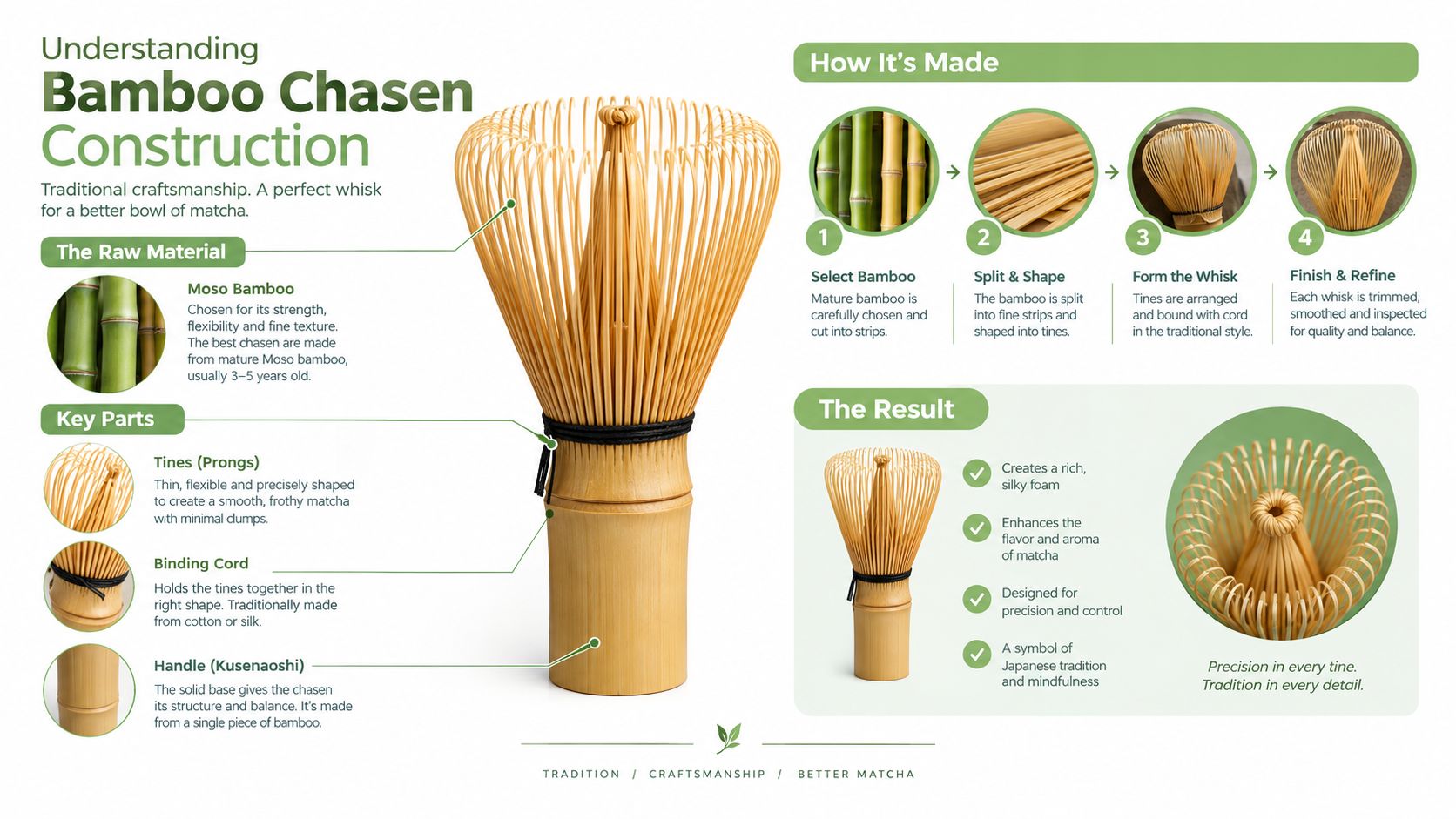
Understanding Bamboo Chasen Construction
A bamboo chasen isn't a tiny kitchen whisk. It works more like a fine brush that happens to whip liquid. The carved tines flex, gather the matcha, and help create a surface foam without smashing the powder into clumps.
What the parts actually do
The central idea is simple. A chasen is carved from bamboo so the tines are thin, springy, and closely spaced. That shape lets the whisk move through a shallow pool of matcha and water with less resistance than a bulky metal whisk.
Think of it this way:
- The outer tines help agitate the liquid and build foam.
- The inner tines help break up small clumps and refine the texture.
- The handle gives you control without forcing a heavy stirring motion.
One Australian retailer notes that a chasen is made from bamboo specifically to create the frothy texture needed for matcha, which is a useful reminder that the material isn't decorative. It's part of the brewing result (matcha whisk product guidance).
Why construction affects your cup
A poorly shaped whisk can still mix matcha. It just won't do it elegantly. You may end up with larger bubbles, weak foam, or sediment that settles too quickly.
If you're learning at home, a traditional whisk also teaches better movement. That's one reason many people still choose a dedicated chasen rather than treating matcha like a protein powder.
For readers comparing tools, our matcha tea brush collection shows the kind of purpose-built whisk Australians often look for when they want a proper preparation tool instead of a generic frother.
Here's a useful visual demonstration of how a bamboo whisk is shaped and used in practice.
A simple test before you buy
Practical rule: If the listing doesn't show the tine shape clearly, you're buying half-blind.
Check for:
| Detail | Why it matters |
|---|---|
| Clear tine definition | Suggests the whisk is designed for actual matcha preparation |
| Material description | Helps you distinguish bamboo from resin or metal alternatives |
| Use instructions | Often a sign the seller understands the product |
| Set or standalone listing | Helps you decide if you also need a holder |
Bamboo Versus Alternative Matcha Tools
Australian retailers don't sell just one kind of matcha whisk anymore. Local listings include traditional bamboo chasen, resin reusable whisks, and stainless-steel mechanical whisks, with prices ranging from about AU$18.80 to AU$59.00 across these formats (Australian matcha whisk collection).
That broader choice is useful, but it can also blur the decision. Different tools suit different routines.
How the main options compare
| Tool type | Froth quality | Durability | Cleanup | Best fit |
|---|---|---|---|---|
| Bamboo chasen | Fine, traditional foam | More delicate | Easy if rinsed promptly | Daily matcha tea, mindful prep, usucha |
| Resin whisk | More convenient feel, less traditional texture | Reusable and sturdier | Straightforward | Frequent casual use |
| Stainless or mechanical whisk | Good for mixing, especially with milk | Stronger build | Usually easy | Lattes, quick prep, busy kitchens |
What bamboo does better
Bamboo is still the benchmark if your goal is a classic bowl of matcha with a light foam and smooth top. The tines are designed for that motion. They skim and whip rather than churn.
It also feels better in the hand for traditional preparation. That may sound minor, but the whisking motion is easier to learn when the tool was made for the task.
When alternatives earn their place
Resin and stainless options make sense for people who prioritise convenience. If you make iced lattes, add milk often, or want something less fragile, they can be practical.
One Australian retail category also shows a much cheaper entry point for mechanical whisks at about A$4.80, while bamboo and premium handmade options sit much higher. That spread shows why buyers shouldn't assume all “matcha whisks” solve the same problem (Australian matcha accessories range).
Bamboo usually wins on texture. Alternative tools often win on speed.
For many households, that's the trade-off.
Choosing Prong Count by Drink Style
Prong count sounds technical, but it's one of the easiest ways to narrow your choice. In simple terms, more prongs usually mean a finer, softer foam, while fewer prongs can feel a bit sturdier and forgiving for thicker or milk-based drinks.
Australian listings give a clear pricing snapshot: a 64-prong bamboo chasen is A$18.80, an 80-prong whisk is A$18.80, a 100-prong whisk is A$34.80, a 120-prong whisk is A$39.80, and a premium Takayama chasen is A$90.00 (Australian chasen pricing examples).
A practical way to match prongs to your routine
Use this simple guide:
Choose lower prong counts for casual milk drinks.
If you mostly make matcha lattes, a 64-prong whisk can be perfectly sensible. You're blending for smoothness, but the milk will shape much of the final texture.Choose mid-range prong counts for everyday all-round use.
An 80-prong whisk suits many home drinkers because it can handle both straight matcha and occasional lattes without feeling too specialised.Choose higher prong counts for finer foam.
If you enjoy more traditional preparation and want a silkier surface, a 100-prong or 120-prong whisk is often the more satisfying choice.
Don't let price lead the whole decision
The jump in price doesn't always mean the whisk is “better” for you. It may reflect finer workmanship, workshop provenance, or a more specialised shape.
Ask yourself these questions before you buy:
- Do I drink straight matcha or mostly lattes?
- Will I use it daily or only on weekends?
- Am I replacing a damaged whisk or buying my first one?
- Do I care more about ritual, durability, or speed?
A lower-priced whisk can be excellent value if it matches your drink style. A premium whisk only makes sense when you'll appreciate what it does differently.
Sourcing Matches Where Australian Buyers Shop
Where should an Australian buyer look for a good matcha whisk, once price stops being the only filter?
The short answer is that you have more options than many first-time buyers expect. Matcha whisks are sold through specialist tea shops, broader kitchen retailers, and large online marketplaces. That wider retail spread matters because it changes how you compare options. Instead of asking only, “What is the cheapest chasen I can find?”, you can ask, “What am I getting for this material, this prong count, and this level of finish?”
Australia already has an established retail channel for tea and tea tools. Industry context from IBISWorld shows a mature local online market for kitchen and diningware, which helps explain why matcha accessories are not limited to hard-to-find niche imports (Australian online kitchen and diningware industry context).
That practical availability helps in two ways.
First, it gives you room to compare construction details, not just shipping costs. A bamboo whisk with neatly separated tines and a shape suited to your drink style will usually produce better daily foam than a cheap option with uneven cuts, even if both look similar in a product photo. Second, local stock makes it easier to replace a whisk before a worn-out one starts giving you flat, clumpy results.
Where quality differences usually show up
A chasen is a bit like a paintbrush. From a distance, several may look alike. In use, the cut of the bristles, the flexibility of the material, and the overall shape change the result.
When you shop in Australia, check whether the seller clearly states:
- the whisk material, such as traditional bamboo or a non-bamboo substitute
- the prong count, especially if you care about finer foam for straight matcha
- the origin or workshop details, if provenance matters to you
- whether the item is stocked locally, which affects delivery speed and returns
Those details help close the decision gap many buyers run into. Two whisks can sit close together on price, but one may suit daily usucha far better because the prongs are finer and more numerous. Another may be better value for latte drinkers because it is simpler, sturdier, and less fussy.
Local stock can make comparison easier
One dedicated Australian seller states that its chasen are sourced from the Takayama workshop of Chikumeido and says it is the only stockist they supply in Australia. That shows some Japan-made whisks are available domestically, rather than only through direct overseas ordering (Takayama chasen listing in Australia).
That kind of listing is useful because it gives you something concrete to assess. If a seller explains where the whisk was made, what style it is, and who it suits, you can judge value more clearly. If the page says very little beyond “matcha whisk,” you may be buying blind.
Australian interest in matcha appears to be growing, as noted earlier. That helps explain why more local shops now carry preparation tools. For buyers, the main benefit is simple. Better availability means more chances to compare prong count, material, and build quality side by side, instead of treating every whisk as the same product with a different price tag.
Simple Care Routines for Longevity
A bamboo whisk can last well if you treat it gently. Most breakage happens because the prongs dry out, get pressed flat, or are scrubbed like ordinary kitchen gear.
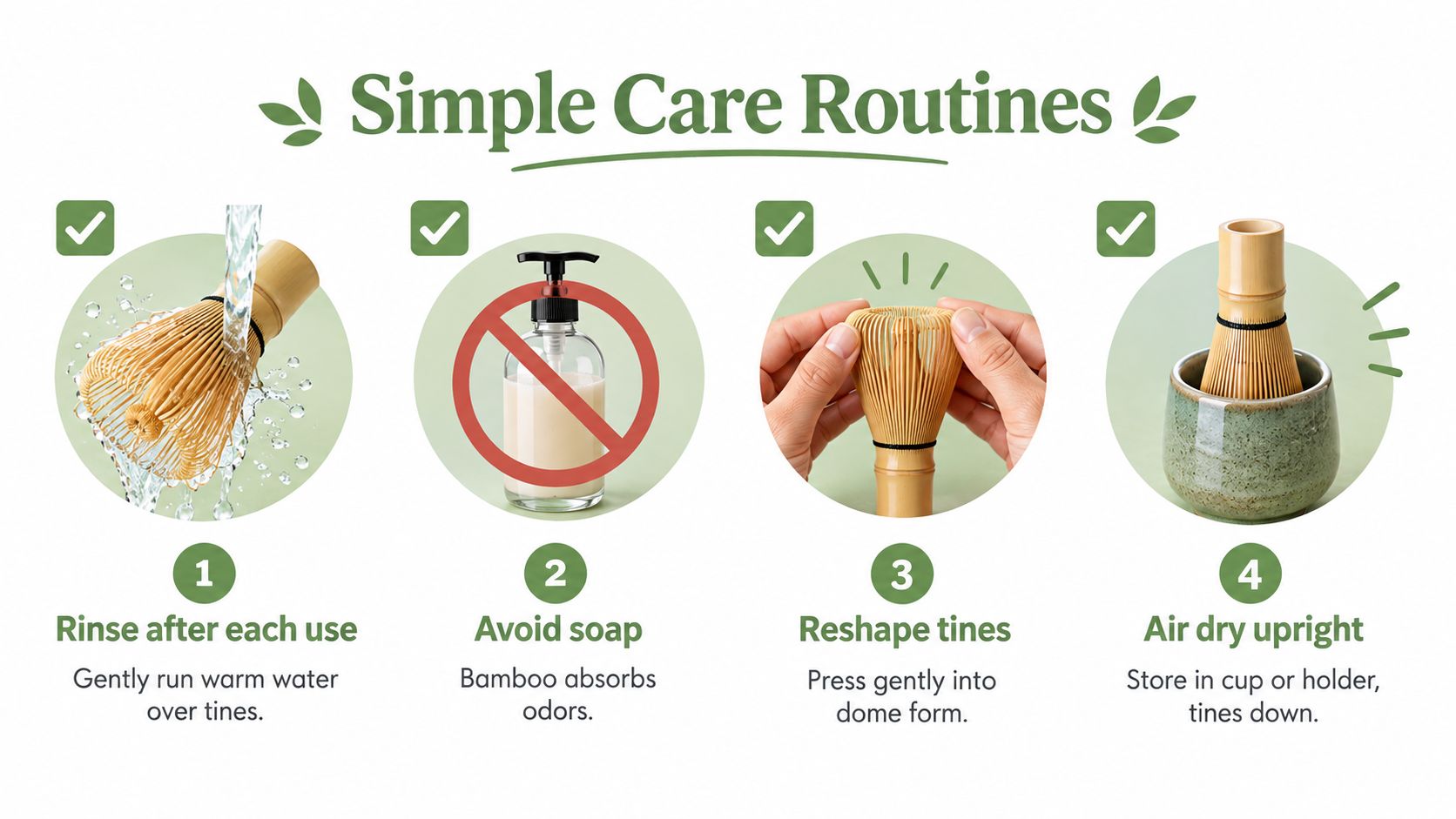
Several Australian sellers advise pre-soaking the whisk in warm water before use to help prevent breakage and improve foam formation, and one guide recommends whisking 2 scoops of matcha with 100 ml of 70°C water in a figure-of-eight motion before rinsing and air-drying upright (Amazon Australia matcha guide).
The daily routine that makes the biggest difference
You don't need special products. You need consistency.
- Before whisking: Soak the tines briefly in warm water so the bamboo softens.
- After whisking: Rinse with warm water soon after use.
- While drying: Let it air-dry upright, not trapped in a drawer.
- For shape support: A holder helps the whisk keep its curve between uses.
If you use a bamboo whisk often, a dedicated matcha whisk stand is a practical add-on because it supports the tine shape while drying.
What not to do
Don't treat a chasen like a dishwasher-safe gadget. It's carved bamboo, and it responds better to gentle habits than hard cleaning.
Avoid these common mistakes:
| Mistake | What happens |
|---|---|
| Leaving matcha to dry on the tines | Residue stiffens the prongs |
| Using soap | Bamboo can hold odours and flavours |
| Storing wet in a closed cupboard | Moisture lingers where air can't circulate |
| Pressing hard against the bowl base | Tines can bend or snap sooner |
A little care goes a long way. With bamboo, maintenance is part of the tool, not an optional extra.
When Mechanical or Electric Whisks Make Sense
Traditionalists sometimes dismiss mechanical or electric whisks too quickly. That isn't always fair. For some Australian households, they solve a real problem.
If you're making a fast weekday latte, or prepping several milk-based drinks in a café, a mechanical tool can be the more practical choice. It's especially relevant because local sellers do offer these alternatives alongside bamboo and resin models, rather than treating them as unrelated kitchen gadgets.
The best use case for a shortcut
Mechanical and electric whisks make the most sense when:
- You mostly drink matcha with milk
- You care more about speed than ritual
- You want a sturdier tool for frequent handling
- You're less concerned with traditional surface foam
That last point matters. A quick frother can blend powder and liquid well, but the texture often feels different from a hand-whisked bowl made with a chasen.
Where they fall short
A mechanical whisk can over-aerate, create a different bubble structure, or miss the softer finish many people want in straight matcha. If your goal is a calm bowl of usucha, bamboo still tends to feel more precise.
For readers who know they prefer convenience, an electric matcha whisk option is one route worth considering, especially for latte-heavy routines where speed matters more than ceremony.
The key is honesty about the drink you make. A shortcut is only a compromise if you wanted the traditional result in the first place.
Final Thoughts on Choosing Wisely
The best answer to where to buy matcha whisk in Australia isn't just the name of a shop. It's the combination of the right seller and the right whisk style for your drink habits.
If you want the safest starting point, check an Australian specialty tea retailer first. If you want broad comparison shopping, curated marketplaces and kitchenware stores can be useful. Then narrow the choice by material, prong count, and whether you'll be making straight matcha or mostly milk-based drinks.
The decision that matters most
A few buyers need handmade provenance. Some need a durable daily tool. Others just need a whisk that won't leave clumps in a morning latte.
That's why price alone doesn't help much. An A$18.80 whisk may be a smart buy for one person, while another will be happier paying more for a finer whisk geometry or Japan-based workshop sourcing, as covered earlier.
A simple buying checklist
Before you click buy, make sure you know:
- Your main drink style
- Your preferred material
- Whether you need a set or a standalone whisk
- Whether the seller offers local stock and clear care advice
The right whisk should fit your routine so naturally that you stop thinking about the tool and start enjoying the tea.
Good matcha preparation doesn't need to be complicated. It just needs a bit of thought at the start, then a little care afterwards.
If you're building a better matcha routine at home or for your café, Pep Tea offers premium organic Japanese matcha, practical preparation guidance, and the kind of tea education that helps you choose tools with confidence. You can explore our matcha range, learn how to whisk it properly, and find straightforward advice for everyday Australian matcha drinking.