
Tag: how to use a chasen
Matcha Whisk Set: Your Complete Australian Guide

You order a matcha at your favourite café. It arrives bright green, smooth, lightly creamy, and somehow calmer than coffee without feeling flat. Then you try making one at home and end up with floating clumps, weak foam, and a whisk that already looks stressed.
That gap usually isn’t about effort. It’s about tools and technique.
A matcha whisk set looks simple, but it solves the exact problems that frustrate most beginners. The bowl gives you room to whisk properly. The scoop helps with consistent measuring. The whisk is built to suspend fine powder in water and create the soft froth that makes matcha feel rounded rather than gritty. Once you use the set as intended, the whole process starts to make sense.
There’s also a reason these tools have lasted for centuries. The Asia-Pacific region, including Australia, represents 45% of the global matcha whisk set market, a dominance tied to long tea traditions reaching back to the Muromachi period (Research Intelo market report). For Australians, that matters in a practical way. It means strong access to authentic tools, better importing pathways, and more choice for homes and cafés that want to prepare matcha properly.

Matcha also rewards good preparation. The powder is delicate, and the way you mix it changes texture, flavour, and your overall experience of the drink. A whisk set turns matcha from “green powder in hot water” into a repeatable ritual you can enjoy before work, after the gym, or during a quieter afternoon.
If you run a hospitality venue, the same principle applies. Small tool choices shape consistency. For teams building a broader beverage offering, this guide to tea for cafés and offices is a useful companion read because it looks at tea service from an operational point of view rather than only from a home kitchen lens.
Great matcha isn’t mysterious. It comes from the right bowl, the right whisk, the right water, and a few habits that become second nature very quickly.
Introduction The Secret to Cafe-Quality Matcha at Home
The matcha often gets the initial blame. Fair enough. Powder quality matters. But if your whisking tool is wrong, even a beautiful ceremonial-grade matcha can turn dull, clumpy, or bitter.
A proper matcha whisk set gives each part of the process a job. That’s why it feels more organised than using a mug, a teaspoon, and whatever frother happens to be in the drawer. The set was designed around one goal. Make powdered tea combine evenly with water while preserving texture and balance.
Why the set matters more than people think
A lot of confusion starts with the idea that any whisk will do. It won’t. Matcha is not brewed like loose-leaf tea. You’re drinking the leaf itself in powdered form, so the powder has to be dispersed thoroughly through the liquid.
That’s where the set changes everything:
- The whisk creates suspension so the powder doesn’t sit in grainy pockets.
- The bowl supports movement because you need space to whisk briskly.
- The scoop adds consistency so each cup starts with a repeatable amount.
- The holder protects the whisk so performance stays reliable over time.
For home drinkers, this means fewer failed cups. For cafés, it means a more consistent workflow and better texture from one serve to the next.
Why café matcha feels different
When café matcha tastes better, it’s usually because the basics are dialled in. The person making it has the right bowl shape, a whisk in decent condition, and a method they repeat every time. The drink feels silky because the powder was incorporated properly, not because there was some secret ingredient.
That’s encouraging news. You don’t need years of tea ceremony training to make a lovely bowl at home. You just need to understand what each piece does and how to use it with intention.
Deconstructing the Traditional Matcha Whisk Set
A traditional matcha whisk set is beautifully simple. Each piece looks modest on its own, but together they form a system that’s been refined over generations.
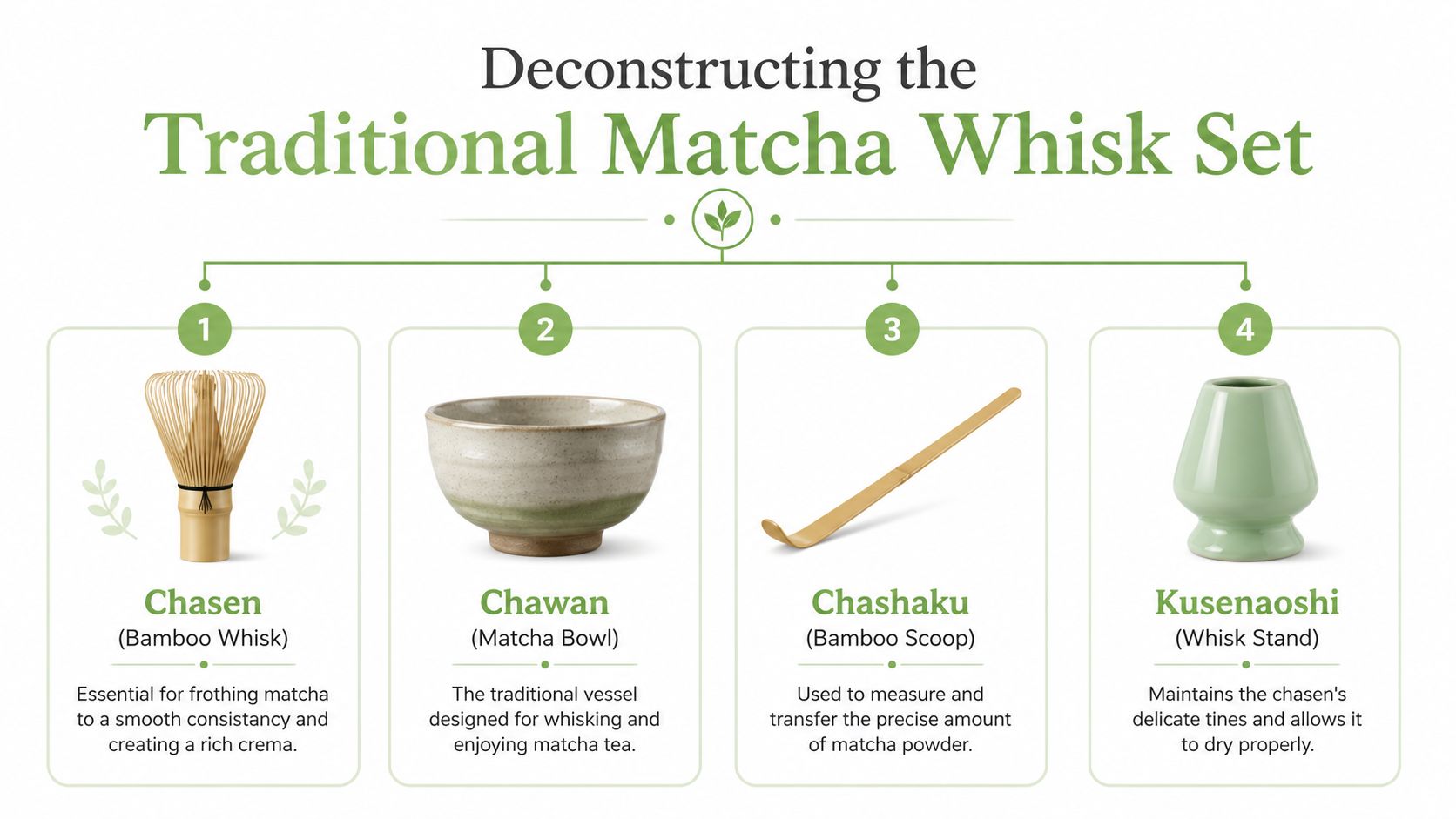
Chasen the bamboo whisk
The chasen is the heart of the set. It’s the traditional bamboo whisk used to mix and froth matcha. Unlike a kitchen whisk, it’s carved from a single piece of bamboo and shaped into many fine tines that move through liquid with surprising delicacy.
Its job isn’t just to stir. It breaks up small clusters of powder, lifts air into the tea, and helps create that soft foam many people associate with well-made usucha. If you’ve only ever mixed matcha with a spoon, using a chasen is the moment the drink starts to feel proper.
If you want to see a dedicated option for this tool, Pep Tea’s matcha tea brush collection shows the style commonly associated with a traditional whisk.
Chawan the matcha bowl
The chawan is the bowl used for preparing and drinking matcha. Its wider shape is functional, not decorative. You need room at the base for the whisk to move quickly in a zigzag motion without banging into narrow sides.
A mug can work in a pinch, but it makes whisking awkward. The bowl gives you control. It also helps you see the texture developing as you whisk, which is useful when you’re learning what “smooth enough” looks like.
Practical rule: If the vessel is too narrow for fast wrist movement, it’s too narrow for easy matcha.
Chashaku the bamboo scoop
The chashaku is the curved bamboo scoop used to transfer matcha from tin to bowl. It looks very minimal, and that’s part of its charm. It encourages a measured, repeatable approach instead of guessing with a kitchen spoon.
That consistency matters more than people realise. Matcha is sensitive to ratio. Too much powder can make the drink thick or harsh. Too little can leave it washed out. The scoop helps turn the ritual into something calm and dependable.
Kusenaoshi the whisk holder
The kusenaoshi is the whisk holder or stand. It’s one of the most underrated pieces in the set because people often think it’s optional. In practice, it helps the whisk keep its shape and dry more evenly after use.
That matters because bamboo is natural and responsive. If a whisk dries crumpled or stays damp in the wrong spots, the tines lose their neat form faster. A holder helps preserve that open, tulip-like shape that lets the chasen work properly.
Why the set works as one system
The beauty of a matcha whisk set is that none of the tools are trying to do too much. Each one solves a very specific problem. The bowl creates space. The scoop creates consistency. The whisk creates texture. The stand protects the whisk between uses.
Here’s the short version:
- Chasen for mixing and frothing
- Chawan for whisking room and drinking
- Chashaku for measured dosing
- Kusenaoshi for shape retention and drying
When people say matcha feels mindful, this is often what they mean. The tools slow you down just enough to do things well.
How to Choose the Right Matcha Whisk Set for You
Buying a matcha whisk set gets confusing fast because many sets look similar online. Differences are in whisk design, materials, and whether the set matches how you’ll use it.
If you mainly drink usucha, whisk performance matters most. Australian tea experts recommend a chasen with 80 to 120 tines for the best froth in usucha, and a 100-prong whisk can produce 20 to 30% more stable foam than a 64-tine version (tea expert demonstration). That’s the kind of detail worth paying attention to because it directly affects what ends up in your bowl.
Start with the whisk, not the packaging
Many shoppers focus on whether the set comes in a gift box, includes extras, or matches their kitchen. Nothing wrong with that. But the whisk is still the working part.
These practical checkpoints are often considered:
- Tine count for usucha matters if you want that light foam and smoother mouthfeel.
- Bamboo quality affects how evenly the whisk opens and how delicate the tines feel.
- A whisk holder included is useful if you want the set to last.
- A wider bowl makes learning easier than a narrow, decorative cup.
If you love a pared-back kitchen setup, this HYDAWAY minimalist kitchen guide is a nice reminder that the best tools are often the ones with one clear purpose and daily usefulness.
Bamboo versus modern alternatives
There’s a practical gap in most matcha content. It often tells you bamboo is traditional, but it doesn’t always explain whether that matters in daily Australian use.
Here’s the honest version. Bamboo is traditional because it works beautifully with matcha. It’s flexible, light, and designed for the whisking motion that this drink requires. Plastic or metal alternatives may look durable, but they change the feel of preparation and often miss the softer aeration you get from a proper chasen.
For many readers, the decision comes down to priorities:
- Choose bamboo if you care about texture, ritual, and authentic preparation.
- Choose a simpler starter set if you’re new and want to learn without overthinking.
- Choose sets with replaceable core pieces if you make matcha often and expect wear over time.
Matcha Whisk Set Buyer’s Guide
| Feature | Best for Beginners | Best for Enthusiasts | Best for Cafés |
|---|---|---|---|
| Whisk style | Bamboo chasen with an easy-to-use tine count suited to everyday usucha | Finely crafted bamboo chasen chosen for feel, control, and foam quality | Multiple bamboo chasen kept in rotation for service consistency |
| Bowl choice | Wide bowl that gives plenty of room to learn the motion | Bowl selected for comfort, weight, and whisking response | Durable bowls with enough width for repeat prep during busy periods |
| Scoop | Standard bamboo scoop for consistent habits | Traditional scoop used with a more deliberate ritual | Scoop or measured workflow that supports repeatable dosing |
| Whisk holder | Strongly recommended | Essential | Essential for storage and turnover |
| Best use case | Home practice, lattes, daily ritual | Straight matcha, intentional preparation, collecting quality teaware | Hot matcha, iced matcha, latte service, staff training |
| Buying focus | Simplicity and ease | Craft and performance | Consistency, replacement planning, workflow |
What suits different readers
A beginner usually does best with a straightforward set that includes the four basics and doesn’t demand too much fuss. The goal is building confidence.
An enthusiast often notices finer points. How springy the whisk feels. How the bowl sits in the hand. Whether the foam is delicate rather than coarse.
A café owner needs something else again. Reliability matters more than romance during service. Sets need to be easy for staff to use correctly, easy to dry properly, and easy to replace when parts wear out. A practical place to browse supporting tools is Pep Tea’s matcha tea accessories range.
The right set isn’t the fanciest one. It’s the one that matches your drinking habits and helps you make good matcha consistently.
A Step-by-Step Guide to Whisking Perfect Matcha
Technique is where the whole set comes alive. The good news is that proper whisking is simple once you know what to pay attention to.
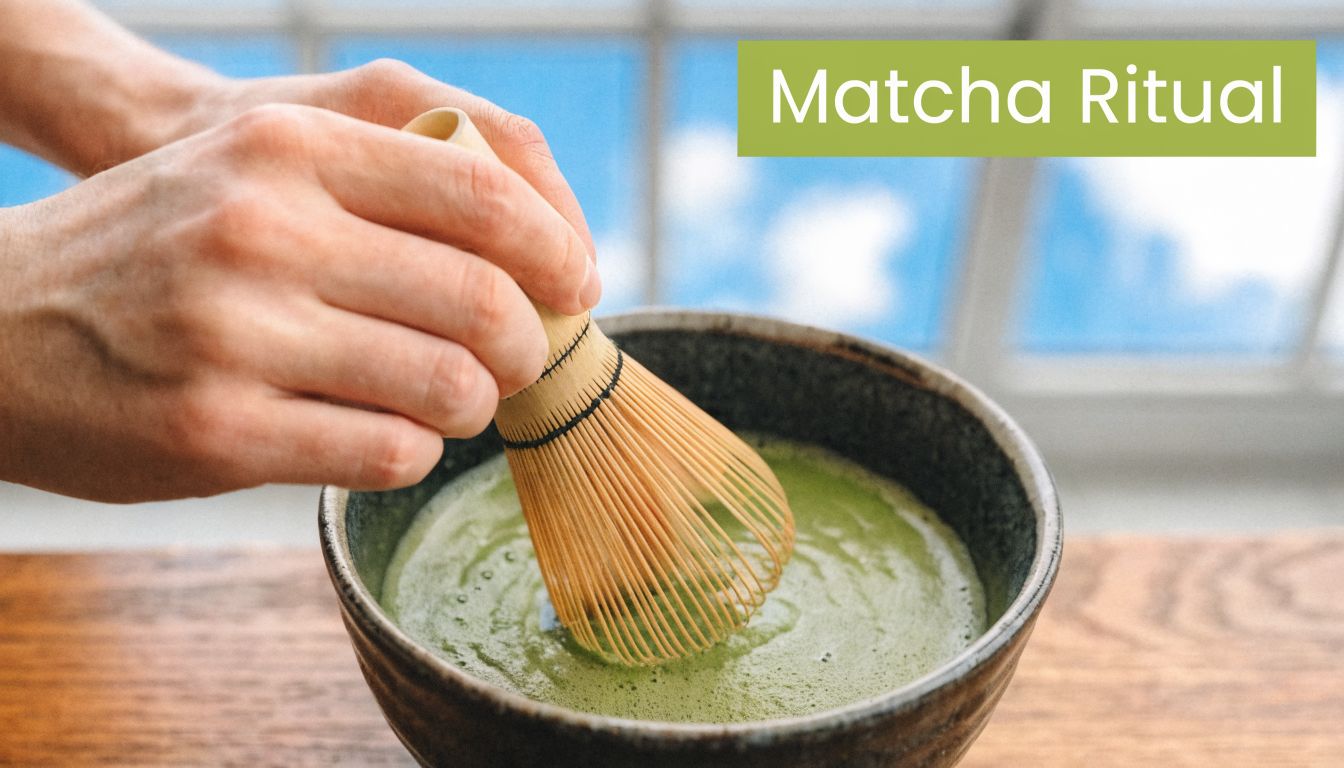
Wake up the whisk first
Don’t use a dry bamboo whisk straight away. The chasen activation process involves soaking the whisk in 80°C water for 1 to 2 minutes, which unfurls the tines and can increase surface area by up to 35% for better dispersion (preparation guide).
That step sounds small, but it changes everything. A softened whisk is less likely to snap and much better at moving through the tea. Dry, tight tines don’t glide properly.
Build the bowl properly
Add your matcha to the bowl using the scoop. If your powder has compacted in the tin, sift it first. Sifting isn’t fussy. It helps prevent little dry lumps that no whisk can completely rescue once they’re wet.
Then add warm water, keeping your temperature in the 70 to 80°C range mentioned in the preparation benchmarks from the earlier cited tea guidance. Water that’s too hot can push flavour in a harsher direction. Water that’s too cool can leave the drink flat and underdeveloped.
A useful reference for broader tea brewing habits is this guide to the secrets to perfect Japanese green tea, especially if you enjoy exploring how temperature changes flavour across different Japanese teas.
Use the W motion, not circles
This is the point most beginners get wrong. Circular stirring feels natural, but it doesn’t whisk matcha efficiently. The same preparation guidance notes that a rapid W-shaped whisking pattern is superior to circular motions, which tend to trap air unevenly in the liquid.
Try this sequence:
- Hold the bowl steady with your free hand.
- Keep the whisk low so the tips move through the liquid, not above it.
- Whisk briskly in a W or M motion from the wrist, not the whole arm.
- Ease off at the end and lift gently to settle the foam.
You’re not beating eggs. You’re creating fast, light agitation close to the surface.
After you’ve read the steps, it helps to watch the movement once in real time.
What good matcha should look like
You’re aiming for a smooth liquid with fine foam across the top for usucha. Not giant bubbles. Not a thick cap. Just a neat layer that looks even and lively.
If you make matcha for lattes, think of this whisked bowl as your base. Once the powder is fully dispersed and the top looks smooth, you can pour it over milk or ice without fighting clumps later.
Small, quick wrist motions beat big dramatic ones every time.
A simple home routine
If you want a practical rhythm, keep it uncomplicated:
- Warm the whisk
- Add matcha to bowl
- Sift if needed
- Add warm water
- Whisk in a W
- Drink as is or turn it into a latte
After a few days, the process feels less like a recipe and more like muscle memory.
Caring for Your Set in the Australian Climate
Australian conditions are hard on natural materials. Coastal humidity, warm kitchens, and quick temperature changes can all shorten the life of a bamboo whisk if you leave it damp or crushed after use.
That’s why aftercare matters almost as much as whisking technique.
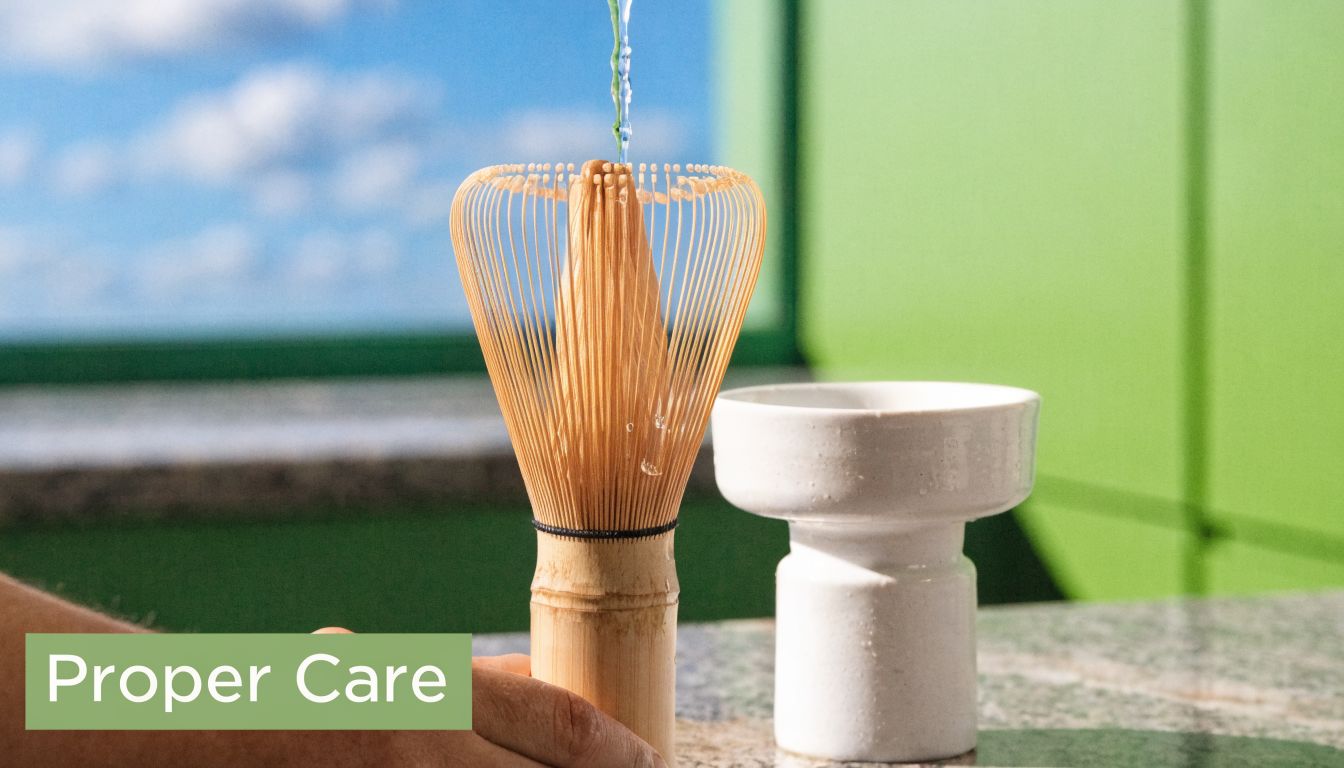
Clean it gently and straight away
As soon as you’ve finished making matcha, rinse the whisk under warm water. Skip soap. Bamboo can hold onto detergent smell and flavour, which you don’t want in the next bowl.
The bowl can be washed as you would other ceramics, and the scoop can be wiped clean and kept dry. The whisk needs the most attention because its tines are thin and vulnerable when left coated with drying matcha.
Why the whisk holder matters in Australia
Generic tea advice often ignores climate. In Australia, with humid conditions in many areas, a ceramic whisk holder can reduce breakage by up to 40% compared with leaving the whisk unprotected because it helps maintain bristle integrity and airflow (regional care note).
That’s not a decorative extra. It’s practical equipment.
A holder helps by:
- Supporting the whisk’s shape as it dries
- Allowing better airflow around the inner tines
- Reducing stress on bent bristles
- Making storage tidier if your tea station is used daily
If you need one, Pep Tea’s matcha whisk stand is the type of tool designed for that exact job.
Smart storage habits
Where you store your set matters more than people expect. Avoid sealing a damp whisk in a drawer or cupboard with poor airflow. Keep it away from direct sun as well, since harsh drying can make bamboo brittle.
A few habits help a lot:
- Let the whisk dry fully before tucking things away
- Store the set somewhere airy rather than cramped and steamy
- Keep the bowl dry so moisture doesn’t build around the base
- Check the whisk regularly for bent, split, or darkened tines
A whisk wears out gradually. If the tines have lost their shape or the bamboo no longer opens well after soaking, it’s time to replace it.
When to retire a whisk
No bamboo whisk lasts forever. With regular use, some tines will eventually fray, break, or sit unevenly. That doesn’t mean you’ve done anything wrong. It means a natural tool has been used.
The aim isn’t to preserve it forever. It’s to help it age well, stay clean, and work reliably for as long as possible.
Troubleshooting Common Matcha Making Problems
Even with a good matcha whisk set, a few issues show up again and again. Most are easy to fix once you know what’s causing them.
Why isn’t my matcha frothing
The first culprit is usually technique. If you’re stirring in circles, whisking too slowly, or using a vessel that’s too narrow, foam will struggle to form. The second culprit is the whisk itself. If the tines are cramped, damaged, or not softened first, they won’t move enough air into the tea.
Check these points:
- Use a wide bowl, not a narrow mug
- Soak the whisk before use so the tines open properly
- Whisk from the wrist in a fast zigzag motion
- Use fresh matcha that hasn’t compacted or dulled in storage
Why is my matcha clumpy
Clumps usually start before whisking. Matcha powder is very fine, so it tends to gather if it’s been sitting in the tin or exposed to moisture. Once wet, those tiny clumps become harder to break up.
The fix is simple. Sift the powder before adding water, then whisk briskly once liquid goes in. If you still get little pockets of powder, your whisk may need replacing or your motion may be too slow.
Why does my matcha taste bitter
Bitter matcha is often overheated matcha. Water that’s too hot can pull the drink out of balance quickly. Preparation also matters. If the powder isn’t dispersed evenly, you can get concentrated sips that taste rougher than the rest of the bowl.
Quality plays a role too. Smoother organic matcha intended for drinking tends to be more forgiving than powder meant mainly for cooking. If you’re making straight matcha often, choosing a grade suited to drinking makes the experience much easier.
Why is my whisk breaking or getting mouldy
This comes down to care. Bamboo doesn’t like being left wet, crammed, or coated in drying matcha residue. If the whisk goes back into storage damp and unsupported, damage follows.
A quick reset usually solves the problem:
- Rinse immediately after use
- Let it air dry on a holder
- Keep it out of sealed damp spaces
- Replace it once the tines are heavily split or misshapen
Most matcha problems aren’t signs that you’re bad at making matcha. They’re signs that one small part of the process needs adjusting.
Beyond the Bowl Simple Recipes and Ideas
Once you can whisk a smooth bowl of matcha, your set becomes useful far beyond traditional preparation. The trick is to use the whisk set to create a silky matcha base first, then build your drink from there.
Classic matcha latte
Start by whisking your matcha with warm water in the bowl until smooth and lightly frothy. Pour that into a cup, then add your milk of choice. If you like a softer, rounded drink, warm the milk first.
This approach works because the powder is already fully dispersed before the milk goes in. You avoid the green lumps that happen when people try to stir matcha straight into a full mug of milk.
Iced matcha latte for Australian weather
For warmer days, whisk your matcha base exactly as you would for a hot drink. Then pour it over ice and cold milk. That gives you a cleaner flavour and a brighter colour than trying to shake dry powder into a chilled drink.
A simple format looks like this:
- Whisk matcha with warm water until smooth
- Fill a glass with ice
- Add cold milk
- Pour the matcha over the top
- Stir before drinking
The result feels café-friendly but still easy enough for a weekday morning.
Smoothies and kitchen use
A matcha whisk set can also help with small-batch prep for smoothies or simple kitchen recipes. Whisk a concentrated matcha base first, then pour it into yoghurt, oats, or a smoothie blender. Starting with a smooth liquid base gives you more even colour and flavour.
Ceremonial and culinary uses
People often ask whether the set is only for ceremonial-grade matcha. Not at all. The set is designed around proper preparation, but the final liquid can head in different directions. Use drinking-grade matcha for a more direct bowl or a refined latte. Use culinary matcha when the drink or recipe includes other stronger flavours.
That flexibility is part of why the set earns its place in the kitchen. It supports a traditional method, but it fits easily into modern Australian routines.
Conclusion Your Partner in the Perfect Cup
A matcha whisk set isn’t a decorative extra. It’s the tool that makes matcha easier to understand, easier to enjoy, and far more consistent from cup to cup.
The key ideas are simple. Choose a set that suits how you drink matcha. Learn the basic whisking motion properly. Care for the bamboo well, especially in Australian conditions where humidity can shorten its life. Once those habits click, the whole process feels less intimidating and much more rewarding.
That’s true whether you’re making a quiet morning bowl at home or training staff to serve matcha lattes with confidence. The right setup gives you control over texture, flavour, and ritual.
We’re big believers in making matcha approachable. If you’re ready to build your own daily routine, explore the curated range at Pep Tea for organic matcha, accessories, and practical tools that support the process from first whisk to final sip.