
Tag: l-theanine
Matcha Green Tea Properties Explained for 2026

The most popular advice about matcha is also the least useful: choose the brightest green powder and expect calm, crash-free energy. Colour can help you assess a tea, but it can't tell you its caffeine dose or how you'll feel after drinking it. Understanding matcha green tea properties starts with the leaf, the grams in your bowl and the difference between a measured ingredient and a promised health benefit.
Why the Whole Leaf Changes the Drink
Your usual café order arrives looking beautifully green, with a neat layer of milk foam. That colour doesn't reveal whether the barista used plain Japanese matcha, a sweetened blend or a generous scoop of powder. Those are different drinks, even if they look similar through the takeaway lid.
Matcha is made from shade-grown tea leaves that are steamed, dried, stripped of stems and ground into fine powder. Unlike an ordinary infusion, it forms a suspension, tiny leaf particles dispersed through the drink rather than completely dissolved.
The leaf stays in the cup
With loose-leaf green tea, you remove the leaves after steeping. With matcha, you swallow the ground leaf, including its caffeine, catechins, amino acids, pigments and minerals.
That distinction is more useful than treating matcha as a mysterious wellness ingredient. It's concentrated tea with measurable caffeine, not a caffeine-free drink or a treatment for a health condition.
- Check the powder: Plain matcha and a sweetened latte mix aren't interchangeable.
- Check the preparation: A larger cup doesn't necessarily contain more tea.
- Check the serving mass: A weighed portion tells you more than the shade of green.
For a closer look at the preparation difference, see our guide to matcha green tea versus ordinary green tea. Judge a tin by its grade, serving information and freshness, rather than the colour of someone else's latte.
Matcha Green Tea Properties by Grade
Caffeine and catechin markers by tea format
The measured concentrations and catechin findings below come from a 2023 peer-reviewed analysis of 15 commercially available green teas, with serving calculations based on its averages. The brewed-cup comparison uses the Australian Institute of Sport's green-tea benchmark of approximately 30–50 mg per 250 mL cup.
| Property | Ceremonial matcha | Culinary matcha | Ordinary green tea |
|---|---|---|---|
| Average caffeine | 31.45 ± 1.08 mg/g | 26.29 ± 1.86 mg/g | 23.08 ± 1.43 mg/g, bagged or gunpowder |
| Caffeine range in the 15-tea study | Up to 35.01 mg/g | Not reported separately | As low as 17.11 mg/g in one bagged tea |
| Caffeine in a 2 g serve, calculated | About 62.9 mg | About 52.6 mg | Not directly comparable; about 30–50 mg per 250 mL brewed cup |
| Main catechins | EGCG and epigallocatechin | EGCG and epigallocatechin | EGCG and epigallocatechin |
| What is swallowed | Whole stone-ground leaf | Whole stone-ground leaf | Water extract; leaf discarded |
| Labels interchangeable? | No, test each batch | No, test each batch | Different format, not a weaker matcha |
Read the units before comparing drinks
Milligrams per gram describes the powder's concentration. To estimate caffeine in a serving, multiply that concentration by the mass of powder used. The serving row demonstrates that calculation, but it isn't a laboratory result for every tin carrying the same grade name.
The ordinary-green-tea column needs particular care. Dry-leaf caffeine concentration isn't the same as caffeine delivered into brewing water, because you don't normally swallow those leaves. Comparing dry tea with a finished matcha latte without accounting for preparation mixes up different measures.
These results also describe a particular set of commercial products, not a universal ranking of every Japanese tea. Cultivar, shading, harvest and processing can change composition before the powder reaches your kitchen.
Three rules for reading a matcha label
- Grade isn't a chemical specification: Ceremonial and culinary powders weren't chemically interchangeable in the tested products. Neither label guarantees a particular caffeine or antioxidant concentration.
- An EGCG claim needs evidence: A fixed content claim is most meaningful when the supplier can support it with product-specific, preferably batch-specific, laboratory testing.
- A bigger scoop isn't automatically better: Increasing the powder increases exposure to its constituents. That doesn't establish a greater health benefit.
EGCG and epigallocatechin were prominent across the tested tea formats. They're useful chemical markers of green tea, not a secret ingredient found only in ceremonial powder.
Choose a grade for the way you'll use it, then look separately for credible composition information. Taste, intended use and laboratory content answer different questions.
What EGCG, L-Theanine and Caffeine Each Do
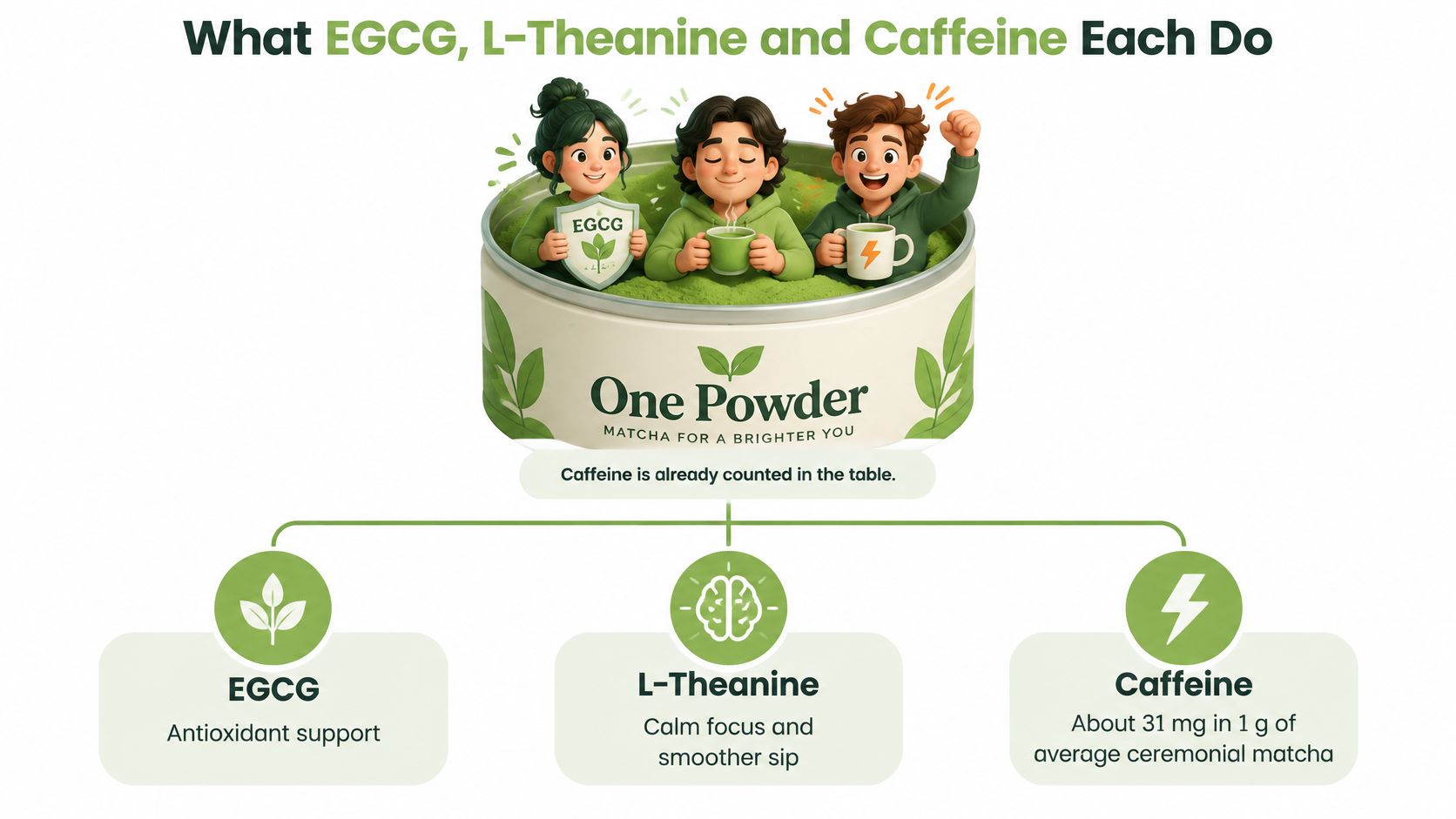
These compounds arrive in the same scoop, like three housemates sharing one kitchen: same address, different jobs. Finding them together does not make the bowl a set of precisely dosed supplements.
The illustration gives a simple overview. Its calm-focus wording describes a possible experience, not a guaranteed outcome.
EGCG is an antioxidant marker
EGCG, short for epigallocatechin gallate, belongs to the catechin family of polyphenols. It works more like a measurable piece of green tea chemistry than a shield that guarantees protection against illness.
A catechin result can help characterise a powder, but a laboratory measurement does not establish a clinical benefit from your morning bowl. When a brand makes a specific antioxidant claim, the testing method and the batch behind it matter.
For a plain-language explanation of the name and its role in tea, read what EGCG is. That background helps you compare products without turning every chemical name into a health promise.
L-theanine isn't a built-in supplement dose
L-theanine is an amino acid naturally present in tea. It can sit alongside caffeine like a steadying passenger, but it is not an off-switch that cancels stimulation.
An Australian-linked systematic review of nine randomised controlled studies found that 200–400 mg daily of supplemental L-theanine may help reduce stress or anxiety responses under stressful conditions. An ordinary matcha serving generally supplies substantially less, and that review does not set a per-gram matcha figure for turning a supplement dose into bowls.
Reality check: A compound being present and a drink matching a clinical trial dose are different claims.
Caffeine is the stimulant housemate
Caffeine works more like turning down a sleepiness signal than recharging a battery. It can support alertness, while sleep, food and recovery still do the underlying work.
No single matcha-to-coffee ratio is reliable without naming the coffee's preparation and serving size. Compare supplier information for the actual drinks rather than assuming every coffee is stronger or every matcha is gentler.
If tea is being used to push through tiredness, The Sleep Consultant's discussion of restorative sleep for high-performing professionals offers a separate recovery perspective. Treat it as a sleep resource, not proof of matcha's effects.
Chlorophyll gives the powder its green colour, and other amino acids and minerals travel with the leaf. Their presence alone does not make matcha a multivitamin or establish immune support.
Calm Focus, Sleep and Iron Timing
Calm energy isn't a guaranteed matcha property. Some people find the drink gentler than coffee; others still notice restlessness, a racing mind or trouble settling at bedtime.
An Australian food-and-nutrition scientist quoted in The Age's explanation of matcha's café popularity describes a possible gentler experience associated with its L-theanine and powdered-leaf format. The same account stresses that caffeine temporarily reduces perceived sleepiness rather than creating energy, and highlights tea's interaction with iron supplements.
The useful message is personal response, not a universal promise.
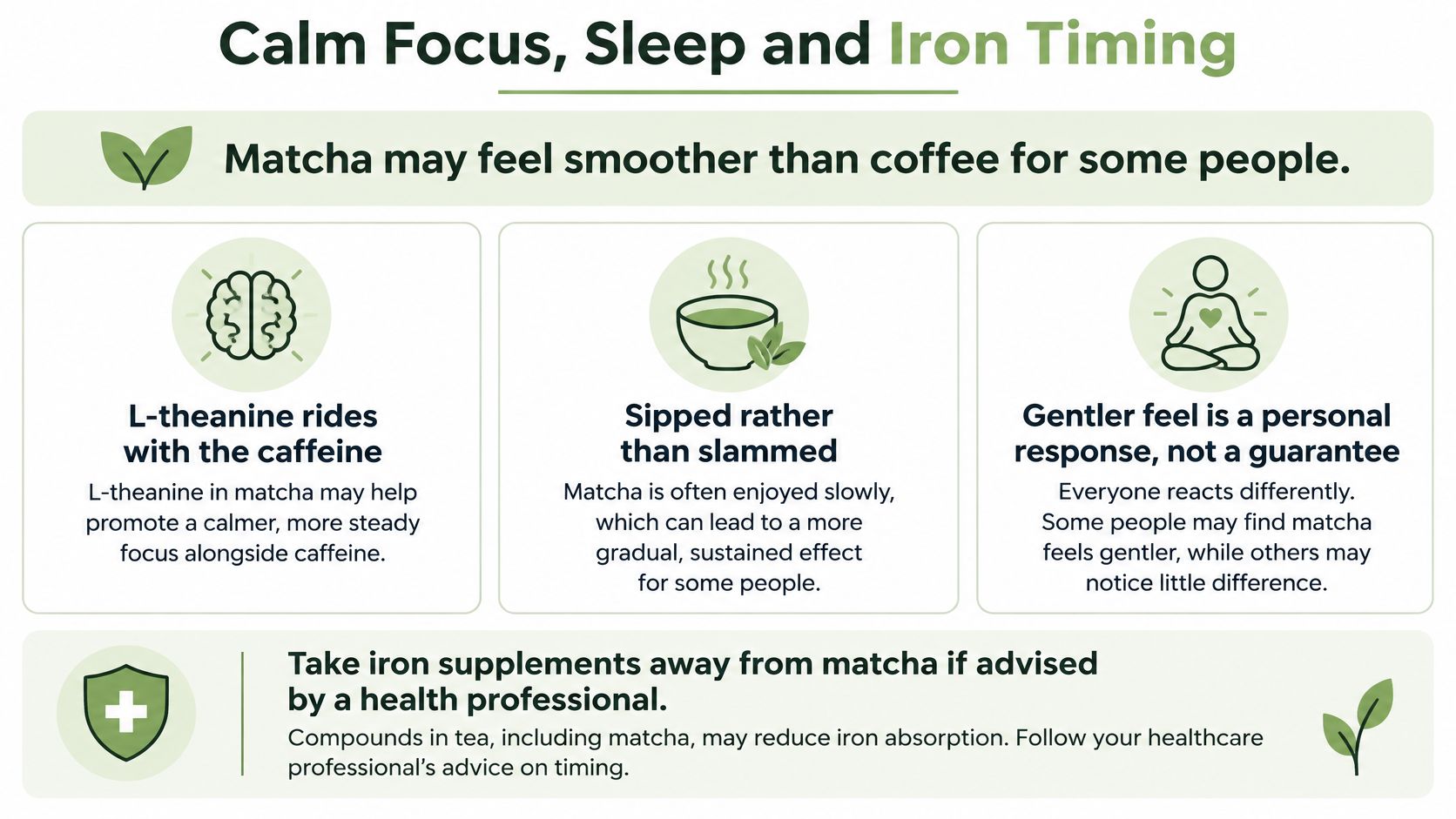
The same order can suit different days differently
Say you drink matcha during a mid-morning break after breakfast. You enjoy the ritual, feel alert and sleep normally that night. That experience doesn't tell you how an afternoon matcha will feel after a morning long black, another tea and a cola with lunch.
The important change is the whole day's caffeine, plus timing and your sensitivity. Milk, a slower drinking pace or a mellow taste shouldn't be treated as evidence that the stimulant dose has disappeared.
- If sleep is fragile: Move caffeinated drinks earlier or choose something else later in the day.
- If you feel jittery: Reduce exposure rather than adding another matcha to chase the advertised calm.
- If you're pregnant or buying for a child: Follow your clinician's caffeine advice, not a general adult allowance or a café's standard scoop.
Food Standards Australia New Zealand's caffeine guidance provides general healthy-adult benchmarks of up to 400 mg daily and up to 200 mg at once without general safety concern. These population-level figures aren't targets, personalised clearance or pregnancy limits.
Keep iron treatment separate
Tea can reduce the effectiveness of iron supplements. If you're treating iron deficiency, ask your pharmacist or clinician how to separate matcha from your tablet and from meals intended to improve iron intake.
Don't guess a universal waiting interval. The appropriate routine should fit the supplement, your treatment plan and the advice you've received.
Feeling comfortable after a caffeinated drink doesn't prove it won't affect tonight's sleep.
For a long shift or training session, keep the expectation modest: matcha is a caffeinated beverage that may help with alertness. It isn't a substitute for recovery, and adding more powder doesn't make that trade-off disappear.
Three Ways the Same Powder Behaves
A straight bowl, a latte and a smoothie can start with the same powder and finish with very different flavours. Water, milk, fruit and heat change the eating experience, but a pale drink isn't necessarily a low-caffeine drink.
Use the following as worked preparation examples, not laboratory nutrition specifications. The quantities are kitchen choices, and a scale is more useful than assuming every teaspoon holds the same mass.
Three preparations compared
| Preparation | Powder | Base | What changes | What stays |
|---|---|---|---|---|
| Usucha | For example, 2 g ceremonial | About 70 mL water | Bitterness, aroma, foam | Leaf constituents remain in the bowl if fully consumed |
| Café latte | For example, 2 g | About 200 mL hot or cold milk | Colour, softness, perceived bitterness | Powder remains; syrup belongs to the recipe, not the leaf |
| Baking or smoothie | For example, 1–2 tsp, mass not fixed | Batter or blended fruit | Colour, texture, heat effects | Leaf material remains; final compound dose isn't established |
Start with a smooth suspension
For the usucha example, sift the powder into a wide bowl. Add a small splash of water, around 75–80°C as a preparation starting point, and whisk out the dry pockets before adding the rest.
Use a bamboo chasen with quick back-and-forth movements rather than scraping circles around the bowl. A fine foam and no dry specks are useful signs you've dispersed the powder well; foam depth isn't an antioxidant test.
For the latte, make the same smooth base before adding milk. Pouring milk directly onto dry matcha often leaves stubborn pockets, while whisking first gives you better control over texture.
Change the recipe, not the expectation
Milk softens perceived bitterness and makes the colour paler. Sweetener may make the drink more approachable, but a syrup-heavy order should be assessed as a complete recipe, not as plain tea.
For baking, sift matcha with the dry ingredients so it doesn't leave concentrated green spots. For a smoothie or cold shake, disperse it in a little liquid before blending with the other ingredients.
The illustration shows how a straight bowl, milk latte and cold shake differ in presentation.
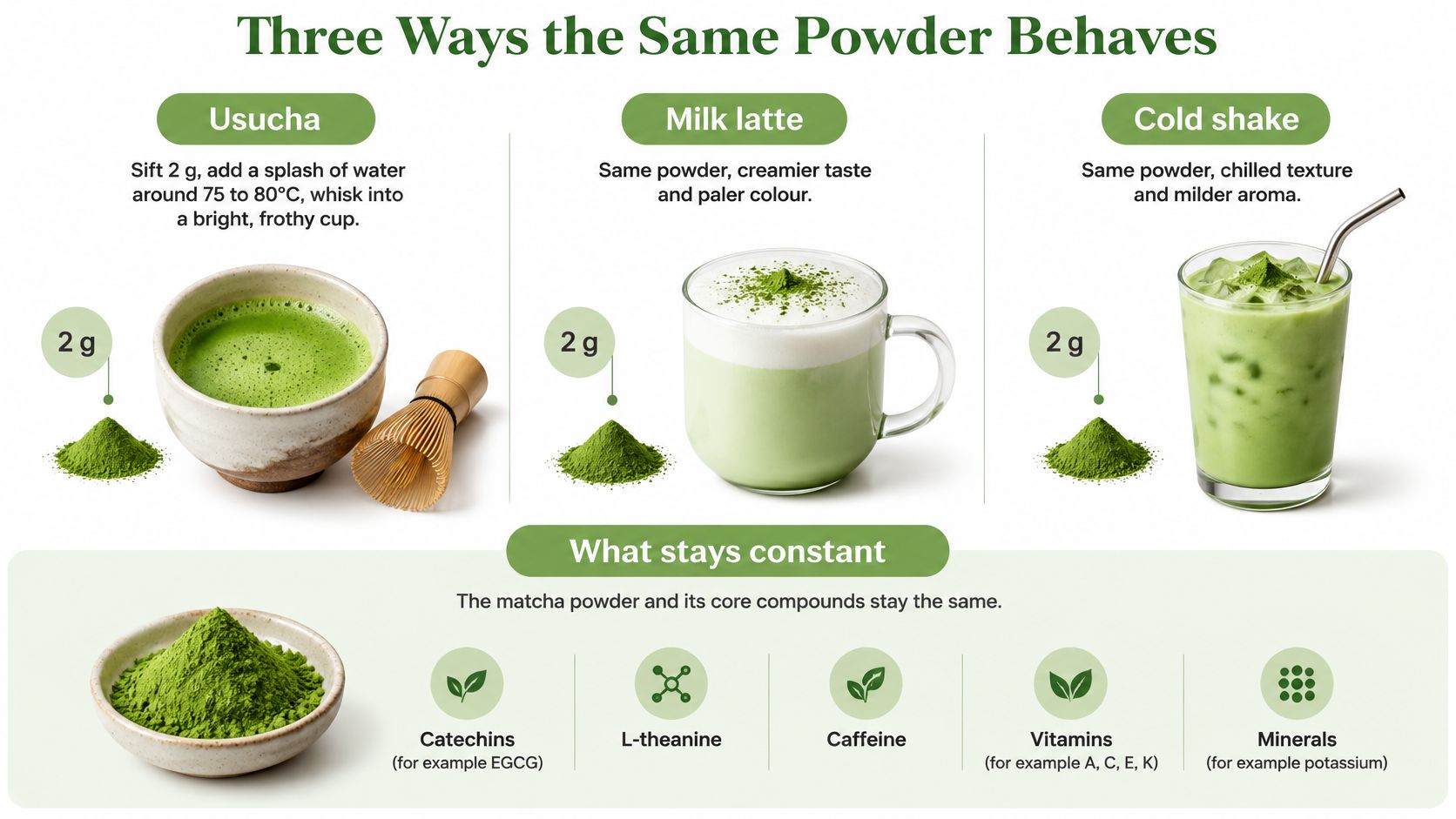
Choose ceremonial powder for a straight bowl and culinary powder for milk drinks or baking, where other ingredients shape the result. Heat and processing can change compounds, so the illustration's constant-compounds message shouldn't be read as a guarantee of identical retained antioxidant content after baking.
A grassy, lightly marine aroma can be appealing in the bowl, while a cake needs balance with its other flavours. Neither a green crumb nor a creamy latte establishes a precise functional dose.
Colour, Freshness and Storing the Tin
Colour, smell and texture are useful shopping clues, provided you don't ask them to do a laboratory's job. Fresh matcha often looks lively green, smells grassy with marine notes and feels finely milled rather than gritty.
A powder-and-bowl comparison is helpful for noticing texture and presentation.
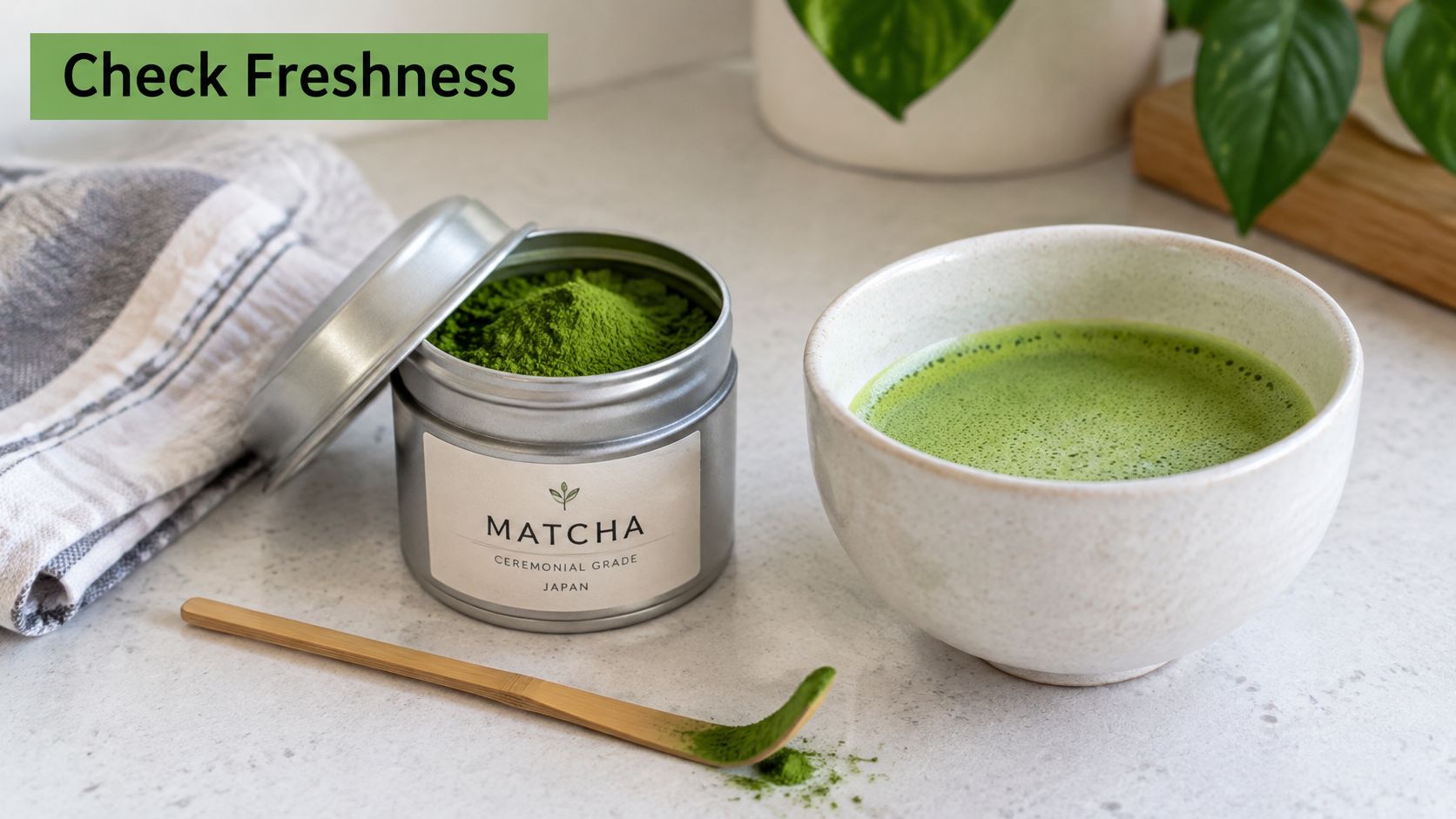
Olive or brown tones and a stale, hay-like smell can indicate deterioration, although grade and processing also affect appearance. You can't look at dull powder and conclude that all its catechins have vanished.
Give the powder a sensible home
- Close it promptly: Keep the container airtight between uses.
- Keep moisture out: Use a clean, dry spoon and avoid opening the tin over steam.
- Avoid hot spots: A cupboard away from the kettle, oven and direct sunlight is more suitable than a display shelf.
- Handle refrigeration carefully: Only refrigerate a properly sealed container, and let it come to room temperature before opening to reduce condensation.
Buy a pack size you'll realistically use rather than keeping a large tin open indefinitely. Check the supplier's storage advice and our guide to matcha shelf life for practical handling considerations.
Buying rule: Ask about origin, storage and testing before paying extra for an impressive tin.
Check provenance when demand is strong
SBS's reporting on Australia's matcha boom describes Australian imports of Japanese green tea rising nearly 20% year-on-year in 2024, with shortages and higher import costs becoming more visible during 2025. That context makes traceability more useful than fashionable packaging.
Look for Japanese origin, identifiable organic certification, a stated grade and a supplier who can explain handling and product testing. Organic certification answers a production-standard question; it doesn't independently verify caffeine, EGCG or freshness.
For a visual preparation reference, the video below accompanies the practical handling discussion.
Naturally occurring caffeine in tea generally doesn't carry the same labelling requirements as added caffeine, as the Australian Institute of Sport explains in its caffeine guidance. If the packet doesn't give a useful serving or composition guide, ask the supplier rather than interpreting silence as caffeine-free.
Pick the Serve That Fits Today
The useful matcha choice is the tea that suits what you are making, tastes good to you and fits your day's caffeine intake. Strength and price are only part of the decision.
For a straight bowl, prioritise aroma, texture and a finish you enjoy without needing to cover it up. Ceremonial-grade organic matcha is a sensible starting point for that purpose, while the label still works best alongside tasting and credible product information.
Match the grade to the job
Ceremonial and culinary grades are not chemically interchangeable in the cup, even before milk or flour enter the picture. For a latte, culinary-grade organic matcha can be practical because milk changes how you experience the tea. In baking, choose a powder with enough flavour to remain noticeable alongside flour, fat and sweetness.
- For a quiet tea break: Use a measured portion and adjust the water to taste.
- For a café menu: Standardise the powder mass, distinguish plain and sweetened recipes, and make ingredient information easy to obtain.
- For a bakery tray: Think about flavour per portion rather than presenting the finished food as an antioxidant supplement.
A digital scale helps make your first preparations repeatable. Once you have found a portion you like, you can reproduce it without relying on the shape of a heaped spoon. That matters more than chasing a perfect ritual, because the same powder can taste focused in a small bowl and disappear in a sweet slice.
Count the day, not just the bowl
The FSANZ dietary-intake assessment reports an average adult Australian caffeine intake of approximately 175 mg daily, with at least 25% of adults consuming more than 230 mg daily. That makes the rest of your routine relevant when adding matcha.
Coffee, black tea, cola, chocolate and energy drinks all belong in that check. A matcha on an otherwise caffeine-light day is a different decision from a matcha added to several caffeinated drinks, and calm focus is better treated as your own response to caffeine plus L-theanine than as a promise on the tin.
For refreshment rather than focus, sugar-free organic kombucha brewed in NSW is another option, although tea-based kombucha should not automatically be assumed caffeine-free.
Understanding matcha green tea properties should make choosing easier, not turn your kitchen into a laboratory. Buy a named grade, measure what you use and pay attention to how the complete routine suits you.
At Pep Tea, we offer organic ceremonial and culinary matcha for straight bowls, milk drinks and cooking, alongside sugar-free organic kombucha brewed in NSW. Visit Pep Tea to choose a grade that suits your cup or café menu, then weigh your first serves to make the result repeatable.
Is Matcha Good for You? Caffeine and Benefits

Yes, for most healthy adults, unsweetened matcha is a sensible everyday tea: a typical 2 g serving carries about 72.5 mg of caffeine and about 170 mg of catechins, including EGCG. It is not a disease treatment, and it is not an unlimited green drink.
The popular line is that a green cup is automatically a superfood, calmer than coffee, and safe all afternoon. That advice skips the only question that changes the answer. How many grams of powder are in the bowl, and what else have you already had? Matcha is powdered tea leaf, so the cup is a real caffeine serve, not a herbal rinse. Milk, syrup and a second café shot can turn a tidy morning drink into a dessert plus another stimulant. Judge is matcha good for you against your own caffeine budget, not against a wellness headline.
Is Matcha Good for You in One Serving
For most healthy adults, one unsweetened serve is a good everyday tea, not a cure. Because you swallow the powdered leaf instead of steeping it and tipping the leaves away, that small bowl carries both caffeine and a useful load of catechins.
A published comparison of a typical serving puts the numbers in plain sight. About 2 g of matcha can contain about 72.5 mg of caffeine and 170 mg of total catechins, including antioxidant compounds such as EGCG, and that whole-leaf intake can sit higher than ordinary brewed green tea, according to a 2025 review of matcha composition. The same paper sets this beside Australian habits: the Australian Bureau of Statistics reported average daily caffeine intakes in 2023 of 161 mg for males and 145 mg for females, with tea already contributing 14.6% of adult caffeine intake. One matcha serve is therefore a real share of a typical day, especially beside coffee, cola, chocolate or another tea.
Pick your row before you worry about how the drink feels.
| Drink or limit | Caffeine | Catechins or note | How to use the number |
|---|---|---|---|
| About 2 g matcha | About 72.5 mg | About 170 mg total catechins, including EGCG | Count it as one caffeinated drink |
| Ceremonial matcha | 31.45 mg per gram | EGCG the highest catechin in tested teas | Whisk a small measured serving |
| Culinary matcha | 26.29 mg per gram | EGCG and EGC predominant | Lattes, smoothies and baking |
| Bagged or gunpowder green tea | 23.08 mg per gram | Lower caffeine than ceremonial matcha | Infusion, leaves discarded |
| Healthy adults | Up to about 400 mg a day from all sources | Acute intakes to 200 mg not a concern in healthy adults | Add coffee, tea, cola and chocolate |
| Pregnancy and breastfeeding | 200 mg a day from all sources | Higher intakes linked with pregnancy risks | Count every caffeinated food and drink |
What changes the row
Home whisk: two grams, hot water, no sugar. That is the cleanest reading of the first row.
Café latte: the barista may use more than 2 g, then add milk and syrup. Milk doesn't erase caffeine. Sugar changes whether the drink still looks like a wellness choice.
National tea figures describe tea in general. They don't isolate matcha, ceremonial powder, or sweetened café drinks, so you can't borrow a population average as your personal dose.
Practical rule: Weigh the powder, write the grams on the café order in your head, and add that caffeine to everything else you drink that day.
Ceremonial powder is the strongest per gram in the table, culinary sits a step down, and bagged or gunpowder green tea is the lightest of the three. A healthy-adult ceiling near 400 mg from all sources, and a pregnancy ceiling of 200 mg, are the fences around those rows. Choose the row that matches your cup, then read why the compounds can feel different from a straight coffee.
Why the Whole Leaf Changes the Cup
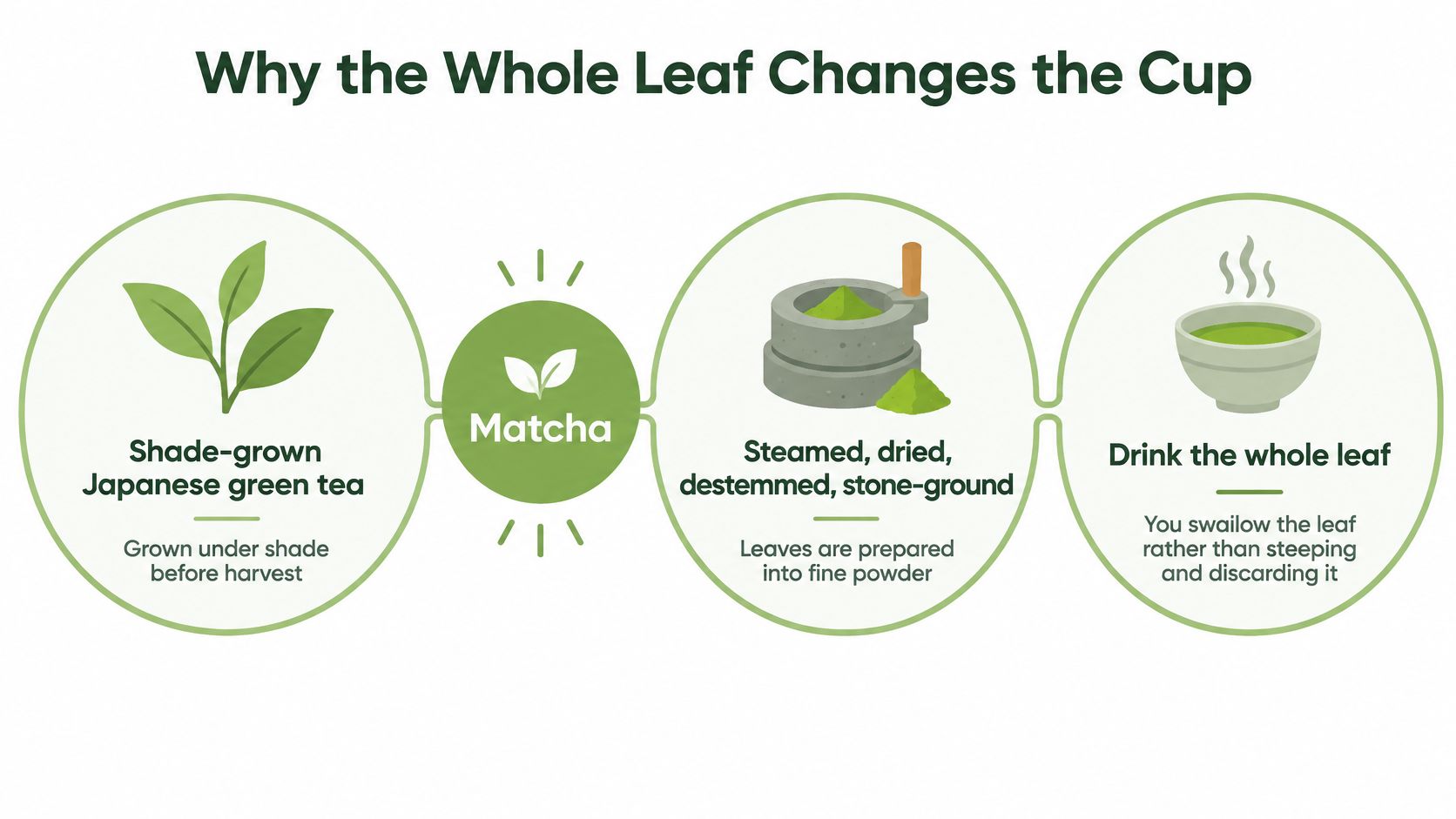
Say you brew a pot of green tea and throw the leaves in the compost. You've had a rinse of the leaf. Matcha is the leaf itself, suspended in the bowl.
The path is simple. Shade-grown Japanese green tea is harvested, steamed, dried and destemmed, then stone-ground into a fine powder. Shading before harvest pushes the leaf toward a deeper green and a softer, savoury taste. You don't filter that powder out. You drink it.
Two grades, two jobs
Ceremonial grade is usually made for drinking straight. Younger leaf is common in that style, and the bowl is meant to taste smooth when you whisk it with water alone.
Culinary grade has a stronger flavor. It stands up in a latte, a smoothie or a biscuit, where milk, fruit or flour would flatten a delicate bowl. If you mostly mix, culinary is usually the better buy. If you drink it plain, ceremonial earns its place.
Commercially available powders don't share one antioxidant strength. In one analysis of teas on the Australian market, ceremonial matcha averaged 31.45 mg of caffeine per gram, culinary matcha 26.29 mg/g, and bagged or gunpowder green tea 23.08 mg/g, with ceremonial matcha significantly higher than that last group, as reported in research on commercial matcha products. EGCG and EGC were the predominant catechins, and EGCG sat at the highest concentration. Younger leaf and processing help explain the caffeine gap, so a "premium" or "ceremonial" sticker is not a fixed antioxidant dose.
A label tells you the style. The gram weight tells you what actually reaches the cup.
An organic Japanese tin that names the grade, ceremonial or culinary, makes the choice concrete. Scoop by eye and you lose the comparison you just read. Weigh 2 g, whisk, and you know which row you're in. Grade decides taste and concentration. The health story still depends on how much powder you swallow.
What Caffeine, EGCG and L-Theanine May Do
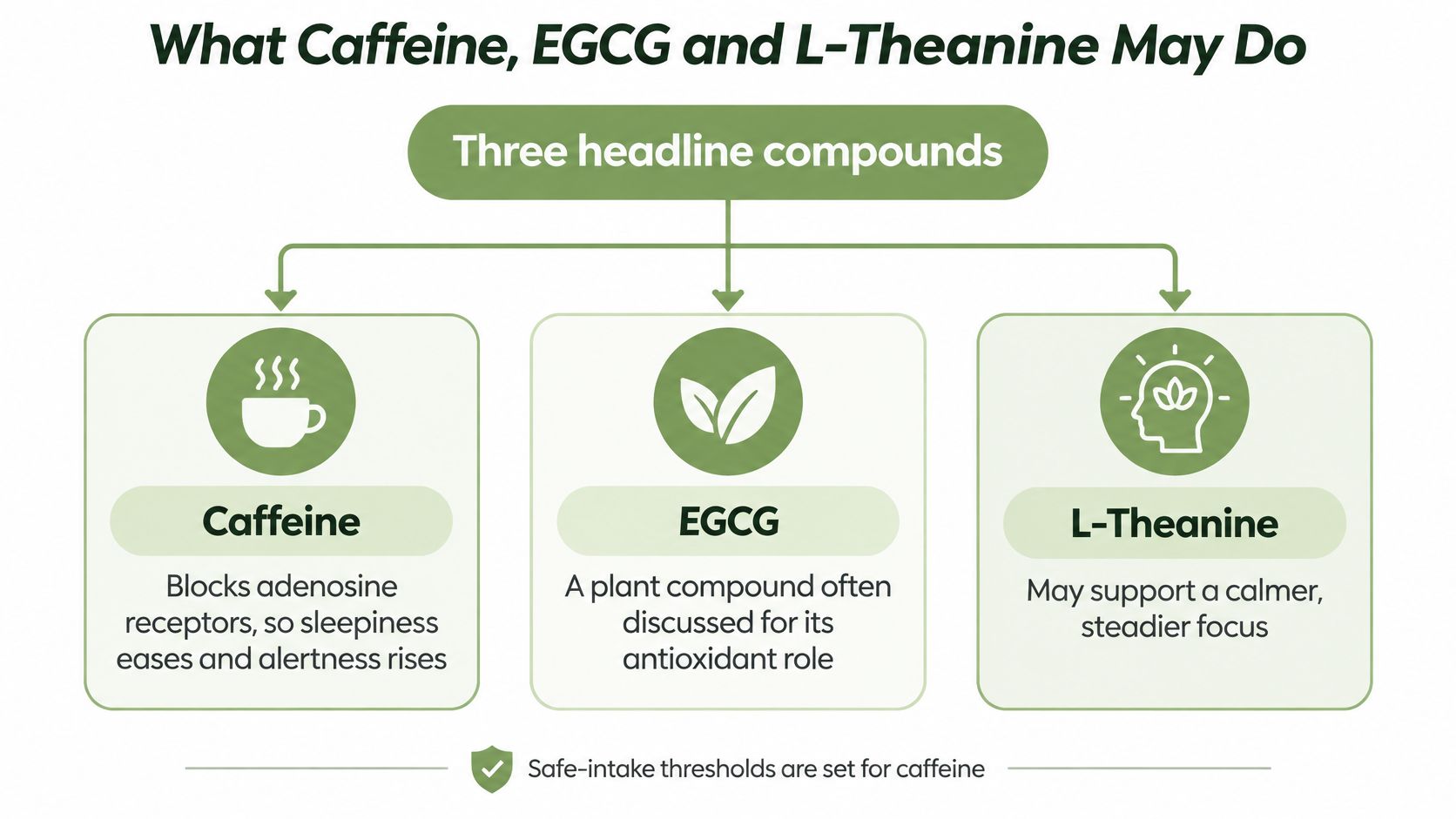
Three compounds get the headlines. None of them is a miracle pill, and together they still don't turn matcha into medicine.
Caffeine
Caffeine blocks adenosine receptors in the brain. Adenosine is one of the signals that makes you feel sleepy, so when caffeine gets in the way, sleepiness eases and alertness rises. That is the job. It doesn't promise a better mood, a faster workout, or sharper thinking on a tired night.
Because you drink the whole leaf, the dose moves with cultivar, shading, particle size and how many grams you use. Food Standards Australia New Zealand treats caffeine as a mild stimulant and notes that acute intakes up to 200 mg don't raise safety concerns in healthy adults, while chronic intake up to 400 mg a day is generally not linked with significant adverse effects in the general adult population. Count matcha in that total. It isn't a mild herbal tea.
EGCG
EGCG (epigallocatechin gallate) is a catechin, a plant compound in the antioxidant family. Along with related catechins, it may support the body's usual defences against oxidative stress, especially if the bowl replaces a sugary drink. A longer walk through the compound sits on our EGCG explainer. What it can't promise is weight loss, a detox, or immunity in any disease sense.
L-theanine
L-theanine is an amino acid found in tea. People have traditionally enjoyed it for a calmer kind of focus, and it's a fair reason a matcha bowl often feels smoother than a coffee with a similar caffeine hit. The pairing is plausible for a morning shift, a study block or a café service. It doesn't guarantee concentration, and it doesn't cancel the stimulant.
Milk, syrup and extra shots can erase the clean-energy idea even when the powder is excellent. If you want the calm-plus-caffeine effect, take one measured morning serve rather than topping up all day. Caffeine can still delay sleep when the drink feels subjectively smooth, so a late bowl is a poor trade. People with anxiety, hypertension, heart conditions or a jittery response should sit under the adult guide, and pregnancy has its own lower line, covered with the groups who need a tighter cap. For a café, listing the grams and sticking to one measured portion keeps the dose honest in lattes, smoothies and shots.
Matcha Against Coffee and Plain Green Tea
You're usually choosing between matcha and the coffee you already drink. Matcha isn't caffeine-free. Its caffeine arrives with L-theanine, and you also take in more of the leaf's catechins because nothing is discarded.
Per gram, bagged or gunpowder green tea carried the least caffeine of the teas compared earlier, and a plain infusion is usually the lower-caffeine cup. A 2 g matcha serve, about 72.5 mg, is a modest coffee-sized nudge for many people, not a herbal sip. Coffee itself swings wildly with cup size, roast and the café recipe, so read the pack or ask the café rather than assuming one standard mug.
When the swap makes sense
A gentler morning lift. You want to wake up without the hard edge some coffees give you. One unsweetened matcha, drunk on its own, is a fair trial for a fortnight. Judge it by sleep and jitters, not by a feeling on day one.
Replacing a second afternoon coffee. If the first coffee already did the job, a lighter tea habit can keep the afternoon from stacking. Plain green tea suits that late slot better than matcha, because you're not swallowing the whole leaf.
When it doesn't
You're already near your ceiling. Adding matcha on top of a large coffee, a cola and chocolate is how a "healthy" drink blows the budget. Add each drink to the daily total before you call it a swap.
You want a fast jolt. Matcha isn't built for that. If you need a hard hit, coffee is the more honest tool, and a third matcha at night isn't a softer version of the same idea.
Our notes on matcha energy compared with coffee walk the feel of the two drinks without ranking one as morally better. This is a caffeine budget, not a health league table.
Who Should Limit Matcha and Why
"Good for you" shrinks as soon as the day's caffeine has to stay inside a smaller fence.
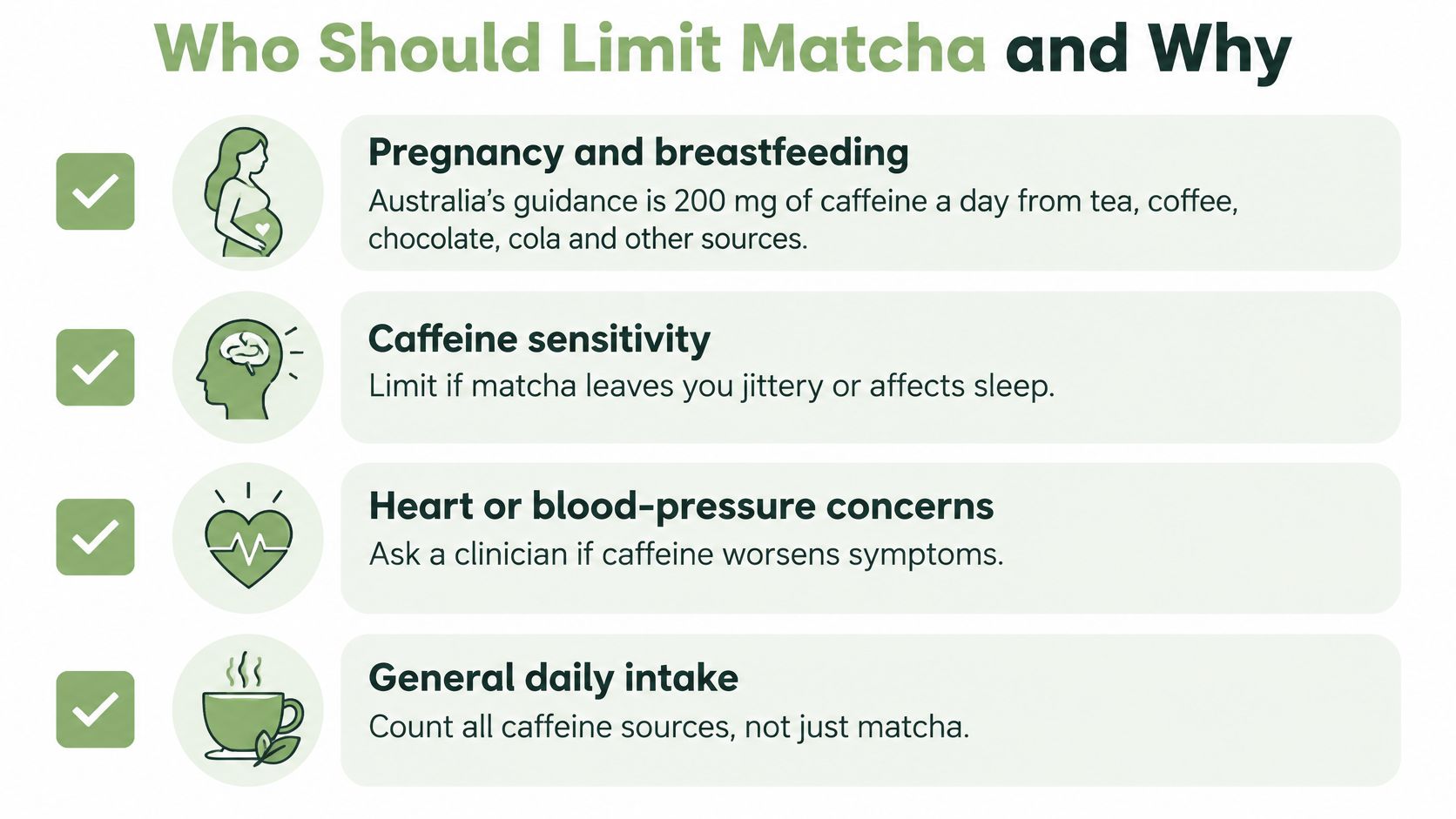
Pregnancy and breastfeeding
Australian guidance is to limit total caffeine during pregnancy and breastfeeding to 200 mg a day, counting tea, coffee, chocolate, cola and other sources together, as set out in NSW Health's healthy eating in pregnancy advice. FSANZ's caffeine review gives pregnant women the same ceiling, because higher intakes may be associated with miscarriage, stillbirth, preterm delivery, low birthweight and babies who are small for gestational age. One cup isn't a fixed safe unit. Powder grams and café recipes move the dose. If you're pregnant or breastfeeding, the practical page is our guide to matcha in pregnancy.
Tea can also reduce iron absorption, which matters more in pregnancy. You don't have to ban the drink. Leave a gap around iron-rich meals and iron supplements so the tea isn't sitting in the same window.
Other reasons to go smaller
People with anxiety, poor sleep, hypertension, heart conditions or a jittery response should set a personal cap below the general adult guide. Skip matcha late in the day. L-theanine can make the bowl feel smooth while caffeine still pushes sleep later.
A simple check works better than a vibe:
- Read the pack for any caffeine figure printed on that tin.
- Weigh the powder instead of using a heaped souvenir spoon.
- Add the rest of the day, including coffee, cola, chocolate and energy drinks.
- Stop or shrink the serve if sleep, heart rate or anxiety gets worse.
| Situation | Threshold | What to do |
|---|---|---|
| Healthy adult | About 400 mg caffeine a day from everything | Keep matcha inside that total |
| Single sitting, healthy adult | Up to 200 mg caffeine not a general concern | Avoid stacking several strong drinks at once |
| Pregnancy or breastfeeding | 200 mg caffeine a day, all sources | Count tea, coffee, cola and chocolate; check café serves |
| Iron-rich meals or supplements | Tea can reduce iron absorption | Leave a gap around those meals |
| Anxiety, sleep trouble or caffeine sensitivity | A personal cap below the adult guide | Smaller serves and none late in the day |
Antioxidant talk and calm-focus marketing can make matcha sound unrestricted. The clinical question is total caffeine and how you personally respond. A normal whisked cup is also a different product from a green-tea extract capsule, which belongs in the claims section, not in this table.
Claims That Outrun the Evidence
Calm doesn't mean harmless. L-theanine is why a bowl can feel smoother than coffee, and that feeling gets used as a licence for a third serve at night. A strong bowl can still rival a small coffee. If you're sensitive, "gentler" is a mood word, not a measurement.
Extracts aren't a stronger cup
More antioxidants aren't automatically better. Traditional green-tea infusions and concentrated supplements sit in different safety lanes. A systematic review notes that the European Food Safety Authority considered catechins from traditionally prepared green-tea infusions generally safe at reported intake levels, while supplemental EGCG doses of 800 mg a day or more may increase serum transaminases, a marker associated with liver injury, as summarised in this review of green-tea catechins. That threshold is about capsules and high-dose extracts, not a normal cup of matcha. It doesn't mean a whisked bowl harms the liver. It does mean a detox shot or a fat-burning stack isn't the same product. Don't stack matcha with concentrated green-tea extracts unless a clinician is across it.
A grade isn't a prescription
Ceremonial isn't a medical grade. It often means younger leaf and more caffeine per gram, which can be lovely in the bowl and less ideal if you're already near your cap. "Premium" on a label doesn't fix the gram weight.
A drink isn't a diet
Matcha doesn't replace vegetables, sleep, iron-rich meals or medical care. An unsweetened cup doesn't cancel a syrup-heavy latte ordered an hour later. Australian figures on tea drinking describe tea in general. They aren't proof of a matcha health effect, and matcha-specific intake data are still thin.
If a pack promises disease prevention, rapid fat loss or unrestricted safety, put it back.
The modest version is enough. A measured organic matcha can be a better daily choice than a sugary energy drink when you tolerate caffeine. It remains a beverage.
What a Good Matcha Day Looks Like
Matcha's established place in Australia is as a caffeinated tea, not as a proven treatment. The Australian Bureau of Statistics National Health Survey found that 38.5% of Australian adults reported consuming tea in 2023, compared with 8.1% of children aged 2–17, and that 44.3% of adult women consumed tea versus 32.5% of adult men. Those figures cover tea generally. They don't isolate matcha, ceremonial grade, or drinks with milk and sugar. Unsweetened matcha can sit inside a habit Australians already have, as caffeine plus plant compounds, not as a stand-in for medical care or a balanced diet.
Three days you can copy
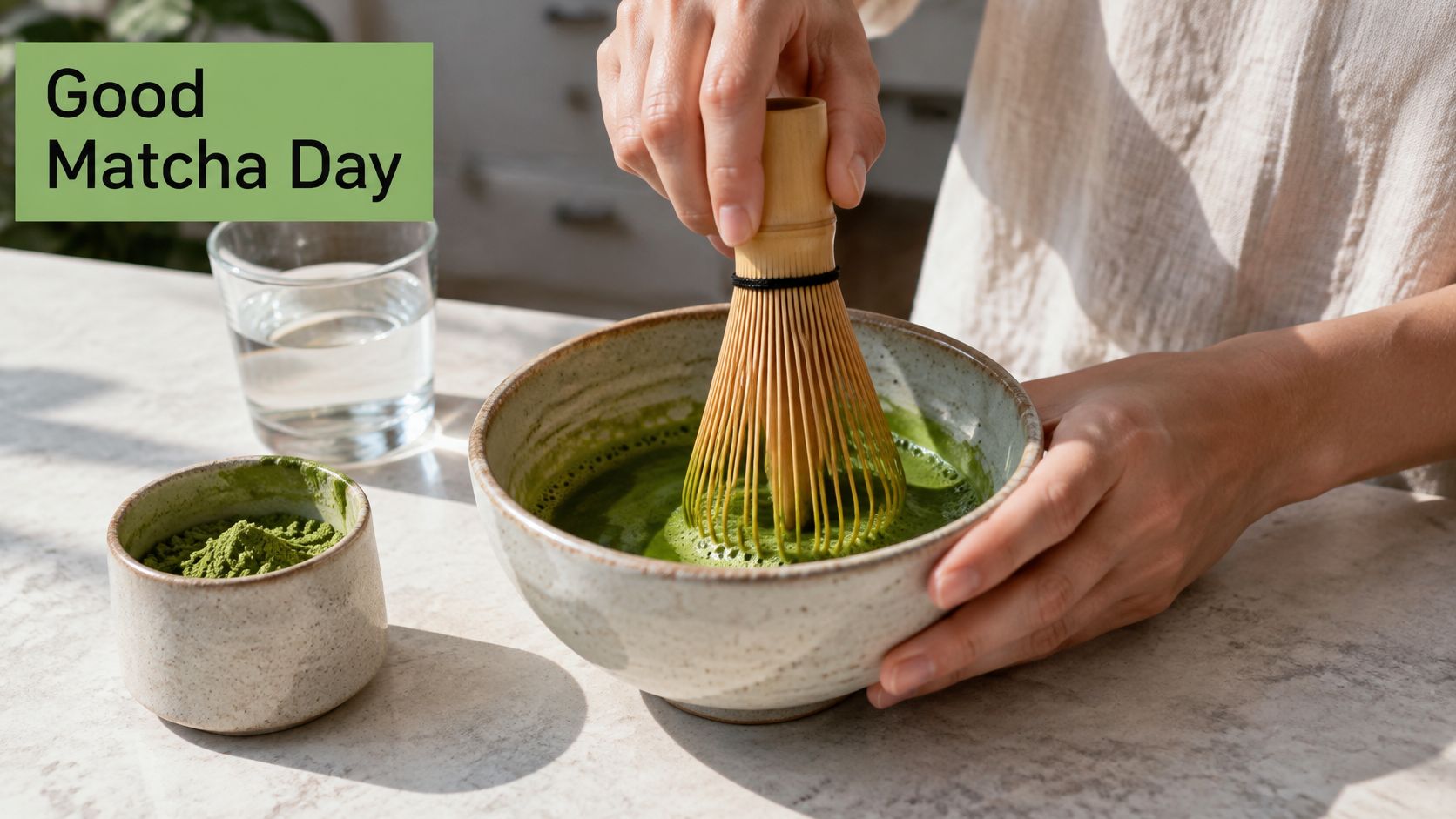
Home morning. Whisk 2 g of ceremonial powder with about 70 ml of water around 80°C. No sugar. Make it the only caffeine before noon. A second bowl still counts, so decide on it before you leave the kitchen, not at 3 pm when you're flat.
Café day. Order one measured matcha latte and skip the extra coffee. Milk doesn't cancel caffeine, and a pump of syrup can turn the cup into a dessert. If the menu doesn't list grams, ask for a single shot and treat anything larger as two drinks.
Baker or café pass. Use culinary grade in a smoothie, biscuit or ice cream, where flavour matters more than a bare bowl. List the grams on the prep sheet so staff and customers can see the dose. For warm months, an unsweetened iced matcha uses the same weighed powder over ice, not a bigger scoop because the glass is taller.
A sugar-free kombucha is a different drink for the afternoon if you want something cold without adding another caffeine serve. It doesn't change what the morning matcha already contributed.
The one-line test is boring and useful. If sleep is fine and the drink isn't a sugar vehicle, the pattern is doing its job.
Choose a Measured Matcha Habit
For a healthy adult who sleeps well, one unsweetened morning serving of about 2 g is a measured way to enjoy matcha. Count it alongside the rest of the day's caffeine. Whether matcha suits you depends less on a superfood label than on how that serving fits your routine.
If you're pregnant, breastfeeding, anxious, hypertensive or already drinking coffee, keep the 200 mg frame in mind or set a lower personal limit, and avoid late serves. Matcha can still fit, but the total caffeine in your day matters.
For lattes or baking, culinary grade can suit the stronger flavours around it; for drinking straight, ceremonial grade is often chosen for a bowl on its own. Whichever you use, weigh the powder rather than guessing. Keep the tin sealed and away from light and heat to help preserve its colour and flavour. A faded, bitter powder may have lost freshness in storage.
Pep Tea offers organic matcha, a straightforward option to explore if you want to weigh a serving at home. Taste it, notice how your sleep responds, and consider the rest of your diet. A measured habit is more useful than a superfood headline.
If you're building a calmer caffeine routine, start with one unsweetened morning bowl and see how you sleep. Visit Pep Tea to explore its organic matcha range.
Matcha Green Tea Powder Health Benefits: What Holds Up
The advice to swap coffee for matcha because it gives you calm energy without a crash leaves out the most important detail: how much powder goes into your cup. Matcha isn't automatically low in caffeine, and adding more doesn't necessarily make it healthier.
The strongest case for matcha green tea powder health benefits is straightforward. It contributes tea polyphenols to your diet and contains caffeine that can support alertness. Bigger promises about fat loss, immunity and disease prevention need a more cautious reading, especially when the evidence comes from ordinary green tea or concentrated extracts rather than matcha itself.
Matcha Health Benefits at a Glance
Matcha health claims rated by evidence strength
| Claim | Main compound | Evidence strength | Plain-English reading |
|---|---|---|---|
| Antioxidant intake | Catechins including EGCG | Supported as part of the diet | Adds tea polyphenols to a varied diet |
| Heart health | Catechins and nitric-oxide support | Associated, emerging | Linked in guidance, not proof of prevention |
| Alertness and calm focus | Caffeine with L-theanine | Plausible, limited human trials | Can support focus at moderate doses |
| Weight management | Catechins with caffeine | Small and inconsistent | Supportive at best, not a fat-loss product |
| Gut health and immunity | Not established for matcha | Mostly consumer demand | Treat as unproven |
The table separates what matcha contains from what drinking it has been shown to achieve. Those aren't interchangeable statements. Finding an antioxidant in tea doesn't establish that a particular latte prevents illness.
The Australian Dietary Guidelines discuss tea catechins in connection with cardiovascular health, including support for nitric-oxide production in the lining of blood vessels. Nitric oxide helps blood vessels relax, giving researchers a plausible explanation for beneficial effects on circulation. However, the guidance describes green-tea evidence as emerging and doesn't prove that matcha prevents cardiovascular disease or stroke.
How to judge a health claim
Start with the mechanism. A compound might affect a process in a laboratory, such as oxidation or blood-vessel signalling. That tells us something worth investigating, not what will happen after your morning drink.
Next, look for a human trial using a realistic preparation. A capsule containing concentrated green-tea extract isn't the same intervention as whisked matcha with breakfast.
Finally, ask about the meaningful outcome. Did people experience a useful improvement in health, or did researchers measure a small change in a laboratory marker?
A useful distinction: Evidence that a drink contains beneficial compounds is stronger than evidence that the drink treats a condition.
This doesn't make matcha disappointing. It gives it a sensible place in everyday eating: an enjoyable source of tea polyphenols alongside vegetables, fruit, legumes and other varied foods. Our certified-organic Japanese matcha fits that role without needing to be presented as a treatment.
Whole-Leaf Matcha Compared With Green Tea, Coffee and Kombucha
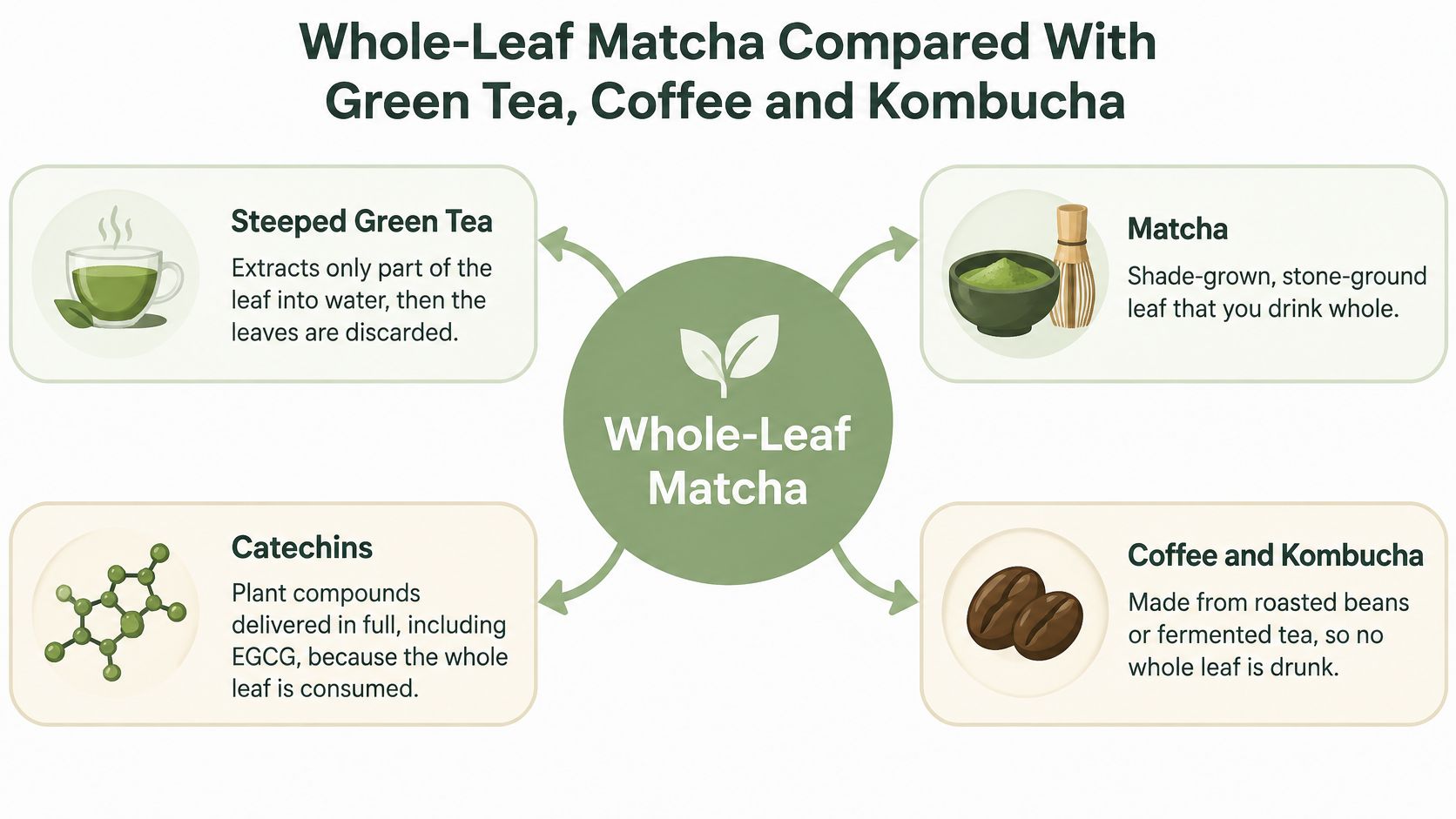
Matcha is a whole-leaf powder, while brewed green tea is an infusion: water draws compounds from the leaves, which are then removed. With matcha, you whisk the powdered leaf into the drink and consume it. The difference is like making stock, where some compounds move into the liquid, versus blending herbs into soup, where you eat the plant material too.
That also means the amount of matcha matters. Each gram adds tea compounds, including epigallocatechin gallate, or EGCG, as well as caffeine and L-theanine, an amino acid associated with tea's characteristic experience. Whole-leaf preparation explains what goes into the cup, but it does not by itself prove a health benefit.
The visual below summarises how these drinks are made.
What the compounds actually do
A Western Sydney University review identifies catechins, caffeine and L-theanine as key matcha constituents, while noting that human clinical evidence remains limited compared with laboratory and animal research. EGCG can take part in oxidation-related reactions, caffeine blocks adenosine receptors involved in drowsiness, and L-theanine may cross the blood-brain barrier.
Together, these mechanisms make alertness with less subjective tension plausible. They do not guarantee that every drinker will feel focused or relaxed, or avoid a caffeine crash.
Shading helps shape matcha's amino-acid profile, including L-theanine. Cultivar, growing conditions and processing also affect the finished powder. Colour, grade and texture cannot reliably tell you its caffeine content, so the amount used remains important.
Tea is an important source of dietary polyphenols in Australia. A nationally representative analysis published in the Journal of Human Nutrition and Dietetics attributed 64.3% of energy-adjusted polyphenol intake to tea, compared with 29.3% to coffee and coffee substitutes. These figures describe tea and coffee consumption generally, not a specific health advantage from matcha.
Matcha, green tea, coffee and kombucha compared
| Drink | What you consume | Live cultures | Typical added sugar | Best fit |
|---|---|---|---|---|
| Matcha powder | Whole stone-ground leaf | No | None unless sweetened | Lattes, baking and smoothies |
| Brewed green tea | Leaf infusion, leaves discarded | No | None unless sweetened | Lighter caffeine and daily hydration |
| Brewed coffee | Bean extract | No | None black; check milk and syrups | A direct caffeine hit |
| Sugar-free kombucha | Fermented tea | Yes, in living, unpasteurised products | Low or none; check labels | Fizzy, low-sugar alternative to soft drinks |
Choose for the occasion
Brewed green tea suits a lighter tea ritual. Matcha works well whisked, in lattes or in recipes where you want the leaf's flavour and colour. The guide to the difference between matcha and green tea explains how their preparation differs.
Sugar-free organic kombucha brewed in NSW offers a sparkling alternative, while coffee suits those who prefer roasted flavours. Live cultures in fermented tea do not establish a guaranteed gut-health benefit, just as matcha's catechins do not establish an immunity benefit.
Matcha is a concentrated functional beverage, not an unlimited antioxidant supplement.
Syrups and sweetened milk change the nutritional profile of any finished drink.
Caffeine per Serving and Your Daily Limit
Caffeine per serving compared with daily limits
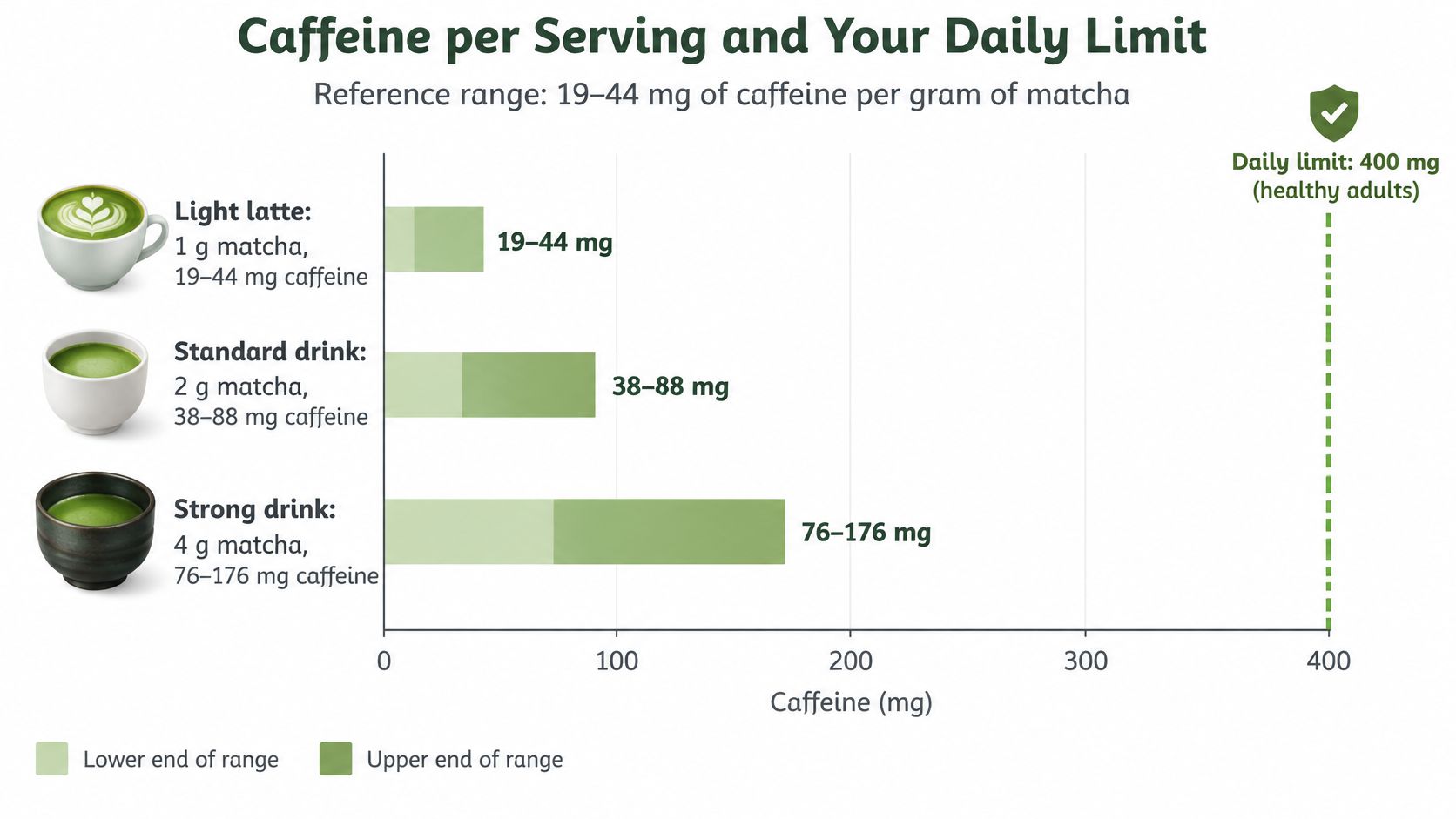
Matcha is a whole-leaf powder, so each extra gram adds more caffeine and other tea compounds to your drink. The estimates below use 19–44 mg of caffeine per gram, a range reported by Nine's matcha explainer, citing a scientific paper. They are estimates, not product-specific test results.
| Serving | Powder or volume | Estimated caffeine | Share of adult daily ceiling |
|---|---|---|---|
| Light matcha latte | 1 g powder | 19–44 mg | 5–11% |
| Standard matcha drink | 2 g powder | 38–88 mg | 10–22% |
| Strong or ceremonial serving | 4 g powder | 76–176 mg | 19–44% |
| Ordinary green tea | 250 mL cup | 30–50 mg | 8–13% |
Coffee's caffeine varies with brew strength and cup size, so this table compares matcha and green tea servings only.
The Australian Institute of Sport's caffeine guidance says up to 400 mg daily from all sources is generally safe for healthy adults, with a suggested maximum of 200 mg in a single serving. The percentage column compares each serving with the 400 mg daily ceiling and rounds to whole percentages.
The chart shows how the estimated caffeine amount rises with the matcha powder used.
Count the powder, not the cup
A tall iced latte is not necessarily stronger than a small bowl of matcha. Milk, ice and water increase the drink's volume, but they do not remove caffeine already present in the powder.
Ceremonial describes a product's intended use, not a fixed serving weight. Ask a café how much matcha it adds, and weigh your own portion with kitchen scales rather than relying on a heaped spoon. A few extra grams can shift the caffeine estimate substantially.
The Australian Institute of Sport's intake overview estimates that Australian adults average approximately 175 mg of caffeine daily, with at least 25% consuming more than 230 mg. It also lists ordinary green tea at approximately 30–50 mg per 250 mL cup. Those figures put one matcha in context: its contribution matters alongside the coffee, tea or other caffeine already in your routine.
Build a realistic daily total
A running list can make the total easier to judge:
- Record the recipe: Write down the powder weight, not just “matcha latte”.
- Include other drinks: Add coffee, tea, cola and energy drinks using labels or supplier information.
- Check overlooked sources: Include chocolate, pre-workout products and caffeinated supplements.
- Leave room for uncertainty: Café recipes and powders vary, so avoid planning right against the daily ceiling.
A morning matcha followed by afternoon coffee is not automatically excessive. Adding pre-workout before an evening gym session could change the total, so count that too.
For preparation context, this video can accompany a home-brewing routine.
Our guide to caffeine content in green tea compares tea types. Matcha may feel like calm focus, but that does not prevent dose effects: jitters, palpitations or disrupted sleep are reasons to reduce your intake.
Who Should Be Careful With Matcha
Matcha is whole-leaf powder, so the amount of caffeine and other compounds depends on how much powder goes into the cup. That makes the serving size especially relevant for children, pregnant or breastfeeding people, and anyone sensitive to caffeine or taking medicines. The table offers a starting point, not a personal prescription.
| Group | Caffeine guidance | What it means for matcha |
|---|---|---|
| Healthy adults | General adult ceiling, not a target | Count matcha alongside other caffeine sources |
| Single serving | Keep below the suggested single-dose maximum | Check the grams used in each drink |
| Pregnancy | No more than 200 mg daily | Count matcha with tea, coffee and chocolate |
| Children aged 9–13 | Anxiety has been reported at about 120 mg daily | Matcha is not automatically suitable |
| Breastfeeding | No single figure applied here | Ask a GP or midwife before regular use |
| Anxiety, sleep sensitivity or medicines | An individual, potentially lower limit | Discuss symptoms and medicines with a health professional |
During pregnancy, guidance recommends no more than 200 mg of caffeine daily, according to Better Health Channel's caffeine advice. That is a combined daily total from foods, drinks and other sources, not an allowance for matcha alone.
Natural doesn't mean suitable for children
The NSW Food Authority's summary of FSANZ advice says there is no universal health-based Acceptable Daily Intake for caffeine. It reports increased anxiety in children at approximately 3 mg per kilogram of body weight daily, or about 120 mg for children aged 9–13. For a child weighing 40 kg, that calculation also comes to 120 mg.
This is a marker of observed concern, not a target to reach. Because matcha is powdered whole leaf, using more powder increases the caffeine in the drink. A concentrated serving can contribute before chocolate, cola or other tea is counted.
Conditions and medicines change the decision
People who are breastfeeding, take relevant medicines or are sensitive to caffeine may need individual advice. The FSANZ caffeine safety assessment discusses how dose and sensitivity matter for anxiety, blood-pressure responses and sleep difficulties. If you have insomnia, palpitations, anxiety or reflux, switching from coffee to matcha may not resolve the problem.
Tea can also reduce absorption of non-haem iron, the form found in plant foods. If you're pregnant, iron deficient or taking iron supplements, discuss timing with your clinician.
Use these steps to make a cautious choice:
- Count everything: Include drinks, foods and supplements.
- Respond to symptoms: Reduce or stop caffeine if sleep, jitters or palpitations become a problem.
- Ask about interactions: Bring your medicine and supplement list to a GP or pharmacist.
- Review supplements separately: Vitamin safety with Pumpernickel Health Foods covers supplement considerations and kidney health, though your own medicines and caffeine intake call for advice from a health professional.
Weight Loss and Heart Health Claims Put to the Test
Matcha's fat-burning reputation rests on a plausible mechanism, not proven weight loss. Catechins may affect fat oxidation, while caffeine can raise energy expenditure, but neither effect establishes that an everyday matcha drink produces meaningful, lasting weight loss.
Trials of green-tea catechins and caffeine have generally shown little or no meaningful weight loss compared with placebo. The evidence on the FSANZ food-health relationship register should not be read as proof that matcha causes weight loss. A proposed relationship listed there does not establish that drinking matcha leads to a clinically useful result.
A mechanism isn't a result
A small or inconsistent change in energy expenditure may not add up to a useful difference in body weight. Studies of green-tea extracts also cannot be directly translated into cups of matcha. Matcha is a whole-leaf powder, so the amount of caffeine and other compounds rises with each gram you add. Increasing the serving to chase a metabolic effect can also mean more caffeine exposure.
Understanding what EGCG is helps distinguish a compound's properties from claims about a finished drink. A plausible effect in the body is only one step in the chain. It does not show that a typical serving changes weight.
Heart-health claims need the same caution
Tea compounds may affect blood-vessel function, a possible pathway for cardiovascular health. Yet associations between tea drinking and better health outcomes do not prove that matcha itself prevents disease. Tea drinkers may differ in other habits, and a measured change in vessel function is not the same as evidence of fewer heart attacks. Stronger conclusions would require longer human trials using measured matcha doses and meaningful clinical outcomes.
The practical verdict: Enjoy matcha as a drink, not as a fat-loss product or cardiovascular treatment.
Replacing a sugary drink with unsweetened matcha may be a useful change. Any benefit comes from the substitution and your wider routine, not a promise that tea will burn body fat.
Matcha Questions Readers Ask Most
Does matcha keep you awake?
It can, because it contains caffeine. L-theanine may soften subjective tension for some people, but it doesn't cancel caffeine or guarantee relaxed alertness.
When is the best time to drink it?
Morning or early afternoon is a sensible starting point. If you struggle to fall asleep, move your drink earlier or reduce the powder rather than assuming a milky latte is too gentle to matter.
Can I have matcha every day?
Many healthy adults can include it in a daily routine. Keep the serving consistent, account for other caffeine sources and let sleep and symptoms guide you rather than treating a general ceiling as a target.
Is matcha better than coffee for weight loss?
Neither deserves to be treated as a fat-loss product. An unsweetened drink may be a useful replacement for a sugary café order, but matcha doesn't have an established weight-loss advantage over coffee.
Is organic matcha worth it?
Organic certification reflects production standards, while freshness, storage and the intended grade help shape flavour and colour. Choose certified organic if those standards matter to you, but don't use the label to predict caffeine content or assume it proves superior clinical benefits.
For straight drinking, a smoother ceremonial-style powder may suit your palate. For cooking, a culinary powder offers a practical way to bring tea flavour into a recipe without paying for qualities that milk or baking may obscure.
Is there a caffeine-free matcha?
Conventional matcha naturally contains caffeine because it's powdered green tea leaf. A caffeine-free herbal infusion is a clearer choice if you need to avoid caffeine entirely.
Sugar-free kombucha may offer a different drinking experience, but fermented tea isn't automatically caffeine-free. Check the label rather than assuming fermentation removes it.
Start a Matcha Routine Within Safe Limits
Because matcha is powdered whole leaf, the amount you use shapes both its flavour and caffeine. A steady, measured serving makes it easier to enjoy the drink and notice how it affects you.
Build consistency before strength
Begin with a light, weighed serving. Use kitchen scales that measure small amounts accurately. Spoonfuls can vary, so weighing helps keep each drink consistent.
Check your usual caffeine sources. Write down your coffee, tea, chocolate and supplements. Matcha adds to that daily total, even when it is mixed into a latte.
Choose a grade for the recipe. Japanese ceremonial matcha suits whisking with water. Culinary matcha works well in lattes, smoothies and baking.
Keep preparation simple. Sift the powder into a bowl and whisk with a little hot, not boiling, water. Add more water or unsweetened milk to taste, so the tea's flavour comes through without unnecessary sweetness.
Notice how your body responds. Track sleep, restlessness and a racing heartbeat over time. Reduce the amount or stop if the drink does not agree with you.
Adjust only for a reason. If you want stronger flavour and tolerate your current serving, increase the measured amount gradually rather than adding a heaped spoon.
Make the drink suit your day
For an iced latte, whisk matcha into a smooth concentrate, then pour it over milk and ice. In a smoothie, blend it with plain yoghurt or an unsweetened alternative and taste before adding anything sweet.
Keep the powder tightly sealed and away from heat, moisture and light. Buy an amount you can use while its flavour remains fresh, rather than leaving a large bag open for occasional baking.
Pregnant or breastfeeding readers, children and people taking medicines should seek individual advice before making matcha a regular habit. If you need to avoid caffeine, choose a genuinely caffeine-free drink; extra milk does not remove matcha's caffeine.
Pep Tea offers organic Japanese matcha for whisking, lattes and cooking, as well as sugar-free organic kombucha. Visit Pep Tea to explore the matcha range or browse the kombucha range for a low-sugar option that suits your routine.
Matcha Green Tea L Theanine: Benefits for Calm Focus
Matcha contains naturally occurring L-theanine, an amino acid that, paired with caffeine, is associated with calm alertness. However, a typical 2 g serve delivers far less L-theanine than the 200–400 mg/day doses used in clinical sleep and anxiety studies, so the experience depends heavily on grade, shading, and dose.
Have you ever wondered whether matcha's famous “energy without the jitters” reputation comes from the drink itself, or from a much larger dose of purified L-theanine than your cup can realistically provide? That distinction matters. Matcha green tea L-theanine is a useful food-and-beverage story, but it isn't the same thing as taking a controlled supplement.
Matcha can still be a pleasant source of caffeine, amino acids and antioxidant compounds. The sensible question is not whether it's a magic calm-focus drink. It's what a particular serve contains, how you prepare it, and what the human evidence can tell us.
Why Everyone Is Talking About Matcha and L-Theanine
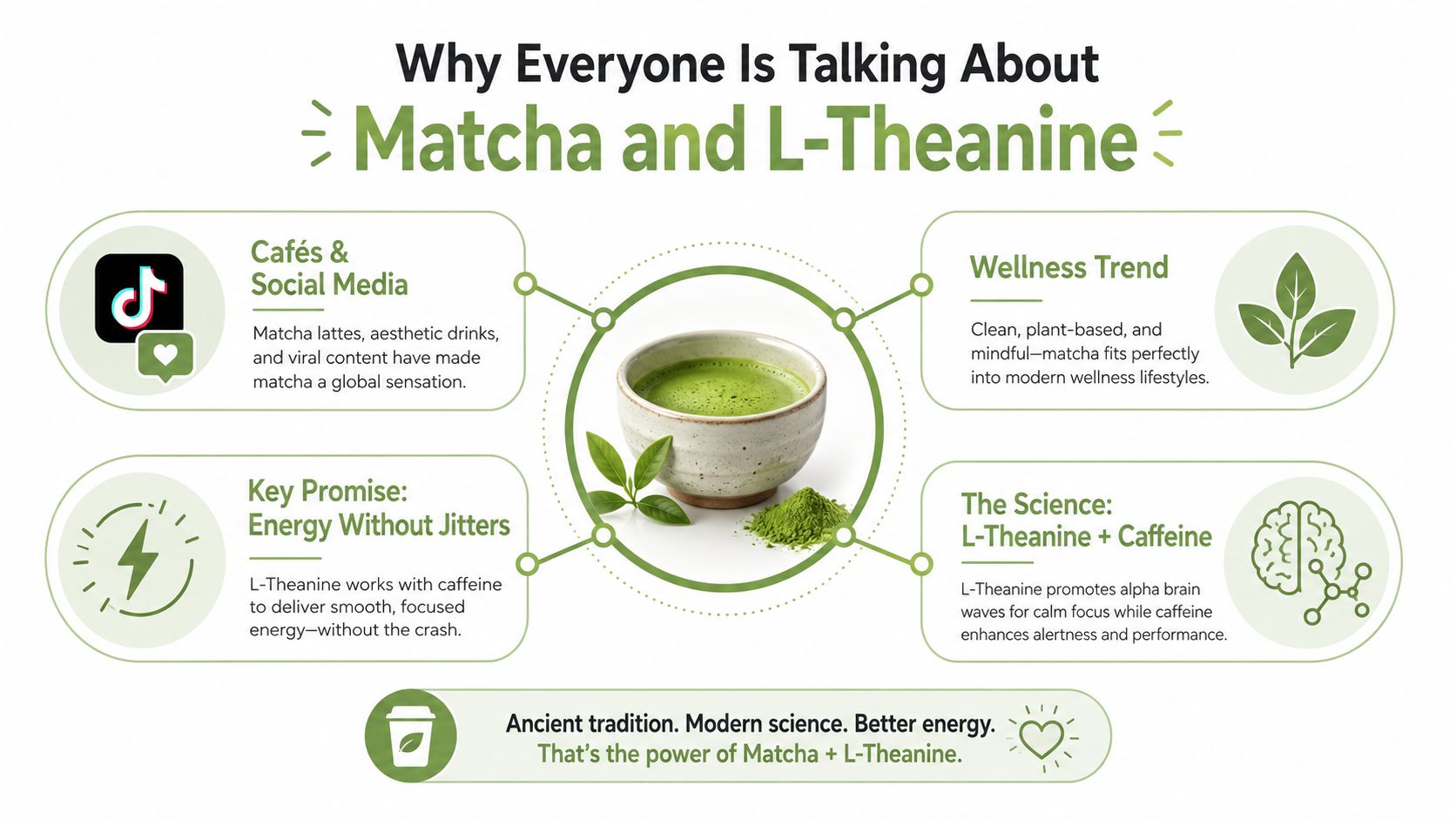
Matcha has moved from specialist tea counters into cafés, wellness shelves and social feeds. The usual promise is familiar: smooth energy, better concentration and fewer sharp edges than coffee. The compound most often placed at the centre of that story is L-theanine, an amino acid naturally found in the leaves of the tea plant, Camellia sinensis.
At a chemical level, L-theanine is one of the compounds that contributes to tea's savoury, rounded character. It helps explain why some green teas taste brothy or umami rather than just bitter. Tea plants produce it as part of their natural chemistry, and shading the plants changes the balance of compounds inside the leaf.
That's why marketers talk about L-theanine whenever matcha appears in a conversation about focus. The drink combines the amino acid with caffeine, so people often describe the result as alert but less edgy than a strongly caffeinated drink. Human research has examined isolated L-theanine in stressful conditions, with a systematic review identifying 9 peer-reviewed randomised controlled trials and concluding that 200–400 mg per day may help reduce stress and anxiety in people exposed to stress, while also noting that larger and longer studies are needed. Read the systematic review on L-theanine and stress
The molecule behind the message
The important catch is dose. A clinical study of isolated L-theanine doesn't automatically prove that a café latte produces the same effect. Matcha is a whole-leaf beverage matrix, containing caffeine, polyphenols, flavour compounds and amino acids in proportions that vary between products.
So, when you see matcha green tea L-theanine described as a calm-focus solution, read the phrase carefully. It points to a plausible combination, not a guaranteed outcome. Explore PepTea's matcha education and products to see how the ingredient fits into a broader tea ritual.
What Matcha Actually Is and Why Its Chemistry Differs
Matcha isn't just green tea brewed more strongly. With ordinary loose-leaf green tea, hot water draws compounds out of the leaves, and you usually discard the leaves. With matcha, you drink finely stone-ground leaf powder, so the preparation includes the leaf itself.
The difference begins in the field. Matcha plants are shade-grown before harvest. A useful café analogy is to think of the leaves as wearing sunscreen. With less direct sunlight, the plant's chemistry shifts, supporting more chlorophyll and preserving more amino-acid character, including L-theanine. The leaves also retain caffeine, which is why matcha can feel more concentrated than a typical green-tea infusion.
Ceremonial and culinary grades
Ceremonial-grade matcha is generally selected for drinking. It tends to have a brighter colour, finer texture and more delicate balance, so whisking it with water can produce a clean, rounded cup. Culinary-grade matcha is designed to hold its flavour in foods such as smoothies, cakes, sauces and ice cream, where milk, fruit, sugar or other ingredients compete with the tea.
Those labels describe intended use more than they guarantee a precise L-theanine amount. A higher price, vivid colour or ceremonial wording cannot replace a product-specific lab result. Shading, cultivar, harvest conditions, processing and storage all influence the finished powder.
Stone-grinding matters because it turns the prepared leaf into a fine powder rather than an infusion. That gives matcha its dense texture and concentrated flavour, but it doesn't create a fixed dose of L-theanine. Two powders can look similar while delivering different amounts per gram.
A useful mental model: matcha is a concentrated leaf preparation, not a standardised L-theanine capsule.
That distinction also explains why matcha can taste both rich and slightly bitter. L-theanine contributes savoury softness, while caffeine and polyphenols add bitterness and astringency. The balance depends on the leaf and on your brewing technique.
How L-Theanine and Caffeine Create Calm Focus
The phrase calm focus describes a combined experience, not a single switch in the brain. Caffeine supports alertness, while L-theanine has been studied for its relationship with relaxation and stress responses. Researchers have also examined L-theanine in relation to alpha brain-wave activity, GABA and other neurotransmitter systems, but these mechanisms shouldn't be treated as proof that every matcha drink produces a predictable mental state.
A helpful analogy is lighting. Caffeine alone can feel like a bright strobe for some people, especially when taken quickly or on an empty stomach. L-theanine may make the experience feel more like a steady LED bulb, where alertness remains present without the same sense of sharp stimulation. That analogy is useful, but individual responses still vary.
What the evidence can and cannot show
Human evidence is strongest for isolated L-theanine doses, particularly in the 200–400 mg/day range discussed in the systematic review of stress and anxiety trials. Typical matcha beverages usually contain much less, so it would be a mistake to copy a supplement claim directly onto a teaspoon of powder.
L-theanine also isn't a sedative in the usual sense. A person may feel less tense while staying awake, but that doesn't mean matcha will treat anxiety, insomnia or a medical condition. Caffeine can also work against relaxation if the serving is large, the drink is consumed late, or the drinker is especially sensitive.
The caffeine-to-theanine relationship is central to the way matcha is marketed. An Australian matcha education source describes matcha caffeine as being absorbed and released slowly over 6–8 hours, and positions L-theanine as part of the drink's smoother focus profile. That is a useful description of the product narrative, but it shouldn't be read as a guarantee for every person or every preparation. Read Australian matcha guidance on caffeine and L-theanine
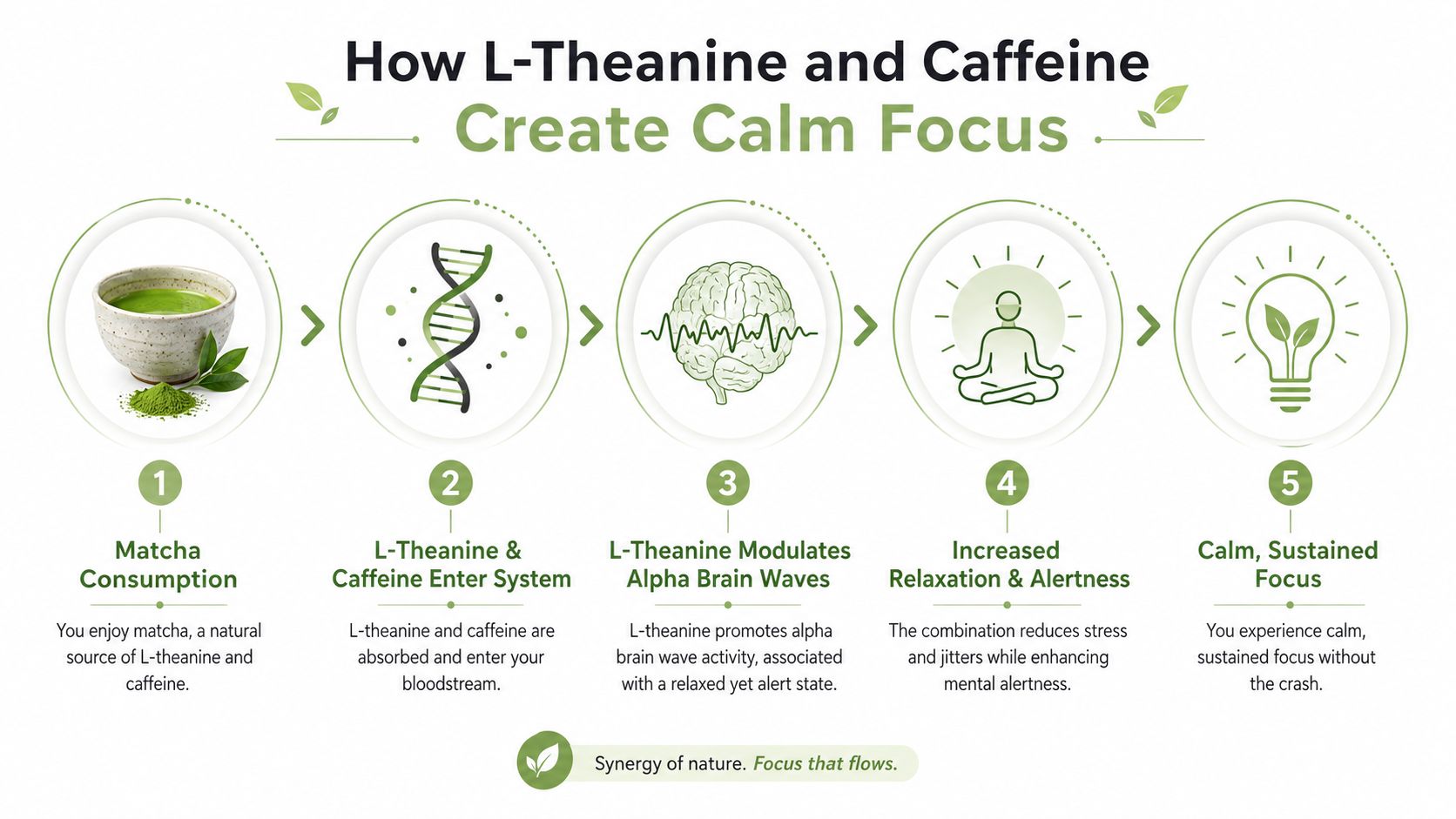
For a visual explanation of the calm-focus idea, this video provides an accessible introduction:
If you'd like the chemistry explained in more detail, learn what L-theanine is before deciding how much weight to give the claim. The honest summary is simple: matcha may feel smoother than some caffeinated drinks, but it isn't a guaranteed focus pill.
Matcha Versus Other Teas and Supplements on L-Theanine
How much L-theanine does matcha provide compared with ordinary tea or a supplement? The answer depends on both the product and the form being compared.
One Australian lab-tested matcha product contained 21.3 mg of L-theanine per gram and 33.3 mg of caffeine per gram. The cited averages across 36 commercial green teas were lower, at 6.46 mg of theanine per gram and 16.28 mg of caffeine per gram. View the Australian matcha potency results
| Source | Typical L-theanine per gram | Typical caffeine per gram | Notes |
|---|---|---|---|
| Lab-tested Australian matcha product | 21.3 mg | 33.3 mg | Product-specific laboratory result |
| Cited mean across commercial green teas | 6.46 mg | 16.28 mg | Mean across 36 commercial teas |
| Isolated L-theanine used in human research | 200–400 mg/day | Not applicable | Clinical dose range, not a tea measurement |
The difference comes partly from preparation. Matcha contains powdered whole leaf, while a standard green-tea infusion contains only the compounds that move into the water. Even so, the higher concentration in this tested product does not make an ordinary matcha serving equivalent to the isolated amounts used in supplement research.
Oolong and black tea cannot be assigned one fixed L-theanine value. Cultivar, harvest, oxidation, processing and brewing can all alter the final cup. Saying that green tea generally contains more may offer a rough direction, but it cannot replace analysis of the specific tea.
Why supplements are a different category
An L-theanine supplement is built around a stated amount of one compound. Matcha is a food with naturally variable composition, and it brings caffeine plus other tea constituents along with the L-theanine. The result is a beverage with taste, texture and a whole-leaf ritual, rather than a precisely controlled research dose.
The choice depends on the goal. Matcha suits someone who wants L-theanine as part of a drink and daily routine. A supplement suits someone who needs clearer control over the amount. Neither format automatically delivers the same experience or evidence base as the other.
The Dose Reality Most Articles Skip Over
How much L-theanine does a normal cup of matcha provide? The answer depends on the powder and serving size, so the word matcha alone cannot predict a clinical dose.
An Australian nutrition panel listing 180 mg of L-theanine per 100 g works out to about 7.2 mg in a 4 g serve. That example shows why labels matter: products can differ substantially in composition. Review the Australian nutrition panel example
The same arithmetic helps put supplement claims in perspective. A serving may contribute L-theanine as part of a drink, but it does not automatically deliver the isolated amounts used in research. A larger serve could move the beverage closer to those research doses, while also increasing caffeine intake. The result is less like taking a measured tablet and more like eating a food whose ingredients arrive together.
Caffeine is the main reason dose comparisons need care. Matcha supplies L-theanine alongside caffeine and other tea compounds, so increasing the powder changes more than one variable. Someone who wants a predictable L-theanine amount may find a supplement easier to measure. Someone who values flavour, texture and a daily ritual may prefer matcha, accepting that its composition varies.
Dose matters more than the word “matcha”. Check the powder's serving size, L-theanine information and caffeine content before assuming your cup mirrors a clinical trial.
There is no universal cup count that suits everyone. Body size, caffeine sensitivity, preparation strength, timing and other sources of caffeine all affect the experience. For practical guidance on serving amounts and personal tolerance, read this guide to how many cups of matcha powder may be suitable per day. Anyone who is pregnant, taking medication, managing a health condition or unusually sensitive to caffeine should discuss regular use with a qualified health professional.
What the 2026 Australian Research Is Telling Us
Australia's L-theanine research is becoming more practical, but it hasn't settled the question of what an everyday matcha latte does for everyone. An Australian clinical trial registered in 2026 for the THESleep project recruited 60 healthy adults aged 18–65 with mild to moderate sleep disturbances. The design included 4 arms, testing 100 mg, 200 mg and 400 mg of L-theanine or placebo over 14 days, following a 7-day baseline. Review the Australian THESleep trial record
That design is valuable because it tests several defined doses against placebo. It also highlights the translation problem. Participants receive a measured amount of isolated L-theanine, while a matcha drink contains a variable amount of L-theanine alongside caffeine and other compounds.
What this means for a real kitchen
The evidence supports caution rather than cynicism. Matcha may fit comfortably into a morning routine for someone who enjoys its flavour and tolerates caffeine. It shouldn't be described as a sleep treatment, a sedative or a substitute for professional care.
Timing becomes especially important. A morning serve may suit focus, while an afternoon or evening serve could be less comfortable for someone whose sleep is caffeine-sensitive. Food, hydration, regular movement and a consistent sleep routine remain more reliable foundations than trying to push a beverage towards a supplement dose.
Local research also shows why Australian readers deserve more than imported wellness slogans. The science is developing, and carefully controlled trials are useful, but a trial of purified L-theanine doesn't erase the variability of matcha powder.
Practical Ways to Get the Most From Matcha's L-Theanine
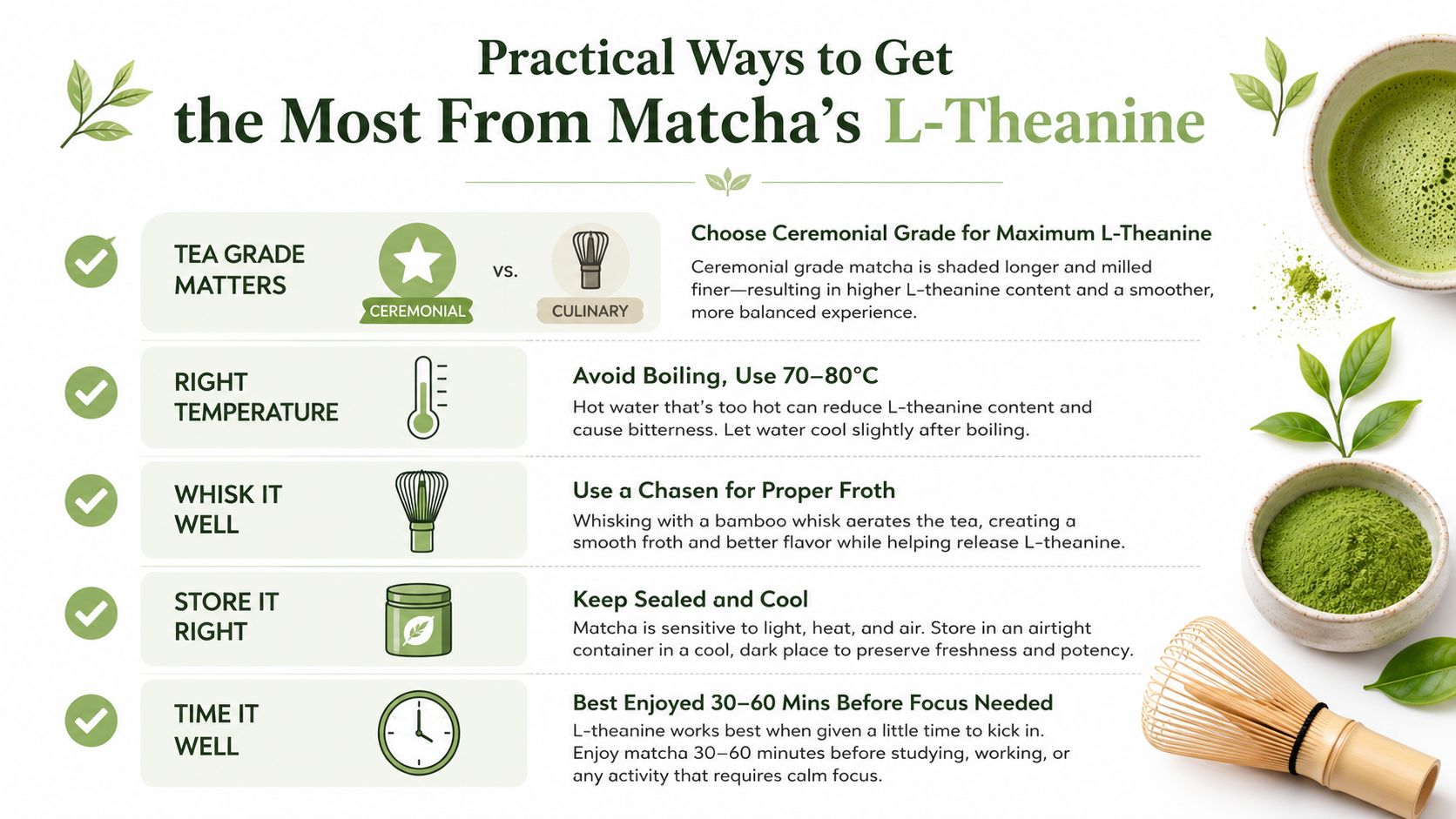
How can you make matcha's L-theanine useful without treating the powder like a supplement? Start with a drink you can prepare and tolerate regularly. A smooth ceremonial-grade powder generally suits plain drinking, while culinary-grade matcha works well in smoothies, baking or ice cream, where its stronger tea flavour can balance other ingredients.
Brewing changes the cup's flavour more predictably than its exact L-theanine content. Use warm rather than boiling water, sift the powder if it clumps, then whisk with a bamboo chasen or small electric frother until evenly mixed. Very hot water can make matcha taste harsh. A cooler approach improves the drinking experience, but it does not create more L-theanine.
A practical serving guide
The earlier Australian lab results are useful for understanding the relationship between powder, caffeine and L-theanine. They should guide preparation, not encourage chasing a supplement-style dose. Begin with a modest amount, especially if you are sensitive to caffeine, and adjust only after noticing how the drink feels.
For steadier flavour, dissolve the powder in a small amount of warm water first, then add more water or milk. Drinking it with breakfast may feel more comfortable than taking concentrated caffeine on an empty stomach. A latte can also spread the flavour through a larger drink, although it does not change the powder's measured L-theanine content.
Matcha values vary between products. One Australian nutrition panel reported a much smaller amount of L-theanine for a larger serve than the lab-tested product discussed earlier. Grade, sourcing, storage and testing can all affect what reaches the cup, so a package label is more useful than assuming every matcha has the same chemistry.
Four questions to ask before brewing
Should I drink matcha before sleep? If caffeine disrupts your sleep, late-day matcha may be a poor fit, whatever its L-theanine content. Research on isolated L-theanine does not establish that an ordinary matcha beverage improves sleep.
Does lower-temperature water preserve more L-theanine? It can produce a smoother, less bitter cup. It cannot turn a small beverage serving into a clinical dose.
Can I combine matcha with coffee? You can, but both drinks contribute caffeine. If you feel wired, reduce one drink first rather than trying to offset it with extra L-theanine.
What should I pair with matcha? Breakfast with protein, fibre and carbohydrates may feel steadier than concentrated caffeine on an empty stomach. That is a practical eating choice, not proof that food changes L-theanine absorption.
Answers to Common Matcha and L-Theanine Questions
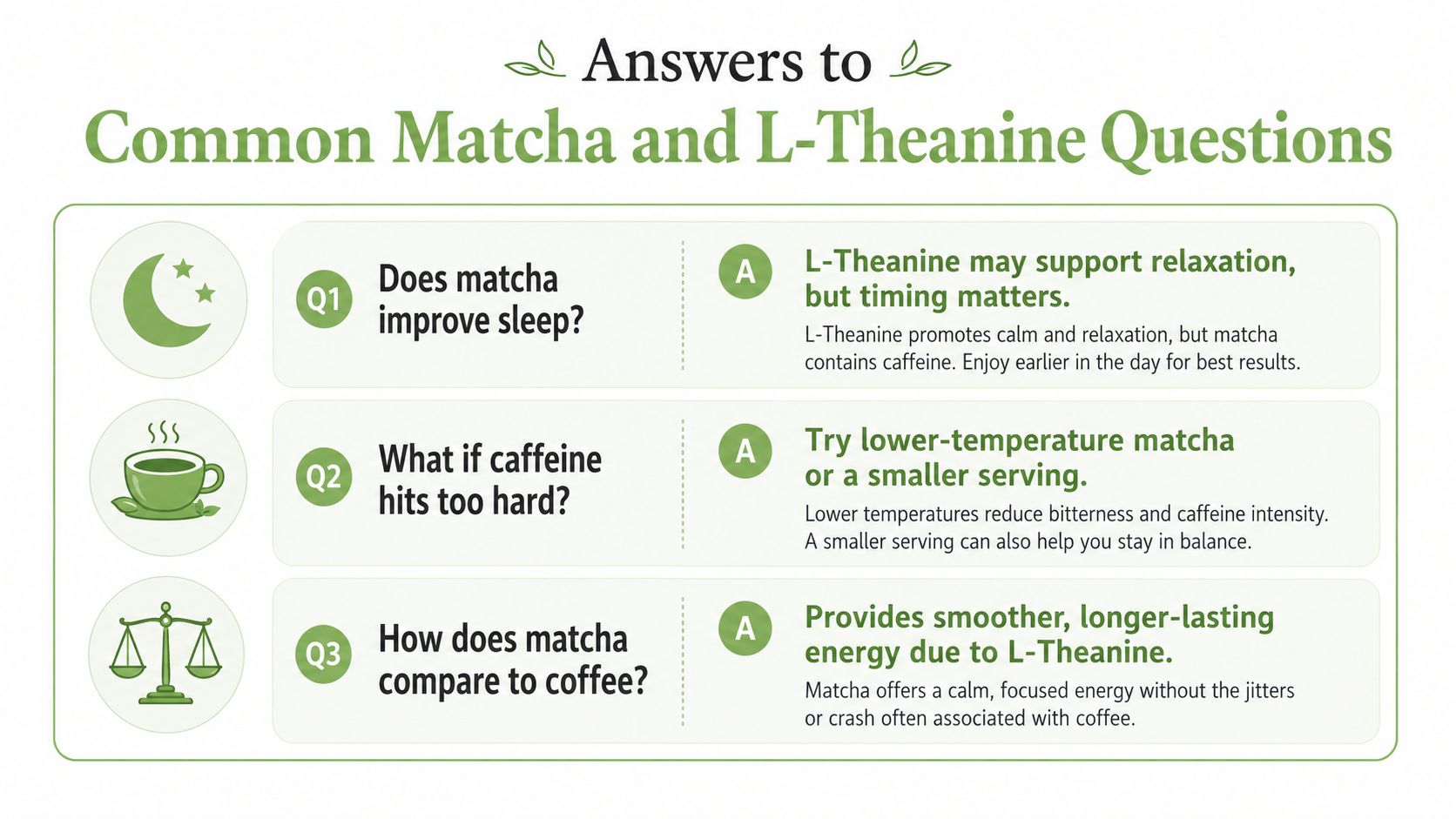
Does matcha improve sleep?
Matcha contains L-theanine, and human research on isolated L-theanine has examined stress, anxiety and sleep-related outcomes. Matcha also contains caffeine, so a late serve may make sleep harder for caffeine-sensitive people. The evidence doesn't justify calling ordinary matcha a sleep treatment.
Is L-theanine in matcha enough to make a difference?
It may contribute to the drink's character and to an individual's experience of calm alertness. However, the studied isolated range of 200–400 mg/day is much higher than the amount supplied by many beverage serves, so you shouldn't assume that matcha reproduces a supplement result.
What if caffeine hits me too hard?
Use a smaller serve and drink it earlier in the day. You can also make a latte with less powder, eat beforehand and avoid stacking the drink with coffee until you know how your body responds.
How does matcha compare with an L-theanine capsule for studying?
Matcha gives you a beverage ritual, caffeine and a variable amount of L-theanine. A capsule gives you a stated amount of isolated L-theanine, which is closer to the format used in clinical research. Neither option guarantees better concentration, and sleep, stress, food and study conditions still matter.
Is daily matcha sensible?
For many adults, a modest morning matcha can be a reasonable beverage habit if they tolerate caffeine. Sensible use means treating matcha as part of a balanced routine, not increasing the powder aggressively to chase a supplement-style effect.
Does matcha have benefits beyond L-theanine?
Matcha is also a concentrated source of plant compounds. A 2020 analysis indexed in PubMed reported phenolic measurements of 169–273 mg gallic acid equivalents per gram and flavonoid measurements of 99–139 mg rutin equivalents per gram in matcha fractions, supporting its description as a concentrated source of antioxidant compounds. Read the PubMed analysis of matcha phenolics and flavonoids
Does matcha contain more L-theanine than regular green tea?
A tested Australian matcha product reported a higher L-theanine density than the cited mean across commercial green teas. The comparison is useful, but it doesn't mean every matcha powder has the same composition or that every brewed cup reaches a particular threshold.
The most useful mantra is matcha is a low-to-moderate L-theanine habit, not a stand-alone focus drug. It contains L-theanine and can provide more of it per gram than the cited green-tea average, but beverage servings remain far below many isolated supplement doses. Australian research is helping close the local evidence gap, while also showing why dose and study design matter.
For readers who want to make the ritual part of their day, Pep Tea offers organically grown Japanese matcha, including premium ceremonial-grade and culinary-style options for drinking and recipes. Visit Pep Tea to explore the organic matcha range and choose a powder that suits your serving style, caffeine tolerance and everyday routine.