
Is Matcha Good for You? Caffeine and Benefits

Yes, for most healthy adults, unsweetened matcha is a sensible everyday tea: a typical 2 g serving carries about 72.5 mg of caffeine and about 170 mg of catechins, including EGCG. It is not a disease treatment, and it is not an unlimited green drink.
The popular line is that a green cup is automatically a superfood, calmer than coffee, and safe all afternoon. That advice skips the only question that changes the answer. How many grams of powder are in the bowl, and what else have you already had? Matcha is powdered tea leaf, so the cup is a real caffeine serve, not a herbal rinse. Milk, syrup and a second café shot can turn a tidy morning drink into a dessert plus another stimulant. Judge is matcha good for you against your own caffeine budget, not against a wellness headline.
Is Matcha Good for You in One Serving
For most healthy adults, one unsweetened serve is a good everyday tea, not a cure. Because you swallow the powdered leaf instead of steeping it and tipping the leaves away, that small bowl carries both caffeine and a useful load of catechins.
A published comparison of a typical serving puts the numbers in plain sight. About 2 g of matcha can contain about 72.5 mg of caffeine and 170 mg of total catechins, including antioxidant compounds such as EGCG, and that whole-leaf intake can sit higher than ordinary brewed green tea, according to a 2025 review of matcha composition. The same paper sets this beside Australian habits: the Australian Bureau of Statistics reported average daily caffeine intakes in 2023 of 161 mg for males and 145 mg for females, with tea already contributing 14.6% of adult caffeine intake. One matcha serve is therefore a real share of a typical day, especially beside coffee, cola, chocolate or another tea.
Pick your row before you worry about how the drink feels.
| Drink or limit | Caffeine | Catechins or note | How to use the number |
|---|---|---|---|
| About 2 g matcha | About 72.5 mg | About 170 mg total catechins, including EGCG | Count it as one caffeinated drink |
| Ceremonial matcha | 31.45 mg per gram | EGCG the highest catechin in tested teas | Whisk a small measured serving |
| Culinary matcha | 26.29 mg per gram | EGCG and EGC predominant | Lattes, smoothies and baking |
| Bagged or gunpowder green tea | 23.08 mg per gram | Lower caffeine than ceremonial matcha | Infusion, leaves discarded |
| Healthy adults | Up to about 400 mg a day from all sources | Acute intakes to 200 mg not a concern in healthy adults | Add coffee, tea, cola and chocolate |
| Pregnancy and breastfeeding | 200 mg a day from all sources | Higher intakes linked with pregnancy risks | Count every caffeinated food and drink |
What changes the row
Home whisk: two grams, hot water, no sugar. That is the cleanest reading of the first row.
Café latte: the barista may use more than 2 g, then add milk and syrup. Milk doesn't erase caffeine. Sugar changes whether the drink still looks like a wellness choice.
National tea figures describe tea in general. They don't isolate matcha, ceremonial powder, or sweetened café drinks, so you can't borrow a population average as your personal dose.
Practical rule: Weigh the powder, write the grams on the café order in your head, and add that caffeine to everything else you drink that day.
Ceremonial powder is the strongest per gram in the table, culinary sits a step down, and bagged or gunpowder green tea is the lightest of the three. A healthy-adult ceiling near 400 mg from all sources, and a pregnancy ceiling of 200 mg, are the fences around those rows. Choose the row that matches your cup, then read why the compounds can feel different from a straight coffee.
Why the Whole Leaf Changes the Cup
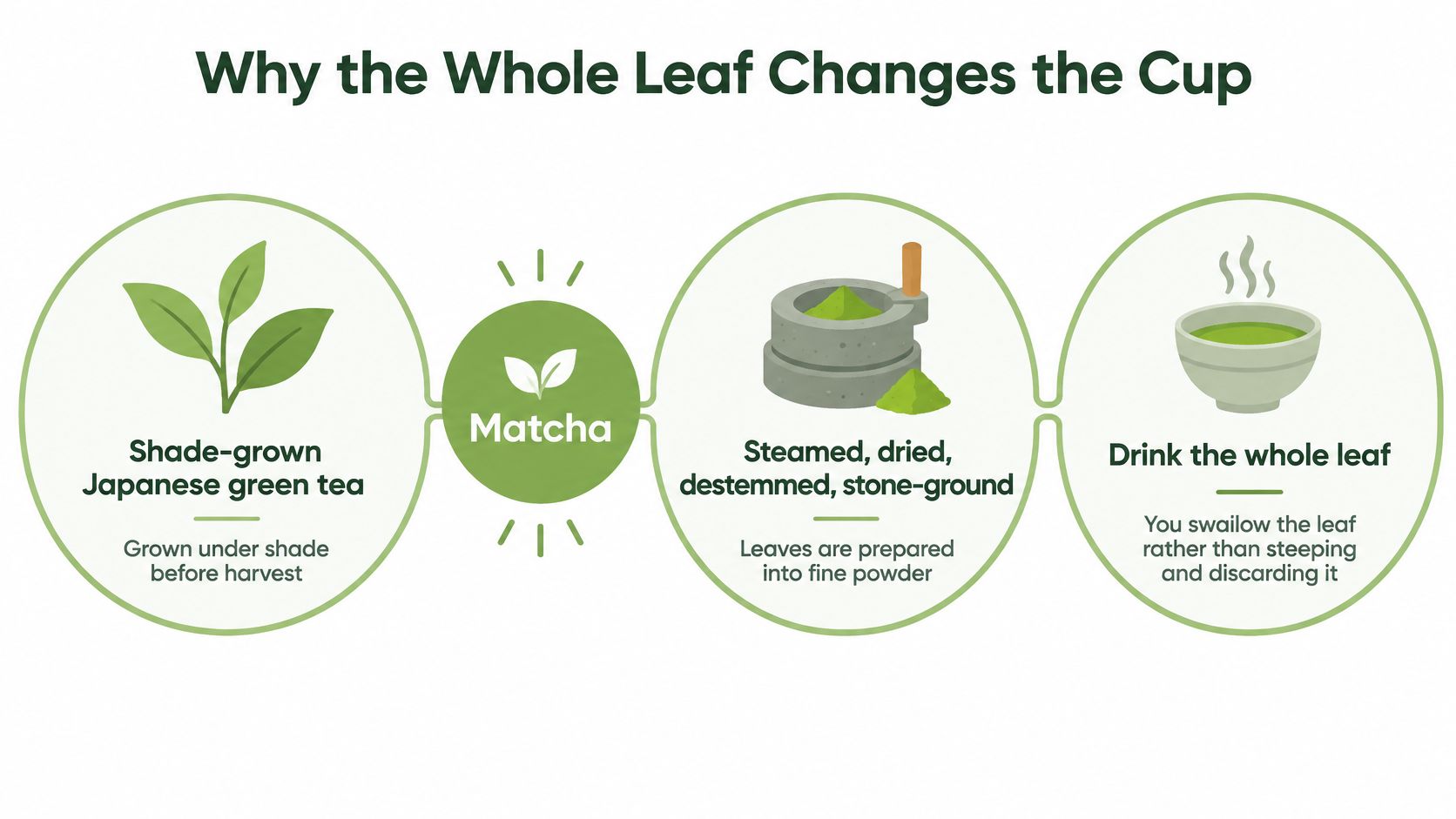
Say you brew a pot of green tea and throw the leaves in the compost. You've had a rinse of the leaf. Matcha is the leaf itself, suspended in the bowl.
The path is simple. Shade-grown Japanese green tea is harvested, steamed, dried and destemmed, then stone-ground into a fine powder. Shading before harvest pushes the leaf toward a deeper green and a softer, savoury taste. You don't filter that powder out. You drink it.
Two grades, two jobs
Ceremonial grade is usually made for drinking straight. Younger leaf is common in that style, and the bowl is meant to taste smooth when you whisk it with water alone.
Culinary grade has a stronger flavor. It stands up in a latte, a smoothie or a biscuit, where milk, fruit or flour would flatten a delicate bowl. If you mostly mix, culinary is usually the better buy. If you drink it plain, ceremonial earns its place.
Commercially available powders don't share one antioxidant strength. In one analysis of teas on the Australian market, ceremonial matcha averaged 31.45 mg of caffeine per gram, culinary matcha 26.29 mg/g, and bagged or gunpowder green tea 23.08 mg/g, with ceremonial matcha significantly higher than that last group, as reported in research on commercial matcha products. EGCG and EGC were the predominant catechins, and EGCG sat at the highest concentration. Younger leaf and processing help explain the caffeine gap, so a "premium" or "ceremonial" sticker is not a fixed antioxidant dose.
A label tells you the style. The gram weight tells you what actually reaches the cup.
An organic Japanese tin that names the grade, ceremonial or culinary, makes the choice concrete. Scoop by eye and you lose the comparison you just read. Weigh 2 g, whisk, and you know which row you're in. Grade decides taste and concentration. The health story still depends on how much powder you swallow.
What Caffeine, EGCG and L-Theanine May Do
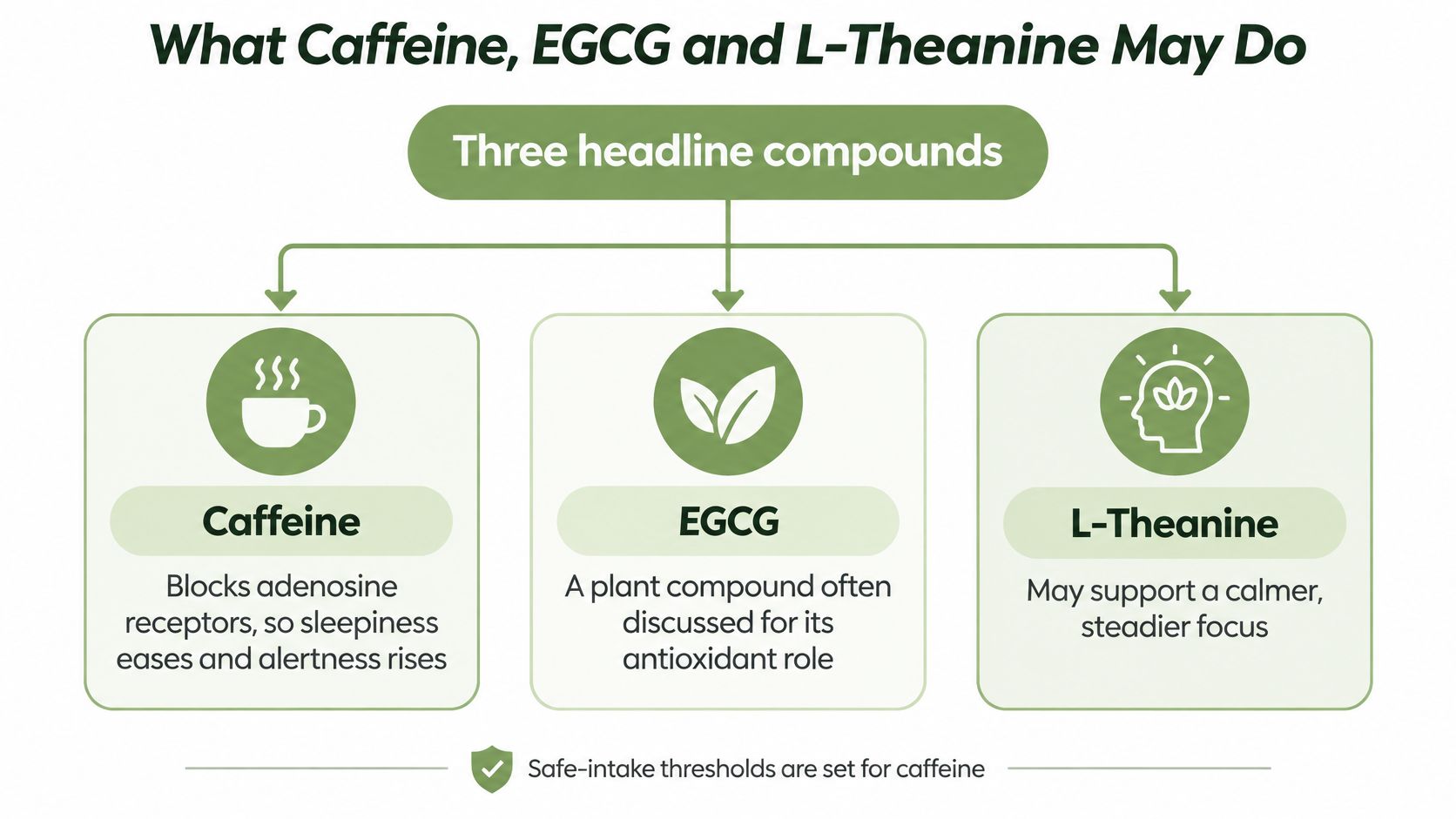
Three compounds get the headlines. None of them is a miracle pill, and together they still don't turn matcha into medicine.
Caffeine
Caffeine blocks adenosine receptors in the brain. Adenosine is one of the signals that makes you feel sleepy, so when caffeine gets in the way, sleepiness eases and alertness rises. That is the job. It doesn't promise a better mood, a faster workout, or sharper thinking on a tired night.
Because you drink the whole leaf, the dose moves with cultivar, shading, particle size and how many grams you use. Food Standards Australia New Zealand treats caffeine as a mild stimulant and notes that acute intakes up to 200 mg don't raise safety concerns in healthy adults, while chronic intake up to 400 mg a day is generally not linked with significant adverse effects in the general adult population. Count matcha in that total. It isn't a mild herbal tea.
EGCG
EGCG (epigallocatechin gallate) is a catechin, a plant compound in the antioxidant family. Along with related catechins, it may support the body's usual defences against oxidative stress, especially if the bowl replaces a sugary drink. A longer walk through the compound sits on our EGCG explainer. What it can't promise is weight loss, a detox, or immunity in any disease sense.
L-theanine
L-theanine is an amino acid found in tea. People have traditionally enjoyed it for a calmer kind of focus, and it's a fair reason a matcha bowl often feels smoother than a coffee with a similar caffeine hit. The pairing is plausible for a morning shift, a study block or a café service. It doesn't guarantee concentration, and it doesn't cancel the stimulant.
Milk, syrup and extra shots can erase the clean-energy idea even when the powder is excellent. If you want the calm-plus-caffeine effect, take one measured morning serve rather than topping up all day. Caffeine can still delay sleep when the drink feels subjectively smooth, so a late bowl is a poor trade. People with anxiety, hypertension, heart conditions or a jittery response should sit under the adult guide, and pregnancy has its own lower line, covered with the groups who need a tighter cap. For a café, listing the grams and sticking to one measured portion keeps the dose honest in lattes, smoothies and shots.
Matcha Against Coffee and Plain Green Tea
You're usually choosing between matcha and the coffee you already drink. Matcha isn't caffeine-free. Its caffeine arrives with L-theanine, and you also take in more of the leaf's catechins because nothing is discarded.
Per gram, bagged or gunpowder green tea carried the least caffeine of the teas compared earlier, and a plain infusion is usually the lower-caffeine cup. A 2 g matcha serve, about 72.5 mg, is a modest coffee-sized nudge for many people, not a herbal sip. Coffee itself swings wildly with cup size, roast and the café recipe, so read the pack or ask the café rather than assuming one standard mug.
When the swap makes sense
A gentler morning lift. You want to wake up without the hard edge some coffees give you. One unsweetened matcha, drunk on its own, is a fair trial for a fortnight. Judge it by sleep and jitters, not by a feeling on day one.
Replacing a second afternoon coffee. If the first coffee already did the job, a lighter tea habit can keep the afternoon from stacking. Plain green tea suits that late slot better than matcha, because you're not swallowing the whole leaf.
When it doesn't
You're already near your ceiling. Adding matcha on top of a large coffee, a cola and chocolate is how a "healthy" drink blows the budget. Add each drink to the daily total before you call it a swap.
You want a fast jolt. Matcha isn't built for that. If you need a hard hit, coffee is the more honest tool, and a third matcha at night isn't a softer version of the same idea.
Our notes on matcha energy compared with coffee walk the feel of the two drinks without ranking one as morally better. This is a caffeine budget, not a health league table.
Who Should Limit Matcha and Why
"Good for you" shrinks as soon as the day's caffeine has to stay inside a smaller fence.
Pregnancy and breastfeeding
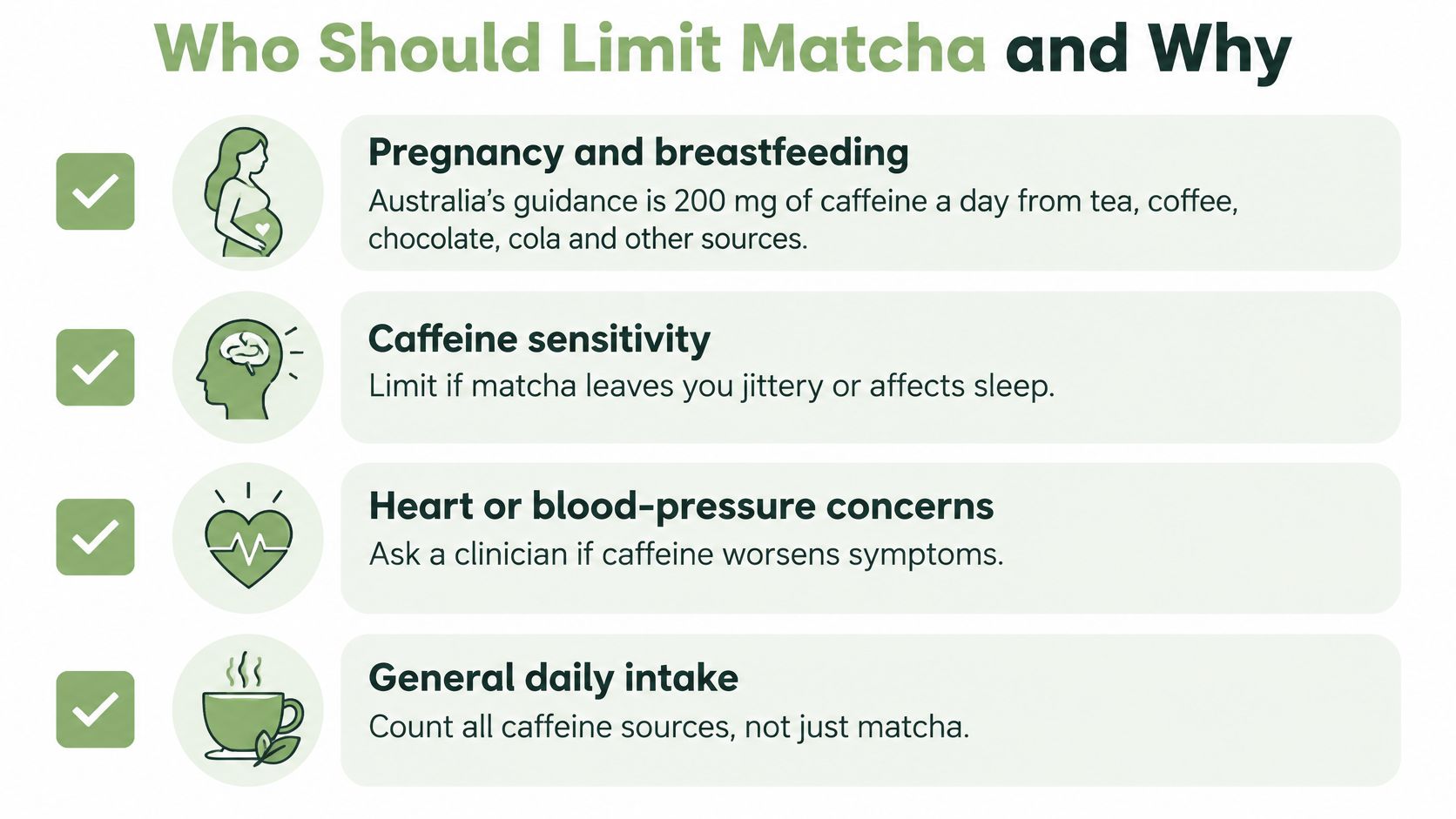
Australian guidance is to limit total caffeine during pregnancy and breastfeeding to 200 mg a day, counting tea, coffee, chocolate, cola and other sources together, as set out in NSW Health's healthy eating in pregnancy advice. FSANZ's caffeine review gives pregnant women the same ceiling, because higher intakes may be associated with miscarriage, stillbirth, preterm delivery, low birthweight and babies who are small for gestational age. One cup isn't a fixed safe unit. Powder grams and café recipes move the dose. If you're pregnant or breastfeeding, the practical page is our guide to matcha in pregnancy.
Tea can also reduce iron absorption, which matters more in pregnancy. You don't have to ban the drink. Leave a gap around iron-rich meals and iron supplements so the tea isn't sitting in the same window.
Other reasons to go smaller
People with anxiety, poor sleep, hypertension, heart conditions or a jittery response should set a personal cap below the general adult guide. Skip matcha late in the day. L-theanine can make the bowl feel smooth while caffeine still pushes sleep later.
A simple check works better than a vibe:
- Read the pack for any caffeine figure printed on that tin.
- Weigh the powder instead of using a heaped souvenir spoon.
- Add the rest of the day, including coffee, cola, chocolate and energy drinks.
- Stop or shrink the serve if sleep, heart rate or anxiety gets worse.
| Situation | Threshold | What to do |
|---|---|---|
| Healthy adult | About 400 mg caffeine a day from everything | Keep matcha inside that total |
| Single sitting, healthy adult | Up to 200 mg caffeine not a general concern | Avoid stacking several strong drinks at once |
| Pregnancy or breastfeeding | 200 mg caffeine a day, all sources | Count tea, coffee, cola and chocolate; check café serves |
| Iron-rich meals or supplements | Tea can reduce iron absorption | Leave a gap around those meals |
| Anxiety, sleep trouble or caffeine sensitivity | A personal cap below the adult guide | Smaller serves and none late in the day |
Antioxidant talk and calm-focus marketing can make matcha sound unrestricted. The clinical question is total caffeine and how you personally respond. A normal whisked cup is also a different product from a green-tea extract capsule, which belongs in the claims section, not in this table.
Claims That Outrun the Evidence
Calm doesn't mean harmless. L-theanine is why a bowl can feel smoother than coffee, and that feeling gets used as a licence for a third serve at night. A strong bowl can still rival a small coffee. If you're sensitive, "gentler" is a mood word, not a measurement.
Extracts aren't a stronger cup
More antioxidants aren't automatically better. Traditional green-tea infusions and concentrated supplements sit in different safety lanes. A systematic review notes that the European Food Safety Authority considered catechins from traditionally prepared green-tea infusions generally safe at reported intake levels, while supplemental EGCG doses of 800 mg a day or more may increase serum transaminases, a marker associated with liver injury, as summarised in this review of green-tea catechins. That threshold is about capsules and high-dose extracts, not a normal cup of matcha. It doesn't mean a whisked bowl harms the liver. It does mean a detox shot or a fat-burning stack isn't the same product. Don't stack matcha with concentrated green-tea extracts unless a clinician is across it.
A grade isn't a prescription
Ceremonial isn't a medical grade. It often means younger leaf and more caffeine per gram, which can be lovely in the bowl and less ideal if you're already near your cap. "Premium" on a label doesn't fix the gram weight.
A drink isn't a diet
Matcha doesn't replace vegetables, sleep, iron-rich meals or medical care. An unsweetened cup doesn't cancel a syrup-heavy latte ordered an hour later. Australian figures on tea drinking describe tea in general. They aren't proof of a matcha health effect, and matcha-specific intake data are still thin.
If a pack promises disease prevention, rapid fat loss or unrestricted safety, put it back.
The modest version is enough. A measured organic matcha can be a better daily choice than a sugary energy drink when you tolerate caffeine. It remains a beverage.
What a Good Matcha Day Looks Like
Matcha's established place in Australia is as a caffeinated tea, not as a proven treatment. The Australian Bureau of Statistics National Health Survey found that 38.5% of Australian adults reported consuming tea in 2023, compared with 8.1% of children aged 2–17, and that 44.3% of adult women consumed tea versus 32.5% of adult men. Those figures cover tea generally. They don't isolate matcha, ceremonial grade, or drinks with milk and sugar. Unsweetened matcha can sit inside a habit Australians already have, as caffeine plus plant compounds, not as a stand-in for medical care or a balanced diet.
Three days you can copy
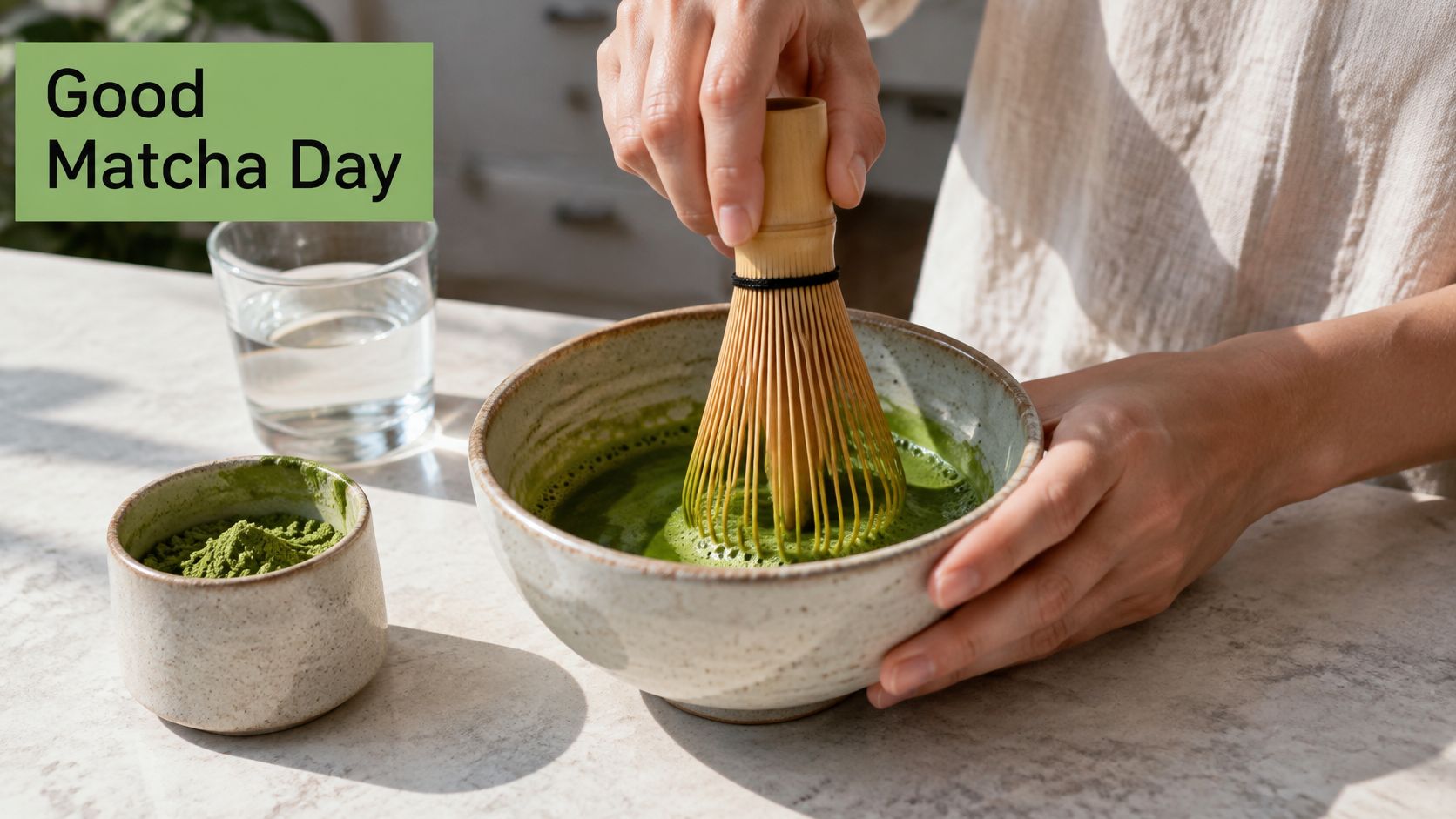
Home morning. Whisk 2 g of ceremonial powder with about 70 ml of water around 80°C. No sugar. Make it the only caffeine before noon. A second bowl still counts, so decide on it before you leave the kitchen, not at 3 pm when you're flat.
Café day. Order one measured matcha latte and skip the extra coffee. Milk doesn't cancel caffeine, and a pump of syrup can turn the cup into a dessert. If the menu doesn't list grams, ask for a single shot and treat anything larger as two drinks.
Baker or café pass. Use culinary grade in a smoothie, biscuit or ice cream, where flavour matters more than a bare bowl. List the grams on the prep sheet so staff and customers can see the dose. For warm months, an unsweetened iced matcha uses the same weighed powder over ice, not a bigger scoop because the glass is taller.
A sugar-free kombucha is a different drink for the afternoon if you want something cold without adding another caffeine serve. It doesn't change what the morning matcha already contributed.
The one-line test is boring and useful. If sleep is fine and the drink isn't a sugar vehicle, the pattern is doing its job.
Choose a Measured Matcha Habit
For a healthy adult who sleeps well, one unsweetened morning serving of about 2 g is a measured way to enjoy matcha. Count it alongside the rest of the day's caffeine. Whether matcha suits you depends less on a superfood label than on how that serving fits your routine.
If you're pregnant, breastfeeding, anxious, hypertensive or already drinking coffee, keep the 200 mg frame in mind or set a lower personal limit, and avoid late serves. Matcha can still fit, but the total caffeine in your day matters.
For lattes or baking, culinary grade can suit the stronger flavours around it; for drinking straight, ceremonial grade is often chosen for a bowl on its own. Whichever you use, weigh the powder rather than guessing. Keep the tin sealed and away from light and heat to help preserve its colour and flavour. A faded, bitter powder may have lost freshness in storage.
Pep Tea offers organic matcha, a straightforward option to explore if you want to weigh a serving at home. Taste it, notice how your sleep responds, and consider the rest of your diet. A measured habit is more useful than a superfood headline.
If you're building a calmer caffeine routine, start with one unsweetened morning bowl and see how you sleep. Visit Pep Tea to explore its organic matcha range.