
Tag: probiotic drink powder
Probiotic Drink Powder: A Complete Guide for Australians

You've probably stood in front of a shelf, a café fridge, or an online store tab and wondered if a probiotic powder is worth buying. The label looks tidy, the claims sound healthy, and the sachet seems easier than hauling home a bottle of fermented drink. The question is simpler and more useful, though, can that powder still deliver live cultures by the time it reaches your glass, your shaker, or your café menu?
That's where probiotic drink powder earns its own category. It's not just a dried version of a drink, and it's not quite the same as yoghurt cultures or ready-to-drink kombucha. The format exists because shelf stability, transport, flavour control, and low-sugar preferences all matter, especially in Australia where products often sit in warm kitchens, travel through long supply chains, and need to work for both home use and hospitality service.
What Probiotic Drink Powder Actually Is
A customer in Melbourne might be comparing two tins, one with a glossy wellness label and one with a plain ingredient panel, while a café owner in Brisbane is trying to work out which sachet will behave properly in iced drinks. Both are asking the same thing in different words. What is this powder, and what makes it more than flavoured dust?
The cleanest definition comes from the International Scientific Association for Probiotics and Prebiotics. Probiotics are “live microorganisms that, when administered in adequate amounts, confer a health benefit on the host” (NIH fact sheet). In plain English, a probiotic drink powder is a shelf-stable, dehydrated format of live cultures designed to be mixed into water, smoothies, or food.
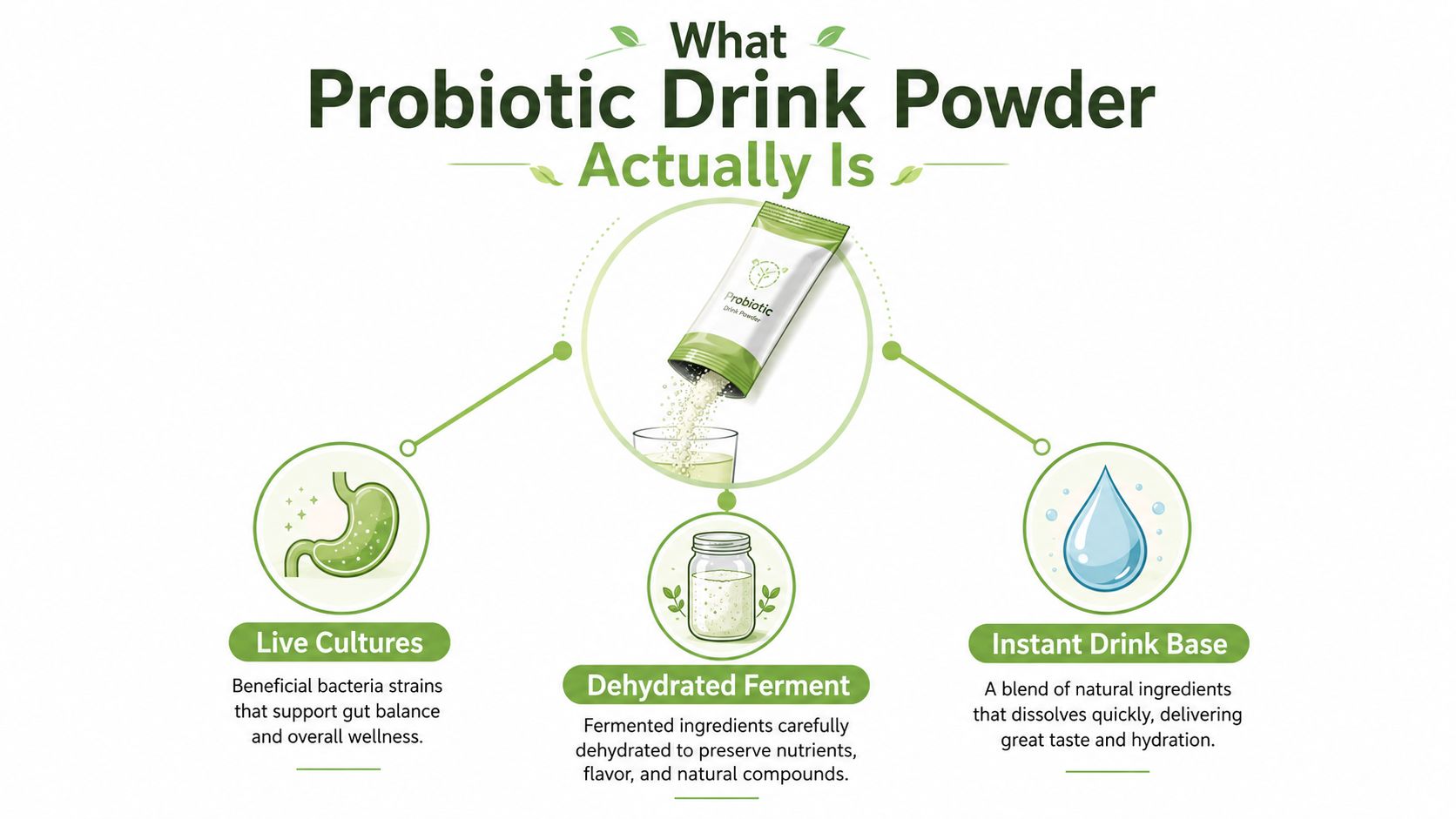
Why the powder format exists
Powders solve a practical problem. Liquid fermented drinks can be awkward to ship, store, and portion. A powder can sit in a pantry, live in a café dry store, and travel more easily than a chilled bottle, which matters in a country where logistics and temperature swings are part of daily life.
That doesn't make powder automatically superior. It just means the format is built for convenience, dosing flexibility, and storage ease. If you're using it at home, it might go into a smoothie or a glass of cold water. If you're using it in hospitality, it can be measured into a menu drink with more consistency than a loosely poured fermented base.
Practical rule: if a powder can't tell you what live cultures are inside and how many are still there by the time you drink it, you're buying a format, not a function.
For readers trying to separate genuine functional products from wellness marketing, our guide on what are prebiotics and probiotics is a useful companion. It helps connect the powder on the shelf with the biology behind it, without overcomplicating the jargon.
The Health Mechanisms Behind the Format
A powder helps the gut only if its live organisms survive the trip in usable numbers. That is the basic test for the format, whether you are pouring it into a café glass or shaking it up at home. Once you look at the product that way, the label starts to mean something practical instead of sounding like wellness noise.
Helpful tourists and occasional residents
Probiotic microbes work like helpful tourists in the gut, and sometimes like temporary visitors who leave a useful trace behind. Some strains pass through and interact with the existing microbiome without settling in permanently, while others influence the gut environment in more targeted ways. The point is not that every strain moves in for good, it is that the right organisms can still do useful work while they are there.
That work is often linked to digestion and microbiome balance, which is why fermented foods like yoghurt, kefir, and kombucha sit alongside probiotic products in consumer education. Harvard Health notes that probiotics are widely used in fermented foods and may help with digestion, immune function, and protection against unwanted microbes (Harvard Health).
Why prebiotic carriers matter
Many powders pair probiotics with a prebiotic matrix, often including ingredients like inulin. That carrier can help protect the organisms during drying, storage, and reconstitution, a bit like packing fragile produce in a carton instead of loose in the back of a ute. It can also give the microbes a better chance of reaching the gut in a usable state rather than dying off in the tin.
A good powder is doing two jobs at once, protecting the live culture and making the drink easy to use.
The formulation matters because a probiotic powder is not just dried fermentation for its own sake. A yoghurt spooned from a tub and a probiotic sachet may both be called probiotic in broad terms, but they are built for different jobs. One is a food. The other is a deliberately dosed functional ingredient.
For a closer look at what sits beyond the live culture layer, our page on postbiotics and the benefits of beneficial bacteria gives a useful next step. It helps explain why some products lean on fermentation by-products as well as live cultures.
Decoding Strains, CFU and Formulation Choices
This is the section you want before buying your first tub. The label can look technical at first glance, but once you know what to check, the category becomes much easier to compare.
Strain names matter more than the word probiotic
A label that only says “Lactobacillus” or “Bifidobacterium” gives you a family name, not a full identity. Different strains can behave differently, so quality-focused producers usually name them more precisely. That is not marketing fluff, it is part of how you know what is inside.
The NIH fact sheet notes that probiotic use in trials is often strain-specific, and that doses vary by organism and purpose (NIH fact sheet). Cleveland Clinic also describes probiotics as live bacteria and yeasts, which is a useful reminder that not every probiotic product is bacterial in the narrow sense (Cleveland Clinic).
CFU is the number you need to check
CFU means colony-forming units, a measure of how many viable microbes are present. A peer-reviewed review in Nutrients says probiotic products are generally accepted to need a minimum concentration of 10^6 CFU per mL or gram, and that consumers should typically ingest around 10^8 to 10^9 probiotic microorganisms daily for the probiotic effect to be transferred (Nutrients review).
That does not mean more is automatically better. It means the label should give you enough detail to judge whether the product is likely to deliver a meaningful live dose.
A useful benchmark appears in a cited formulation where 1 g delivered a 100 billion CFU blend, built on a prebiotic matrix of inulin plus a proprietary polysaccharide complex. Another powder-format beverage reported 10 billion probiotic bacteria per 250 mL serving when diluted (NIH PDF). Those figures show the order of magnitude some products are aiming for, especially once storage and transport losses are taken into account.
Quick Comparison of Common Probiotic Drink Powder Variables
| Format | Typical CFU per serving | Common carriers | Sugar content |
|---|---|---|---|
| Basic drink mix | Varies by brand | Inulin, starches, fibres | Can range from none to added sugars |
| Synbiotic powder | Varies by brand | Inulin, other prebiotics | Often lower in sugar-focused versions |
| Encapsulated powder | Varies by brand | Protective coatings, fibre matrices | Usually designed to minimise added sugar |
| DIY home-dried powder | Unpredictable | Whatever remains after drying | Depends on the base used |
The hidden part of the label
A strong powder also depends on moisture control, encapsulation, and the way the product was dried. Reviews of probiotic powders consistently point out that heat and moisture can damage viability, so a bag that looks fine can still underperform if the formulation was not built well from the start.
Buyer's shortcut: if the brand will not tell you whether the CFU count is valid through shelf life, treat the number as a manufacturing claim, not a consumption guarantee.
How to Use Probiotic Drink Powder Every Day
Once you've got the right tin, the use case should be easy, not fussy. The simplest rule is also the most overlooked one, keep the liquid cool enough for live cultures to survive.
Mix it like a functional drink, not a hot tea
Cold water and lukewarm water are the safest everyday options. Very hot liquids are a bad idea because heat kills live cultures, which defeats the whole point of buying a probiotic product in the first place. If you're stirring powder into a smoothie, add it near the end rather than blending it endlessly with warm ingredients.
A few practical ways Australians tend to use it:
- Morning water mix: Stir into cold water before breakfast for the simplest routine.
- Smoothie add-in: Blend with banana, berries, or spinach after the main liquid is already cool.
- Breakfast bowl boost: Sprinkle over overnight oats or yoghurt once the food is no longer hot.
- Café menu use: Add to chilled drinks or layered functional beverages rather than steaming liquids.
Small recipes that don't get in the way of the cultures
A citrus-style spritzer can be built with cold sparkling water, lemon, and a measured scoop of powder. A ginger and lime drink works well as a recovery-style option after a long day or a workout, especially if the flavour profile already sits in that direction. A kombucha-and-powder hybrid can also make sense when you want the refreshment of a fermented drink plus the measured dose of a powder in the same glass.
That last idea is where cafés can get creative without overcomplicating the menu. A functional flight, with one kombucha, one powder drink, and one matcha option, gives customers a cleaner way to compare flavours and formats. PepTea's own sugar-free organic kombucha can sit comfortably in that kind of menu alongside a probiotic powder, especially for customers who want low-sugar choices.
For hospitality teams, the useful principle is consistency. Measure the powder, keep the liquid cool, and avoid letting staff freestyle the dose if you want the product to behave predictably from one serve to the next.
Storage, Shelf Life and Real-World Viability
A probiotic powder only matters if the microbes are still alive when the drink is made. That sounds obvious, but it is the part many skip, especially in Australian homes and cafés where warm rooms, open lids, and rushed service can wear a product down over time.
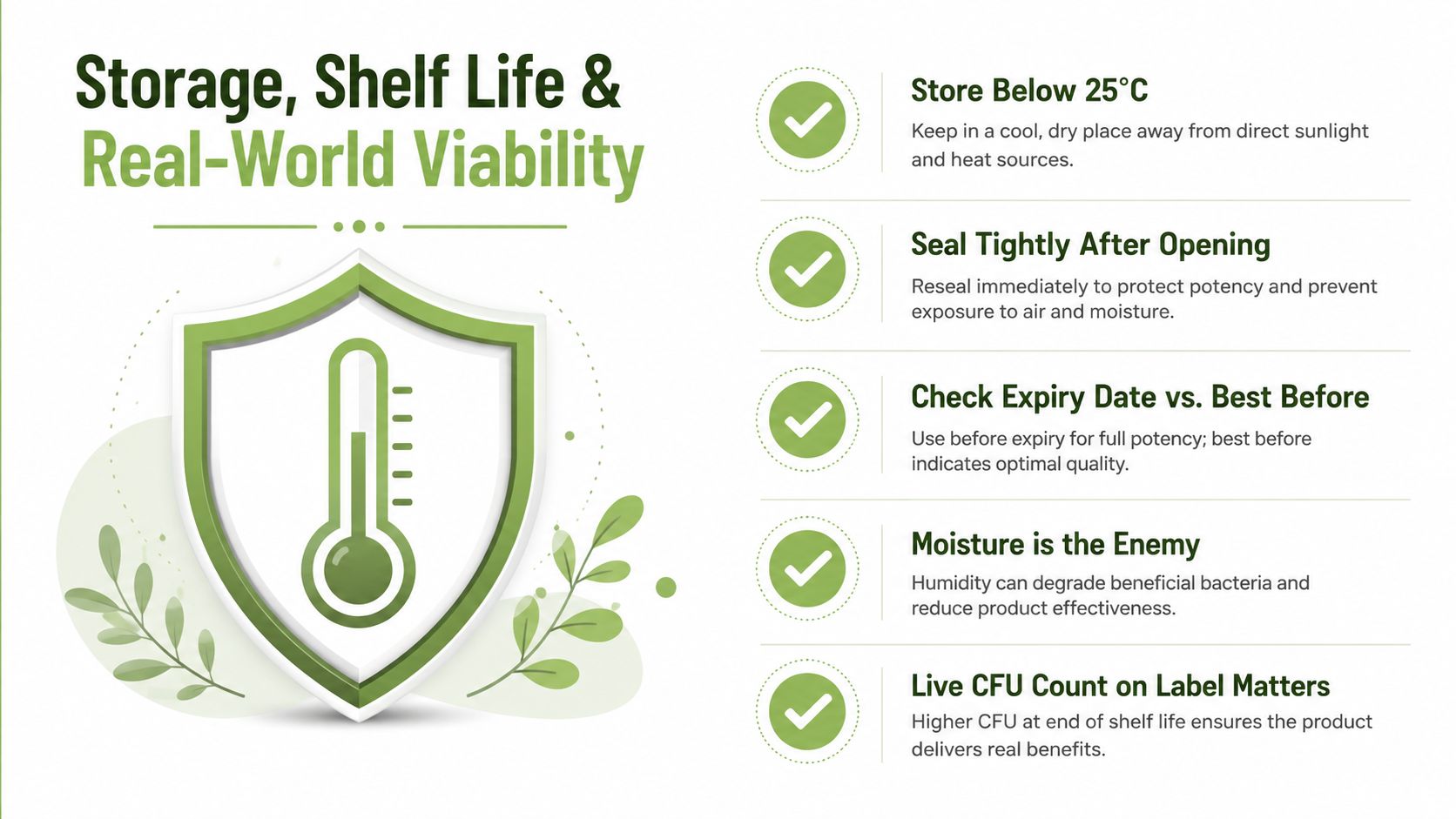
Moisture is the quiet enemy
Published powder-quality work found probiotic powder formulations with 2.97% to 3.35% water content had flow rates of 0.38 to 0.62 g/s and angle of repose values of 20.39° to 29.83°, which are practical signs of whether a powder will dispense cleanly or clump awkwardly (PMC study). Another cited synbiotic drink powder reported 4.03% to 6.12% moisture, and the same paper described a serving design of 30 g powder in 100 mL water that still had to meet a minimum viable lactic-acid-bacteria level of 6.53 log CFU/g to comply with the standard discussed there.
Those details matter because moisture affects both flowability and bacterial survival. If a powder clumps, it is not just annoying. It can also mean the product has absorbed enough water to put viability at risk.
Storage rules that help
Keep the container sealed. Use a dry spoon. Store it away from heat and light. If the label allows refrigeration after opening, do it. If the powder smells off or has changed texture in a way that looks wrong, trust your nose and bin it.
A refrigerated product is not automatically better than a shelf-stable one. What matters is whether the packaging, drying method, and storage conditions preserve the live count long enough for the label promise to mean something at the time of drinking.
For transport-heavy businesses, even simple handling improvements help. A useful guide to thermal delivery bags can show how cafés and retailers reduce heat exposure when products are moved between locations or sent out for service.
A café example that gets this right
A small venue might keep sachets in a cool dry cupboard near service, then open only one pack at a time during a shift. A home user might do the same in a pantry, but the mistake usually comes later, when the lid stays loose and a damp scoop goes back into the tin. That is how a live product becomes a dusty one.
Internal storage habits matter just as much as what the label says. If you want a broader guide for fermented products, our how to store kombucha page covers the logic in a way that transfers neatly to powders too.
DIY Versus Commercial Powders in Australia
A lot of Australians have a practical streak, so the idea of drying a home culture into powder can sound appealing. It feels resourceful, a bit old-school, and cheaper on paper. The trouble is that probiotic powders are judged by what survives the process, not by how charming the process sounds.
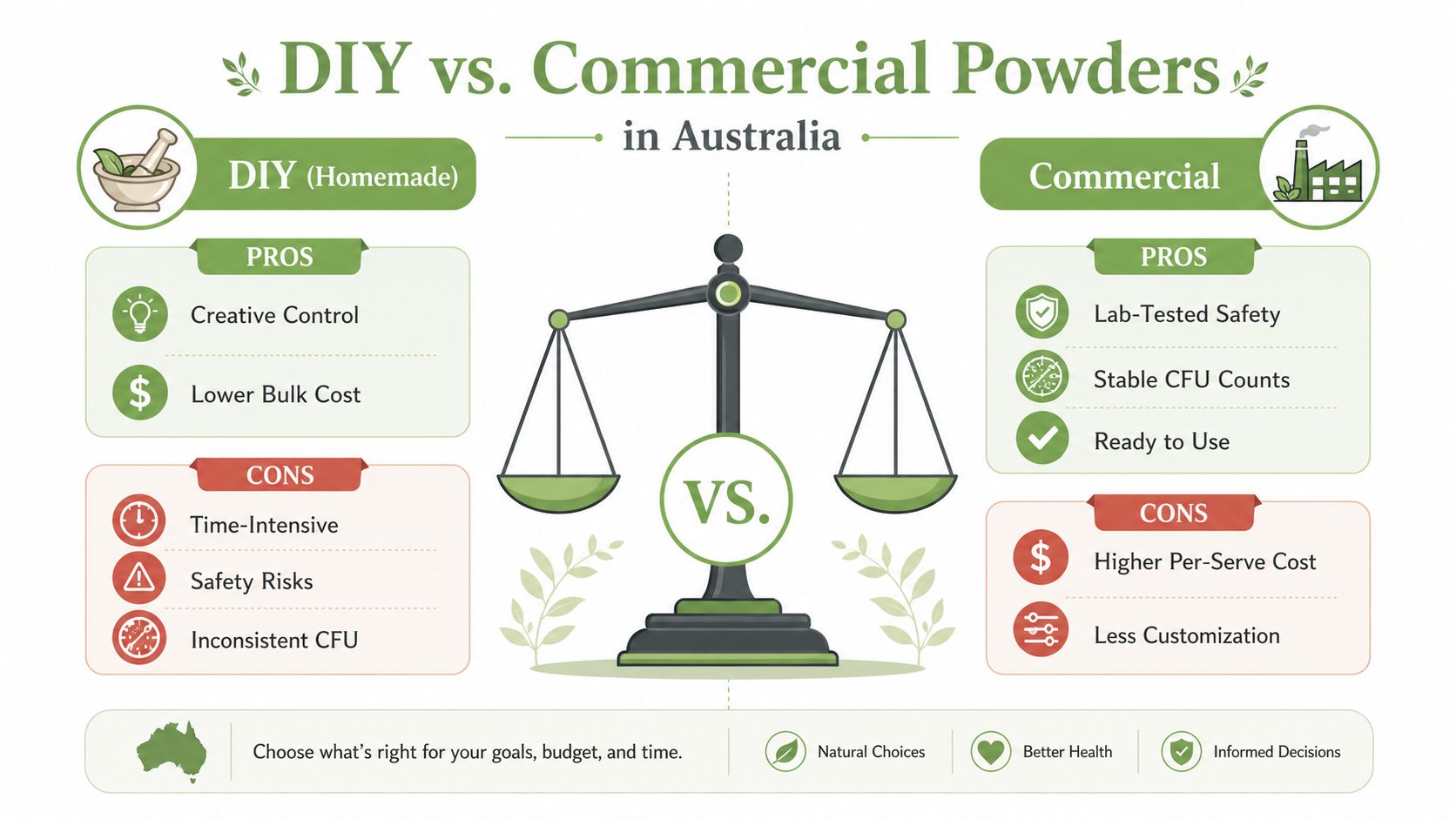
The trade-off is control versus reliability
DIY drying gives you creative control, but it also gives you inconsistency. Without professional controls for heat, moisture, and contamination, the CFU count at the end can drift fast. Commercial powders are built with spray-drying, encapsulation, and manufacturing controls designed to protect viability through storage and distribution.
Short version: homemade can be meaningful as a kitchen experiment, commercial is usually better when the goal is a predictable live dose.
Why commercial systems usually win on dose reliability
The hard part isn't making a powder-like material. The hard part is keeping enough live organisms intact after processing, transport, and shelf time. That's why lab-tested products usually focus on strain identity, viable count, and packaging controls rather than just the romance of fermentation.
In Australia, that difference matters if you're selling to cafés or retail customers, because the buyer isn't paying for a story. They're paying for a product that behaves the same way every time someone opens it.
For cautious producers and home makers alike
If your goal is a weekend fermentation project, DIY can be satisfying. If your goal is a product with stable dose expectations and a clear label claim, commercial manufacturing is the safer lane. The deciding factor is rarely price alone, it's whether the final powder still works when someone mixes it at the end of the week, not just on day one.
A Buyer Checklist for Cafés, Retailers and Wellness Brands
A good buyer doesn't just ask whether a powder is “healthy”. They ask whether it will serve well, store well, and hold up under real café conditions. That's the commercial test, and it's where a lot of products separate quickly.
What to check before you buy
- Strain transparency: Look for full strain names, not just broad species labels.
- CFU at end of shelf life: Ask whether the count is valid through expiry, not just at manufacture.
- Carrier system: Check whether the powder uses inulin, fibre matrices, or other stabilising ingredients.
- Sugar and additive profile: Confirm whether the product fits low-sugar or clean-label goals.
- Allergen and vegan status: This matters for café menus and retail shelves.
- Packaging format: Sachets, tubs, and stick packs all behave differently in service.
- Cost per live dose: Price per gram can be misleading if the viable count is weak.
A useful commercial lens is the broader Asia-Pacific demand signal, where probiotic beverage formats are growing strongly in the region according to industry projections (global probiotic drinks market analysis). That matters to Australian buyers because the local market is connected to the same functional-beverage trend, not insulated from it.
A simple shortlist method
Ask suppliers for a data sheet, a sample, and a clear answer on storage. Then test the product in your actual service conditions. A sachet that looks fine in a lab can still clump on a café bench or taste awkward in a menu drink.
For wholesalers and wellness brands, the strongest products are usually the ones that can answer the boring questions without hesitation. That's often a better sign than a long list of broad health claims.
Dosing, Safety and Frequently Asked Questions
A good starting point for most adults is the dose on the label. The right amount depends on the strain, the way the powder is formulated, and how many live cultures are present when you use it. Read the serving size with the same care you'd use for coffee dosing in a café, because a scoop that looks generous is not the same thing as a meaningful live dose.
Safety deserves the same attention. Probiotics are generally considered safe for healthy people, but people with weaker immune systems can face a small risk of adverse side effects. If you are immunocompromised, pregnant, or managing a complex health condition, it makes sense to check with a health professional before adding a probiotic powder to your routine.
Can probiotic drink powder replace kombucha?
They serve different jobs. Kombucha is a fermented drink, while powder is a dry format you mix yourself, so the live cultures, flavour, and handling are not identical. A powder can suit a measured daily routine, while kombucha sits more in the ready-to-drink, fermented category.
How long before you feel anything?
That depends on the strain, the dose, and your own digestion. Some people notice a change quickly, while others feel nothing obvious even if the product is still doing its job. For that reason, the label and the formulation matter more than expecting one fixed timeline for everyone.
Can children use it?
Sometimes, but not automatically. Whether a product suits a child depends on the strain, the dose, and the child's health status, so it is better to get professional advice than to assume every powder is family-friendly.
What about sugar, lactose, and vegan needs?
Powders can be useful here because the format can be built to suit low-sugar, dairy-free, or simpler ingredient preferences. A café menu or home routine can benefit from that flexibility, especially when customers are trying to match a probiotic product with other dietary needs. That said, not every powder is made that way, so the ingredient list still needs a proper look.
For people building a daily ritual rather than chasing a miracle product, a sugar-free organic kombucha in the fridge and a measured probiotic powder in the pantry can work as a practical pair. If you also want a clean energy option, ceremonial-grade matcha gives a different kind of functional drink altogether, one that is about calm focus rather than live cultures.
PepTea makes it easy to keep that routine practical, with Australian-brewed sugar-free kombucha and organic matcha that fit neatly into a low-sugar, functional lifestyle. If you are comparing probiotic drink powder with other gut-health options, visit Pep Tea to explore the range and see what works for your kitchen, café, or retail shelves.