
Tag: matcha quality
Where Do You Buy Matcha Green Tea Powder
Most buying advice starts with the wrong question. Where do you buy matcha green tea powder? The usual answer is “find a reputable shop”, but a polished website, a Japanese-looking tin and the word ceremonial don't prove much. Australians waste money when they judge the storefront instead of the powder, its paperwork and its intended use.
The better question is simple: what evidence does the listing provide? Whether you're comparing an online specialist, a café, a supermarket or a marketplace seller, check the batch details, organic certification, price per serve and freshness date before you pay. Matcha is a whole-leaf powder, so origin, handling and traceability matter more than attractive branding.
The Real Question Is Not Where but What to Check
A specialist tea shop can sell excellent matcha, but it can also sell an expensive product with little useful information. A supermarket can offer a practical everyday powder, while a marketplace listing might show a premium tin with no clear Australian importer, batch code or storage guidance. The channel helps, but the listing makes the case.
Australia's matcha buyers generally use four routes:
- Online specialists, where product pages can explain origin, grade, certification and preparation.
- Cafés, which may sell the powder they use behind the counter or direct customers to a supplier.
- Supermarkets and health-food retailers, which offer convenience and physical access.
- Third-party marketplaces, where choice is broad but seller transparency varies sharply.
Online and health-oriented channels matter particularly for matcha powder. One Australia-focused market estimate places distribution at approximately 40% online, 35% through retail health stores and 25% through foodservice, although those figures are directional market estimates rather than official Australian government statistics. The estimate is useful because it reflects how matcha is bought, as a packaged ingredient for home preparation as well as a café drink. Australia-focused matcha channel estimate
Four tests before you trust the seller
Batch transparency tells you whether the product can be traced. Look for a lot or batch identifier, an importer or Australian business address, and a best-before date.
Certification evidence matters more than the word “organic”. A genuine claim should point to a certifier and identifiable certification details.
Price per serve exposes inflated ceremonial pricing. Compare the pack size with how you drink matcha, not with the prestige of the label.
Freshness information helps you judge whether the powder is likely to retain its colour and flavour. A listing that hides the date or gives only vague wording deserves caution.
Practical rule: If you can't identify the origin, grade, batch information and intended use, don't let a low price make the decision for you.
The best buying habit is to stop searching for a perfect shop and start evaluating a specific product. Use the guidance in our explanation of matcha grades to understand the difference between powder designed for whisking and powder made for food, then demand evidence from the seller.
Australian Matcha Channels Compared
There isn't one correct place to buy matcha in Australia. The right channel depends on whether you want a daily latte, occasional whisked tea, baking powder or a hospitality supply. The available market estimate places online platforms ahead of health stores and foodservice, but it doesn't provide a separate official share for supermarkets or third-party marketplaces. Treat those channels as practical buying options, not as fixed market categories.
What each channel does well
Dedicated online specialists usually provide the clearest product education. A good listing can show Japanese origin, grade, ingredients, storage advice, certification information and pack sizes. The weakness is that you can't inspect the powder before purchase, so the seller's transparency and returns policy carry more weight.
Direct-from-café sales can be useful when you already like the flavour in your drink. Ask whether the café can identify the supplier, batch and grade. The limitation is that cafés often sell for beverage use, not necessarily with the full retail labelling and documentation you should expect from packaged food.
Major supermarkets and health-food retailers win on convenience. They suit a cautious first purchase or someone who wants a small pack without waiting for delivery. Selection may be narrower, and a sachet or small pouch can look cheap while costing more per gram than a larger specialist pack.
Third-party marketplaces offer access to imported tins, unusual origins and a wide range of prices. They also create the greatest need for scrutiny. The seller, importer, packaging date, country of origin and return process may be unclear, particularly when the listing relies on lifestyle language rather than product evidence.
| Channel | Typical AUD price approach | Strength | Weakness |
|---|---|---|---|
| Online specialist | Compare by grade and grams | Strongest product education and selection | You rely on listing accuracy |
| Café direct | Usually tied to the café's chosen product | Taste can be judged in a prepared drink | Batch and retail documentation may be limited |
| Supermarket or health retailer | Small packs and sachets are common | Convenient and easy to access | Less choice and weaker origin detail |
| Marketplace | Wide range, including imported premium tins | Broadest selection | Seller transparency varies |
For an everyday latte, I favour an online specialist or a clearly labelled health-food retailer. Milk, fruit, sweeteners and ice soften the differences between grades, so culinary or middle-tier powder usually makes more sense than paying a ceremonial premium. For a once-a-week whisked tea, buy a smaller, fresher ceremonial pack from a supplier that publishes origin and batch information.
Matcha also fits neatly into simple food routines. If you're making dairy-free snacks alongside your tea, a practical gluten-free and nut-free snacks guide can help you choose recipes where culinary matcha will add colour and flavour without wasting a delicate drinking grade.
How to Read an Australian Matcha Listing
A product page should answer basic food-buying questions before you reach the checkout. If it doesn't, move on. The colour of the tin matters less than the information behind it.
Start with the powder and its identity
A fresh, well-made matcha generally appears vivid jade green, while dull olive, yellow-green or brown tones can indicate age, oxidation or lower-grade leaf. Colour isn't proof by itself, because photography and packaging affect what you see, but a seller should provide a clear product image rather than hiding the powder behind decorative branding.
The texture should be extremely fine. Matcha is stone-ground or finely milled tencha, not crushed loose-leaf tea. A listing should identify the product as matcha or green tea powder and show an ingredient statement. For a plain product, the ingredients should be 100% green tea powder, without sugar, maltodextrin, starch or anti-caking agents.
Look for the following details:
- Country of origin: “Japan” is not the same as “packed in Australia”. Check where the tea was grown and where it was packed.
- Region or producer information: A named growing region or supplier gives you more to assess than “Japanese-style”.
- Batch or lot code: This supports traceability if a product is recalled or a quality issue appears.
- Best-before date: A packed-on date alone doesn't tell you how long the product remains suitable.
- Storage directions: Matcha should be protected from heat, moisture, light and air.
- Particle and preparation guidance: A serious seller explains whether the powder suits whisking, milk drinks or cooking.
Australian food labelling rules cover product identity, ingredients, date marking, storage directions, nutrition information, country-of-origin information and relevant claims. The parliamentary overview of matcha and Australian food requirements also explains why commercial packaging matters, especially for a whole-leaf product that the consumer ingests rather than merely infuses.
Treat “organic” as a claim to verify
Domestic organic certification is voluntary. A product can use organic language without carrying independent certification, but “certified organic” should be supported by a genuine mark and identifiable certification details. Australian guidance recommends checking the certifying organisation, grower name and certification number where applicable. ACCC guidance on organic claims
If a listing hides the origin or grade, don't buy it, regardless of the colour of the tin or the apparent bargain. Those two details define what you're purchasing and how you should use it.
Ceremonial vs Culinary and What Your Money Buys
“Ceremonial” sounds precise, but it isn't a nationally standardised quality grade. Sellers use the term differently, so the label can't replace evidence about origin, freshness, processing, packaging and testing.
The practical distinction is use. Ceremonial matcha is made to be whisked with water, where umami, sweetness, colour and texture are exposed. Culinary matcha is made to work with milk, fruit, sugar, flour and other ingredients, where a stronger or more assertive flavour can be useful.
Verified Australian market guidance places indicative retail pricing at AUD 30–80 per 100g for ceremonial matcha and AUD 18–35 per 100g for culinary matcha. Australian organic green tea and matcha pricing estimate Those are directional ranges, not a guarantee of quality. A high price doesn't turn an anonymous powder into a superior one.
Match the grade to the drink
A daily latte usually doesn't need the most expensive powder. Milk changes the flavour balance, and culinary matcha is designed to hold its own in that setting. Use it for smoothies, baking, pancakes, ice cream, sauces and energy balls. If you're whisking matcha with water and drinking it without additions, a fresher ceremonial product is the sensible place to spend more.
| Attribute | Ceremonial matcha | Culinary matcha |
|---|---|---|
| Best use | Whisked with water | Lattes, smoothies and cooking |
| Flavour focus | Umami, sweetness and smooth texture | More robust flavour that works with other ingredients |
| Colour expectation | Usually brighter when fresh | May be less vivid |
| Buying priority | Origin, harvest detail, freshness and texture | Clean ingredients, flavour strength and cost per use |
| Sensible buyer | Straight-tea drinker | Latte drinker, baker or smoothie maker |
Price-per-serve maths makes the decision clearer. Take the pack price, divide by the total grams, then multiply by the amount you use in one drink. Don't compare a small ceremonial tin with a large culinary pouch by shelf price alone. Compare the cost of the bowl or latte you make.
A middle option can work for people who drink both styles. Labels such as “premium culinary” or “latte grade” may describe a powder positioned between everyday culinary matcha and a whisking-focused product. Treat those names as marketing descriptions, then check the evidence. PepTea's ceremonial and culinary matcha comparison is useful when you're deciding whether the extra spend will be noticeable in your usual preparation.
Labels Certifications and Legal Requirements Decoded
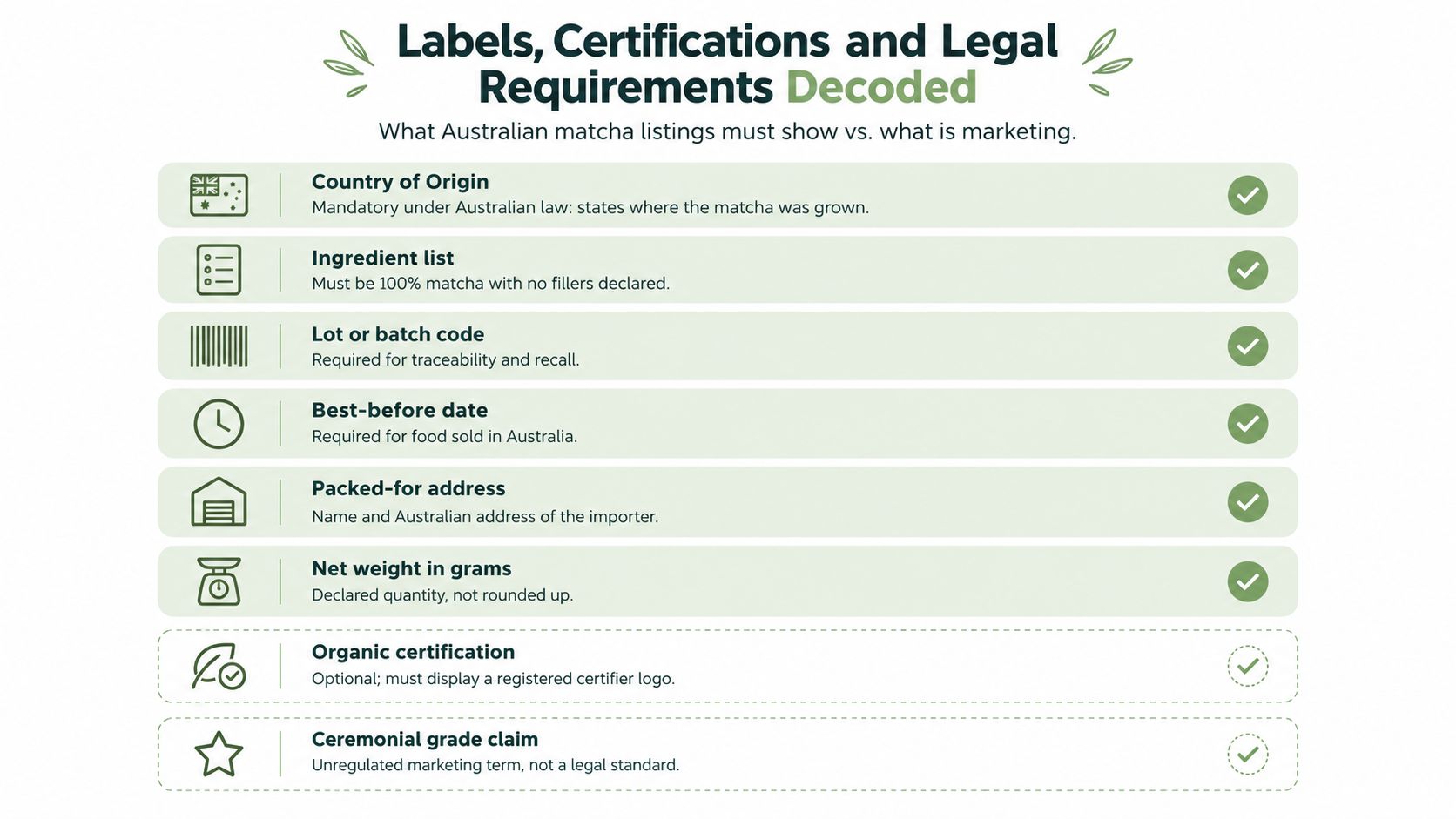
Australian matcha buyers need to separate mandatory food information from optional marketing language. “Ceremonial”, “premium”, “clean” and “Japanese-style” may influence your impression, but they don't prove the powder's origin or quality.
Country-of-origin information is central. An Australian supplier may pack imported matcha locally, but that doesn't make the tea Australian-grown. Read the wording carefully and look for the country where the tea was produced, along with the Australian importer or business details.
Organic systems can also appear on packaging. You may see Australian Certified Organic, USDA Organic, JAS or EU Organic marks, depending on the producer and supply chain. Don't treat the logo alone as enough. Match the mark to an identifiable certifier, operator or certification record, particularly when the product carries a premium price.
Caffeine and GST require careful reading
Plain tea naturally contains caffeine, while added caffeine must be declared in relevant foods. If matcha is blended with other caffeine sources or sold as a formulated beverage, read the ingredient and advisory statements rather than relying on “energy” or “focus” language. Food Standards Australia New Zealand's caffeine guidance explains the difference between naturally caffeinated tea and products with caffeine added as an ingredient.
Don't confuse ordinary matcha with concentrated caffeine powder. Pure and highly concentrated caffeine products are banned from retail sale in Australia and New Zealand in the categories described by the food regulator. Naturally caffeinated tea is treated differently, but a product presented as a high-concentration caffeine powder is not a normal matcha purchase. FSANZ guidance on caffeine powders and high-caffeine foods
GST treatment isn't as simple as adding a fixed tax assumption to every matcha product. The Australian Taxation Office says tea is generally GST-free when sold as food, but classification can depend on promotion, name, labelling, packaging, display and placement. Check how the product is presented, especially if it is marketed primarily as a supplement, ingredient or ready-to-drink beverage. ATO guidance on GST-free food
The useful information to retain is straightforward: ingredient panel, net weight, batch number, best-before date, origin, importer details and certification documentation. Use PepTea's guide to organic certification in Australia as a reference for the kind of evidence an organic claim should provide.
A Practical Matcha Buying Checklist
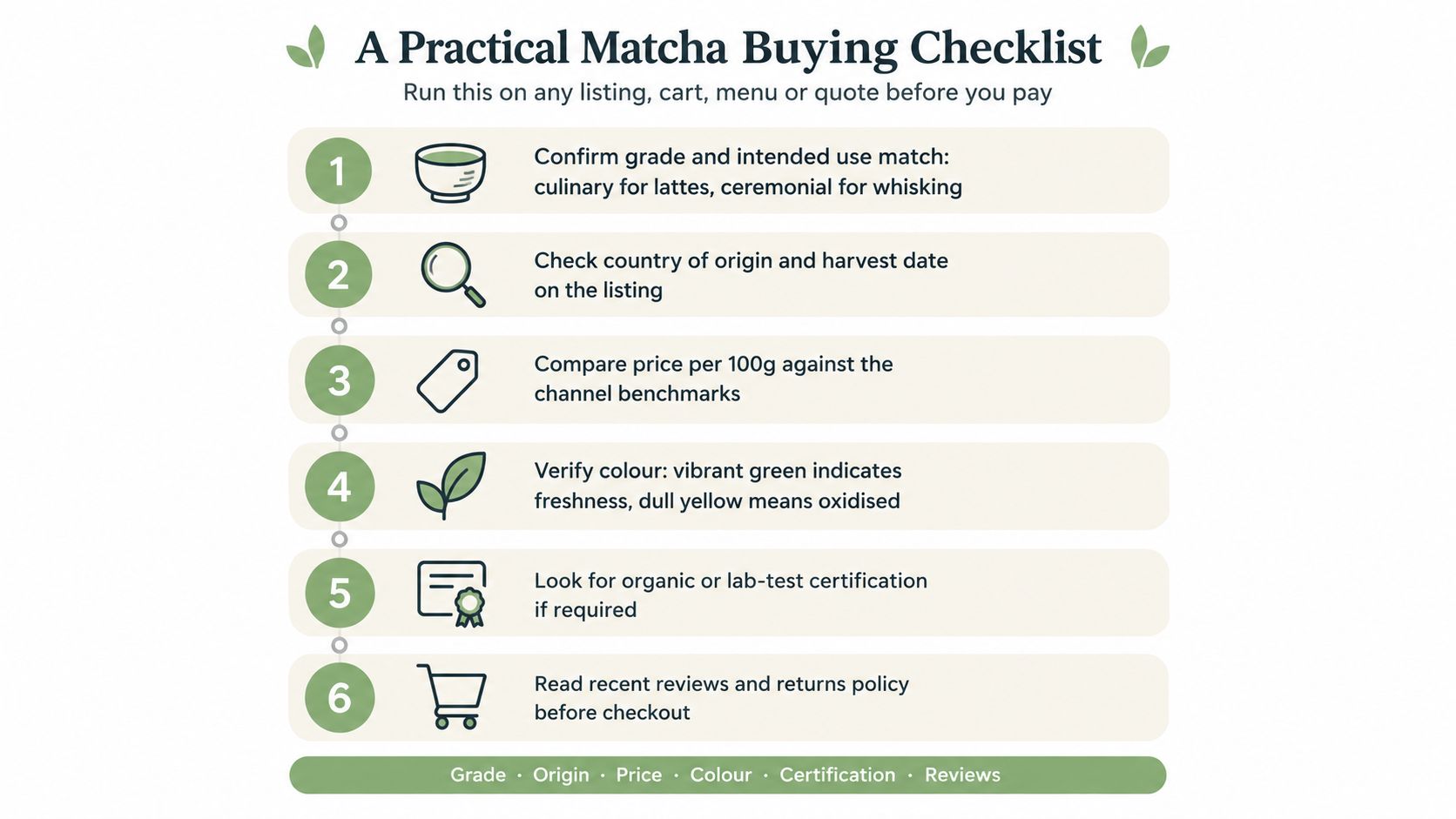
Run this checklist on a product page, café menu, supermarket pack or wholesaler quote. You shouldn't need specialist equipment to reject a vague listing.
- Choose the use first. Culinary powder suits lattes, smoothies and baking. Ceremonial powder earns consideration when you whisk it with water and drink it straight.
- Inspect the colour. Look for a lively green product image. Yellow-green or brown powder deserves questions about age, oxidation and storage.
- Find the origin and harvest detail. A named Japanese region such as Uji, Nishio or Kagoshima is more useful than “Japanese-style”. A harvest year or clearly explained shade-growing claim can add context, but it still doesn't replace a batch code.
- Read the ingredients. Plain matcha should identify green tea powder without fillers, sugar, maltodextrin or anti-caking agents.
- Verify the seller. The listing should show a batch number, best-before date, country of origin, Australian business address and, where relevant, ABN or importer information.
- Calculate the unit cost. Compare price per gram and price per serve with the verified Australian guide ranges, rather than comparing tins by sticker price.
- Ask wholesalers direct questions. Request the harvest date, particle size, storage and transport conditions, stone-milling information, specification sheet and certificate of analysis where the product is for café service.
Some red flags should end the purchase immediately:
- Vague origin: “Japanese-style” without a growing country or region.
- Missing business details: No Australian address, importer or traceability information.
- Unclear pack format: Bulk pricing with no sealed retail option or labelling.
- Suspiciously low pricing: A price well below the verified culinary range deserves a full explanation, not an impulse purchase.
- Unsubstantiated certification: “Organic” with no certifier, operator identity or record to check.
For café buyers, request testing information for microbial limits, heavy metals, pesticide residues and moisture. A consumer buying one sealed pack doesn't need the same supplier file, but should still expect a labelled product from an identifiable seller.
Putting It Together and Buying With Confidence
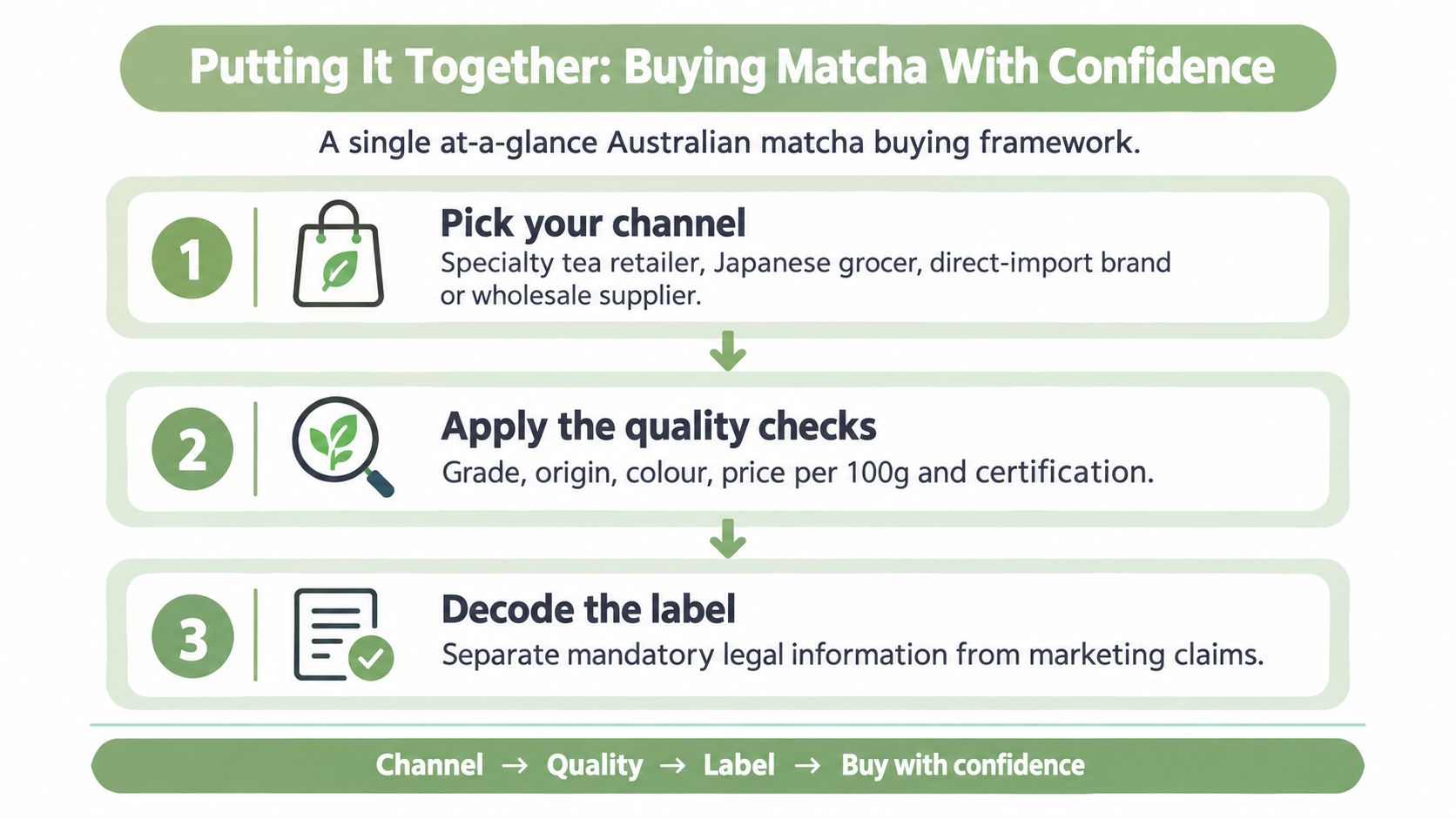
A reliable matcha purchase follows three decisions. First, choose the channel according to your use and budget. Second, apply the evidence checks to the individual listing. Third, calculate the cost per serve and ask whether the grade makes sense for the drink you prepare most often.
Pick the channel for the job
Choose an online specialist when origin, certification and preparation guidance matter. Use a supermarket or health-food retailer for a straightforward first trial, provided the pack is sealed and fully labelled. Buy through a café when you trust the flavour and the business can identify its supplier. Treat a marketplace as a research exercise, not an automatic shortcut to premium quality.
Apply the product checks
Look for a clear grade, growing country, ingredients, best-before date, batch information and Australian seller details. Check the powder's colour and the storage instructions. For an organic product, verify the certification claim rather than assuming the word itself is regulated.
PepTea provides an example of the Australian specialist model, selling Japanese organic matcha online through its Australian operation with products intended for both home use and larger supply formats. The useful standard isn't the brand name. It's whether a seller publishes enough origin, grade and batch information for you to judge the product before buying.
Calculate before you commit
A ceremonial product should make sense for whisked drinking, where texture and flavour are visible. Culinary matcha should make economic sense in lattes, baking and smoothies. If you're paying a ceremonial price for a powder that disappears into milk, reconsider the purchase.
Bookmark the checklist, compare two or three sellers side by side and start with a pack size that suits your consumption. You don't need to commit to a brand after one order. Buy transparently, taste the powder in the preparation you make, and let evidence rather than packaging decide your next purchase.
Pep Tea offers organic Japanese matcha green tea powder online, with options suited to both everyday preparation and larger-use requirements. Visit Pep Tea to compare the range, review the product information and choose a matcha that fits the way you drink it.