
Organic Ceremonial Matcha Guide for Health and Brewing
Australia's matcha market generated more than $54 million in 2024, while Japanese green tea exports to Australia reached 195,319 kg between January and August 2025, a 131% year-on-year increase according to SBS News coverage of Australia's matcha boom. That growth has pushed organic ceremonial matcha from a niche tea-shop ingredient into a mainstream wellness product, but popularity also creates confusion. A green powder labelled “ceremonial” isn't automatically authentic, organic, fresh, or nutritionally consistent.
Organic ceremonial matcha is whole, shade-grown green tea leaf, processed into a fine powder and consumed rather than steeped and discarded. Its appeal comes from a combination of Japanese provenance, organic certification, vibrant flavour, naturally occurring caffeine, L-theanine and catechins, plus the calm ritual of whisking a fresh bowl.
For Australian buyers, quality involves more than colour and branding. You'll need to consider origin, certification, harvest and processing information, packaging, taste, and preferably lot-specific laboratory data. This guide breaks down those decisions, then shows you how to brew organic ceremonial matcha, use it in lattes and recipes, and buy it with greater confidence.
Introduction to Organic Ceremonial Matcha
Matcha differs from ordinary green tea because you consume the leaf itself. Loose-leaf tea works like an infusion: hot water extracts selected compounds, while the leaves remain in the strainer. Matcha instead keeps finely milled powder suspended in water, so storage, preparation, and sourcing shape the result.
Organic describes the tea's production system and the certification supporting that claim. It does not promise a particular flavour, caffeine level, or freshness. Ceremonial generally indicates matcha intended for whisking with water and drinking on its own, yet the term has no universal quality standard. A grade name is therefore only one clue, not proof of authenticity.
Australia's import-dependent supply makes provenance details especially useful. Industry market analysis reports that over 90% of consumed matcha volume is imported, with combined green tea powder imports estimated to have risen at a 13–17% CAGR from 2020 to 2025. Premium buyers consequently depend largely on imported certified products, particularly Japanese matcha.
Start with three checks: can the supplier identify the powder's origin, show its organic certification, and provide laboratory testing that supports its quality? These records work like a product passport. Colour and branding may suggest quality, but traceable documents offer stronger evidence when choosing organic ceremonial matcha in Australia.
Understanding What Makes Matcha Ceremonial
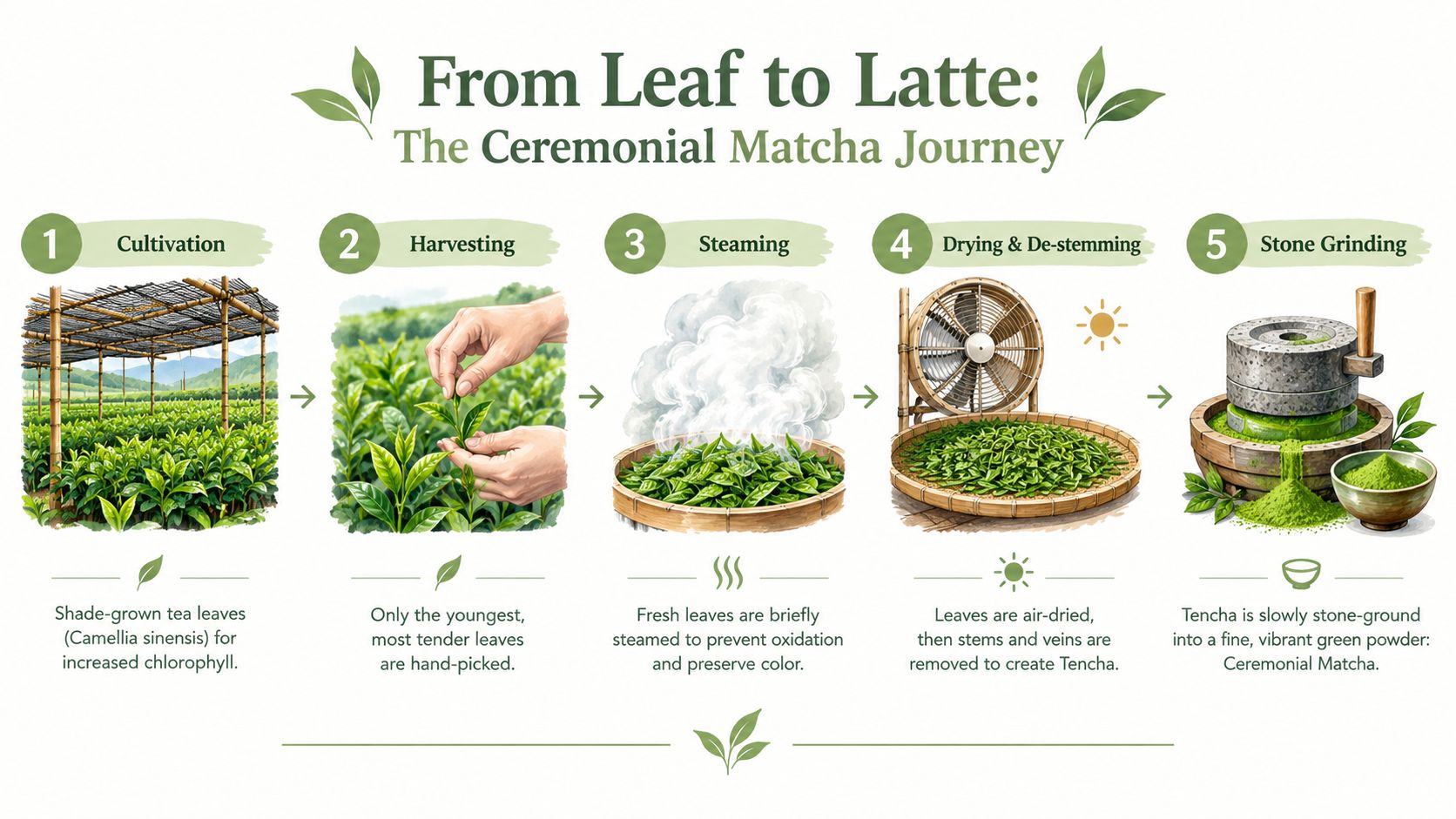
Ceremonial matcha begins as Camellia sinensis, the same tea plant used for green, black and white tea. The difference lies in cultivation and processing. Before harvest, producers shade the plants, often using structures that reduce direct sunlight. This encourages the leaves to retain a deep green colour and develop a softer, umami-led flavour.
From shaded leaf to tencha
The youngest leaves are selected because they're tender and well suited to drinking without milk or sugar. Producers quickly steam the fresh leaves to limit oxidation, then dry them. Stems and veins are removed, leaving tencha, the leaf material that becomes matcha.
Think of tencha as the carefully prepared flour of the tea world. A baker wouldn't describe a coarse bran mixture as the same thing as finely sifted pastry flour. In a similar way, removing tougher leaf parts helps create the smooth texture expected from matcha designed for whisking.
Why stone grinding matters
The dried tencha is slowly ground into an exceptionally fine powder, traditionally using stone mills. The process resembles artisan flour milling, where patience and controlled movement matter more than speed. The result should disperse smoothly when whisked, rather than feel gritty or heavy on the tongue.
This whole-leaf format explains why matcha has a more concentrated taste than a cup of steeped green tea. It also means poor storage can affect the aroma and colour directly, because there's no separate leaf to remove after brewing.
For readers comparing powdered tea formats, this guide to choosing instant matcha can help clarify the difference between convenience powders and matcha intended for a more traditional preparation. PepTea also provides a useful overview of how matcha tea is made, including the transformation from leaf to powder.
Health Benefits and Key Compounds
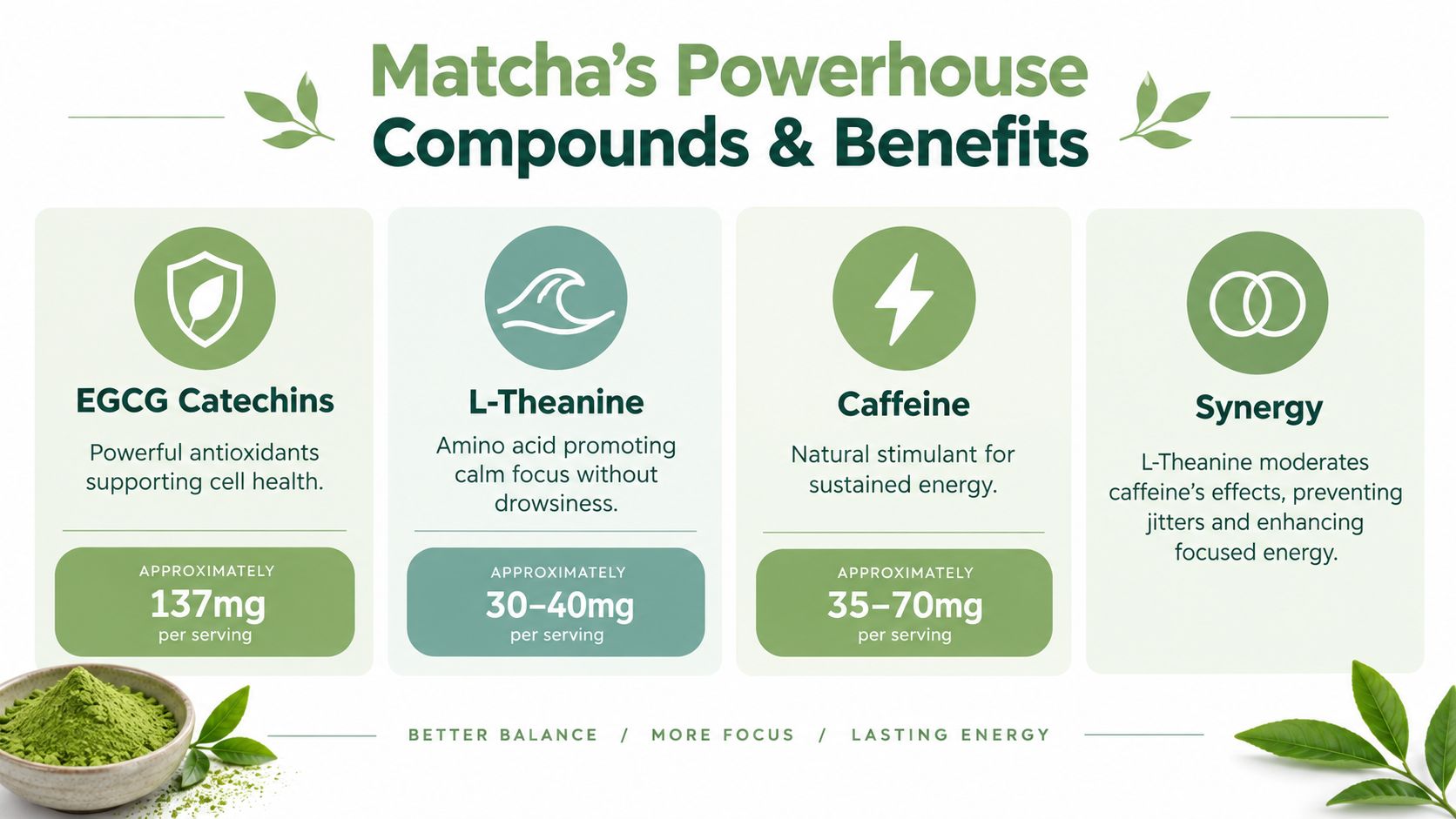
Organic ceremonial matcha contains several naturally occurring compounds that shape both its flavour and its physiological effects. The main trio is catechins, L-theanine and caffeine. It's more accurate to say matcha may support alertness and focused energy than to promise a medical outcome.
Catechins are plant compounds with antioxidant activity. EGCG, or epigallocatechin gallate, is one of the best-known catechins in green tea. A useful everyday analogy is a clean-up crew. Antioxidants help the body manage oxidative processes, but they aren't a cure-all and shouldn't replace a balanced diet or medical advice.
L-theanine is an amino acid associated with tea's characteristic savoury, rounded taste. Caffeine provides stimulation, while L-theanine may help make the experience feel calmer and less abrupt for some people. The combination can feel different from drinking a strongly caffeinated beverage on its own.
Practical rule: Treat matcha as a whole-leaf food and a caffeinated drink, not as a medicine.
A randomized placebo-controlled study used 2.07 g of matcha per day, providing 50.3 mg of theanine, 171.0 mg of catechins and 72.5 mg of caffeine. Participants showed a statistically significant reduction in reaction time and more correct responses on an emotion-perception task, as reported in the published study available through PubMed Central. That result supports interest in the combined matrix, but it doesn't mean every product or serving delivers the same composition.
Preparation can change the sensory experience. Very hot water may draw out more bitterness, while excessive milk or sweetener can hide the fresh, grassy and umami notes that distinguish good matcha. Readers interested in the role of EGCG can explore what EGCG is before deciding how much weight to place on antioxidant language.
Grading Origins and Sourcing in Australia
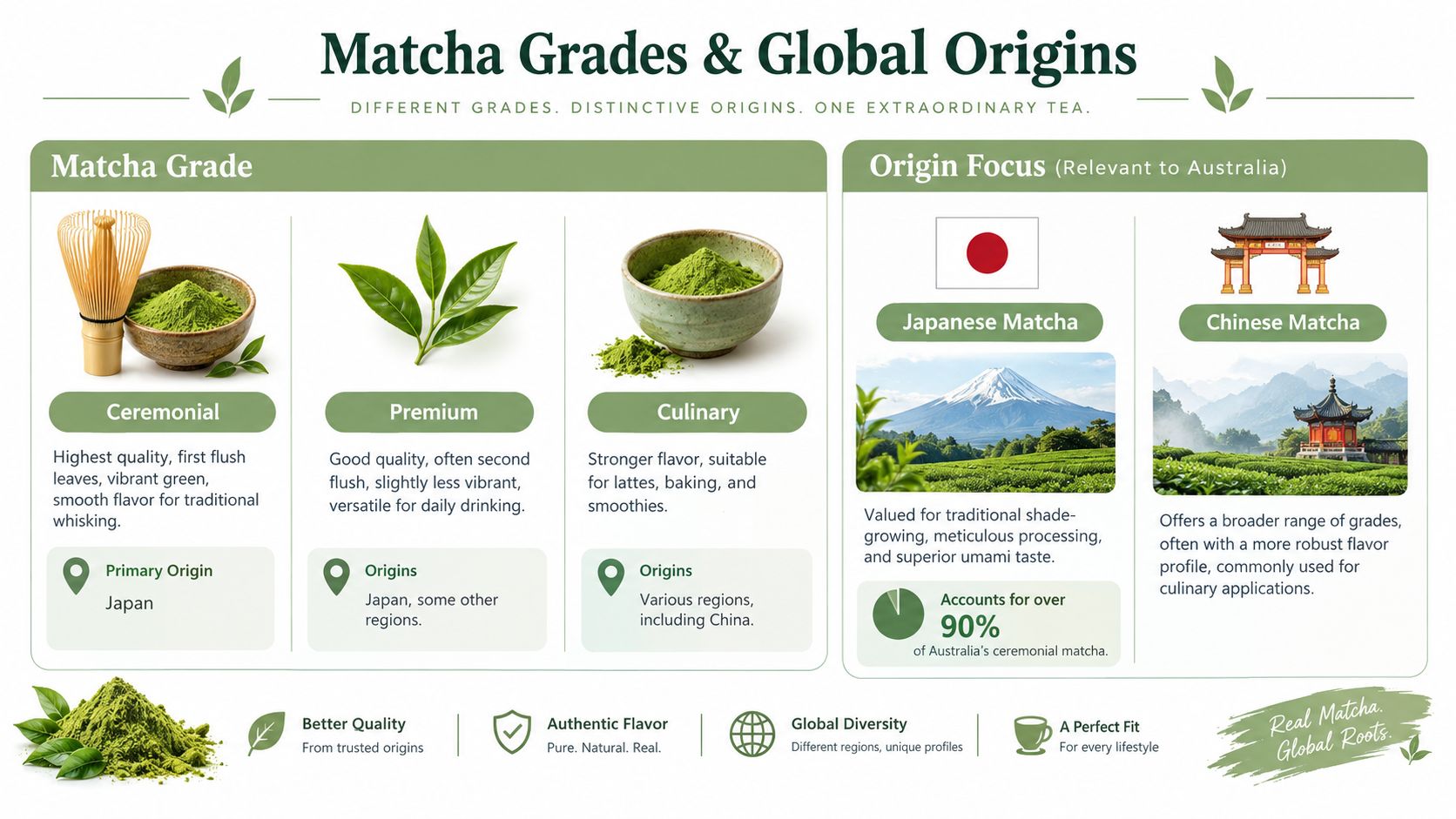
Australia's ceremonial matcha market depends heavily on imported products, so a packet's origin story matters as much as its colour or label. The terms ceremonial, premium and culinary provide useful starting points, but they describe intended use more than they prove authenticity.
Ceremonial matcha is generally selected for a fine texture, attractive colour and balanced flavour when whisked with water. Premium matcha may suit everyday drinking or lattes. Culinary matcha usually has a stronger flavour designed to remain noticeable alongside milk, fruit, flour or chocolate. These categories work like menu labels, not independent laboratory standards.
Origin adds another layer. Japanese matcha is associated with established shading and processing traditions and with umami-focused drinking styles. Chinese matcha is also sold in various grades, often for culinary applications. A country name alone cannot confirm that a product is organic, fresh or appropriate for ceremonial preparation.
Why Australian provenance matters
IndexBox's Australian market analysis describes Australia as an import-dependent market, with Japan supplying much of the value associated with premium matcha and China contributing substantially to import volume. That pattern makes traceability, stock continuity and accurate labelling practical concerns for Australian buyers.
Supply pressure can also affect availability. Australian hospitality coverage describes a fast-growing category, new supply agreements and pressure on shipments of ceremonial Japanese matcha. Treat vague wording such as “Japanese style” or “inspired by Japan” as a prompt to ask questions. Look for the producing country, region where available, importer and batch details.
Reading organic certification
Certification connects an organic claim with an identifiable standard and certifying body. Australian shoppers may see:
- Australian Certified Organic: A certification scheme used for eligible organic products sold in Australia.
- NASAA Certified Organic: Another recognised Australian organic certification pathway.
- JAS: Japan's Agricultural Standards system, relevant when Japanese organic certification is stated.
Check the logo, certification details, product name and importer together. Japanese origin does not automatically mean certified organic, and organic certification does not establish ceremonial grade. For stronger verification, compare the label with lot-specific laboratory data, such as a certificate of analysis showing the tested batch and relevant contaminant or composition results.
How to Choose High Quality Ceremonial Matcha
Start with transparency, not the colour of the tin. A bright jade-green powder can be a positive sign, but appearance alone can't verify origin, organic status, freshness or potency. The most dependable choice combines sensory checks with documentation.
Use the five-part check
-
Read the origin statement. Look for the producing country and, where available, the region, cultivar, harvest information and importer. A specific statement is more useful than a broad phrase such as “Japanese matcha blend”.
-
Verify organic certification. Check for an identifiable certification mark, not just the word “organic” in large type. If the package is unclear, ask the supplier which body certified the product and whether the certification applies to that particular matcha.
-
Inspect the powder. Fresh ceremonial matcha should look vivid rather than dull, yellowed or grey-green. It should feel fine and silky between the fingers, without obvious coarse particles.
-
Smell before tasting. A fresh, gently sweet and vegetal aroma is more encouraging than a stale, musty or hay-like smell. Once whisked, the flavour should be rounded and umami-led, with bitterness and astringency kept in balance.
-
Ask for a lot-specific COA. A certificate of analysis should identify the tested batch and show relevant results rather than relying on generic marketing copy.
The final point deserves particular attention. Independent ceremonial matcha lab results show substantial variation between samples. One analysis reported EGCG at 69.73 mg/g, EGC at 24.47 mg/g and caffeine at 35.01 mg/g. Another test reported L-theanine at 21.3 mg/g and caffeine at 56 mg/g.
Those figures don't create a universal pass or fail threshold, but they demonstrate why “ceremonial” isn't a reliable proxy for potency. A lot-specific COA can help you understand the likely bitterness, intensity and serving consistency of the product in front of you.
A sealed package protects quality, but it can't replace traceability. You need both.
Choose packaging that limits exposure to light and air, check the best-before information, and note the lot number before opening. If a supplier won't answer basic questions about certification, origin or batch testing, choose a product with clearer documentation instead.
Brewing Basics and Creative Use Cases
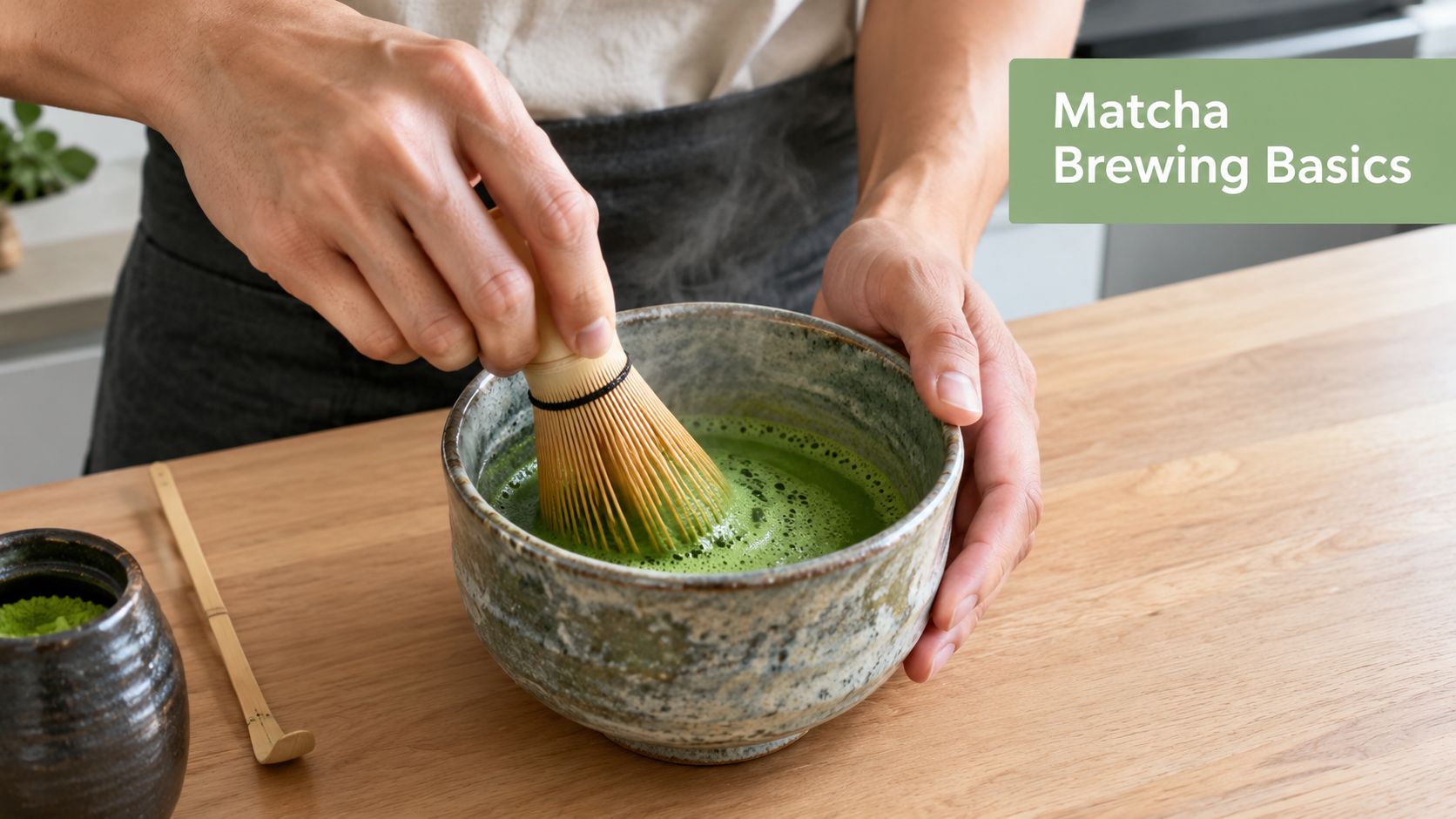
The simplest way to taste organic ceremonial matcha is to whisk it with water. Use a clean bowl, a bamboo whisk called a chasen, a small sieve and fresh water. Sifting breaks up compacted powder before it meets the water, so you won't need to fight stubborn lumps.
A reliable bowl method
- Warm the bowl, then discard the warming water.
- Sift your chosen amount of matcha into the bowl.
- Add a small amount of warm water and work the powder into a smooth paste.
- Add more water and whisk briskly in a back-and-forth W motion.
- Stop when the surface looks lightly foamy and the powder is evenly suspended.
Avoid boiling water. Excessive heat can make the drink taste harsh, while cooler water tends to preserve delicate sweetness and umami. For a more precise guide, use PepTea's instructions on matcha brewing temperature.
You can also follow the technique visually before adapting it to your own bowl and whisk.
Turning matcha into everyday drinks
A latte starts with a concentrated matcha paste. Whisk the powder with warm water first, then add steamed or chilled dairy milk or plant milk. Oat milk brings sweetness and body, while unsweetened almond milk keeps the tea profile lighter. Add sweetener only after tasting, because sugar can quickly cover the powder's natural character.
For an iced drink, make the concentrate, pour it over ice, then add cold milk or water. A matcha smoothie works well with banana, yoghurt or fruit, but use enough matcha to remain noticeable among the other ingredients. Strong culinary matcha can be practical here because its flavour is designed to stand up to food.
Baking gives you even more flexibility:
- Muffins: Sift matcha with the dry ingredients to distribute the powder evenly.
- Brownies: Stir it into part of the batter for a green tea swirl beside chocolate.
- Ice cream: Blend matcha into the dairy or plant-based base before chilling.
- Smoothies: Combine matcha with fruit, yoghurt and liquid, then taste before adding sweetness.
Cafés can benefit from consistent weighing, water temperature and milk volume. Teams wanting to strengthen their coffee and tea service can also explore TP Training's barista programs for broader beverage preparation skills.
Shopping Guide and Quality Certifications
Buying organic ceremonial matcha in Australia becomes easier when you separate four questions: Is it organic? Is it from the stated origin? Is it fresh? Can the supplier support the quality claim?
Specialist tea retailers, established cafés and direct brand websites can all be useful, provided the product page or packaging gives enough information. Look for a named certification scheme such as NASAA, Australian Certified Organic or JAS, then check that the certification applies to the product rather than only to the business generally.
Use this quick shopping sequence:
- Confirm the label: Check origin, grade description, organic mark, importer details and lot information.
- Examine the pack: Prefer sealed, light-protective packaging that limits air exposure.
- Check freshness: Read the best-before information and avoid products with unclear dating.
- Request evidence: Ask for a lot-specific COA showing relevant compounds such as catechins, caffeine and L-theanine.
- Store it carefully: Keep opened matcha sealed, away from heat, light, moisture and strong kitchen odours.
PepTea offers organic Japanese matcha products, including organic premium and ceremonial-style powders intended for whisking, alongside its Australian-brewed organic kombucha range. That gives shoppers one local supplier option to investigate while comparing certification and product documentation across the category.
A supplier that can't explain its certification, origin or testing may still sell an enjoyable powder, but you won't have enough information to verify the claims. Choose transparency first, then judge the flavour for yourself.
Explore the organic matcha range at Pep Tea to compare Japanese powders for whisking, lattes and recipes. You can also browse its Australian organic kombucha options when you're building a lower-sugar, functional drinks routine.