
Tag: matcha latte calories
Iced Matcha Latte Calories: Kilojoules, Milks and Sugar
Why do two drinks with the same green colour and the same name land so far apart? In Australia, an iced matcha latte can sit anywhere from roughly 30 to 340 kcal, about 130 to 1,430 kJ, depending on milk, sweetener and cup size.
The matcha powder works like the food colouring of the drink: it brings flavour and colour, while the pale base around it carries most of the energy. Milk fills most of the glass. Sugar can hide in premixes, syrups and foam. Separate those parts and the number stops being mysterious: swapping milk changes the base, skipping syrup removes added sugar, and ordering smaller shrinks every liquid component at once.
Iced Matcha Latte Calories at a Glance
Why does one label say 770 kJ while a recipe site says 184 kcal for a similar-looking drink? Unit and serving size explain most of that gap. Iced matcha latte calories are easiest to compare when every drink uses the same unit, the same serving size and the same sweetener description.
Reading The Range Without Guessing
Australia uses kilojoules (kJ) on most labels, while many recipes and café websites use kilocalories (kcal). Divide kilojoules by about 4.2 to get kilocalories. A drink near 770 kJ sits near 184 kcal, and a drink near 1,430 kJ sits near 340 kcal.
Serving size trips people up next. A small home glass and a large café cup are different serves even when the recipe tastes identical, because a larger cup holds more milk and more milk means more energy. Ice is the exception. It fills the glass without adding anything.
Iced matcha latte calories by variation
| Drink | Milk and sweetener | Serving | Energy (kcal) |
|---|---|---|---|
| Unsweetened, reduced-fat milk | 250 mL reduced-fat milk, no added sugar, milk only | 250 mL | about 126 |
| Unsweetened, extra-creamy milk | 250 mL extra-creamy milk, no added sugar | 250 mL | about 176 |
| Unsweetened oat milk | 250 mL unsweetened oat milk | 250 mL | about 120 |
| Unsweetened almond milk | 250 mL unsweetened almond milk | 250 mL | about 30 to 60 |
| Café benchmark, Jamaica Blue | Sweetened matcha premix with milk and ice, 23 g sugar | 330 g | about 184 |
| Flavoured café iced matcha | Sweetened matcha with flavour syrup and toppings | Café size | about 184 and up |
What The Table Is Really Showing
Read the first four rows as one ingredient changing while everything else stays fixed. The matcha powder adds little energy in each of them. Milk volume, milk type and sweetener decide the count. Swap reduced-fat milk for extra-creamy milk at the same 250 mL and the base climbs by about 50 kcal before a single gram of sugar is added. Move to the café rows and the jump comes from a different place: a sweetened premix, syrup or topping rather than the milk alone.
That split is the useful habit. Ask two questions of any iced matcha latte: what milk, in what volume, and what sweetener, in what form. The powder answer barely moves the total. The milk and sugar answers move it a lot.
Sugar deserves its own check. A drink can sit lower in energy because you picked a lower-fat milk, yet still carry plenty of sugar from a sweetened powder or syrup. Checking only calories hides the sugar. Checking only sugar hides what a creamy milk or topping adds.
Practical rule: Compare energy and sugar together, and always note the serving size in millilitres or grams.
Use the table as a starting map for your own order. Your cup size matters most because it sets the milk volume. Once you know that volume and whether the matcha is sweetened, your estimate is already close.
Hot and iced versions of the same build carry much the same energy. The gap appears when the iced version uses a bigger glass, more milk, a premix or extra syrup to stand up to dilution from ice.
Why Milk Drives Most of the Calories
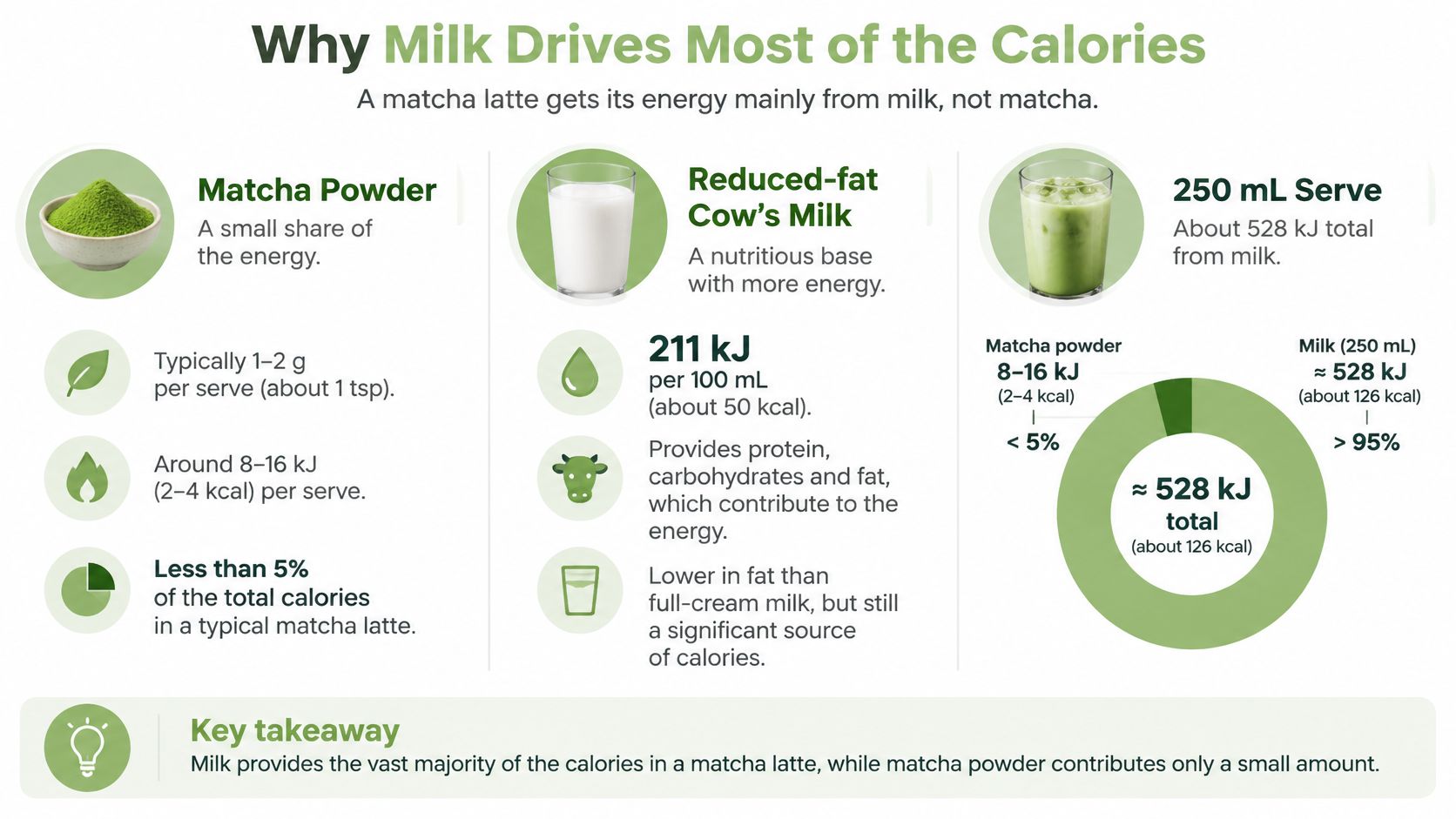
Picture your glass before you pour. You'll add a spoon of green powder, a splash of water, a handful of ice and then a long pour of milk. The milk is most of what you drink, so it's usually most of the energy.
The Per 100 mL Figure Does The Work
Food Standards Australia New Zealand's nutrient data in the Australian Food Composition Database nutrient file lists reduced-fat cow's milk at 211 kJ per 100 mL, about 50 kcal per 100 mL. On that basis, 250 mL contributes about 528 kJ, or 126 kcal, and 350 mL contributes about 739 kJ, or 176 kcal, before matcha or sweetener.
The same data lists an extra-creamy milk at 295 kJ per 100 mL, about 70 kcal, so 250 mL contributes about 738 kJ, or 176 kcal. Changing only the milk can alter the base by roughly 50 kcal per 250 mL serving, with no change to sugar from a sweetener because you haven't added one yet.
That fits the broader point from Healthdirect's kilojoules guide, which states that 1 kilocalorie equals approximately 4.2 kilojoules, so 500 kJ provides about 119 kcal and 800 kJ provides about 191 kcal. It also gives an average adult daily energy reference of approximately 8,700 kJ, about 2,070 kcal.
A Simple Way To Calculate Your Glass
Use this order every time. It works for dairy milk and for plant milks, including the options we discuss in our guide to matcha with coconut milk.
- Find the per 100 mL value: Read it on the carton or in composition data.
- Multiply by your volume: For 250 mL, multiply by 2.5. For 300 mL, multiply by 3.
- Add sweetener separately: Keep milk energy and sugar energy apart.
- Convert at the end: Divide total kilojoules by about 4.2 if you want kilocalories.
Say a 400 mL café cup holds 300 mL reduced-fat milk, 2 g matcha and ice. The milk gives about 633 kJ, roughly 151 kcal. The same recipe at 250 mL of milk sits near 126 kcal for the milk. Nothing about the matcha changed. The cup did.
Australian panels help because they show energy per serving and per 100 mL for liquids. Check both. The per serving figure tells you what you'll drink. The per 100 mL figure lets you compare two milks fairly, even when the cartons use different serve sizes.
How Sugar, Syrups and Toppings Add Up
Sweeteners are the lever many people miss because they're often already in the powder. You might say no to sugar at the counter and still get a sweetened drink if the café uses a premix.
Common add-ons and their typical energy
| Add-on | Typical amount | Approx. energy (kcal) | Practical note |
|---|---|---|---|
| White sugar | 1 teaspoon | about 16 | Dissolves slowly in cold drinks |
| Honey | 1 tablespoon | about 64 | Sweeter, so less is often needed |
| Flavour syrup | 1 pump | about 20 | Check the label, as sugar varies by brand |
| Cold foam or whipped cream | 1 standard topping | about 50 to 100 | Adds fat and energy quickly |
| Sweetened matcha premix | One café serve | about 184 for a 330 g serve | Contains 23 g sugar per serve |
| Stevia or monk fruit drops | A few drops | about 0 | Check for bulking agents on the label |
Why A Premix Changes The Question
A sweetened matcha premix carries sugar in the powder itself. So an order described as no extra sugar isn't automatically sugar-free. You need to know whether the base powder is unsweetened matcha or a blended product made with sugar, milk powder or flavourings.
That distinction matters for another reason. A lower-fat milk can reduce energy while sugar stays high. You'll see a smaller calorie number and may assume the drink is also low in sugar, but the syrup and premix can keep sugar exactly where it was. Check both numbers when a café publishes them.
Australian guidance on eating well from the Department of Health identifies sugar-sweetened drinks, including lemonade and cola, as discretionary choices because they can be high in added sugar and energy while supplying few nutrients, and should form only a very small part of the diet. For matcha, the useful lesson is to separate the milk and matcha from added sugar, flavoured syrups, sweetened sauces and whipped toppings.
Where Toppings Fit
Cold foam looks light because it's airy. It can still add milk, cream, sugar or flavouring on top of an already complete latte. Whipped cream does the same in a smaller-looking spoonful. Neither makes a drink a bad choice. Both make the plain estimate for matcha and milk too low.
Context helps explain why cafés now offer more options. The Australian Bureau of Statistics reported that 28.9% of Australians consumed sweetened beverages in 2023 in its release on sweetened beverages consumption, including 20.9% who consumed sugar-sweetened beverages. A low-sugar matcha option gives those customers another choice, as long as the milk and any sweetener are still counted.
At home, sweeteners are the easiest part to measure. Add half your usual amount, stir, taste, then decide. Cold drinks dull sweetness a little, and sugar doesn't dissolve well over ice, so a small amount of syrup or honey whisked into the warm matcha paste often tastes more even than granulated sugar added at the end.
Calorie Build-Up for a Homemade Iced Matcha Latte
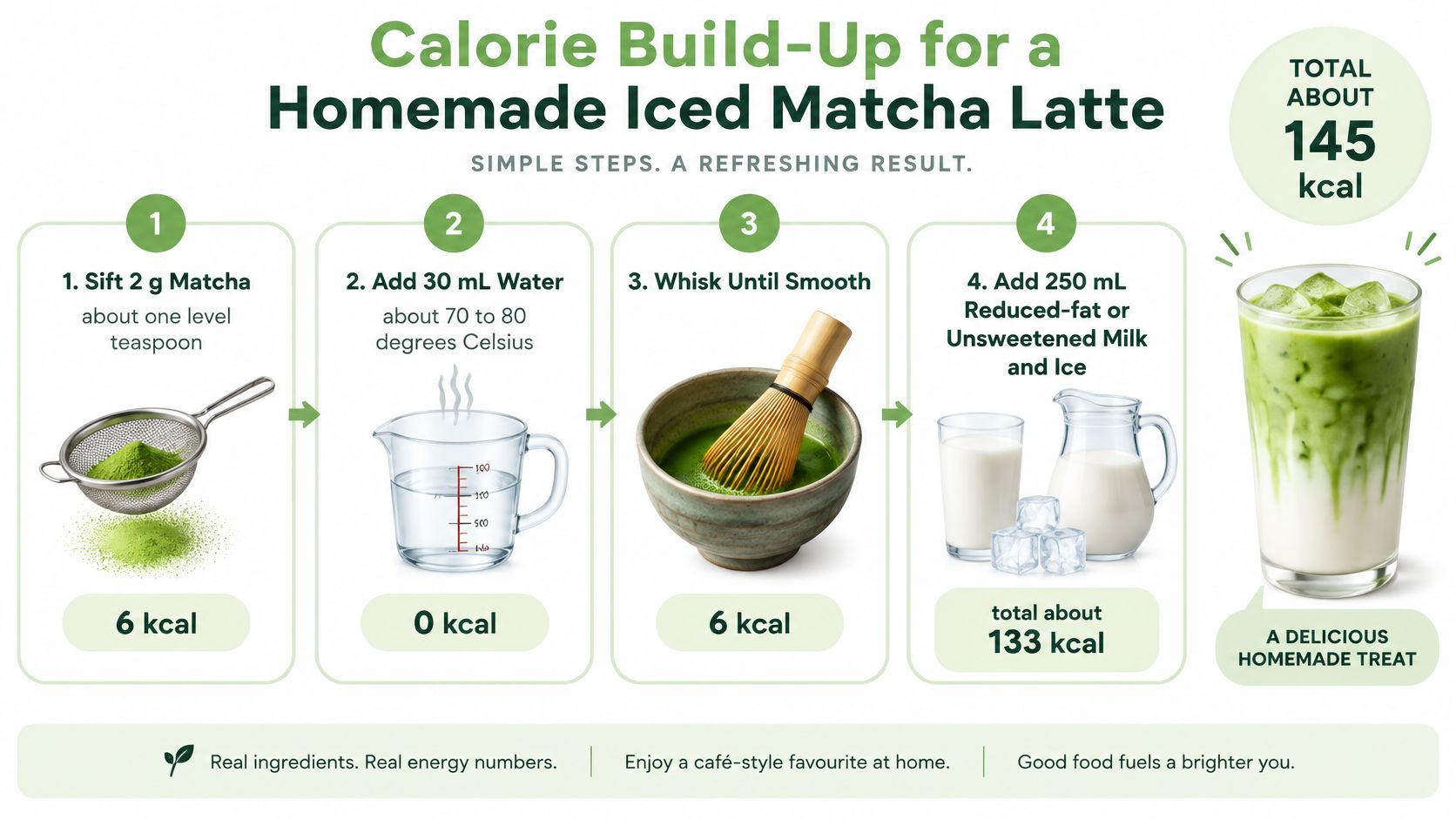
A home recipe gives you control because you can see each ingredient go in. Follow the steps in order, and notice where the count changes. Most of the glass stays at zero until the milk arrives.
Step By Step Build
Sift the matcha: Sift 2 g, about one level teaspoon, into a small bowl. This breaks up lumps that won't whisk out later, and the powder adds only a small amount of energy.
Make a smooth paste: Add 30 mL water at about 70 to 80 degrees Celsius. Whisk briskly in a zigzag until smooth and lightly frothy. Boiling water can make the flavour harsher, which pushes many people to add sugar they might not otherwise want.
Fill the glass with ice: Use a 350 mL glass and fill it well. Ice adds volume and chill, not energy, and a full glass helps the drink feel generous without more milk.
Measure the milk: Measure 250 mL reduced-fat milk in a jug. Measuring matters more than any special technique here, because a free pour can become 300 mL or more.
Pour and layer: Pour the milk over the ice, then pour the whisked matcha over the milk. Stir if you want an even colour, or leave the layers if you prefer to mix as you drink.
Taste before sweetening: Add one teaspoon of sugar only if you need it, then stir again. If you know you'll sweeten it, whisking the sugar into the warm paste at step 2 helps it dissolve.
The Build-Up In Numbers
Calorie build-up for one homemade serve
| Ingredient | Amount | Approx. energy (kcal) | Notes |
|---|---|---|---|
| Matcha powder | 2 g (1 level teaspoon) | about 7 | Powder adds little energy |
| Reduced-fat milk | 250 mL | about 126 | 211 kJ per 100 mL |
| Ice | 1 glass | 0 | Adds volume, not energy |
| Hot water for whisking | 30 mL | 0 | Used only to make the paste |
| White sugar (optional) | 1 teaspoon | about 16 | Skip for the lowest count |
| Total, unsweetened | Matcha, milk and ice | about 133 | Lowest version of this recipe |
| Total, with one teaspoon of sugar | Matcha, milk, ice and sugar | about 149 | Add only if needed |
The total is simple because there's nowhere for energy to hide. Matcha contributes about 7 kcal, the milk contributes about 126 kcal, and ice and water contribute zero. That gives about 133 kcal unsweetened and about 149 kcal with one teaspoon of sugar.
If you'd like more detail on whisking, milk choices and flavour variations, our best matcha latte recipe guide walks through the method for hot and iced versions. Use it for technique, then return to your measured milk volume for the count.
Swapping The Milk Without Losing Track
To swap in an unsweetened plant milk, don't guess from the front of the carton. Read the per 100 mL energy figure on the nutrition panel and multiply by 2.5 for a 250 mL pour. Then add the matcha figure and any sweetener.
Barista-style plant milks deserve a closer look. Some are sweetened or made richer so they foam like dairy milk, so two cartons with similar names can give different totals. The word plant-based doesn't settle the count. The panel does.
Measure the milk in a jug for the first week. After that, you'll recognise the right level in your usual glass and your count will stay consistent.
A common mistake is to change three things at once, then wonder why the drink tastes thin. Change one variable at a time. Try the same matcha with a different milk on one day, then adjust sweetener on another day. You'll learn which change affects flavour and which one mainly affects energy.
Ordering a Café Iced Matcha Latte Without Surprises
A café menu name cannot tell you the build. Two cafés can sell the same iced matcha latte and still pour different volumes, use different powders and choose different milks, so the label tells you less than the recipe does.
One Australian Benchmark
Jamaica Blue lists in its iced matcha latte menu details a 330 g iced matcha latte at 770 kJ, equivalent to approximately 184 kcal, with 23 g sugar, 26.6 g carbohydrate, 6.8 g protein and 5.4 g fat per serving. Its formulation contains 45.5% milk, 36.4% ice, 12.1% water and 6.1% tea powder, and the powder itself contains sugar and only 30% matcha.
Read that build as a split. Ice and water work like padding in a parcel: they make the serve look bigger while adding no energy. Milk and the sweetened tea powder carry the count, while the matcha solids sit inside the small powder portion. That is why a café drink can look light in the cup yet still arrive with 23 g sugar already mixed in.
Treat the benchmark as a reference point for the same levers elsewhere. When another café gives a higher or lower figure, check which lever moved: cup size, milk volume, sweetened powder, syrup or topping.
Questions That Get You A Clear Answer
Ask short, specific questions. Baristas answer these every day, and clear questions help them make the drink you expect.
- What size is it in millilitres: Cup names like regular and large don't mean the same volume everywhere.
- Is the matcha powder sweetened: This tells you whether sugar is already in the base.
- How many syrup pumps go in: Ask for half or none if you want a less sweet drink.
- Which milks are unsweetened: Barista plant milks may be sweetened even when the café calls the drink unsweetened.
- Can cold foam be left off: Removing a topping is often easier than rebuilding the whole recipe.
The same habit applies when your choice is between a matcha and a different takeaway drink, including drive-thru coffee choices for weight management: check the size, the milk and the flavourings before you compare totals.
You don't need to interrogate anyone. One or two questions are usually enough. Start with size and sweetened powder, because those two answers explain most surprises.
Keeping the Flavour While Cutting Calories
A lower calorie iced matcha latte still has to taste like matcha. When the powder is bitter or grassy, sugar, syrup and extra milk start to look like fixes. Start by making the base smoother, then let the milk and sweetener do only the jobs they need to do.
The calorie split matters here. Matcha powder is the small part of the energy load; milk volume, syrup and toppings are where the total climbs. That is why changing from extra-creamy milk to reduced-fat milk, or pouring less milk over more ice, usually saves more energy than switching matcha grades.
Small Changes That Protect The Taste
- Choose a smoother grade for drinking: A ceremonial grade is often better suited to a plain latte, while culinary grades can work well when other flavours are present.
- Whisk until frothy: A smooth, airy paste tastes richer and mixes evenly, so you don't need extra milk to mask lumps.
- Use a smaller glass with more ice: You'll keep a satisfying serve while reducing the milk pour.
- Try aroma before syrup: A splash of vanilla extract or a pinch of cinnamon can add perceived sweetness without a pump of syrup.
- Pick reduced-fat or unsweetened milk: Check the panel rather than relying on the carton name.
- Taste first, then sweeten: Add half, stir and taste again before adding the rest.
Our guide to a sugar-free matcha latte is a useful starting point if you want a version built around unsweetened matcha and milk. Treat it as a base recipe, then adjust the milk volume to your glass.
One product example is PepTea's organic matcha, which is sold as unsweetened powder for whisking at home or in cafés. Keeping the powder and sweetener separate lets you decide how much sugar, if any, belongs in your drink.
Putting The Number In Context
Use 250 mL reduced-fat milk as the comparison point: about 528 kJ, or 126 kcal. The same 250 mL of extra-creamy milk is closer to 738 kJ, so the milk choice can move the drink more than most flavour tweaks.
The Australian Dietary Guidelines summary uses about 600 kJ as a maximum daily discretionary-choice benchmark for many adults. A latte near that mark uses the whole benchmark, and larger flavoured versions can pass it, so milk size and syrup count are the dials to watch.
Small changes are easier to keep than a complete rebuild. If you drink matcha several times a week, measuring the milk and halving the sweetener will usually matter more than hunting for a perfect recipe once.
Choose the Iced Matcha Latte That Suits Your Day
Use a default you can repeat. At home, start with 2 g matcha, 250 mL reduced-fat or unsweetened milk, ice and no added sugar. That puts you near 133 kcal and gives you a baseline you can adjust without recalculating everything.
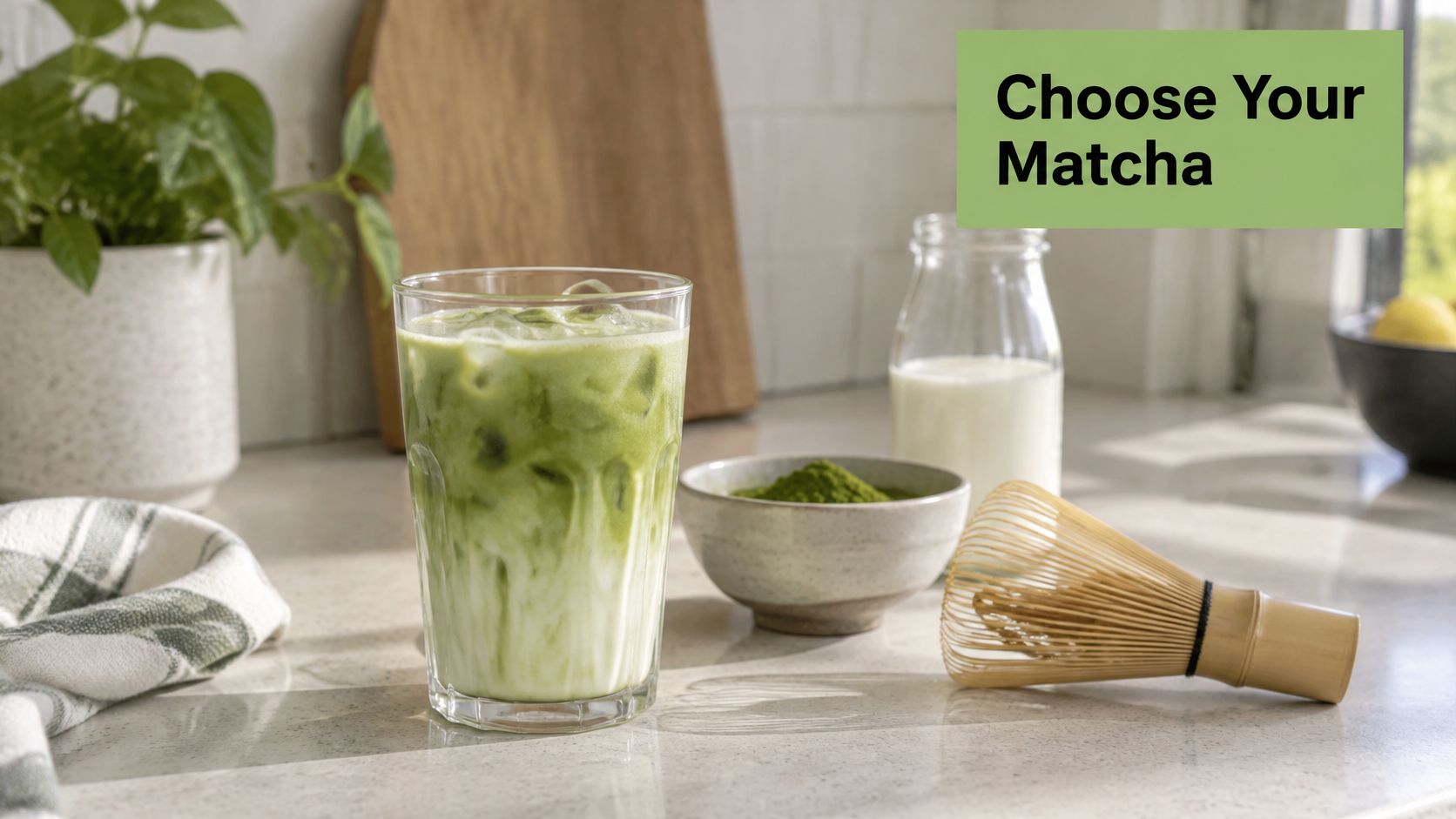
Here's a simple serve to picture while you set up your glass and whisk.
Treat café orders differently. Check size, sweetened powder and syrups before you order, since a flavoured version can reach roughly 330 kcal or more. That doesn't rule it out. It just means you can choose it knowingly, perhaps as an occasional drink rather than your everyday default.
Keep a simple log for one week if you're unsure which choices matter in your routine. Note the milk, the volume, the sweetener and whether you added a topping. You'll usually spot one habit doing most of the work, such as a larger pour at home or a daily syrup pump at a café.
This short video is handy if you'd rather watch the whisking and pouring order before you make your next glass.
Try your default recipe with a smoother ceremonial grade matcha and taste it before adding anything sweet. Many people find they need less sweetener than they expected once the paste is smooth and the water isn't boiling.
Iced Matcha Latte Calories FAQs
Does Matcha Itself Add Many Calories
No. A 2 g serve adds about 7 kcal, so the milk and sweetener set almost all of the total. Changing the matcha amount mainly changes strength and flavour.
Is An Iced Matcha Latte Low In Calories
It can be moderate at home. With 250 mL reduced-fat milk and no sugar, it sits near 133 kcal, while café versions mentioned here range from 184 to 339 kcal. Size and sweetener explain most of that difference.
Does Ice Add Energy
No. Ice and water add volume only. They can make a drink look larger without changing the energy from milk or sugar.
Are Oat Or Almond Milks Lower In Calories
Check the specific carton. Read the per 100 mL value, multiply by the millilitres you'll pour, then compare. Sweetened and barista-style products can differ from unsweetened versions.
Are Sugar-Free Sweeteners Calorie-Free
Stevia or monk fruit drops contribute about zero kcal in a few drops. Still check the label, because powders and blends may include bulking agents.
Can I Still Enjoy A Café Version
Yes. Ask about size, sweetened powder and syrup pumps, then choose the version that suits your day. A flavoured café drink can be an occasional choice rather than a daily default.
Ready to make your default at home with an unsweetened base you can measure and adjust? Explore the certified organic Japanese matcha range from Pep Tea, choose a grade that suits lattes, and try it with 250 mL of your preferred unsweetened milk before adding any sweetener.
Matcha Latte Calories and How to Reduce Them
A matcha latte isn't automatically a light drink. In Australia, the phrase can describe anything from a low-energy sachet prepared at home to a flavoured café drink with several hundred calories. The matcha powder matters, but milk, portion size, syrups and toppings usually shape the final energy load far more.
That's why a single online answer to “how many calories are in a matcha latte?” can be misleading. A standard iced drink, a pistachio version, a bubble tea serve and a supermarket sachet aren't nutritionally interchangeable. Learning to read the recipe behind the label is the practical way to manage matcha latte calories without giving up the creamy, earthy drink you enjoy.
The Truth About Matcha Latte Calories
Many Australians order matcha expecting a universally wholesome alternative to coffee or hot chocolate. Pure matcha has a reputation for being clean and functional, but a café latte is a prepared recipe, not just green tea in a cup. Once milk, sugar, flavour syrup, cream or toppings enter the picture, the energy content can change sharply.
Australian menus make that variation clear. McCafé lists a Matcha Latte at about 184 kcal, while Jamaica Blue lists its Medium Matcha Latte at 177 kcal. Starbucks Australia lists an Iced Matcha Green Tea Latte at 240 kcal for a Grande, whereas its flavoured iced products range from 318 kcal to 339 kcal, depending on the recipe and size. These examples are shown in this Australian matcha latte guide, and they make one point hard to miss: “matcha latte” isn't a reliable calorie description on its own.
The label hides the recipe
A café menu may tell you the drink name and size without clearly showing the milk, sweetener concentration or topping formula. Two drinks with the same name can therefore have very different kilojoule and calorie counts.
Starbucks Australia's Pistachio Flavoured Matcha Latte rises from 318 kcal in a Small to 626 kcal in a Venti, while the listed serving sizes also increase from 273 mL to 591 mL. That's a difference of more than 300 kcal, driven by the combined effect of a larger serve and flavouring. The Starbucks Australia product listing provides the serving details.
Practical rule: Treat the flavour name and cup size as nutrition information, not decoration.
A matcha latte can still fit comfortably into a balanced routine. The useful question isn't whether matcha is “good” or “bad”. Ask instead: what's in this particular drink, and how often am I choosing it?
Breaking Down the Ingredients and Energy Load
A matcha latte has three main energy contributors: the powder, the liquid base and anything added for sweetness or flavour. Pure matcha is usually the smallest contributor. The larger differences come from the volume and type of milk, plus sugar-containing powders, syrups and toppings.
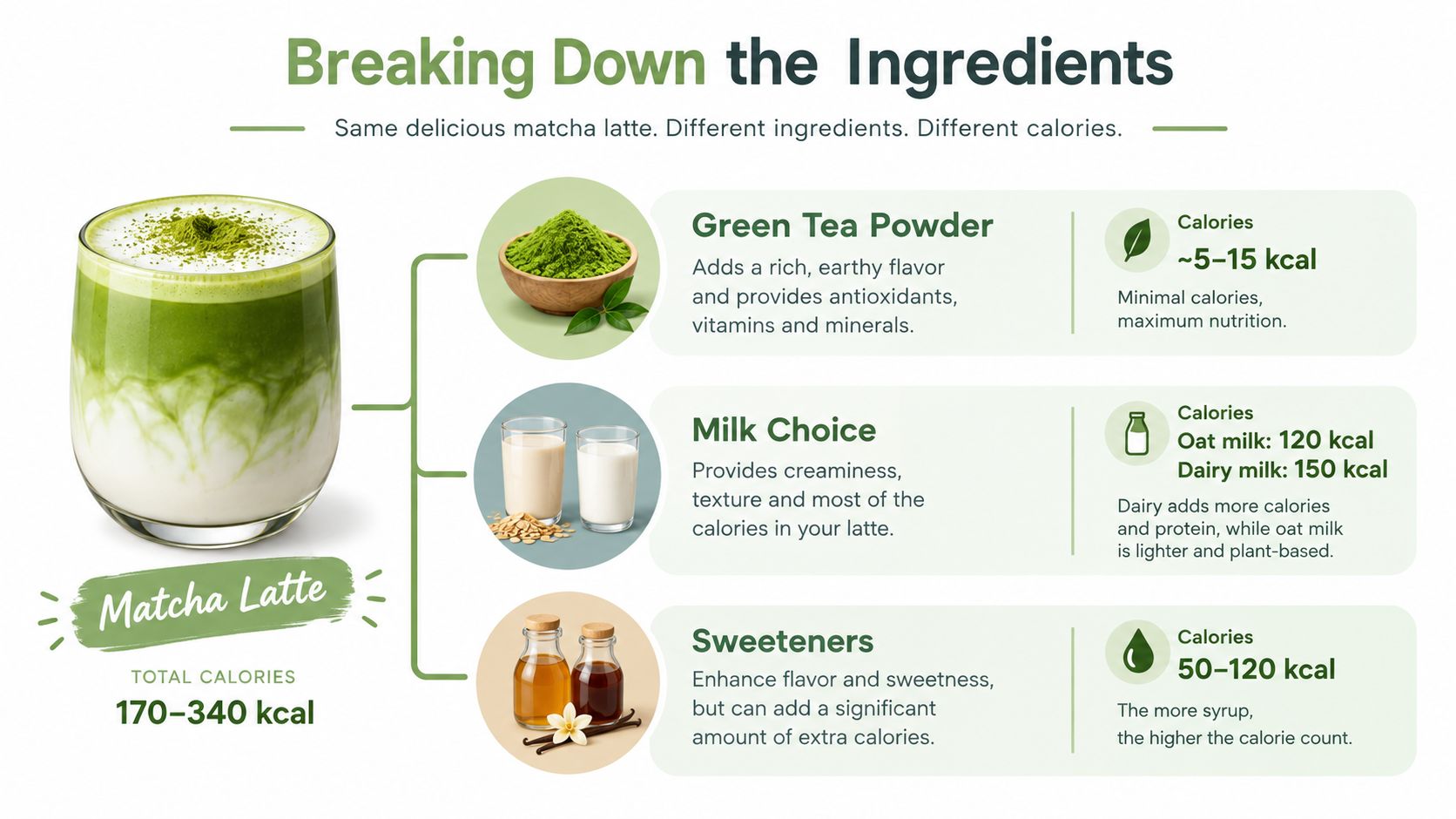
Matcha powder is rarely the main issue
Matcha is finely ground green tea leaf, so it contributes flavour, colour and naturally occurring compounds such as catechins and L-theanine. In a latte, however, the powder itself generally accounts for far less energy than a generous serving of milk or sweetened flavour base. Increasing the powder dose may make the drink stronger and more bitter, but it isn't usually the most effective way to reduce matcha latte calories.
The liquid base has a much bigger practical effect. A neutral Australian calories guide gives an at-home range of about 52 kcal with almond milk to 154 kcal with whole dairy, showing how milk choice can outweigh the matcha itself. Those figures are discussed in the Australian matcha latte nutrition overview.
Milk and sweeteners set the total
Milk contributes energy through its natural or added carbohydrate, fat and protein. Plant-based options also vary, particularly when they're sweetened or formulated for café steaming. The word “oat” or “almond” doesn't automatically mean low-energy, so check the product or café nutrition information where it's available.
Sweeteners create another layer of variation:
- Plain powder: Gives you control over the final drink, especially when mixed with unsweetened milk.
- Pre-mixed powder: May include sugar and milk solids before you add any extra sweetener.
- Flavoured syrup: Can turn a simple tea latte into a dessert-style drink.
- Toppings: Creamy foams, sauces and confectionery-style additions add energy without making the cup feel much larger.
Woolworths lists Twinings Matcha Latte Sachets at 251 kJ per serving, about 60 kcal, with 12.2 g of carbohydrate and 10.4 g of sugars, while Morning Made Matcha Latte Original is listed at 80 kJ per serving, about 19 kcal, with 0.2 g of sugars. The contrast appears in the Morning Made product information. It's a formulation comparison, not a judgement about every sachet.
For a home recipe, you can enter the exact milk and sweetener quantities into a recipe calorie calculator. That's more useful than relying on a generic matcha latte estimate when your ingredients differ from a café recipe.
One more detail deserves attention: caffeine isn't the same thing as calories. Matcha can contribute caffeine even when the drink is prepared with little energy. For a clearer explanation of what affects caffeine in the cup, see how caffeine works in a matcha latte.
Comparing Popular Australian Cafes and Retail Brands
Real menus show why matcha latte calories need an Australian context. The figures below come from café and retail listings, but they shouldn't be treated as a universal ranking. Recipes, sizes and preparation methods differ, and a product can change over time.
| Brand / Product | Size / Serve | Calories (kcal) |
|---|---|---|
| McCafé Matcha Latte | One serving | 184 |
| Jamaica Blue Matcha Latte | Medium | 177 |
| Chatime Matcha Latte | Regular | 192 |
| Chatime Matcha Latte | Large | 246 |
| Starbucks Iced Matcha Green Tea Latte | Tall, 354 mL | 184 |
| Starbucks Iced Matcha Green Tea Latte | Grande, 473 mL | 240 |
| Starbucks Pistachio Flavoured Matcha Latte | Small, 273 mL | 318 |
| Starbucks Pistachio Flavoured Matcha Latte | Tall | 390 |
| Starbucks Pistachio Flavoured Matcha Latte | Grande | 519 |
| Starbucks Pistachio Flavoured Matcha Latte | Venti, 591 mL | 626 |
| Twinings Matcha Latte Sachets | One serving | About 60 |
| Morning Made Matcha Latte Original | One listed serving | About 19 |
The Jamaica Blue figures come from its Australian iced matcha menu information. Chatime's Regular and Large values, including the 54 kcal difference between sizes, are listed by Macro Menu Australia. Starbucks' standard iced figures and flavoured examples come from the linked Australian product listings cited above.
What the comparison tells you
The café examples cluster differently from the low-energy retail products because they're prepared as milk-based drinks, often with a larger liquid volume. The flavoured Starbucks range shows how quickly a sweetened recipe can move into dessert territory. A standard iced matcha and a pistachio matcha may share a green colour, but they don't share the same nutritional profile.
Retail sachets require label reading too. Twinings' sachet contains substantially more energy and sugar than Morning Made's listed serving, despite both being sold as matcha latte products. A pre-mixed base can be convenient, but convenience doesn't tell you how much sugar or milk powder is included.
The useful comparison isn't brand versus brand. It's unsweetened versus sweetened, smaller versus larger, and plain versus flavoured.
When ordering, ask whether the powder is sweetened, which milk is used and whether the syrup is optional. That short conversation can reveal more than the drink name.
How to Order and Brew Lighter Matcha Lattes
You don't need to drink matcha plain to lower the energy content. The strongest approach is to control the ingredients that contribute most, while keeping enough milk to create the texture you like.
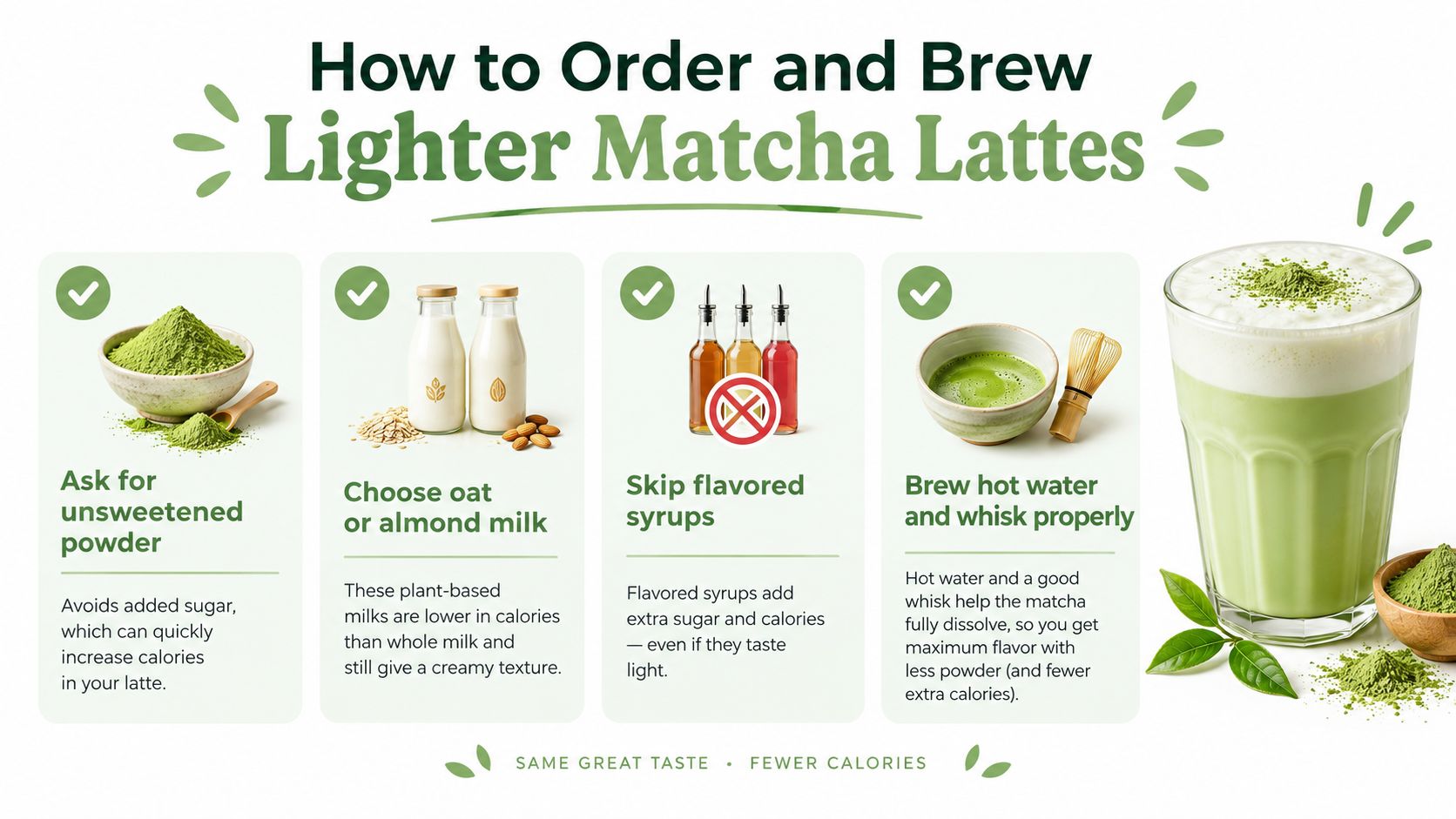
Ordering at a café
Use a specific order rather than asking vaguely for a “healthy” matcha. Café staff may interpret that request in different ways.
- Ask for unsweetened powder. Some café bases are already sweetened, so removing an added syrup won't necessarily remove all the sugar.
- Choose your milk deliberately. Unsweetened almond milk can be a lower-energy option, while oat and dairy recipes vary by brand and pour size. If the café publishes nutrition information, use that rather than guessing.
- Skip flavoured syrups and dessert toppings. Pistachio, white chocolate, cream foam and sauce are the additions most likely to change a simple latte into a richer treat.
- Choose a smaller size if you want the same style of drink less often. The Chatime comparison demonstrates that serving volume alone can create a measurable difference.
- Ask for the recipe if you're tracking closely. “Is the matcha sweetened, and what milk do you use?” is more useful than relying on the menu title.
Making one at home
Home preparation gives you control without removing the ritual. Whisk the powder with a small amount of hot water first, then add chilled or warmed unsweetened milk. Proper whisking disperses the tea and helps the drink taste smoother, which can reduce the temptation to cover bitterness with sugar.
A simple method looks like this:
- Sift the matcha if it's lumpy. This creates a more even texture.
- Add hot, not boiling, water. Very high heat can make the flavour seem harsher.
- Whisk briskly until smooth. A bamboo whisk or handheld frother works well.
- Pour in unsweetened milk. Adjust the amount for a stronger tea flavour or creamier finish.
- Taste before sweetening. If you need sweetness, add a small amount deliberately rather than using a pre-sweetened base by default.
Start with the powder and milk you actually want, then add sweetness only if the finished drink needs it.
This method also makes it easier to compare your home recipe with a café drink. You'll know whether the difference comes from milk, sweetener or serving size instead of blaming the matcha.
Clean Energy and Sustained Focus Without the Crash
A lower-calorie drink can be useful, but the quality of the whole beverage matters too. Pure, unsweetened matcha supplies the tea leaf itself, while a heavily flavoured latte can deliver much more sugar and energy without necessarily providing a better tea experience.

Matcha contains naturally occurring catechins, including antioxidant compounds, and L-theanine. L-theanine is an amino acid found in tea that many people associate with a calmer, more settled experience alongside caffeine. That doesn't make matcha a medical treatment or guarantee a particular feeling, but it helps explain why some drinkers prefer it for focused work.
The caffeine amount depends on the quantity of powder used and the recipe. It also deserves attention if you're sensitive to caffeine or already drink coffee during the day. A lower-calorie latte isn't automatically suitable at every time of day, especially if it affects your sleep or makes you feel uncomfortable.
Sweetness changes the experience
A strongly sweetened drink can taste immediately rewarding, but it can also make the earthy character of quality matcha difficult to notice. When you reduce syrup gradually, your palate has more opportunity to recognise vegetal, creamy and lightly umami notes.
That matters for cafés and home drinkers alike. A café menu can offer a satisfying non-alcoholic option without relying on heavy flavouring, while a home routine can use organic Japanese matcha, unsweetened milk and careful whisking. The result is a drink built around tea rather than a sweet dessert base.
Choose the version that supports your day, not just the version with the most appealing name. Clean energy starts with a clear ingredient list and a serving you can enjoy consistently.
Building a Mindful Matcha Routine at Home
A home matcha habit makes the recipe visible. You choose the powder, measure the milk, decide whether sweetness is needed and can prepare a smaller or larger drink according to the occasion. That control is often more valuable than searching for one universal matcha latte calorie number.
For a weekday cup, use authentic stone-ground Japanese matcha with a naturally vibrant colour and balanced flavour. A ceremonial-grade matcha is suited to whisking with water or milk, while a culinary-grade matcha is practical for smoothies, baking and other recipes where stronger flavours are already present. Neither grade removes the need to check the rest of the recipe.
Keep the routine simple:
- Whisk matcha with hot water.
- Add unsweetened milk.
- Taste before adding sweetener.
- Reserve flavoured versions for an occasional treat.
- Notice how the drink fits into your overall day.
Australia's café and retail market shows that milk, added sugar and portion size drive matcha latte calories far more than the green tea label suggests. Once you understand that, you can enjoy matcha with less guesswork and make choices that suit your preferences.
Pep Tea offers premium organic Japanese matcha for mindful home preparation, along with Australian-brewed sugar-free organic kombucha from the Hunter Valley, NSW. Explore the range at Pep Tea and choose a clean, low-sugar option for your next daily drink.