
Tag: matcha latte mix
Matcha Latte Mix Guide: Pure vs Pre-Sweetened Options
Australian matcha entries in MyFitnessPal rose 33.8% from 2024 to 2025, according to reporting by Melbourne Insider. That measures food logs, not matcha latte mix sales, but it's a useful reminder that more Australians are fitting matcha into everyday routines. The important buying question isn't whether the packet says matcha. It's what ends up in your cup, including the sugar, caffeine, milk and actual dose of tea.
What a Matcha Latte Mix Is and Why Australians Are Buying It
A matcha latte mix is powdered matcha blended with ingredients such as milk powder, sweetener or flavouring, ready for you to add water or milk. Pure matcha powder is different: it supplies the tea, while you choose the rest of the drink.
Australia's interest extends beyond specialist tea shops. Market estimates reported by SBS put Australian matcha revenue above A$54 million in 2024, with projected annual growth of 7.1% over the following five years and revenue projected to exceed A$81 million by 2030. Those are matcha-category estimates, not figures specifically for latte premixes.
Convenience changes the preparation
Say you're making a latte before work. With pure powder, you weigh the matcha, sift it, whisk it with water, then add your chosen milk. With an all-in-one premix, you measure the blend and follow its mixing directions.
The difference is a little like instant coffee beside a pour-over: the premix is quicker and easier to repeat, but the manufacturer has already made some ingredient decisions for you. Unlike loose-leaf green tea, neither format needs straining after steeping. Matcha is powdered leaf that stays in the drink.
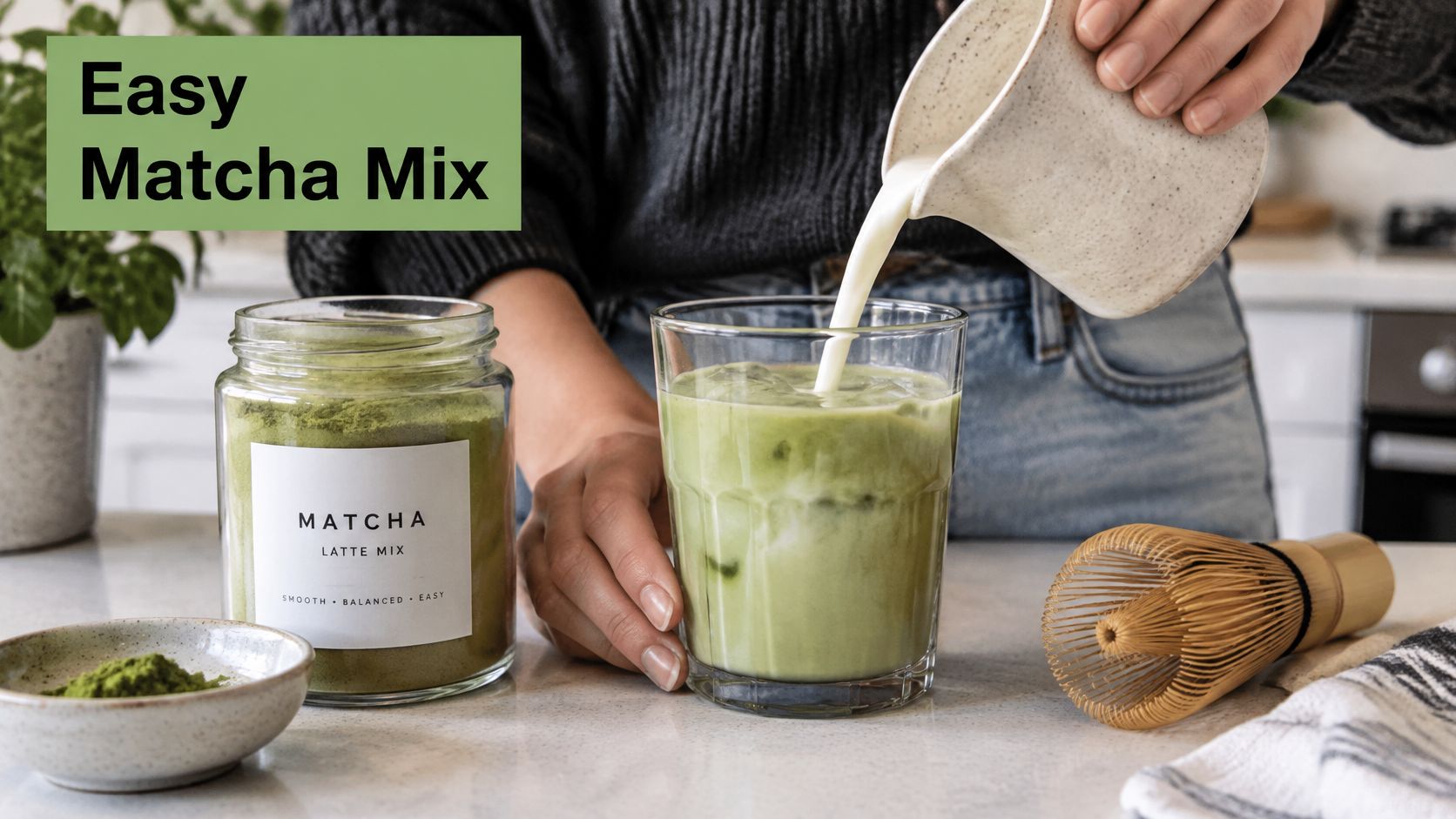
This is the finished cup you're aiming to judge, rather than the appearance of the powder alone.
Who's choosing matcha?
Australian MyFitnessPal reporting published by Mirage News found that people aged 18–34 accounted for 53% of Australian matcha entries. Again, these are app entries, not purchases, but they help explain why cafés offer matcha alongside familiar coffee drinks.
For a café operator, convenience means more than speed. Staff need a recipe they can reproduce during a rush, while customers need to know whether they're ordering an unsweetened tea latte or a sweetened beverage.
Buying rule: Choose the format first, then judge the prepared drink by its sugar, caffeine, tea dose and cost per serve.
A useful matcha latte mix should fit your routine without leaving you guessing about what you're drinking.
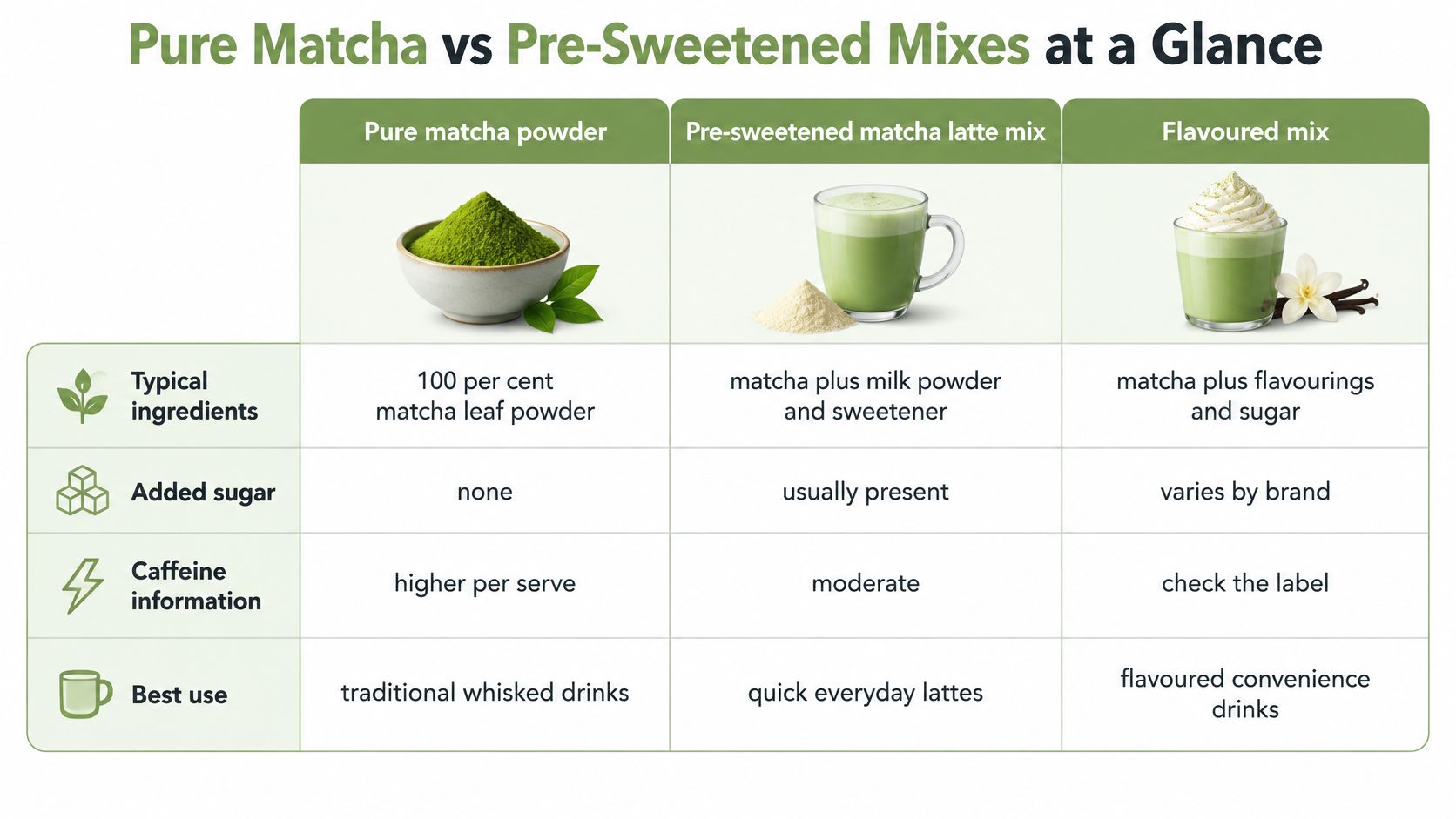
Pure Matcha vs Pre-Sweetened Mixes at a Glance
Matcha latte mix formats compared
| Format | Typical ingredients | Added sugar | Caffeine information | Best for |
|---|---|---|---|---|
| Pure matcha powder | 100 per cent matcha, with milk and sweetener added at home | None unless you add it | Set by your dose; weigh it and request a tested figure | Control over sugar and dose |
| Pre-sweetened mix | Matcha, sugar, milk powder, flavourings | Present; check per-serve sugars | Check tested milligrams at the recommended serving weight | Fast, café-style sweetness |
| Sugar-free mix | Matcha with milk powder or plant milk powder and non-sugar sweetener or none | Check the claim; milk sugars still count towards total sugars | Check tested milligrams per prepared serve | Lower-sugar daily routines |
The visual comparison below summarises common formats. Treat its caffeine descriptions as prompts to investigate, not a reliable ranking: a product's tested serving dose matters more than its format.
What you gain and give up
Pure matcha offers the most flexibility. You can change the milk, leave out sweetener or make a stronger-tasting drink without adding more sugar. The trade-off is preparation: a fine sieve, small digital scale and whisk make the process much more dependable than tipping powder straight into a mug of milk.
Pep Tea's organic Japanese pure matcha powder is one example of a base you can prepare this way. Compare it with other pure powders on origin, freshness, flavour and suitability for milk, rather than assuming an elaborate tin guarantees a better latte.
Pre-sweetened mixes reduce decisions. That's useful when you want the same sweetness each morning, but increasing the scoop to strengthen the tea also increases every other ingredient. You can't separate the matcha from the sugar once they're blended.
Sugar-free mixes occupy the middle ground. They can simplify preparation without relying on added sugar, although the sweetener's aftertaste and the milk powder's texture still need a taste test. Organic versions can exist in any of these formats.
For a preparation demonstration to accompany your comparison, watch the video below.
Compare the cost of the cup
Use pack price ÷ usable serves = powder cost per drink. Calculate usable serves from the dose you'll make, not a smaller advertised portion you won't enjoy.
Then account for anything missing from the packet:
- Milk: A water-only premix and a pure powder requiring fresh milk aren't equivalent purchases.
- Sweetener and flavour: Include additions you'll use regularly.
- Waste: A large bag isn't good value if it loses its appealing flavour before you finish it.
If you're organising a drinks shelf, keep flavoured additions separate while learning your preferred tea strength. The same ingredient-first approach helps when choosing chocolate for your next hot drink from Fresco Chocolate: compare the intended cup, not just the bag size.
Reading the Label for Sugar, Caffeine and Organic Claims
Start with the back of the pack. A grassy-green front label can belong to pure tea, a milk-heavy blend or a sweetened drink powder.
Check the pack in this order
- Ingredients: Look for matcha, dairy or plant milk powder, sugar, glucose syrup, maltodextrin and flavourings. Ingredient order shows their relative weight, but it doesn't reveal the exact matcha proportion unless that's stated.
- Serving weight: Find the gram dose, not just the scoop description. A heaped scoop and a level scoop won't necessarily produce the same drink.
- Preparation liquid: Establish whether the nutrition information assumes water, dairy milk or a particular plant milk.
- Sugars per prepared serve: Compare equivalent cup sizes made as you intend to drink them.
- Caffeine information: Look for a tested milligram amount and whether caffeine has been added separately.
- Allergens: Check milk, soy and other declared allergens, including relevant cross-contact statements.
Sugar near the top tells you it's a substantial ingredient. It doesn't, by itself, prove that most of the packet is sugar. Likewise, maltodextrin isn't interchangeable with sugar on a nutrition panel, so don't try to calculate total sugars from ingredient names alone.
For readers choosing drinks during pregnancy, NSW Health's healthy-eating guidance provides broader dietary context. A wellness description on a drink packet shouldn't replace an assessment of its ingredients or your individual needs.
Sugar-free powder isn't automatically a sugar-free latte
FSANZ explains that total sugars include naturally occurring and added sugars. That distinction matters when the powder contains milk solids, or when you add milk yourself.
No added sugar and sugar-free aren't interchangeable claims. Judge the drink at the intended dilution and serving size. Unsweetened milk can still contribute naturally occurring sugars, and a flavoured plant milk may change the result again.
Say you enjoy sweetness but want to reduce sugar. Compare the prepared sugars on competing packs using the same milk and cup size, then check how each gets its sweetness. Milk powder listed after matcha might help identify a more tea-forward blend, but it isn't proof of lower total sugar.
Don't compare a water-prepared nutrition panel with your milk-made latte and assume the numbers still describe your drink.
A packaged pure tea may not carry the same nutrition information as a nutritionally substantial latte blend. If the information you need is missing, ask the supplier rather than treating a blank panel as a nutritional advantage.
Separate caffeine rules from organic claims
Naturally occurring caffeine in tea and separately added caffeine have different labelling implications. FSANZ's caffeine guidance states that added caffeine must appear in the ingredient statement and that foods containing added caffeine must carry a statement that they contain caffeine.
Products classified as formulated caffeinated beverages face additional requirements. The FSANZ caffeine review describes warnings for children, pregnant or lactating women and caffeine-sensitive people, alongside a stated daily consumption quantity. Don't assume an ordinary matcha powder belongs to that category just because tea contains caffeine.
Organic certification concerns production and processing. It doesn't establish low sugar, low caffeine or a clinical health benefit. Check the certification information and origin separately from the nutrition panel.
Similarly, antioxidant and L-theanine language doesn't tell you how sweet the drink is or whether its caffeine suits you. Phrases such as may support wellbeing shouldn't be read as promises of immunity, treatment or crash-free energy.
Finally, test performance. A sugar-free blend still needs to taste balanced, disperse smoothly and remain acceptable during storage; persistent sludge, stale aromas or an unpleasant sweetener finish aren't solved by a reassuring front label.
How Much Caffeine Is in Each Serve
Caffeine reference figures for matcha drinks
| Reference | Caffeine figure | What it applies to |
|---|---|---|
| Tea, typical cup | 10 to 50 mg, according to Pregnancy, Birth and Baby | General tea guidance, not a tested matcha latte mix value |
| Matcha latte mix, per serve | Use the tested milligrams for the stated gram dose | Ask the brand if it isn't listed |
| Pregnant or breastfeeding adults, daily | No more than 200 mg, under FSANZ's caffeine guidance | Total caffeine from all sources |
| General adult reference, daily | Up to 400 mg, in the same FSANZ caffeine review | General reference for total intake, not an individual target |
The general tea range isn't a substitute for a matcha result. Matcha contains powdered leaf, and caffeine concentration can change with cultivar, shading, harvest and batch. Your weighed dose then determines how much of that powder reaches the cup.
Ask for a usable answer
A supplier's most useful response is a tested caffeine amount tied to a clearly stated serving weight. Tea strength, colour and bitterness can't reliably provide that answer.
For a café, record the recipe in grams and train staff to weigh it. A larger cup made with the same tea dose has more dilution, not less total caffeine; adding more powder to maintain flavour changes the exposure.
Optimal Native's guide to understanding matcha's caffeine content offers another reading option when comparing products. For the actual drink you're buying, prioritise the manufacturer's tested serving information over a generic online estimate.
Calculate your day without inventing a dose
Suppose your day includes three matcha lattes, a coffee and a square of dark chocolate. Use this calculation:
Daily caffeine = matcha caffeine per serve × number of lattes + coffee caffeine + chocolate caffeine.
Insert the tested amount for your matcha recipe and reliable serving information for the other products. If the café can't identify its matcha dose or caffeine content, you can't produce a precise total.
Include cola, energy drinks and any other caffeine sources too. Compare that complete total with the guidance relevant to you, rather than counting cups of matcha alone.
Caffeine check: A drink that feels gentle can still contribute meaningfully to your daily intake.
Calm energy isn't another term for caffeine-free. If you're sensitive, pregnant or breastfeeding, discuss an uncertain product with your health professional rather than assuming a smaller scoop makes it suitable.
Tea taken with meals can also reduce iron absorption, a separate consideration from how alert you feel afterwards. Readers managing iron status should ask their clinician about drink timing.
For recipe-specific questions, our guide to caffeine in a matcha latte can help you identify what information to request. Don't treat the general adult reference as an amount you need to reach, especially if caffeine affects your sleep or comfort.
How to Make Your Own Matcha Latte Mix at Home
Home matcha latte mix ratios
These are practical starting recipes, not tested caffeine specifications. Adjust sweetness separately so you can learn how the tea and milk taste together.
| Batch | Matcha | Milk powder | Serves |
|---|---|---|---|
| Single serve | 2 g, approximately 1 level teaspoon | 15 g | 1 |
| Small jar | 20 g | 150 g | About 10 |
| Plant-based version | 2 g | 15 g unsweetened plant milk powder | 1 |
A teaspoon is only an approximation. Use a digital scale for repeatable tea doses, particularly when making a larger batch.
Blend a small jar first
- Sift the matcha. Pass 2 g through a fine sieve into a dry bowl to break up clumps before adding anything else.
- Add the milk powder. Stir in 15 g of dairy milk powder or unsweetened plant milk powder, checking that it's suitable for making drinks.
- Mix thoroughly and store dry. Transfer the blend to a clean, airtight jar away from light and heat, using only dry utensils. Make enough for a few weeks, while respecting any shorter ingredient storage directions.
- Make a smooth concentrate. Whisk a single serve with about 60 ml of water at 70 to 80°C, rather than straight from a boiling kettle. This is a starting preparation range intended to avoid an overly harsh-tasting cup.
- Add the milk. Stir in about 150 ml of warm milk, then taste before adding anything else.
- Adjust sweetness last. Leave it unsweetened or add your preferred sweetener gradually, noting the amount if you want to repeat the result.
Using milk powder plus fresh milk produces a particularly creamy drink. If that feels too heavy, try water for the final dilution or omit the powder and prepare a fresh-milk latte instead.
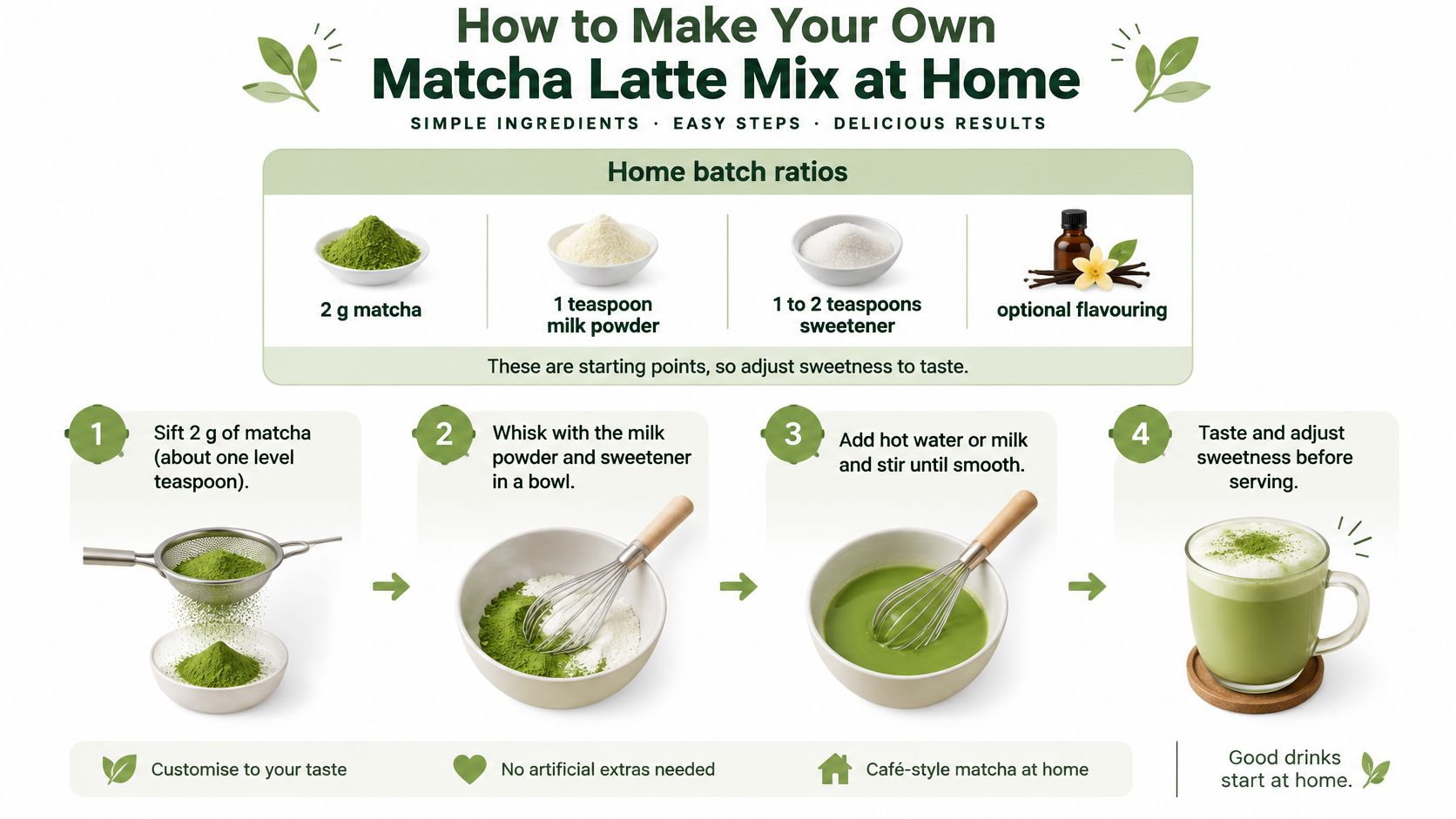
The infographic offers a lighter, spoon-based variation. Its milk powder quantity is different from the weighed recipe above, so choose one approach rather than combining their measurements.
Fix texture before adding more sweetener
If the drink is lumpy, work on dispersion first. A bamboo whisk suits pure matcha; a small electric frother is useful for a milk-powder blend, provided you use a vessel deep enough to prevent splashing.
Matcha is a suspension, not instant coffee that dissolves completely. Some settling is normal, so stir before drinking rather than trying to eliminate every trace of sediment with extra powder or syrup.
For the small jar, stir the dry ingredients again before portioning. Powders can separate during handling, and weighing a portion of an uneven blend won't guarantee the intended tea dose.
When the jar runs out
Whisk 2 g of pure matcha with a little hot water, then add warm milk. For an iced drink, prepare the concentrate first and pour it over cold milk and ice, or shake with cold milk in a tightly sealed bottle.
Don't shake hot liquid in a sealed container. For more preparation ideas, use our organic matcha latte guide to compare hot and cold methods.
Keep a note of the matcha used in each home serve. A recipe gives you control over the amount of powder, but it doesn't establish caffeine milligrams without information for that tea.
Choosing a Mix for Your Routine and Where to Start
Choose according to the job you need the mix to do, not the most ambitious wellness wording.
- For caffeine-sensitive readers: Look for a tested serving figure before buying. Pure powder allows measured dosing, but it isn't automatically suitable during pregnancy or breastfeeding.
- For cafés and home baristas: A weighed pure base lets you standardise the tea while offering different milks and sweetness levels.
- For sugar reduction: Choose pure matcha or assess a sugar-free blend using the drink you'll prepare.
- For busy mornings: A pre-sweetened mix can be practical if you enjoy its fixed sweetness and understand its ingredients.
- For a first purchase: I'd start with a small pack of culinary-grade pure matcha intended for lattes. Learn whether you enjoy the flavour before paying for a more delicate ceremonial option.
If you're also comparing powders with capsules or extracts, NexiHerb LLC's practical guide to matcha supplementation provides context for that separate purchase. Don't treat supplement doses as interchangeable with a café recipe.
The useful purchase is the one you can prepare consistently, enjoy drinking and assess without guesswork. Buy a manageable pack, keep your preferred recipe written down and change one ingredient at a time.
Pep Tea offers organic Japanese matcha for making hot or iced lattes with your choice of milk and sweetness. Visit Pep Tea to compare the organic matcha range, or get in touch about wholesale supply for your café or shop.