
Matcha Green Tea Properties Explained for 2026

The most popular advice about matcha is also the least useful: choose the brightest green powder and expect calm, crash-free energy. Colour can help you assess a tea, but it can't tell you its caffeine dose or how you'll feel after drinking it. Understanding matcha green tea properties starts with the leaf, the grams in your bowl and the difference between a measured ingredient and a promised health benefit.
Why the Whole Leaf Changes the Drink
Your usual café order arrives looking beautifully green, with a neat layer of milk foam. That colour doesn't reveal whether the barista used plain Japanese matcha, a sweetened blend or a generous scoop of powder. Those are different drinks, even if they look similar through the takeaway lid.
Matcha is made from shade-grown tea leaves that are steamed, dried, stripped of stems and ground into fine powder. Unlike an ordinary infusion, it forms a suspension, tiny leaf particles dispersed through the drink rather than completely dissolved.
The leaf stays in the cup
With loose-leaf green tea, you remove the leaves after steeping. With matcha, you swallow the ground leaf, including its caffeine, catechins, amino acids, pigments and minerals.
That distinction is more useful than treating matcha as a mysterious wellness ingredient. It's concentrated tea with measurable caffeine, not a caffeine-free drink or a treatment for a health condition.
- Check the powder: Plain matcha and a sweetened latte mix aren't interchangeable.
- Check the preparation: A larger cup doesn't necessarily contain more tea.
- Check the serving mass: A weighed portion tells you more than the shade of green.
For a closer look at the preparation difference, see our guide to matcha green tea versus ordinary green tea. Judge a tin by its grade, serving information and freshness, rather than the colour of someone else's latte.
Matcha Green Tea Properties by Grade
Caffeine and catechin markers by tea format
The measured concentrations and catechin findings below come from a 2023 peer-reviewed analysis of 15 commercially available green teas, with serving calculations based on its averages. The brewed-cup comparison uses the Australian Institute of Sport's green-tea benchmark of approximately 30–50 mg per 250 mL cup.
| Property | Ceremonial matcha | Culinary matcha | Ordinary green tea |
|---|---|---|---|
| Average caffeine | 31.45 ± 1.08 mg/g | 26.29 ± 1.86 mg/g | 23.08 ± 1.43 mg/g, bagged or gunpowder |
| Caffeine range in the 15-tea study | Up to 35.01 mg/g | Not reported separately | As low as 17.11 mg/g in one bagged tea |
| Caffeine in a 2 g serve, calculated | About 62.9 mg | About 52.6 mg | Not directly comparable; about 30–50 mg per 250 mL brewed cup |
| Main catechins | EGCG and epigallocatechin | EGCG and epigallocatechin | EGCG and epigallocatechin |
| What is swallowed | Whole stone-ground leaf | Whole stone-ground leaf | Water extract; leaf discarded |
| Labels interchangeable? | No, test each batch | No, test each batch | Different format, not a weaker matcha |
Read the units before comparing drinks
Milligrams per gram describes the powder's concentration. To estimate caffeine in a serving, multiply that concentration by the mass of powder used. The serving row demonstrates that calculation, but it isn't a laboratory result for every tin carrying the same grade name.
The ordinary-green-tea column needs particular care. Dry-leaf caffeine concentration isn't the same as caffeine delivered into brewing water, because you don't normally swallow those leaves. Comparing dry tea with a finished matcha latte without accounting for preparation mixes up different measures.
These results also describe a particular set of commercial products, not a universal ranking of every Japanese tea. Cultivar, shading, harvest and processing can change composition before the powder reaches your kitchen.
Three rules for reading a matcha label
- Grade isn't a chemical specification: Ceremonial and culinary powders weren't chemically interchangeable in the tested products. Neither label guarantees a particular caffeine or antioxidant concentration.
- An EGCG claim needs evidence: A fixed content claim is most meaningful when the supplier can support it with product-specific, preferably batch-specific, laboratory testing.
- A bigger scoop isn't automatically better: Increasing the powder increases exposure to its constituents. That doesn't establish a greater health benefit.
EGCG and epigallocatechin were prominent across the tested tea formats. They're useful chemical markers of green tea, not a secret ingredient found only in ceremonial powder.
Choose a grade for the way you'll use it, then look separately for credible composition information. Taste, intended use and laboratory content answer different questions.
What EGCG, L-Theanine and Caffeine Each Do
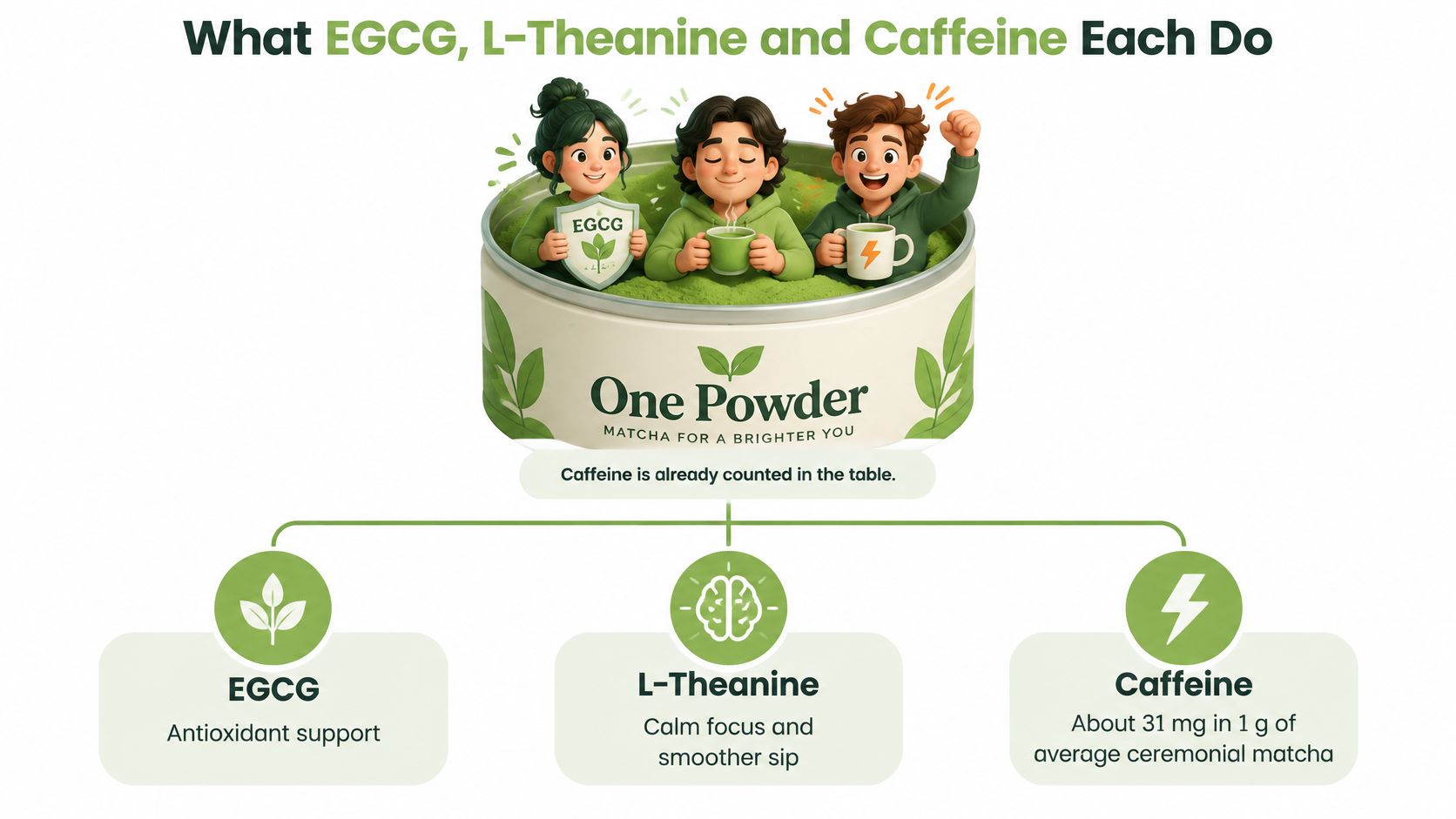
These compounds arrive in the same scoop, like three housemates sharing one kitchen: same address, different jobs. Finding them together does not make the bowl a set of precisely dosed supplements.
The illustration gives a simple overview. Its calm-focus wording describes a possible experience, not a guaranteed outcome.
EGCG is an antioxidant marker
EGCG, short for epigallocatechin gallate, belongs to the catechin family of polyphenols. It works more like a measurable piece of green tea chemistry than a shield that guarantees protection against illness.
A catechin result can help characterise a powder, but a laboratory measurement does not establish a clinical benefit from your morning bowl. When a brand makes a specific antioxidant claim, the testing method and the batch behind it matter.
For a plain-language explanation of the name and its role in tea, read what EGCG is. That background helps you compare products without turning every chemical name into a health promise.
L-theanine isn't a built-in supplement dose
L-theanine is an amino acid naturally present in tea. It can sit alongside caffeine like a steadying passenger, but it is not an off-switch that cancels stimulation.
An Australian-linked systematic review of nine randomised controlled studies found that 200–400 mg daily of supplemental L-theanine may help reduce stress or anxiety responses under stressful conditions. An ordinary matcha serving generally supplies substantially less, and that review does not set a per-gram matcha figure for turning a supplement dose into bowls.
Reality check: A compound being present and a drink matching a clinical trial dose are different claims.
Caffeine is the stimulant housemate
Caffeine works more like turning down a sleepiness signal than recharging a battery. It can support alertness, while sleep, food and recovery still do the underlying work.
No single matcha-to-coffee ratio is reliable without naming the coffee's preparation and serving size. Compare supplier information for the actual drinks rather than assuming every coffee is stronger or every matcha is gentler.
If tea is being used to push through tiredness, The Sleep Consultant's discussion of restorative sleep for high-performing professionals offers a separate recovery perspective. Treat it as a sleep resource, not proof of matcha's effects.
Chlorophyll gives the powder its green colour, and other amino acids and minerals travel with the leaf. Their presence alone does not make matcha a multivitamin or establish immune support.
Calm Focus, Sleep and Iron Timing
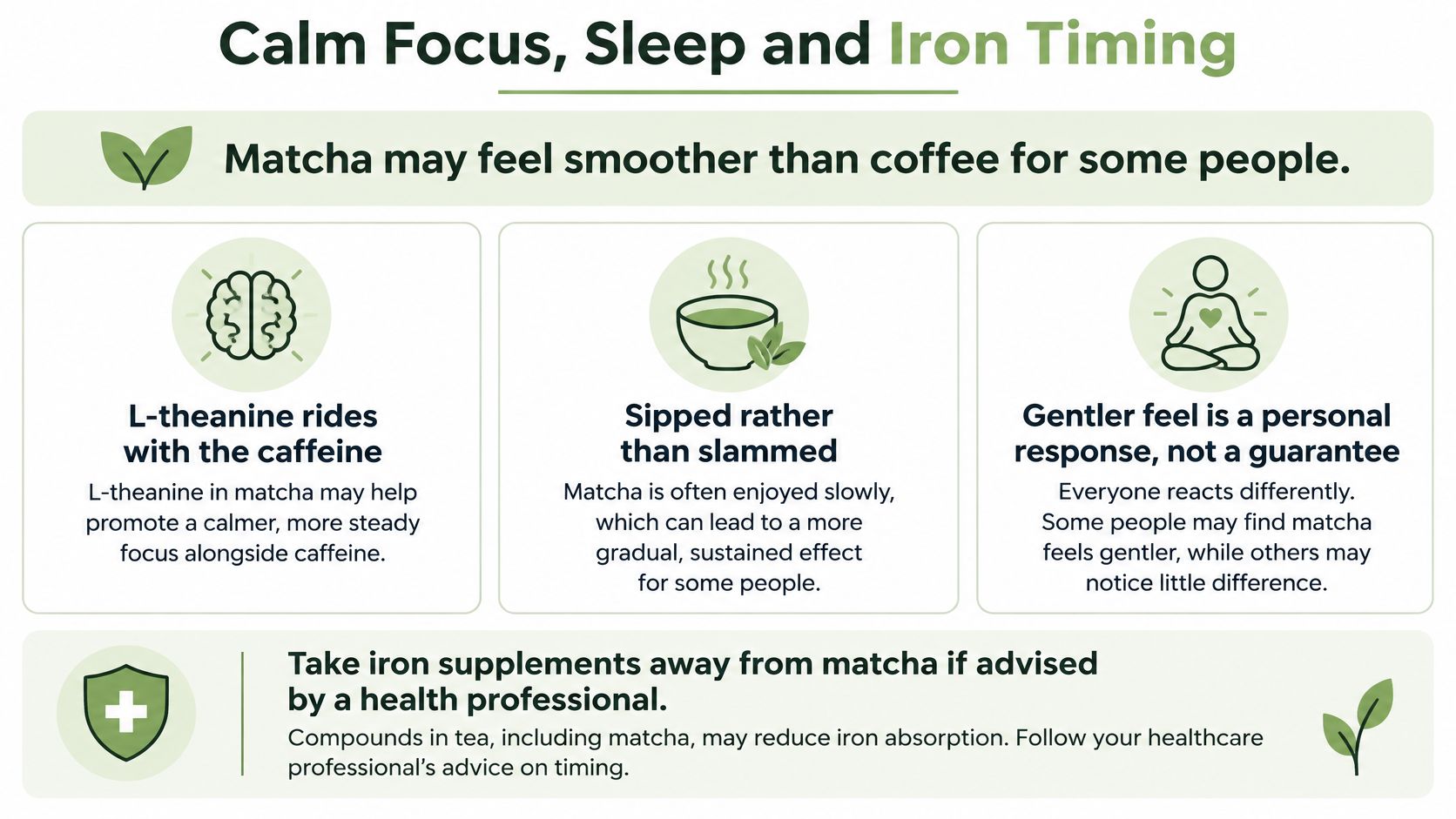
Calm energy isn't a guaranteed matcha property. Some people find the drink gentler than coffee; others still notice restlessness, a racing mind or trouble settling at bedtime.
An Australian food-and-nutrition scientist quoted in The Age's explanation of matcha's café popularity describes a possible gentler experience associated with its L-theanine and powdered-leaf format. The same account stresses that caffeine temporarily reduces perceived sleepiness rather than creating energy, and highlights tea's interaction with iron supplements.
The useful message is personal response, not a universal promise.
The same order can suit different days differently
Say you drink matcha during a mid-morning break after breakfast. You enjoy the ritual, feel alert and sleep normally that night. That experience doesn't tell you how an afternoon matcha will feel after a morning long black, another tea and a cola with lunch.
The important change is the whole day's caffeine, plus timing and your sensitivity. Milk, a slower drinking pace or a mellow taste shouldn't be treated as evidence that the stimulant dose has disappeared.
- If sleep is fragile: Move caffeinated drinks earlier or choose something else later in the day.
- If you feel jittery: Reduce exposure rather than adding another matcha to chase the advertised calm.
- If you're pregnant or buying for a child: Follow your clinician's caffeine advice, not a general adult allowance or a café's standard scoop.
Food Standards Australia New Zealand's caffeine guidance provides general healthy-adult benchmarks of up to 400 mg daily and up to 200 mg at once without general safety concern. These population-level figures aren't targets, personalised clearance or pregnancy limits.
Keep iron treatment separate
Tea can reduce the effectiveness of iron supplements. If you're treating iron deficiency, ask your pharmacist or clinician how to separate matcha from your tablet and from meals intended to improve iron intake.
Don't guess a universal waiting interval. The appropriate routine should fit the supplement, your treatment plan and the advice you've received.
Feeling comfortable after a caffeinated drink doesn't prove it won't affect tonight's sleep.
For a long shift or training session, keep the expectation modest: matcha is a caffeinated beverage that may help with alertness. It isn't a substitute for recovery, and adding more powder doesn't make that trade-off disappear.
Three Ways the Same Powder Behaves
A straight bowl, a latte and a smoothie can start with the same powder and finish with very different flavours. Water, milk, fruit and heat change the eating experience, but a pale drink isn't necessarily a low-caffeine drink.
Use the following as worked preparation examples, not laboratory nutrition specifications. The quantities are kitchen choices, and a scale is more useful than assuming every teaspoon holds the same mass.
Three preparations compared
| Preparation | Powder | Base | What changes | What stays |
|---|---|---|---|---|
| Usucha | For example, 2 g ceremonial | About 70 mL water | Bitterness, aroma, foam | Leaf constituents remain in the bowl if fully consumed |
| Café latte | For example, 2 g | About 200 mL hot or cold milk | Colour, softness, perceived bitterness | Powder remains; syrup belongs to the recipe, not the leaf |
| Baking or smoothie | For example, 1–2 tsp, mass not fixed | Batter or blended fruit | Colour, texture, heat effects | Leaf material remains; final compound dose isn't established |
Start with a smooth suspension
For the usucha example, sift the powder into a wide bowl. Add a small splash of water, around 75–80°C as a preparation starting point, and whisk out the dry pockets before adding the rest.
Use a bamboo chasen with quick back-and-forth movements rather than scraping circles around the bowl. A fine foam and no dry specks are useful signs you've dispersed the powder well; foam depth isn't an antioxidant test.
For the latte, make the same smooth base before adding milk. Pouring milk directly onto dry matcha often leaves stubborn pockets, while whisking first gives you better control over texture.
Change the recipe, not the expectation
Milk softens perceived bitterness and makes the colour paler. Sweetener may make the drink more approachable, but a syrup-heavy order should be assessed as a complete recipe, not as plain tea.
For baking, sift matcha with the dry ingredients so it doesn't leave concentrated green spots. For a smoothie or cold shake, disperse it in a little liquid before blending with the other ingredients.
The illustration shows how a straight bowl, milk latte and cold shake differ in presentation.
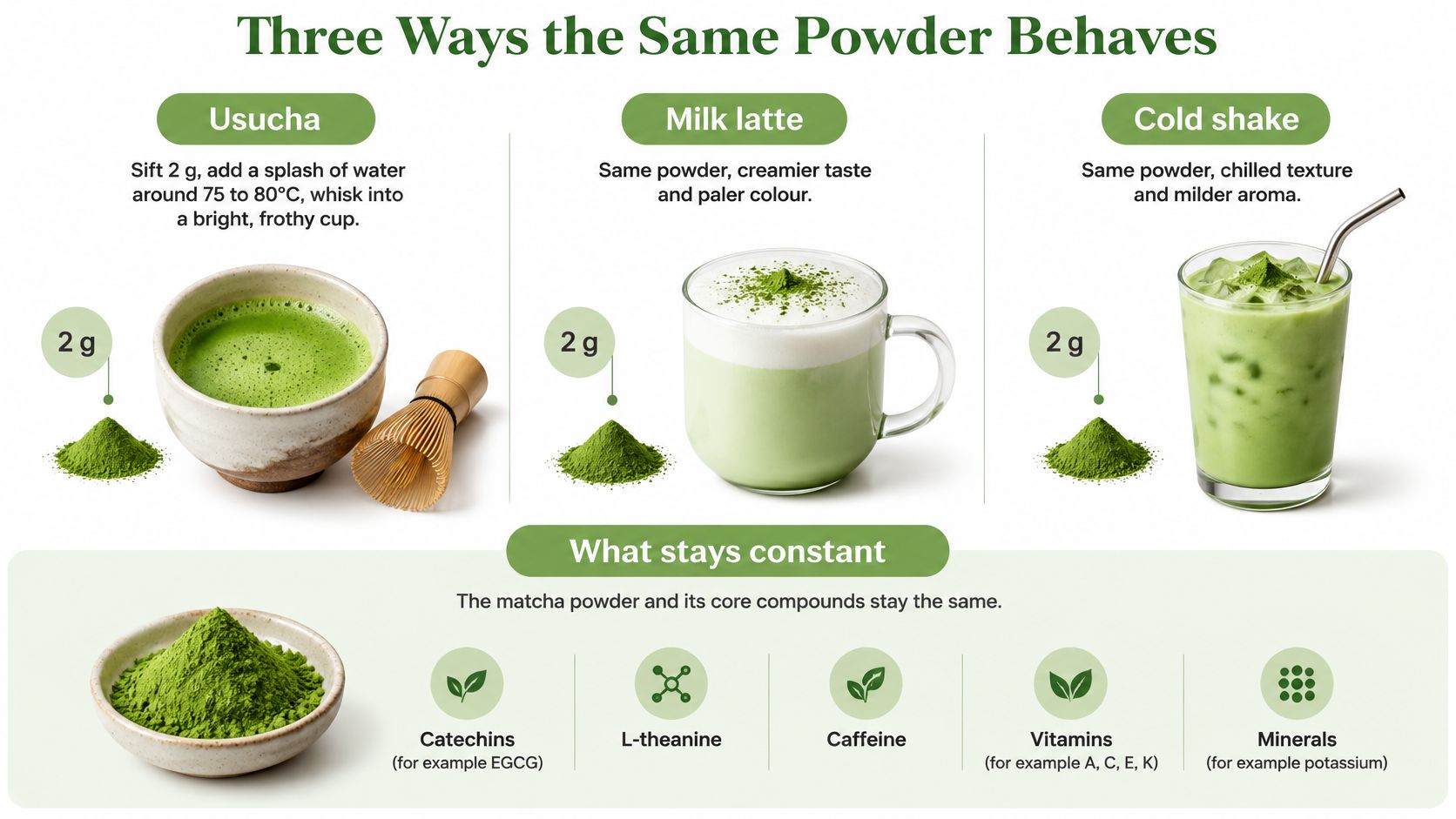
Choose ceremonial powder for a straight bowl and culinary powder for milk drinks or baking, where other ingredients shape the result. Heat and processing can change compounds, so the illustration's constant-compounds message shouldn't be read as a guarantee of identical retained antioxidant content after baking.
A grassy, lightly marine aroma can be appealing in the bowl, while a cake needs balance with its other flavours. Neither a green crumb nor a creamy latte establishes a precise functional dose.
Colour, Freshness and Storing the Tin
Colour, smell and texture are useful shopping clues, provided you don't ask them to do a laboratory's job. Fresh matcha often looks lively green, smells grassy with marine notes and feels finely milled rather than gritty.
A powder-and-bowl comparison is helpful for noticing texture and presentation.
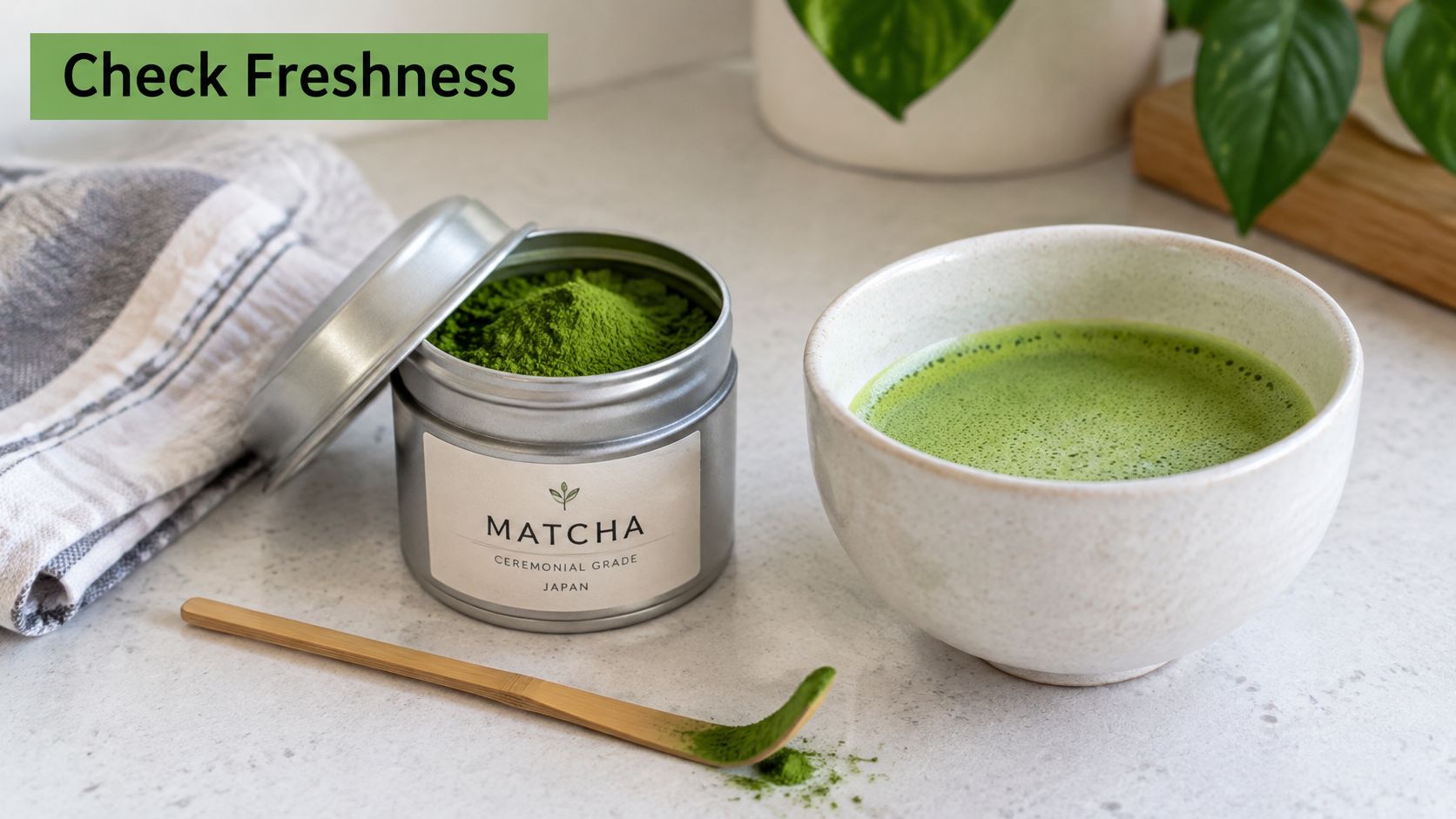
Olive or brown tones and a stale, hay-like smell can indicate deterioration, although grade and processing also affect appearance. You can't look at dull powder and conclude that all its catechins have vanished.
Give the powder a sensible home
- Close it promptly: Keep the container airtight between uses.
- Keep moisture out: Use a clean, dry spoon and avoid opening the tin over steam.
- Avoid hot spots: A cupboard away from the kettle, oven and direct sunlight is more suitable than a display shelf.
- Handle refrigeration carefully: Only refrigerate a properly sealed container, and let it come to room temperature before opening to reduce condensation.
Buy a pack size you'll realistically use rather than keeping a large tin open indefinitely. Check the supplier's storage advice and our guide to matcha shelf life for practical handling considerations.
Buying rule: Ask about origin, storage and testing before paying extra for an impressive tin.
Check provenance when demand is strong
SBS's reporting on Australia's matcha boom describes Australian imports of Japanese green tea rising nearly 20% year-on-year in 2024, with shortages and higher import costs becoming more visible during 2025. That context makes traceability more useful than fashionable packaging.
Look for Japanese origin, identifiable organic certification, a stated grade and a supplier who can explain handling and product testing. Organic certification answers a production-standard question; it doesn't independently verify caffeine, EGCG or freshness.
For a visual preparation reference, the video below accompanies the practical handling discussion.
Naturally occurring caffeine in tea generally doesn't carry the same labelling requirements as added caffeine, as the Australian Institute of Sport explains in its caffeine guidance. If the packet doesn't give a useful serving or composition guide, ask the supplier rather than interpreting silence as caffeine-free.
Pick the Serve That Fits Today
The useful matcha choice is the tea that suits what you are making, tastes good to you and fits your day's caffeine intake. Strength and price are only part of the decision.
For a straight bowl, prioritise aroma, texture and a finish you enjoy without needing to cover it up. Ceremonial-grade organic matcha is a sensible starting point for that purpose, while the label still works best alongside tasting and credible product information.
Match the grade to the job
Ceremonial and culinary grades are not chemically interchangeable in the cup, even before milk or flour enter the picture. For a latte, culinary-grade organic matcha can be practical because milk changes how you experience the tea. In baking, choose a powder with enough flavour to remain noticeable alongside flour, fat and sweetness.
- For a quiet tea break: Use a measured portion and adjust the water to taste.
- For a café menu: Standardise the powder mass, distinguish plain and sweetened recipes, and make ingredient information easy to obtain.
- For a bakery tray: Think about flavour per portion rather than presenting the finished food as an antioxidant supplement.
A digital scale helps make your first preparations repeatable. Once you have found a portion you like, you can reproduce it without relying on the shape of a heaped spoon. That matters more than chasing a perfect ritual, because the same powder can taste focused in a small bowl and disappear in a sweet slice.
Count the day, not just the bowl
The FSANZ dietary-intake assessment reports an average adult Australian caffeine intake of approximately 175 mg daily, with at least 25% of adults consuming more than 230 mg daily. That makes the rest of your routine relevant when adding matcha.
Coffee, black tea, cola, chocolate and energy drinks all belong in that check. A matcha on an otherwise caffeine-light day is a different decision from a matcha added to several caffeinated drinks, and calm focus is better treated as your own response to caffeine plus L-theanine than as a promise on the tin.
For refreshment rather than focus, sugar-free organic kombucha brewed in NSW is another option, although tea-based kombucha should not automatically be assumed caffeine-free.
Understanding matcha green tea properties should make choosing easier, not turn your kitchen into a laboratory. Buy a named grade, measure what you use and pay attention to how the complete routine suits you.
At Pep Tea, we offer organic ceremonial and culinary matcha for straight bowls, milk drinks and cooking, alongside sugar-free organic kombucha brewed in NSW. Visit Pep Tea to choose a grade that suits your cup or café menu, then weigh your first serves to make the result repeatable.