
What Is Matcha Green Tea Good for: A Practical Guide
What is matcha green tea good for, really? Is it mainly an antioxidant-rich wellness drink, a gentler coffee alternative, or a vivid green café trend? The most useful answer sits between those ideas. Matcha is a whole-leaf Japanese green tea that can provide calm focus, moderate caffeine and concentrated catechins, but its benefits depend on the serving, the product and how your body responds.
For Australians, matcha makes practical sense as an unsweetened morning drink, an iced café-style latte, a smoothie ingredient or a way to replace a sugary beverage. It isn't a miracle cure, and the evidence for cognitive and metabolic effects is measured rather than dramatic. Used thoughtfully, however, it can become a simple part of an everyday routine.
What Matcha Actually Is and Why It Stands Out
Matcha is made from Camellia sinensis, the same tea plant used for other green, black and white teas. The difference is what happens to the leaf. Producers grow suitable tea bushes under shade, harvest and process the leaves, then grind the prepared leaf into a fine powder. When you drink matcha, you consume that powder rather than removing the leaves after steeping.
That whole-leaf format explains why matcha is often associated with higher antioxidant intake. Standard green tea releases some compounds into water, while the spent leaf is discarded. Matcha keeps the leaf material in the cup, so its catechins, chlorophyll and amino acids remain part of the drink. A review of matcha research describes it as a powdered green tea with particularly high antioxidant potential, and reports that matcha infusions showed the highest antioxidant potential among the tea types considered in that review. A later comparative study reported antioxidant activity 1.2 to 2.5 times higher than standard green tea, depending on the assay used, as outlined in this scientific review of matcha.
Ceremonial and culinary grades
The words ceremonial-grade and culinary-grade describe intended use more than a universal legal standard. Ceremonial matcha is generally selected for drinking with water, where colour, aroma, texture and umami are easy to notice. Culinary matcha is designed to work with milk, yoghurt, fruit, flour and other ingredients, so its stronger flavour can hold its own in recipes.
Neither grade automatically makes a person healthier. A well-made culinary powder can be useful in a latte or smoothie, while a good ceremonial powder is best appreciated whisked with water. The key is to match the product to the way you'll use it.
Practical rule: Choose matcha for the drink or recipe you actually want to make, not for the label alone.
How Matcha Is Grown and Made
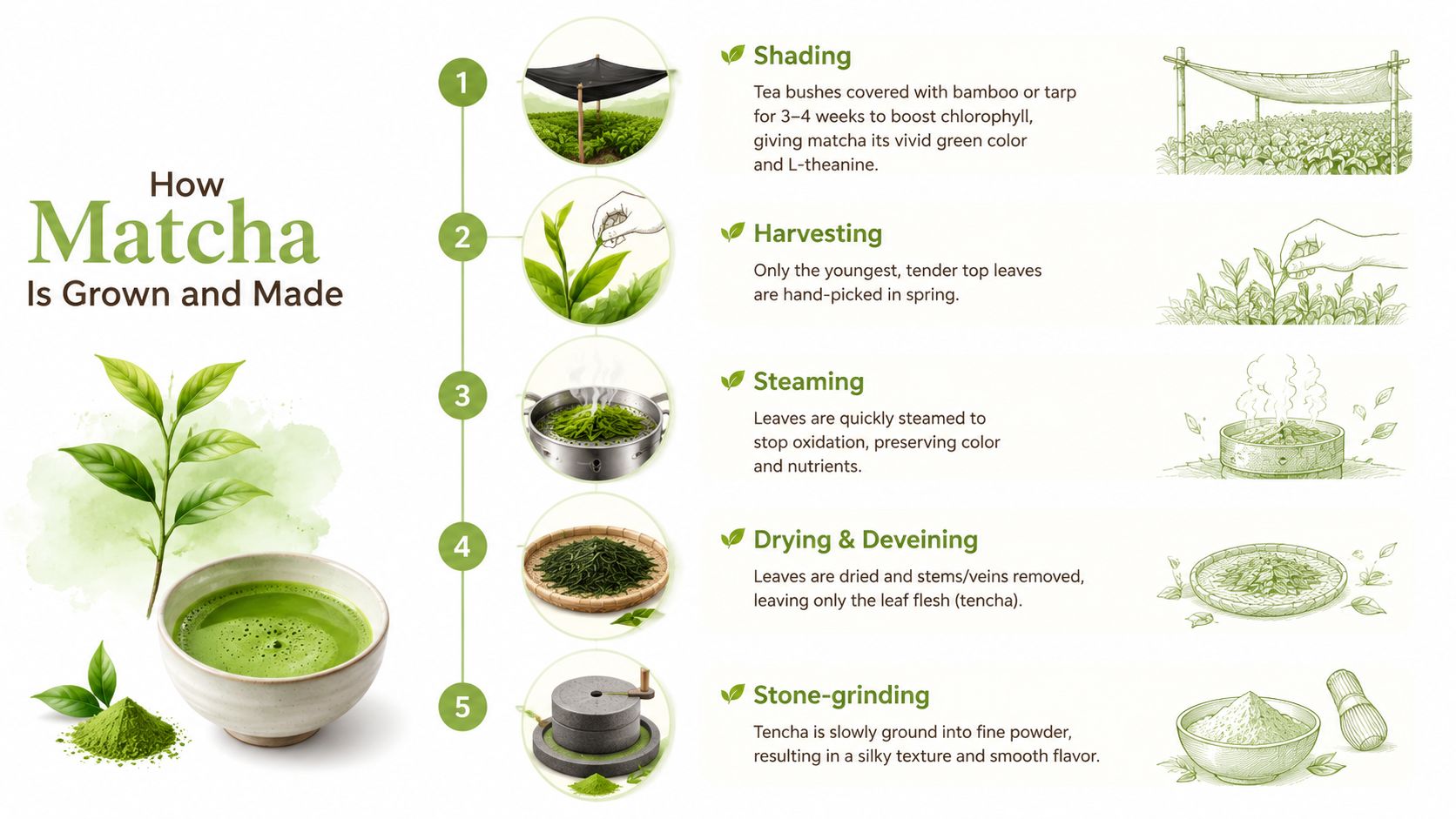
Matcha's flavour and colour begin in the tea field. Producers shade tea bushes from direct sunlight for three to four weeks before harvest, a practice discussed in the research literature on matcha composition. Reduced light supports the vivid green appearance and helps create matcha's rounded, savoury flavour.
The production sequence involves several linked decisions:
- Shading: Covers block direct sunlight before harvest. This encourages chlorophyll and helps preserve the amino-acid profile associated with a smooth, umami character.
- Harvesting: Producers select young leaves and buds. They become the raw material for tencha, the leaf prepared for matcha, rather than sencha, which is commonly brewed and removed.
- Steaming: Japanese tea processing quickly steams the leaves to halt oxidation. This helps retain their green colour and fresh vegetal flavour.
- Drying and deveining: The leaves are dried, then stems and veins are removed. The remaining leaf flesh is called tencha.
- Stone-grinding: Granite mills slowly turn tencha into a fine powder. Properly prepared matcha should feel silky, not gritty.
Why whole-leaf processing matters
Brewing extracts compounds into water, while matcha keeps the processed leaf suspended in the cup. The final composition still varies with tea variety, growing conditions, grade, storage and preparation. That difference matters for Australian drinkers choosing between a straight whisked cup, a café-style latte or a recipe.
You can follow each production stage in PepTea's guide to how matcha tea is made. The process also helps explain flavour differences. Fresh, well-stored matcha may taste sweet, grassy and umami-rich, while older or lower-quality powder can seem flat, dusty or harsh. Choose a grade suited to the drink or recipe you want to make.
The Key Compounds Behind Matcha's Benefits
What makes matcha feel different from ordinary green tea or coffee? Its character comes from three naturally occurring compounds working together: catechins, L-theanine and caffeine. They do not make matcha a medicine. They help explain why a whisked cup can feel alerting while remaining more even for some drinkers than coffee.
Catechins and EGCg
Catechins are plant compounds with antioxidant activity. The best-known catechin in matcha is epigallocatechin gallate, usually shortened to EGCg or EGCG. Because matcha is made from powdered leaf, you consume the leaf rather than only the compounds extracted into water. That makes it a catechin-rich beverage, although the amount varies with the tea, grade, storage and preparation.
Laboratory antioxidant activity is not the same as a predictable health outcome. Human effects depend on serving size, diet, lifestyle and individual biology. Research interest includes cardio-metabolic and cellular protection, but a daily cup should not be presented as disease prevention or a guaranteed way to change body composition.
For a plain-language explanation of this major catechin, see PepTea's guide to what EGCg is.
L-theanine and the feel of focus
L-theanine is an amino acid naturally found in tea. Shading during cultivation and consuming the whole powdered leaf help make it part of a matcha serving, though levels differ between products and preparation methods. Studies examine its relationship with relaxed attention and the way caffeine feels.
A review of randomised clinical trials reported that matcha decreased stress and slightly enhanced attention and memory, with no effect on mood. The finding supports a measured description: matcha may suit focused work for some people, but it is not a guaranteed productivity enhancer.
The practical analogy is a dimmer switch rather than a second engine. Caffeine provides stimulation, while L-theanine may contribute to a calmer experience. Individual responses still vary.
Caffeine and realistic expectations
How much caffeine is in the cup matters to Australian drinkers. A typical serving contains about 60 to 75 mg of caffeine, according to an Australian Broadcasting Corporation explainer cited in the matcha review above. That can suit morning alertness or an afternoon work block, but a café latte may contain a different amount depending on the powder and recipe.
Matcha is not caffeine-free energy. People sensitive to caffeine can still experience restlessness, a racing heart or disrupted sleep, especially with a larger serving or late-day use. Start with a modest serve, check the product guidance, and choose morning or early afternoon if sleep is easily affected. The research overview above gives useful context for how cultivation and processing influence matcha's composition.
Matcha Versus Coffee and Green Tea
Could matcha offer a middle ground between brewed green tea and coffee? In Australian café use, a standard matcha serve is often described as roughly 70 mg of caffeine, while the comparison for coffee is 80 to 100 mg. ABC reporting These amounts change with the powder, recipe and serving size, so treat them as a guide rather than a promise. Some drinkers also prefer matcha because they associate it with less of a coffee crash, although that experience differs between individuals.
The preparation method explains much of the difference. Brewed green tea uses water to draw compounds from the leaves, while matcha mixes powdered leaf into the drink. Matcha therefore provides whole-leaf exposure, including catechins such as EGCg, but the amount still varies by product and preparation.
| Beverage, 1 serve | Caffeine | EGCg catechins | Energy profile | Best time of day |
|---|---|---|---|---|
| Matcha | About 60 to 75 mg, ABC reporting | Varies by product and preparation | Alerting, with L-theanine-associated calm focus | Morning or early afternoon |
| Coffee | About 80 to 100 mg in the Australian comparison | Varies widely | Faster, sharper stimulation for many drinkers | Morning or earlier in the day |
| Steeped green tea | Varies by tea and steeping method | Less whole-leaf exposure than matcha | Lighter, gentler stimulation | Across the day, depending on tolerance |
Choosing by sensitivity
Coffee can feel too stimulating for some people, making matcha a practical café substitution. Choose an unsweetened preparation when you want to avoid added sugar, start with a smaller serve, and watch your own sleep and concentration rather than assuming the same response as another drinker.
Timing also matters. A late espresso may interfere with sleep, whereas an early-afternoon matcha may suit a work routine for some people. That is an individual response, not a universal rule.
Practical Ways to Use Matcha Every Day
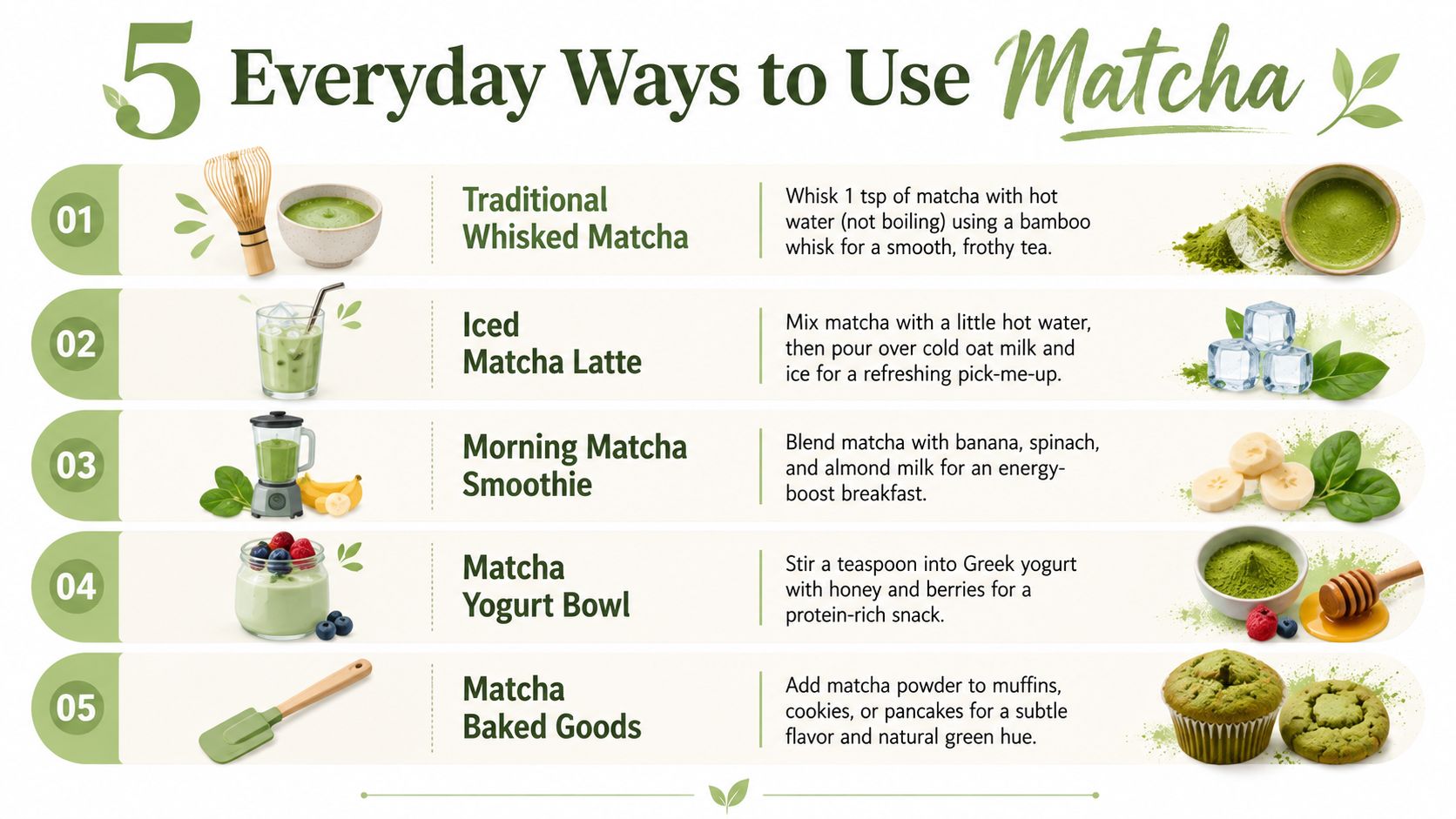
Matcha doesn't need to stay inside a traditional tea ceremony. Its powder format makes it useful in drinks, breakfasts, baking and savoury food. The following serving ideas give beginners a clear place to start.
Straight and milky drinks
For traditional whisked matcha, sift one teaspoon into a bowl. Add a small amount of hot, not boiling, water and whisk until smooth, then add more water to taste. A bamboo whisk creates the familiar foam, but a small handheld frother can work for an everyday kitchen version.
For an iced oat matcha latte, use two teaspoons of matcha, first mixed with a little hot water to form a smooth paste. Pour it over cold oat milk and ice. Keep the drink unsweetened initially so you can taste the powder's natural balance before deciding whether it needs anything else.
Breakfast and snacks
A morning smoothie can take one and a half teaspoons of matcha with banana, spinach and almond milk. Banana softens matcha's vegetal edge, while the greens make the colour feel at home. Start with less if you're sensitive to bitterness or caffeine.
For a yoghurt bowl, stir a teaspoon through Greek yoghurt, then add berries and a small amount of honey if desired. This is a simple way to use culinary matcha without turning it into a strongly flavoured drink.
Baking and savoury cooking
Culinary matcha works well in blondies, energy balls, muffins, pancakes and ice cream. Sift it with the dry ingredients to reduce lumps, and remember that heat, flour and dairy will soften its flavour.
Savoury uses are less common but worth trying. Mix matcha into salt for roasted vegetables, or add a small amount to a vinaigrette with citrus and olive oil. Use a light hand. Matcha should add freshness and umami, not dominate the dish.
Store opened matcha sealed, protected from heat, light, air and moisture. Refrigeration can help preserve freshness, but let the container come to room temperature before opening so condensation doesn't enter the powder.
How to Choose Quality Organic Matcha
A good matcha announces itself through several sensory cues. Don't rely on a premium-sounding name alone. Terms such as ceremonial and premium aren't universal proof of quality, so inspect the powder and check the supplier's origin and testing information.
Four useful checks
- Colour: Look for a vivid jade-green powder. Yellow or brown tones can indicate older material, oxidation or poor storage.
- Aroma: Fresh matcha should smell grassy and gently sweet. Hay-like, stale or fishy notes are warning signs.
- Texture: The powder should be very fine and talc-like. It should whisk into water smoothly rather than remain sandy or heavily lumpy.
- Taste: A quality drinking matcha tends to have clean umami, mild sweetness and a rounded finish. Aggressive bitterness can point to quality, storage or preparation problems.
Origin matters, too. Japanese regions such as Uji and Nishio are well known for matcha production, but a named origin doesn't replace sensory quality or transparent product information. Look for a clear ingredient list, organic certification where that matters to you, and evidence that the product is matcha rather than a sweetened blend or powder containing fillers.
For Australian shoppers, organic certification can provide useful reassurance about production standards and synthetic pesticide use. Buy a size you can finish while the powder is fresh. Smaller tins are often more practical than a large container that sits open in a warm kitchen for months.
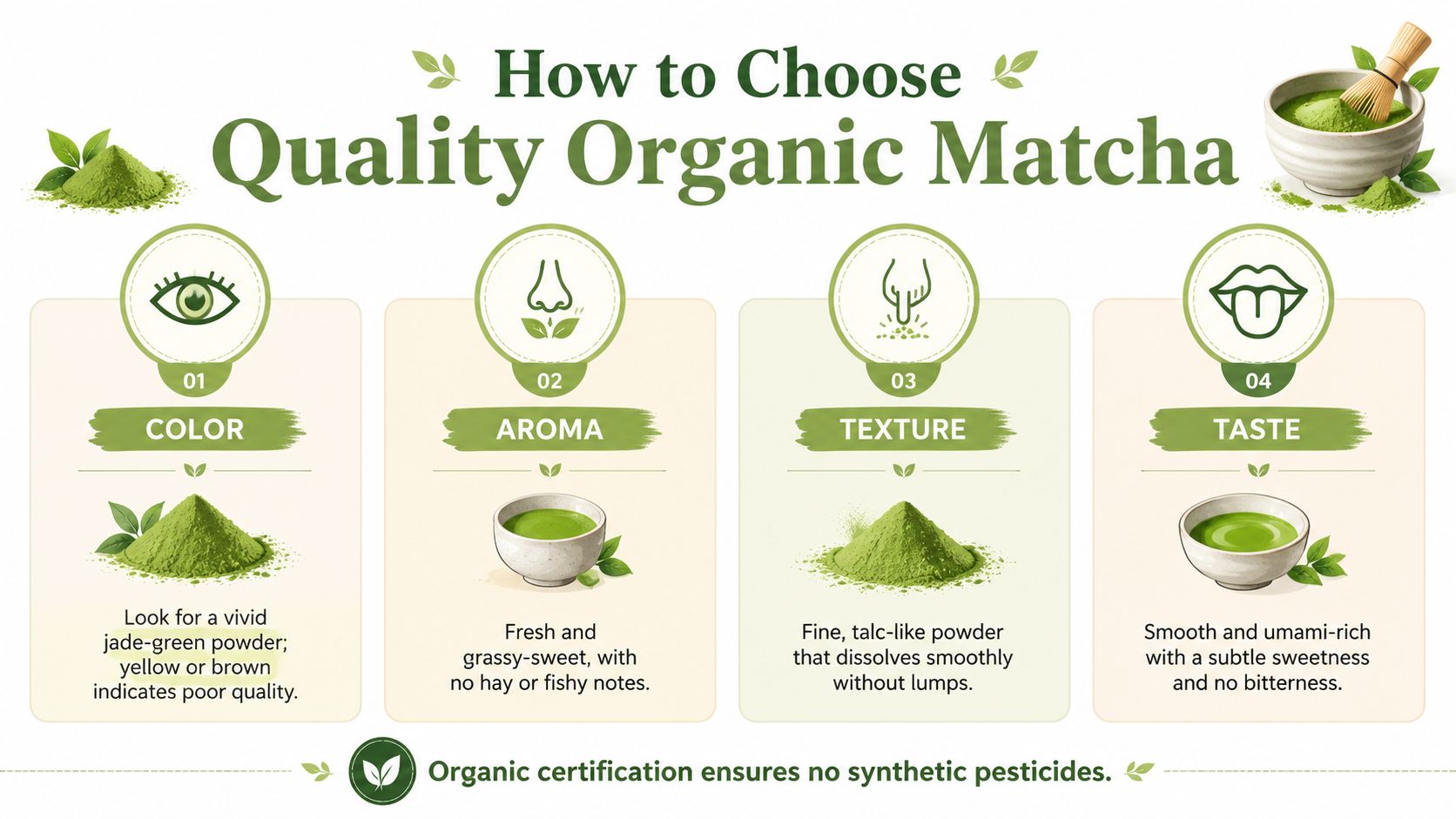
The following visual guide shows how colour, aroma, texture and taste work together:
For a deeper explanation of grades and buying cues, see PepTea's matcha grade and quality guide.
Serving Sizes, Safety, and Common Myths
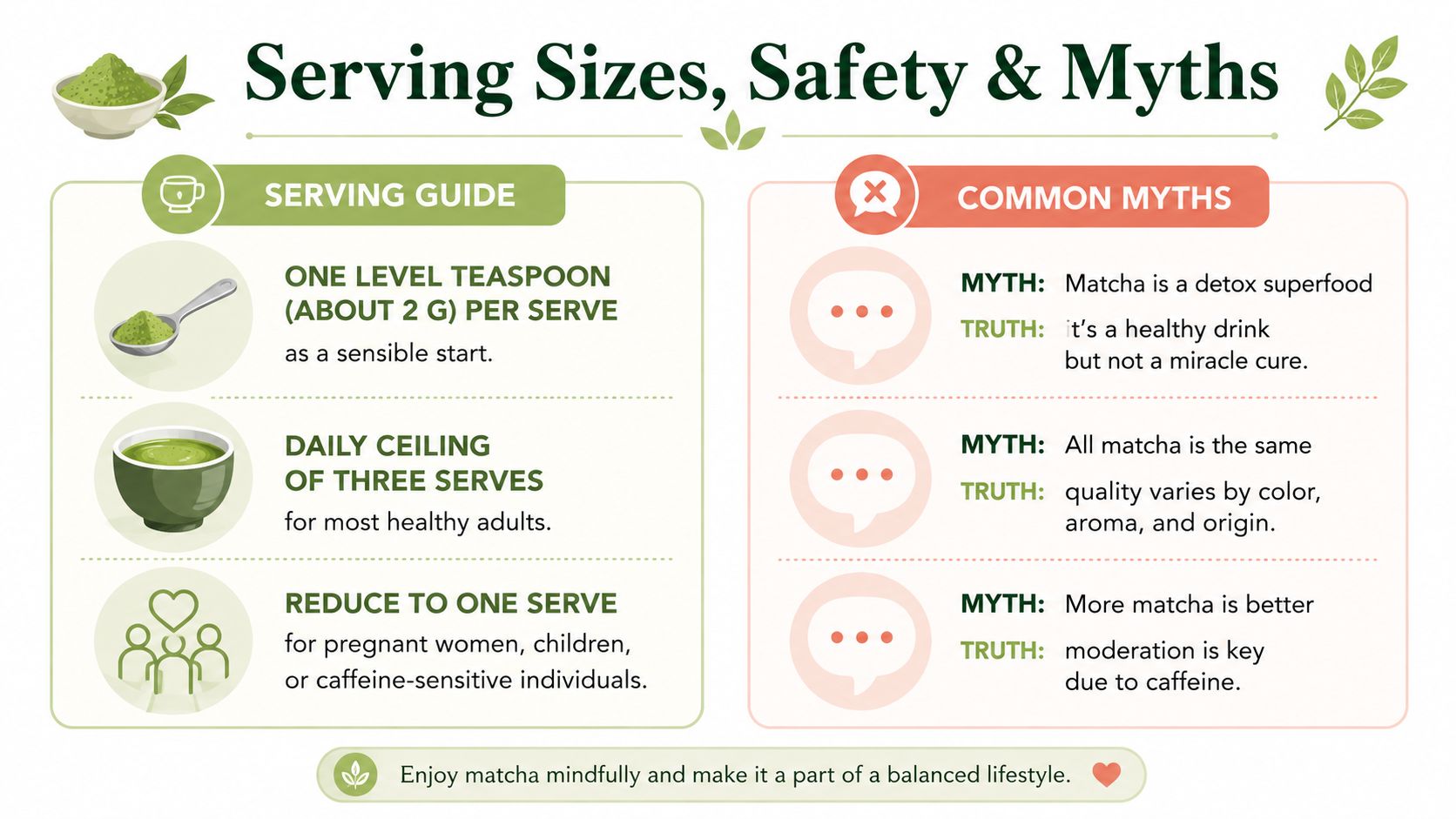
A sensible starting point for many healthy adults is one level teaspoon, about 2 g, per serve. A practical daily ceiling is around three serves for most healthy adults, with less appropriate for pregnant people, children and anyone who is caffeine-sensitive. These are cautious everyday guidelines rather than a substitute for individual medical advice.
Caffeine isn't the only consideration. Tea compounds can affect the absorption of non-haem iron from plant foods, so people managing iron deficiency may want to separate matcha from iron-rich meals and discuss their routine with a healthcare professional. Drinking matcha with food may also feel gentler than taking it on an empty stomach.
What matcha isn't
- Not a detox cure: Matcha is a healthy beverage option, not a miracle treatment.
- Not the same as an extract: Concentrated green tea extracts can deliver far higher doses than a normal drink.
- Not automatically better by grade: Ceremonial grade is generally chosen for straight drinking, but it isn't a guarantee of superior health effects.
- Not unlimited energy: More powder means more caffeine and more catechins, not necessarily more benefit.
The Australian Therapeutic Goods Administration states that rare liver injury cases have been linked to concentrated green tea extracts, while the majority of green tea use, including beverage form, is unlikely to cause harm. That distinction matters. Typical matcha is a food-format drink, whereas capsules and concentrated extracts deserve more caution, particularly if you have a medical condition or take medication.
Bringing Matcha Into Your Routine
The easiest routine is the one you can repeat. Start with one morning matcha in place of a coffee, using a modest serving and no added sugar. Give yourself time to notice the flavour, alertness and effect on sleep before adding another serving.
Keep a small sealed tin beside the kettle, but store it away from heat and direct light. Whisking matcha into hot water is the quickest default. Across the week, you can turn the same powder into an iced oat latte, a smoothie, overnight oats or a yoghurt bowl.
A pre-workout or mid-afternoon serve may suit some adults, but caffeine tolerance varies. If you notice restlessness or disrupted sleep, reduce the amount or move matcha earlier. Pregnant people, children and people taking medication should seek personalised advice before making matcha a daily habit.
Consistency matters more than chasing perfect gram precision. Choose a grade that fits your use, buy a quantity you'll finish while fresh, and treat matcha as one useful beverage within a varied diet rather than as a replacement for proper meals or medical care.
PepTea offers organic Japanese matcha for straight drinking, lattes and cooking, making it a convenient Australian source for readers who want to begin with a clearly defined product and serving style.
Explore the organic matcha range at Pep Tea and choose a powder suited to whisking, lattes or recipes. Start with one simple morning serve, then build your matcha routine around the flavour and caffeine level that work for you.