
Green Matcha Benefits: What the Evidence Really Shows
Australian matcha sales have grown, though one widely repeated retail figure deserves care. T2 Tea chief executive Michael Young reported a 344% rise in wholesale sales to cafés, restaurants, hotels and specialty grocers in an interview published in April 2025. The category generated more than AUD 54 million in revenue in 2024, according to Grand View Research. Those figures show a fast-growing market, but popularity alone cannot tell you what a cup does for your health.
Matcha is often marketed as calm energy, detox support, an immunity boost and a gentler substitute for coffee. These claims do not all have the same level of evidence.
The practical question is what a cup can reliably provide, what remains uncertain and how much you drink. Matcha is whisked into water rather than strained out like brewed tea, so you consume the powdered leaf. That provides tea compounds along with caffeine, but it does not guarantee lower cholesterol or stronger immunity. Dose matters, especially when weighing matcha's dependable caffeine effects against broader health claims.
Green Matcha Benefits at a Glance
Café menus filled in before the science caught up. A 2025 Milklab survey found 40% of Australians aged 18 to 24 had ordered a matcha drink during the previous six months, as reported in the survey coverage. That's a routine purchase for a generation that mostly grew up on coffee.
Popularity doesn't tell you whether a benefit is real. The table below does the sorting, and the confidence column is the part worth reading twice.
| Benefit | Key compound | What the evidence shows | Confidence |
|---|---|---|---|
| Steady alertness and less fatigue | Caffeine, L-theanine | Caffeine raises alertness and reduces perceived fatigue; L-theanine may moderate the feel of it | Well supported |
| Antioxidant intake | Catechins, EGCG | Whole-leaf polyphenols are consumed, but lab antioxidant capacity does not prove protection in the body | Plausible, not proven |
| Calm focus | L-theanine | Early evidence; individual response varies | Preliminary |
| Cholesterol support | EGCG | A small pilot used concentrated EGCG capsules, not matcha | Early, not applicable to a cup |
| Immunity or detox | None established | No reliable evidence for matcha | Not supported |
The short version: matcha may support alertness and a healthy antioxidant intake as part of a balanced diet, and its strongest benefits are tied to caffeine and the polyphenols in the whole leaf.
The confidence ratings follow dose. Where a benefit comes from a molecule with a known pharmacological action at a known intake, which is caffeine, prediction is easy. Where it depends on a compound being absorbed, transported and used by your tissue, prediction gets much harder, and that's exactly where catechin claims start to wobble.
Two rows deserve their low ratings for different reasons. Cholesterol support has one small human study behind it, conducted with a capsule rather than a beverage. Immunity and detox have no credible trial at all, only inference from antioxidant chemistry that happens in a dish rather than in a person.
What Sets Matcha Apart From Brewed Green Tea
Matcha isn't a stronger version of the green tea in a teabag. The plant is grown differently, the leaf is picked differently, and the part you drink is different. Pep Tea's matcha comes from young leaves taken from the tips of shade-grown plants and ground into a very fine powder, and those two steps explain most of what ends up in your bowl.
Growers shade the plantations from the sun for the last few weeks of growth, which increases chlorophyll content and deepens the colour to that almost electric green. Shade also changes flavour, pulling the leaf away from bitterness and towards a savoury, vegetal sweetness. Only the young tips are harvested, because older leaf turns grassy and tough.
The easiest way to hold the difference in your head is cooking. Steeping a teabag is like making stock and throwing away the vegetables. Whisking matcha is like eating the vegetables themselves. Same plant, very different nutritional transaction.
Why swallowing the leaf changes the maths
A teabag gives you an infusion. Hot water pulls some compounds out of the leaf and you pour the rest away, so the drink is a partial extract of whatever was harvested. Matcha goes into the bowl and stays there.
Laboratory work on ground green tea shows how much preparation matters. A University of Newcastle thesis found that brewing ground green tea at 80°C for 30 minutes, then running a second 80°C extraction, improved catechin recovery compared with a single preparation, at water-to-tea ratios of 12:1 mL/g for the first extraction and 8:1 mL/g for the second (the Newcastle extraction thesis). Particle size was 1 mm or less. The takeaway for a drinker is simple: how you prepare the leaf shapes how much of it you get.
Here's the visual version of the same comparison.
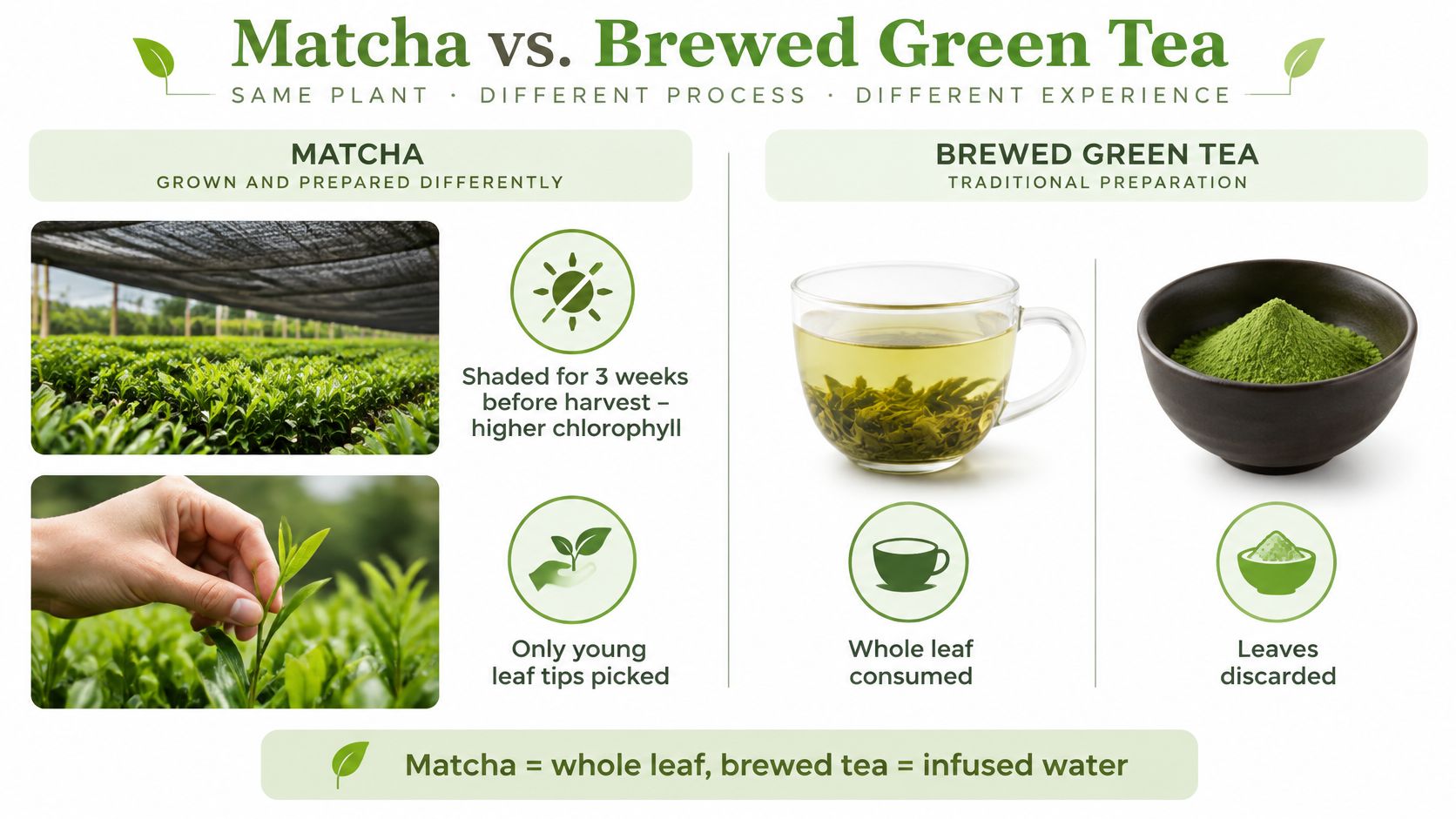
| Feature | Matcha | Brewed green tea |
|---|---|---|
| Leaf form | Stone-ground powder from young tips | Loose leaf or a tea bag |
| Growing | Shaded in the weeks before harvest | Usual green-tea leaf, not powdered |
| What you swallow | The whole leaf | The infusion only; solids are discarded |
| Compounds in the cup | Catechins including EGCG, L-theanine and caffeine from the leaf | Only what the water extracts |
| Preparation | Whisked and drunk | Steeped, then the leaf is thrown out |
| What changes the dose | Powder weight, batch and cultivar | Leaf amount and steep, still a partial extract |
If you want the broader comparison across styles, our guide to the difference between matcha and green tea covers how they sit side by side.
One caution sits under all of this. Compound levels shift between batches, cultivars and serving sizes, so matcha is best treated as a food with a variable payload rather than a fixed supplement. Two spoons from two tins are not the same dose.
How Caffeine and L-theanine Shape Your Energy
Caffeine's effect is the more predictable part of matcha's energy profile. It blocks adenosine receptors, which respond to a signal associated with tiredness. The Australian Institute of Sport's caffeine guidance puts brewed green tea at roughly 30 to 50 mg of caffeine per 250 mL serving and describes caffeine as a performance-relevant stimulant at low to moderate doses.
L-theanine, an amino acid found naturally in tea, may make the stimulation feel less edgy for some people. It does not cancel caffeine's effects on the body, including its influence on heart rate and sleep. Read more about L-theanine and its role in tea.
A calmer-feeling lift is still a stimulant effect. The sensation can differ from coffee, but the caffeine still counts.
The Australian food regulator says naturally occurring caffeine in tea and coffee does not normally exceed 100 mg in a standard serving. It also reports measurable pharmacological effects from around 80 mg a day in adults (FSANZ review of dietary caffeine). With matcha, you drink the powdered leaf rather than discarding it after steeping, so the amount of powder helps determine your caffeine intake.
Why one cup is not a fixed dose
The dose varies with the weight of matcha, how much water or milk you add, and other caffeine you consume that day. A level teaspoon and a heaped teaspoon deliver different amounts of powder, while a café drink may use more than a home serving. For a steadier energy option around endurance training, see steady fuel for endurance athletes.
One cup is not a standard measure of caffeine. Weighing the powder gives you a more consistent starting point than guessing by spoon, and tracking your other caffeinated drinks helps put that serving in context.
Antioxidants, Heart Health and What Research Still Needs
The antioxidant claim is the one many have heard and the hardest to check. Matcha carries catechins, a family of plant polyphenols that includes EGCG, and because you consume the whole leaf you take in more of them than an infusion would give you.
A properly whisked bowl, and the tools that make it, is where many beginners start.
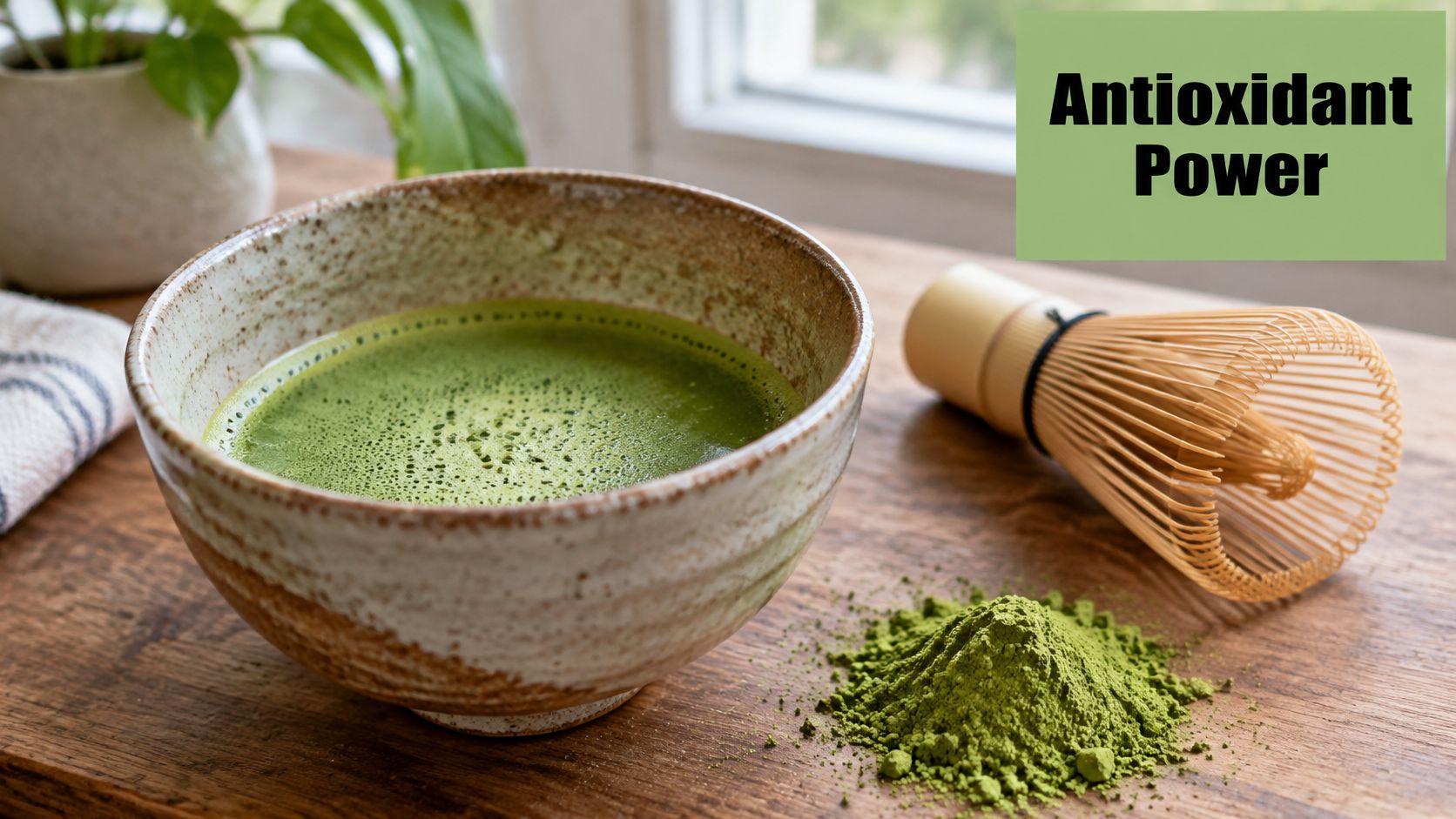
Catechins do scavenge free radicals in a laboratory dish. That's real chemistry, not a marketing invention. The gap opens after you drink them, because the body has to absorb, transport and use those compounds before any of that chemistry matters to your arteries.
The most quoted human number comes from a small Australian pilot run through the University of Newcastle. Ten people with moderate hypercholesterolaemia took 1 gram of purified EGCG in capsules each day for four weeks, and at the end LDL cholesterol was 25% lower in the EGCG group than in the control group, with statistical significance reported at p=0.026, while total cholesterol showed no difference (the EGCG cholesterol pilot). The intervention was tolerated without serious adverse effects over that short period.
What the capsule study actually tested
Read the design and the headline shrinks to its true size. The dose was a concentrated capsule, not a spoon of powder stirred into water. The group was 10 people. The study ran four weeks and looked at a population with already high cholesterol. It says something interesting about EGCG as a compound. It says nothing about what a matcha latte does to your next blood test.
Absorption is the sticking point. How much catechin reaches your tissue depends on dose, the food matrix you drink it with, digestion and individual metabolism. A high score on a lab antioxidant assay describes the assay, not your bloodstream.
An Australian-linked technical review indexed by CAB Direct draws the same line, reporting that matcha contains caffeine, amino acids and plant polyphenols while noting that measurable composition has stronger support than long-term human benefit claims (CAB Direct's overview of matcha). It also flags that catechin bioavailability varies with dose, food matrix, digestion and metabolism, so lab antioxidant capacity doesn't translate directly into antioxidant protection in human tissue.
Nothing in a bowl of matcha replaces sleep, movement and a diet built on vegetables, fruit and whole grains.
For a visual walk through the leaf and the whisk, this clip is a useful companion to the reading.
If you want the compound itself unpacked, our page on what EGCG is covers it properly. The fair conclusion is that matcha contributes polyphenols to a diet that should already be rich in them, and that detox, weight loss and disease prevention claims need evidence nobody has produced. Stronger work would mean larger trials, whole matcha rather than capsules, and follow-up measured in years rather than weeks.
Daily Caffeine Limits for Matcha Drinkers
Matcha belongs in the same column as your coffee, not in a separate wellness column. Every milligram counts against one daily total, whether it arrives in a flat white, a cola, a square of chocolate, a pre-workout tub or a bowl of whisked green powder.
| Group | Limit | What it means for matcha |
|---|---|---|
| Healthy adults, total daily | 400 mg | Includes matcha, coffee, tea, cola and chocolate |
| Adults, single serving | 200 mg | Keep one matcha serving well under this if you also drink other caffeine |
| Pregnant and breastfeeding people, total daily | 200 mg | Count matcha carefully and check with a midwife or doctor |
| Under 18s, single serving | 3 mg per kg body weight | Weigh the serving against body weight, not adult limits |
| Adult single intake reviewed by FSANZ | Up to 210 mg | Adverse effects not generally associated, higher amounts linked to raised blood pressure and anxiety |
| Concentrated green-tea extracts | Treated as a separate product category | Not comparable to culinary matcha; ask a health professional if you use them |
Those figures come from Food Standards Australia New Zealand, which sets 400 mg a day for healthy adults, 200 mg a day for pregnant and breastfeeding people, 200 mg in a single serving for adults and 3 mg per kilogram of body weight in a single serving for under-18s. FSANZ's approval work also found single intakes up to 210 mg for adults were not generally associated with adverse effects, while intake above that level was associated with increases in blood pressure, plasma catecholamines and anxiety (the FSANZ approval report).
Rule of thumb: count your matcha in the same column as your coffee, then check what's left of the day.
Counting a real day
Say your morning is a matcha, mid-morning brings a flat white and the afternoon includes a square of dark chocolate. Coffee carries most of the load in this country anyway: FSANZ's dietary exposure work found non-alcoholic beverages supplied 96% of caffeine intake in Australia and New Zealand, with coffee the largest contributor at 66% (FSANZ dietary exposure assessment). The same assessment found 87% of Australians consumed caffeine on day one of the national nutrition surveys, and put 95th-percentile intake among adults aged 20 and over at 420 mg a day for males and 393 mg a day for females.
That last number is worth sitting with. The heaviest drinkers in the population already sit at or above the 400 mg guideline, and most of them have never thought of themselves as heavy caffeine users.
Be most careful if you're pregnant or breastfeeding, under 18, sensitive to caffeine, managing a cardiovascular condition, or stacking matcha with energy drinks and supplements. Anyone with liver disease, anyone taking regular medicines, and anyone using concentrated green-tea extracts should get individual advice, because a culinary powder and a high-dose extract are not interchangeable products.
How to Brew Matcha for Everyday Wellness
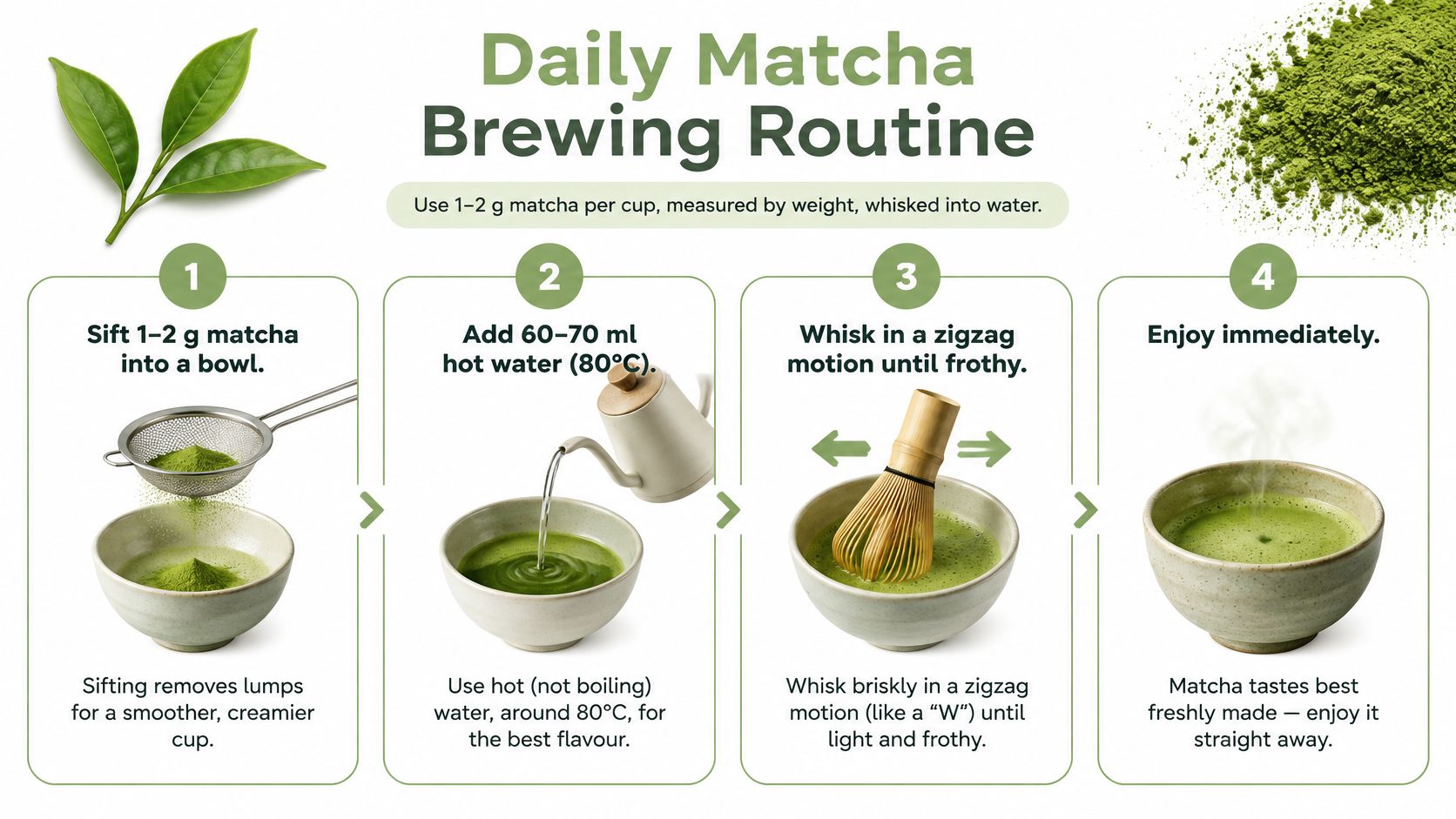
A repeatable routine beats a perfect one. Start with 1 to 2 g of matcha per cup, measured by weight rather than scooped by eye, because the powder weight is what sets your dose of everything else.
- Sift the powder. Push 1 to 2 g through a small sieve into your bowl. This breaks up clumps that would otherwise sit dry on the surface and taste bitter in the last sip.
- Add water at 70 to 80°C. Around 70 mL is right for a straight cup. Boiling water scalds the powder and turns it harsh, so let the kettle rest for a minute after it clicks.
- Whisk in a fast W or M motion. Fifteen to twenty seconds with a bamboo chasen, moving through the liquid rather than around it, builds a fine foam. A milk frother works if you don't own a whisk, though the texture is coarser.
- Build a latte if you prefer. Add about 150 mL of warm milk or an oat or soy alternative and stir gently. Sweeten with nothing at first, then adjust.
- Drink it while the foam holds. Matcha settles and oxidises quickly, and the flavour is brightest in the first few minutes.
Timing matters as much as technique. A morning or early afternoon cup fits well into a daily routine, because a late one can sit on your sleep for hours if you're sensitive. If you drink two cups, treat the second as part of your caffeine count rather than a free refill.
Sugar-free ways to serve it
Sweetness is optional and mostly habit. A pinch of cinnamon or a scrape of vanilla bean gives the impression of sweetness without sugar. Unsweetened milk, dairy or plant, carries enough natural sweetness for most palates once you've adjusted for a week or two. Matcha also blends well into smoothies and baked goods, where it adds colour and flavour without needing a syrup to carry it.
For everyday drinking, ceremonial quality matters more than people expect. Pep Tea's Imperial grade is ceremonial grade, stone ground from first and second flush leaf, and it holds up well as a daily cup rather than a rare treat.
Give it a week before you judge it. One cup a day for seven days, same time, same amount, and note how you sleep, how steady your energy feels through the afternoon and whether you're reaching for a second coffee. Then adjust the powder weight up or down. That small experiment tells you more about your own response than any general recommendation can.
Choose the Right Matcha Grade for Your Routine
The grade you buy should follow the job you're asking it to do. A culinary blend built for milk and sugar is wasted on a plain bowl, and a delicate ceremonial powder is expensive in a smoothie.
| Grade | Best use | Pack sizes | Organic |
|---|---|---|---|
| Premium | Lattes, smoothies and baking | 100 g, 1 kg | Certified organic |
| Imperial | Everyday drinking, ceremonial quality | 30 g, 100 g | Certified organic |
| Supreme | Finest ceremonial cup | 30 g | Certified organic |
All Pep Tea matcha powders are certified organic and sold in 30 g, 100 g and 1 kg sizes, so you can start small and scale up once you know what you like.
A quick checklist before you decide:
- Buying for recipes: choose Premium, the culinary grade blend made from autumn crops, which holds its colour and flavour when mixed with milk, fruit or batter.
- Buying for a daily bowl: choose Imperial, the ceremonial grade stone ground from first and second flush leaf.
- Buying for a special cup: choose Supreme, the finest ceremonial grade, and drink it plain with water so nothing masks it.
- Buying for a household or a café: start with a 100 g pack, then move to 1 kg once your weekly volume is predictable.
That's the whole decision. Grade follows use, use follows habit, and habit is built one cup at a time.
Matcha is at its best when you know exactly what you're buying and why. Pep Tea supplies certified organic Japanese matcha across three grades, from the culinary Premium blend for lattes and baking to the ceremonial Imperial and Supreme powders for a straight bowl, all available in sizes that suit a single drinker or a busy café. If you'd like to put the dose checks in this article into practice, visit Pep Tea to compare the grades and choose the one that fits your morning.