
Matcha What Is It Good for? Benefits, Dosing and Uses
People ask what matcha is good for as if the powder were a wellness shortcut. The sharper question is what it adds to the caffeine you already drink, and whether that cup is the one you want.
Matcha is finely ground green tea. It can lift alertness, it may feel gentler than coffee for some people, and plain powder has no added sugar. It isn't a medicine, and it isn't caffeine-free. What follows sorts solid uses from early clues and from marketing, then shows how to count a serving against the rest of the day.
What Matcha Is and How It Differs from Green Tea
You order matcha and expect a pot of green tea. You won't get one, because the leaf stays in the cup.
Matcha is finely stone-ground powder from young leaves picked at the tips of Camellia sinensis. Plantations are shaded for the last few weeks of growth. That shade raises chlorophyll, which is why good powder is vivid green and tastes savoury rather than thin.
Brewed green tea works the other way. Leaves are steeped, then strained, so you drink only the infusion. Matcha is whisked in, and you consume the whole leaf.
Think of soup. Steeping is stock with the vegetables thrown out. Matcha is those vegetables blended into the bowl.
Ceremonial grade is for drinking straight, when you want a clean, delicate flavour. Culinary grade is bolder, and it stands up in lattes, baking and smoothies.
A whole-leaf serve can feel different from an ordinary cup because you take in more of the leaf itself. Supply has surged with the fashion. The Japanese Tea Export Promotion Council, reported by MarketersMedia, recorded 195,319 kilograms of Japanese green tea exported to Australia from January through August 2025, a 131% year-on-year increase. A busy market doesn't prove a health claim. The useful effects and the oversold ones need separating.
What Matcha Is Good For at a Glance
Matcha is good for a short list with solid support, a couple of uses with early evidence, and a few jobs that are practical rather than clinical. Antioxidant marketing sits at the weak end.
| Use | Main Compound | Evidence Strength | Realistic Expectation |
|---|---|---|---|
| Daily alertness | Caffeine | Well established | A gentle, dose-dependent lift |
| Calmer focus | L-theanine, with caffeine | Early, mostly small studies | Smoother alertness, not sedation |
| Antioxidant intake | EGCg and other catechins | Mostly laboratory and observational | A contribution to a varied diet, not treatment |
| Endurance performance | Caffeine | Supported at moderate doses | Small time-trial gains in some sports |
| Replacing sugary drinks | Naturally low in sugar | Practical, no trial needed | A lower-sugar choice when you want something warm or iced |
| Baking and cooking | Colour and earthy flavour | Culinary, not a health claim | Vivid colour and a distinct taste |
Read the rows from the top. Caffeine is the dependable piece: alertness rises with the dose, not with the colour of the tin. L-theanine is the amino acid people credit for a calmer edge, and most of that work is still small. EGCg and other catechins show antioxidant activity in lab work. That isn't proof you will avoid illness.
Caffeine at moderate doses has also been tied to small time-trial gains in endurance sport. Swapping a soft drink for plain matcha is a sugar cut you can taste the same day. In a muffin or smoothie, the powder is colour and earthy flavour, not a supplement.
No row promises a result. The steadier outcomes come from a measured daily habit, not a rescue cup. The sections below take each row in turn.
How Caffeine and L-Theanine Work Together
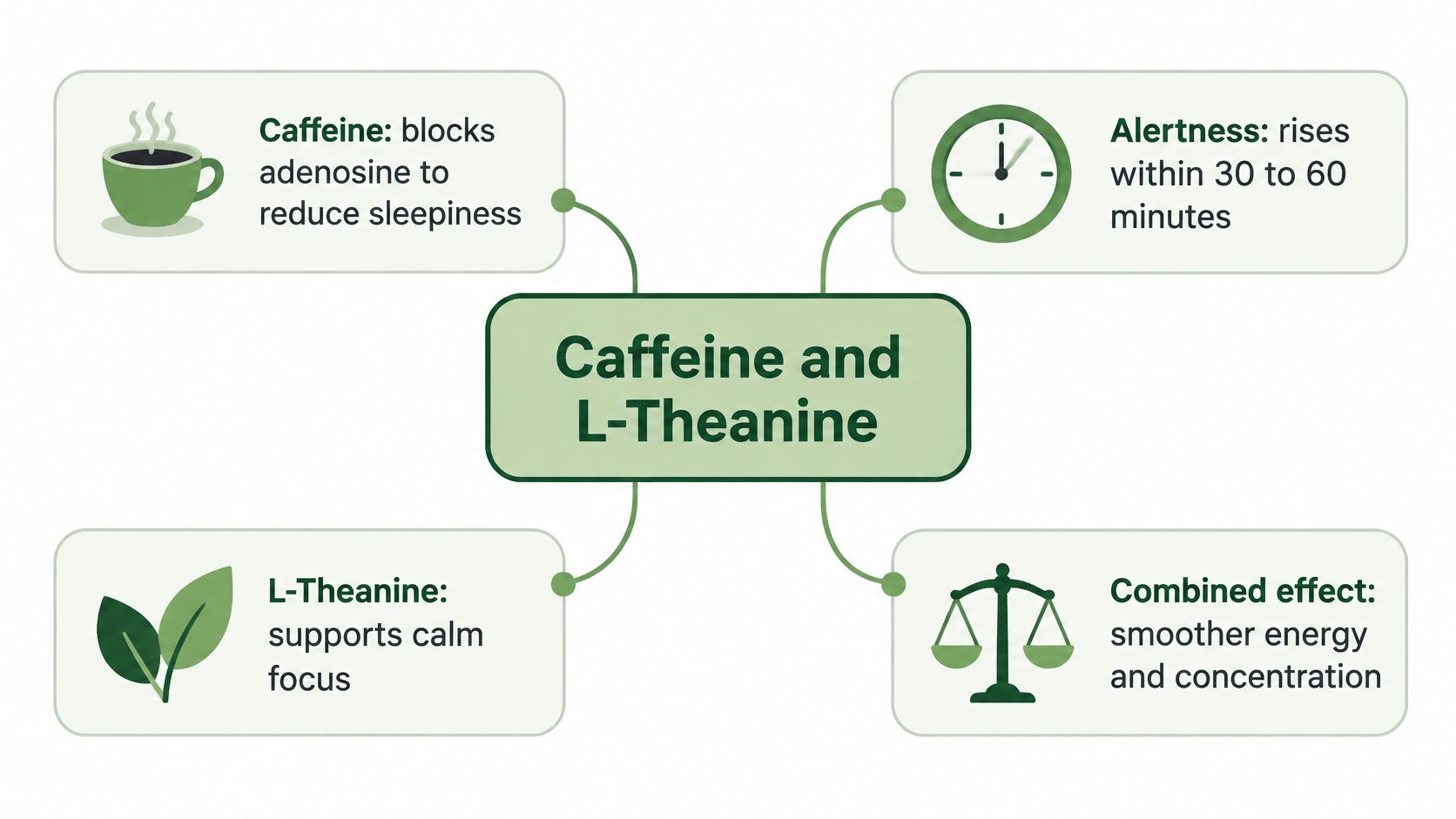
Caffeine is a mild stimulant that blocks adenosine, the chemical that builds through the day and makes you sleepy. Alertness often rises within 30 to 60 minutes.
Food Standards Australia New Zealand describes caffeine as naturally occurring in tea, with a long history of use as a mild stimulant. Matcha is that familiar stimulant in powdered form, not a new drug.
L-theanine is an amino acid found mainly in tea leaves and studied for relaxed alertness. If caffeine is the lead singer, L-theanine keeps the tempo steady. Our plain-language note on what L-theanine is covers the amino acid without turning it into a mood cure. Most trials are small and short, so the fair reading is a modest smoothing, not a guaranteed calm.
A morning cup versus a fast espresso
Say you drink matcha with breakfast, and a friend has a double espresso on an empty stomach. Many people find the matcha gentler. Some don't. Sensitivity, sleep and what you ate all change the feel.
The same caffeine can matter in sport. A FSANZ review of human trials covered cycling, running, rowing and swimming across 42 pairwise comparisons and a pooled 674 participants. It found a small time-trial improvement versus placebo. Tested doses ran from 1.25 to 9 mg per kilogram of body weight, with benefit noted from about 1.25–3 mg/kg and also around 6 mg/kg. For a 70 kg adult, that lower band is roughly 90 to 210 mg.
A smaller serving with food suits most people better than a large one drunk quickly.
What the Research Says About EGCg and Antioxidants
The popular claim is that matcha is a superfood because it is packed with antioxidants. The compounds behind that line are real. The disease-prevention leap isn't.
Catechins, mainly epigallocatechin gallate (EGCg), are polyphenols in tea leaves. You swallow the whole leaf, so a serve can carry a broader share of those leaf compounds than a strained cup. Lab and animal work has linked EGCg to antioxidant activity. That is why tins get bold slogans.
Australian guidance is firmer on caffeine than on a measured matcha antioxidant benefit. FSANZ's safety discussion of dietary caffeine notes that the amount you get hinges on powder quality, dose, storage, water temperature and preparation. Tea composition varies, so a universal EGCg number is not honest unless a lab has tested that batch. We keep a short explainer on what EGCg is for readers who want the compound, not a cure story.
Three checks before you trust a number
- Grade and origin: See whether the pack says ceremonial or culinary, and where the leaf was grown.
- Organic status: Look for certification printed on the label.
- Batch testing: If antioxidant content matters to you, ask whether that lot was tested. A pretty green colour isn't a lab result.
A brewed cup and a matcha serve both contain catechins. Matcha drinkers take in more of the leaf, so exposure can differ, still without a fixed score. FSANZ also notes that naturally occurring caffeine in tea isn't generally capped, while added-caffeine products face specific Australian and New Zealand rules. Portion control matters more than a superfood badge.
A short walk-through of the leaf compounds sits here if you want the chemistry in pictures rather than slogans.
Matcha can be one pleasant part of a diet that already has vegetables, fruit and whole foods. It isn't treatment, and it doesn't replace advice from your clinician.
Matcha Compared with Coffee and Green Tea
How much caffeine does matcha provide compared with coffee or green tea? The amount depends partly on how much powder goes into the cup: a traditional bowl uses less than a latte made with a full teaspoon.
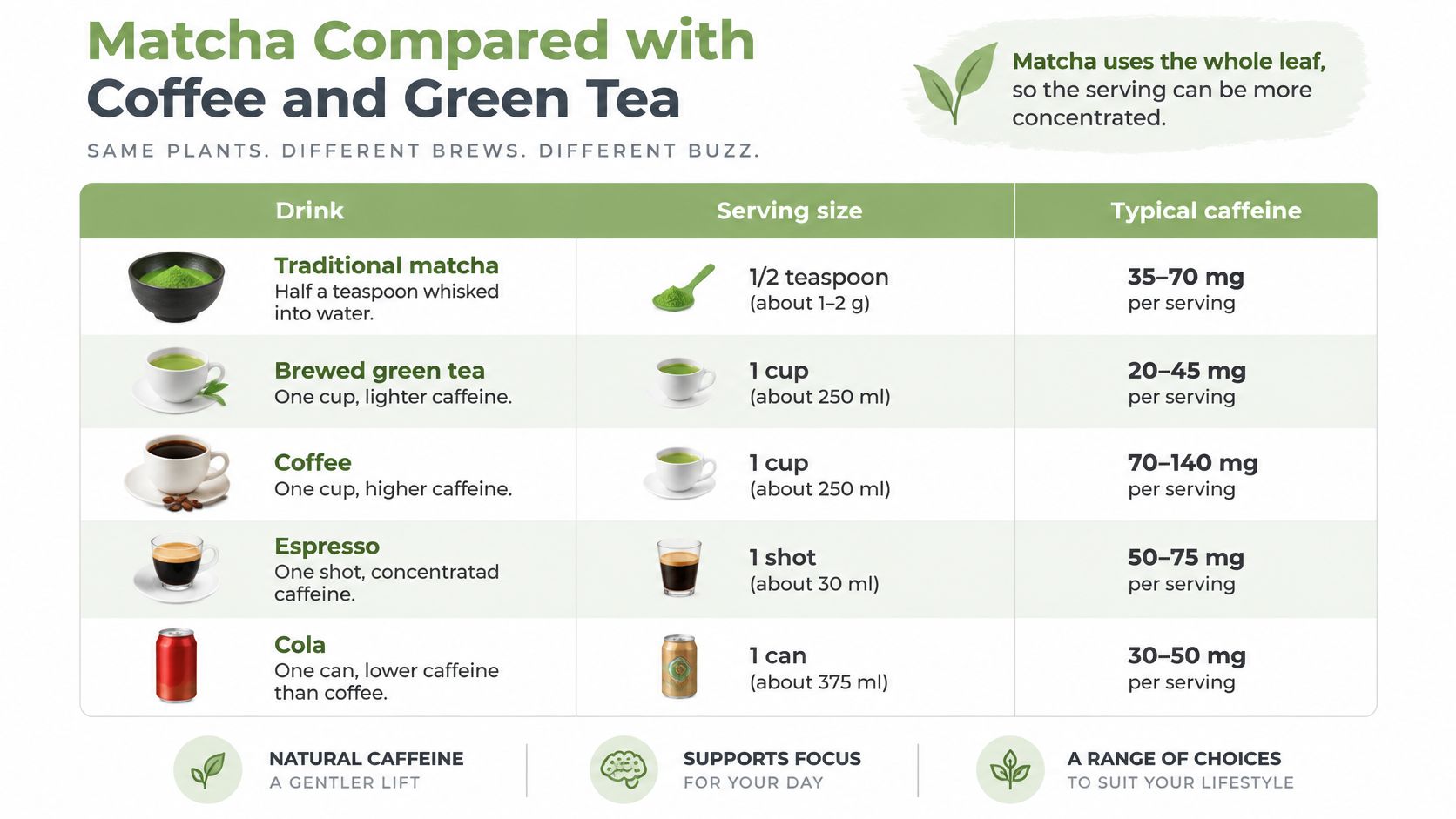
| Drink | Typical Serving | Typical Caffeine | What Stands Out |
|---|---|---|---|
| Traditional matcha | 1/2 tsp whisked in water | About 30–35 mg | Whole leaf consumed, no added sugar |
| Matcha latte | 1 tsp in 250 mL milk | About 60–70 mg | Milk adds protein and calcium; caffeine depends on the powder dose |
| Brewed green tea | 250 mL | 30–50 mg | Leaves are strained out before drinking |
| Espresso | 30 mL shot | About 60–70 mg | Concentrated caffeine in a small serving |
| Brewed coffee | 250 mL | About 80–100 mg | Typically more caffeine than a traditional matcha bowl |
| Cola | 375 mL can | About 35–40 mg | Often contains added sugar |
A half-teaspoon bowl provides a relatively modest caffeine serving. Using a full teaspoon in a latte roughly doubles the amount of matcha powder, bringing its caffeine closer to that of a small coffee. For a guide to café serving styles, compare popular café coffee drinks.
Three contrasts that change the choice
Matcha versus brewed green tea. Matcha is whisked into water, so you drink the powdered leaf rather than straining it out. Brewed green tea is an infusion, with the leaves removed before drinking.
Matcha versus coffee. A traditional matcha bowl usually contains less caffeine than a serving of brewed coffee. L-theanine is often associated with matcha's smoother-feeling lift, though individual responses vary.
Matcha versus sweetened drinks. Plain matcha powder has no added sugar. It can be a way to replace a sweetened drink, provided you do not add sugar or sweetened syrups.
These figures are guides, not fixed amounts. Powder dose and preparation affect the caffeine in your cup. Choose based on the serving you want: a smaller matcha bowl, a larger latte, coffee, or brewed green tea.
How Much Matcha Is Safe Each Day
A matcha serving counts toward your caffeine total, just like coffee, tea, cola and chocolate. Add up the day's drinks before deciding whether another cup fits.
| Group | Daily Caffeine Guidance | What It Means for Matcha |
|---|---|---|
| Healthy adults | Up to 400 mg a day, with no more than 200 mg in one intake | Count matcha alongside every other caffeine source |
| Pregnant or breastfeeding | Up to 200 mg a day in total | Include all drinks and foods that contain caffeine |
| Children | Under 2.5 mg per kg of body weight a day | For a 30 kg child, that is under about 75 mg |
| Caffeine-sensitive adults | Set a lower personal limit | Start with 1/4 tsp and notice how it affects sleep and anxiety |
The Australian Institute of Sport's caffeine guidance gives 30–50 mg as a typical range for a 250 mL cup of green tea. The amount depends on strength, cultivar and preparation. Matcha is powdered leaf mixed into the drink, so its caffeine content can differ from brewed green tea. The same guidance sets adult limits at 400 mg per day and 200 mg in one intake; during pregnancy or breastfeeding, the daily limit is 200 mg in total.
A day added up
Suppose a morning matcha latte contains about 65 mg of caffeine, two espressos about 130 mg, and a cola about 40 mg. That comes to about 235 mg before dinner. It is below the adult daily benchmark, but above the pregnancy and breastfeeding limit.
For children, Australian guidance recommends staying below 2.5 mg per kilogram of body weight a day (Australian Institute of Sport caffeine guidance). A 30 kg child's limit is therefore under about 75 mg. A matcha drink's caffeine varies with the amount of powder, so don't assume a child-sized cup contains a child-sized dose.
Practical rule: Keep your serving steady for a week, then check your sleep and how you feel before changing the amount.
If you are pregnant, breastfeeding or have been advised to limit caffeine, ask your clinician what daily amount is suitable for you. Caffeine-sensitive adults can start with a quarter teaspoon and adjust based on their response. If your aim is hydration rather than stimulation, water remains a straightforward choice; the HYDAWAY guide to hydration alternatives offers other drink ideas.
Choose the Right Matcha Grade for You
Choose the grade by the job, not by the brightest photo.
For a daily traditional cup, ceremonial grade is the one you taste on its own. Our Imperial grade organic matcha is ceremonial, first and second flush, and stone ground, which is what we use when the drink is just tea. For lattes, baking and smoothies, culinary grade keeps a bolder flavour against milk and heat. If you want the side-by-side in more detail, see ceremonial versus culinary matcha.
What to check while the market is loud
SBS News reported that Australia's matcha market generated more than A$54 million in 2024 and is projected to exceed A$81 million by 2030. Growth is a sales story. It isn't clinical proof.
Judge the tin instead:
- Origin and grade: Country of origin and a stated grade should be on the pack.
- Harvest and colour: A recent harvest and a bright green powder are better signs than a dull olive tin.
- Certification: Our organic matcha is certified organically grown by the Japanese Ministry of Agriculture, and the ministry's logo is on the back label.
Very cheap or unlabelled powder often tastes flat or bitter, and poor storage makes that worse. We pack organic matcha in 30 g, 100 g and 1 kg sizes so a home whisk and a busy café aren't forced into the same bag. Pick the grade that matches the drink you make.
How to Whisk Matcha and Use It in Recipes
A traditional bowl takes about a minute once the kettle has cooled off the boil.
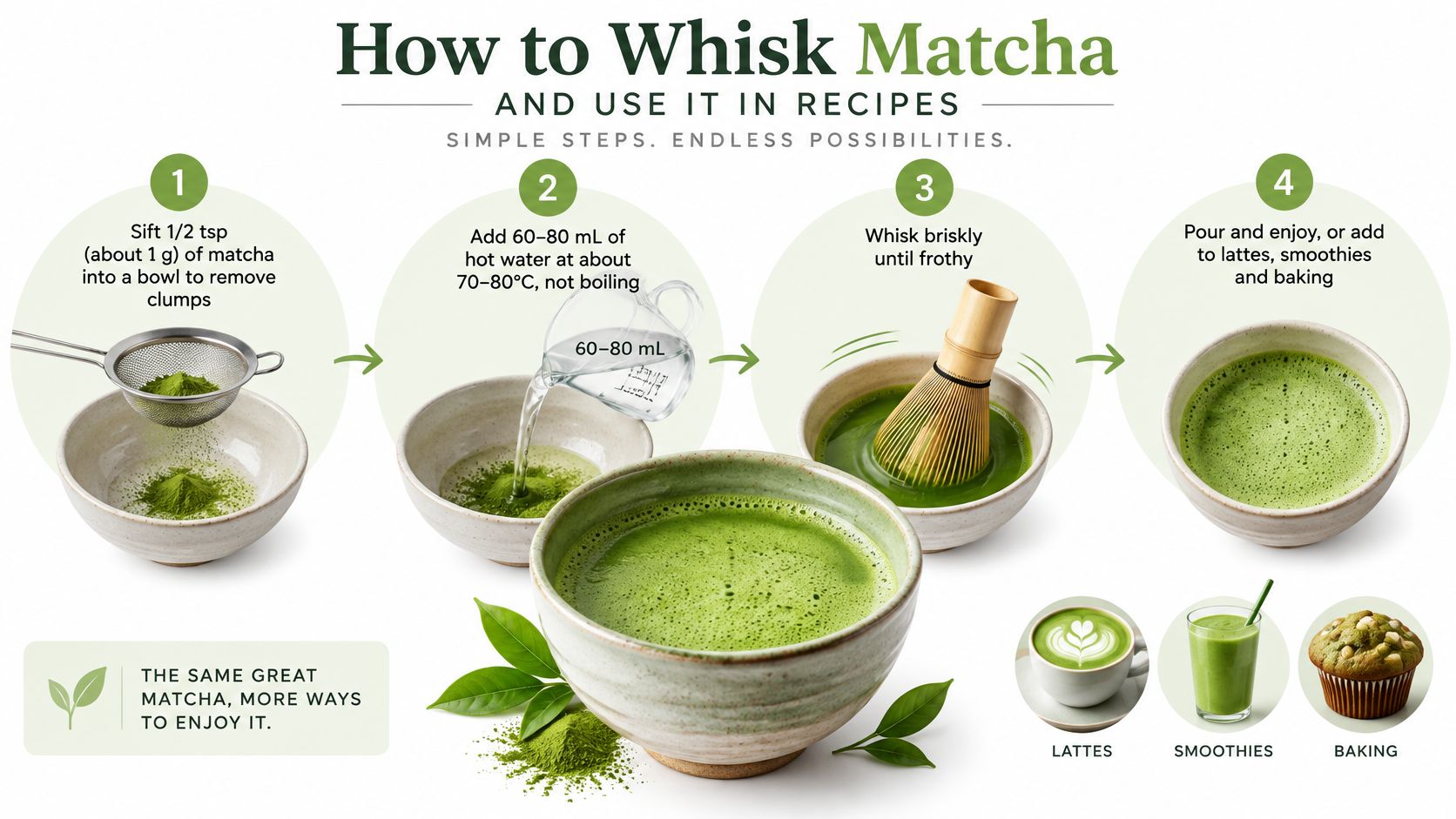
- Sift 1/2 tsp (about 1 g) into a bowl. Sifting breaks clumps the whisk would otherwise chase.
- Add 60–80 mL of water at about 70–80°C. Boiling water scorches the powder and turns it bitter.
- Whisk in a quick W or zigzag for 20–30 seconds with a bamboo whisk or a small milk frother, until a fine foam shows.
- Drink it while the foam is still fresh. It settles if you leave it.
Latte, smoothie, muffins
For a latte, whisk 1 tsp of culinary-grade powder with 30 mL of hot water into a smooth paste, then add 200–250 mL of steamed milk or a plant drink. Sweeten only if you want to, with a teaspoon of honey or maple syrup.
A smoothie is one teaspoon, a frozen banana and a splash of milk. For muffins, stir one teaspoon of culinary-grade powder through the batter. Culinary grade holds up to heat and dairy. Ceremonial grade is wasted there, because you can no longer taste the delicate cup it was made for.
Skipping the sift leaves lumps. A good bowl is bright green, with an even foam that holds for a few minutes.
Start a One-Week Matcha Routine
Use the week to notice how matcha fits your day, including its effect on sleep and energy.
- Days 1 to 3. Have one traditional cup in the morning, made with 1/2 tsp of ceremonial-grade powder. Take it with food.
- Days 4 to 5. If the caffeine feels comfortable, try a culinary-grade latte. Count its caffeine along with your other drinks against the 400 mg adult ceiling. If you are pregnant or breastfeeding, follow your clinician's limit instead.
- Days 6 to 7. Review your sleep, energy and nerves, then adjust the amount. If caffeine tends to make you feel wired, start with a quarter teaspoon.
If your sleep suffers or your heart feels busy, stop at one serve. Choose a dose and grade that make the drink comfortable to repeat.
Pep Tea is an Australian organic tea specialist offering Japanese ceremonial and culinary matcha, as well as sugar-free organic kombucha brewed in a purpose-built brewery in NSW. To choose a powder for your routine, visit Pep Tea and compare the grades.