
Tag: organic certification australia
Organic Farming Practices: Healthy Tea & Environment
You taste it before you know the reason. A bright matcha with a clean, grassy sweetness or a kombucha that finishes crisp rather than harsh usually starts with what happened in the paddock long before it reached your cup.
That's why organic farming practices matter. They don't just shape the environment around a farm. They shape flavour, purity, resilience, and the quality of the ingredients we drink every day.
What Organic Farming Really Looks Like
Early on an organic farm, the work doesn't begin with a spray rig. It starts with observation. Someone checks the soil underfoot, looks at the cover between rows, watches which insects are moving, and decides what the land needs next.
On a conventional farm, the quickest answer to a weed, pest, or nutrient issue can be an external input. On an organic farm, the question is different. The farmer asks how to strengthen the whole system so the problem is less likely to take hold in the first place.
That difference is bigger than the phrase “no chemicals” can capture. Organic farming practices exclude synthetic pesticides, herbicides, fertilisers, and genetically modified organisms, but they also rely on compost, crop rotation, biological pest control, and other natural methods that build soil health and biodiversity. In Australia, that approach isn't niche. The organic industry is valued at over $2.6 billion, and industrywide revenue was projected to reach $3.8 billion in 2024-25, growing at a compound annual rate of 10.1% over the preceding five years, according to research on Australia's organic sector.
What that looks like on the ground
- Soil gets fed first. Farmers add composts, plant green manures, and keep living roots in the ground where possible.
- Pests are managed as part of an ecosystem. Habitat, timing, and plant diversity matter just as much as any direct intervention.
- Fertility is planned over seasons. If you want a useful primer on the difference in approach, this guide on compare fertilizer types is a practical starting point.
Organic farming is less about withholding inputs and more about replacing shortcuts with stewardship.
That's why “organic” is more than a label. It reflects a whole way of growing food and drink ingredients, from vegetables and grains to the tea leaves used in a daily brew.
The Heart of the Farm Why Soil Health Is Everything
If plants had a digestive system, it would look a lot like soil.
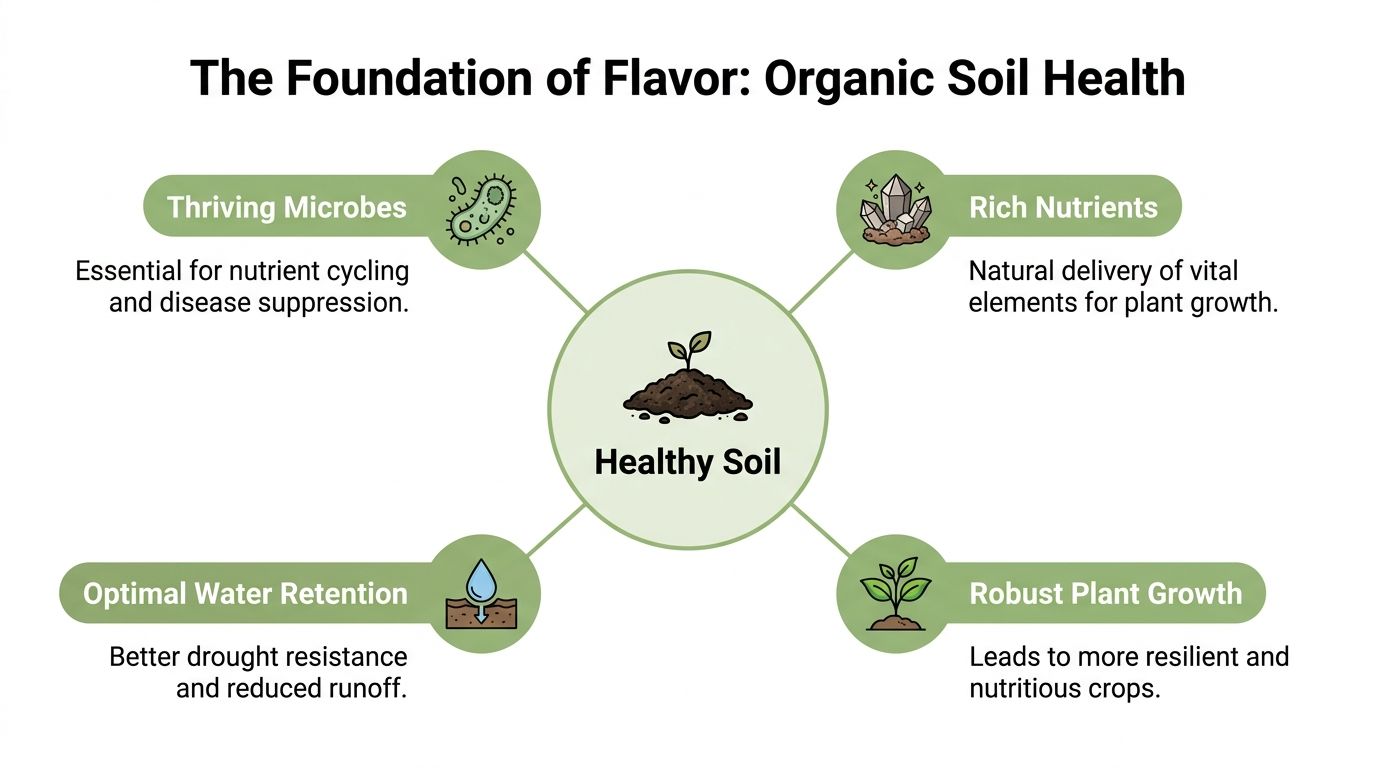
Healthy soil isn't just dirt holding roots upright. It's a living community made up of fungi, bacteria, worms, decaying plant matter, air pockets, minerals, and moisture. When organic farmers talk about feeding the soil, they mean feeding that entire underground community so plants can access nutrients steadily and naturally.
Soil works like a farm's gut
A healthy gut helps a person absorb nutrients well. Healthy soil does the same for plants. Microbes break down organic matter, help roots access minerals, and support stronger plant growth.
That microbial life is one reason organic systems matter so much. Charles Sturt University's overview of organic farming in Australia notes that organic farms support a 30% increase in species biodiversity and a 50% increase in beneficial microorganisms compared to conventional farms.
When readers get confused here, it's usually because “fertility” sounds like a bag of nutrients. In organic farming, fertility is also structure, biology, and timing. A plant can sit in nutrient-rich ground and still struggle if the soil is compacted, lifeless, or poor at holding water.
What builds living soil
Organic farmers usually combine several practices rather than relying on one silver bullet.
- Compost and organic matter improve structure and feed microbial life.
- Cover crops protect bare ground, reduce erosion, and return biomass to the soil.
- Minimal disturbance helps preserve fungal networks and soil structure.
- Diverse planting supports a more varied underground ecosystem.
For readers who want a broader view, these regenerative farming techniques are useful because they show how soil-building practices work together rather than as isolated tasks.
Practical rule: If a farming method only feeds the plant for the short term but weakens the soil over time, organic growers usually see it as the wrong trade-off.
Why synthetic fertilisers are avoided
Synthetic fertilisers can deliver nutrients quickly, but organic farming takes a longer view. The aim is to avoid replacing a living system with a chemical feeding schedule.
A simple comparison helps:
| Approach | Main focus | Likely long-term goal |
|---|---|---|
| Organic soil building | Feed the soil community | Resilient plants and stable fertility |
| Synthetic input model | Feed the plant directly | Fast correction of deficiencies |
That's why so much of the flavour story begins underground. A stronger root environment usually means stronger, steadier plant growth above ground.
Working with Nature Through Crop Rotation and Biodiversity
A good crop rotation works a bit like a varied diet. If you ate the same thing every day, your body would eventually struggle. Soil does too.
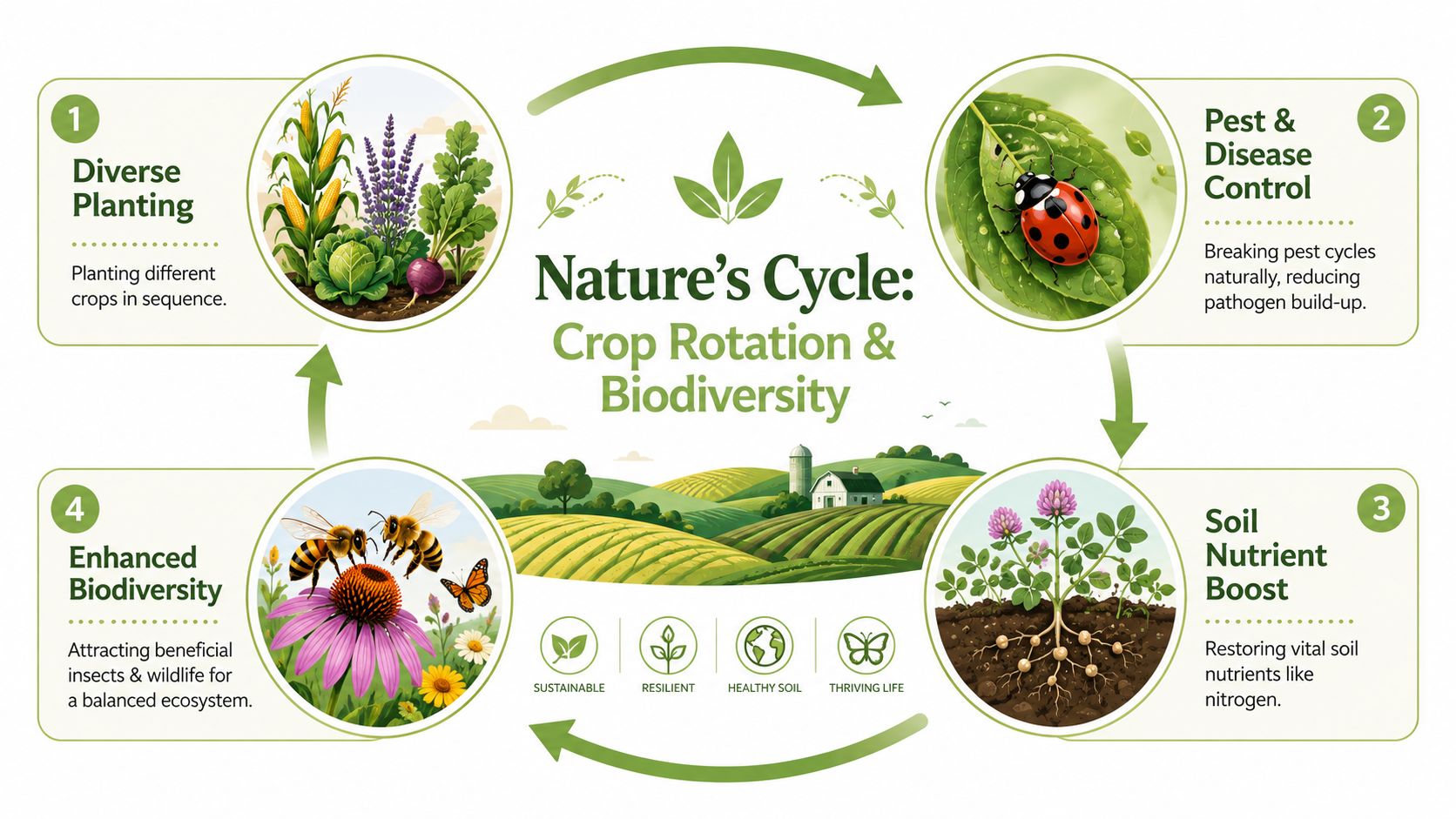
Growing the same crop in the same place year after year tends to pull on the same nutrients, attract the same pests, and encourage the same diseases. Organic farmers break that pattern by changing what grows where and when.
Rotation feeds the next crop
Some plants are heavy feeders. Others help restore balance. Legumes are especially important because they work with soil biology to support nitrogen availability.
Industry reporting on the Australian organic farming market notes that Australian organic farmers use legume-based crop rotation cycles to naturally inoculate soil with 40–60 kg of nitrogen per hectare annually, eliminating the need for synthetic nitrogen fertilisers and enhancing soil microbiome diversity.
That sounds technical, but the everyday version is simple. One crop prepares the ground for the next.
Rotation also interrupts pest pressure
Pests and diseases often depend on predictability. If a field keeps offering the same host plant, the problem can settle in. Rotation breaks that routine.
Consider this short comparison:
| If a farmer repeats one crop | If a farmer rotates crops |
|---|---|
| Pests find the same host again | Pest life cycles get interrupted |
| Nutrient drawdown stays narrow | Nutrient use becomes more balanced |
| Disease pressure can build in place | Disease carryover is reduced |
This is one reason organic systems often look more planned than people expect. The farmer isn't just deciding what to grow this season. They're deciding what condition they want the land to be in next season too.
Biodiversity isn't decoration
Biodiversity on an organic farm might include flowering borders, mixed planting, shelter for beneficial insects, or areas left specifically to support habitat. These features are practical, not ornamental.
- Pollinators need food and shelter. Flowering plants help bring them in.
- Beneficial insects need a home. If the farm supports predators, pest outbreaks are easier to keep in check.
- The whole farm becomes more stable. A diverse system tends to be less brittle than a simplified one.
A farm with biodiversity has more built-in helpers. A farm without it usually has to buy more solutions.
That logic matters all the way down the supply chain. Ingredients grown in a balanced system often arrive with a cleaner, less stressed origin story than ingredients produced through repeated chemical correction.
Natural Pest and Weed Management Strategies
Organic farmers don't ignore weeds or hope pests disappear. They manage both, but they use an integrated approach rather than a single broad chemical fix.
That's an important distinction. “Natural” doesn't mean passive. It means the response is usually more targeted, more observant, and often more labour-intensive.
How organic pest control works in practice
One method on its own rarely does the full job. Farmers combine strategies so each one supports the others.
- Beneficial insects can help keep pest populations in check. Ladybirds, lacewings, and other predators become part of the farm's working system.
- Companion planting can confuse, deter, or distract pests while supporting a more varied ecosystem.
- Physical barriers such as nets, row covers, or guards can protect vulnerable plants during key stages.
- Timing and monitoring matter. A farmer who spots an issue early usually has more non-synthetic options available.
Aphids are a good example. On a conventional system, the first move might be a spray. On an organic system, the response could involve habitat for predator insects, plant diversity, airflow, and close monitoring so the issue doesn't escalate.
Weed control takes planning and effort
Weeds are one of the clearest places where people underestimate organic farming practices. Without synthetic herbicides, weed control often depends on manual labour, mulching, mechanical cultivation, and tighter crop planning.
That has real consequences.
Organic weed management asks more from the farmer because it asks them to replace chemistry with attention, timing, and physical work.
Some growers suppress weeds by shading soil with cover crops. Others use stale seedbed techniques, mulch layers, or strategic cultivation before weeds become established. None of that is lazy farming. It's detailed farming.
Why this matters for food and drink quality
Pest and weed management affects more than yield. It affects plant stress, soil disturbance, and the amount of residue risk consumers want to avoid. For products people drink regularly, that cleaner production logic matters. You may not see it on the label, but it shows up in trust, flavour clarity, and how confidently a producer can stand behind what's in the final product.
Australian Organic Standards and Certification
Organic farming only builds trust if the claim means something.
In Australia, that's where certification becomes useful. It gives buyers a way to tell the difference between a product that sounds natural and one that has met a documented standard across production, handling, and processing.
What certification is actually checking
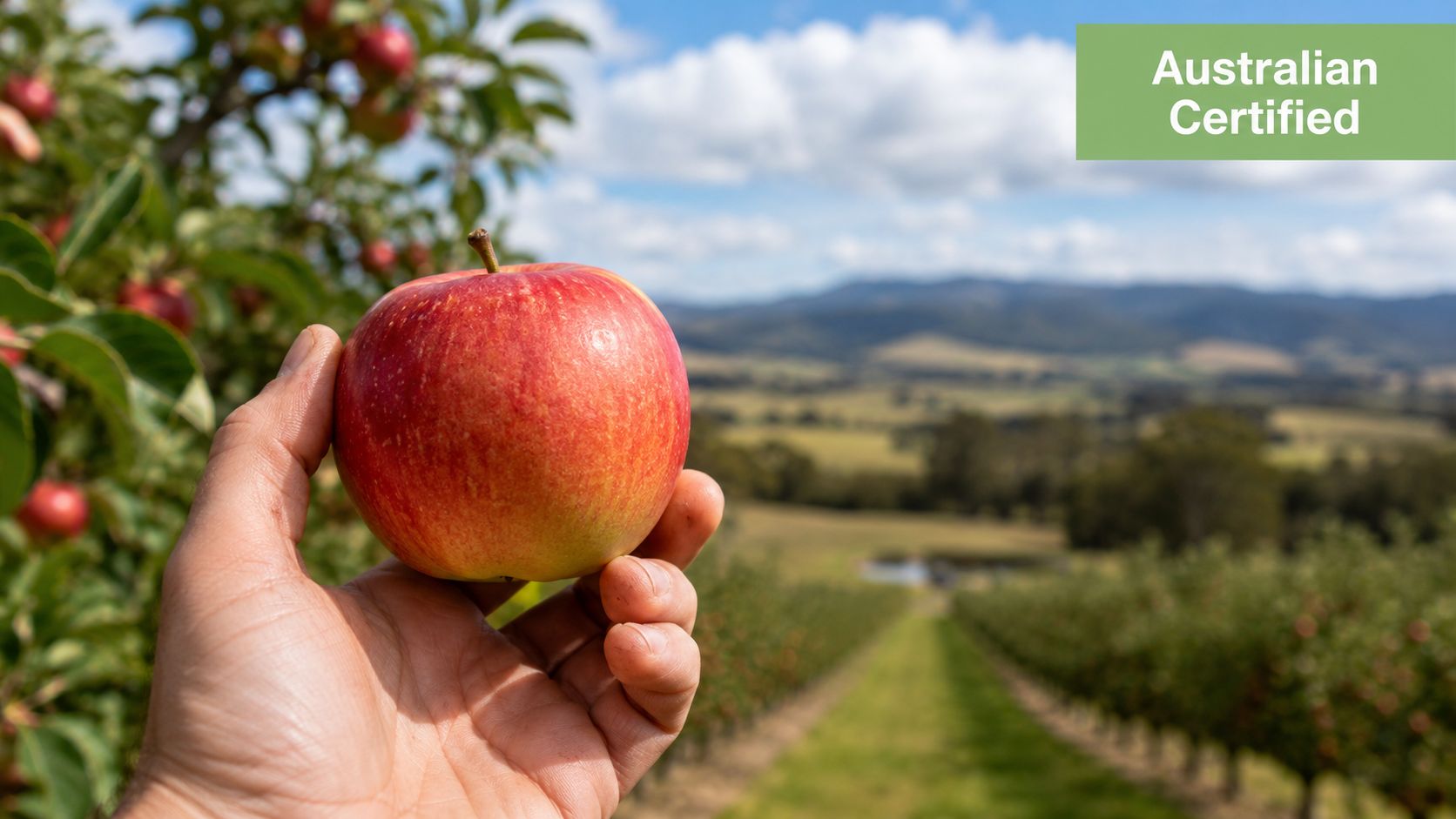
Organic certification is not just a quick farm visit. It's about integrity across the chain. That includes how crops are grown, how inputs are managed, how contamination is avoided, and how products are handled after harvest.
Consumers often assume “organic” only refers to the paddock. In practice, the claim is stronger when it follows the product from cultivation through to packing and delivery. If you'd like a plain-English overview of that process in an Australian context, this guide to organic certification in Australia is a helpful reference.
Why Australia's scale matters
Australia holds the world's largest area of certified organic farmland, with over 35.6 million hectares, representing approximately 51% of the global total, as noted in the earlier source on Australia's organic sector. That scale matters because it shows organic production here isn't a fringe experiment. It's part of a serious agricultural system with real infrastructure and experience behind it.
For buyers, that leadership matters in practical ways:
- It supports confidence. There's a well-established base of certified production.
- It improves market understanding. More producers, processors, and operators means a more mature supply environment.
- It raises expectations. Serious certification makes lazy greenwashing easier to spot.
What to look for on pack
A useful label should answer three questions.
| Question | Why it matters |
|---|---|
| Is there recognised certification? | It gives the organic claim substance |
| Is handling separated from non-organic product? | It helps prevent cross-contamination |
| Does the brand explain origin clearly? | Transparency usually signals stronger standards |
Certification matters most when it protects the whole chain, not just the field where the crop began.
That's especially relevant for products that are milled, brewed, fermented, packed, and shipped. The more steps involved, the more valuable a credible system becomes.
The Organic Difference in Your Matcha and Kombucha
When people talk about organic beverages, they often jump straight to health language. The more useful place to start is raw material quality.
Tea leaves absorb the conditions they're grown in. Fermentation responds to the quality of the ingredients it begins with. If the farming system is cleaner and more stable, the final drink usually has a better foundation.
Why organic standards matter for matcha
Matcha is unusually intimate as a tea. You're consuming the whole leaf in powdered form, not just an infusion. That's one reason growing standards matter so much.
Guidance on organic matcha production under JAS explains that organic matcha must be produced under Japan Agricultural Standard (JAS) Organic Certification, which requires tea leaves to be grown without synthetic pesticides, herbicides, or chemical fertilisers, and that farms maintain chemical-free soil for several years prior to certification.
That doesn't automatically tell you whether a matcha is vibrant, smooth, or suited to whisking straight versus blending into a latte. Grade, harvest timing, and processing still matter. For a practical consumer-focused breakdown, this guide on the difference between regular and ultimate Matcha tea powder helps explain what to look for beyond the word organic.
Why a clean tea base matters in kombucha
Kombucha starts with tea, water, and culture. Fermentation can develop lovely acidity and complexity, but it can't rescue poor starting ingredients.
A cleaner organic tea base gives the brew a simpler starting point. That matters for taste, but also for consistency. If you care about probiotic-rich drinks, low-sugar options, and the difference between properly fermented kombucha and overly sweet imitations, understanding the agricultural side helps you buy more wisely.
Here's a visual look at the broader connection between organic ingredients and tea culture:
Cleaner farming doesn't guarantee a better beverage on its own. It gives the maker a better starting point, and that's where quality usually begins.
What you can notice in the cup
- Matcha drinkers often look for colour and freshness. Bright green usually signals better handling than dull or yellowing powder.
- Kombucha drinkers often notice finish. A well-brewed organic kombucha tends to taste clean and deliberate rather than muddy or syrupy.
- Both reward ingredient integrity. The less the producer has to hide, the more the base ingredient can speak for itself.
A Buyer's Guide to Sourcing and Supporting Organic
Buying organic well is less about chasing marketing words and more about asking better questions.
For everyday shoppers, that starts with the pack. For cafés, retailers, and hospitality buyers, it also includes supplier transparency, consistency, and how clearly the product's story can be passed on to customers.
What consumers should check first
A quick label scan can tell you a lot.
- Look for recognised certification. If the organic claim is serious, there should be clear evidence behind it.
- Check the ingredient list. Simpler lists are easier to understand and compare.
- Notice product type. Matcha for straight whisking and matcha for baking or lattes may both be organic, but they're not interchangeable.
- Read beyond buzzwords. Terms like “natural” can sound reassuring without meaning much on their own.
If you're shopping for tea specifically, browsing a specialist range of organic green tea online can help you compare product descriptions, origins, and intended uses side by side.
What cafés and hospitality buyers should ask suppliers
A café menu has limited space. Every drink needs a reason to be there.
Ask practical questions such as:
- Is the product certified organic through the supply chain?
- Is the matcha intended for ceremonial use, lattes, or kitchen prep?
- Is the kombucha properly fermented, and how is flavour balance handled?
- Can the supplier explain origin, processing, and storage clearly?
Why the higher price can make sense
Organic products can cost more because the farming often requires more labour, more planning, and more careful handling. That price difference isn't just about a badge on the front. It reflects slower fertility building, non-synthetic pest control, and tighter product integrity.
Buy organic because you understand the system behind it, not because the label sounds fashionable.
Support for organic farming is also support for growers who choose to work with soil biology, biodiversity, and long-term land health rather than short-term extraction.
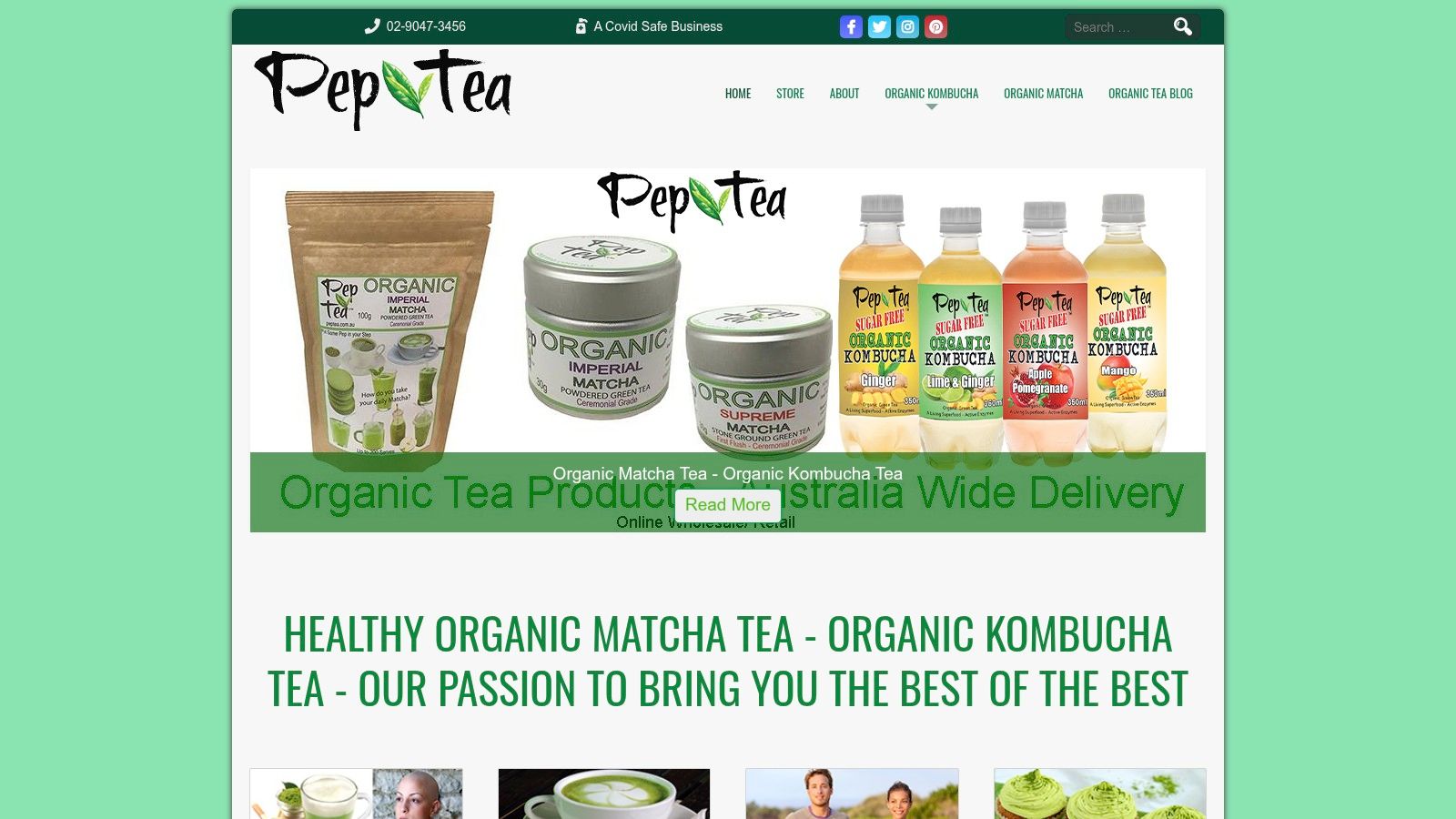
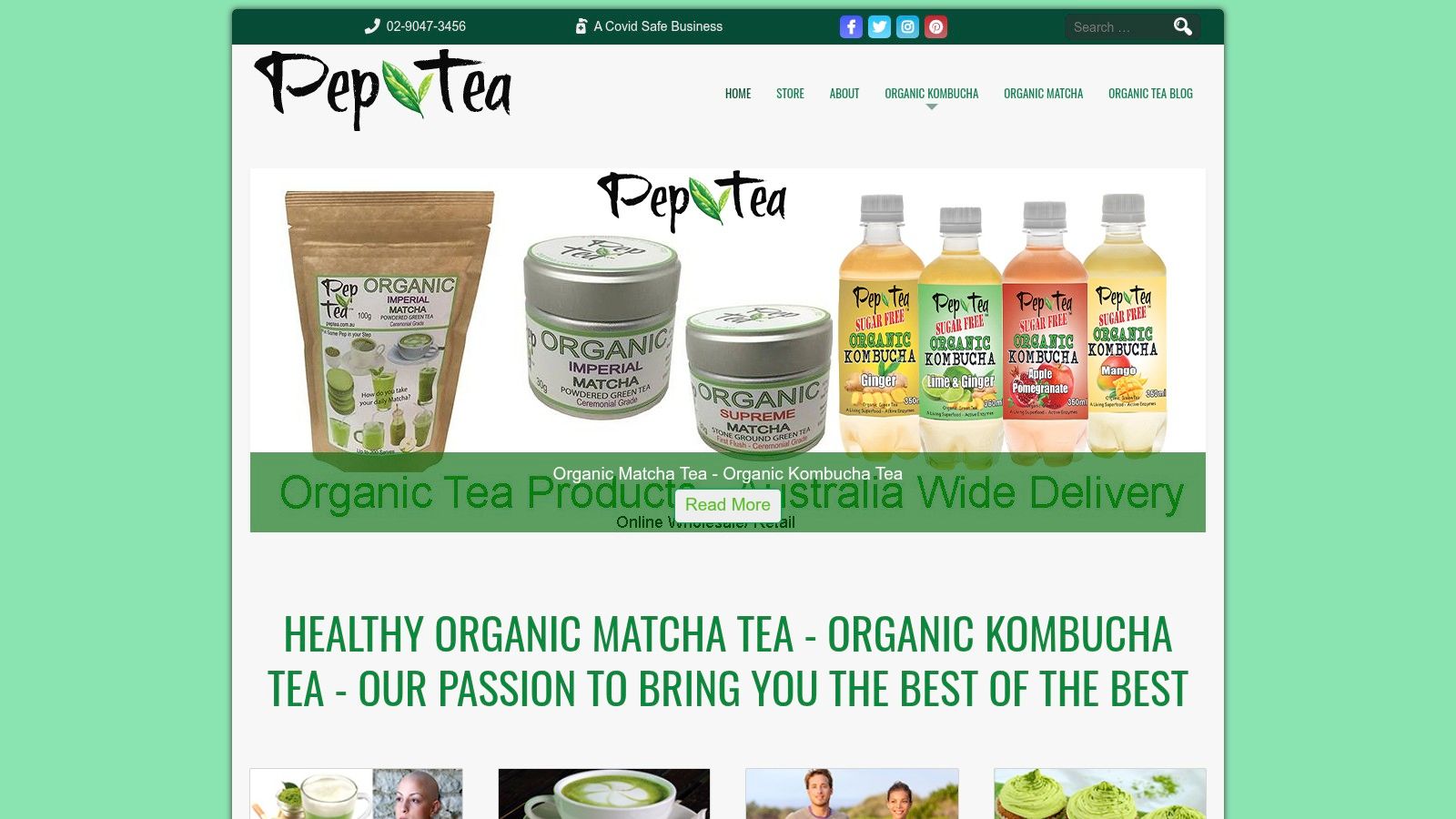
If you'd like to put these ideas into practice, explore Pep Tea for certified organic options across premium matcha and Australian-brewed kombucha. It's a simple way to choose beverages that align with cleaner farming, careful sourcing, and everyday wellness.
Organic Certification Australia: Your 2026 Guide
You've probably been here already. You've sourced organic tea, refined a kombucha recipe, designed a clean label, and started talking to cafés or retailers. Then the hard question lands: do you need organic certification, or is being careful with ingredients enough?
That's where many Australian beverage brands get stuck. The rules aren't always obvious, the terminology can feel bureaucratic, and buyers often use “organic” to mean very different things. For a matcha brand, a kombucha brewer, or a café choosing what to stock, the difference between organic ingredients, certified organic product, and a general organic claim is more critical than often perceived.
At Pep Tea, we spend a lot of time helping people sort through that confusion in a practical way. We work in a category where trust matters. Our premium Japanese organic Matcha and Australian-brewed sugar-free organic Kombucha sit in a part of the market where customers care about quality, clean ingredients, authenticity, and a product story they can believe. That makes organic certification Australia an important topic, not just for producers, but also for cafés, wholesalers, and retailers who want confidence in what they're putting on shelf or menu.
Is Organic Certification Worth It for Your Brand
A small beverage founder launches a new ginger kombucha. The tea is organic. The sugar source is chosen carefully. The fermentation process is dialled in. Early customers love it. Then a retailer asks a simple question: “Is it certified organic?”
That moment changes the conversation. It's no longer only about flavour, wellness positioning, or packaging. It becomes a trust question.
What certification changes in practice
For many small brands, certification can feel like admin layered on top of a busy production schedule. But in practice, it often works as a business signal. It tells buyers that someone independent has checked your systems, ingredients, and records.
That matters in Australia because the local organic sector is not small or fringe. Australia is a global leader in certified organic farmland, managing the largest share of the world's certified organic agricultural area. In 2018, Australia reported 35.7 million certified organic hectares, representing about half of the world's total at the time according to research on Australia's certified organic land area.
For a beverage brand, that scale sends an important message. Organics in Australia aren't a niche side category. They're part of a mature system with recognised standards, audits, and established buyer expectations.
When it's worth it
Certification tends to be more valuable when you're selling into channels where proof matters as much as the product itself.
- Retail shelves: Buyers often want clarity they can defend if customers ask questions.
- Hospitality supply: Café owners need products that fit their menu values and are easy for staff to explain.
- Premium positioning: If your label leans on purity, quality, and natural wellness, certification can support that message.
- Future flexibility: Brands that start with tighter systems often find later growth easier to manage.
Practical rule: If “organic” sits near the centre of your brand story, certification usually deserves serious consideration.
That doesn't mean every brand needs to rush into it on day one. Some businesses start by tightening sourcing and documentation first. Others certify early because they know they want stronger retail access or export options later.
For tea, matcha, and kombucha brands, the bigger question isn't whether certification is merely symbolic. It's whether your current proof matches the promise on your label.
Understanding Australian Organic Standards
When shoppers see “Certified Organic” on a pouch of matcha or a bottle of kombucha, they often assume somebody tested the final product and ticked it off. That's only part of the picture. In Australia, the system goes much deeper.
It's a process standard, not just a product claim
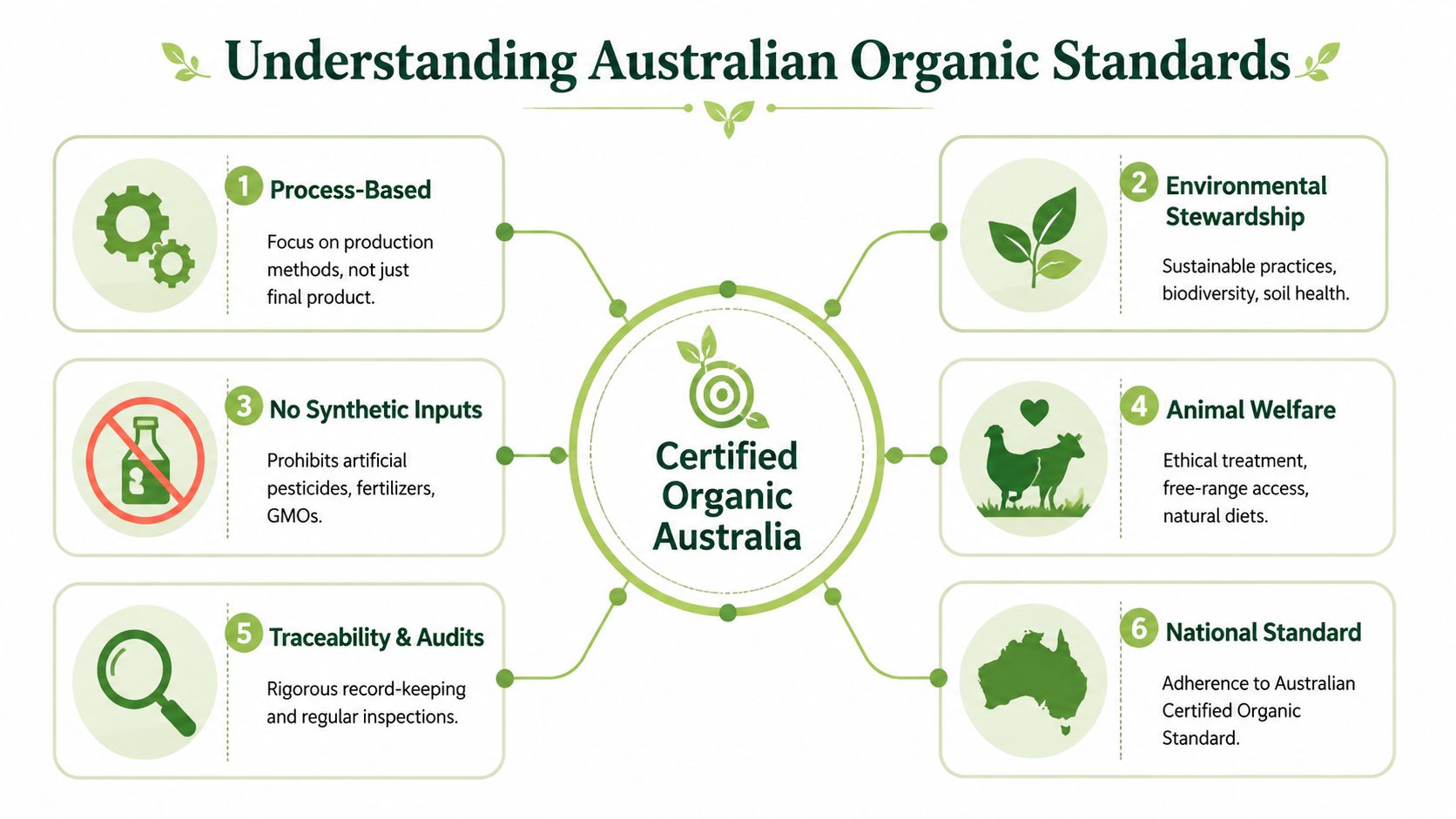
Australian organic certification is a process standard, which means auditors assess how a product is grown, handled, processed, stored, and traced through the supply chain. The checks cover inputs, animal welfare, biodiversity, and traceability under frameworks such as the National Standard for Organic and Bio-Dynamic Produce, as outlined in this explanation of Australian organic audit systems.
A simple way to think about it is a recipe with supervision at every stage. It's not enough for the final cup of matcha to look green and clean. The system asks where the leaves came from, what happened during growing, how they were processed, how they were packed, and whether records support every step.
The two standards most brands hear about
Australian brands usually come across two key frameworks.
National Standard for Organic and Bio-Dynamic Produce
This is the core export framework. If a product is being exported from Australia as organic, this standard matters in a very direct way.
It shapes how certifiers assess compliance and gives structure to the claim behind exported organic goods.
Australian Standard for Organic and Biodynamic Products
This standard, often referred to as AS 6000, is used in the domestic market and for imports. It helps create consistency for products sold within Australia, even though domestic certification rules work differently from export requirements.
Why beverage brands need to understand both
Tea and kombucha businesses sit in an interesting spot. They often rely on multiple ingredients, multiple suppliers, and processing steps that have to stay organised. That's why standards matter even if a brand starts small.
For example, a brand blending ceremonial-grade or culinary-grade matcha, bottling kombucha, or supplying cafés needs traceability that can stand up to buyer questions. If you want a plain-language introduction to how organic tea fits into that bigger picture, our guide on what organic green tea means is a useful starting point.
Certified organic isn't just a nice phrase on packaging. It's the result of a documented system that follows the product from paddock to plate.
What buyers are really relying on
When a café stocks an organic matcha for lattes or a retailer ranges an organic kombucha, they're trusting more than the ingredient list.
They're trusting that:
- Inputs were checked: The ingredients fit the standard.
- Handling was controlled: Organic and non-organic materials weren't mixed carelessly.
- Records exist: The brand can prove what went into each batch.
- Auditing happened: An independent body reviewed the process.
That's the core of organic certification Australia. It's less about marketing language and more about verified systems.
The Path to Getting Your Products Certified
The certification process feels intimidating until you break it into pieces. Most beverage brands don't struggle because the steps are impossible. They struggle because they try to understand everything at once.

Step one is getting your paperwork aligned
Before an auditor visits, a certifier usually wants a clear picture of your business. That includes what you make, where ingredients come from, how products move through your site, and how you separate any non-organic materials if they exist in the same facility.
For a kombucha producer, that might include your organic tea source, any flavour inputs, cleaning procedures, bottling flow, and batch records. For a matcha business, it often includes supplier certificates, packing or repacking details, and storage controls.
A good starting point is a practical overview like Pep Tea's guide to organic certification standards, which helps translate the rules into product-level decisions.
Your management plan matters more than people expect
Most certifiers want a written plan that explains how you maintain compliance. Think of it as your operating playbook. It should show that your team knows what to do, not just what to say.
Your plan usually needs to cover:
Ingredient sourcing
Which suppliers provide certified organic ingredients, and how you verify those claims.Production flow
How ingredients enter the site, where they're stored, and how batches are made.Cleaning and separation
What prevents cross-contact if organic and non-organic materials are both present.Labelling control
How you avoid using the wrong artwork, claims, or certification references.
What the audit actually checks
Organic certification in Australia typically follows an annual audit cycle, with on-site inspections and detailed record-keeping of inputs, practices, and sales to support traceability and consumer confidence, as described in this overview of organic certification practice.
That sounds formal, but on the ground it often comes down to organised evidence. Auditors want to see whether the story on your label matches how your operations are conducted.
They may review:
- Purchase records
- Batch sheets
- Storage areas
- Packaging and labels
- Sales records
- Cleaning logs
- Supplier documentation
Here's a short video that gives helpful visual context around certification thinking and process.
Small systems make audits smoother
The brands that cope best with certification usually aren't the biggest. They're the most organised.
Keep records as you go. Rebuilding batch history from old emails and invoices is where small teams lose time.
For beverage brands, simple habits help a lot:
- Save supplier certificates in one place
- Assign batch codes consistently
- Match sales records to production lots
- Train staff on what “organic” means in your facility
Certification is thorough, but it's not mysterious. It rewards businesses that can show their work.
Choosing Your Organic Certifying Body
Once you decide to pursue certification, the next question is who you'll work with. In Australia, the Department of Agriculture, Fisheries and Forestry accredits multiple certification bodies for organic systems used in export settings, and the market also recognises several established certifiers more broadly through domestic schemes and industry practice.
For most small beverage brands, the choice isn't about finding the “right” standard from scratch. It's about choosing a certifier whose process, support style, and market recognition fit your business.
What to compare before you sign up
Some certifiers are more familiar to supermarket buyers. Others may feel more approachable for smaller operators. Some have stronger recognition in conversations around future export readiness.
Look closely at:
- Your sales channel. Grocery, hospitality, and wholesale buyers may recognise different logos more readily.
- Support style. New applicants often need practical answers, not just policy documents.
- Paperwork expectations. Some businesses prefer a more guided onboarding process.
- International ambitions. If export is on your horizon, ask how the certifier handles equivalence and documentation.
Major Australian Organic Certifiers at a Glance
| Certifier | Market Recognition | Best For | International Equivalence |
|---|---|---|---|
| Australian Certified Organic (ACO) | Widely recognised in Australian retail and by many consumers | Brands seeking strong logo recognition on-pack | Ask directly about destination-market recognition and export pathways |
| NASAA Certified Organic (NCO) | Well known across organic agriculture and processing | Producers wanting an established certifier with broad sector familiarity | Ask directly about export documentation and partner-market acceptance |
| Australian Organic | Familiar within the domestic organic conversation | Brands comparing domestic positioning and support | Confirm how its certification pathway aligns with your market plans |
A few smart questions to ask
Before choosing, send each certifier the same short list of questions. Their replies often reveal a lot.
Ask things like:
- How do you handle mixed facilities?
- What records do beverage brands usually need ready?
- How do you support first-time applicants?
- What does your review cycle look like if labels change?
A certifier is not just an auditor. For many small brands, they become part of the operating rhythm of the business.
If you brew kombucha, repack tea, or manage several SKUs for cafés and retail, the practical fit matters as much as the logo itself.
A Practical Checklist for Food and Beverage Brands
A lot of certification stress can be avoided before the application starts. If your systems are loose, certification will feel painful. If your systems are tidy, the process becomes much more manageable.
Your pre-certification checklist
Australia's organic sector includes over 3,000 certified operators, supports more than 5,500 jobs, and is valued at A$3.8 billion in 2024-25. In the same reporting, 39% of shoppers said they would avoid an organic product without a certification logo, according to Australian organic market reporting.
That makes readiness more than a compliance issue. It's a commercial one.
Sourcing
- Confirm ingredient certificates: Make sure every key ingredient you want to describe as organic has current supporting documentation from suppliers.
- Check continuity: One certified input isn't enough if you can't maintain supply across future batches.
- Review packaging claims: Your labels should match the certification status of the finished product, not just one ingredient.
Operations
- Map your batch flow: Know what arrives, where it's stored, how it's used, and what leaves the site.
- Separate materials clearly: If your facility handles different product types, storage and production need to stay organised.
- Train your team: Staff should know what paperwork matters and what claims they can't make casually.
Commercial readiness matters too
Certification should support the way you sell. That means asking whether your likely customers will value it and whether it helps you hold your position in a premium segment.
For beverage brands, useful prompts include:
- Will cafés ask for proof before ranging your product?
- Will retailers want a logo they can trust quickly?
- Does your pricing rely on a premium organic position?
- Are you building toward larger wholesale or export conversations?
Keep your proof close
The easiest businesses to audit are usually the ones that already run clean admin.
If you can trace one bottle of kombucha or one pouch of matcha from supplier document to customer invoice, you're in a strong position.
That's especially relevant in categories like sugar-free kombucha and premium matcha, where customers often care about ingredient integrity and process quality at the same time.
Reading the Label A Guide for Cafes and Retailers
If you buy for a café, health food store, or grocery range, “organic” on a product label shouldn't end your due diligence. It should start it.
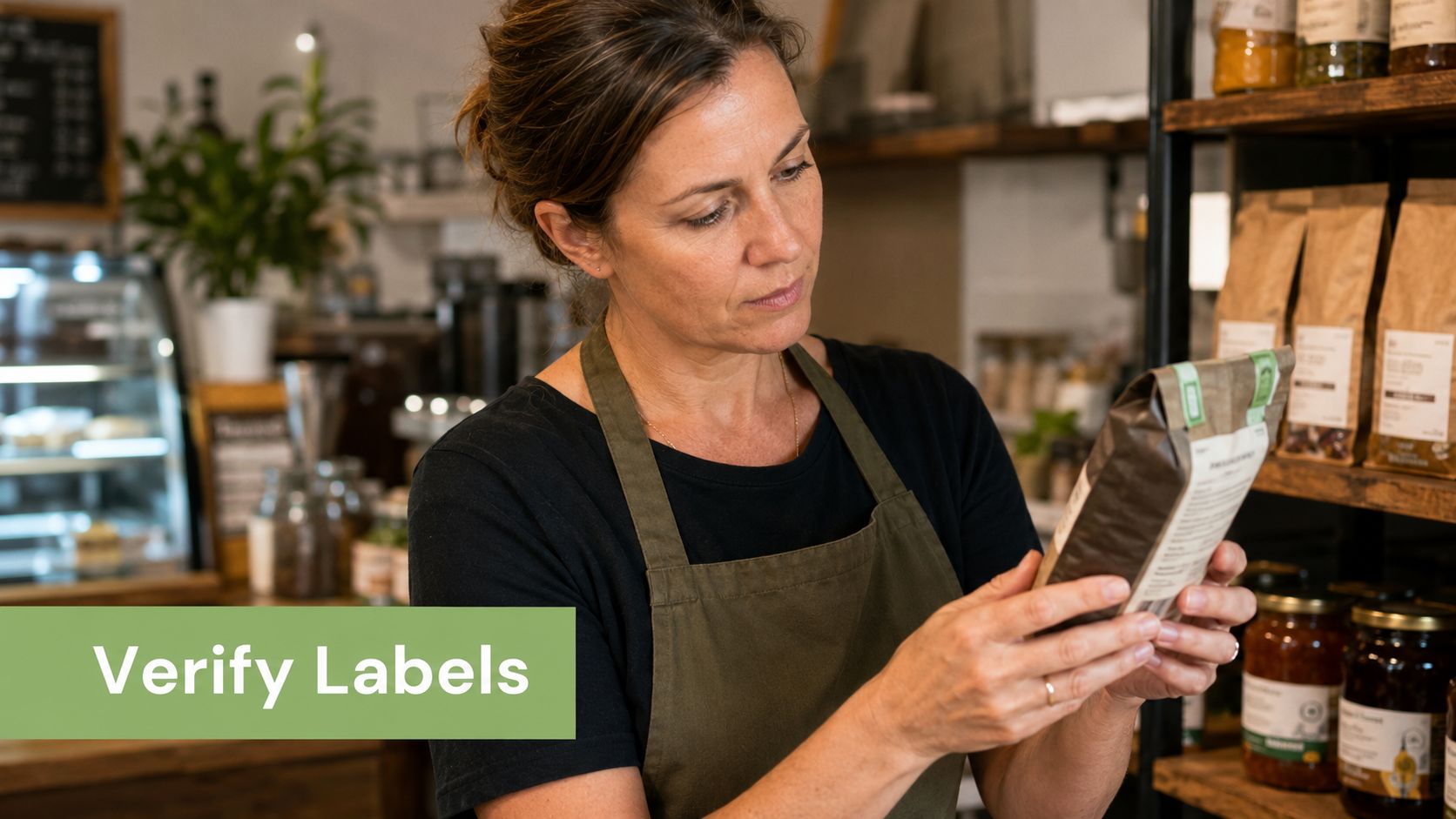
Why buyers need to check more closely
The ACCC confirms that organic certification is not mandatory for domestic products, but businesses must still be able to substantiate organic claims. That creates confusion for retailers who may struggle to tell the difference between a substantiated claim and a fully audited certified product, as noted on the ACCC page about organic claims.
For buyers, that means two products can both reference “organic” in some way while offering very different levels of assurance.
What to look for on-pack
A careful buyer should check for more than attractive green packaging or wellness language.
Look for:
- A certification logo: This is often the quickest visual cue that a product has gone through formal auditing.
- Clear product description: “Made with organic ingredients” is not the same as a certified organic finished product.
- Supplier backup: Ask for current certification documents if the claim matters to your menu or shelf standards.
- Consistency across materials: Label, website, sales sheet, and invoice language should line up.
If you're buying tea for a café menu or retail shelf, browsing products through a clear product page such as buying organic green tea online can make it easier to compare what's stated openly versus what needs follow-up.
The risk of being too casual
If your venue markets itself around clean living, premium ingredients, or natural wellness, vague organic claims can create brand risk. Staff may repeat supplier claims to customers without knowing whether those claims are certified, self-substantiated, or only ingredient-level.
That matters in beverage service. Matcha lattes, bottled kombucha, and wellness drinks are often sold with a story. If the story is fuzzy, customers notice.
Ask one simple question: “Is the finished product certified organic, and can you send the current proof?”
A safer buying habit
For cafés and retailers, the safest approach is straightforward:
- Request the certification detail.
- Check that the claim applies to the finished product.
- Keep supplier documentation on file.
- Review again when products, labels, or suppliers change.
That extra step protects your business and helps customers trust what you pour, stock, and recommend.
Your Organic Certification Questions Answered
Do I need certification to call a product organic in Australia
Not always for domestic sales. A business can make organic claims domestically if those claims are truthful and can be substantiated. The challenge is that substantiation without formal certification can be harder to communicate clearly to buyers and customers.
Is certified organic the same as using organic ingredients
No. A product can contain organic ingredients without the finished product itself being certified organic. That distinction matters a lot for processed beverages like kombucha, ready-to-drink tea, and blends with multiple inputs.
How often does certification get checked
Certification in Australia commonly works on an annual audit cycle, with inspections and record review forming part of the process. Businesses need to maintain records throughout the year, not just tidy things up when an audit is due.
What usually trips small brands up
Most problems come from documentation gaps, unclear supplier records, inconsistent labels, or poor batch traceability. The ingredient quality may be fine, but the paper trail doesn't back it up strongly enough.
Does certification matter for cafés if they aren't manufacturing
Yes, because cafés still make buying and menu claims. If a venue says it uses organic matcha or stocks organic kombucha, it should understand whether the supplier claim is certified and current.
Is certification worth it for a small beverage brand
Often, yes, if organic is central to your positioning and you want stronger credibility with retailers, hospitality buyers, and health-conscious customers. If you're not ready yet, getting your sourcing and record-keeping in order is still a smart move.
What about export later on
That's where early discipline helps. Brands that align their systems with recognised standards from the start usually have an easier path when export becomes realistic.
If you're building a beverage brand or choosing products for your café, we're always in favour of clearer proof and better questions. Explore Pep Tea for organic Matcha, sugar-free organic Kombucha, and practical guidance for Australian businesses and wellness-minded customers who want confidence in what they drink.