
Tag: kombucha fermentation
What Is Kombucha SCOBY Used for: A Practical Guide

You've opened a jar of kombucha and found a pale, rubbery disc floating on top. It may look unusual, but that pancake-like layer is part of the culture that turns sweet tea into kombucha. The more useful question isn't only what is kombucha SCOBY used for, but also what you should do with it once your jar produces more than you need.
A SCOBY can start another brew, support a vinegar-style ferment, live in a storage jar known as a SCOBY hotel, or go into the compost when it's past its useful life. It can also be explored as a cellulose material, although home reuse requires careful food-safety judgement. The key is understanding the difference between the visible pellicle, the acidic starter liquid and signs of contamination.
What a Kombucha SCOBY Actually Is
A SCOBY means Symbiotic Culture Of Bacteria and Yeast. In a kitchen jar, it usually appears as a cream, pale brown or translucent rubbery disc floating on the surface of fermented tea. Some cultures sink, split into layers or form uneven patches. Those variations don't automatically mean anything is wrong.
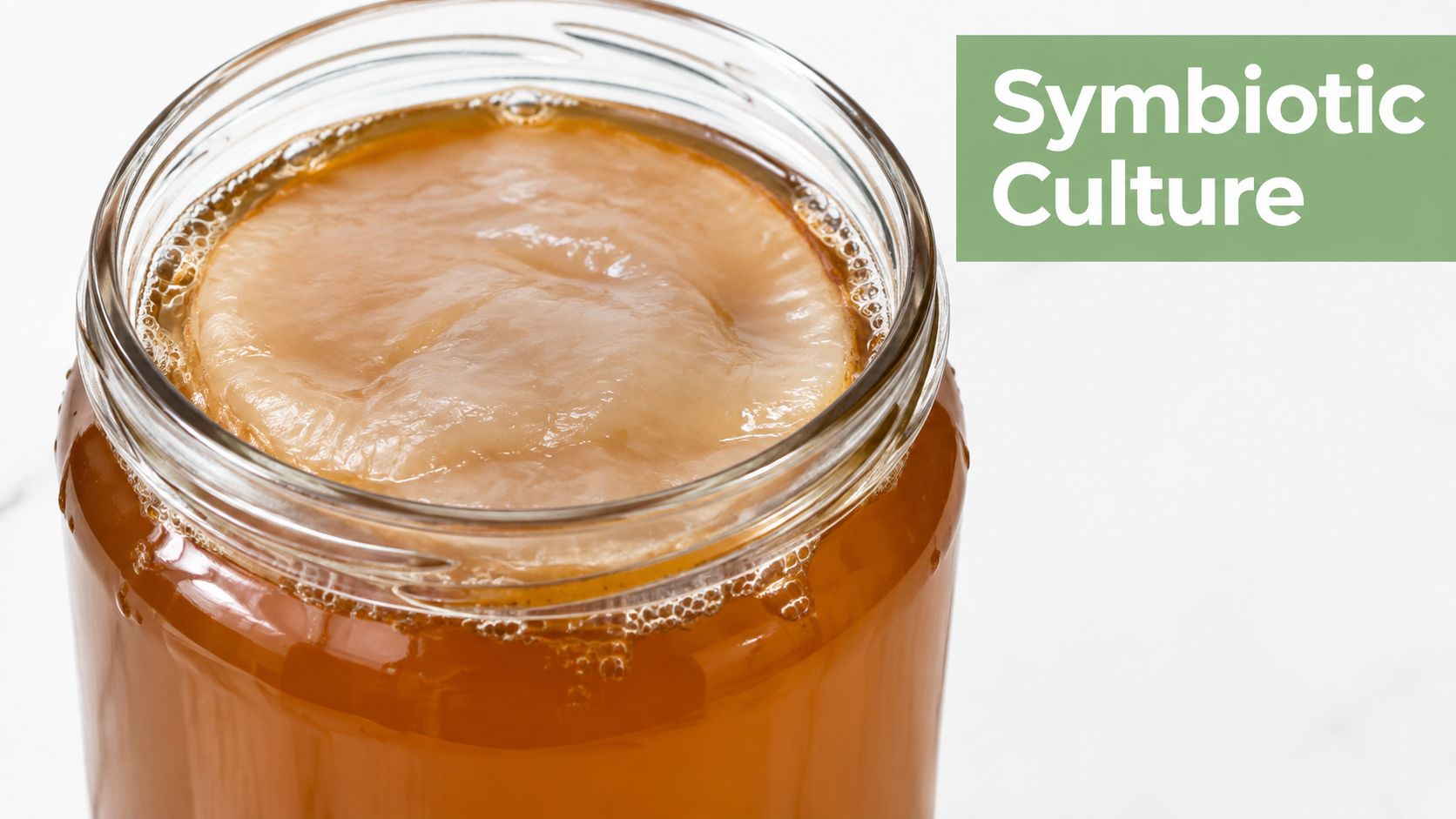
A helpful analogy is a living apartment building. Yeasts occupy the culture first, breaking down sugar and producing ethanol and carbon dioxide. Acetic acid bacteria then use the ethanol and convert it into acetic acid, which gives kombucha its familiar tartness. Australian material describes SCOBY communities as including acetic acid bacteria such as Komagataeibacter, Gluconobacter and Acetobacter, together with lactic acid bacteria such as Lactobacillus and Lactococcus. You can read more about fermented foods and their place in the diet in this Skin Perfection fermented food guide.
The pellicle is only part of the culture
The solid disc is called the pellicle. It's a cellulose mat produced by bacteria as they grow at the tea's air surface. The mat gives the culture its recognisable shape and may offer a protective home for parts of the microbial community.
The liquid matters just as much. Finished kombucha contains the active acidic starter culture, including yeast and bacteria suspended throughout the brew. For that reason, a thick pellicle alone isn't the complete SCOBY, and an attractive-looking disc isn't a guarantee of a healthy fermentation.
Practical rule: Treat the pellicle as the visible component, and the reserved acidic kombucha as essential starter liquid.
Australian university research has found that SCOBYs aren't uniform blocks of microbes. Different areas of the solid pellicle can contain spatially differentiated communities, so a commercial brewer monitoring consistency needs representative samples from both upper and lower layers. For a home brewer, the practical lesson is simple: don't judge the entire culture from one tiny fragment or one unusual strand.
How a SCOBY Ferments Sweet Tea Into Kombucha
The fermentation starts with cooled, sweetened tea. A home recipe may use black tea and roughly 60 to 80 grams of sugar per litre, then add the SCOBY and about 10 per cent starter liquid from a previous batch. Sugar isn't added because the finished drink needs to remain sweet. It feeds the microorganisms, which transform it during fermentation.
The two-stage process
At first, yeast break sucrose into simpler sugars, including glucose and fructose. They also produce ethanol and carbon dioxide. You may notice small bubbles, sediment or brown yeast strands during this part of the process.
Bacteria then oxidise the ethanol into acetic acid. The tea becomes sharper, the pH falls and the developing drink moves away from sweet tea towards kombucha. Australian fermentation guidance describes the first stage as commonly running in an open vessel for 7 to 10 days at 22°C to 30°C, with fermentation often stopped around pH below 4.2 before the SCOBY is removed for bottle-conditioning. These conditions and control points are discussed in Australian fermentation guidance.
The jar needs a clean, breathable cloth rather than an airtight lid during primary fermentation. Air supports the surface bacteria, while the cover helps keep dust and insects away. Place the vessel away from direct sunlight at a stable room temperature, then use smell, taste and pH testing rather than a calendar alone to decide when the batch is ready.
This explains why kombucha needs tea. Tea supplies more than flavour. It provides the brewing environment that the culture uses alongside sugar.
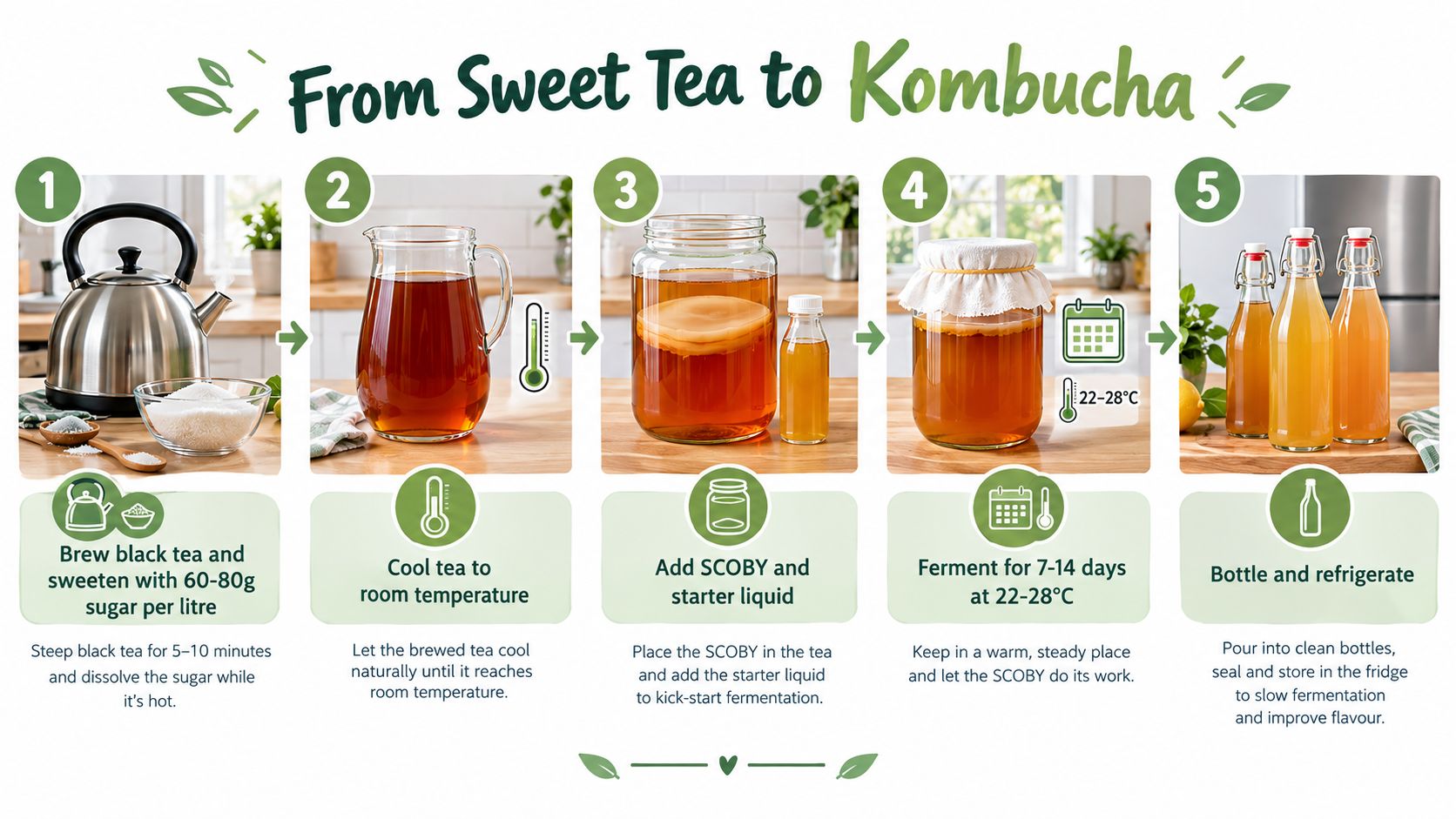
The visible “baby” SCOBY forms as bacteria produce more cellulose at the surface. It may begin as a thin film and thicken unevenly. Once the tea has reached safe acidity and tastes balanced, remove the culture, reserve starter liquid for the next batch and refrigerate the finished drink.
Practical Uses for a SCOBY at Home
An extra SCOBY doesn't have to become kitchen waste immediately. Its best use depends on whether you brew regularly, want to experiment, garden, or need a safe way to manage surplus culture.
| Practical SCOBY Uses at a Glance | Best For | Key Requirement |
|---|---|---|
| Start another batch | Active brewers | Healthy pellicle plus acidic starter liquid |
| SCOBY hotel | People keeping spare cultures | Clean jar, enough liquid and regular checks |
| Vinegar-style starter | Cooks who enjoy sharper ferments | Extended fermentation and careful monitoring |
| Compost | Gardeners with surplus cultures | Only use sound, uncontaminated SCOBYs |
| DIY or skincare experiments | Curious makers | Clean handling and no use on damaged skin |
Starting another batch
This remains the most dependable use. Put a healthy pellicle into cooled sweet tea and add reserved starter liquid from a finished brew. Local Food Connect recommends cutting off a small piece of the solid SCOBY, keeping about a cup of liquid and using that combination to refresh the next batch. The liquid is particularly useful because it carries the active culture through the brew.
If you only have a small pellicle, don't force it into a large batch. Match the amount of sweet tea to the starter culture you have, and watch acidity closely.
Keeping a SCOBY hotel
A SCOBY hotel is a clean jar containing spare pellicles and enough acidic kombucha to keep them covered. It suits regular brewers who want backup cultures without starting a new batch every time. Australian conditions can vary between cool indoor rooms and warm summer kitchens, so the jar still needs inspection rather than being forgotten.
Making a vinegar-style ferment
Leave a batch fermenting longer and the flavour can become increasingly sharp, closer to a mild kombucha vinegar. Use it as a cooking experiment rather than assuming it has the same characteristics as commercial vinegar. Keep the vessel covered, monitor it and discard the entire batch if mould or abnormal odour appears.
Composting and DIY ideas
A sound, unwanted SCOBY can be cut into smaller pieces and added to compost. It contributes moist organic material, but it shouldn't go into the garden if there are visible mould signs or an unpleasant smell.
Some makers blend small pieces into DIY face-mask experiments or explore the pellicle as a biodegradable sheet. Skin use needs extra caution. Fermented material isn't automatically suitable for every person, and it shouldn't be applied to broken, irritated or reactive skin. Patch testing and clean handling matter more than novelty.
How to Store Spare SCOBYs Safely
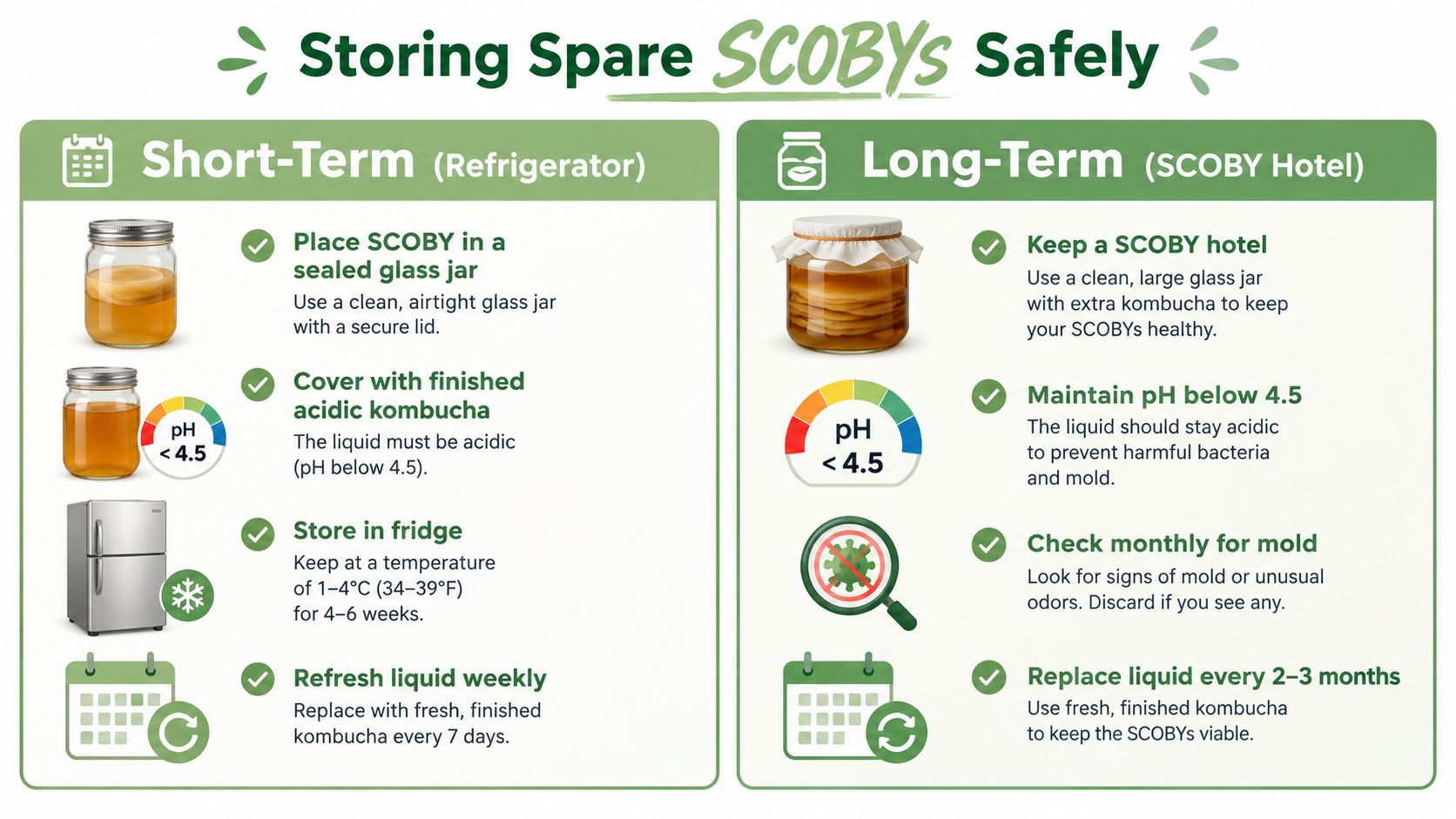
Short-term storage is usually easiest in a clean glass jar. Cover the SCOBY with finished acidic kombucha, keep the container sealed and refrigerate it. The supplied storage plan allows 4 to 6 weeks in the fridge when the culture remains covered in acidic liquid, although every stored culture still needs inspection before reuse.
A SCOBY hotel suits people who accumulate several pellicles. Place the cultures in a larger clean jar and add enough starter liquid to cover them. Keep the jar organised, label it with the date and avoid dipping used utensils into it. Periodic liquid replacement helps maintain an acidic environment and reduces the chance of the culture drying out.
A simple storage checklist
- Use glass: Choose a clean jar that won't retain food smells or residues.
- Keep it covered: The liquid should cover the pellicles so exposed areas don't dry out.
- Control the temperature: Refrigeration slows activity for short-term holding.
- Check before use: Look for fuzzy growth, unusual colour, off-odour or a slimy texture.
- Choose a commercial starter when unsure: Commercial cultures offer a more controlled starting point for beginners.
Food Standards Australia New Zealand warns that kombucha risks can include contamination from the SCOBY or dirty equipment, as well as excessive acid or alcohol levels. It recommends clean, sanitised equipment, proven commercial starter cultures and cooling tea quickly from 60°C to 20°C within 2 hours before adding the SCOBY. Read the FSANZ kombucha safety guidance before developing a regular home-brewing routine.
Freezing and dehydrating are sometimes discussed as longer-term options, but they can change the culture's texture and performance. A thawed pellicle may be softer, and a dried sheet may need careful rehydration before it proves useful. If you can't confirm that a stored culture is sound, start with a fresh commercial starter rather than gambling on an uncertain jar.
Beyond the Brew, Australian SCOBY Innovation
A SCOBY is useful because it performs two jobs at once. It helps ferment a beverage, and its bacteria produce cellulose, the structural material that forms the pellicle. That cellulose has attracted Australian interest for textiles and paper, offering a way to consider fermentation as a materials process rather than only a drink-making method.
A University of Queensland-associated project describes the microbial sequence clearly. Yeast first breaks sugar into glucose and fructose, then bacteria convert those sugars into cellulose. The team is exploring a synthetic SCOBY using omics-based methods to investigate more sustainable cellulose production. Australian reporting also describes SCOBY cellulose being considered for material applications such as textiles and paper. The Australian functional beverage trends guide places this experimentation within the wider movement towards drinks and ingredients with more than one practical role.
The beverage itself is also being studied in Australia. A Sydney University randomized crossover trial found that live kombucha reduced the post-meal blood sugar spike and improved insulin response compared with soda water or diet soft drink. The study kombucha was reported to contain about 200 microbial species and about 2.5 times the polyphenol content of green tea, as described in the Australian industry report Tonic to Textiles. Those findings don't turn kombucha into a medicine, and they don't mean every bottle has the same composition.
| Australian Kombucha Market Snapshot | Value |
|---|---|
| Surveyed products classed as alcoholic at a 0.5% ABV threshold | 64.8% |
| Sales rise reported over three years | 174% |
| Largest consumer market identified | NSW |
| Next biggest consumer market identified | Queensland |
Australia's regulatory discussion also records that kombucha sales rose 174% over three years, while 64.8% of surveyed products would be classed as alcoholic in jurisdictions using a 0.5% ABV threshold. The history is older than the current wellness category too, with fermented tea use dating back to at least 220 B.C. These details show why controlled fermentation matters for both home brewers and Australian producers.
A SCOBY Safety Decision Tree for Home Brewers
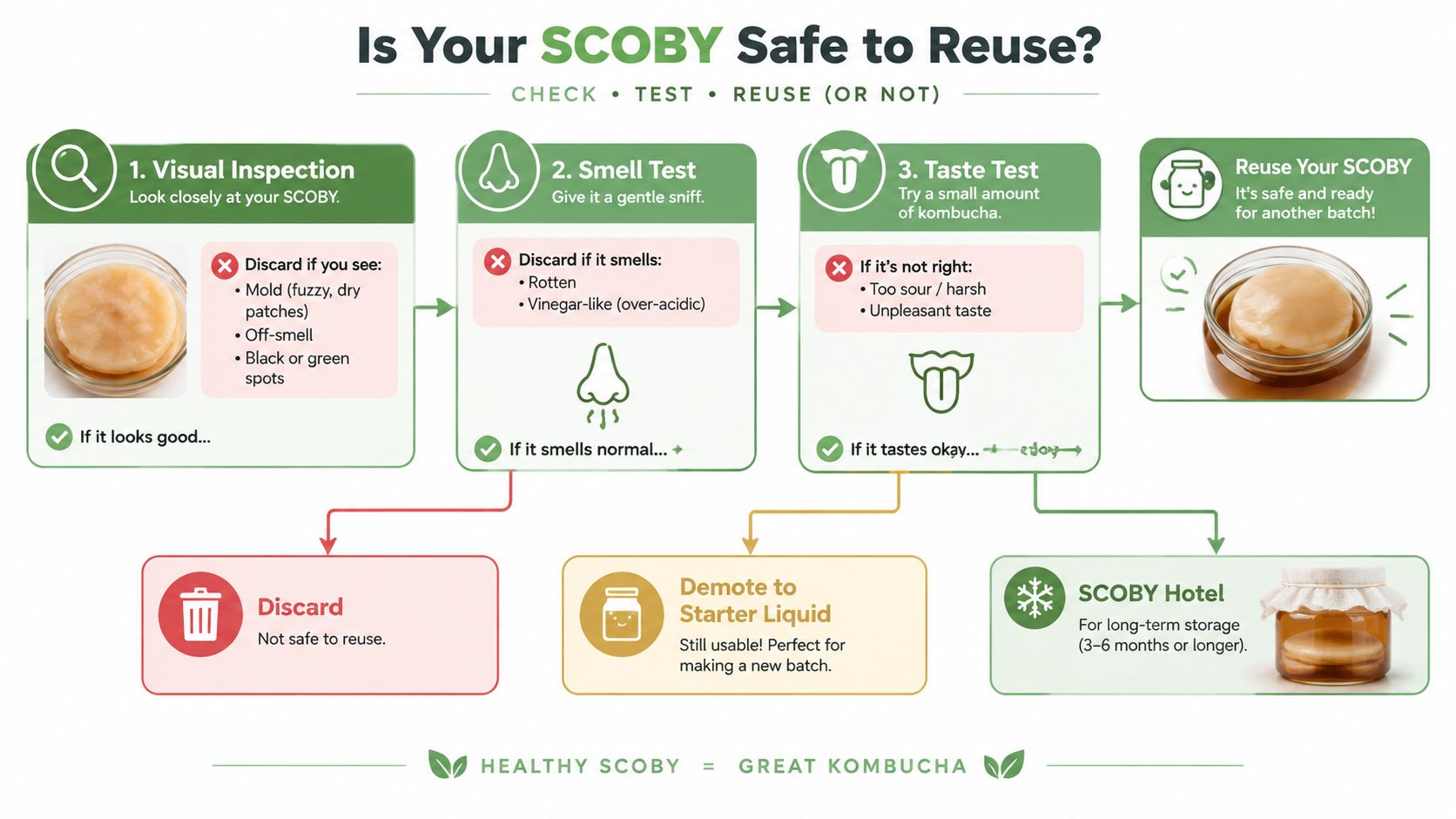
Use a SCOBY only after checking the whole culture, not just the top surface. Australian food-safety guidance says kombucha cultures should be checked for discolouration and abnormal odour, and that green, white, black or grey growth means the SCOBY should be discarded. Australian kombucha food-safety advice provides the basic standard for that inspection.
Start with the appearance
A healthy pellicle may be pale, tan or brown, with yeast strands, bubbles and uneven layers. Those features can look messy without being dangerous. Fuzzy, dry growth is different from a smooth cellulose film. If you see green, black, grey or suspicious white mould, don't scrape it off and continue. Discard the culture and the associated liquid.
Pink or orange discolouration also deserves a discard decision, especially when it appears as an unusual bloom rather than a normal tea stain. A mushy, disintegrating pellicle has lost its practical value, even if it doesn't show obvious mould.
Smell the liquid and culture
A light yeasty or vinegary aroma fits normal fermentation. Rotten, ammonia-like or faecal odours don't. Don't taste a batch that already smells contaminated, and don't try to rescue it by adding fresh tea.
Decide how to reuse it
If appearance and smell are normal, inspect the texture. A firm, rubbery disc with brown strands can usually return to a fresh brew, provided the starter liquid is also sound. If the pellicle is weak but the acidic liquid smells and looks normal, you may choose to keep the liquid as starter while composting the deteriorated solid layer.
Keep acidity under control. Western Australian guidance treats pH monitoring as a critical control point, with fermentation commonly taking 7 to 10 days at 20°C to 23°C, reaching pH 4.2 or lower, followed by removal of the starter culture and refrigeration at 4°C. A digital pH meter for kombucha monitoring can make repeated checks easier than relying only on taste.
Print this decision path for your pantry:
- Fuzzy or abnormal growth? Discard the culture and liquid.
- Rotten or chemical odour? Discard rather than tasting.
- Firm pellicle and clean sour aroma? Keep for brewing or storage.
- Soft pellicle but sound acidic liquid? Demote the pellicle to compost and retain only the liquid if you're confident it's safe.
- Uncertain at any stage? Discard and use a proven starter culture.
Common SCOBY Myths and Smart Next Steps
Myth one, the disc is the entire culture. The pellicle is visible, but the liquid carries active yeast and bacteria too. A thick disc can look reassuring while a weak or contaminated liquid undermines the next batch. Treat both components as part of the starter system.
Myth two, every new batch needs a large SCOBY. A healthy pellicle can help, but reserved acidic kombucha is a carrier of the culture. If you have enough reliable starter liquid, you don't need to keep an ever-growing stack of rubbery discs. This is why many experienced brewers separate the practical need for starter liquid from the emotional attachment to every “baby” SCOBY.
Myth three, brown strings and a sour smell mean mould. Brown strands commonly come from yeast and can hang beneath the pellicle. A clean vinegary aroma also fits fermentation. Mould is more likely to appear as fuzzy, dry growth or unusual green, black, grey or pink discolouration, and Australian food-safety guidance says affected cultures should be discarded rather than skimmed.
Sensible next steps
- Use suitable ingredients: Brew with quality tea, real fermentable sugar and a reliable starter culture.
- Keep equipment clean: Sanitise jars, utensils and cloth covers before handling the ferment.
- Measure acidity: Use pH checks alongside taste and smell, particularly when you're learning.
- Reduce the culture pile: Keep one or two useful backups, share sound extras or compost cultures you no longer need.
- Start without the maintenance: Pep Tea offers Australian-brewed, sugar-free organic kombucha from the Hunter Valley, NSW, so beginners can explore the drink without managing a SCOBY straight away.
A SCOBY is best understood as a working fermentation culture, not a collectible object. Keep it when it's healthy and useful, use the liquid intelligently, and discard anything that raises a genuine contamination concern.
Pep Tea offers sugar-free organic kombucha brewed in the Hunter Valley, NSW, along with organic Japanese matcha for everyday tea rituals. Visit Pep Tea to explore the range, find a convenient way to enjoy live kombucha and learn more about Australian tea and fermentation.