
Tag: how to choose green tea
Best Organic Green Tea Loose Leaf: An Australian Guide
You're probably here because you've stood in front of a shelf, or scrolled through page after page online, and seen every tea described as premium, pure, clean, ceremonial, artisan, or wellness-focused. It sounds impressive until you realise none of those words tells you whether the tea will taste good, brew well, or feel worth the money.
That's where the search for the best organic green tea loose leaf often gets stuck. The assumption is that the answer is a single brand name. In practice, the better answer is a skill set. Once you know what to look for, you stop buying on buzzwords and start buying with confidence.
In Australia, that matters even more because tea buyers are seeing more specialty options, more imported styles, and more health-led marketing than ever before. The good news is that quality leaves clues. You can spot them in the leaf itself, in the label, in the way the tea is stored, and in how it behaves in the cup.
Your Guide to Choosing Quality Green Tea
A friend once asked me why one loose-leaf green tea felt refined and smooth, while another tasted flat and sharp even though both were sold as organic. The answer had nothing to do with flashy packaging. It came down to what was inside the pouch, and whether the seller gave enough real information to support the claims.
Australian tea buying has moved well beyond basic supermarket tea bags. In Your Guide to Choosing Quality Green Tea, the key shift is understanding that loose-leaf sits in a more specialist part of the market, where buyers are encouraged to look for whole leaves, freshness, and less processing rather than treating tea like a generic pantry item. That pattern is reflected in guidance around premium and specialty tea, which treats loose-leaf green tea as a craft beverage rather than a commodity, with whole leaves valued because they preserve more aroma and are generally less processed (retailer guidance on organic loose-leaf green tea).
Stop chasing the word best
The word best causes most of the confusion.
For one person, the best organic green tea loose leaf is a soft, sweet Japanese-style green for a quiet morning cup. For another, it's a sturdier tea that can hold up in an iced drink or a café batch brew. If you don't separate quality from personal preference, every purchase feels like guesswork.
What to focus on first
Start with three practical questions:
- Is it verifiable? Organic claims should be supported by proper certification, not just earthy packaging.
- Can you assess the leaf? Whole, intact leaves usually tell you more than the marketing on the front.
- Does it suit your use? A tea for slow sipping is not always the same tea you'd use for a chilled wellness drink.
The smartest tea buyers don't memorise brand rankings. They learn to read the leaf, the label, and the brewing behaviour.
That's the ultimate goal. Not to copy someone else's favourites, but to become the person who can tell quality for yourself.
What Really Defines Quality in Organic Green Tea
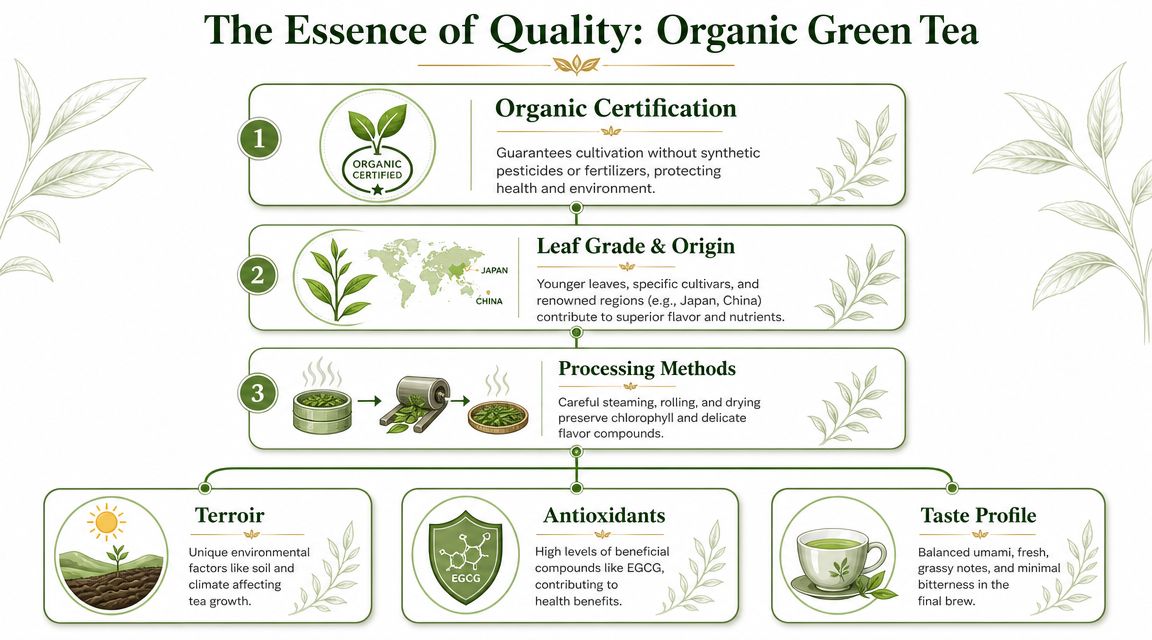
When people talk about quality in green tea, they often jump straight to flavour. Flavour matters, of course, but it's only the final result. The deeper story starts with the leaf itself, how intact it is, how it was processed, and whether it matches the way you plan to use it.
Why whole leaves matter
Green tea isn't just dried plant material. Its quality is tied to delicate compounds that can be lost or damaged when the leaf is heavily broken, handled roughly, or poorly stored.
A strong technical benchmark comes from research showing that green tea leaves contain polyphenols at about 25 to 35% of dry weight, with catechins making up roughly 70% of total polyphenols, and EGCG standing out as the most prominent catechin behind many of green tea's antioxidant effects. The same research also notes that loose-leaf tea with larger, intact leaves generally preserves more of these compounds than more heavily broken material (green tea polyphenol and catechin data).
That sounds scientific, but the buying takeaway is simple. If the leaf has been reduced to tiny fragments, you're often looking at a tea that has lost some of the elegance people expect from a good green tea.
Quality is not one thing
A lot of buyers assume quality can be ranked on a single ladder. It can't. Good green tea is really a combination of factors working together.
Here's a simple way to look at it:
| Quality signal | What it tells you | Why it matters |
|---|---|---|
| Leaf integrity | Whether the leaves are whole or broken | Whole leaves usually brew with more nuance |
| Processing care | How gently the tea was handled after harvest | Better handling protects flavour and freshness |
| Intended use | Whether the tea suits your drinking style | A tea can be high quality and still wrong for your purpose |
Many guides often fall short. They tell you what's expensive, but not what's suitable.
The best tea depends on the job
A lighter, sweeter green tea often suits a calm-focus cup, especially when you want softness and delicacy. A more full-bodied loose-leaf style can make more sense for iced tea, blending, or higher-volume brewing where you need the flavour to hold its shape.
That difference becomes much clearer when you compare classic loose-leaf green tea to powdered tea styles. If you want a clean explanation of how leaf tea and matcha behave differently, Pep Tea's guide on the difference between matcha, green tea and green tea forms is a useful reference.
Practical rule: Don't ask only “Is this a good tea?” Ask “Is this a good tea for the way I drink tea?”
That small shift saves people from buying lovely leaves for the wrong purpose, then blaming the tea when the result disappoints.
Decoding Labels and Certifications in Australia
Marketing myths need a firm reality check. Plenty of tea packs use natural-looking colours, minimalist design, and words like clean or pure. None of that proves the tea is organically certified, traceable, or handled with proper food-safety discipline.
What organic should mean in Australia
In the Australian market, the strongest starting point for organic credibility is the Australian Organic Standard (AS 6000:2015). It functions as the main benchmark for products sold as organic, and equivalency arrangements with markets such as Japan and the EU make it a useful proxy for traceability and clean-label assurance for both consumers and cafés.
If you're buying the best organic green tea loose leaf, this matters because certification gives you something firmer than brand storytelling. It tells you the product is being assessed against a recognised organic standard, not just wrapped in wellness language.
What the label does not tell you
This is the part many shoppers miss. Organic is not the same as fully explained food safety.
A tea can be organic and still leave important buyer questions unanswered if the brand says nothing about testing, sourcing transparency, or packaging protection. That's why careful shoppers increasingly ask for more than a certification badge.
Look for signs that a brand can clearly explain:
- Origin traceability such as where the tea was grown and packed
- Batch testing transparency around residues or contaminants
- Protective packaging that helps reduce exposure to moisture, odours, and handling issues
- Storage guidance so the tea stays stable after purchase
How origin shapes flavour
Origin doesn't just sound romantic. It helps you predict taste.
Japanese green teas are often associated with fresh, grassy, marine, or umami-leaning notes. Many Chinese green teas can lean nuttier, toastier, or earthier depending on style and processing. Neither is automatically better. They serve different palates.
If you know you dislike sharp grassy notes, buying blindly from a style known for that profile won't make much sense. If you love a clean savoury finish, that same profile might be exactly what you want.
A better label-reading checklist
When you pick up a tea, run through this short filter:
Check the organic claim
Look for actual certification language, not just nature-inspired branding.Check the origin detail
Country of origin should be clear enough to help you understand likely flavour.Check whether the brand explains quality control
If testing and traceability are never mentioned, ask.Check the packaging format
Good tea deserves packaging that protects it from light, air, and contamination.
Organic status is a strong foundation. It isn't the whole story.
That's the myth worth dropping. The best tea brands don't ask you to trust the label alone. They give you enough information to judge the tea properly.
A Sensory Guide to Judging Loose Leaf Tea
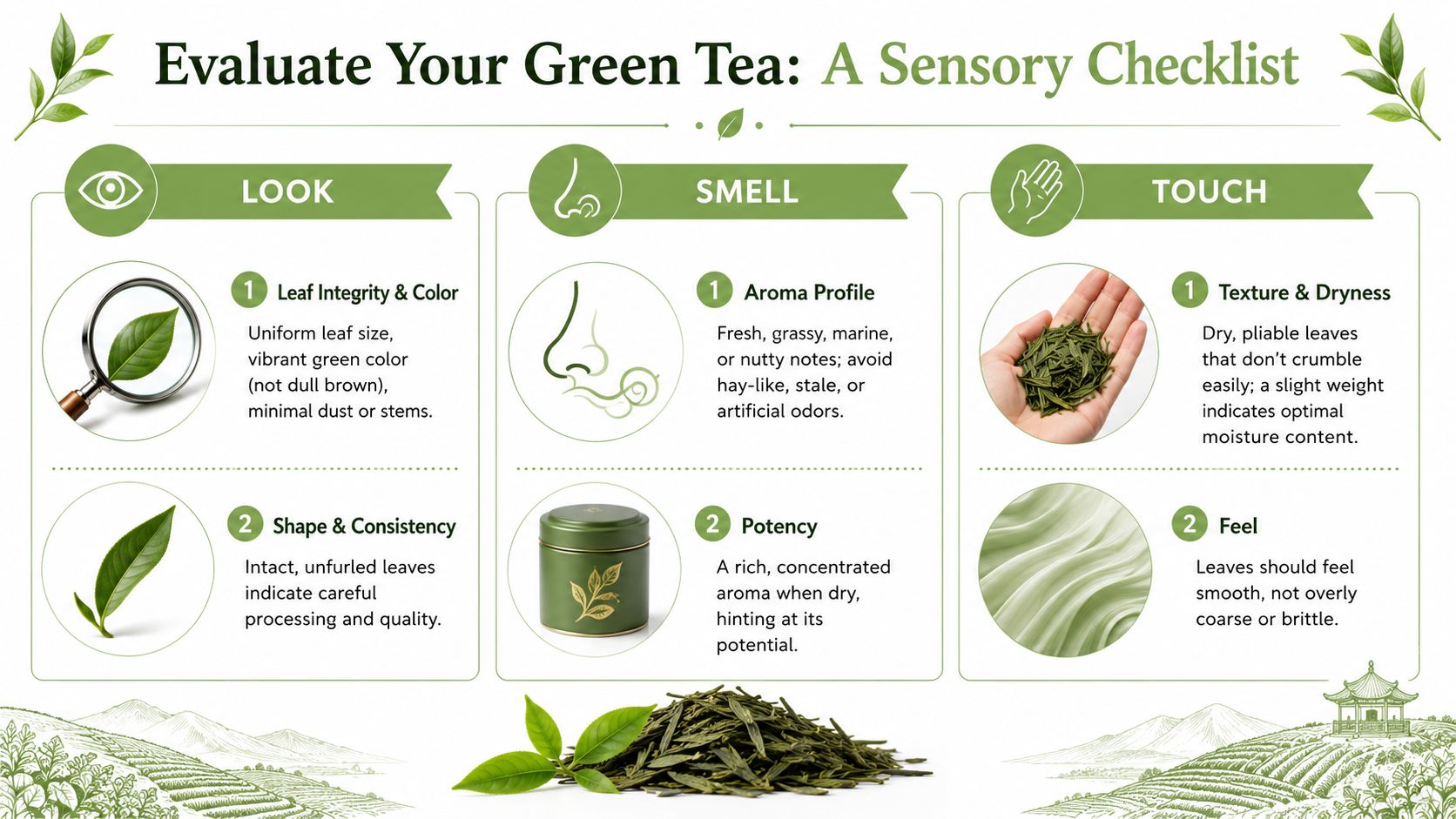
The fastest way to get better at buying tea is to use your senses before you ever boil water. A good dry-leaf check can save you from dull, stale, or badly handled tea, even when the front label looks convincing.
Look first
Dry leaf appearance tells you a lot.
A quality loose-leaf green tea usually looks intentional. The leaves should have a reasonably consistent size and shape for the style. You don't want a bag full of dust, excessive stem, or random crushed fragments unless the style itself naturally runs smaller.
Pay attention to colour too. Green tea should look alive, not tired. Dull brownish tones can point to age, poor storage, or rough handling.
Smell second
Open the pouch or tin and breathe in gently. You're looking for a fresh aroma that fits the style.
That might mean grassy, sweet, marine, nutty, or softly vegetal. What you don't want is a stale hay-like smell, no aroma at all, or anything that feels artificially perfumed.
Aroma isn't just a luxury detail. It often tells you whether the tea still has its freshness.
Touch third
If you can handle the leaf, touch helps confirm what your eyes already suspected.
The leaves should feel dry but not frail. You don't want them disintegrating the second you rub them between your fingers. Well-kept tea feels light and structured, not damp, limp, or oddly brittle from mishandling.
Match the tea to the moment
Many buying guides act as if one green tea can do every job. That's rarely true. The more useful approach is to choose by use case.
Guidance around green tea styles suggests a better match-up: lighter, sweeter shaded leaves suit calm-focus drinks, while more full-bodied loose-leaf styles suit batch brewing, café service, or iced tea preparation (practical style matching for green tea use cases).
That means your sensory check should include a practical question. Does this leaf look delicate and refined, or sturdy and adaptable?
A simple shop test
Use this mini checklist:
- Leaf looks clean with minimal dust and obvious breakage
- Aroma smells fresh and style-appropriate
- Colour looks lively rather than faded
- Texture feels intact not crumbly
- Leaf style matches use such as hot sipping, iced tea, or café brewing
If the dry leaf already looks tired, the brewed cup usually won't rescue it.
That one rule will stop a surprising number of disappointing purchases.
Brewing for Flavour Not Bitterness
A lot of people think they dislike green tea when they've really just been brewing it too hot and too long. Good leaves can turn harsh very quickly if you treat them like black tea.
Green tea needs a gentler hand, much like cooking something delicate. You wouldn't blast a fine piece of fish the way you'd boil potatoes. Tea works the same way. Too much heat pulls out bitterness before the pleasant flavours have room to shine.
Start cooler and shorter
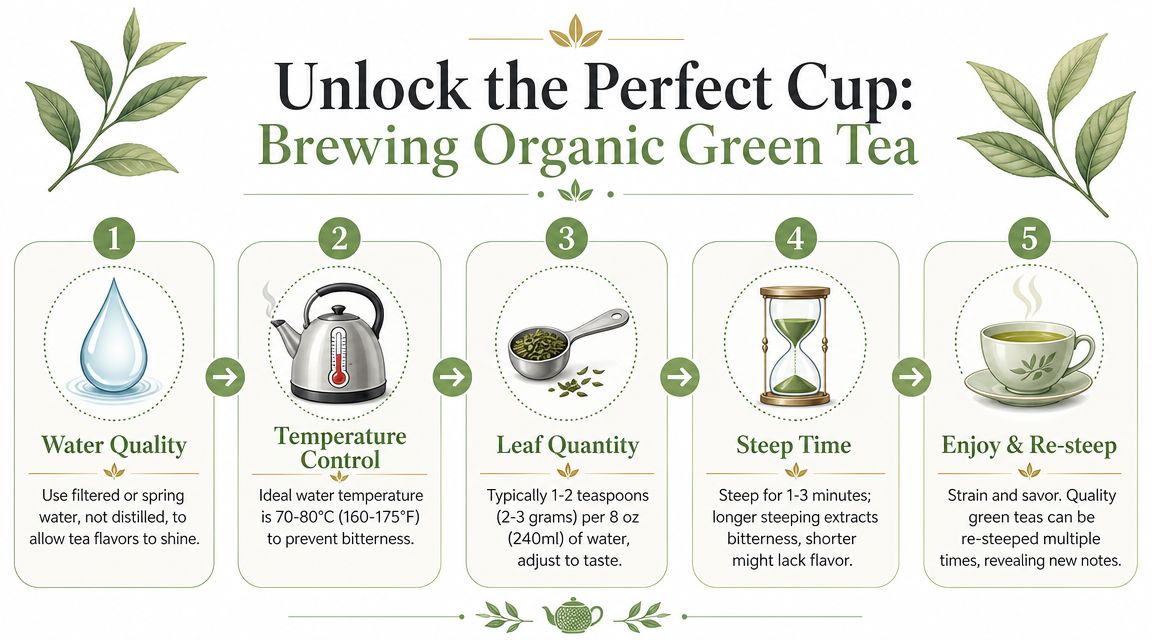
Premium brewing guidance in Australia commonly points to cooler water and short steeps of 1 to 2 minutes for delicate green teas, specifically to avoid bitterness and bring out better flavour (Australian brewing guidance for loose-leaf green tea).
That's the easiest habit shift to make if your cups keep turning astringent.
If you want more control over that process, a kettle with adjustable settings helps a lot. Something like an electric tea kettle with temperature control makes it easier to repeat the same result instead of guessing every time.
A practical brewing method
Try this simple starting routine:
Warm your teapot or cup first
A quick rinse with warm water helps stabilise the brew.Use cooler water
Boiling water is usually too aggressive for delicate green tea.Keep the first steep short
Start around the lower end and adjust from there.Taste and refine
If the cup seems thin, add a little time next round. If it bites, reduce heat or steeping time.
Here's a visual guide you can use as a quick refresher while brewing:
Common mistakes that ruin good tea
| Mistake | What happens |
|---|---|
| Water too hot | The cup turns bitter and rough |
| Steeping too long | The finish gets astringent |
| Too much leaf without adjustment | The tea can feel heavy or sharp |
| Ignoring the tea style | Delicate teas get overpowered |
Green tea usually needs restraint, not force.
Once you get that, the whole category changes. Suddenly the sweetness, softness, and layered aroma that people talk about emerge in your cup.
Storing and Using Your Tea Beyond the Cup
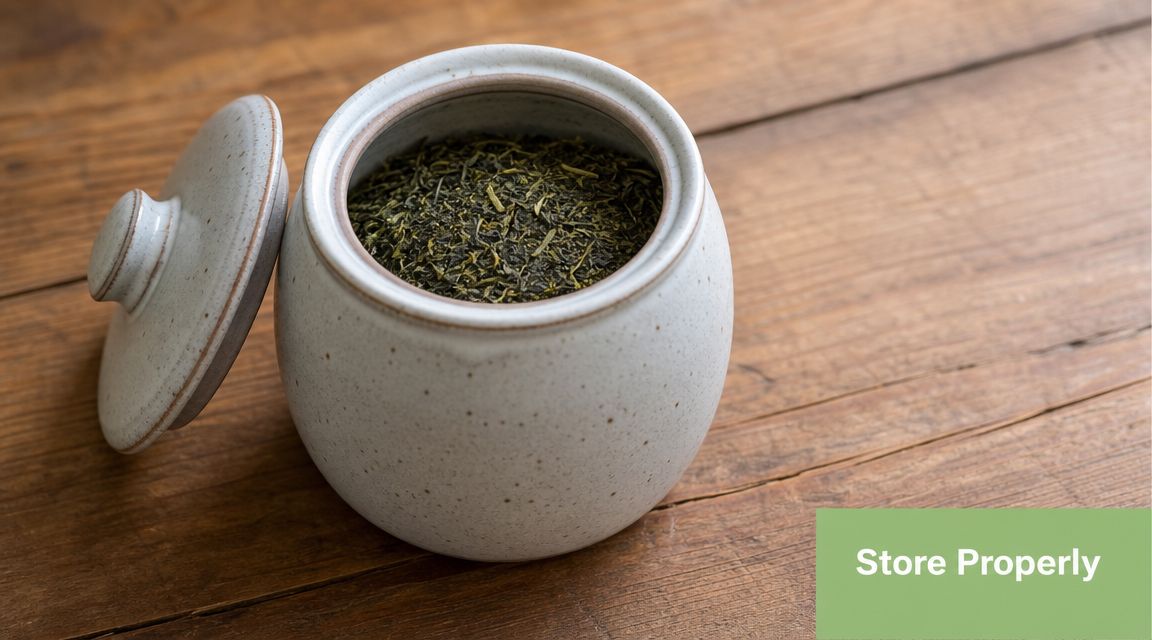
You can buy beautiful tea and still ruin it at home with poor storage. Green tea is especially sensitive to light, air, moisture, heat, and strong smells from nearby foods.
How to store it properly
Keep your tea in an airtight, opaque container and place it somewhere cool, dry, and away from direct sun. Don't store it beside spices, coffee, or anything strongly aromatic. Tea absorbs odours more easily than many people realise.
A simple metal tin or well-sealed pouch stored in a cupboard usually does the job well. The goal is to protect the leaf from the things that flatten its aroma and make the cup taste dull before its time.
Ways to use it outside a teapot
Loose-leaf green tea is more versatile than people think. Once you know how it tastes on its own, you can start using it in simple food and drink ideas.
Here are a few easy options:
- Cold infusions for a gentler iced tea with less harshness
- Tea syrups for desserts or alcohol-free café drinks
- Smoothie additions where brewed tea replaces part of the liquid
- Citrus pairings for a brighter, fresher profile
If you like that citrus direction, an option such as organic green tea with lemon shows how green tea can move from a straight brew into a more everyday wellness drink style.
Think of tea as an ingredient
Many home drinkers level up when they stop treating tea as a single-use beverage and start treating it as a pantry ingredient.
Brewed green tea can work in iced drinks, light jellies, poached fruit liquids, and simple mocktail bases. Delicate teas shine in cleaner recipes. More full-bodied loose-leaf styles tend to cope better with sweeteners, citrus, and chilled serving.
Your Journey to the Perfect Cup
Finding the best organic green tea loose leaf isn't about memorising a top-ten list. It's about knowing how to read quality with your own eyes, nose, hands, and palate.
The strongest buyers look for real organic credibility, clear traceability, and leaves that show care before they ever hit the cup. They don't confuse fancy wording with proof. They don't assume expensive means suitable. And they know that brewing can either reveal quality or bury it.
That's good news, because it means you don't need to be a tea snob to buy well. You just need a few reliable habits. Check the certification. Look at the leaf. Trust your senses. Brew gently. Store it properly. Match the style to the way you drink tea.
Once you start doing that, tea shopping gets much less confusing and much more enjoyable. You stop hoping for a good cup and start creating one on purpose.
If you'd like a practical place to continue, Pep Tea offers an Australian starting point for people who care about organic tea, clean flavour, and straightforward education around matcha, green tea, and functional drinks.