
Tag: organic certification standards
Organic Certification Standards a Guide for AU Brands
You're probably here because you've seen an organic logo on a tea tin, kombucha label, or wholesale product sheet and thought, “We should understand this properly before we make any claims ourselves.”
That's a smart instinct.
For Australian business owners, organic certification can look simple from the outside and surprisingly technical once you get into the details. That's especially true if you're buying imported ingredients like Japanese matcha, blending multiple ingredients into a finished product, or brewing something processed like kombucha. At that point, the question isn't just “Is this ingredient organic?” It's “Can we prove the whole chain is compliant?”
That distinction matters. A lot.
Why Organic Certification Is More Than Just a Logo
A café owner starts stocking premium matcha. A small beverage brand begins trialling a kombucha line. A retailer compares two tea suppliers and notices one carries a recognised organic certification mark while the other just says “organic” on the pack. The product may look similar on the shelf, but the business risk behind those labels is very different.
That's where many owners feel torn. They want the trust that comes with certification, but they also worry it means paperwork, audits, and rules that seem built for farms rather than finished drinks.
In practice, organic certification is less about bureaucracy and more about credibility you can demonstrate.
Health-conscious customers don't just want attractive packaging or wellness language. They want to know how a product was grown, handled, packed, and transported. Certification gives you a structured way to answer those questions. Instead of asking buyers to accept your claims, you're showing that an independent system has checked them.
Why the logo carries weight
The organic logo matters because it acts like a shortcut for trust. It tells the customer that the product isn't relying on vague words like “clean”, “natural”, or “pure”. It's tied to documented standards, supplier controls, and auditing.
That's particularly useful in categories like tea and kombucha, where buyers often care about origin, processing, and ingredient integrity. Someone choosing ceremonial matcha or a low-sugar fermented drink usually reads labels closely. They want more than a nice story.
Organic certification works best when you treat it as part of your operations, not just your marketing.
For Australian brands, that can become a real commercial advantage. It helps with wholesale conversations, supports retailer confidence, and makes your internal systems sharper. Teams usually become more organised because certification forces clarity around sourcing, storage, and records.
Why it feels harder than it first appears
Organic certification sounds simple until your business has to manage real-world details.
For example:
- Imported ingredients: Your tea may come from Japan, but your finished pack is sold in Australia.
- Shared facilities: You may handle both certified and non-certified products in the same site.
- Processed products: A kombucha recipe includes tea, sugar, cultures, flavourings, cleaning controls, and batch records.
- Customer expectations: Buyers often assume “organic” is a single government-run label, when it isn't.
That's why educational content matters. If you want a useful starting point on certified tea and what buyers often look for, Pep Tea's guide to organic green tea online is a practical example of how certification connects to product quality, not just branding.
What Organic Certification Really Guarantees
Many people assume organic certification means someone tests the finished product and confirms it's “clean”. That's not really how organic certification standards work.
A better way to think about it is a verified cookbook. The certifier doesn't only inspect the final cake sitting on the bench. They check the recipe, the ingredients, the kitchen procedures, the storage, and whether the baker kept the organic flour separate from everything else. The guarantee is about the system being followed from start to finish.
It's a process guarantee
The most important idea to understand is this: certification verifies process integrity.
The operational implication of organic certification is that a brand must maintain a documented organic system, approved inputs, and traceability across farming, processing, and handling to satisfy audits. The system is designed to verify process control, including field history, input approval, segregation, and records, so any break in the chain of custody can invalidate status, as explained in this overview of organic certification process control.
That's why a finished product can lose organic status even if it still looks identical to the customer. If a non-approved cleaning input was used, if records don't match, or if organic and non-organic stock were mixed without proper controls, the issue is procedural and still serious.
What that looks like in plain language
Organic certification standards generally ask a business to prove that it can control the full path of the product.
That usually means:
- Knowing your inputs: Every ingredient, processing aid, and relevant material needs to be assessed for compliance.
- Maintaining separation: Organic goods can't just sit anywhere and hope for the best. They need clear segregation in receiving, storage, production, and packing.
- Keeping records: Purchase records, batch sheets, labels, cleaning logs, and dispatch documents all help prove what happened.
- Protecting traceability: You should be able to follow a product backward to suppliers and forward to customers.
If you're also reviewing packaging choices alongside certification, it can help to look at broader operational resources like these sustainable food packaging options UK, especially if your team is trying to align environmental decisions across product, pack, and presentation.
A certified organic product isn't simply “made from good ingredients”. It comes from a controlled, documented system.
That's why the difference between “organic” and “natural” is so important. “Natural” can mean almost anything in consumer marketing. Certified organic means a certifier can inspect the process behind the claim.
For a consumer-friendly explanation of what this means in tea, Pep Tea's article on what organic green tea is gives a useful product-level example.
The Core Requirements for Australian Businesses
In Australia, organic certification is governed by a private standards-and-audit system. A 2023 Senate inquiry noted that the sector operates through multiple approved certifiers, 11 at the time, with standards such as the National Standard for Organic and Bio-Dynamic Produce forming the core compliance framework, especially for exports, as noted in this summary of the Australian organic certification framework.
That surprises a lot of business owners. They expect a single government logo and a single public agency. Instead, you're usually working with a private certifier that audits your operation against recognised standards.
Approved inputs
The first pillar is simple in theory and detailed in practice. You need to know what comes into your business and whether it's permitted.
For a tea or kombucha operation, that may include ingredients such as tea, matcha, sugar, fruit components, flavourings, and processing aids. It can also extend to cleaning and sanitation products, depending on how they're used in the operation.
Questions certifiers usually want answered include:
- What is it? Ingredient, aid, additive, or other material.
- Who supplied it? Supplier identity and supporting documentation.
- Is it approved? Evidence that it fits your certifier's requirements.
- Where is it used? Receiving, blending, brewing, bottling, or packing.
A common mistake is assuming a supplier's marketing statement is enough. It usually isn't. You need documentation that fits the certifier's expectations.
Organic management practices
This pillar is about how your site runs.
A business may have compliant ingredients and still fail if the day-to-day handling isn't controlled. Organic management practices usually focus on physical separation, prevention of contamination, handling procedures, and clear staff routines.
A processor often needs workable rules such as:
- Segregated storage: Organic stock is clearly identified and separated.
- Controlled production runs: Staff know when and how organic products are made.
- Cleaning verification: The team can show how equipment is cleaned before an organic run.
- Label control: Packaging and finished labels are checked so the wrong claim isn't applied.
Audits and recordkeeping
Organic certification standards become very real at this point. If the first two pillars are what you do, this third one is how you prove it.
Many owners worry about “paperwork”, but it helps to think of records as your protection. Good records let you show that your claim matches your operation.
A useful basic set includes:
| Record type | Why it matters |
|---|---|
| Supplier certificates | Shows the origin and status of ingredients |
| Invoices and goods received | Connects what you bought to what you used |
| Batch sheets | Links ingredients to finished product |
| Cleaning logs | Supports process control before production |
| Label approvals | Helps prevent incorrect organic claims |
| Dispatch records | Maintains traceability to customers |
If an auditor can't follow your product from supplier to finished batch, your organic claim becomes hard to defend.
The practical takeaway is reassuring. You don't need a perfect enterprise system from day one. You do need a clear, repeatable one.
Navigating Global Organic Certification Schemes
Australian tea and beverage businesses rarely operate in a purely local bubble. You might buy matcha from Japan, import packaged ingredients from another region, pack in Australia, and sell to cafés, retailers, or export customers. That's why it helps to recognise the major certification schemes your suppliers may hold.
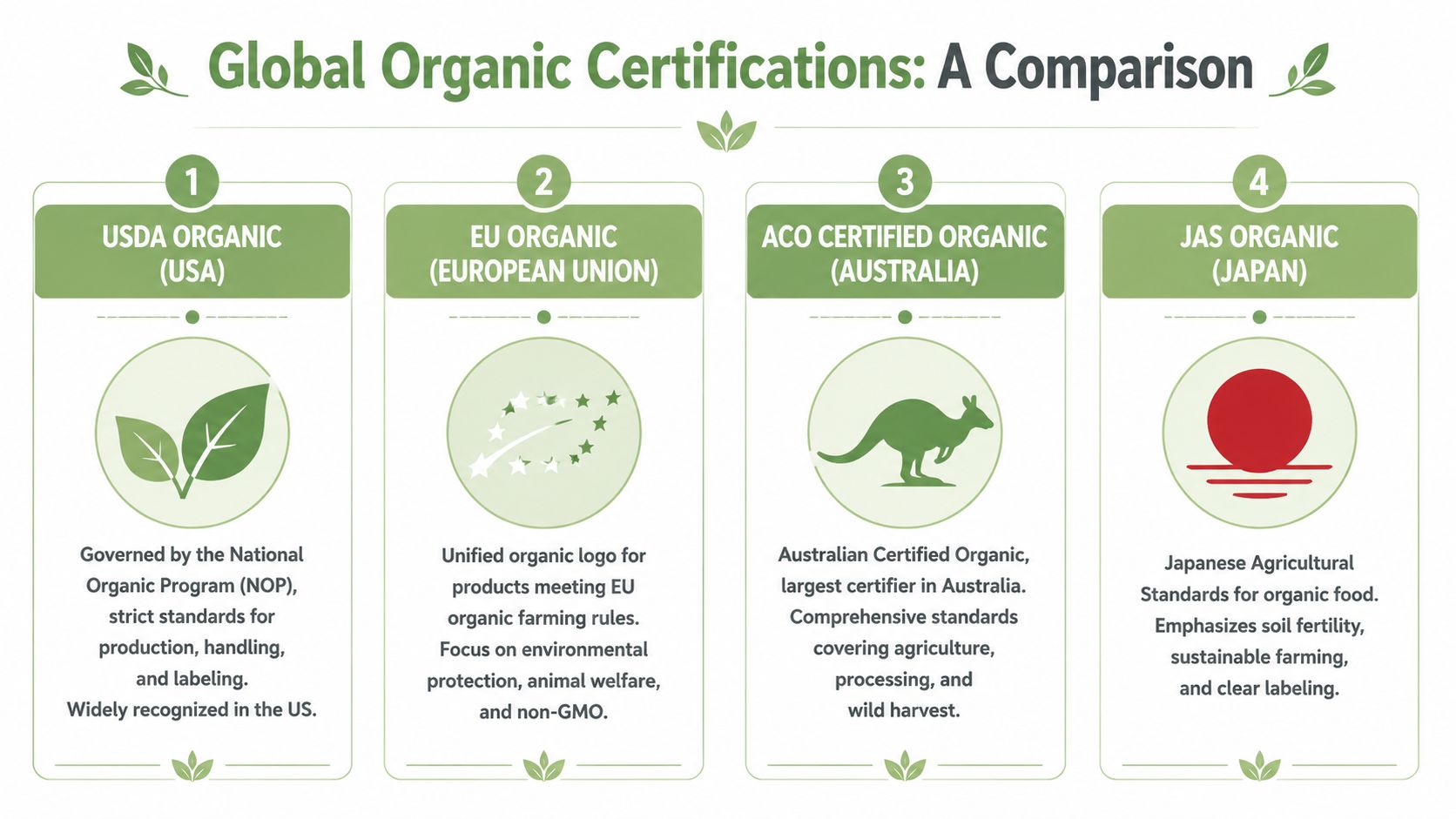
Four schemes you'll see often
Here's a plain-English comparison of the logos and systems many Australian buyers encounter.
| Scheme | Region | What it usually signals |
|---|---|---|
| USDA Organic | United States | Organic compliance for production, handling, and labelling under the US system |
| EU Organic | European Union | A unified EU organic framework with its own rules for eligible products |
| ACO Certified Organic | Australia | Certification through an Australian private certifier operating within the local framework |
| JAS Organic | Japan | Organic certification under Japanese Agricultural Standards |
The important point isn't memorising every rule difference. It's knowing that each scheme belongs to a regulatory context, and your Australian business can't assume one certificate automatically answers every local compliance question.
Why imported products create confusion
Readers often get stuck at this point.
A supplier may send you a perfectly legitimate overseas organic certificate. That's helpful, but it doesn't automatically settle how your certifier will view the ingredient inside your own certified system. You still need to confirm whether the documentation, chain of custody, and product description line up with your certifier's requirements.
That matters even more for processed ingredients. Whole leaf tea is one thing. A flavoured blend, extract, premix, or finished beverage has more moving parts.
Imported organic ingredients should be treated as verified inputs to assess, not assumptions to accept.
Where equivalency comes in
Business owners often hear about “equivalency” and assume it means easy acceptance across borders. In practice, equivalency is best understood as a pathway that may reduce duplication, not a licence to stop checking.
If you source globally or sell internationally, your team still needs to ask practical questions:
- Which scheme certified the ingredient?
- Does the certificate match the exact product?
- Who held certification during packing and export?
- Will your Australian certifier accept that evidence as sufficient?
- Will your destination market require anything additional?
For teams building a wider compliance framework beyond organic alone, this guide to a universal key for international operations can be a useful companion resource because it highlights how cross-border compliance often depends on documentation discipline, not assumptions.
A sensible sourcing mindset
The safest approach is to compare schemes with curiosity, not suspicion. Overseas certification isn't a red flag. It just needs interpretation in the context of your Australian operation.
For businesses importing Japanese matcha, that means reviewing the supplier certificate, product scope, packing details, and traceability documents before the ingredient enters your certified production stream. The same mindset applies if you're sourcing botanicals, flavourings, or bulk tea from overseas.
Your Roadmap to Becoming Certified Organic
The first certification application usually feels bigger in your head than it is on paper. Once you break it into stages, it becomes a project you can manage.
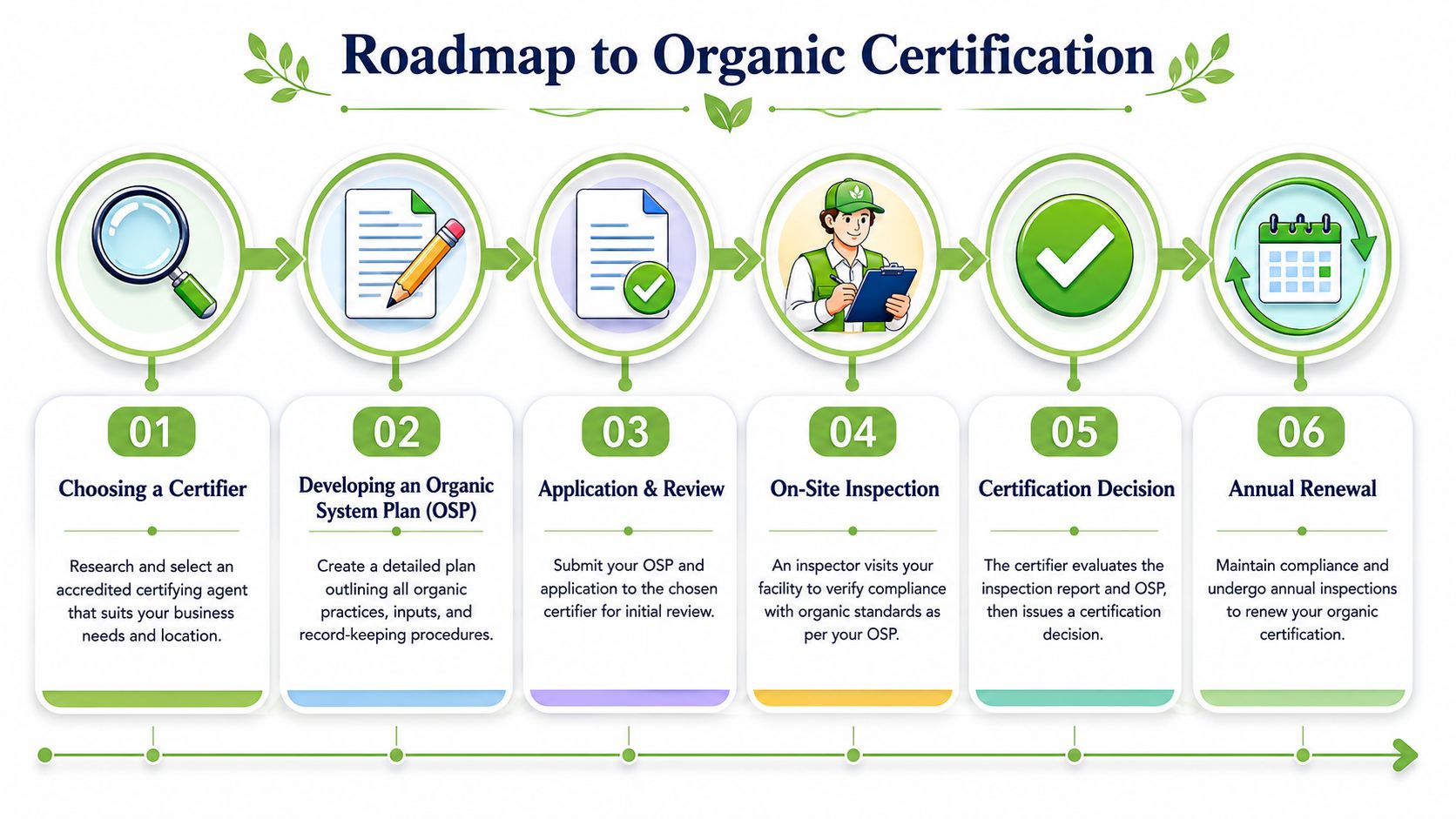
Step 1 and Step 2
Start by choosing a certifier whose scope matches your business. A farm, a tea importer, and a kombucha manufacturer won't all ask the same operational questions, so industry fit matters.
Then build your Organic System Plan or equivalent documented system. In it, you explain how ingredients are approved, how organic stock is handled, how records are maintained, and how labels are controlled.
Good plans are practical. They describe what your team does.
Step 3 and Step 4
Next comes application review and the on-site audit.
The certifier reviews your documents, then an inspector visits to compare paperwork with reality. They want to see that your documented system matches your premises, equipment flow, storage, production steps, and records.
Before the audit, it helps to run your own mini-check:
- Walk the site: Can staff clearly identify organic stock and materials?
- Trace one batch: Can you follow it from supplier invoice to finished label?
- Review inputs: Are all ingredients and relevant materials approved and current?
- Check your labels: Do your claims match what certification allows?
- Train the team: Can staff explain the process consistently?
A visual summary often makes the path feel more manageable:
Step 5 and Step 6
After inspection, the certifier makes a certification decision. If corrective actions are required, you address them. If approved, certification doesn't end the process. It becomes part of your annual operating rhythm through renewals, inspections, updates, and ongoing compliance.
Common pitfalls are usually ordinary operational mistakes, not dramatic failures:
- Unapproved substitutions: Someone buys a replacement ingredient or cleaner without checking.
- Weak traceability: Records exist, but they don't connect cleanly.
- Shared storage confusion: Organic and non-organic stock are present without clear separation.
- Label drift: Marketing wording changes before compliance review catches it.
The easiest time to fix an organic compliance issue is before the product is made, labelled, and sold.
One note on timing and cost: these vary by certifier, business type, product scope, and complexity. It's better to ask directly for a specific quote and document checklist than rely on broad online guesses.
Organic Standards for Tea and Kombucha Producers
Tea and kombucha businesses face a version of organic certification that's more layered than many farm-based examples suggest. You're often dealing with imported ingredients, processing steps, multi-ingredient recipes, sanitation controls, and final labels that need to hold up under audit.
A major blind spot in Australian content is how organic rules apply to imported and processed products, not just farms. That matters because the Australian organic sector was estimated at A$2.6 billion in 2021, and import-heavy supply chains make certification, traceability, and equivalency especially relevant for products like tea and fermented beverages, as noted in this discussion of organic requirements for imported and processed products.
For tea importers and packers
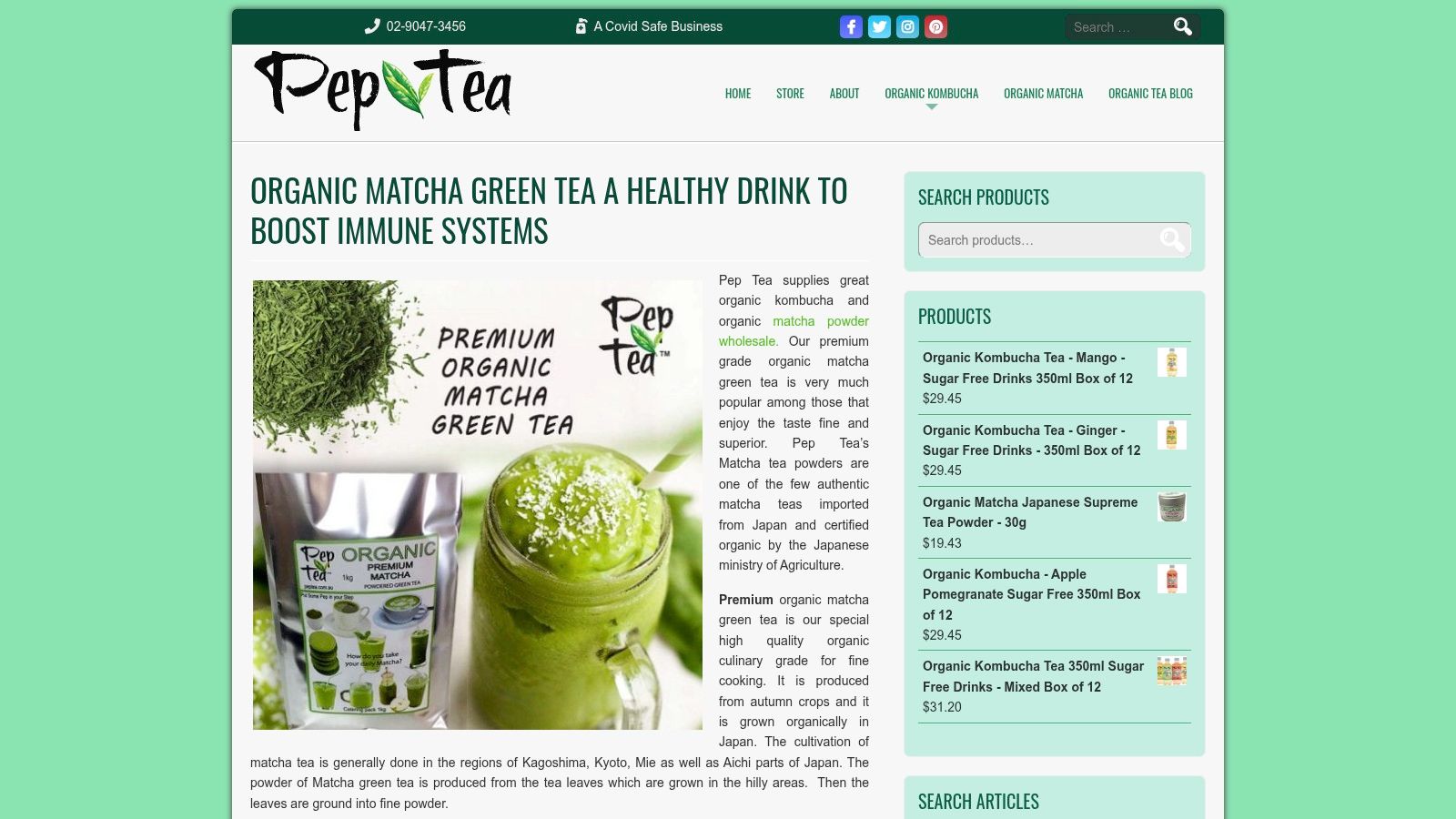
If you source Japanese matcha or other imported teas, the main challenge is proving that the ingredient's organic status survives the trip from origin to your finished Australian product.
That usually means checking:
- Supplier certification documents
- Product-level identification
- Packing and export traceability
- Handling records once stock arrives in Australia
The key question isn't just whether the tea garden was organic. It's whether the chain of custody is clear enough for your certifier to accept.
For kombucha brewers
Kombucha brings another layer because it's a processed product. You're managing tea, sugar, cultures, flavour inputs, brewing, cleaning, filling, and labelling.
That creates three practical pressure points:
Input compliance
Your tea base, sugar, flavourings, and any other relevant ingredients need to fit the standard.Process control
Organic handling needs to sit neatly beside your existing food safety systems. If you already work with HACCP discipline, that mindset helps because both systems value consistency, records, and controlled procedures.Labelling accuracy
Multi-ingredient products need careful claim review. It's not enough for one input to be organic if the final label suggests more than the certified composition allows.
What this looks like in a real Australian product category
For a business selling both imported organic matcha and locally brewed kombucha, the operational challenge is to connect two very different supply stories into one compliant system. One ingredient may begin overseas under another scheme. The finished fermented product may be produced domestically with its own controls and records.
That's why tea and kombucha brands need practical product pages and education, not just broad farm-level explanations. Pep Tea's organic kombucha range is one example of a product category where buyers often want to understand both certification and processing, especially when low sugar, live cultures, and ingredient integrity all matter at once.
Your Business Checklist and Frequently Asked Questions
If you're preparing for certification, the fastest way to reduce stress is to get organised before you contact a certifier. You don't need every answer on day one, but you do need a workable foundation.
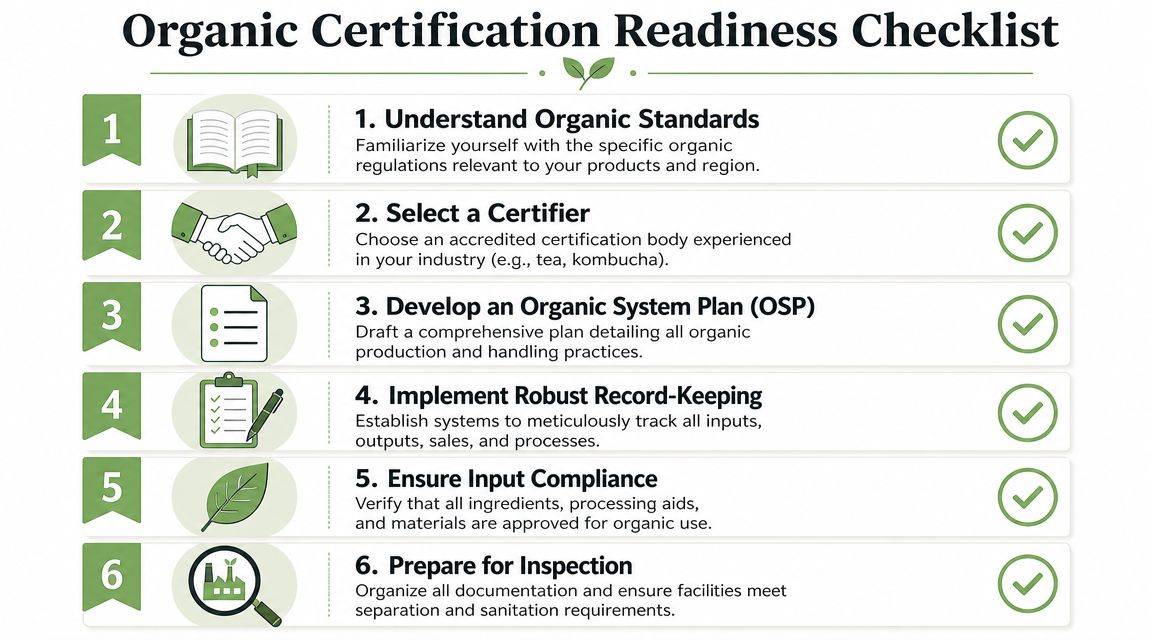
A practical readiness checklist
- Map your products: List each product, ingredient, and supplier clearly.
- Identify your risk points: Note where mixing, relabelling, repacking, or substitutions could happen.
- Gather supplier documents: Keep certificates, specifications, and invoices in one system.
- Write your operating rules: Storage, cleaning, production flow, and label approval should be documented.
- Train staff early: The team handling receiving, production, and dispatch should know the basics.
- Check imported ingredients carefully: Don't assume overseas certification will answer every local question.
Frequently asked questions
How can a café owner verify that a supplier's organic claim is legitimate
Ask for current certification details and product documentation that matches what you're buying. The key is consistency between the supplier, the product, and the claim on the pack or menu material.
What's the difference between “100% organic”, “organic”, and “made with organic ingredients”
These phrases are governed by certification and labelling rules, not just marketing preference. The exact threshold and permitted wording depend on the applicable standard and certifier. If you're selling or repacking a product, don't guess. Confirm the permitted claim before printing menus or labels.
Do imported ingredients need extra checking
Yes. Imported ingredients often create the biggest confusion because certification, traceability, and equivalency need to be reviewed together. The overseas certificate is part of the answer, not always the whole answer.
Is certification only relevant for farmers
No. It also matters for processors, packers, importers, wholesalers, retailers, and hospitality businesses that want confidence in the claims attached to what they buy or sell.
The businesses that handle certification well usually make it part of procurement and operations, not a last-minute label exercise.
If you'd like a practical product-level view of certified organic tea and kombucha in Australia, explore Pep Tea for organic matcha, Australian-brewed kombucha, and educational guides that make the standards easier to understand before you buy, stock, or develop your own range.