
Tag: matcha cheesecake recipe no bake
Your Perfect Matcha Cheesecake Recipe No Bake
You're probably here because you want a dessert that looks polished, tastes grown-up, and doesn't ask you to heat the kitchen. That's exactly where a good matcha cheesecake recipe no bake shines.
This is the kind of dessert that feels right in an Australian summer, on a dinner-party table, or tucked into the fridge the night before guests arrive. It has the cool creaminess of cheesecake, the gentle depth of green tea, and that striking green colour that makes everyone think you've gone to far more effort than you did.
An Elegant Dessert Without the Oven
You get home to a warm kitchen, want a dessert that looks polished, and have no interest in baking a cheesecake in summer. A no-bake matcha version solves that beautifully. You press in a biscuit base, whisk and fold the filling, chill it, and let the fridge do the setting.
That simplicity is part of its appeal, but the magic resides in its texture. A good no-bake matcha cheesecake should land somewhere between classic cheesecake and mousse. It needs enough body to slice neatly, yet enough air to feel soft and light on the spoon. That is why technique matters so much here. If you beat everything together too aggressively, the filling can turn heavy. If you fold with a gentle hand, you keep the whipped cream airy and the final texture far more delicate.
In practical terms, it is also an easy dessert for Australian home cooks. You can make it ahead, keep the kitchen cool, and pull out a cake that feels calm and considered rather than last-minute.
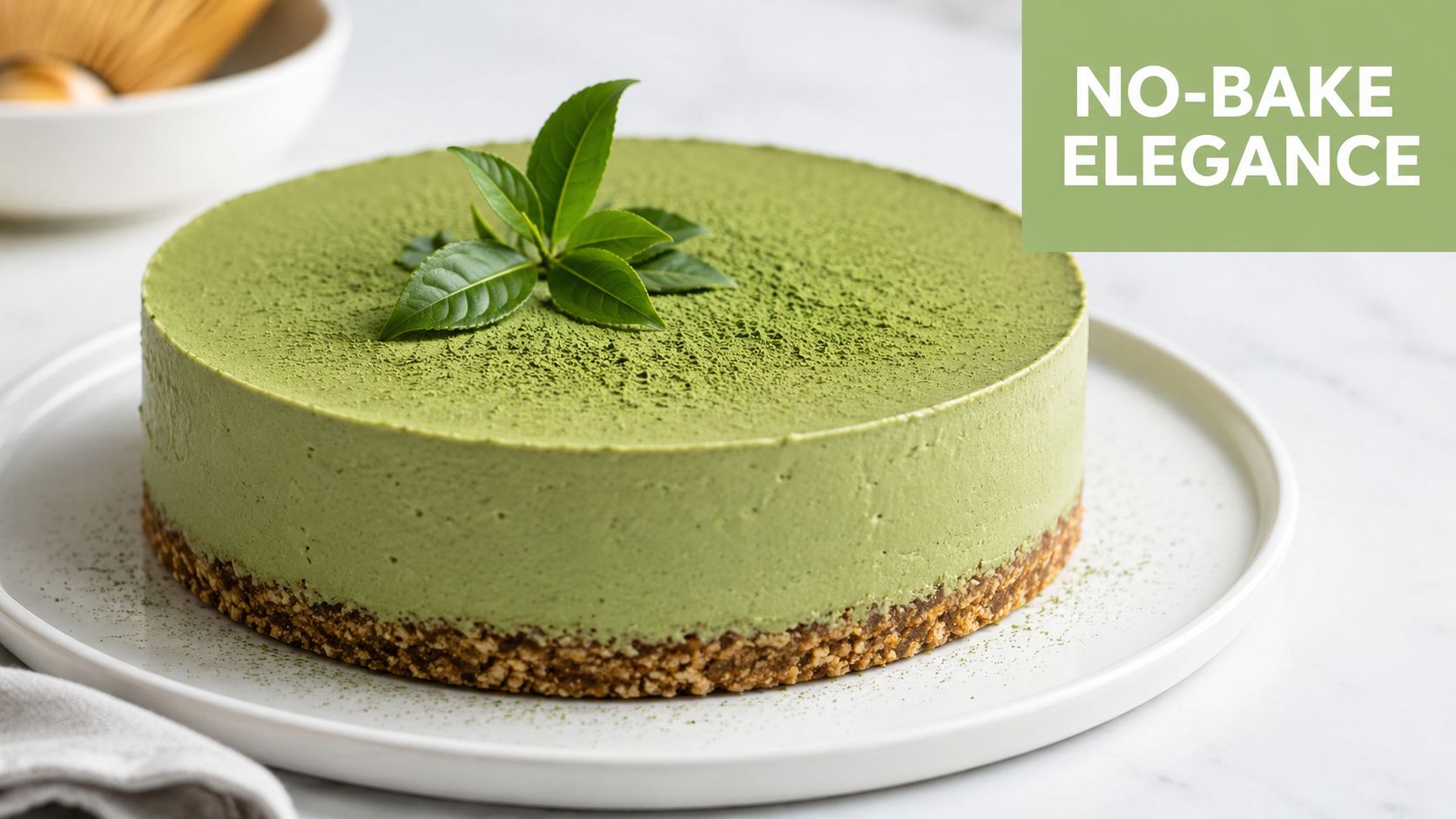
Why this dessert feels so special
Matcha does much more than tint the filling green. Good matcha brings gentle bitterness, fresh grassy notes, a little sweetness, and that clean tea finish that keeps cream cheese from feeling too rich. The result tastes poised and balanced, with richness held in check by the tea.
The choice of matcha makes a bigger difference than many recipes admit. Low-quality powder can taste flat, muddy, or sharply bitter, which is often why homemade matcha desserts disappoint. For baking and desserts, I like using organic culinary matcha powder chosen for cooking because it gives you stronger flavour and better colour without forcing you to use an excessive amount. If you want to find unique matcha from local makers, look for a powder with a fresh aroma and a vibrant green tone rather than an olive or brown cast.
The pan style is flexible too. Many home bakers use a springform tin for clean edges, but the same filling can work in a smaller pan or sliced bars if you want a different presentation.
A good no-bake cheesecake should feel cool, creamy and light on the palate, not dense and stodgy.
What success looks like
When this cheesecake is made well, each layer has a clear role. The base is firm enough to hold together, the filling is smooth and airy, and the matcha comes through clearly without any harsh, dry finish.
You should get creaminess first, then the green tea notes, then a clean finish that invites the next bite. That is what gives the dessert its elegant feel. It is refined, yes, but still very achievable at home when you use good ingredients and treat the filling gently.
Your Ingredients and Equipment Checklist
The ingredient list is short, but each item has a job. In a no-bake cheesecake, you don't have heat doing the setting for you, so texture comes from fat, temperature and technique. That's why this recipe works best when you use the proper ingredients, not lighter substitutes.
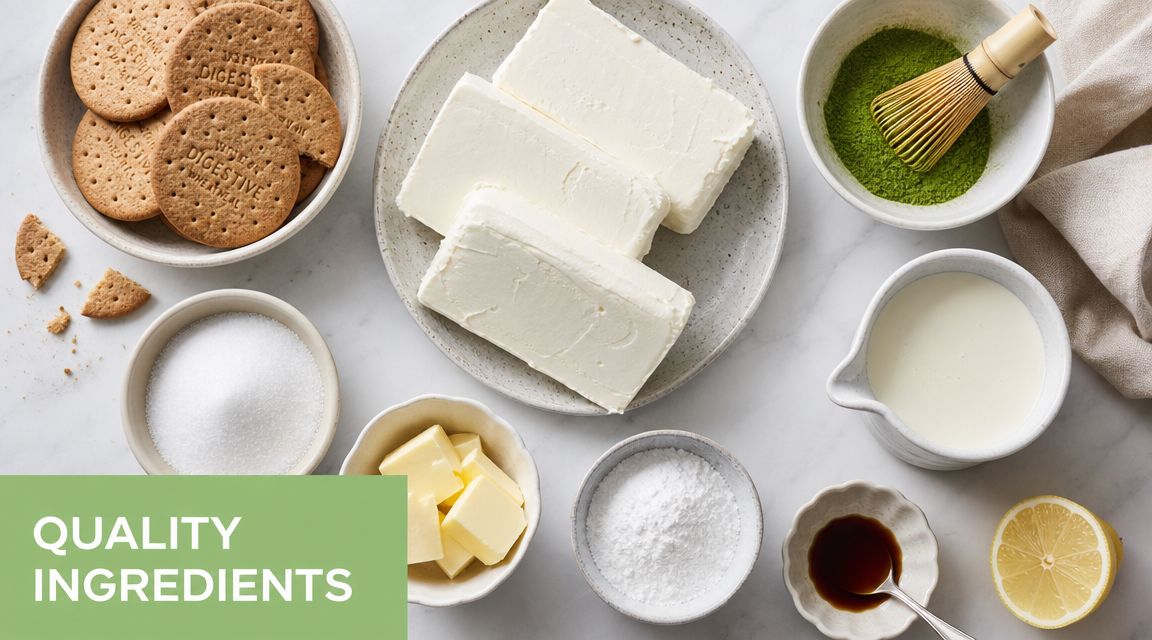
The core ingredients
For the base and filling, keep your shopping list simple:
- Plain sweet biscuits such as digestives or similar. These crush evenly and make a tidy, buttery base.
- Melted butter to bind the crumbs so the crust slices cleanly.
- Full-fat cream cheese for body, richness and structure.
- Caster sugar or icing sugar, depending on your preferred texture.
- Thickened cream or heavy cream to create the light finish.
- A little acid such as lemon juice. It brightens the filling and helps balance richness.
- Pure matcha powder for flavour and colour.
A lot of confusion starts with the cream cheese. Use block-style, full-fat cream cheese if you can. Spreadable tub versions are often softer and can leave the filling looser than you want.
Choosing the right matcha
Often, recipes become vague. One of the biggest gaps in no-bake matcha cheesecake recipes is that they often tell readers to add “matcha” without explaining how culinary grade versus ceremonial grade affects flavour, colour or bitterness, as discussed in this matcha cheesecake guide.
That matters because cheesecake is rich. The dairy can mute delicate tea notes, so your matcha needs enough presence to come through clearly.
Here's the practical rule:
- Use high-quality culinary matcha for baking and desserts. It has the strength to stand up to cream cheese, cream and sugar.
- Don't reach straight for ceremonial matcha unless you know the flavour profile you want. Ceremonial matcha is lovely whisked as tea, but in a cheesecake it can be an expensive ingredient whose subtle notes get lost.
- Sift the matcha first so you don't end up with little dark green lumps in the filling.
If you enjoy comparing tea styles before choosing one for baking, it can help to find unique matcha from local makers and notice how colour, aroma and bitterness differ from one powder to another.
For dessert use, a dedicated organic culinary matcha powder for cooking is the easiest starting point because it's designed to perform well in recipes, not just in a tea bowl.
The best matcha for cheesecake gives you a fresh green colour and a rounded tea flavour, not an aggressive grassy finish.
Equipment that makes life easier
You don't need a professional kitchen. You do need a few reliable tools:
| Tool | Why it helps |
|---|---|
| Springform pan | Releases the cheesecake neatly without damaging the sides |
| Electric mixer | Smooths the cream cheese properly |
| Mixing bowls | One for the cream cheese base, one for the whipped cream |
| Spatula | Essential for folding without knocking out air |
| Fine sieve or sifter | Breaks up clumps in the matcha |
| Food processor or rolling pin | Crushes the biscuits evenly |
A 20 cm springform pan is the usual home-baker choice in Australia and sits comfortably within the common 9-inch recipe style found in published no-bake versions.
The Step-by-Step No-Bake Method
The secret to a mousse-like cheesecake isn't luck. It comes from handling the filling in two distinct stages. Recipe sources consistently warn that the main failure point is overmixing, and that the best texture comes when you beat the cream cheese and flavourings until smooth, whip the cream separately to stiff peaks, then gently fold it in according to this technique-focused recipe.
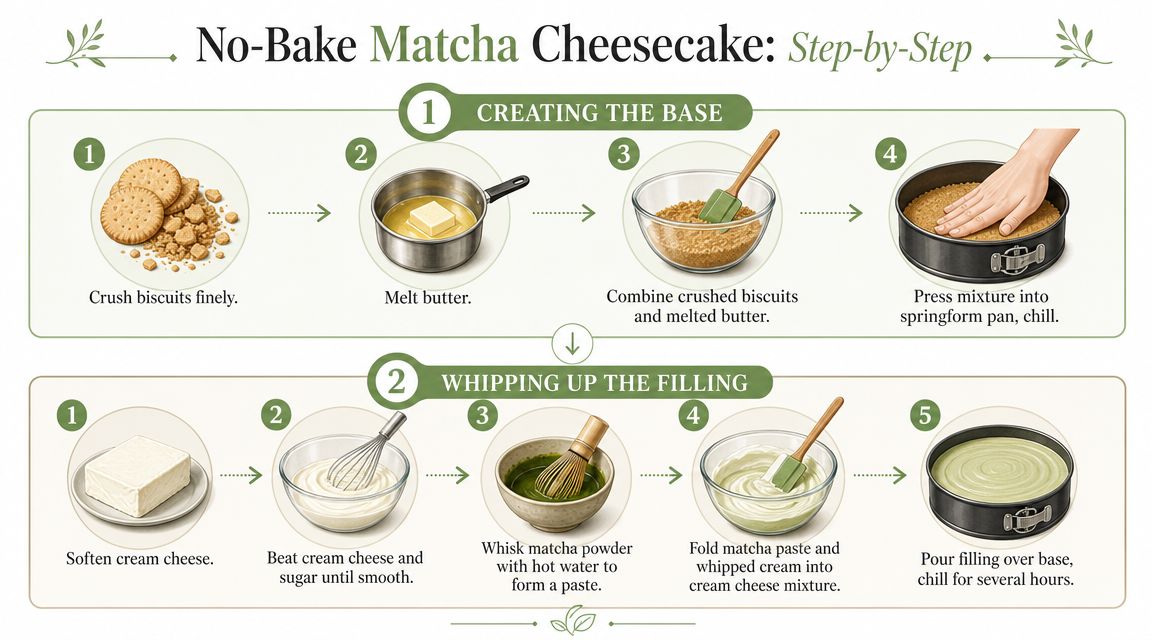
Stage one for the biscuit base
Crush the biscuits finely.
You want an even crumb, almost like damp sand once the butter is added. Large chunks make the base harder to slice neatly.Stir through melted butter.
Mix until every crumb looks coated. If some crumbs stay dry, the base won't hold together well.Press the mixture into your springform pan.
Use the back of a spoon or the base of a glass. Press firmly across the bottom and slightly up the sides if you like a taller edge.Chill the base while you make the filling.
This helps it firm up early so it doesn't shift when the filling goes in.
Stage two for the filling
Here, the texture is won or lost.
Beat the cream cheese until smooth.
It should be soft enough to mix without lumps. Cold cream cheese fights back and leaves grainy bits through the filling.Add sugar, matcha and any flavourings.
Sift the matcha before adding it. If you like, whisk the matcha with a small amount of liquid first to make a smooth paste before it goes into the bowl. That helps the colour distribute evenly.Mix until fully homogenous.
You're aiming for one smooth, green mixture with no streaks and no pockets of unmixed cream cheese.Whip the cream separately to stiff peaks.
This matters more than many readers realise. Stiff peaks mean the cream holds shape when you lift the beaters. That whipped air is what gives the cheesecake its lighter body.
For a smoother, lump-free finish in the tea itself, a matcha tea sifter is useful before the powder ever reaches the mixing bowl.
Practical rule: Stop the mixer once the cream reaches stiff peaks. Keep going and you risk turning silky cream into a grainier mixture that won't fold as cleanly.
The folding step that changes everything
Fold the whipped cream into the matcha cream cheese mixture gently.
Use a spatula, not the mixer. Scoop from the bottom of the bowl and lift over the top in broad, slow motions.Work in batches if that feels easier.
Fold in a small amount first to loosen the base, then add the rest. This makes it easier to keep the air you've whipped in.Stop once combined.
The mixture should look smooth and airy. If you keep stirring after that point, you'll deflate the whipped cream and lose the mousse-like texture.
This is the step many home bakers rush. Mixing feels faster, but folding is what protects the tiny air bubbles in the cream. Those bubbles help the filling feel soft and elegant instead of compact and heavy.
Finish the cheesecake properly
Spoon the filling over the chilled base.
Spread it gently to the edges with a spatula.Smooth the top.
A small offset spatula works well, but the back of a spoon is fine too.Cover and refrigerate.
Let the cold do the setting.
A simple workflow helps:
- Room-temperature dairy for mixing makes the filling smoother.
- Cold cream for whipping gives better volume.
- Gentle folding at the end protects the final texture.
If you keep those three ideas straight, this dessert becomes very reliable.
Achieving the Perfect Set and Finish
You lift the springform tin, slide in the knife for the first slice, and hope the centre holds. This is the stage where a no-bake matcha cheesecake becomes either beautifully mousse-like or a little too loose. The difference usually comes down to time, temperature, and restraint.
This cheesecake sets in the fridge as the fats in the cream and cream cheese firm up and the airy filling settles into a stable structure. Cold does the work slowly, which is why a rushed chill often gives you soft, untidy slices. An overnight rest gives the cleanest result, but a longer daytime chill can still work well if the filling was folded gently and whipped to the right stage earlier.
Texture matters here just as much as appearance. A good no-bake matcha cheesecake should hold a neat edge on the plate, then soften quickly on the fork. That is the sweet spot. You want a dessert that feels light, almost like a set cream, not dense or rubbery.
What a proper set looks like
The outer edge should look smooth and hold its shape when the ring is removed. The centre may have a slight wobble, but it should not ripple like liquid. If you press the top very lightly with a clean fingertip, it should feel softly springy.
That gentle wobble can confuse home bakers. It does not mean failure. It means the filling is chilled yet still delicate, which is exactly what gives this cheesecake its mousse-like character.
How to finish it neatly
Keep the decoration simple so the matcha can stay the star, both in flavour and colour. High-quality organic culinary matcha earns that spotlight. It gives you a fresher green hue and a fuller tea flavour, without the dull colour or harsh bitterness that can make other versions taste flat.
A few finishing options work especially well:
- A fine dusting of matcha just before serving for a clean, classic look
- Fresh raspberries for brightness and contrast
- White chocolate shavings for a softer, sweeter finish
- Black sesame seeds for a nutty accent and a striking dark detail
Use a light hand. Too many toppings can hide the clean flavour of the tea and make the dessert look busy.
Small finishing habits that make a big difference
For the cleanest slices, warm your knife in hot water, wipe it dry, and clean it between cuts. Chill the cheesecake fully before dusting with matcha, or the powder can darken in patches on the damp surface. If you are making this for guests, topping it shortly before serving keeps the finish sharp and fresh.
If you enjoy learning how fine powders behave in desserts, instant coffee baking techniques offer useful ideas about dissolving flavour evenly without creating gritty pockets. The principle is similar with matcha. A smooth, even finish starts with careful handling from the beginning and pays off at the end.
Patience gives you the final polish here. Let the chill do its job, keep the finish elegant, and your cheesecake will slice with confidence and taste as lovely as it looks.
Troubleshooting and Recipe Variations
Even when the recipe is straightforward, small things can throw the texture off. The good news is that most problems come from one of a few easy-to-fix causes.
If something went wrong
The filling seems too soft
The cream may not have been whipped firmly enough, or the cheesecake may need more time in the fridge.The cheesecake tastes bitter
The matcha may be too strong for the amount of dairy and sugar, or the powder itself may be lower quality and more astringent.The base crumbles when sliced
It usually needs a little firmer pressing next time. Very uneven biscuit crumbs can also make the crust less stable.The filling looks lumpy
Cream cheese that was too cold is often the culprit. Beat it until smooth before adding anything else.
Easy ways to adapt it
This recipe is flexible enough to suit different dietary needs:
- Gluten-free version uses gluten-free biscuits for the base.
- Lower-sugar option works best with a powdered sweetener so the filling stays smooth rather than gritty.
- Vegan version can be made with vegan cream cheese and coconut cream or a whipped plant-based alternative, though the final texture may differ.
If you enjoy flavour layering in desserts, it's worth studying methods from other baking niches too. For example, instant coffee baking techniques offer useful ideas about dissolving bold powders smoothly into creamy mixtures, and that same thinking can help when you're trying to avoid matcha clumps or harsh pockets of flavour.
Most no-bake cheesecake problems aren't disasters. They're texture clues. Once you know what caused them, the next one is usually excellent.
How to Serve and Pair Your Creation
You have chilled the cheesecake, lifted out a clean slice, and that soft green centre looks almost like a set matcha mousse. This is the moment to keep everything else simple, so the texture stays the star and the flavour of the matcha stays clear.
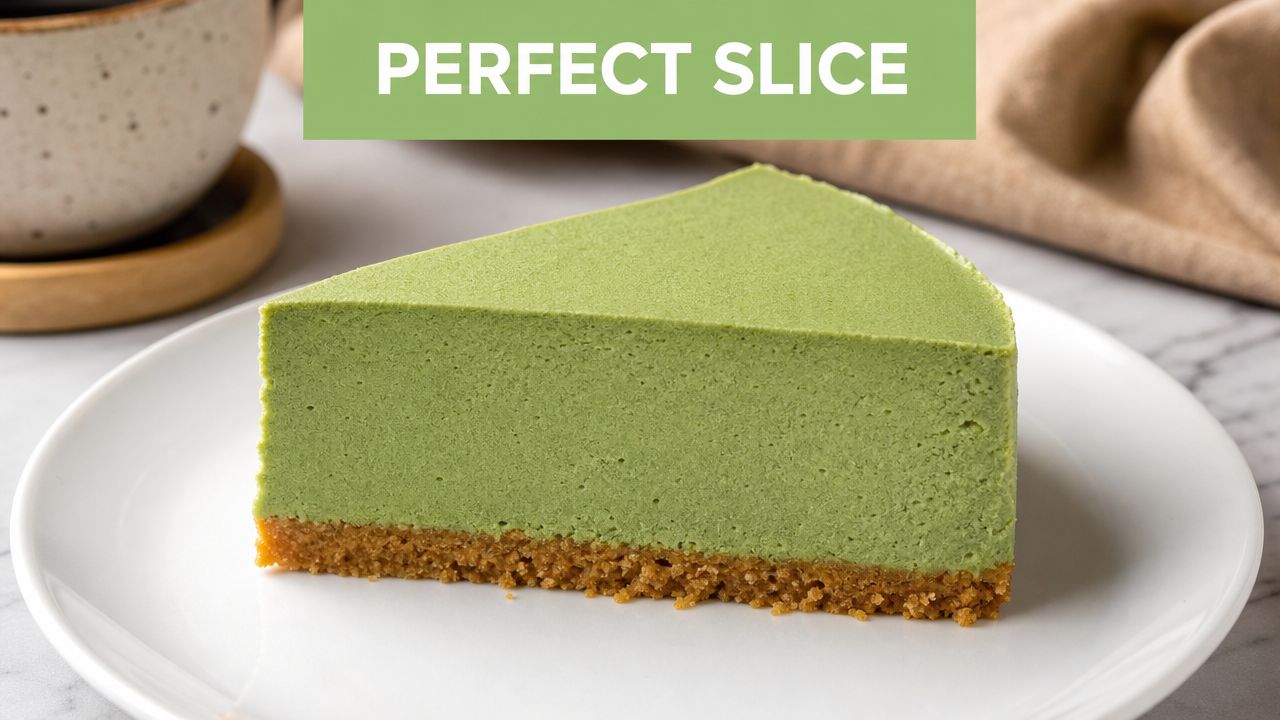
For the neatest slices, use a sharp knife dipped in hot water, then wipe it dry before cutting. Clean the blade between each slice too. It works like cutting custard with a warm spoon. You glide through the filling instead of dragging it, which keeps those layers distinct and protects that light, airy structure you worked so carefully to build.
Serve each slice well chilled, but not ice-cold straight from the back of the fridge. A few minutes at room temperature lets the creaminess soften slightly, and the matcha becomes easier to taste. This matters even more if you used a good organic culinary matcha, because its grassy sweetness and vivid colour deserve room to show themselves. Lower-quality matcha can taste flat or bitter, so keep garnishes and drinks restrained rather than piling on extra sweetness to cover it.
Pairings that make the dessert feel complete
The best pairing refreshes your palate between bites. Sparkling water with lemon, a cold yuzu drink, or lightly sweetened iced tea all do that job beautifully because they cut through the richness without fighting the tea notes.
An iced matcha drink can work well too, as long as it is lighter and less creamy than the cheesecake itself. If you enjoy matching dessert with a tea-based drink, this guide on how to make an iced matcha latte is a lovely companion read.
For garnish, less is usually more. A small dusting of matcha, a few white chocolate curls, or a couple of fresh raspberries give contrast without distracting from the filling. White chocolate is especially good with matcha because its sweetness rounds out any faint astringency and lets the green tea flavour feel softer and fuller. If you want to add coloured chocolate details or a decorative drizzle, DBakerAid™'s expert chocolate coloring advice is a helpful resource.
A quick visual guide can help before you plate your own.
A thoughtful plate is enough. One clean slice, one restrained garnish, one fresh drink on the side. That balance lets the mousse-like texture and the clean flavour of quality matcha come through clearly.
If you'd like to make this with premium organic matcha chosen for both drinking and kitchen use, explore Pep Tea for Australian matcha and tea inspiration, including recipe ideas, iced matcha guides and pantry staples for your next bake.