
Kombucha Starter Liquid: What It Is and Why It Matters

You've brewed the tea, dissolved the sugar and waited for it to cool. The SCOBY is ready beside the jar, but one small detail can decide whether the batch starts cleanly or sits vulnerable for too long: kombucha starter liquid.
At a Hunter Valley café, this is the part of the process that's easy to overlook because it doesn't look dramatic. It's mature, tangy kombucha. Yet that liquid carries the established culture and acidity that help guide fresh sweet tea towards a safer fermentation. Treating it as leftover drink misses its most important job.
The Hidden Foundation of Every Successful Brew
A new brewer often spends plenty of time choosing black or green tea, measuring sugar and planning flavours such as ginger or mango. Then the tea cools, the SCOBY goes in, and the jar is covered. If the batch develops an odd smell or takes too long to turn tart, the starter liquid may have been the missing piece.
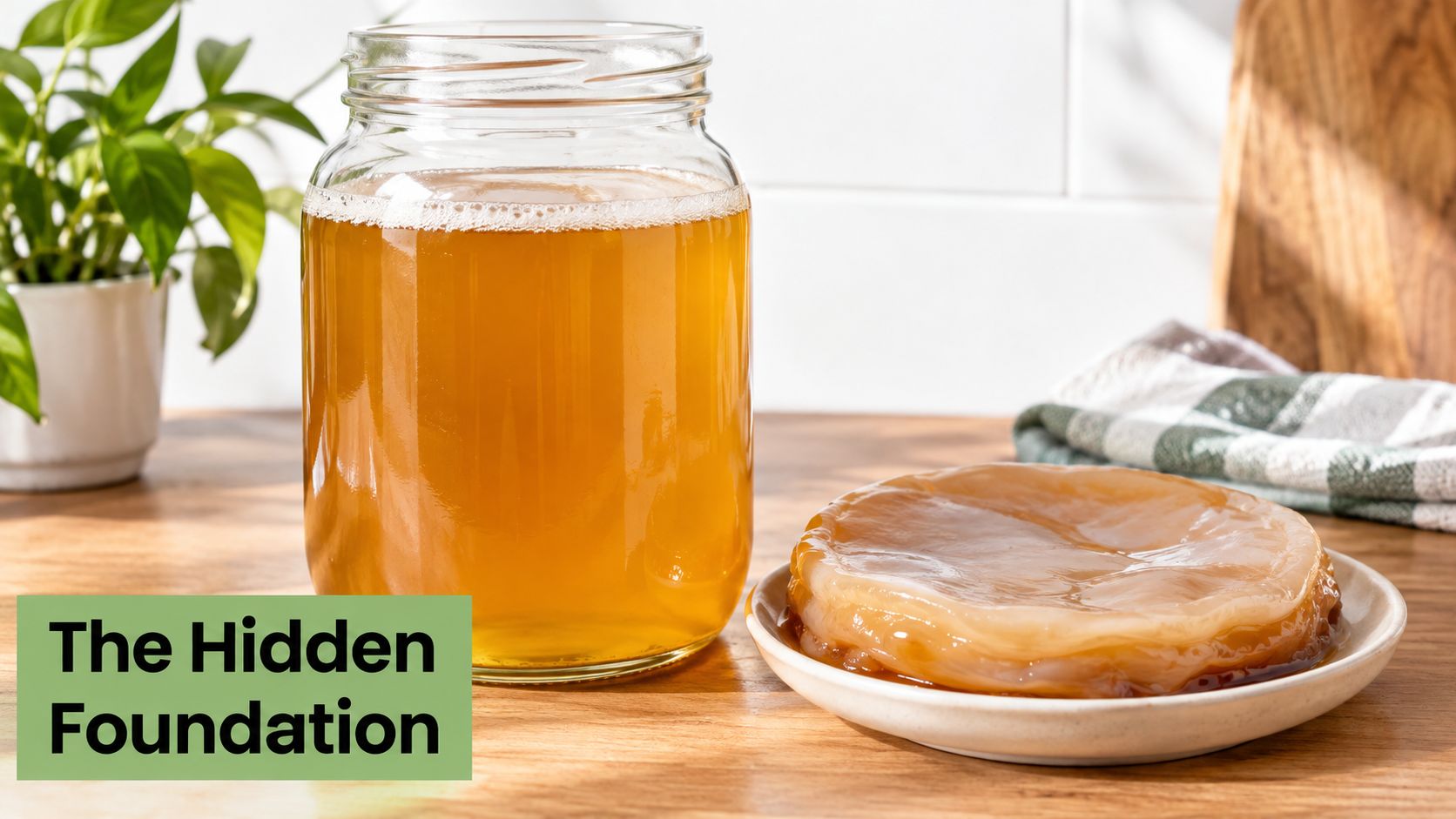
Starter liquid is the mature kombucha reserved from an active, successful batch. It brings an established community of yeasts and bacteria into the new tea, while its existing acidity changes the starting conditions straight away. The SCOBY matters too, but the liquid surrounding it is an active part of the fermentation system, not just a carrying medium.
Picture planting a garden bed. Fresh sweet tea is the prepared soil, the SCOBY is part of the living garden, and starter liquid brings an established population that can begin working immediately. Without that head start, the new batch has to develop its balance while the sweet tea remains in a condition where unwanted microorganisms may gain an opportunity.
Practical rule: A healthy-looking SCOBY without sufficiently active, acidic liquid isn't a complete fermentation plan.
This matters at home, but it matters even more in cafés and small production spaces. A hospitality team needs repeatable batches, predictable flavour and responsible control of a living drink after it leaves the brew vessel. The first pour of starter liquid influences all three.
Starter liquid also changes how you judge a recipe. Rather than measuring only by volume, you need to consider its acidity, smell, activity and history. A small amount of reliable mature kombucha can help a fresh batch move in the right direction, while weak, contaminated or poorly stored liquid can create uncertainty from the beginning.
What Kombucha Starter Liquid Actually Is
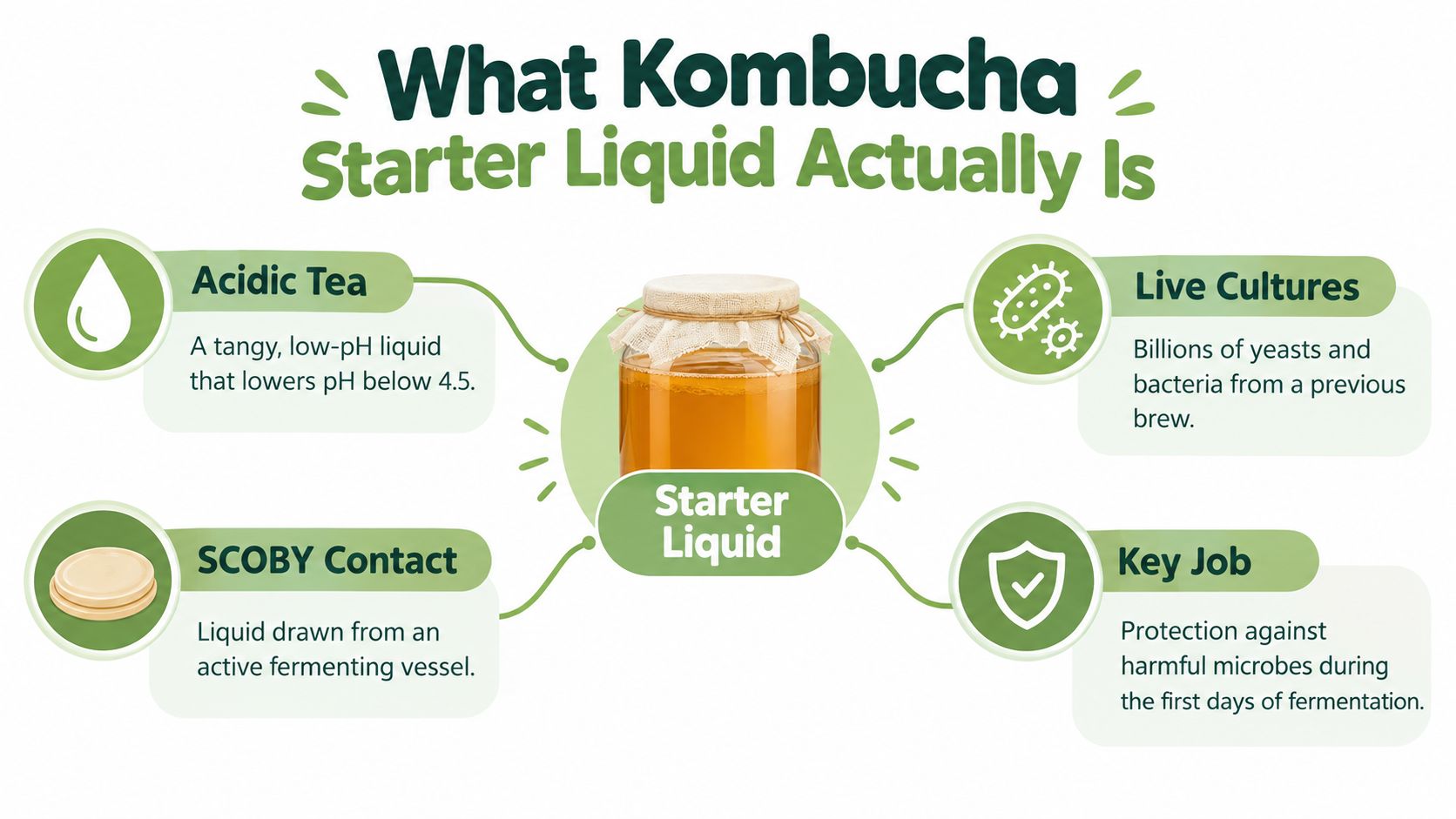
Kombucha starter liquid is finished, acidic kombucha from an active fermentation, usually taken from the vessel before flavouring or bottling. It contains the yeasts and acetic-acid bacteria that have already adapted to the tea environment. When added to fresh sweet tea, these organisms continue the sequence that creates kombucha's characteristic tartness.
The roles are complementary:
- Yeasts use available sugar and produce ethanol and carbon dioxide as part of fermentation.
- Acetic-acid bacteria use oxygen and convert yeast-produced ethanol into organic acids, including acetic acid.
- The liquid itself carries acidity and living culture into the next batch.
- The SCOBY is the visible cellulose-rich layer formed by the culture. It can support fermentation, but it isn't the only place where the active organisms live.
The simplest comparison is a sourdough starter. You wouldn't expect a dry piece of crust to ferment a fresh dough reliably. The living mixture around it carries much of the activity. Kombucha starter liquid plays a similar practical role, although the organisms and process are different.
Starter liquid and a SCOBY are not interchangeable
Adding a SCOBY alone can leave the new tea without enough acidity at the beginning. The liquid helps lower the starting pH and introduces organisms throughout the batch, rather than relying only on contact with a floating or sinking disc.
The liquid should come from a batch that smells pleasantly sour or tea-like, without fuzzy growth, rotten odours or unexplained discolouration. A SCOBY can naturally sink, float or sit at an angle, so its position isn't a reliable test of culture health. The condition of the liquid and the way the brew progresses matter more.
Why mature liquid is carried forward
Each successful batch leaves behind a portion of mature kombucha that can seed the next one. This creates continuity. You're not starting with a blank jar each time, but carrying forward a working culture that has already converted sweet tea into an acidic ferment.
That's why starter liquid deserves to be measured and protected. It is both an inoculum, meaning a source of living culture, and an early acidification control.
How pH Control Makes Starter Liquid a Safety Tool
Freshly brewed sweet tea begins at approximately pH 5, a range in which potential contaminants can grow. Food Standards Australia New Zealand advises cooling tea rapidly from 60°C to 20°C within 2 hours, then adding a proven, uncontaminated starter culture as soon as possible. You can review the broader fermentation context in Yuve's gut health guide, but kombucha brewing needs its own careful controls.
Starter liquid helps the culture begin producing acid sooner. The yeasts and acetic-acid bacteria work in sequence, and oxygen supports the bacteria as they oxidise yeast-produced ethanol into acetic acid. That gradual acidification lowers pH and changes the environment in favour of the intended culture.
The useful pH milestones
Australian guidance identifies pH 4.2 or below as the point at which kombucha becomes a non-potentially hazardous food that doesn't support pathogen growth or toxin production. The practical lesson is simple: the batch needs to reach that milestone promptly, not merely taste sour after a long wait.
A final pH of approximately 2.5 or higher is described as typical. Excessive acidification can produce an aggressively sharp drink and may create additional safety concerns, so lower isn't automatically better.
| Brewing question | Practical answer |
|---|---|
| Is taste enough? | No. Taste can help judge flavour, but it doesn't replace measurement. |
| Does oxygen matter? | Yes. Aerobic fermentation supports acetic-acid production. |
| What should be measured? | Track pH during fermentation with a calibrated meter. |
| Is the starting liquid important? | Yes. Its acidity and culture activity influence how quickly the new batch changes. |
A calibrated digital pH meter for kombucha brewing gives you a clearer view than elapsed time alone. Two jars brewed in different kitchens can move at different speeds because of temperature, tea, culture condition and handling. Recording pH gives a café team or home brewer evidence to work with.
Taste tells you what the drink is becoming. A pH meter tells you whether the process is moving into the intended safety range.
Use clean equipment, cool the tea before adding culture and keep the ferment exposed to suitable air circulation. If the pH doesn't move as expected, don't solve the problem by waiting indefinitely. Review the starter's condition, the temperature, the equipment and the possibility of contamination.
Where to Source or Make Your Starter Liquid
There are two sensible routes. You can obtain starter liquid from an established kombucha producer, or reserve it from your own healthy batch. The right choice depends on whether you're learning at home, restarting after a break or trying to keep café production consistent.
Buying from a reliable producer
A supplied starter should have a clear origin and handling information. Ask how it was brewed, whether it has been kept clean and whether the supplier can explain how to use it with your tea. A reputable source should be able to describe the culture rather than treating the liquid as a generic flavour additive.
For a first batch, a packaged option such as PepTea's starter tea kombucha product can be useful because it is presented specifically for establishing fermentation alongside a SCOBY. The important point isn't the packaging itself. It's knowing what the liquid is, where it came from and how it has been handled.
Reserving liquid from your own batch
Before flavouring or bottling a successful brew, decant clean mature kombucha into a sanitised container. Choose liquid from a batch with a pleasant acidic aroma and no visible mould. If the brew has an unusual smell, fuzzy growth or signs of spoilage, don't preserve it as your next starter.
A small café should label the container with the batch identity and date, then store it under the same controlled conditions used for the rest of the production process. Home brewers can use a simpler note on the jar, but the principle is identical: know which batch you're carrying forward.
How much is enough
PepTea's product guidance describes mature acidic kombucha at approximately 10% of a new batch as a way to lower initial pH and establish fermentation. The exact suitability depends on the acidity and activity of the liquid, so volume alone shouldn't be your only check.
If the starter is unusually mild, old, diluted or uncertain, adding more by guesswork won't guarantee a safe result. Measure pH, use a known culture and keep your process consistent. A starter liquid with strong acidity and healthy activity gives the new tea a more dependable beginning.
Storing and Maintaining Starter Liquid Correctly
Starter liquid is alive, so storage is about slowing change without treating it as a lifeless ingredient. A clean container, stable refrigeration and careful handling help preserve its useful acidity and culture activity between brews.

Use a clean glass container with enough room for safe handling. Keep the lid secure, but avoid repeatedly opening the jar just to smell it. Every opening creates another opportunity for dust, insects or accidental contact to enter.
A simple storage routine
- Label the jar: Record the batch source and storage date so nobody has to guess what it contains.
- Keep it cold: Refrigeration slows fermentation and helps maintain a more stable flavour and activity profile.
- Protect the liquid: If a SCOBY is stored with it, keep the culture covered so it doesn't dry out.
- Use clean utensils: Never dip a used spoon or tasting glass into the container.
- Inspect before use: Look for mould, unpleasant odours or a change that doesn't resemble normal acidic fermentation.
A refrigerated starter can become more sour over time, and its activity may change. “It still smells acidic” is useful information, but it isn't proof that the liquid is suitable for every new batch. Measure and observe rather than assuming that starter liquid never expires.
Freezing can also alter texture and culture activity, so it isn't automatically the best preservation method. For a short brewing pause, stable refrigeration is the more straightforward routine. If you're unsure about a stored culture, discard it rather than trying to rescue a questionable ferment.
The following video can help visualise practical SCOBY storage habits:
For a longer pause between batches, keep the culture submerged in mature kombucha and avoid repeated transfers. PepTea's guide to storing a SCOBY between brews offers a useful reference for maintaining the culture without letting it dry out.
Spotting Contamination and Managing Alcohol Risk
A healthy kombucha culture can look different from batch to batch. The SCOBY may float, sink or form an uneven new layer, and strands or sediment can appear as yeast activity continues. Those changes aren't automatically contamination.
Mould is different. Fuzzy or dry growth, especially with suspicious colours, is a reason to discard the affected batch and starter rather than skim the surface. A rotten, solvent-like or otherwise offensive smell also deserves caution. If the liquid has been exposed to dirty equipment, insects or questionable water, don't use it to seed another brew. For general background on checking water quality, how to test well water for E. coli is a useful resource, although a home water test doesn't replace good brewing hygiene.
Alcohol can change after bottling
Acidity is only half the control problem. Yeasts can remain active after the SCOBY is removed, particularly when residual sugar, warm storage, sealed bottles or a second fermentation give them favourable conditions.
A national survey of 239 fermented soft drink samples found that only 35.2 per cent of kombucha tested below 0.5 per cent alcohol by volume, while some products increased in alcohol during shelf life. The findings are reported in the Australian fermented-beverages issues paper.
In the same survey, 41.9 per cent of all sampled fermented drinks measured above 0.5 per cent and below 1.15 per cent ABV, while 22.9 per cent exceeded 1.15 per cent ABV. Kombucha represented 132 samples, or 55.2 per cent, of the total fermented-drink sample. These figures show why a bottle that tastes fine at filling can't automatically be treated as stable throughout its shelf life.
Practical controls for cafés and home brewers
- Reduce uncontrolled sugar: Residual fermentable sugar gives yeast more material to convert.
- Control warmth: Cold storage slows, but doesn't magically erase, ongoing fermentation.
- Treat sealed bottles carefully: Carbonation stages can trap gas and support continued yeast activity.
- Check the finished product: Commercial operators should validate alcohol at bottling and during shelf-life studies.
- Avoid blanket claims: Don't describe a living fermented drink as alcohol-free without appropriate testing and awareness of applicable Australian requirements.
In New South Wales, guidance states that kombucha sold as a non-alcoholic beverage must contain less than 0.5% ABV, as outlined by the NSW Food Authority. Requirements and classification can vary between states, so a café serving or selling kombucha should document its controls rather than rely on assumptions.
Best Practices for Home Brewers and Hospitality Use
The best process is the one you can repeat. Home brewers need a clean jar, reliable starter liquid and a way to check progress. Cafés need those same foundations, plus batch records, staff consistency and a clear approach to storage and product claims.
Keep the framework practical:
- Start with known liquid. Use mature starter from a healthy ferment or a traceable supplier.
- Cool before inoculating. Hot tea can damage the living culture.
- Measure pH. Don't rely on taste, smell or the calendar alone.
- Keep equipment hygienic. Clean jars, utensils, bottles and meter probes after use.
- Provide oxygen during primary fermentation. The acetic-acid bacteria need it for their work.
- Control the post-bottling stage. Residual sugar, active yeast and warm storage can keep fermentation moving.
- Record what happened. Note the starter source, pH observations, storage conditions and any alcohol testing.
A café doesn't need a laboratory bench beside the espresso machine, but commercial production does benefit from organised testing and suitable food-grade workspaces. Businesses planning more formal analysis can browse food testing lab benches for context on laboratory furniture and workflow design.
Home brewers can keep their notes in a notebook. Hospitality teams should make the process easy for every staff member to follow. In both settings, starter liquid should be treated as a safety control and fermentation tool, not an optional flavouring.
Pep Tea offers Australian-brewed, sugar-free organic kombucha from the Hunter Valley, along with organic Japanese matcha and practical guidance for mindful beverage routines. Visit Pep Tea to explore the range, learn more about kombucha culture care and enquire about options for home, café or wholesale use.