
Tag: vegan pancake mix Australia
Vegan Pancake Mix: How to Choose the Right One
You're standing in the supermarket aisle with a pancake mix in your hand. The front says vegan, which sounds promising, but someone at breakfast needs gluten-free food and another person avoids nuts. Is this the convenient option you hoped for, or another label you need to untangle?
A vegan pancake mix can make breakfast easier, but the useful information isn't all on the front. Start with dietary suitability, then compare nutrition, price and preparation. That order helps you choose a mix everyone at the table can eat, rather than discovering a problem after you've heated the pan.
What Replaces Eggs and Milk in the Mix
A traditional pancake batter gives each ingredient a job. Egg helps bind the batter and provides structure as it cooks. Milk supplies moisture and contributes to softness and browning, while butter adds richness and helps prevent sticking. Baking powder or bicarbonate of soda provides lift.
A vegan mix redistributes those jobs rather than removing the egg and milk. Manufacturers combine flours, starches and raising agents so the batter can set without animal ingredients. Depending on the product, you'll add plant milk, water, oil or a combination.
How the substitutions work
- Instead of egg: Ground flaxseed can help bind moisture, while chickpea flour contributes body and structure. Raising agents provide lift, but they don't perform every binding function of an egg.
- Instead of cow's milk: Some mixes include oat, soy or almond milk powder. Others leave the milk choice to you, which gives you more control over flavour and dietary suitability.
- Instead of butter: Vegetable oil or coconut oil supplies fat. Check whether it's already included in the mix before adding more.
- Instead of wheat flour: Buckwheat, oat or chickpea flour can change the flavour, texture and nutritional profile. A different flour also means a different set of label checks.
Baking powder usually remains part of the recipe. Check the complete ingredient list, including compound ingredients and any milk-derived additions, rather than assuming a familiar baking ingredient settles the question.
If you're choosing a milk for breakfast as well as your morning drink, the guide to plant-based coffee options from Cartograph Coffee offers useful context on flavour and texture. A milk you enjoy in coffee may still produce a different result in pancake batter.
Practical rule: Similar front labels don't guarantee similar pancakes. Flour, fat and milk choices affect colour, flavour and browning.
Choose the substitution that matters to you, whether that's a mild taste, a particular protein source or compatibility with a household allergy.
Vegan Is Not the Same as Allergy-Safe
It's easy to read vegan as suitable for everyone. It isn't. Vegan describes the absence of animal ingredients, not the absence of allergens.
A mix without egg, milk, butter or honey can still contain wheat flour, soy protein, lupin flour, almond meal or sesame ingredients. It may also be made on equipment that handles milk or egg. For someone managing a food allergy, those are separate questions from whether the recipe is plant-based.
Wheat-free and gluten-free aren't interchangeable either. Removing wheat doesn't necessarily remove barley or rye. Under Food Standards Australia New Zealand's allergy guidance, a gluten-free claim requires no detectable gluten and no oats or gluten-containing cereals. That distinction matters particularly when you're buying for someone with coeliac disease.
What each pancake mix label claim guarantees
| Label claim | What it confirms | What it does not confirm |
|---|---|---|
| Vegan | No animal ingredients such as egg, milk, butter or honey | Wheat, soy, lupin, sesame, nut or gluten content |
| Wheat-free | No wheat ingredient in the mix | Barley or rye, and any gluten they contain |
| Gluten-free | No detectable gluten, and no oats or gluten-containing cereals under FSANZ rules | Other allergens such as milk, egg, soy or nuts |
| May contain or shared-equipment warning | The maker has flagged possible cross-contact | How much allergen is present, since there is no fixed threshold indicated by the warning |
Since 25 February 2024, plain-English allergen requirements have applied, including bold allergen names in the ingredient list and a nearby Contains statement, while precautionary statements such as may contain remain voluntary, according to FSANZ's allergen-labelling guidance.
A precautionary warning isn't a measurement of contamination. Equally, the absence of a voluntary warning isn't proof that a factory has eliminated cross-contact. Someone with a severe allergy needs information relevant to their allergen and their medical advice, not a reassuring general impression.
A label-reading checklist for shared breakfasts
- Read every ingredient. Check each flour, protein, flavour and compound ingredient, rather than stopping when you recognise the main flour.
- Match the Contains statement to the household. Look for each person's specific allergen. Don't treat a short statement as a universal safety approval.
- Check for a gluten-free claim when coeliac disease is involved. A wheat-free description or a naturally gluten-free main ingredient isn't enough to assess the whole mix.
- Read precautionary and shared-equipment wording. Include the plant milk, cooking spray, chocolate chips and toppings in your checks.
- Ask the manufacturer when information is unclear. Ask about the specific allergen, shared production lines and cross-contact controls. If you can't establish suitability, choose another product.
For anyone coordinating meals for others, Guiding Growth's guide to safer grocery shopping for family caregivers is a useful companion to a written household shopping checklist.
The same discipline applies to recipes titled gluten-free raspberry and white chocolate muffins. A gluten-free recipe name doesn't establish whether the ingredients suit someone avoiding dairy or another allergen.
For a household combining vegan and coeliac requirements, look for vegan and gluten-free claims plus a clear allergen declaration. Then check the product against each guest's needs. Even that combination isn't a blanket guarantee for every allergy.
Comparing Prices and Pack Sizes Across Australian Brands
The lowest calculated price among these listings belongs to Well & Good's gluten-free buttermilk mix. That makes it worth considering for budget, but not automatically the best choice for your household.
Use this visual comparison alongside the retailer details below.
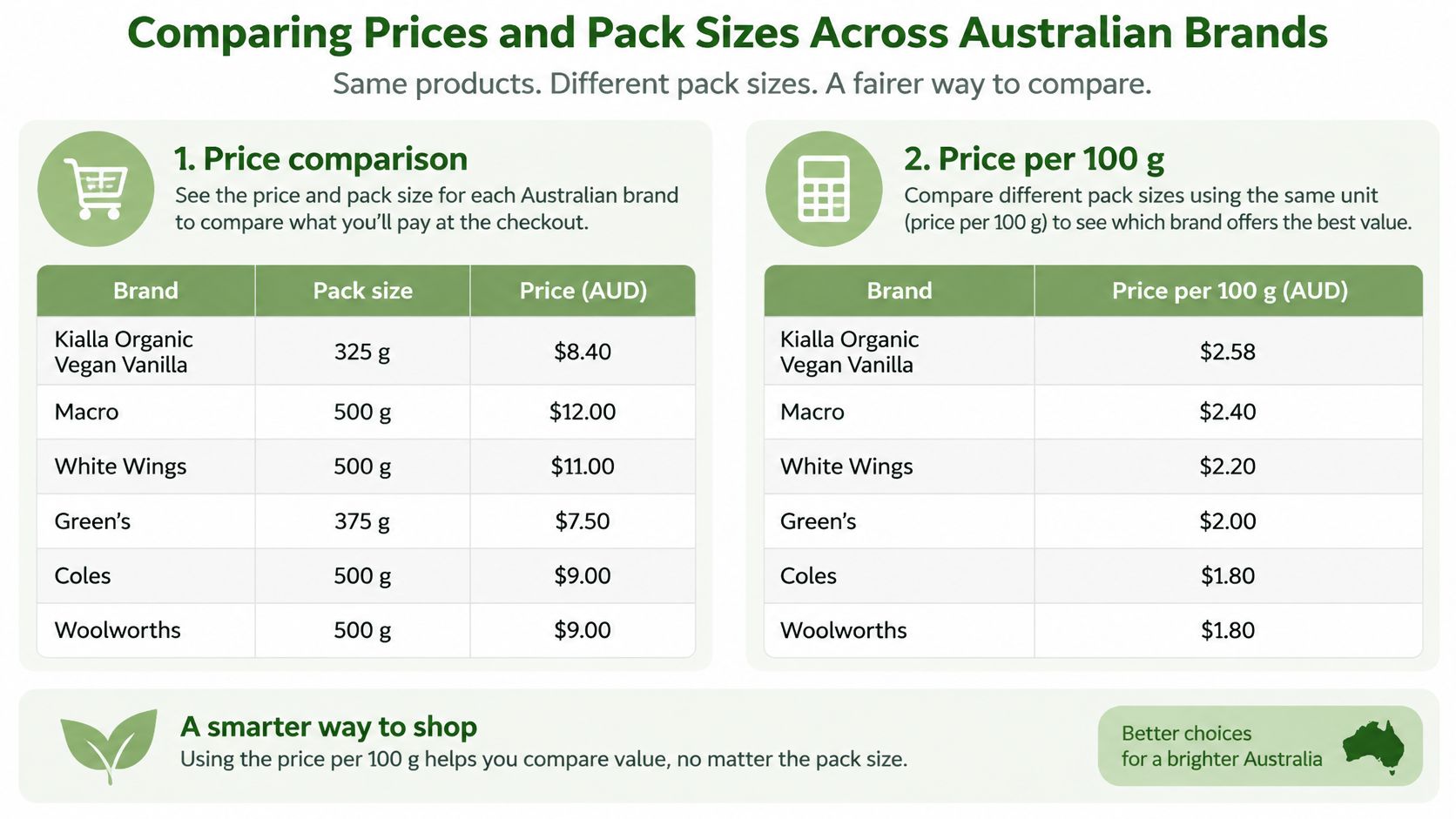
Australian vegan pancake mixes compared on price per 100 g
| Product | Pack size | Price (AU$) | Labelled as |
|---|---|---|---|
| Kialla Organic Vegan Pancake Mix, Vanilla | 325 g | 8.40, approximately 2.58 per 100 g | Vegan, organic, made in Australia. BuyNatural, 2025 listing |
| Botanika Blends Vegan and Gluten Free Pancake Mix, Original | 120 g | 10.00, approximately 8.33 per 100 g | Vegan, gluten free. Healthy Life Australia, 2026 listing |
| Well & Good Gluten Free Buttermilk Pancake Mix | 400 g | 7.40, approximately 1.85 per 100 g | Gluten free, vegan-friendly. Barossa Fresh, 2026 listing |
These are listings from different retailers and years, not a live shelf-price survey. Check current availability, delivery charges and the actual pack before buying. The first products explicitly use vegan in their names, while the Well & Good product was listed as vegan-friendly, a useful reminder not to judge suitability by the word buttermilk alone.
To compare different pack sizes, divide the price by the pack weight in grams, then multiply by 100. For provenance, Ceres Organics' Kialla listing, updated in 2026, describes the vanilla mix as a 325 g product made in Australia from at least 48% Australian ingredients.
A lower unit price tells you what the dry mix costs, not whether it meets your dietary needs or cooks the way you like.
Nutrition comparisons are deliberately left open here because these listings don't provide a complete, verified set of comparable nutrient values. Read the panel on the pack before deciding.
For a kitchen-view break from label reading, you can watch the following video.
How to Read the Nutrition Panel per 100 g
Set aside the front-of-pack wording and compare the per-100 g column. Serving sizes can differ between brands, so a smaller suggested serve can make a product look lighter without changing the mix itself.
FSANZ's Nutrition Information Panel guidance requires average energy, protein, fat, saturated fat, carbohydrate, sugars and sodium per serving and per 100 g; dietary fibre must also be declared when a fibre-related claim is made. Claims such as high protein, good source of fibre and low sugar have criteria, so they should agree with the panel rather than substitute for reading it.
What the numbers help you decide
- Protein: Pea, chickpea or lupin ingredients can contribute protein. Check the finished mix's value rather than assuming a prominent ingredient guarantees a high-protein product.
- Sugars and energy: A flavoured mix may contain added sugar. Sugar-free, natural and plant-based wording doesn't establish low energy, low sodium or high protein.
- Sodium: Baking powder, bicarbonate and salt all contribute. Compare sodium even when the pancakes don't taste particularly salty.
- Fibre and fat: Wholegrain, legume, nut and seed ingredients can change both. Check the declared amounts and whether the ingredients suit your allergies.
Australia's official food and nutrition guidance includes wholegrain or high-fibre grain foods, legumes, nuts and seeds within its core food-group advice. Choosing a mix containing these ingredients can help incorporate them into breakfast, but the complete formulation still matters.
A recording grid for shopping
Copy this grid and fill it from the packs you're considering.
| Nutrient per 100 g of dry mix | Product A | Product B | Product C |
|---|---|---|---|
| Energy | Record from pack | Record from pack | Record from pack |
| Protein | Record from pack | Record from pack | Record from pack |
| Fat | Record from pack | Record from pack | Record from pack |
| Saturated fat | Record from pack | Record from pack | Record from pack |
| Carbohydrate | Record from pack | Record from pack | Record from pack |
| Sugars | Record from pack | Record from pack | Record from pack |
| Sodium | Record from pack | Record from pack | Record from pack |
| Fibre | Record if declared | Record if declared | Record if declared |
Use the current pack panel as the reliable reference for these products. If fibre isn't declared, don't record it as zero.
Finally, distinguish dry mix from the prepared breakfast. Plant milk, oil, maple syrup, coconut cream and nut butter change what you eat. When experimenting with matcha baking recipes, apply the same whole-recipe approach rather than judging the finished food by one ingredient.
How to Make Vegan Pancakes and Vary Them
Start with the pack instructions, not a universal batter ratio. Some mixes already contain fats or milk powders, while others need more added ingredients. Measure the dry mix and liquid with proper measuring cups, and use a flexible spatula to scrape the bowl without beating the batter.
This visual guide summarises the cooking sequence, but the instructions on your chosen pack take priority.
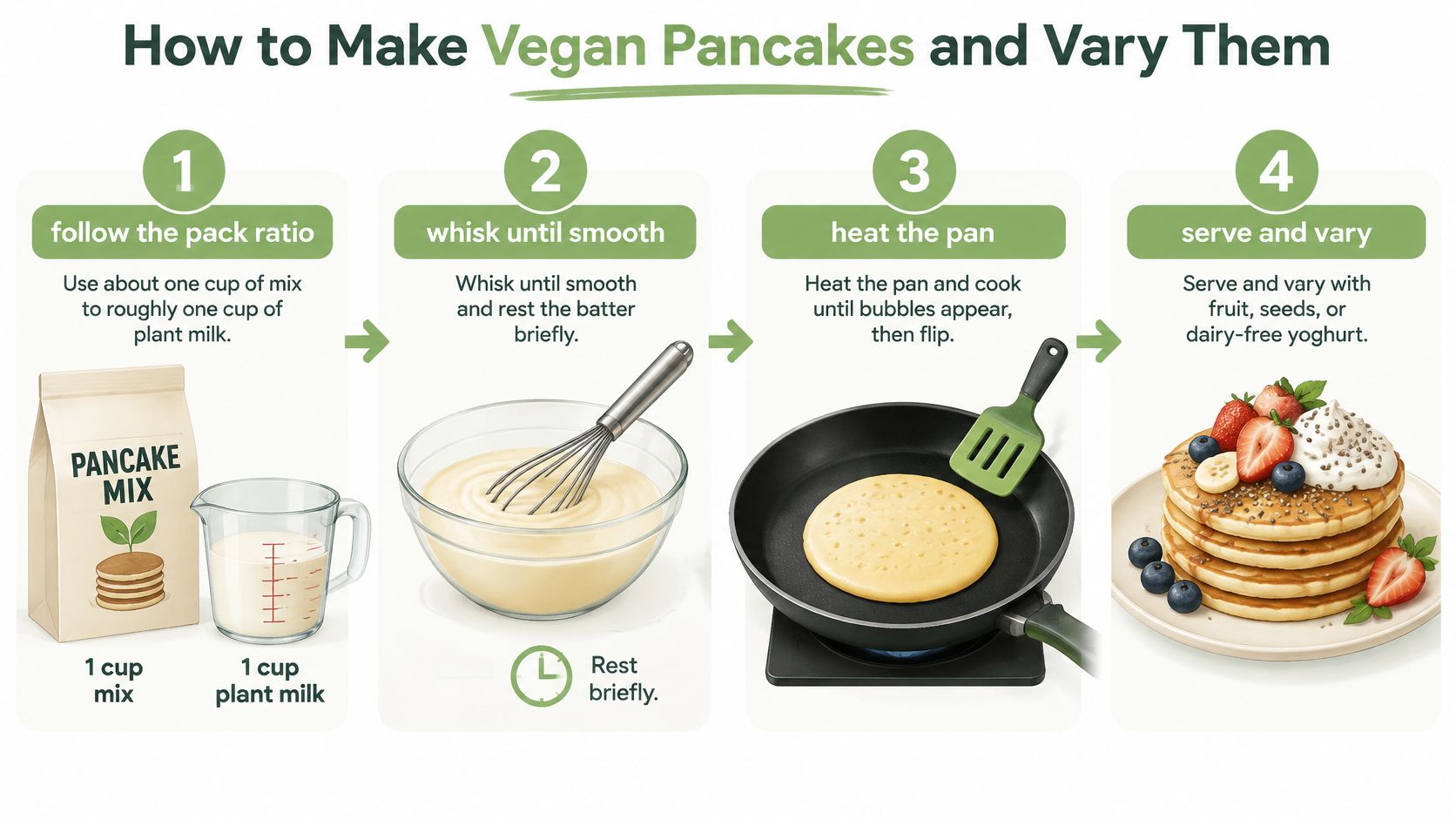
From dry mix to a cooked pancake
- Measure the ingredients. Follow the pack ratio and add oil only if directed. A cup of mix with roughly a cup of plant milk and a spoonful of oil is a possible starting example, not a ratio that suits every product.
- Whisk the liquid and mix until just combined, leaving small lumps. Don't keep beating in pursuit of a perfectly smooth batter.
- Rest the batter briefly. About five minutes is a useful trial if the pack gives no direction, allowing flour and starch to absorb moisture.
- Heat a lightly oiled non-stick pan over medium heat. Spread the oil with a pastry brush so it doesn't collect in puddles.
- Pour roughly a quarter cup of batter for each pancake, leaving space to slide a turner underneath. Keep the first pancake small so you can assess the heat.
- Flip when bubbles appear across the surface and the edges look dry. Start checking around two minutes, but use those visual cues rather than the clock alone.
- Keep cooked pancakes warm while finishing the batch. Avoid pressing them down with the turner, which flattens the texture.
Overmixing can make wheat-based pancakes tough. If the underside becomes dark while the centre remains wet, lower the heat rather than flipping repeatedly.
Add-ins and variations for one cup of vegan pancake mix
Treat these amounts as small-batch kitchen starting points and adjust the liquid to suit your mix.
| Variation | Add to the batter | Amount per cup of mix | Watch for |
|---|---|---|---|
| Blueberry | Fresh or frozen blueberries | 1/2 cup | Fold in last; frozen berries can turn the batter grey |
| Cinnamon apple | Grated apple and cinnamon | 1 small apple and 1/2 tsp cinnamon | Apple adds moisture, so use a little less plant milk |
| Chocolate | Dairy-free chocolate chips | 1/3 cup | Check the chocolate label for milk and allergens |
| Banana | Mashed ripe banana replacing part of the plant milk | 1 medium banana | Makes pancakes denser and sweeter, and browns faster |
Oat and soy milks can encourage faster browning, depending on their formulation. Lower the heat slightly if your usual setting colours the pancakes too quickly.
Fold frozen fruit in last with a spatula. Repeated stirring spreads the fruit juices through the batter.
For a green-tea variation, try this matcha pancakes recipe. Make a plain test pancake first when adapting a packaged mix, then adjust the remaining batter for flavour and consistency.
Choose Your Mix and Bake a First Batch
The right vegan pancake mix is the one that matches the people eating it and the breakfast you want to make. You don't need the longest list of claims or the most expensive packet.
Use your situation to narrow the shelf:
- Avoiding animal ingredients: Start with a vegan claim and confirm the ingredients and preparation instructions suit your preferences.
- Managing coeliac disease or gluten sensitivity: Apply the relevant gluten-free checks and your individual dietary advice before considering flavour.
- Cooking for a mixed household or café: Check every guest's requirements before buying in bulk, and use suitable utensils, preparation surfaces and toppings.
- Prioritising protein or fibre: Compare the nutrition panels, considering legume, wholegrain and seed-based options without overlooking allergens.
- Keeping costs manageable: Compare unit prices, then account for the extra ingredients needed to prepare the batch.
Choose a modest pack for your first trial. Make cinnamon apple pancakes this weekend, follow the cooking sequence, and note whether you'd prefer a thinner batter or gentler heat next time.
If you enjoy experimenting, a little organic matcha mixed into the dry ingredients adds green colour and a distinctive tea flavour. Start gently so it complements the pancake rather than overwhelming it.
We offer premium Japanese organic matcha for drinks and baking, alongside sugar-free organic kombucha brewed in NSW. Visit Pep Tea to explore our organic matcha range for your next pancake experiment or choose a refreshing drink to serve with weekend brunch.