
Tag: matcha catechins
Matcha Green Tea Antioxidants: Do They Survive Brewing?
One gram of matcha contained 56 mg of EGCG, a key tea antioxidant, in a Eurofins Food Testing Australia analysis of an organic matcha sample. That's a useful measurement, but it isn't a health score. A bigger scoop increases your exposure to tea compounds, including caffeine, without proving you'll receive greater benefits.
Understanding matcha green tea antioxidants starts with separating what's in the powder, what reaches your cup and what researchers can reasonably say about health. Brewing does not turn off antioxidants. However, the available composition figures don't tell us exactly how much survives every preparation method or how much your body uses.
How Much Antioxidant Matcha Is in a Serve
The Eurofins-tested sample contained 56 mg of EGCG per gram. Weighing out 2 g doubles the measured amounts, giving a concrete example of how serving size affects the figures.
Antioxidant and caffeine content per serve
| Source | Serve | EGCG | Total catechins | Caffeine |
|---|---|---|---|---|
| Eurofins-tested organic matcha (2021) | 1 g | 56 mg | 65.2 mg | Not reported in the cited results |
| Eurofins-tested organic matcha (2021) | 2 g | 112 mg | 130.4 mg | Not reported in the cited results |
These figures describe one commercially available organic matcha sample, not a standard for every packet. The 2 g row is calculated from the 1 g measurement, assuming the weighed powder is representative of that sample. Caffeine was not reported in the cited results, so its value cannot be inferred from the catechin measurements.
Cultivar, growing conditions, harvest, storage and analytical method can all affect reported results. Compare like with like: use the same serving weight and check which compounds each test measures.
Reading the figures without double-counting
EGCG is part of total catechins, not an extra amount to add to that total. Total catechins are the basket; EGCG is one item inside it.
The laboratory used liquid chromatography to separate and measure compounds in the powder. That analysis describes the tested sample. It does not establish exactly what remains after prolonged heating, storage in a prepared drink or digestion.
For a useful product comparison:
- Match serving weights. Compare equal amounts of powder, not different scoop sizes.
- Check the test's scope. Look for the product identity, laboratory and compounds measured.
- Separate missing results. An unreported caffeine value does not mean the product contains no caffeine.
Practical rule: Compare powders by weight first, then consider the drink you make from them.
At home, digital scales that reliably measure small amounts make a serving more repeatable than an estimated spoonful. More powder raises the measured amount of tea compounds, but a higher catechin figure alone does not establish greater health benefits.
What Catechins and EGCG Actually Are
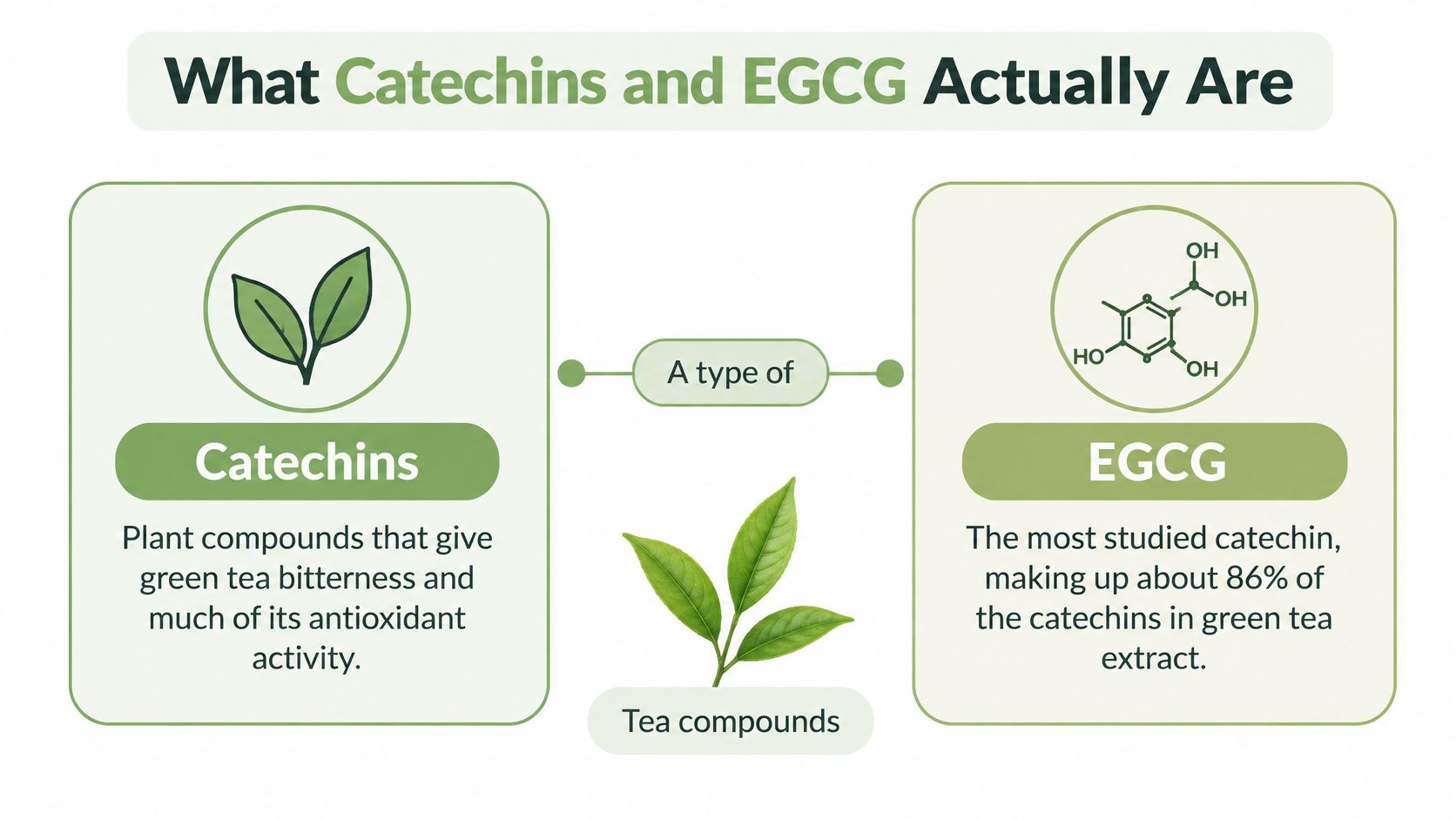
Catechins are a family of plant compounds associated with green tea's bitterness and much of its measured antioxidant activity. Epigallocatechin gallate, usually shortened to EGCG, is the most extensively studied member of that family.
Catechins belong to a broader group called polyphenols. In plain language, these are plant compounds with chemical structures that can participate in antioxidant reactions. “Phenolic content” is a broader laboratory measurement, not another name for EGCG alone.
The relationship is easier to follow visually.
What an antioxidant measurement means
An antioxidant can participate in reactions that limit oxidation under particular conditions. Oxidation is a chemical process, and laboratory antioxidant tests measure how a substance behaves within a defined testing system.
That distinction matters. A test tube doesn't reproduce digestion, absorption, metabolism or the conditions inside human tissues.
A Western Sydney University study of commercial green-tea products found a strong positive relationship between EGCG and total phenolic content, with r² = 0.97. The combined concentrations of several measured markers also correlated positively with antioxidant activity.
Those findings support looking at catechin composition rather than treating every green-tea product as chemically identical. They don't mean the same relationship applies between EGCG intake and a person's health.
Using EGCG as a shopping clue
Think of EGCG as a prominent line on a composition panel. Like the sugar line on a nutrition panel, it tells you something useful, but not everything about the drink.
A shopper still needs context:
- Product form matters. Powdered leaf, infused tea and concentrated extract aren't interchangeable.
- Testing matters. A measured result is more informative than an unsupported antioxidant slogan.
- Purpose matters. A tea you enjoy drinking is different from a supplement marketed around a concentrated dose.
Our guide to what EGCG is explains the terminology in more detail. You don't need to memorise the full chemical name to make a sensible choice.
EGCG is a measure of composition, not a promise. A higher result can establish greater exposure to that compound, but it doesn't automatically establish a better everyday drink.
Why Powdered Matcha Differs From Brewed Green Tea
With ordinary green tea, you steep leaves in water and remove them. You drink the infusion, while the used leaves remain in the pot or tea bag.
With matcha, you whisk finely ground leaf into the drink and consume the powder. That changes what you're consuming, although it doesn't mean your body absorbs every compound in the leaf.
The preparation tools reflect that difference.
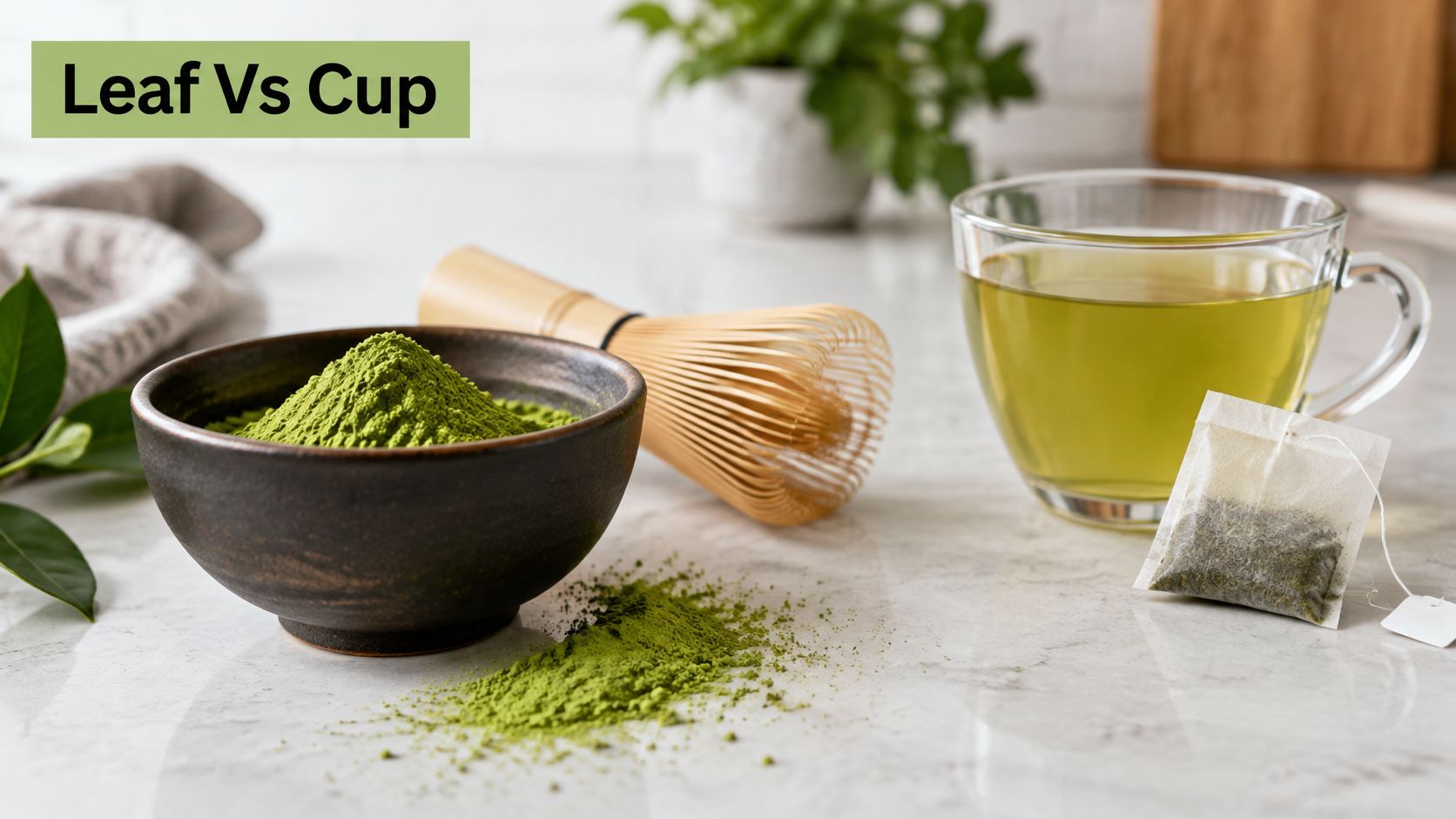
Extraction versus suspension
| Preparation | What you drink | What happens to the leaf |
|---|---|---|
| Brewed green tea | Water containing extracted tea compounds | The steeped leaf is discarded |
| Whisked matcha | Water with finely dispersed leaf powder | The powder is consumed with the drink |
In the Australian commercial-tea comparison, tea-bag tea recorded the lowest measured antioxidant activity among the tested products. That's a finding about those products and testing conditions, not proof that every matcha outperforms every tea bag.
The distinction between matcha tea bags and powder is especially useful when shopping. A product name alone doesn't tell you whether you'll consume powdered leaf or prepare an infusion.
What this means at the café counter
Say a café makes a latte using a scoop of unknown weight, while you weigh the powder for your home bowl. Even if both drinks use the same matcha, you can't compare their composition confidently without knowing how much powder went into each.
A larger latte may contain more milk. It doesn't necessarily contain more tea.
- A teaspoon isn't a fixed weight. A heaped spoon and a level spoon can deliver noticeably different amounts.
- Packet serving information is useful. Use the stated powder weight to make preparation repeatable.
- Whisking changes dispersal. Better technique reduces clumps, but it doesn't add powder or establish a higher antioxidant content.
Matcha can settle, so stir or swirl a drink that's been standing. Leaving a thick layer in the bottom means you haven't consumed all the powder you measured.
Water temperature also affects taste and preparation. It shouldn't be treated as a simple pass-or-fail test for whether antioxidants remain present.
What Changes Antioxidant Levels From Farm to Cup
Matcha leaves are shaded for approximately three to four weeks before harvest, a practice that alters leaf metabolism, according to Western Sydney University's review of matcha bioactive compounds. The review identifies catechins, theanine and caffeine as important constituents and notes that matcha generally contains higher levels of some compounds than conventional green tea.
That provides a plausible explanation for differences in composition. It isn't a guarantee that every shade-grown powder will have the same catechin profile.
Factors that change matcha antioxidant levels
| Factor | How it changes catechins | Practical check |
|---|---|---|
| Cultivar | Different tea varieties carry different catechin profiles | Check whether the packet names the cultivar or origin |
| Shading | Pre-harvest shading alters leaf metabolism | Check whether the product states shade-grown leaves |
| Harvest timing | Leaves picked at different points carry different compound levels | Look for harvest information as well as a best-before date |
| Milling | Fine grinding affects dispersal and exposure during handling | Look for finely milled powder, without treating colour as a laboratory result |
| Storage | Light, heat and air can degrade catechins over time | Keep sealed, opaque and cool, and follow the stated storage window |
| Serving size | More powder increases catechin and caffeine exposure | Weigh the powder rather than measuring by the spoon |
| Preparation | Liquid volume changes concentration, not the starting amount of powder | Use a fixed powder weight and liquid volume |
Growing and processing set the starting point
Cultivar and harvest timing influence what's present before you open the tin. Origin and harvest information offer useful context, but neither substitutes for product testing.
Shading changes the conditions in which the leaf develops. Milling then changes the leaf's physical form, making it possible to disperse the powder in water rather than steep and discard intact leaves.
Stone-ground matcha can be pleasant to prepare, but stone-ground isn't a numerical antioxidant specification. Neither ceremonial-grade nor culinary-grade wording tells you an exact EGCG concentration.
Storage and preparation change the experience
Once the packet is open, control what you can. Close it promptly, keep the powder away from steam and sunlight, and use a dry spoon.
Our guide to storing matcha tea covers practical handling. Buying an amount you'll use while it's fresh is more useful than keeping a large tin open indefinitely.
A larger drink can be more dilute without containing less tea. Powder weight determines the starting dose; liquid volume determines how concentrated it tastes.
For cafés, a written recipe should specify powder weight, liquid volume and preparation method. That helps staff deliver consistent drinks without relying on whichever scoop happens to be available.
The laboratory sample discussed earlier isn't a benchmark every packet must match. Similar-looking labels can conceal meaningful differences in the leaf, processing and storage history.
What Antioxidant Levels Can and Cannot Prove
A higher EGCG reading means more of that catechin was measured in the matcha sample. It does not show that drinking the matcha will produce a greater health benefit. To establish that, research needs to examine people, the amount consumed, how the body absorbs and processes it, and the outcome being measured.
Laboratory tests describe activity under test conditions. Digestion and metabolism alter what happens to compounds in the body, so a result from dry powder cannot by itself prove disease prevention or reduced oxidative stress in people.
Beverage evidence isn't extract evidence
Food Standards Australia New Zealand's record on green-tea safety distinguishes traditional green-tea infusions and beverages of equivalent composition from catechin-enriched extracts. It considers traditional infusions unlikely to raise safety concerns, while noting that the same longstanding tradition of use does not apply to concentrated extracts.
The record also describes cases of idiosyncratic liver toxicity associated with green-tea extracts or extract infusions, possibly linked with high catechin intake. “Idiosyncratic” means an unusual individual reaction, not an outcome everyone experiences.
That distinction matters when comparing a cup of matcha with concentrated supplements. Evidence about extracts does not mean ordinary matcha drinking carries the same risk; equally, the history of traditional tea use cannot guarantee the safety of every concentrated product or oversized serving.
More antioxidants is not automatically better. A concentration result describes what was measured, not a guaranteed improvement in health.
Reading health claims with care
Australian food-health claims are tightly regulated. A laboratory composition result alone does not substantiate claims that matcha treats inflammation, prevents disease or guarantees weight loss.
Even “may support” needs evidence for the specific outcome being claimed. Softening a claim with “may” does not make the evidence stronger.
Keep the practical conclusions measured:
- Enjoy matcha as part of a varied diet. It can be a pleasant tea ritual without turning each cup into an effort to maximise one compound.
- Keep medical treatment separate. Matcha is not a substitute for prescribed care or assessment of persistent symptoms.
- Ask about individual circumstances. If you have a liver condition, take medication or are considering concentrated green-tea supplements, speak with a qualified health professional.
You can appreciate matcha's chemistry while recognising what a lab result cannot establish. For a comparison of other antioxidant compounds, see antioxidant evidence explained by REVETIX. Different compounds and forms are not interchangeable, so a comparison is a prompt to ask what was tested and what the results can show.
Caffeine, Serving Size and Daily Limits in Australia
400 mg a day for adults is the upper daily caffeine guidance from FSANZ. FSANZ also gives an upper limit of 200 mg in a single serving and 200 mg daily during pregnancy and breastfeeding. These are guidance limits, not intake targets; some people may feel caffeine's effects at lower amounts.
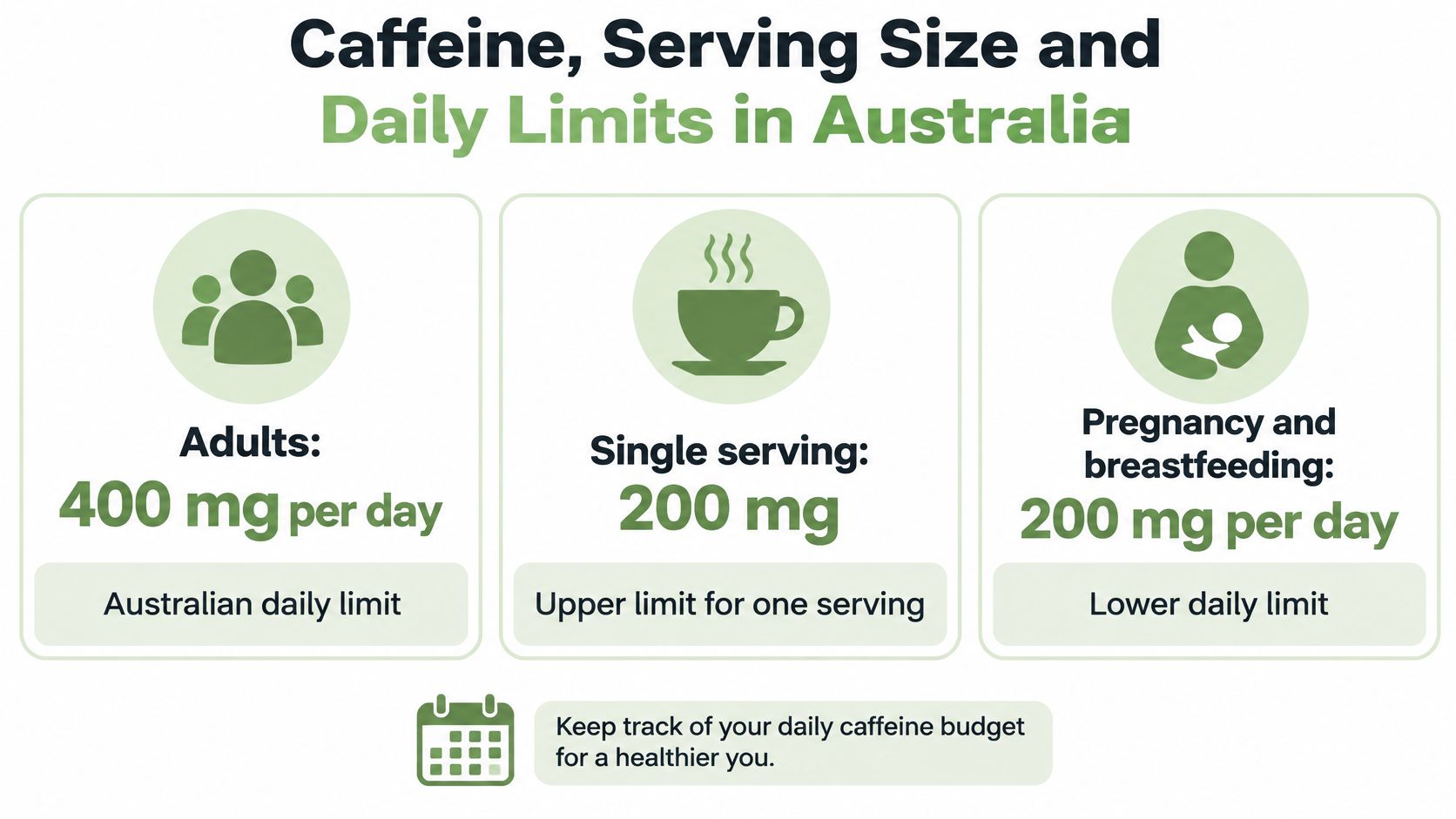
Caffeine benchmarks for matcha and everyday drinks
| Benchmark | Value | Source |
|---|---|---|
| Adult daily caffeine limit | 400 mg | FSANZ consumer guidance |
| Single serving limit | 200 mg | FSANZ consumer guidance |
| Pregnancy and breastfeeding daily limit | 200 mg | FSANZ consumer guidance |
| Matcha powder, 2 g serve | 37.8–88.8 mg | Calculated from reported 18.9–44.4 mg/g range |
| Child reference for anxiety | About 3 mg per kg body weight per day | FSANZ |
The matcha composition figures reported by Mr Vitamins give a caffeine range of 18.9–44.4 mg per gram. At 2 grams, that works out to 37.8–88.8 mg. The range shows why the powder weight matters: two bowls made with different products or serving sizes may contribute quite different amounts of caffeine.
Count the whole day, not just the matcha
A matcha latte and an afternoon flat white draw from the same daily caffeine budget. Include coffee, cola, chocolate, pre-workout products and energy drinks in your tally.
For a café drink, ask how much matcha powder it contains and whether caffeine information is available. Cup size and milkiness don't reveal the amount of caffeine.
- Start modestly. If you're sensitive, use a smaller measured serving.
- Consider timing. Avoid late-day matcha if caffeine affects your sleep.
- Don't rely on theanine as protection. L-theanine may contribute to a smoother subjective experience, but it doesn't remove caffeine.
SBS reporting on matcha and caffeine describes FSANZ's association between increased anxiety in children and caffeine intake of about 3 mg per kilogram of body weight per day. This is a reference point, not a recommended allowance for children.
Pregnancy, adolescence, anxiety, sleep sensitivity and medication questions call for individual advice. A café menu described as family-friendly doesn't make every caffeinated drink suitable for every family member.
Brewing a Measured Matcha Cup at Home
A repeatable cup starts with a measured amount of powder. Choose matcha with clear organic certification and a declared serving weight. If caffeine affects you, begin with less powder; extra milk changes the taste and texture, not the amount of matcha.
Sifting helps the powder whisk evenly.
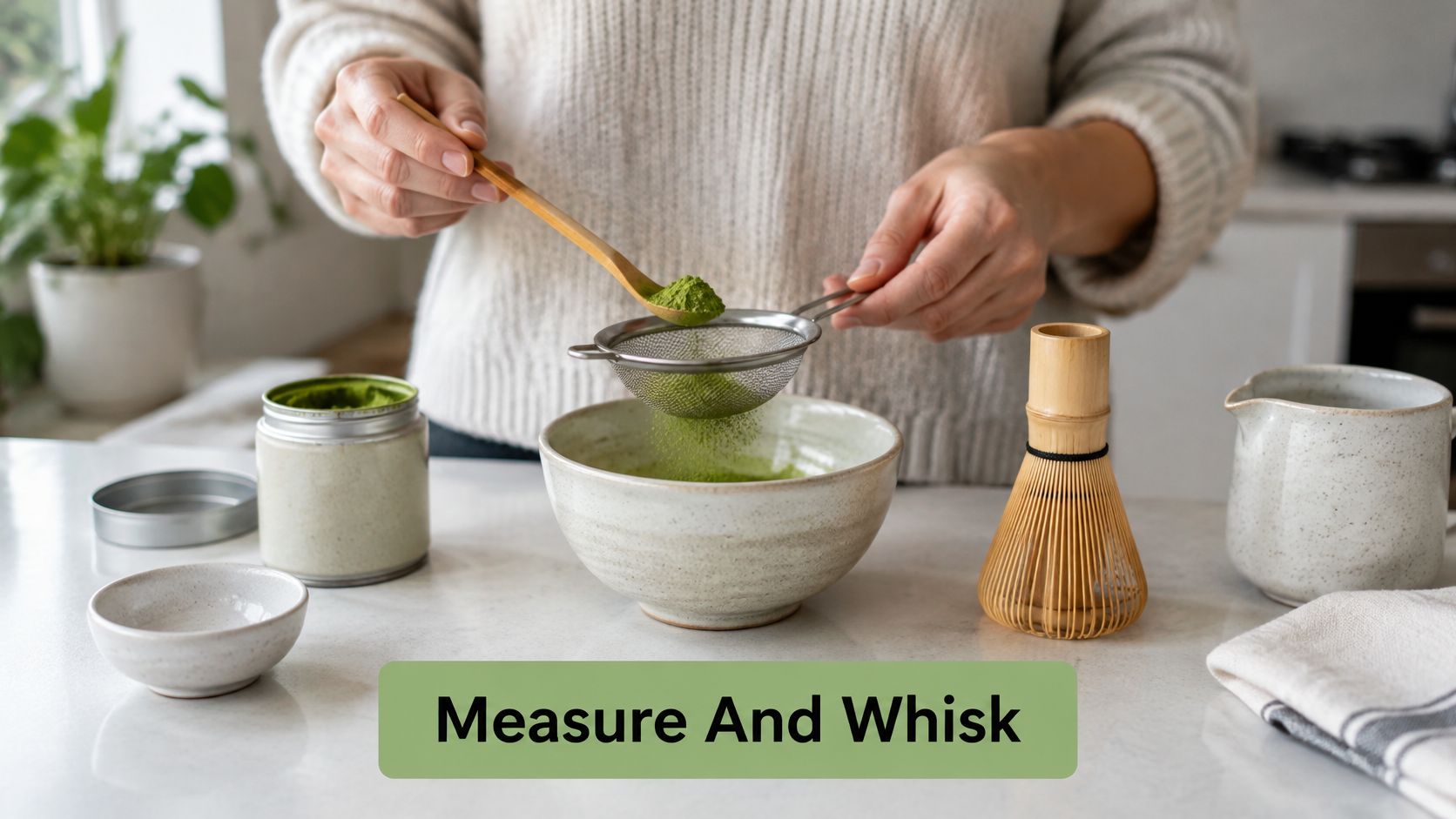
A repeatable bowl rather than a bigger scoop
- Weigh the powder. Place a bowl on digital scales and tare them to zero. Start with 1 g for a light cup or 2 g for a fuller bowl.
- Note the weight, so you can repeat a recipe you enjoy.
- Sift through fine mesh. Break up compacted lumps before adding water.
- Add about 70 mL of water at roughly 70–80°C. This is a practical starting point. Cooler-than-boiling water can help manage bitterness, but it does not guarantee that every catechin is preserved.
- Whisk briskly in a W or M motion. Keep the whisk moving through the liquid to make an even suspension and fine foam.
- Check the product's caffeine information where available. A smooth taste does not mean a low-caffeine cup.
For a latte, whisk the matcha with water first, then add milk to taste. Keep the powder weight the same when adjusting the milk, so the texture changes without increasing the matcha serving.
Watch the preparation movement before trying it yourself.
A larger antioxidant number does not automatically make a better daily cup. Measure the powder, prepare it in a way you enjoy, and consider serving size alongside your overall caffeine intake.
Pep Tea offers organically grown premium matcha for households, hospitality venues and retailers. Visit Pep Tea to explore the organic matcha range and choose a tea for bowls, lattes or cooking, guided by flavour and serving size rather than antioxidant hype.