
Tag: matcha brownies
Matcha Brownies Recipe for Fudgy Results at Home
Your tin is lined, the oven's climbing to temperature, and there's a pot of bright green powder on the bench that you normally only reach for at breakfast. Baking with matcha is where plenty of capable home bakers come unstuck: the colour fades to olive, the bitterness bites, and a tray that should be fudgy turns out cakey.
This is the version worth starting from. A 20 cm square tin, 16 squares, a dark chocolate base that stays dense, and 2 tsp of culinary matcha worked through it as a flavour and colour note rather than as bulk. Every square also carries a small, estimable dose of caffeine, which makes portion size something you can plan instead of guess.
What follows is the shopping list, the order of work, the doneness cues, the fixes for the faults that show up in a home kitchen, and a way to put a number on the caffeine in each square.
Matcha Brownie Ingredients and Quantities
A 20 cm square tin gives 16 squares, and every quantity below is built for that footprint. Line it with baking paper and leave an overhang on two sides so you can lift the slab out later. Weigh everything before you melt anything, because once the butter and chocolate come off the heat the clock starts and you don't want to be hunting for the vanilla.
| Ingredient | Amount | Role in the brownie |
|---|---|---|
| Unsalted butter | 115 g | Fat base for a fudgy, dense crumb |
| Dark chocolate (70% cocoa), chopped | 100 g | Structure, depth and melt-in texture |
| Caster sugar | 150 g | Sweetness and a glossy, crackly top |
| Large eggs, cold from the fridge | 2 | Binding and lift |
| Plain flour | 60 g | Just enough structure without cakiness |
| Culinary-grade matcha, sifted | 2 tsp (about 4 g) | Colour and earthy flavour |
| Cocoa powder (optional) | 15 g | Extra depth that masks any bitterness |
| Vanilla extract | 1 tsp | Rounds out the matcha flavour |
| Fine salt | 1/4 tsp (about 1.5 g) | Lifts the chocolate and matcha notes |
What carries the fudge, and what matcha actually does
Butter and 70% dark chocolate do the structural work. A 115 g butter to 100 g chocolate base against only 60 g of flour is what keeps the crumb dense rather than cake-like. Matcha supplies no gluten and no fat, so it behaves as a colouring and flavouring agent. Push much past 2 tsp in this ratio and you're adding bitterness and dryness, not more flavour.
Australia's national food composition system treats brownies as a real food rather than an informal home-baking idea. The Australian Food Composition Database covers 1,588 foods and provides information on as many as 268 nutrients per food, and its AUSNUT 2023 recipe records describe a homemade brownie using 140 g plain white wheat flour, 55 g cocoa powder, 55 g dark chocolate and 1.5 g table salt, with a separate Australian Dietary Guidelines listing adding 5 g baking soda and 4.75 g vanilla. The Australian reference brownie is therefore a flour, cocoa, chocolate and salt formula, which makes matcha the natural substitute for part of the cocoa while the rest of the skeleton stays intact. The database specifies no standard matcha quantity, so 2 tsp is a recipe decision, not an official one.
Choosing the powder and counting the sugar
Culinary grade is the right buy for baking: it's ground for mixing rather than for whisking into water, and its flavour holds against dark chocolate. If you're weighing up brands, this walkthrough on finding quality matcha powder covers the things that predict how a tin performs, including colour, grind and storage. All Pep Tea matcha tea powders are certified organic, so the pack tells you the grade and the certification before you open it.
Sugars deserve a straight answer. 150 g of caster sugar across 16 squares is about 9 g a square, and that's before the chocolate is counted. Food Standards Australia New Zealand reports that the average share of dietary energy from free sugars fell from 12.5% in 1995 to 10.9% in 2011-12, with both averages still above the WHO's 10% recommended limit, according to its sugar and nutrition data. This is a treat, not a wellness bar.
Last check before the pot goes on: butter weighed, chocolate chopped small enough to melt evenly, matcha sifted with the cocoa, eggs still in the fridge.
How to Make Matcha Brownies Step by Step
Work in one direction: hot fat first, cold eggs last. The order of work matters more than the speed, because each step is there to protect the next one.
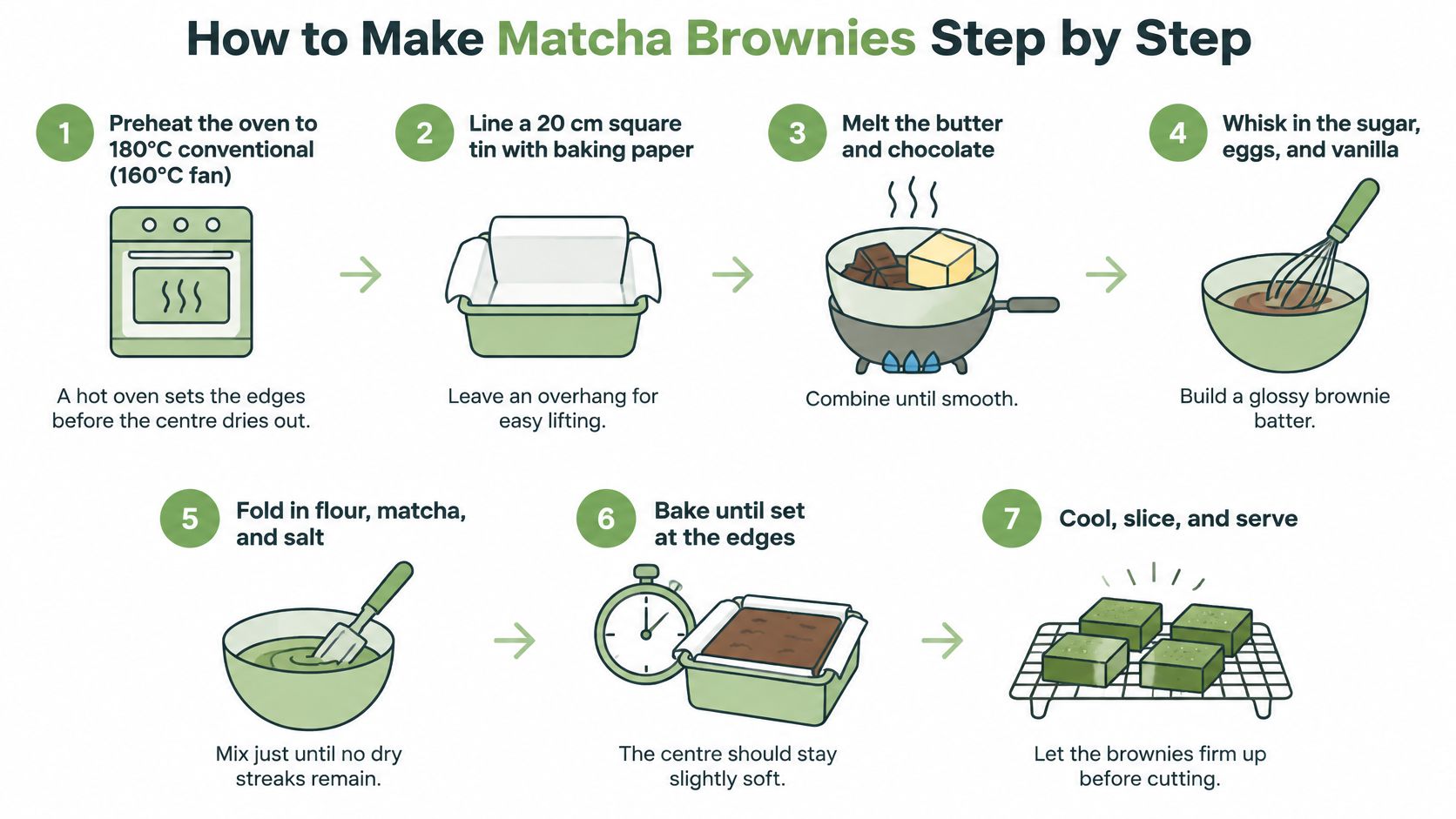
- Heat the oven to 180°C conventional (160°C fan) and line the tin. Use paper with an overhang on two sides. A fully preheated oven sets the edges before the centre has time to dry out, which is the entire trick with a fudgy tray.
- Melt the butter and chocolate over barely simmering water, then rest the bowl for 5 minutes. Overheated chocolate goes grainy and stiff, and a hot mixture starts cooking the eggs the moment they land in it.
- Sift the matcha and cocoa into the warm butter and whisk until no green specks remain. Matcha disperses in fat far more evenly than in cold egg, and clumps left at this stage turn into bitter flecks.
- Whisk in the sugar, then the vanilla and salt. Keep going until the mixture looks thick and glossy rather than grainy.
- Beat in the cold eggs one at a time. A couple of minutes of whisking here builds the shiny surface that cracks as the slab cools, and cold eggs help stop the fat splitting.
- Fold in the sifted flour with a spatula for about 30 seconds. Stop the moment no dry streaks remain. Every extra pass develops gluten and pushes the crumb toward cake.
- Scrape into the tin, level the top and bake immediately. Don't leave the batter beside a hot oven and don't taste it raw. Food Standards Australia New Zealand notes in its national raw egg guidelines that pooling eggs substantially increases the likelihood that Salmonella contamination will spread through the product, and that raw egg product should be kept at or below 5°C during processing, storage and display.
What good batter looks like
Matcha brownie batter should be thick, glossy and reluctant to pour. It falls off the spatula in a slow ribbon and holds a soft mound for a second before settling. Runny batter usually means the eggs went in while the fat was still too warm, and it bakes into a flatter, greasier slab.
Read the surface before the tin goes in. A dull, sandy look means the sugar has not been whisked long enough. Pale flour seams mean the fold is unfinished. A batter that still shows green dust has not had the matcha fully dispersed in the fat, so scrape the bowl sides and bottom once more before giving up.
For cafés and anyone prepping ahead, treat the batter as a potentially hazardous egg-containing food. The temperature control guidance from FSANZ sets the control range at 5°C or colder or 60°C or hotter, with a cumulative limit of four hours in the zone between. Record the time the batter leaves refrigeration and check chilled storage with a calibrated probe thermometer. If the bowl has been sitting out while the oven heats, bake it rather than parking it for later.
Bake Time, Cooling and Doneness Checks
Batter depth decides bake time more than your oven does, so start from the tin in front of you rather than the one in a recipe written for a different shape.
| Tin size | Bake time | Doneness cue |
|---|---|---|
| 20 cm square tin | 22-25 min | Centre set with a slight wobble |
| 23 cm square tin | 18-22 min | Thinner and dries faster, check at 18 min |
| 20 x 30 cm slab tin | 25-30 min | Edges set, centre just firm to the touch |
Three checks that beat a timer
Start testing at the first number in that table, not the last. The centre should look set with a slight wobble, the top should be dull and finely cracked, and a skewer pushed into the middle should come out with moist crumbs rather than wet batter. A skewer that comes out clean and dry means you've baked a cake.
Cooling is part of the recipe
Leave the slab in the tin for at least an hour, then cover and chill it for about two hours. Chilling lets the butter and cocoa butter resolidify, so the crumb firms and the matcha flavour mellows instead of tasting sharp. Cutting early gives you torn edges and a squashed middle.
Practical rule: if you can smell warm chocolate when you lift the paper, the slab is still too soft to cut cleanly.
Cut with a knife dipped in hot water and wiped between passes, giving 16 squares from the 20 cm tin or 12 bars from the slab tin. Store cut squares in an airtight tin for a few days, and refrigerate them if your kitchen is warm, since the batter is egg-based.
For brownies made ahead for a café or a party, the FSANZ food safety standards require potentially hazardous cooked foods to be cooled from 60°C to 21°C within two hours and from 21°C to 5°C within a further four hours, then reheated rapidly to at least 60°C if reheating is needed.
Keep a log of pan size, batter mass, bake time, centre texture and yield. That record, not a universal success rate, is what makes the second tray repeatable.
Fixing Dull Colour, Bitterness and Dry Texture
Nobody emails about the crumb first. The first complaint is colour: a tray that comes out olive-grey rather than green. The second is bitterness, and both are fixable without rewriting the recipe.
| Symptom | Likely cause | Fix |
|---|---|---|
| Dull grey-green top | Old or oxidised matcha, or overbaking | Use fresh powder stored airtight and cold, and check the bake time earlier |
| Bitter aftertaste | Too much matcha or unsifted clumps | Drop to 1 tsp and sift the powder with the sugar |
| Green specks or streaks | Matcha not dispersed in the fat | Whisk matcha into the warm butter before adding eggs |
| Dry, cakey crumb | Overmixed flour or centre baked past set | Fold flour only until no streaks remain and pull at a slight wobble |
| Greasy, flat slab | Underbaked centre or cut while warm | Bake to the set centre and chill fully before cutting |
| Weak matcha flavour | Under-dosed or milder culinary grade | Add 1 tsp more matcha alongside the dark chocolate, not extra sugar |
Colour is mostly a freshness question. Matcha oxidises once the pack is open, so keep it sealed, cold and away from light, and pull the tin at the set centre rather than an extra five minutes. A green crumb that turns brown at the edges is usually the oven, not the powder.
Bitterness runs on dose. The base is 2 tsp; if the tray tastes harsh, drop to 1 tsp and sift the powder with the sugar so it distributes evenly, then taste before you change anything else. Specks and streaks mean the matcha never dispersed, which is why it goes into the warm fat rather than the cold egg.
If the flavour is faint, add a teaspoon more matcha alongside the dark chocolate rather than more sugar. Culinary grade is deliberately milder than ceremonial, so the ceiling sits higher than you might expect.
Change one variable per batch. Matcha, sugar, bake time: pick one, write down the result, and the next tray tells you something useful.
For more on dosage across different baked goods, our guide to baking with matcha and beyond covers scones, pancakes and savoury uses where the powder behaves quite differently.
Gluten-Free and Vegan Matcha Brownie Swaps
The base recipe adapts in two directions, and both change texture more than flavour. Work through the swap table first, then read the notes on what each change does.
| Ingredient | Gluten-free swap | Vegan swap |
|---|---|---|
| Plain flour, 60 g | 60 g gluten-free plain flour blend | 60 g plain flour (already vegan) |
| Large eggs, 2 | 2 large eggs (already gluten-free) | 2 flax eggs (1 tbsp ground linseed plus 2.5 tbsp water each) |
| Dark chocolate, 100 g | Check the label is gluten-free | Dairy-free dark chocolate, checked on the label |
Gluten-free swaps
Use a 1:1 gluten-free plain flour blend rather than a single alternative flour, and check the label for xanthan gum, which is what stops the crumb collapsing. Expect a slightly softer, more crumbly slab. Bake to the same set centre and chill it fully before cutting, because gluten-free brownies tear more readily while warm.
Vegan swaps
A firm plant-based butter block works better than a soft spread, and dairy-free dark chocolate keeps the depth. Two flax eggs, each made from 1 tbsp ground linseed and 2.5 tbsp water, bind well enough for a fudgy tray, and they leave a faint nutty note that suits matcha rather than fights it. Flax doesn't set like egg, so give the slab longer in the fridge before slicing.
Read every label, including baking powder and chocolate, for both gluten and dairy. Swaps also don't make these brownies low-sugar. Food Standards Australia New Zealand notes in its sugar labelling guidance that adding sugar increases a food's energy content and recommends comparing labels for lower added-sugar products, and replacing part of the sugar with unsweetened cocoa or matcha doesn't make a dessert sugar-free while sweetened chocolate or icing remains.
For more adaptions built around the same powder, see our matcha recipes for healthy baking.
How Much Caffeine Is in a Matcha Brownie
A matcha brownie isn't a cup of matcha in a different shape. The powder is concentrated into 16 small portions, so the number of squares you eat matters more than the drink you swapped out.
The Australian Institute of Sport reports average adult caffeine intake at approximately 175 mg per day, with at least 25% of Australians consuming more than 230 mg daily, and notes that caffeine also arrives via tea, chocolate and specialised foods, as set out in its caffeine guidance. NSW Food Authority guidance notes that caffeine occurs in chocolate and baked goods, and that solid foods containing more than 5% caffeine are prohibited.
Working out the dose per square
Take the caffeine per gram from your matcha label, multiply by the grams in the recipe, add a rough allowance for the chocolate, and divide by the number of squares. Treat the answer as approximate, because matcha caffeine varies by product and by harvest.
Here's the arithmetic with an illustrative label value of 30 mg per gram. One teaspoon of matcha weighs about 2 g, so a family batch with 1 tsp gives roughly 60 mg across 16 squares, about 4 mg a square. The base recipe uses 2 tsp (about 4 g), roughly 120 mg across the tin, about 7 mg a square. A stronger café-style batch with 2 tsp cut into 12 works out near 10 mg a square. Substitute the figure from your own pack and you have a real number rather than a vague warning.
Portion, not powder, is the lever. Matcha sounds gentle next to coffee, but concentrating it into dessert puts the serving size in charge.
Pair brownies with a decaffeinated drink in the evening, keep squares small for children, and if you're pregnant or sensitive to caffeine, check with your GP or health professional before making them a regular habit. For a fuller picture of what's in the leaf, read our notes on whether matcha tea has caffeine.
Bake a Test Batch and Adjust From There
Bake the 20 cm version exactly as written this week. Then write down four things: bake time, colour, bitterness and texture. That note is the whole method, because the second batch is where the tray gets improved.
Change one variable only. A teaspoon more matcha is the usual first move if the flavour was shy; five minutes less in the oven if the crumb was dry. Two changes at once and you can't tell which one did the work, so you end up repeating the same experiment twice. If the colour came out dull rather than the flavour weak, look at sifting and oven temperature before you touch the dose. And if the tray tipped bitter, drop back half a teaspoon of matcha instead of reaching for extra sugar, which sweetens without fixing the bitterness.
Three things decide whether this matcha brownies recipe works: sift the matcha, keep the eggs cold until mixing, and pull the tin at a set centre with a slight wobble. Everything else is adjustment.
For baking, our Matcha Premium Tea Powder is an organic culinary-grade powder sold in 100g and 1kg packs, both foil-lined resealable pouches. The 100g size covers plenty of trays while you dial in your dose, and the bulk pack suits anyone baking matcha regularly. The Imperial and Supreme grades come in 30g packs and are the ones to keep for drinking. Share how your tray turned out, especially if you land on a matcha dose that beats 2 tsp.
Pep Tea supplies certified organic Japanese matcha in culinary and ceremonial grades, from 30g packs through to 1kg bulk, plus sugar-free organic kombucha brewed in NSW. The Premium culinary-grade powder in this recipe is the one to start with if you're baking a tray this week. Visit Pep Tea to compare the grades and pick the pack size that matches how often you bake.