
Tag: homemade matcha ice cream
Connoisseur Matcha Ice Cream: What Premium Really Means
A bright green tub and a familiar brand name are the two signals most shoppers use to judge matcha ice cream. Neither tells you much. Colour can come from the powder, from the fat, or from the lighting in a product photo, and a brand you recognise tells you about distribution rather than tea.
The useful information sits in the ingredient list and the nutrition panel, in that order. Read those two blocks first and you can rank a shelf of Connoisseur matcha ice cream and its competitors in about ninety seconds, before price and packaging get a chance to influence you.
Signs of a Premium Matcha Ice Cream
Start in the aisle with the ingredient list, not the front of the tub. Ingredients are listed by weight, so where matcha sits on that list tells you more about tea content than any badge on the lid. If matcha, or matcha green tea, appears after sugar and glucose syrup, the tea is a flavour note in a sweet base rather than the point of the product.
The dairy base is the next check. Anything sold as ice cream in Australia has to clear the composition line in Standard 2.5.6 of the Food Standards Code, which sets at least 10% milk fat and 168 g/L food solids. A frozen dessert that falls short of that is a different product, and it's unfair to judge it as ice cream.
Here's the checklist in the order I'd run it, with the benchmark to hold each marker against.
| Marker | What to look for | Benchmark or example |
|---|---|---|
| Dairy base | Milk fat and food solids at or above the Standard | At least 10% milk fat and 168 g/L food solids |
| Ingredient order | Matcha listed near the top, not as flavour | Check whether it sits above sugar and glucose syrup |
| Matcha share | A stated percentage rather than only green tea naming | Assume a flavour note when the label does not state it |
| Matcha grade | A named grade such as culinary or ceremonial | Culinary for cooking, ceremonial for drinking |
| Caffeine statement | Caffeine declared where it is added or natural | Matcha naturally contains caffeine, so it should never be implied absent |
| Allergen notes | Milk, soy, tree nut, gluten and cross-contact declared | Declared on the tub itself, not only in marketing |
| Sugar per 100 g | Total sugar compared on the same basis | Compare tubs per 100 g, not per serve, because serve sizes differ |
Matcha share, grade and caffeine
A percentage is the single most useful thing a tub can print. Without one, treat the tea as seasoning and judge the product on its dairy and sugar instead. A named grade helps too, because it tells you whether the supplier intended the powder for cooking or for drinking, and those two jobs need very different material.
Caffeine is the marker most labels handle badly. Matcha is tea leaf, so it carries caffeine, and a dessert built on it isn't a caffeine-free evening food. Allergens belong on the tub itself rather than a website, covering milk, soy, tree nuts, gluten and any cross-contact statement.
The one-line test: if a tub can't tell you how much matcha is in it, it can't tell you the product is premium either.
Connoisseur's own account of how it builds flavours is worth knowing. The brand says it selected four Australian dessert chefs in 2010 to create its most indulgent ice cream, establishing a development model built on restaurant-style flavour creation rather than conventional mass-market flavours, as Connoisseur's brand history records. That's a serious brief for flavour. It still says nothing about how much tea lands in the tub.
No single marker proves quality. A tub can name a grade and carry 22 g of sugar per 100 g, or print a percentage and bury it under glucose syrup. Weigh four or five markers together, score the tubs in front of you against the table, shortlist two, and only then compare price.
How Much Matcha and Sugar Are in the Tub
Here's the number that reframes the category. Connoisseur's Matcha Green Tea with White Choc lists 0.9% matcha green tea, and a 71 g serve carries 184 calories, 15.5 g sugar, 9.9 g fat and 7.2 g saturated fat, according to the Connoisseur product page. At that share, a serve holds well under a gram of tea. The powder gives the tub its colour and its name, yet it makes up a tiny slice of the scoop.
Matcha works in small doses by design. A traditional cup is whisked from just half a teaspoon of powder into hot water below boiling point, so the question for any tub is whether the dose inside is enough to clearly taste.
The ingredient list backs up the percentage. Sugar and glucose syrup sit ahead of matcha, with vegetable oil, emulsifiers and stabilisers alongside, as a long-running OzBargain thread on the tub sets out. Shoppers in that thread question whether the matcha flavour is strong enough, and some add their own powder to the bowl. Single comments prove nothing, yet they point at the issue: dose.
Reading sugar on a fair basis
Australian labels report sugars inside the Nutrition Information Panel as part of total carbohydrate and separately as sugars, and that total includes naturally occurring lactose from the milk as well as anything added, as FSANZ explains on its sugar page. So the 15.5 g in a serve isn't all added sugar. Some of it is milk.
That's why per 100 g is the only fair comparison. Serve sizes differ between tubs, so divide the sugars figure by the serve weight and multiply by 100 before you line any two products up. Scale the 71 g serve that way and you get about 22 g of sugar per 100 g. The retail listing for the 1-litre tub separately records 21.9 g of sugar per listed serving, alongside 1,080 kilojoules, 3.5 g protein and 40 mg sodium, per the retail nutrition listing. One figure is measured per serve and the other per listed serving, and neither tells you much until you've converted both to the same basis.
If you want to watch the churn-and-fold method before you buy another tub, this walk-through covers the basics.
What the caffeine line means
The caffeine in a serve moves with the dose and the serve size, so a bigger scoop carries more of it. FSANZ's caffeine guidance reports no recognised health-based guidance value such as an Acceptable Daily Intake for caffeine in Australia and New Zealand, and notes an expert working group concluded the evidence indicated increased anxiety in children at intakes of about 3 milligrams per kilogram of body weight per day. It isn't a default pick for kids or for a late dessert.
The tasting check
Judge the scoop on six things and ignore the colour photography:
- Colour: a clean, fresh green reads well, and a bright green still proves nothing. Sugar, fat and light all shift it.
- Bitterness: a short, clean bitter note is tea. A harsh, chalky one usually means too much low-grade powder.
- Aroma: look for vegetal, slightly marine notes. If you only smell vanilla and chocolate, the tea is quiet.
- Sweetness: white chocolate plus sugar will dominate at under 1% matcha, and that's by design.
- Aftertaste: good matcha leaves a green tea finish. A waxy coating points to the vegetable oil.
- Texture: fine ice crystals mean a fast freeze and enough solids. Coarse ice means neither.
Any benefit from the tea in a 0.9% tub is small and unmeasured. Buy it because you enjoy the flavour, and treat the matcha as the seasoning it is.
Matcha Grades That Suit Ice Cream
For ice cream, buy culinary grade. Save ceremonial for the cup.
Ceremonial grade is stone ground for whisking and drinking, and the finest shades are made to be sipped, where their delicate sweetness reads clearly. Freeze that powder into a sweet dairy base and much of what you paid for disappears. Culinary grade is built for cooking and baking, with a stronger, more astringent profile that survives fat and sugar.
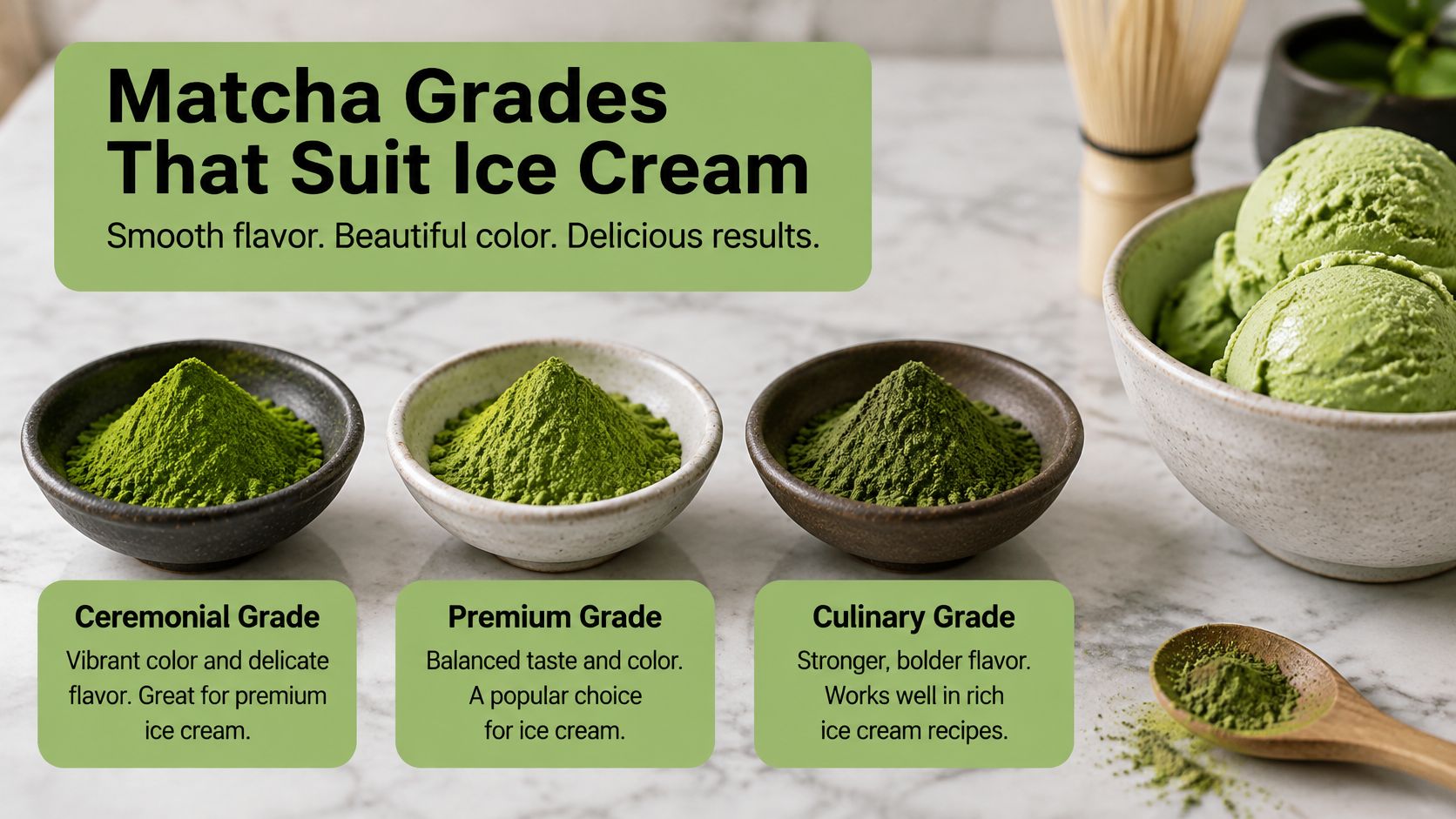
| Grade | Made for | Suits ice cream because | Pep Tea example |
|---|---|---|---|
| Ceremonial | Whisking and daily drinking | Flavour can be muted under dairy and sugar | Imperial (30 g and 100 g) |
| Culinary | Cooking and baking | Holds its flavour in recipes | Premium (100 g and 1 kg) |
| Finest ceremonial | Sipping the powder straight | Costly and best saved for drinks | Supreme (30 g) |
On any bag, look for four things: a named grade, a stated origin, organic certification and independent inspection. The organic tea plantations in southern Japan that supply our matcha are independently inspected, and our matcha is certified organically grown by the Japanese Ministry of Agriculture, with the ministry's certification logo printed on the back label. A tub that says premium without naming a grade tells you nothing you can check.
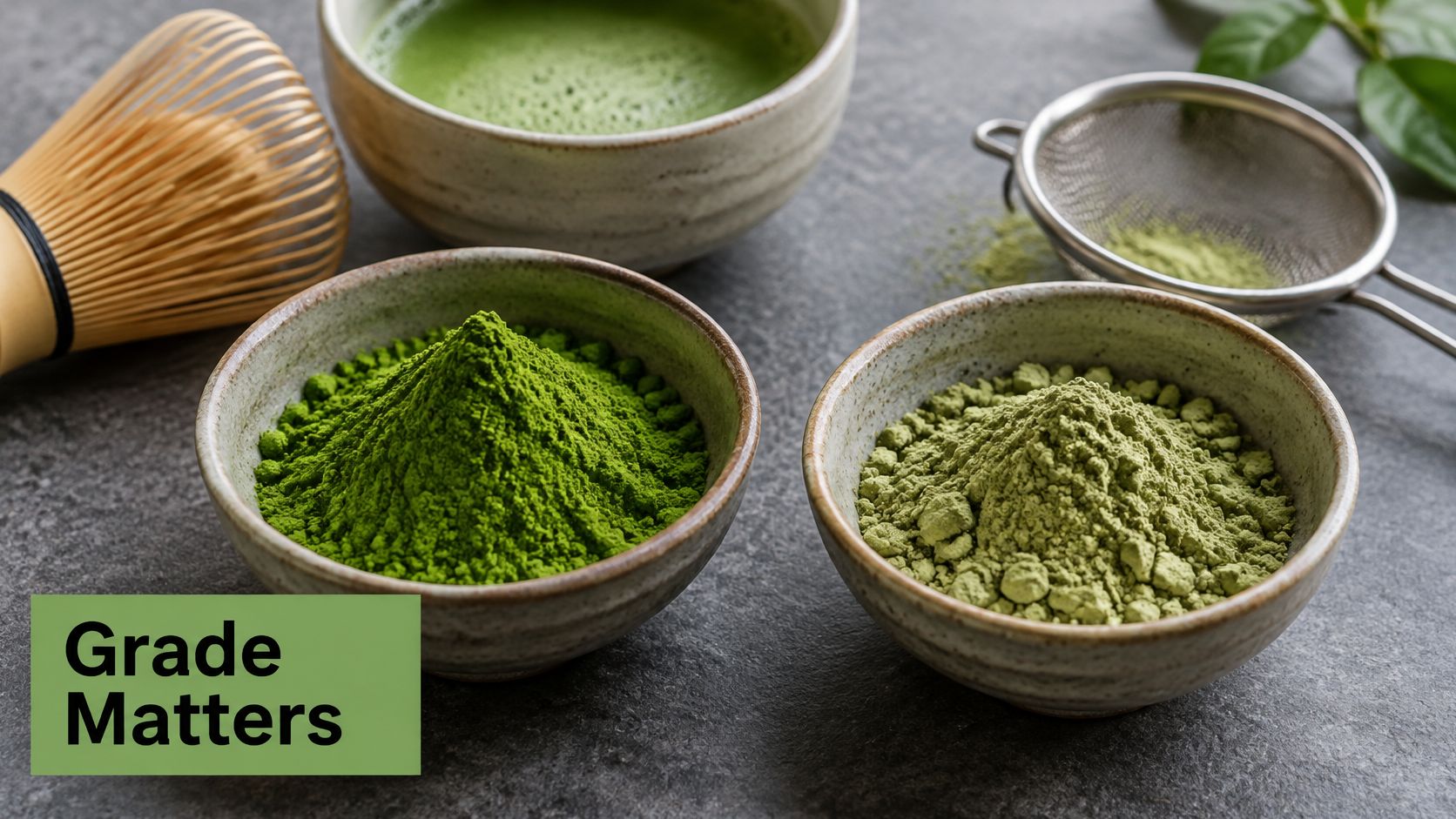
Freshness is the other signal, and it's visual. A bright, fresh green powder suggests recent stock. A dull or yellow-brown powder suggests age or heat exposure, and no amount of sugar will bring the colour back. If you want the longer comparison between the two grades and how they behave in different drinks and dishes, our guide to ceremonial vs culinary matcha sets them side by side.
That grade decision sets up the recipe, because the dose you can afford to use depends on which powder you bought.
How to Make Matcha Ice Cream at Home
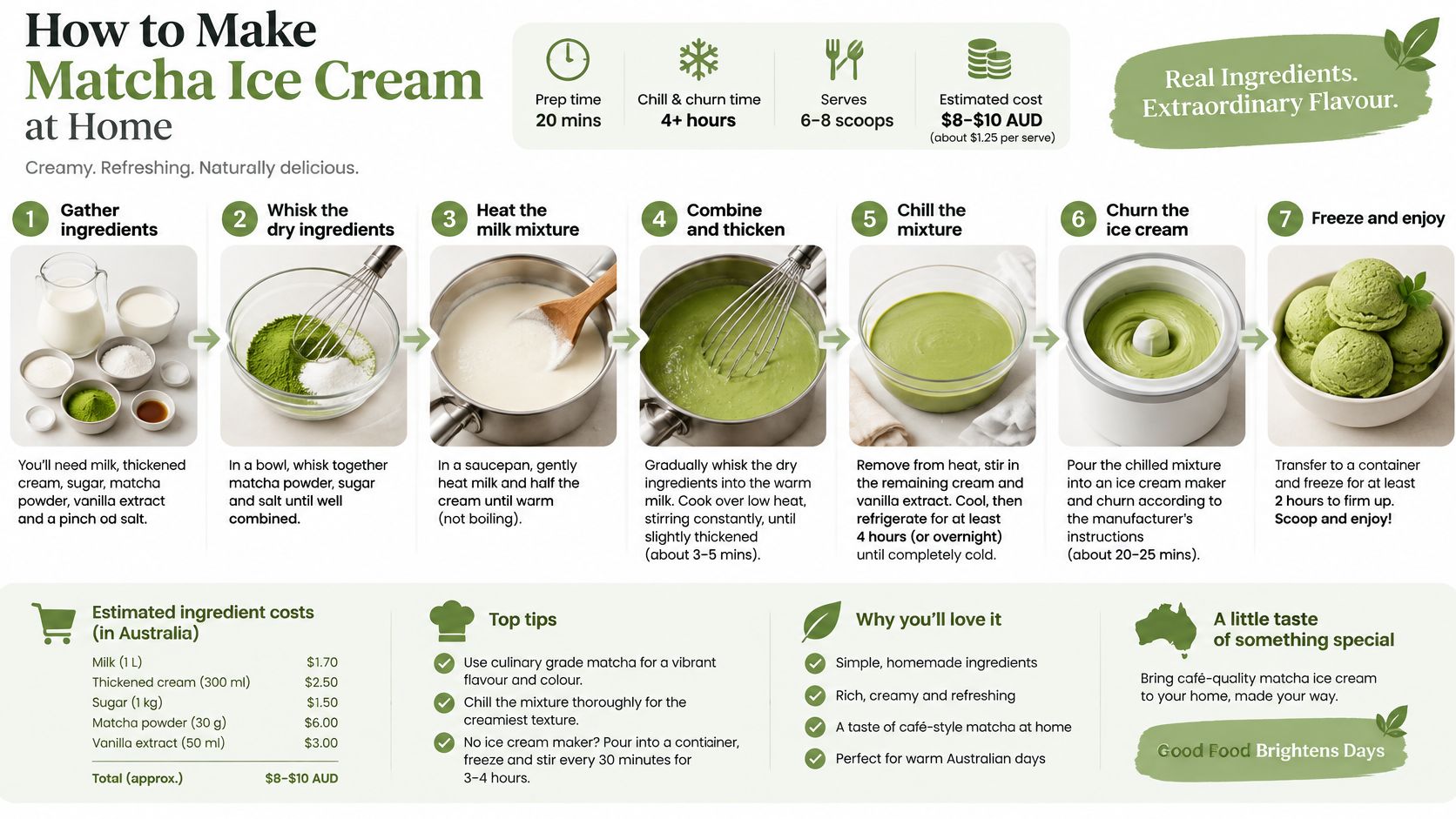
This makes about 1 litre, built so the base clears the Australian composition line rather than landing somewhere near it.
Ingredients: 300 ml pouring cream, 300 ml full-cream milk, 100 g caster sugar, 3 to 4 g culinary matcha (about 1 to 1.5 level teaspoons), a pinch of salt, and 60 g finely chopped white chocolate if you want the confectionery version.
For a deeper comparison of how powder behaves once it hits fat and heat, our notes on cooking with organic matcha powder cover the ratios that hold up.
- Sift the matcha. Push the powder through a fine sieve. Matcha clumps in storage and a whisk alone won't break those clumps down, which is how you get dark specks in a pale base.
- Bloom it in warm milk. Whisk the sifted powder into 60 ml of milk warmed to roughly body temperature until it forms a smooth paste. Warm liquid wets the powder and carries the aroma into the base. Cold liquid just makes lumps.
- Warm the dairy and sugar. Heat the remaining cream and milk with the sugar to 60 to 70°C, stirring until it dissolves. Don't boil it, or you cook the fresh dairy notes out of the mix.
- Combine. Whisk the matcha paste and the pinch of salt into the warm base. Salt sharpens the vegetal edge that sugar flattens.
- Homogenise. Run a stick blender through it for 30 seconds. Smaller fat droplets freeze smoother and hold the colour more evenly.
- Chill hard. Refrigerate for at least four hours, or overnight. A warm base churns grainy.
- Churn or scrape. Churn to your machine's instructions. Without one, pour into a shallow tray, freeze, and scrape with a fork every 30 minutes until firm.
- Firm up. Move it to an airtight container and freeze for six hours before serving.
Stir the optional white chocolate in after step 3, while the base is still warm. It melts without seizing and disperses evenly instead of freezing into shards.
A base that clears the composition line
The recipe is dairy heavy on purpose. Standard 2.5.6 of the Food Standards Code requires at least 100 g/kg (10% by mass) milk fat and 168 g/L food solids for a product sold as ice cream, as the compiled Food Standards Code.pdf) sets out. Milk fat supplies the richness and helps disperse matcha's hydrophobic aroma compounds through the mix. Total food solids drive freezing-point depression, scoopability and resistance to coarse ice crystals.
That's also why you pre-disperse the powder into a warm liquid phase and blend before freezing instead of dusting it over a cold custard. Weigh your ingredients and read the fat percentage on the cream pack rather than guessing, because cream varies by brand.
One caution on numbers. The Australian Food Composition Database holds laboratory-derived information for 1,588 foods and up to 268 nutrients or food components, but FSANZ warns that composition varies with season, brand, formulation, processing and batch, per the Australian Food Composition Database. Test your finished base rather than inferring caffeine or energy from the dry tea. Dilution into milk, sugar and air changes every value per serve.
What good looks like: a fresh, bright green colour, a smooth scoop with no detectable ice, and a texture that softens in three or four minutes on the bench. Serve it slightly tempered, never straight from a deep freeze.
Common Problems and How to Fix Them
The most common failure is a pale or grey-green colour, and it almost always traces back to the powder or to how fast the base chilled. Work through the table before you change the recipe.
| Symptom | Likely cause | Fix |
|---|---|---|
| Pale or grey-green colour | Old powder or heat exposure | Use fresher culinary grade and chill the base quickly |
| Bitter, grassy finish | Too much matcha or water that is too hot | Reduce to 3 g and whisk into warm milk, not boiling liquid |
| Mild, lost matcha flavour | Sugar and white chocolate dominate | Increase matcha to 4 g, reduce sugar and add a pinch of salt |
| Icy or grainy texture | Low milk fat or slow freezing | Keep cream and whole milk in the base and churn or scrape to freeze faster |
| Dark specks or clumps | Powder not sifted | Sift and whisk the matcha into warm liquid before adding it to the base |
Some fixes are immediate and free. Sifting, cooling the base faster, lowering the dose and salting to lift the vegetal note all cost nothing but attention. A dull colour that persists after a fresh sift is a powder problem, and no technique fixes stale leaf. Buy a smaller pack more often instead.
Change one variable per batch. If you adjust the dose, the sugar and the machine setting at once, you'll learn nothing and you'll blame the matcha.
Step 1 in the recipe handles specks, and step 2 handles bitterness from scorched or over-steeped powder. For storage, keep the ice cream in an airtight container at the back of the freezer, away from the door where temperature swings, and eat it within a few weeks for the best colour and flavour. Matcha fades in the cold, and it fades faster than the fat does.
Allergies, Dairy-Free and Lighter Versions
Read the allergen statement on the tub itself. Connoisseur's matcha tub declares milk and soy, with possible peanut, tree nut, gluten and wheat cross-contact. People managing allergies need the packaging, not the marketing copy.
Cross-contact means shared equipment or shared production lines, so traces can be present even when the ingredient list looks clean. For a household with a serious allergy, that warning is the deciding line, not a footnote.
For a homemade batch, work through each ingredient:
- Cream and milk: the dairy allergens, and the reason the base sets well.
- White chocolate: often carries milk and soy traces even in dark-style products, so read that pack too.
- Every other packet: check the "may contain" statement on the sugar, the cocoa and any inclusions.
Plant-based and lower-fat versions need their own thinking. Because the Australian standard requires at least 10% milk fat and 168 g/L food solids for ice cream, a dairy-free or reduced-fat frozen dessert that falls short should carry a different descriptor rather than borrowing the word. A plant-based cream needs testing for texture and solids, and any sweetener swap changes both the sugar per 100 g and the taste.
If you're going dairy-free, our matcha coconut milk guide covers a base that behaves properly in the freezer. Confirm three things before serving guests with allergies: the allergen panel, the cross-contact statement, and the current recipe, since formulations change.
Buy or Make Your Matcha Ice Cream
The buy case is straightforward. A 1-litre tub is shareable, needs no equipment and suits a household or a café dessert menu. Promotional pricing of $6 was reported for the Matcha Green Tea 1-litre tub at Woolworths in 2025 and for Connoisseur 1-litre tubs including the matcha variety at Coles in 2025. Those were promotions, not shelf prices, so check the current ticket rather than budgeting from them.
The case for making it is control. You set the matcha share, the grade, the sugar and the fat, and you can build something matcha-forward rather than tea-scented. Ice cream is classified as a discretionary food under the Australian Dietary Guidelines framework, listed by FSANZ alongside sweet biscuits, cakes, pastries, confectionery and sugar-sweetened drinks, as the FSANZ discretionary foods guidance explains. Adding matcha doesn't move it out of that group, so treat either version as an occasional dessert and watch the portion.
So here's the test. Buy if convenience and sharing matter most. Make if you want to set the matcha dose and the grade, or if you've been disappointed by how mild a tub tastes.
For a first batch, use a culinary grade such as our Premium, which comes in 100 g and 1 kg packs. Test the recipe at one litre, adjust the dose to your own taste over two or three batches, then scale up for a gathering. Explore our organic matcha range when you're ready to choose a grade.
Pep Tea supplies certified organic Japanese matcha in culinary and ceremonial grades, from 30 g bags for a first batch to 1 kg packs for cafés and wholesale. A culinary grade is the honest starting point for ice cream, because it holds its flavour against cream, sugar and white chocolate instead of fading into them. Visit Pep Tea to compare the grades, check current pack sizes and prices, and read the recipes before your next batch.