
Tag: home brewing Australia
Best Organic Kombucha Starter Kit: 7 AU Picks
Is the best organic kombucha starter kit the most complete option, the easiest one to scale, or the kit with the clearest organic credentials? Those are different buying decisions, and a jar filled with tea and a SCOBY doesn't automatically solve all three.
A SCOBY is a living culture of bacteria and yeast that ferments sweetened tea. During the first fermentation, the culture converts some of the sugar into acids and other fermentation products while the brew develops its flavour. The quality and quantity of the starter liquid matter just as much as the rubbery culture itself, because the acidic liquid helps establish the new batch.
This roundup compares compact, family-size, minimalist and continuous-brew options available to Australian buyers. The useful differences are batch capacity, vessel design, monitoring equipment, culture documentation and beginner support. Check whether “organic” applies to the SCOBY, tea, sugar and other edible components, rather than assuming the claim covers the whole kit.
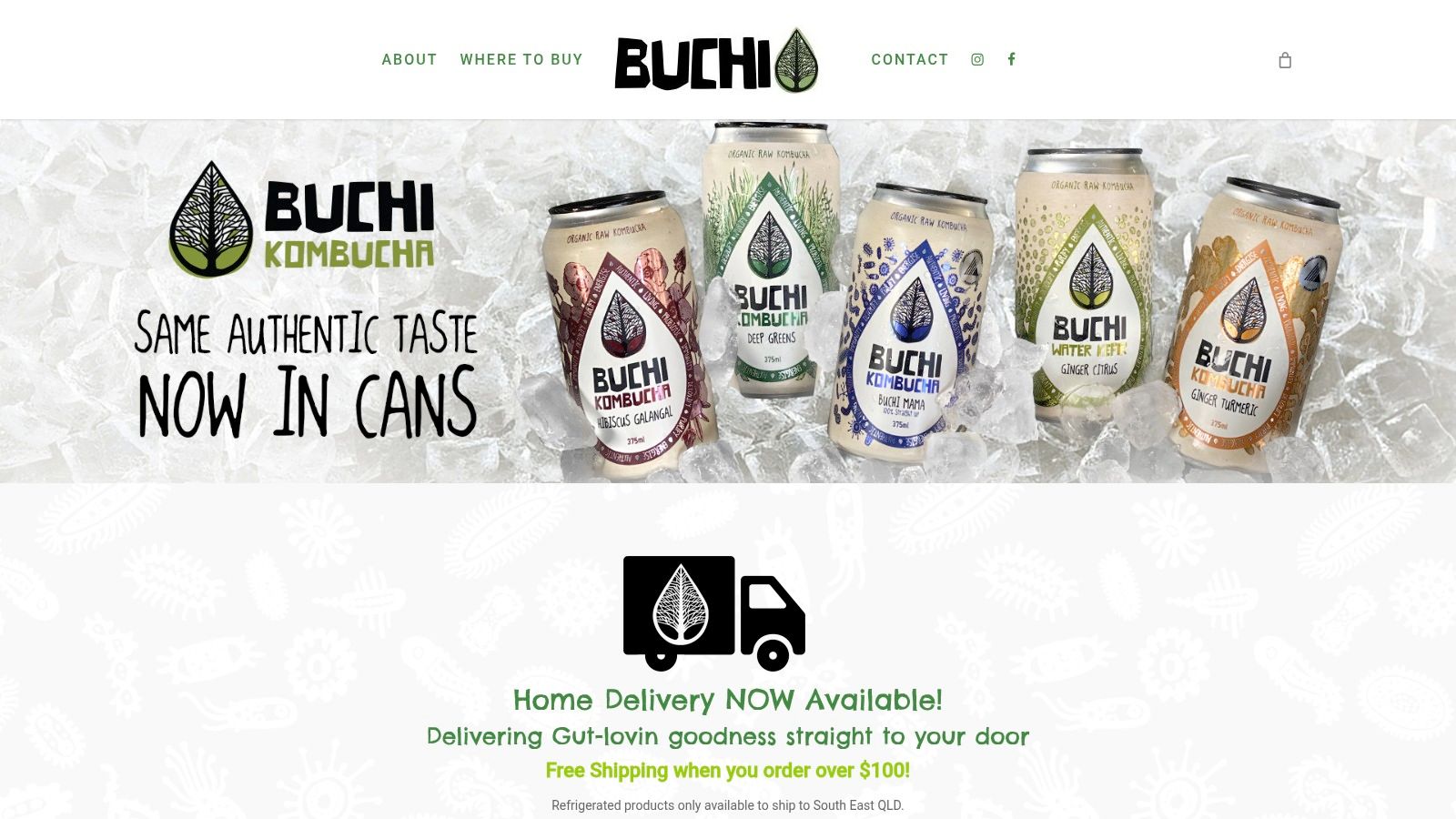
1. Buchi Kombucha Certified Organic Kombucha Home Brew Kit
For buyers who want a complete family-size setup with clear organic credentials, the Buchi certified organic home brew kit is a strong starting point. The Brisbane-based supplier includes a 5 L glass brewing jar, certified-organic SCOBY, organic starter liquid, organic tea and organic sugar. You can begin brewing without sourcing the main ingredients separately.
The kit's main advantage is its culture and ingredient documentation. Buchi markets the edible components as certified organic, including its Australian-brewed cultures and ingredients. That gives certification-focused shoppers more information than a kit that just uses “organic” in its name.
Best fit: Choose Buchi when certified ingredients, a complete bundle and a family-size batch matter more than a dispensing tap or the smallest entry point.
What works well for beginners
The glass jar provides room for the first fermentation, and the supplied instructions set out the process in a practical order. They allow a 7 to 14 day first ferment, helping beginners judge flavour and acidity rather than follow a fixed date. These time figures are included in the Buchi product information.
The setup is straightforward, but it is a standard jar rather than a continuous-brew vessel. Serving requires pouring from the jar, so it suits batch brewing better than a routine that depends on dispensing small amounts while the culture stays in place. Buyers who want that arrangement may prefer a kit with a tap.
Availability is the main practical compromise. Retailer stock can fluctuate, and pricing varies by stockist, so check how replacement cultures are obtained before buying. Also confirm that the instructions cover pH testing, sanitation, cooling and storage. Freshly prepared tea can initially sit at about pH 5, so safe brewing depends on teaching users how to acidify the liquid during fermentation, not just how to develop flavour. FSANZ explains the relevant kombucha control points.
For another Australian option, compare the PepTea kombucha tea kit. Buchi remains the better choice for a certified-organic, family-size starting point.
2. Nourishme Organics Ultimate Kombucha Brewing Kit
Does your brewing routine depend on dispensing kombucha without lifting or disturbing the vessel? The Nourishme Organics Ultimate Kombucha Brewing Kit is built for that use, combining a ceramic brewing vessel with a stainless-steel tap for a more practical continuous-brew setup.
Its 5 to 6 L ceramic vessel leaves enough capacity for regular household brewing while allowing finished kombucha to be drawn from the tap. The vessel is described as lead and cadmium free. The kit also includes organic starter culture, organic raw cane sugar, 100 g of English Breakfast tea, a growler bottle and ongoing brewing resources. Those product specifications are provided by Nourishme Organics.
Where the premium design earns its keep
The tap suits households that serve kombucha regularly and small cafés that want controlled dispensing from an attractive bench-top vessel. It reduces the need to pour from a jar and helps keep the remaining brew in place. Ceramic gives the setup a more considered appearance than a basic preserving jar, although the filled vessel will be heavy and difficult to move.
The equipment is better matched to an established brewing habit than to a cautious first experiment. Its larger capacity commits more tea, sugar and space than a small starter kit, while the ceramic vessel and tap add cleaning requirements. The tap is another contact point for residue and contamination, so it needs thorough cleaning as part of every brewing cycle.
A continuous-brew vessel only saves effort when the tap, cover and surrounding equipment stay clean.
The PepTea kombucha brewing container offers another reference point for buyers comparing dispensing vessels. Nourishme is the stronger fit when serving convenience, a larger batch and an ongoing brewing rhythm matter more than portability. Beginners who are still learning how temperature, sugar, fermentation time and pH affect flavour may find a smaller setup easier to manage.
The included guidance adds value because continuous brewing follows a different routine from a single batch. The brewer removes some finished drink, then replenishes the vessel with fresh sweetened tea. Written instructions can help establish that rhythm, but the culture still needs observation and basic record-keeping. This kit supports repeat brewing well, provided the buyer has room for the vessel and is prepared to maintain the tap carefully.
3. Mad Millie AU Kombucha Kit
Contrasting with Nourishme Organics' larger vessel, the Mad Millie AU Kombucha Kit keeps the equipment compact and the first commitment small. It suits a beginner who wants to learn the basic fermentation process before buying a larger brewing vessel.
The kit includes an organic SCOBY, a 1 L glass jar, muslin cloth, thermometer strip and lid. The instructions set out around 20 minutes of hands-on preparation and an 8 to 25 day fermentation period, according to the brand's product listing. That guidance sets realistic expectations: the brew needs little daily work, but it will not be ready straight away.
The small-batch trade-off
A 1 L batch fits a small kitchen and limits the tea and sugar used during an early experiment. The modest volume also makes it easier to test one choice at a time, such as black tea versus green tea or a shorter ferment versus a longer one. For a cautious beginner, that control can make flavour changes easier to understand.
The culture is identified as organic, while the kit's equipment covers the basic first-fermentation workflow. Buyers should still check the product details for their preferred ingredients and confirm current stock before ordering.
Capacity is the clear compromise. A household that drinks kombucha regularly may finish a litre quickly, then decide to scale up. The jar is not designed for a continuous-brew routine or regular café service, and the compact format leaves less room for serving several people from one batch.
- Good starting equipment: The glass jar, cloth, thermometer strip and lid cover the main needs for a first fermentation.
- Low learning barrier: Clear instructions help first-time brewers begin without already owning specialist equipment.
- Scaling limitation: A larger vessel, extra starter liquid and further monitoring equipment may be needed later.
- Availability consideration: Culture stock can be temporarily unavailable, so check supply before planning a brew.
Mad Millie's broad distribution through Australian kitchenware retailers and online sellers makes replacement equipment convenient to source. This kit is the strongest fit here for a beginner who values a compact learning experience over batch capacity. It is less suitable for anyone already planning frequent brewing or continuous dispensing.
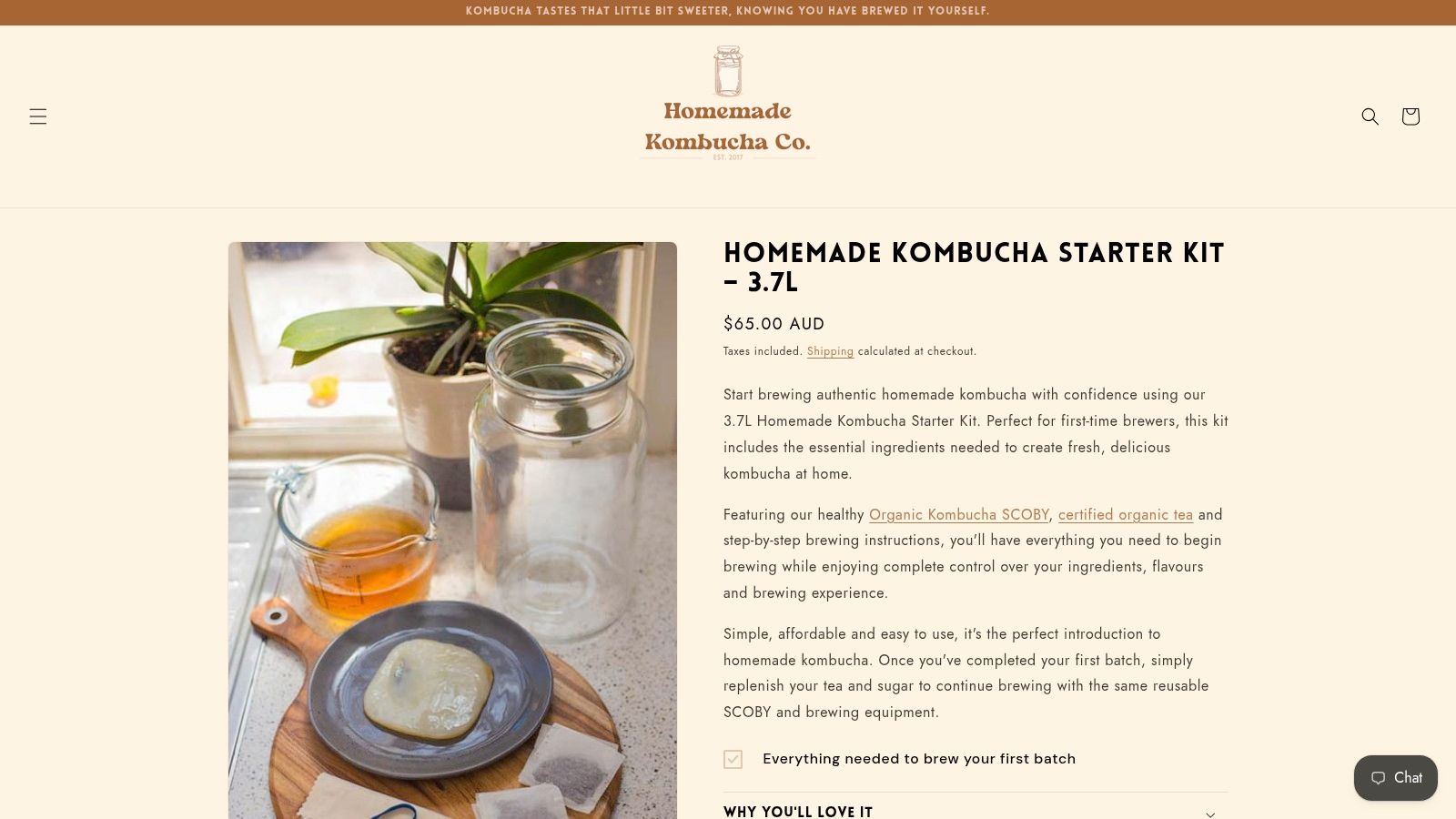
4. Homemade Kombucha Co. 3.8 L Homemade Kombucha Kit
The Homemade Kombucha Co. 3.8 L kit suits brewers choosing between a small trial batch and a larger continuous-brew setup. The Queensland-based specialist supplies a 3.8 L glass brewing jar, breathable cover, starter liquid and a choice between black-tea and green-tea SCOBY options. The product details come directly from Homemade Kombucha Co.
The choice between black-tea and green-tea SCOBY options lets brewers match their preferred flavour profile from the start. Black tea generally gives a more traditional kombucha character, while green tea offers a lighter route into the process. The kit also includes organic tea bags and approximately 500 mL of starter liquid, providing acidic liquid to help establish the new batch. That quantity is stated in the product listing.
A practical family-size compromise
The vessel gives a household more useful batch capacity than a compact beginner jar without moving straight to hospitality-scale equipment. It suits people who want to pour kombucha over several days. The breathable cover allows air exchange during first fermentation while helping keep the jar protected.
Sugar is the main omission. You will need to supply your own, which is straightforward if organic raw sugar is already in the pantry, but it makes this kit less complete than options that include sugar. Use suitable tea, sugar and water, then weigh them consistently so each batch is easier to compare.
Practical rule: A larger jar does not correct an inconsistent recipe. Record the tea, sugar, temperature, fermentation time and pH for every batch.
This kit is a sensible choice for a first-time brewer who wants more capacity than Mad Millie without a tap-equipped continuous-brew vessel. It is not set up for continuous dispensing, so regular high-volume brewing may call for different equipment. Stock can fluctuate, and some variants sell out periodically. Check the available culture and the exact SCOBY option before ordering.
5. Gram Sustainable Kombucha Brew Kit
Do you already have a suitable glass jar for brewing? The Gram Sustainable Kombucha Brew Kit takes a deliberately minimalist approach, supplying the culture, ingredients, cover and instructions while leaving the brewing vessel to you. That keeps the package compact and avoids paying for equipment you already own.
Gram lists an organic-fed SCOBY with more than 200 mL of culture and starter liquid, 50 g of organic tea and 100 g of organic raw sugar, along with a fermentation cloth and instructions. The culture is described as 100% accredited organic and maintained on organic inputs. That gives buyers clearer information about the culture and ingredients than an unverified SCOBY listing, although certification details are still worth checking on the current product page.
Best for an equipped brewer
The absence of a jar is the kit's defining trade-off. It saves duplication for brewers with a clean, food-safe glass vessel, but adds a shopping step for first-timers. Check that your jar is large enough for the supplied culture and starter liquid, has not held unsuitable chemicals, and can be covered with a breathable cloth during first fermentation.
The listed price is positioned as a lower-cost route into organic-fed brewing, but the final cost depends on whether you need to buy a vessel. Product prices and stock can change, so check the current listing before comparing kits.
- Choose it for: An existing jar, organic tea and sugar, and a straightforward first brew.
- Avoid it for: A gift recipient or beginner who needs a complete equipment bundle.
- Check before buying: Current stock, vessel suitability, and whether the instructions cover sanitation and pH checks.
The kit suits conventional batch brewing rather than a tap-based continuous routine. It does not appear designed for dispensing, so choose another setup if you want to draw kombucha regularly from one vessel. For an experienced brewer, the smaller package reduces clutter. A first-timer may prefer a kit that includes every physical component and gives more guidance while learning to judge fermentation.
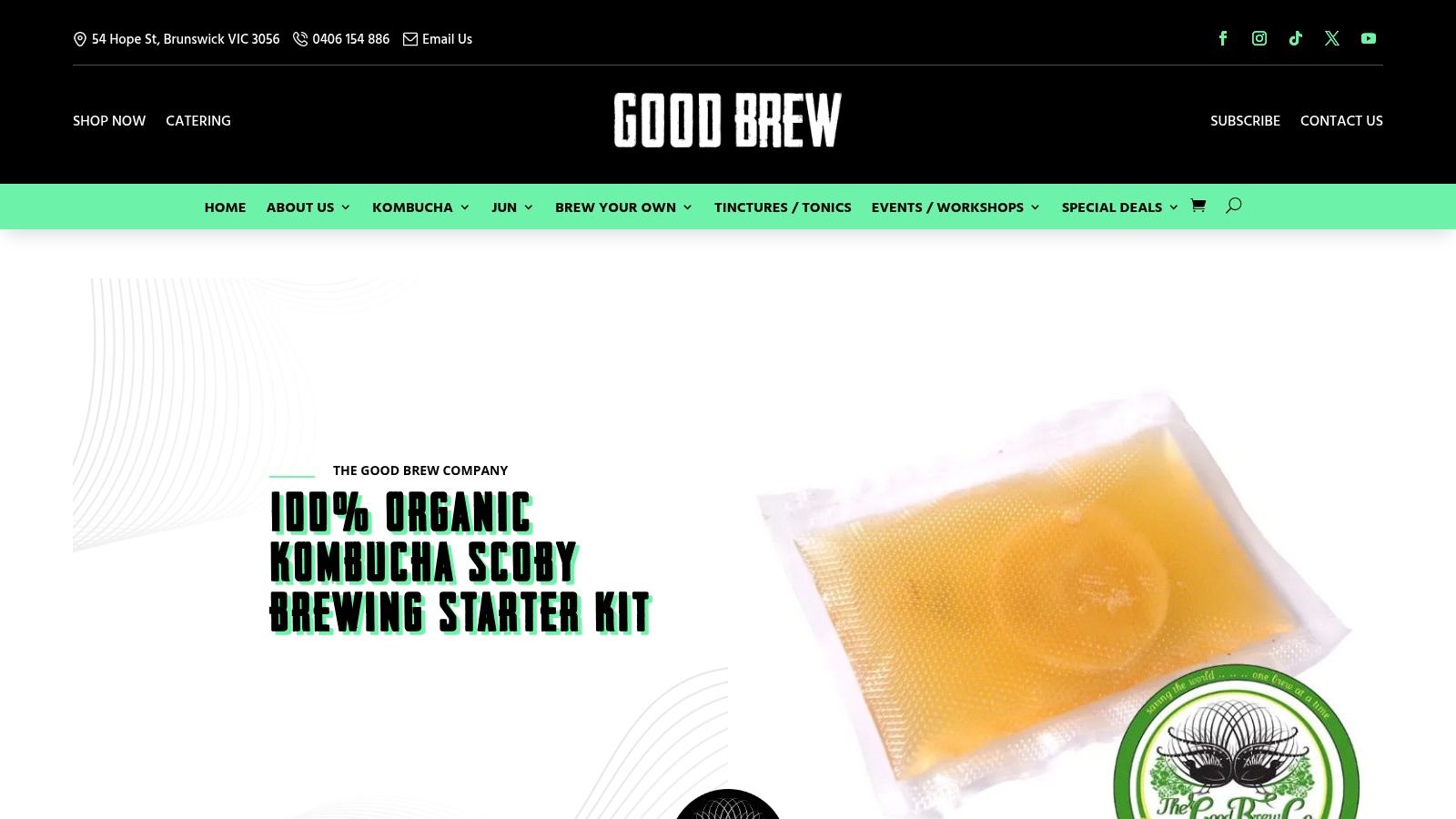
6. The Good Brew Company Organic Kombucha SCOBY Starter Kit
For brewers who already have jars, tea and sugar on hand, The Good Brew Company's Organic Kombucha SCOBY Starter Kit removes the need for bundled equipment. It puts the focus on a living culture and printed brewing instructions, which suits someone refining an established recipe or replacing an existing SCOBY.
The Melbourne and Daylesford-based maker supplies a 100% accredited-organic SCOBY. The culture is intended to scale from 1 L upward, while the 220 mL starter size qualifies for free Australian shipping, as stated on the product listing. The supplier also describes a culture fed with organic inputs for over a decade.
Culture-first buying
This package is strongest on culture provenance and weakest on equipment completeness. You supply the brewing vessel, tea and sugar unless you add extras, so the total setup cost depends on what is already in your pantry and cupboard. That makes it a practical choice for an equipped brewer, but less suitable as a first-brew gift.
The stated starting capacity is 1 L, giving a manageable batch for testing a recipe before scaling up. The culture can grow with the process, but the kit does not provide a tap or dispensing vessel for continuous brewing. Choose another format if drawing regular servings from one container is a priority.
Quality checks matter with any culture-only purchase. Confirm that the starter includes enough liquid, that care instructions are clear, and that the guidance explains healthy appearance and smell. Discard a batch showing mould or visible contamination. Western Australian fermented-food guidance explains the need for pH monitoring and contamination control identifies mould contamination, including Penicillium and Aspergillus, as a hazard in homemade kombucha starter cultures.
For practical help, PepTea's guide to making a kombucha SCOBY is a useful companion. Choose this kit for an organic culture and a scalable starting point, rather than a complete beginner setup.
7. Karl Kombucha 8 L Brewing Kit With Tap
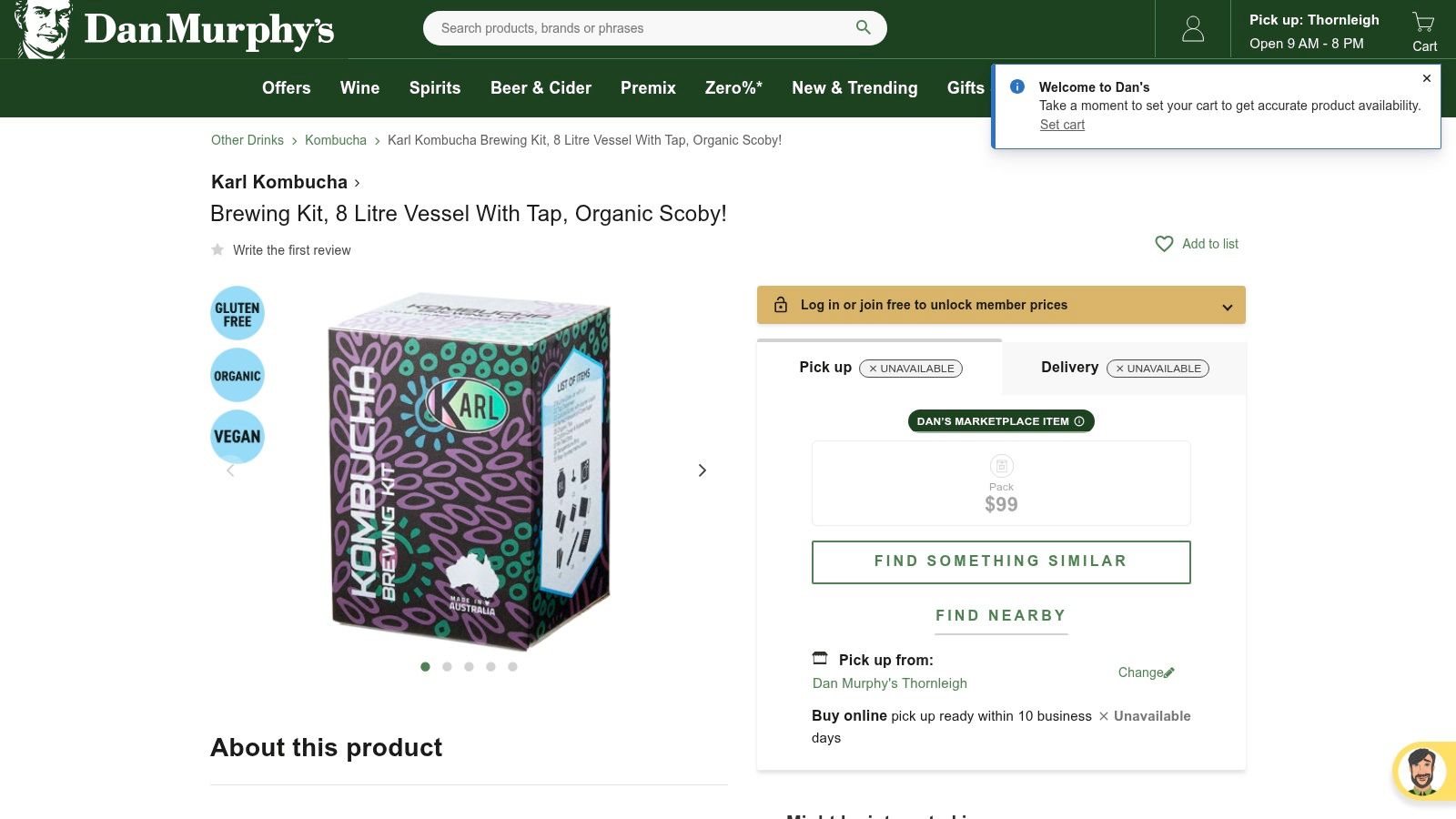
Need a larger batch and easier dispensing? The Karl Kombucha 8 L brewing kit is the highest-capacity option in this comparison. Sold through Dan Murphy's Marketplace, it includes an 8 L vessel with tap, organic SCOBY, organic tea, organic sugar, measuring aids, a cloth and instructions. The product details are available through Dan Murphy's Marketplace.
The included pH strips and temperature strip give brewers practical checks during fermentation. That is useful at this size, where a batch represents more ingredients and time than a compact trial. Australian guidance recommends monitoring kombucha and reaching pH 4.2 or lower, while acidification below pH 3.0 helps inhibit food-poisoning bacteria. The Western Australian fermented-food guideline provides further food-safety detail.
Capacity brings responsibility
The tap simplifies sampling and bottling, and the vessel is better suited to regular production than a small jar. It could suit a café or bar trialling a fermented soft drink, but hospitality use requires a documented process, consistent cleaning, suitable testing and careful storage.
Alcohol control also needs attention. A national Australian survey found that 64% of sampled fermented beverages contained more than 0.5% ABV, 25% exceeded 1.15% ABV, and 15% of alcohol-containing products had no alcohol warning. The FSANZ fermented soft-drinks survey also reported a 174% increase in kombucha sales over the preceding three years.
Those results do not predict every home batch, but they show why fermentation time, temperature, sugar, secondary fermentation, refrigeration and labelling deserve attention. The Karl Kombucha, 8 L Brewing Kit With Tap suits experienced home brewers or small operators who value batch size, dispensing and monitoring tools over the simplicity of a smaller first kit. Marketplace fulfilment may vary by store or delivery route.
Top 7 Organic Kombucha Starter Kits Comparison
| Product | 🔄 Implementation Complexity | ⚡ Resource Requirements | 📊 Expected Outcomes | 💡 Ideal Use Cases | ⭐ Key Advantages |
|---|---|---|---|---|---|
| Buchi Kombucha – Certified Organic Kombucha Home Brew Kit | Low, guided 7–14 day first ferment | Minimal, includes certified organic SCOBY, starter tea, sugar and 5 L glass jar | Family-size 5 L batches; consistent, certified-organic results | Beginners who want a fully certified-organic end-to-end kit | Certified-organic across edible components; robust, beginner-friendly SCOBY |
| Nourishme Organics – Ultimate Kombucha Brewing Kit (6 L ceramic vessel) | Moderate, continuous-brew setup with ongoing maintenance | Mostly included, 5–6 L ceramic jar with stainless tap, starter, sugar, tea, growler | Smooth continuous dispensing; stable long-term brews | Users wanting a turnkey continuous-brew system and easy dispensing | Turnkey ceramic vessel with tap; strong after-sales support |
| Mad Millie (AU) – Kombucha Kit (1 L) | Very low, simple small-batch process | Included, organic SCOBY, 1 L jar, muslin cloth, thermometer strip | Small test batches; ideal for learning or producing a starter | Budget-first-timers and those testing recipes or scaling up | Low entry price; widely available through retailers |
| Homemade Kombucha Co. – 3.8 L Homemade Kombucha Kit | Low, straightforward family-size ferment | Mostly included, 3.8 L glass jar, choice of SCOBY/tea, starter liquid (sugar not included) | Larger family batches (~3.8 L); good value for volume | First-time brewers who want larger batch sizes | Strong price-to-contents value; clear practical guidance |
| Gram Sustainable – Kombucha Brew Kit (No Jar) | Low, simple if you supply your own vessel | Partial, organic-fed SCOBY, organic tea and sugar, fermentation cloth (no jar) | Reliable small-to-medium batches using an organic-fed culture | Brewers who already own jars and want an organic-fed SCOBY | Affordable; SCOBY is 100% accredited-organic |
| The Good Brew Company – Organic Kombucha SCOBY Starter Kit | Low, SCOBY-only option, process depends on user supplies | Minimal, accredited-organic SCOBY and printed instructions (jar/ingredients not included) | Scalable starter culture usable from 1 L upward | Brewers who only need a certified-organic SCOBY to start or scale | Long-running organic-fed cultures; responsive support resources |
| Karl Kombucha – 8 L Brewing Kit with Tap (Dan Murphy's Marketplace) | Moderate, larger-format setup and handling for higher volumes | Comprehensive, 8 L vessel with tap, organic SCOBY, tea, sugar, pH & temp strips, cloth | High-volume batches; suited to continuous or small hospitality use | Households with high consumption or small hospitality/high-volume home use | Large 8 L capacity with tap; national marketplace distribution and pickup options |
Choose Your First Fermentation Setup
The right kit depends less on a universal ranking than on how you'll brew next month. Choose Buchi if you want an end-to-end certified-organic 5 L setup with the main edible components included. It's the most straightforward match for a household that values ingredient certification, a family-size vessel and beginner guidance.
Choose Nourishme Organics or Karl Kombucha if dispensing and larger ongoing batches are central to the decision. Nourishme Organics has the more polished ceramic continuous-brew presentation, while Karl Kombucha combines a larger vessel with pH and temperature monitoring equipment. Both demand more cleaning discipline than a simple jar, particularly around the tap.
Mad Millie is the sensible compact introduction. Its small format keeps the first experiment manageable, although regular drinkers may outgrow it. Homemade Kombucha Co. offers a useful family-size middle ground, especially for buyers who want a glass vessel and starter liquid but don't mind supplying their own sugar.
Gram Sustainable and The Good Brew Company make more sense when a jar and pantry ingredients are already available. Gram includes tea and sugar, while The Good Brew Company is the stronger culture-first option for a brewer who wants to scale an organic-fed SCOBY.
Before ordering, check:
- Certification: Confirm whether organic claims cover the SCOBY, starter liquid, tea, sugar and other edible components.
- Culture quantity: Look for a healthy live SCOBY supplied with enough starter liquid to establish the new batch.
- Vessel material: Prefer a suitable food-safe glass or ceramic vessel and inspect taps, covers and seals for easy cleaning.
- Batch size: Choose a capacity you can drink and refrigerate responsibly, not the largest vessel available.
- Monitoring guidance: Make sure the instructions explain temperature, pH, sanitation and what to do with visible mould.
- Replacement access: Check whether replacement cultures and ingredients are readily available in Australia.
- Stock status: A kit that repeatedly sells out may be harder to use as the foundation for a regular brewing routine.
Australian food-safety guidance says tea should be cooled rapidly from 60°C to 20°C within 2 hours, and the SCOBY should be added as soon as possible to begin acid production. During fermentation, the drink should reach pH 4.2 or lower, while a finished drink should generally remain at pH 2.5 or above. These control points are set out in FSANZ's safe-food guidance. Treat them as safety controls, not as flavour preferences.
Keep equipment clean, follow the supplied timing, leave the first ferment exposed to air, reserve starter liquid for future batches and change one variable at a time. If you alter tea, sugar, temperature and fermentation time together, you won't know which change affected the result. Refrigerate finished kombucha promptly, and remember that fermentation can continue after bottling.
PepTea offers an Australian perspective on properly fermented, low-sugar alternatives through its sugar-free organic kombucha, brewed in the Hunter Valley, NSW, as well as organic tea for home brewing. The brand's Ginger, Lime & Ginger and Mango flavours provide examples of how live fermented drinks can sit alongside non-alcoholic café menus and everyday wellness routines without assuming that every homemade batch has the same sugar or alcohol profile. The Australian Dietary Guidelines recommend limiting foods and drinks containing added sugars, so assess and label a homemade product according to its actual recipe and the applicable Australian rules rather than relying on the phrase “sugar-free” alone.
Explore PepTea's organic tea and sugar-free organic kombucha to compare properly fermented, low-sugar beverage options for home, café and hospitality use. Visit Pep Tea for kombucha education, brewing guidance and the current range.