
Tag: scoby starter
Starter Tea Kombucha: A Practical Guide for Home Brewers

You've left a jar of sweet tea on the kitchen bench for a few days. A pale film is forming on top, strands are drifting through the amber liquid, and you're wondering whether the batch is progressing normally or heading for the sink. In kombucha brewing, starter tea often makes the difference between a controlled ferment and a worrying wait.
Starter tea is mature kombucha liquid reserved from an earlier batch. It brings acidity and living yeast and bacteria into fresh sweet tea, helping the new brew move quickly into a safer acidic environment. The pellicle, commonly called a SCOBY, matters too, but the liquid surrounding it is a vital part of the culture.
Australian guidance describes kombucha as sweetened tea fermented with a SCOBY, or Symbiotic Culture of Bacteria and Yeast. The practical lesson is simple: starter tea isn't just leftover drink. It's part of the brewing system, and understanding it helps you make better decisions about pH, temperature, flavour and storage.
What Starter Tea Actually Is in a Kombucha Brew
Starter tea is the mature, fermented liquid you set aside to inoculate your next batch. It contains the acids produced during fermentation, along with yeasts and bacteria that can continue working in fresh sweet tea. A new pellicle may form on the surface, but the liquid itself carries much of the biological activity needed to begin the next brew.
That distinction clears up a common beginner confusion. The rubbery disc is visible, so it often receives all the attention. Yet Australian regulatory material explains that kombucha should be inoculated with a proven commercial starter culture and that the starter system helps drive rapid acidification. The liquid isn't merely flavouring. It helps establish the conditions the culture needs.
Why acidity matters from the beginning
Fresh sweet tea can sit around pH 5, an acidity level that remains permissive for contaminant growth, according to Australian fermented-beverage guidance. Adding acidic starter tea changes that starting point before fermentation has properly gathered momentum.
Australian guidance treats reaching pH 4.2 or below as a critical control point. That threshold matters because kombucha becomes more acidic as the culture converts sugars and ethanol into organic acids. Starter tea helps shorten the period in which the new batch is relatively unprotected.
Practical rule: Think of starter tea as both an ingredient and a safety control. A healthy pellicle without enough mature liquid can leave fresh tea slow to acidify.
Choose liquid from a batch that smells clean and pleasantly sour, not one with visible mould, rotten aromas or unexplained discolouration. If you're growing or refreshing a culture, the PepTea guide to making a kombucha SCOBY can help you understand the relationship between the pellicle and the liquid culture.
How Starter Tea Drives the Fermentation
You add sweet tea to a clean jar, then wonder why mature kombucha belongs in the same batch. The answer is that starter tea, the SCOBY, temperature, oxygen and acidity form one working system. Follow their sequence and fermentation becomes easier to read.
Yeasts convert sucrose into glucose and fructose, producing ethanol and carbon dioxide. Acetic acid bacteria then oxidise ethanol into acetaldehyde and acetic acid. This handover moves the brew from sweet tea towards a tangy, acidic drink, as explained in Australian food-safety information about kombucha fermentation.
Starter tea brings an active community of organisms into the new jar, so the first changes can begin without waiting for the culture to establish from nothing. The pellicle is the visible structure at the surface. Oxygen, temperature and available sugar affect the pace, while the liquid starter helps the new tea enter the process already connected to an acidic culture.
Australian regulatory material places first fermentation commonly within 7 to 10 days, with conditions generally around 22°C to 30°C, before the SCOBY is removed once the drink reaches a pH below 4.2. These conditions appear in Australian food-regulation material on fermented beverages.
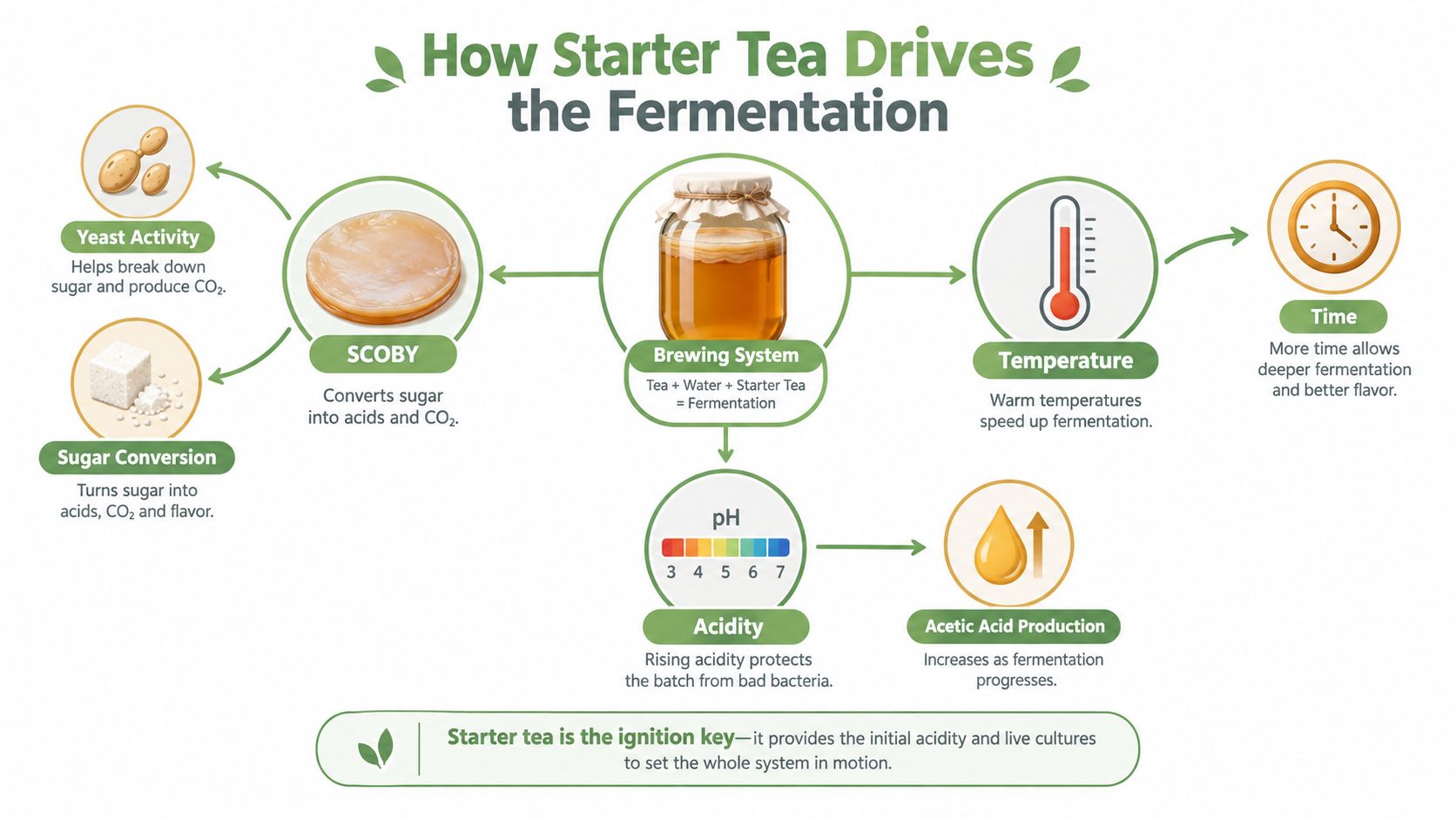
The brewing system in plain language
A small or weak starter culture can leave fresh tea slow to acidify. Warm conditions usually speed the work, while cooler conditions make it more gradual. As acidity rises, the jar becomes less welcoming to unwanted organisms and more suitable for the intended culture.
Australian health guidance recommends cooling tea from 60°C to 20°C within 2 hours, then fermenting at 20°C to 23°C for 7 to 10 days, with pH checked throughout. The finished drink should be refrigerated at 4°C, and pH 4.2 or below is identified as a critical control point. The Western Australian fermented-food safety guideline gives further detail for anyone scaling up or selling kombucha.
For the opening stage, follow PepTea's kombucha first-fermentation guide.
Making and Storing Your Own Starter Tea
The easiest source of starter tea is a clean, successful batch you've already brewed. Reserve some of the finished liquid before adding fruit, herbs or other flavourings. Plain first-fermentation liquid is generally easier to assess and less likely to carry extra particles into the next jar.
Reserve the right liquid
Use kombucha that tastes finished, pleasantly tart and clean. It shouldn't still taste like sweet tea, but it also shouldn't smell rotten or chemically harsh. Straining it through a clean fine mesh strainer can remove loose yeast strands and fragments that make the reserve harder to inspect.
A practical home routine looks like this:
- Clean your equipment. Wash the jar, funnel, strainer and your hands thoroughly. Fermentation works best when the intended culture isn't competing with avoidable contamination.
- Set aside mature kombucha. Keep enough liquid to seed the next batch, then transfer it to a clean glass jar.
- Cover it sensibly. Use a clean cover that protects the liquid from dust while allowing the culture to remain suitable for future brewing.
- Label the jar. Write the date and identify it as plain starter tea, especially if you keep flavoured kombucha nearby.
- Refrigerate the reserve. Australian guidance specifies refrigeration at 4°C for final kombucha. Cold storage slows activity, so allow the starter to return gradually to brewing conditions before adding it to fresh tea.
Inspect before every use
A reserve should look and smell like clean fermented tea. Pink or unusual coloured growth, blue-green mould, fuzzy patches, or a rotten smell are reasons to discard it rather than trying to rescue it. Don't taste a reserve that shows clear contamination.
Keep the starter separate from finished flavoured drinks. Ginger, citrus, fruit and botanicals can alter the culture and make it harder to judge whether an unusual appearance is normal fermentation or spoilage. A labelled jar prevents accidental swaps and keeps your process organised.
Comparing Starter Tea and Acidified Tea Options
Home brewers have several ways to lower the starting acidity of fresh sweet tea. They aren't interchangeable, because some options provide living cultures while others only change the liquid's chemistry.
| Option | Reliability | Flavour Impact | Best Use Case |
|---|---|---|---|
| Reserved starter tea | Strong when sourced from a clean, active batch | Balanced fermented character | Default choice for regular brewing |
| Commercial liquid kombucha starter | Consistent when supplied for brewing | Usually designed to suit kombucha | Useful when starting without a reserve |
| Distilled white vinegar | Acidifies quickly but doesn't provide a kombucha culture | Sharp, vinegary notes | Emergency acid adjustment, not a full culture substitute |
| Food-grade acidified tea | Can lower acidity without live microbial diversity | Depends on the acid and concentration | Backup when live starter isn't available |
Reserved starter tea is usually the most balanced option because it carries both organic acids and a microbial community already adapted to kombucha conditions. It can influence the next batch's aroma, sourness and fermentation behaviour, so a clean, agreeable reserve is worth protecting.
Commercial liquid starter is convenient for a first brew or after a failed batch. Check that the product is intended for kombucha fermentation and follow its directions rather than assuming every bottled kombucha is suitable.
Vinegar may help lower acidity, but it brings a strong acetic taste and doesn't replace the yeasts and bacteria supplied by living kombucha. Food-grade citric or tartaric acid can provide an acidified fallback, yet it also lacks the microbial diversity that drives fermentation and pellicle formation.
Brewing choice: Use reserved starter tea as your normal option. Keep a commercial starter or food-grade acidified tea as a backup, and treat vinegar as an emergency measure rather than the foundation of a batch.
Proportions and Ratios for Each New Batch
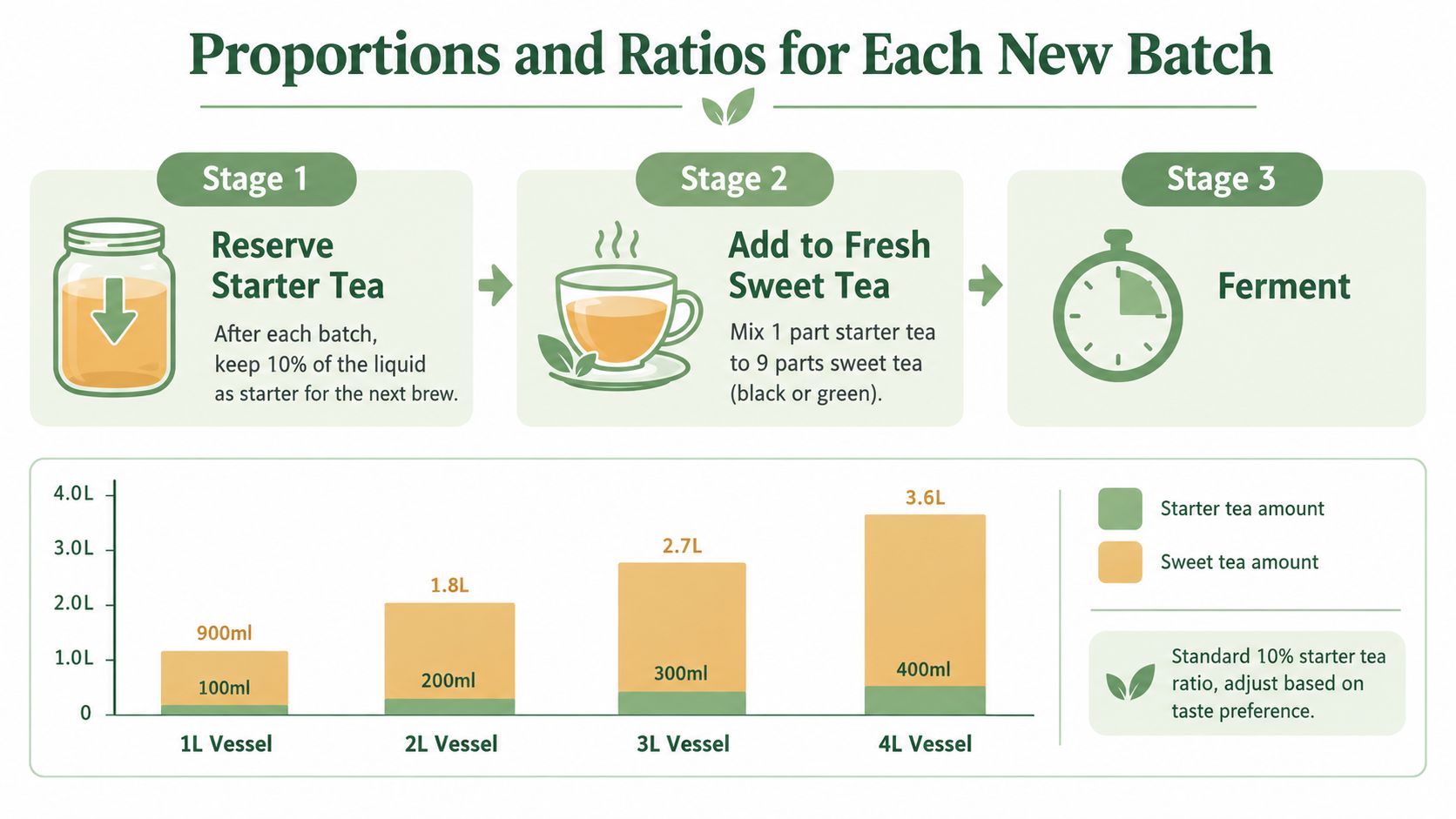
A straightforward starting point is the 10 per cent starter tea rule, meaning roughly 100 millilitres of starter tea for each litre of sweet tea. This ratio is a practical way to introduce enough acidic liquid and live culture without making the new batch dominated by old kombucha flavour.
The volume guide is simple:
- 1-litre vessel: Add 100 millilitres starter tea and 900 millilitres sweet tea.
- 2-litre vessel: Add 200 millilitres starter tea and 1.8 litres sweet tea.
- 3-litre vessel: Add 300 millilitres starter tea and 2.7 litres sweet tea.
- 4-litre vessel: Add 400 millilitres starter tea and 3.6 litres sweet tea.
These exact proportions are represented in the starter tea kombucha brewing ratios infographic.
How to manage the reserve
Before bottling or flavouring a finished batch, pour off the amount you need for the next brew. If you remove nearly all the liquid and leave only a pellicle, the next batch may start more slowly because it has lost much of its mature acidic environment.
For a continuous-brew vessel, the principle is similar but the rhythm changes. You draw finished kombucha from the lower outlet, then replace it with cooled sweet tea. Keep enough mature liquid in the vessel to maintain the established acidic environment, and watch the pH rather than relying only on volume.
Warm Australian kitchens can accelerate fermentation. Instead of changing the ratio automatically, monitor pH and taste, then adjust the next cycle if the brew becomes sharp too quickly. If the reserve has been diluted through repeated top-ups, remove some finished liquid and replenish with a stronger, clean starter reserve before continuing.
Reading the Signs of a Healthy Fermentation
A healthy ferment doesn't always look tidy. Yeast strands can hang below the surface, a new pellicle can form unevenly, and small bubbles can collect around the jar. Those signs alone don't prove that a batch is safe.
The strongest habit is to combine appearance, smell, taste and pH. Australian guidance treats pH 4.2 or below as a critical control point, so a pH reading gives you information that visual inspection can't provide.
What normal development can look like
Early in the brew, the surface may appear quiet while the culture begins working through the sweet tea. Over time, a thin new pellicle may appear across the surface, sometimes smooth and sometimes irregular. Fine bubbles or yeast sediment can also develop below it.
A sour, tea-like or lightly yeasty aroma can fit normal fermentation. A batch with fuzzy mould, blue-green growth, pink discolouration, rotten-egg odour, cheese-like smell or an unmistakably chemical character should not be treated as healthy because it fizzes.
Fizz means gas is present. It doesn't certify the batch.
Surface films deserve close attention. A smooth, wet-looking film may be part of pellicle development, while dry, fuzzy or brightly coloured growth suggests mould. When in doubt, don't scrape off the suspicious area and continue. Discard the batch and clean the equipment thoroughly.
Taste only when the batch looks and smells normal. If the flavour is intensely vinegary, the ferment may have gone further than you prefer, even if the acidity is within the guidance range. For safety decisions, use a properly calibrated pH meter or suitable test method, and remember that pH is one control, not a substitute for clean equipment and careful observation.
Troubleshooting Acidity and Contamination Issues
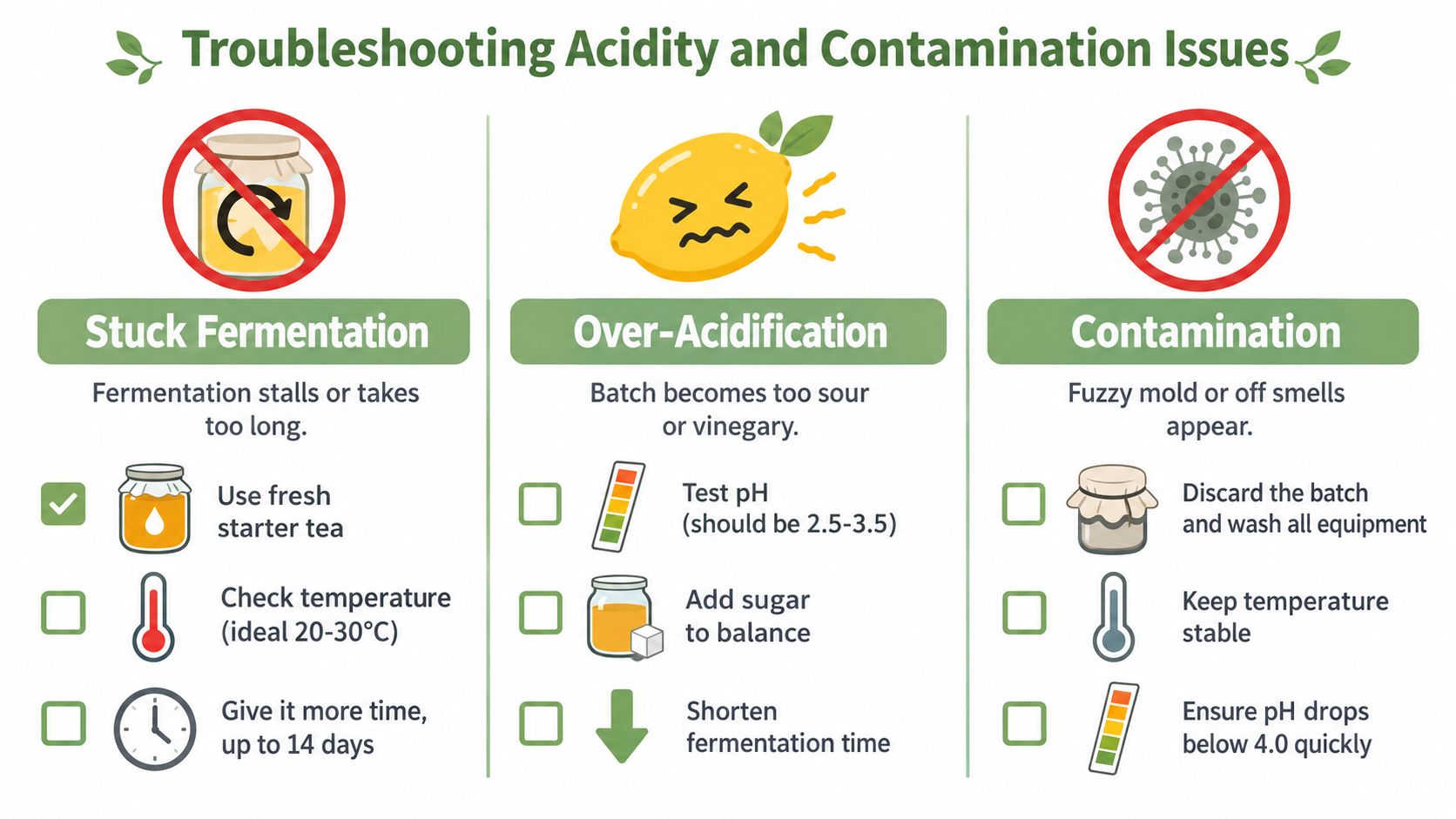
When a brew stalls or turns sharply sour, begin with the symptom and change one factor at a time. Random additions can make a questionable batch harder to assess. Measure, inspect, and record the result so the next decision rests on evidence.
If fermentation seems stuck
A brew that stays sweet with little activity may have started with weak starter tea, a cool room, or an unsuitable sugar balance. One Australian safety protocol describes fermentation around 20°C to 23°C, with the first fermentation commonly lasting 7 to 10 days. Check the room temperature with a thermometer instead of relying on how the kitchen feels.
- Use stronger starter: Add fresh, clean starter tea only when the batch has no contamination signs.
- Stabilise the environment: Put the jar in a clean, undisturbed place within the appropriate brewing range.
- Allow more time: Watch changes in aroma, acidity, and pH rather than using pellicle thickness as the progress marker.
Starter tea works like an acidic head start. If that head start is weak, the culture may need more time to establish the conditions that support fermentation.
If the batch becomes too acidic
A pronounced vinegar flavour usually means the culture has used much of the available sugar and continued producing acids. For the next batch, shorten fermentation, reserve a milder starter, or adjust the sweet-tea balance carefully.
Australian guidance notes that final kombucha typically targets pH at or above 2.5 to avoid over-acidification, as described in the Western Australian safety guideline. Taste can reveal preference, but it cannot confirm whether a batch meets a safety threshold.
If contamination appears
Fuzzy mould, unusual coloured growth, or rotten smells call for discarding the entire batch. Wash and sanitise the jar, cover, utensils, and nearby surfaces before brewing again. Yeasty strands and an uneven pellicle may be normal, yet they still need to be considered alongside smell and pH.
For closer monitoring, a PepTea digital pH meter can show how acidity changes instead of leaving you to judge by bubbles or colour. Follow its care instructions, and record each reading with the temperature and tasting notes.
Bringing It All Together in Your Brewing Routine
A reliable routine can take only a few minutes after each batch. First, inspect the surface and smell the liquid. Then measure pH, taste a small amount if the batch appears normal, and decide whether the acidity suits your preferred drinking style.
Before bottling or flavouring, reserve clean plain kombucha for the next brew. Transfer it to a labelled jar, keep the pellicle in suitable mature liquid, and refrigerate the starter at 4°C in line with Australian guidance. Clean the jar rim and cover before setting up fresh sweet tea.
Write down the room temperature, fermentation duration and pH reading. After several batches, those notes can reveal whether your kitchen runs warm, whether a particular tea ferments quickly, or whether your starter reserve is losing strength.
Ingredient quality supports the whole process. Use clean, filtered water and a suitable loose-leaf black or green tea, then allow the sweetened infusion to cool before adding the culture. If you plan to sell kombucha or offer it in a café, remember that soft-drink alcohol rules apply. CHOICE's Australian kombucha guidance notes a limit under 0.5% ABV in Victoria and Queensland, while the threshold is 1.15% ABV in other states and territories, with labelling required between 0.5% and 1.15% ABV.
PepTea offers Australian-brewed, sugar-free organic kombucha made in the Hunter Valley, NSW, alongside organic Japanese matcha and tea for everyday brewing and café service. Visit Pep Tea to explore kombucha options, quality tea ingredients and wholesale support for your next starter tea kombucha batch.