
Tag: matcha tea benefits
Does Matcha Tea Have Caffeine? Amounts and Effects
Yes, matcha tea does have caffeine, and a typical Australian 250 mL serving is commonly estimated at approximately 60–75 mg. That amount isn't fixed, because the quantity of powder and the final serving size can materially change what ends up in your cup. If you've ever ordered a matcha latte thinking its smooth flavour meant it must be barely caffeinated, you're not alone. Taste is a poor guide to dose, and that misunderstanding is worth unpacking carefully.
Does Matcha Tea Have Caffeine
You are at a café counter, you want something gentler than coffee, and you choose the green drink because it tastes earthy, creamy and calm. It's an understandable choice, but the question people type into search engines as matcha tea have caffeine has a plain answer. Yes, matcha contains naturally occurring caffeine from the tea leaf itself.
Flavour doesn't reveal that fact. A matcha latte can taste softer and less bitter than coffee while still delivering a meaningful amount of caffeine, because milk, sweetness and the savoury character of the powder change perception rather than chemistry. A strong, powder-heavy serve can also take you well past the typical benchmark mentioned above.
Why the Smooth Taste Misleads People
Like cordial strength hidden by ice, a drink can taste milder when diluted or creamy, yet the amount of the active ingredient depends on what was put in at the start. With matcha, that starting point is the powder quantity.
- Flavour intensity: A grassy, bold taste suggests more powder, but it can't tell you a milligram figure.
- Milk and sweeteners: These soften bitterness and texture, they don't remove caffeine.
- Cup size: A larger drink may contain a second portion of powder, not just extra liquid.
A calm taste is not the same thing as a low caffeine dose.
What Determines Your Answer
Two questions matter more than the menu name. How much powder did the maker use, and how large is the finished drink? Once you know those basics, the rest of the picture becomes easier to judge, from how caffeine enters the leaf to why matcha can feel different from coffee for some people. Keep both questions in mind whenever you're comparing a home bowl with a café latte, because the word matcha describes an ingredient, not a standardised dose.
How Caffeine Gets Into Matcha
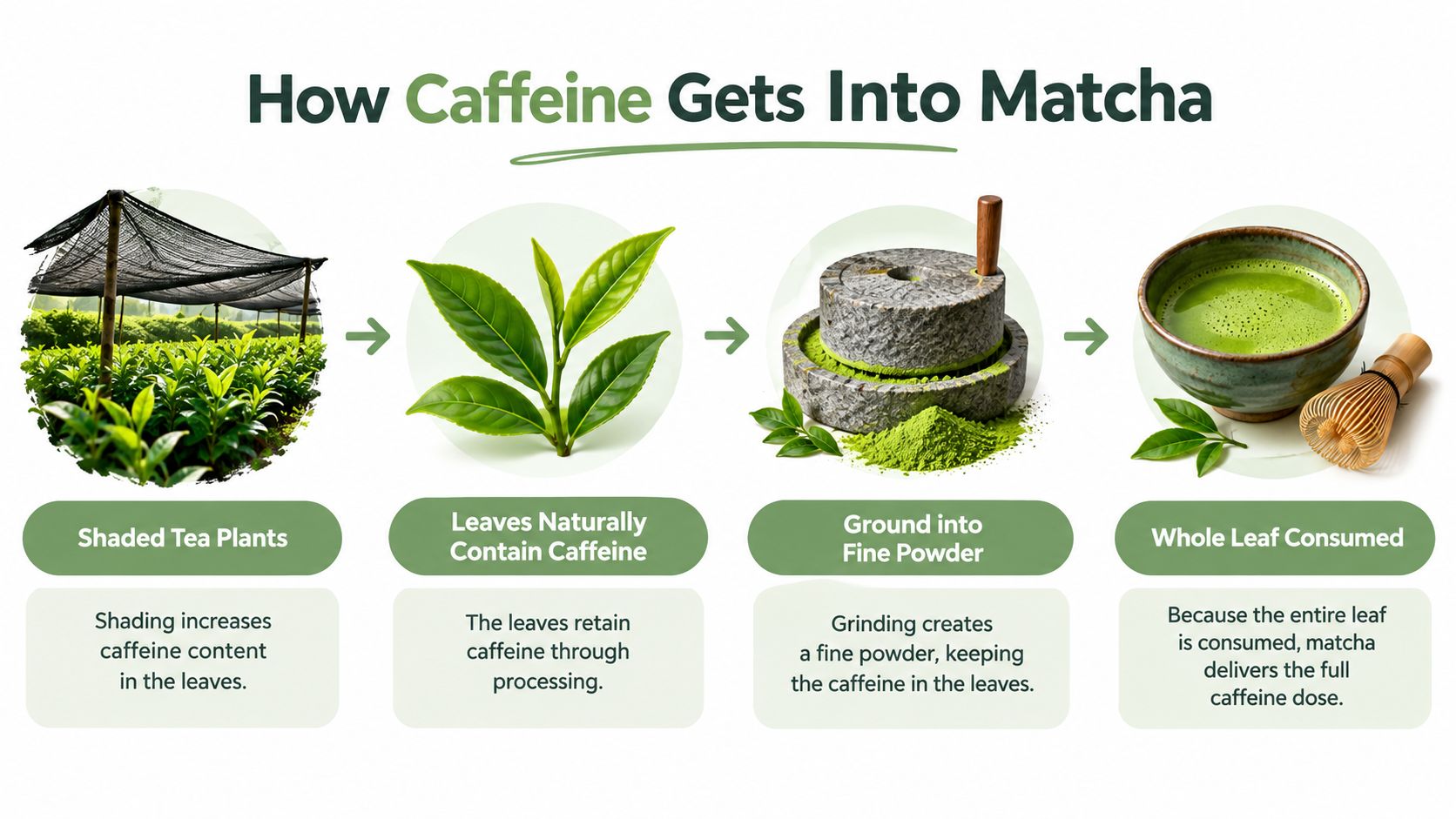
Matcha begins as Camellia sinensis, the same tea species used for green and black tea, so caffeine is already in the leaf before processing. The key difference is what happens to that leaf before it reaches your bowl.
For matcha, growers shade the plants in the weeks before harvest, then dry the leaves and mill them into powder, a production path Australian pharmacology expert Treasure McGuire of Bond University has described in ABC reporting. Shade changes how the leaf develops and helps create the dried leaf called tencha used for milling. Once ground, the leaf is no longer a filter you remove; it becomes the drink itself.
Steeping Compared With Whisking
A brewed cup works like a rinse: water pulls soluble compounds out, then the spent leaf stays behind. Matcha works more like blending spinach into a smoothie. Fine particles stay suspended, so you swallow leaf material along with the liquid.
That single difference explains why drink strength and caffeine dose are separate ideas. A delicate-looking bowl can still carry a substantial serve if it was made with a heavy scoop, while a bold grassy taste may come from cultivar or freshness rather than extra caffeine.
What Colour and Texture Cannot Tell You
Greenness signals style, not milligrams. Particle size, powder mass, water volume and dilution shape what ends up in the cup, and two drinks with a similar jade colour can behave differently once prepared.
The controllable part is the scoop. Measure powder the same way each time, watch one café preparation before copying it, then adjust by recipe instead of guessing from taste. Any softer feel has more to do with the rest of the leaf chemistry than with caffeine vanishing.
Matcha Compared With Other Caffeinated Drinks
A fair comparison starts with equal volume, then treats the result as a benchmark rather than a guarantee. As noted earlier, Treasure McGuire reported roughly 60 to 75 mg for a 250 mL matcha serving, placing it between brewed green tea and coffee at the same volume. The useful lesson is simple: cup strength describes taste and body, while caffeine dose describes how much leaf material and extract reached your mug.
| Drink | Approximate caffeine per 250 mL | How to interpret it |
|---|---|---|
| Matcha | 60 to 75 mg | Generally above brewed green tea because powdered leaf is consumed |
| Brewed green tea | 24 to 45 mg | Steeped and strained, so only extracted compounds remain |
| Black tea | 45 to 75 mg | Can overlap with matcha depending on brewing strength |
| Coffee | around 100 mg | Usually above a typical matcha serving at this volume |
Reading the Table Sensibly
Matcha often surprises people because it looks gentler than espresso yet usually sits above a strained green tea. It can touch black tea territory at the upper end, while a standard café coffee commonly remains higher. A calm way to read it is to see matcha as a middle lane: steady enough to notice, rarely the heaviest option in the room.
The edges blur once recipes leave the lab. Extra espresso, a longer extraction or a larger cup lifts the coffee side. A heaped scoop or a double matcha lifts the tea side. Milk stretches volume and softens bitterness, although the caffeine from the powder is still present; syrup changes sweetness more than dose.
If your real choice is between a morning flat white and a matcha latte, our guide to matcha energy compared with coffee looks at how the two tend to feel over a few hours. Let the table set the expectation, then let your usual order adjust it.
Compare the actual serving in front of you before trusting the reputation of the drink.
A pale bowl can still be brisk, and a milky latte can be gentler than its colour suggests. That is why dose and strength deserve separate labels: one is measured in milligrams, the other is judged by aroma, bitterness and texture.
Why Your Matcha Serving Can Differ
Two people can both say they had a matcha this morning and receive materially different caffeine doses. The main reason is powder mass, because more finely ground leaf means more of the compounds naturally present in that leaf. Final drink volume matters too, but mainly because larger café drinks often use more powder rather than more water or milk.
Independent Australian guidance cited a wider range of roughly 38–176 mg depending on whether a recipe used half to one teaspoon of powder, as discussed in Australian guidance on matcha latte caffeine ranges. That broad spread is exactly why a single universal number can mislead. A strong café latte can approach coffee-level caffeine, while a lightly prepared home drink may contain far less.
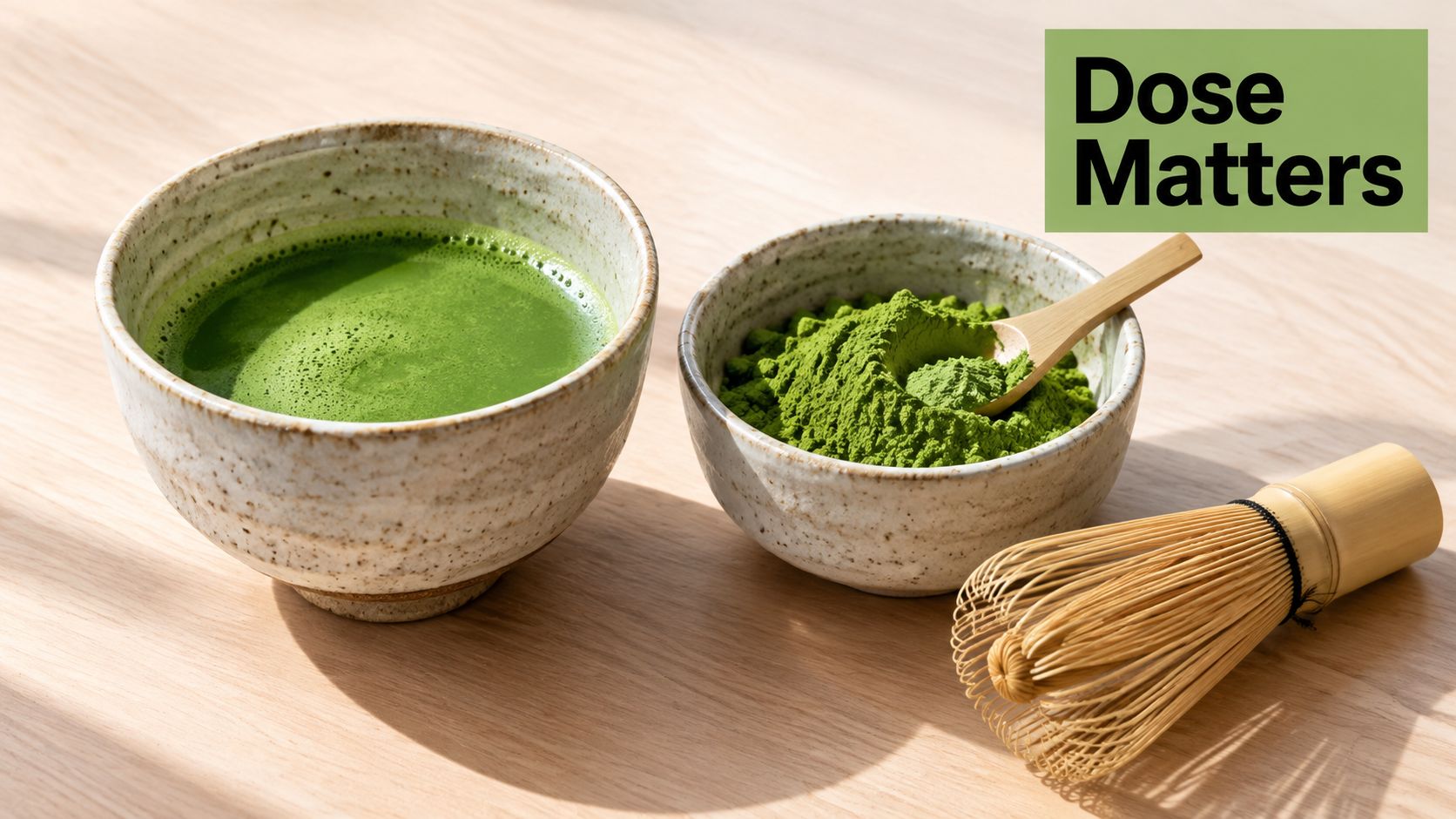
This is the point where looking at the powder itself is more informative than looking at the finished colour.
The Variables Behind Your Cup
- Powder amount: The clearest lever you can measure at home or ask about at a café.
- Number of servings whisked together: A double portion in one cup doubles down on the leaf material, even if the cup size barely changes.
- Dilution: Extra milk or water can make flavour seem milder without reducing the powder already added.
- Cultivar and harvest: Growing conditions influence the leaf before production, so powders aren't identical.
- Preparation conditions: Serving mass and method affect what you consume.
Food Standards Australia New Zealand reported Australian tea caffeine concentrations spanning approximately 0–90 mg per 100 g in FSANZ dietary intake assessment material. The lesson is practical rather than technical. Without knowing the recipe, you can't calculate an exact dose from taste, colour or whether the tin says ceremonial or culinary.
Grade names also cause confusion. Ceremonial and culinary describe intended uses and flavour profiles, they're not caffeine labels with a guaranteed figure. Ask your café how much powder goes into a regular and a large, and at home, use the same scoop for a week so your own routine becomes predictable. Predictability beats guessing by sip.
How Caffeine and L-Theanine Work Together
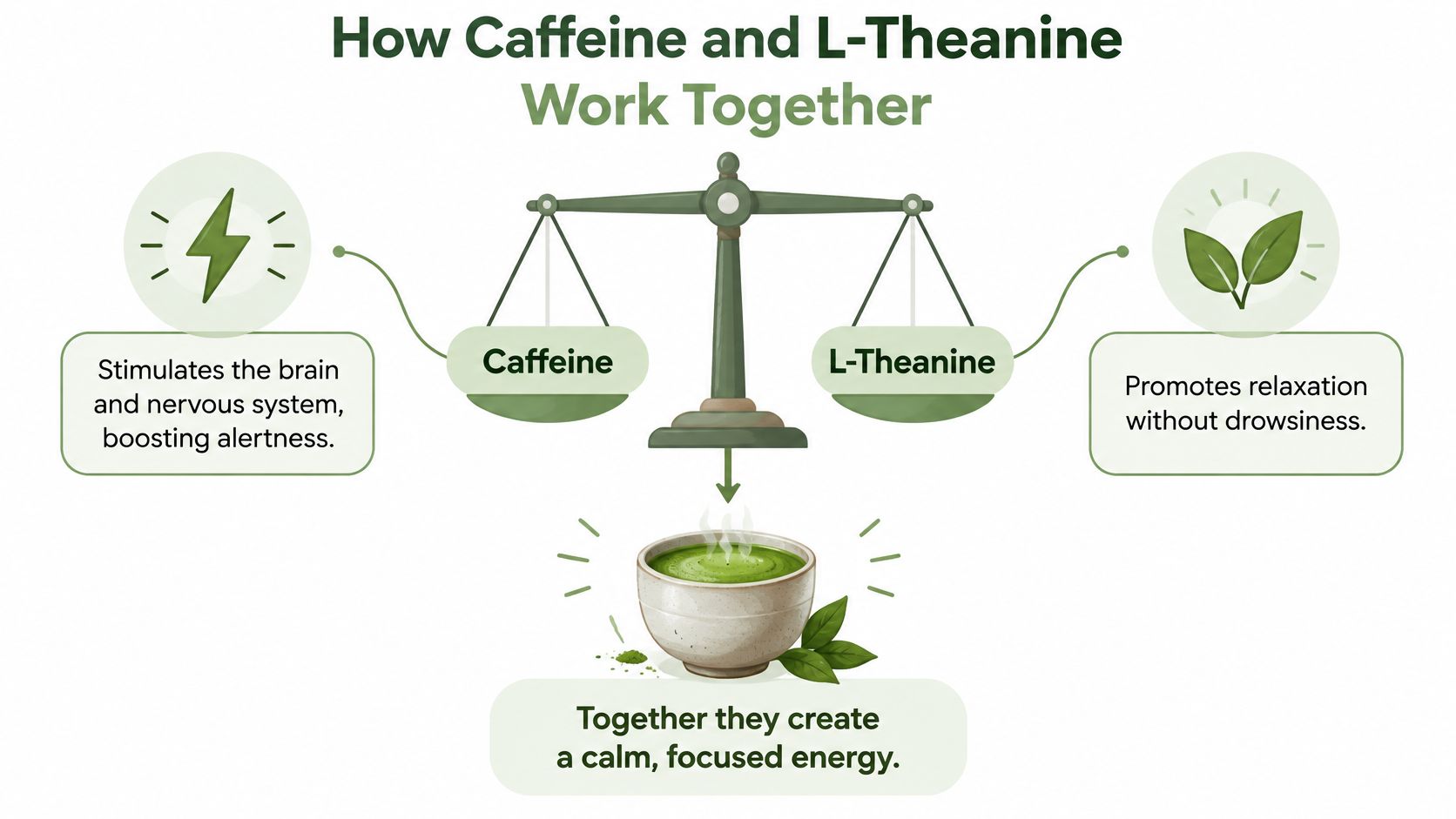
Matcha contains caffeine alongside L-theanine, an amino acid naturally present in tea. Healthdirect describes caffeine as a stimulant affecting the brain and nervous system in Healthdirect caffeine guidance for Australian consumers. That stimulant effect is the alertness side of the experience, while L-theanine is part of why drinkers often describe matcha differently from coffee alone.
This concept visual shows the pairing as a balance rather than a contest between stimulation and calm.
A Simple Balance Analogy
Picture caffeine as the accelerator and L-theanine as a steadier hand on the steering wheel. Many people describe the combination as calmer, smoother or more focused than coffee, but that description is an individual experience, not a guaranteed outcome. How much caffeine is present, when you drink it and how sensitive you are still matter.
For readers who want a plain explanation of the amino acid itself, our page on what L-theanine is and where it occurs gives useful background. A complementary consumer resource is NZ Supps on L-theanine, which discusses the common description of L-theanine smoothing the feel of caffeine. Treat those descriptions as context for the experience, not proof that the caffeine has disappeared.
The short video below is a helpful visual pause point before you think about your own response to a serving.
What Calm Focus Does Not Mean
L-theanine doesn't make matcha caffeine-free, and it doesn't neutralise caffeine in the cup. Someone who feels jittery after coffee may still react to a strong matcha, particularly on an empty stomach or after other caffeinated drinks. Someone else may feel steady after the same bowl.
Pay attention to your own pattern over several days rather than judging from one café order. Note the powder amount if you know it, the time of day and what else you'd consumed. That small record tells you more than a promise that matcha always feels calm.
A Practical Caffeine and Matcha Routine
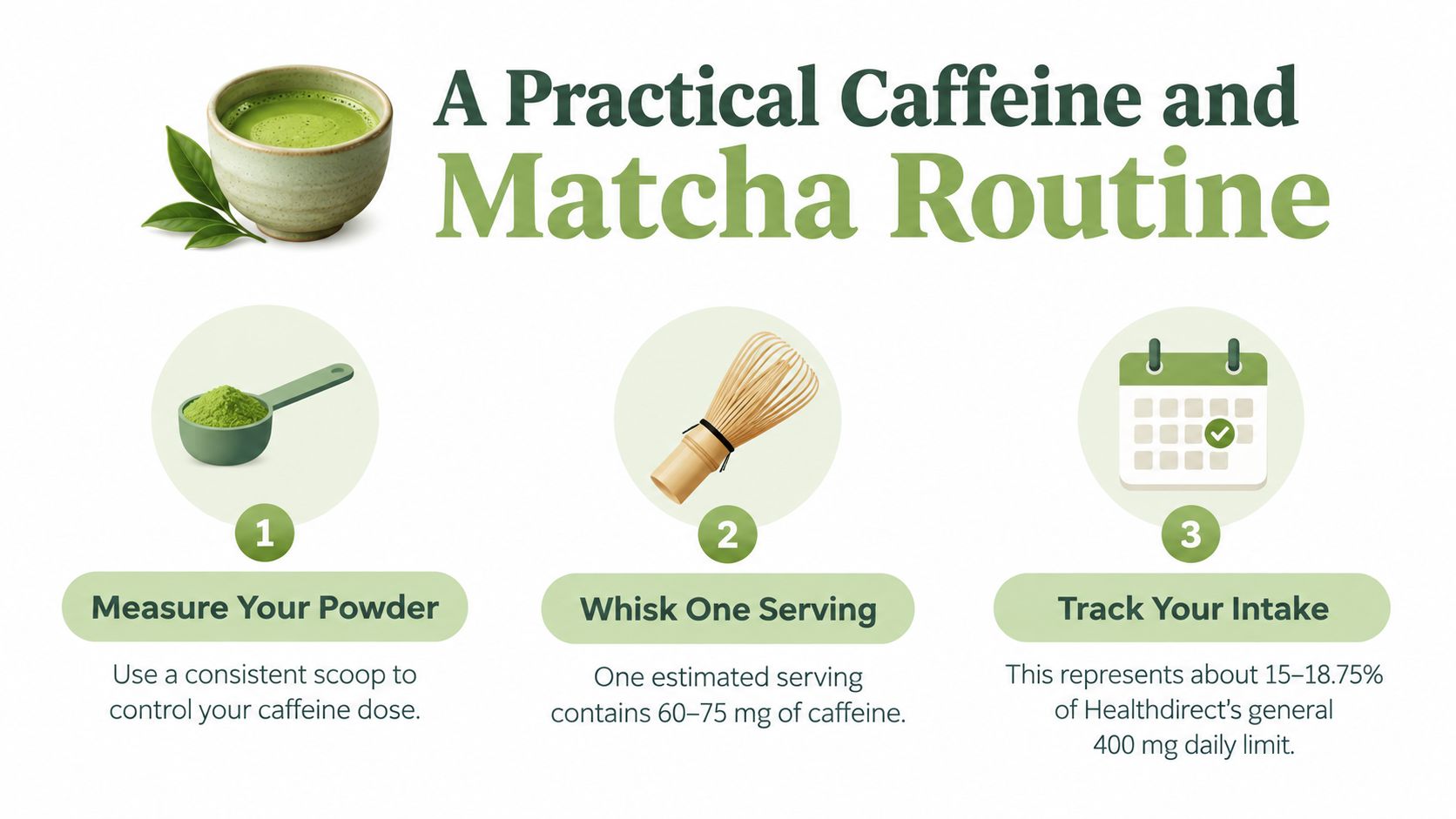
A routine works when you count matcha as part of your whole day, not as a separate wellness category. Using the Healthdirect reference discussed earlier, one estimated matcha serving represents about 15–18.75% of the 400 mg general daily amount for healthy adults. Two servings provide approximately 120–150 mg, or 30–37.5%, so the contribution grows quickly once coffee, black tea, cola, chocolate or energy drinks join the picture.
This routine visual reduces the maths to three habits you can repeat without turning breakfast into a spreadsheet exercise.
Build the Routine Around the Day
- Choose the moment first: Decide whether you want alertness for morning work, study or exercise, then place matcha there deliberately.
- Measure the powder: Use a consistent scoop at home, adjust gradually, and avoid changing powder amount and cup size on the same day.
- Add up other sources: Count the flat white, afternoon cola or chocolate alongside matcha instead of treating tea as an exception.
- Check your response: Note sleep, restlessness and focus, then reduce the powder or move the drink earlier if the pattern doesn't suit you.
Two Servings, Two Different Decisions
A lightly prepared home bowl may fit comfortably into a morning where you've had no coffee. A larger café latte, especially one made with extra powder, needs more deliberate accounting because the benchmark serving no longer describes it well. Four estimated servings could reach roughly 240–300 mg, leaving only 100–160 mg before the general adult benchmark, based on the Healthdirect reference already cited above.
Don't stack a large matcha automatically on top of another large caffeine source and call it gentle because it's green.
Timing is personal. Healthdirect notes individual responses depend on amount and timing, so a late afternoon matcha that suits one person may disturb another person's evening. Start with a measured morning serving, keep the rest of the day visible, and adjust from evidence about your own body rather than chasing a guaranteed energy curve.
Matcha Caffeine Safety for Sensitive Drinkers
Natural doesn't mean inactive. Caffeine from tea is still pharmacologically active caffeine, and Food Standards Australia New Zealand identifies it as naturally occurring in tea with a long history as a mild stimulant in FSANZ consumer guidance on caffeine. The plant origin explains where it comes from, it doesn't remove the need for moderation.
FSANZ also states there's no recognised health-based Acceptable Daily Intake for caffeine, while its expert review found evidence of increased anxiety in children at approximately 3 mg per kilogram of body weight per day, in the same consumer guidance linked above. That uncertainty is a reason to use ranges and context carefully, especially for children, adolescents, pregnant and lactating women and caffeine-sensitive consumers.
Australian Thresholds Worth Knowing
- Healthy adults: FSANZ consumer guidance sets intake at no more than 400 mg per day and no more than 200 mg in one serving, according to FSANZ guidance on caffeine powders and high caffeine foods.
- Pregnant and breastfeeding people: The same guidance advises staying at or below 200 mg per day.
- People under 18: FSANZ uses a single-serving threshold of no more than 3 mg per kilogram of body weight, illustrated as 120 mg for a 40 kg child.
A standard estimated serving would equal 1.5–1.875 mg/kg for a 40 kg child, based on the serving estimate used earlier, but a stronger preparation could approach or exceed that child's single-serving threshold. Child-sized on the menu refers to cup volume, not necessarily powder quantity. Parents and cafés should ask about the recipe rather than assuming a small green drink is low in caffeine.
Where Caution Belongs
If you're pregnant, our resource on matcha during pregnancy is a more specific starting point, alongside advice from your own clinician. People taking medicines affected by stimulants, adolescents and anyone who notices anxiety, sleep disruption or palpitations after caffeine should use more conservative, clinician-informed limits. General thresholds aren't personalised medical advice.
Energy drink rules shouldn't be used to guess a matcha dose either, since formulated caffeinated beverages have their own regulatory labelling framework. Ordinary tea products may not provide an equivalent per-serve figure on the pack. State the powder amount, count total exposure from all sources and don't imply that naturally occurring caffeine has no effect.
Choosing Matcha for Your Energy Routine
A good choice comes from answering three questions together. How much caffeine is your recipe likely to contain, what else have you consumed today, and how do you usually respond to caffeine? Those answers matter more than labelling matcha healthy or unsafe in the abstract.
A lighter serving may suit a gentler routine, particularly if you've already had coffee or you know late caffeine affects your sleep. A powder-heavy latte can still have a place, perhaps earlier in the day, but it deserves honest accounting. Pairing your drink with a satisfying breakfast is also sensible planning, and this guide on what to eat to avoid the crash offers food-focused ideas for steadier mornings.
Ceremonial and culinary aren't caffeine categories, and L-theanine doesn't remove the need for moderation. At Pep Tea, we supply premium Japanese organic matcha as one option for readers who want a measured home ritual and clear preparation at home. Choose the grade for its intended use, measure the powder for your needs, and let your own response guide whether matcha belongs in your morning, your pre-workout window or only occasionally.
If you'd like to put a measured matcha routine into practice, explore the organic matcha range and sugar-free organic kombucha brewed for Australian households and cafés at Pep Tea. You'll find Japanese matcha for whisking, lattes and baking, plus education to help you prepare each serving with confidence.