
Tag: matcha overnight oats
Matcha Overnight Oats: A Simple Recipe for Busy Mornings
Most weekday mornings I'm at the fridge at ten past seven with wet hair and no plan, and the jar I made the night before is the reason breakfast still happens. It's cold, thick and pale green, and it takes less time to eat than the kettle takes to boil. The whole thing cost me about five minutes the evening before, which is the only reason the habit has stuck for years.
Matcha overnight oats are rolled oats soaked with milk, yoghurt and a small measure of ground green tea until the oats soften and the jar sets. Get the ratios right and it's a proper breakfast. Get them wrong and you're eating grassy wallpaper paste. Here's the version I make, and the mistakes I've made enough times to recognise.
Matcha Overnight Oats Recipe at a Glance
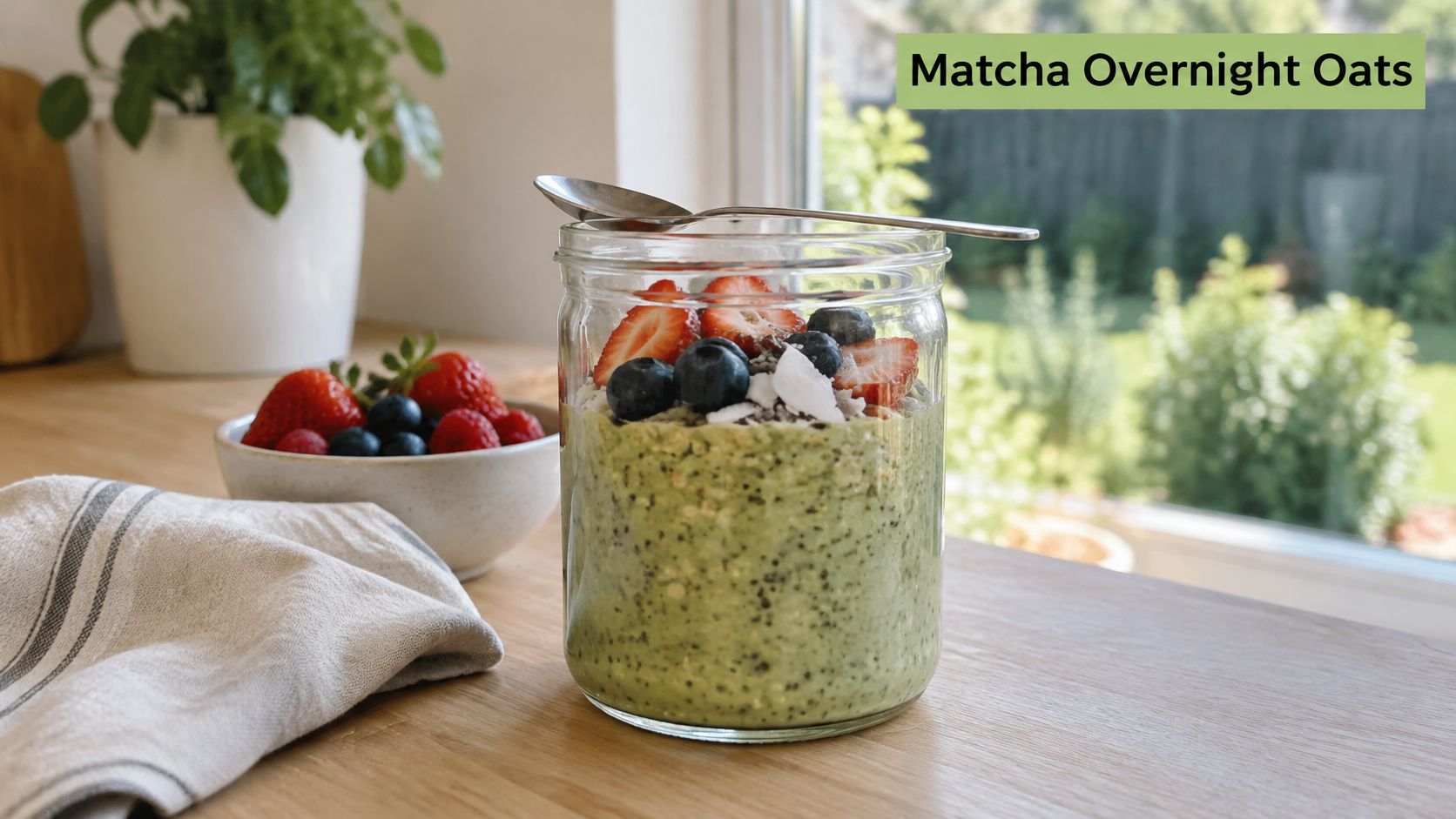
A finished jar should look like this: thick enough to hold a spoon upright for a second, an even pale green from top to bottom, and no dry oat flakes clinging to the glass.
The format has moved well past café menus. Matcha logging by Australian MyFitnessPal users rose 33.8% from 2024 to 2025, according to MyFitnessPal user data reported by Melbourne Insider, which explains why so many home cooks are suddenly trying to work out what the correct powder-to-oats ratio is.
The base quantities for one serving
| Ingredient | Quantity per serving | Role in the jar |
|---|---|---|
| Rolled oats | 50 g | Body, fibre and bulk |
| Milk or unsweetened soy milk | 120 ml | Liquid that softens the oats overnight |
| Greek-style yoghurt | 60 g | Protein and creamy texture |
| Culinary-grade matcha | 1 to 1.5 tsp | Colour and earthy flavour |
| Chia seeds | 1 tbsp (about 12 g) | Thickens the mixture and adds fibre |
| Honey or maple syrup | 0 to 1 tsp | Optional sweetness |
Culinary-grade matcha is the right choice here, not a compromise. It's blended to hold its flavour against milk and oats, where a delicate ceremonial powder gets buried under dairy and disappears. Start at 1 teaspoon and treat the extra half teaspoon as an adjustment for the second batch, once you know how strong you like it.
The ratios above are a starting point, not a rulebook. A 50 g scoop of oats to 120 ml of liquid with 60 g of yoghurt gives a jar you can eat with a spoon rather than drink. Total time is about 5 minutes of hands-on work and at least 6 hours in the fridge, which is why the night before is the only realistic window.
How to Make Matcha Overnight Oats Step by Step
The order matters more than the ingredients list. Most of the batches people describe as failures go wrong at step two.
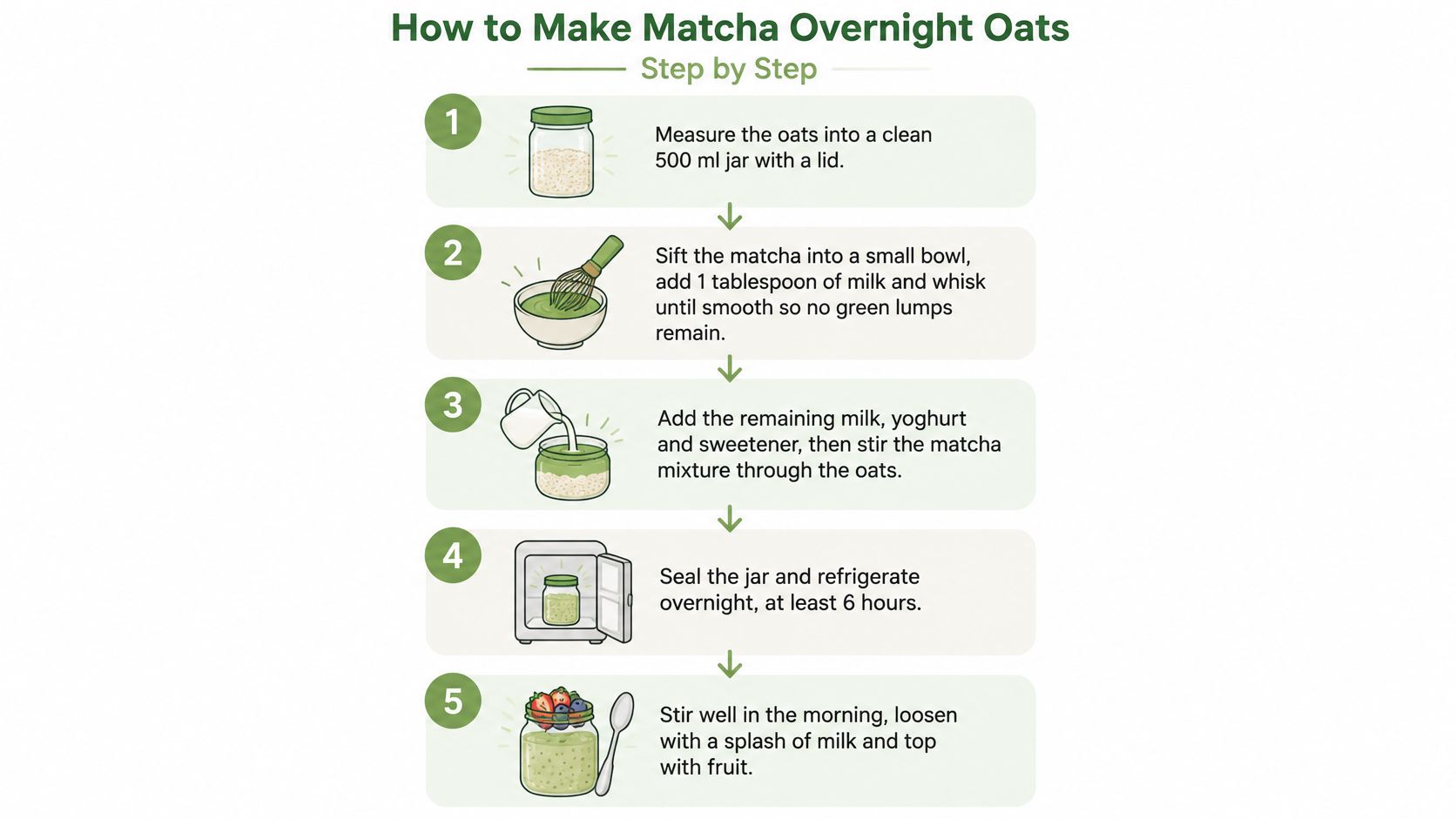
- Measure the oats into a clean 500 ml jar with a lid. Fifty grams fills roughly a third of the jar and leaves room for the liquid to swell into. A jar that's too full is hard to stir, and unstirred oats stay dry at the bottom.
- Sift the matcha into a small bowl, then whisk in 1 tablespoon of the milk. The powder clumps when it hits liquid, and those clumps survive overnight soaking. Whisking it into a smooth paste first is the single change that stops green lumps floating on top of tomorrow's breakfast.
- Add the remaining milk, the yoghurt and the chia seeds to the jar. Then pour the matcha paste in. Adding it last means it disperses through the jar rather than sitting in a concentrated layer.
- Stir for about 30 seconds, until no dry powder or oat patches remain. Scrape the bottom corners with the spoon. Add honey or maple syrup now if you want it, and taste the liquid before it thickens, because that's your only easy chance to adjust.
- Press the oats under the liquid, seal the lid and refrigerate for at least 6 hours. Overnight is simplest. Any oat sitting above the surface stays hard and chalky, so push everything down.
- Stir again before eating and loosen with a splash of milk if it has set too firm. Chia keeps thickening as it sits, so a jar on day two will be stiffer than the same jar on day one.
Why cold milk works here
A traditional bowl of matcha is whisked with hot water because heat releases the aroma and dissolves the powder. Overnight oats break that rule on purpose. You're not brewing the tea, you're eating the leaf, and cold milk with a good whisk does the same dispersing job without cooking the oats or wilting the flavour.
Practical rule: whisk the matcha with liquid in a separate bowl every single time. It takes fifteen seconds and it's the difference between a smooth green jar and one with bitter specks in it.
Top the jar just before serving, not the night before. Berries bleed, nuts go soft and coconut turns to paste after a night in the fridge. Add them at the table and the texture contrast survives.
Choosing Oats, Milk and Matcha for Your Jar
Texture lives or dies on the oat. Use traditional rolled oats, not instant. Instant oats collapse into a gluey porridge within a couple of hours, and the chew that makes the jar worth eating goes with them. Steel-cut oats are a different recipe entirely: they need a longer soak and a noticeably higher liquid ratio, so swapping them into these quantities gives you a jar of gravel by morning.
Milk, dairy or soy
Dairy milk gives the creamiest set and sits well beside the yoghurt. Unsweetened soy milk adds protein and keeps the jar workable for a dairy-free household. Skip the sweetened plant milks, the ones listing vanilla or added sugar, because they pour sugar into the breakfast before a single topping arrives. The word you want on the carton is "unsweetened", and it's worth checking, since plenty of default soy and almond milks are sweetened without advertising it on the front.
Which grade of matcha belongs in a jar
Matcha is the whole tea leaf, ground fine and eaten rather than steeped and discarded, which is why a small measure flavours the entire jar. Only 1/2 tsp brews a traditional cup, so the teaspoon in this recipe is already generous. Culinary grades are built for milk, baking and blending, and that's the grade I reach for here. Ceremonial powders are better saved for drinking, where their subtler flavour isn't buried under oats and yoghurt. For the fuller picture on how the grades differ in flavour and price, our guide to choosing between ceremonial and culinary matcha covers it properly.
Fibre and the wholegrain case for oats
Fibre is where this breakfast earns its place. Healthdirect's guide to high-fibre foods puts the daily target at 25 g for females and 30 g for males, names oats among the sources of soluble fibre, and counts fruit, seeds and nuts toward the total. What a single jar contributes depends on portion size and ingredients, so treat any recipe claiming a fixed percentage of your day with care unless someone calculated it from the exact quantities.
The Australian Dietary Guidelines recommend adults eat around 4 to 6 serves of grain foods a day, with most of them wholegrain or high-fibre. A rolled-oat base is one of the simplest ways to put a wholegrain serve on the board before mid-morning.
Oats alone don't balance the jar, though. The yoghurt and milk carry the protein, the chia and fruit carry most of the fibre, and the matcha contributes flavour and colour more than nutrition at a teaspoon. If you're tracking how breakfast fits the rest of your day, how many calories in everyday foods is a sensible reference before nut butter and honey start going in.
Flavour Variations and Serving Ideas
Once the base is reliable, change one thing at a time so you learn what each addition does.
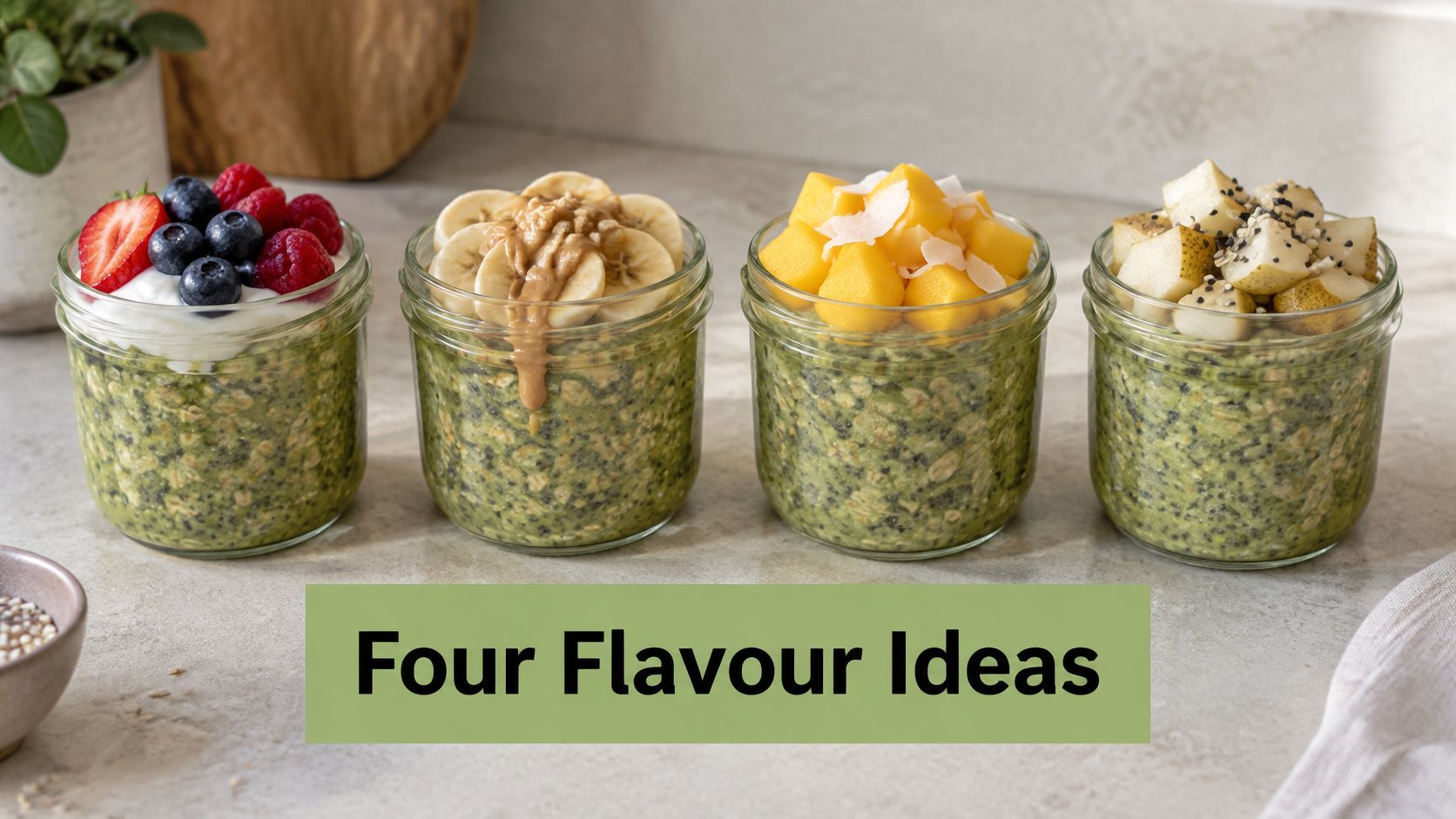
| Variation | Addition per serving | What it changes |
|---|---|---|
| Berry and yoghurt | 60 g mixed berries | Natural sweetness and extra fibre |
| Banana and almond | 1/2 banana mashed, 1 tbsp almond butter | Creamier texture and steady energy |
| Mango and coconut | 60 g diced mango, 1 tbsp unsweetened desiccated coconut | Tropical flavour without added sugar |
| Pear and sesame | 1/2 pear grated, 1 tsp toasted sesame seeds | Earthy notes that pair with matcha |
| Protein boost | 1 extra tbsp Greek-style yoghurt | Higher protein and a thicker jar |
The mashed banana version is the one I make most in winter, because it sweetens the jar without syrup and thickens the set. Grated pear is the sleeper: it's watery enough to loosen a stiff jar and its grain-like texture suits the tea. Mango needs to go in at the table, not overnight, or it dulls the green colour.
The sugar trade-off
Healthdirect groups traditional oats with steel-cut oats and oat bran as a lower-glycaemic-index breakfast cereal choice, while many highly processed cereals sit in the higher-GI group, as its glycaemic index guide sets out. That's a reason to keep rolled oats as the base rather than assuming every oat product behaves the same. The same guide notes that GI is influenced by the food itself and by preparation, so sweeteners, flavoured yoghurt and carbohydrate-rich toppings change the profile of the finished serving.
In practice that means three habits. Use whole fruit for sweetness, use plain yoghurt rather than the flavoured tubs, and cap the honey at one teaspoon. A jar with two teaspoons of syrup, vanilla yoghurt and sweetened almond milk is a dessert with oats in it.
For serving, spoon the mixture into a glass and layer it with extra yoghurt and fruit, scatter crushed pistachios or toasted coconut for crunch, or put a small matcha latte alongside for a café-style plate. If you want a crunch element that keeps, our matcha granola recipe makes a topping that holds its texture.
Try one variation for a full week before changing the base again. Otherwise, you never learn which change you liked.
Fixing Common Matcha Overnight Oats Problems
Bitterness is the complaint I hear most, and it's almost always a quantity problem rather than a bad tin of powder. Matcha carries catechins that read as pleasantly astringent at a teaspoon and aggressively grassy at three. Over-measuring is easy to do with a heaped spoon and hard to undo once the jar has set.
| Symptom | Likely cause | Fix |
|---|---|---|
| Bitter or grassy taste | Too much matcha or powder not sifted | Use 1 tsp next time and add a little more only if mild |
| Green clumps on top | Matcha added dry without whisking | Whisk the matcha with 1 tbsp milk before adding |
| Runny, watery jar | Too much liquid or coarse oats | Reduce milk by 20 ml and stir in an extra spoon of chia |
| Gummy or slimy texture | Instant oats or too little liquid | Use rolled oats and add a splash of milk |
| Dull or greyish colour | Matcha stored in light, heat or air | Store the tin sealed, cool and away from light |
| Sour or off smell | Eaten after the safe storage window | Discard and make a fresh jar |
What you can fix tomorrow and what you can't
Thickness is forgiving. A splash of milk loosens an over-set jar and an extra spoon of chia stirred in at breakfast will tighten a runny one within twenty minutes, though it won't be as smooth as a batch that was right from the start.
Bitterness is not forgiving. Once the powder is in, there's no reliable way to take it out, and adding honey only masks it for the first few spoonfuls. If the flavour is too strong, mark the jar down as a learning batch and drop to a level teaspoon next time.
Clumps are preventable but not fixable. A dry spoonful of powder dumped straight onto wet oats will sit there, and no amount of stirring at breakfast breaks it up properly. If you keep getting a grassy aftertaste rather than a bitter one, our notes on how to make matcha not taste like grass go through the other causes, from water temperature to leaf quality.
Start at one teaspoon. Add half a teaspoon only when the finished jar tastes too mild, and note what you did. The matcha quantity is the easiest variable in the whole recipe to control, and the one most people change too early.
Storage, Safety and Your Weekly Routine
This jar contains milk and yoghurt, which makes it a perishable food rather than a shelf-stable one. Australian health guidance is specific: perishable food should be refrigerated at or below 5°C as soon as possible, and food held in the 5°C to 60°C temperature danger zone can allow bacteria to grow to unsafe levels, as Healthdirect's food safety guidance sets out. The same guidance advises that refrigerated fresh perishables should generally be used within 2 to 3 days.
The chill window is part of the recipe
Leaving the jar on the bench overnight is not a shortcut, it's a food safety failure with a pleasant name. Assemble it, seal it, and put it in the fridge within the time it takes to wipe the bench. Keep it at the back of the shelf where the temperature is steadiest rather than in the door, which swings warm every time someone looks for the milk.
Fruit behaves differently depending on when it goes in. Banana and berries soften and discolour overnight, so add them in the morning. Grated pear and chia can go in at the start because they're part of the set.
The rule I don't bend: if a jar's lid comes off and the smell is sharp or the surface looks glossy in a way it didn't yesterday, it goes in the bin. There's no partial rescue for dairy that's turned.
Build the week around two jars
The routine that survives real life is a Sunday jar and a Wednesday jar, each eaten within three days. That covers four breakfasts if you stretch a large batch across two containers, and it means nothing sits past its window.
Anything older than three days gets thrown out, even if it looks fine. Wasting half a jar of oats costs less than a day off work.
What to keep in the pantry
One tin of culinary-grade matcha, sealed, kept cool and away from light, is all the oats need. Light, heat and air turn the powder dull and grey long before the date on the tin, which is why small packs beat bulk buying if you only use a teaspoon a day. Our Premium 100g organic matcha is a culinary grade blended for cooking from autumn crops, and it's the one I'd keep for jars and baking. For a daily whisked cup, the Matcha Supreme 30g pack is our finest ceremonial grade. All of our matcha powders are certified organic.
That's the whole system: one base recipe, one powder, two jars a week. It isn't a wellness programme. It's a breakfast that's already made when the morning gets away from you.
Pep Tea supplies certified organic Japanese matcha from the Kagoshima, Kyoto and Mie plantations of southern Japan, including culinary grades built for jars like this one and ceremonial grades for a proper whisked cup. If you've been making do with whatever green powder was in the cupboard, start with a grade that's meant for the job and you'll taste the difference in the first batch. Explore the range and see the grades side by side at Pep Tea.