
Tag: matcha brewing temperature
Matcha Brewing Temperature: The Complete Guide 2026
Matcha brewing temperature is the detail that most often separates a smooth, savoury cup from one that tastes harsh and grassy. The popular advice to “just use hot water” sounds harmless, but freshly boiled water can overpower the powder before you have a chance to appreciate its sweetness, aroma and umami.
For Australian matcha drinkers, a practical starting point is 70–80°C, with 75°C as a useful default. Australian brewing guidance consistently warns against boiling water, while local brands commonly position 70–80°C as the working range for matcha service and recipe education (Pure Matcha Australia's brewing guide, Hello Matcha Australia's temperature guide). The best target still depends on your matcha grade, whether you're making usucha or a latte, and the mineral character of your water.
The One Rule Most Matcha Drinkers Get Wrong
The rule is not “use hot water.” It is “choose heat for the matcha in front of you.” Near-boiling water is a common kettle habit, but matcha responds differently from loose-leaf tea because the finely ground leaf remains suspended in the cup.
For a practical Australian starting point, keep the water within 70–80°C. Around 75°C often gives a balanced result, while water above 80°C can bring bitter, drying notes forward quickly. The Hello Matcha Australia guide and Matcha What's temperature guide both place matcha brewing in this moderate range.
Practical rule: If your matcha tastes aggressively bitter, adjust the water temperature before blaming the powder.
Lower heat suits delicate ceremonial matcha, especially when you are drinking it straight and want its sweetness and umami to remain clear. A latte or culinary preparation may need slightly more heat, or a stronger brew, so the matcha remains noticeable beside milk and other ingredients. Iced matcha also changes the balance because cold water and ice soften aroma and intensity.
Water chemistry belongs in the decision too. Hard, highly mineralised water can make the cup feel heavier or more astringent. Balanced filtered water often gives the powder a cleaner platform, although extremely soft water may produce a thinner impression.
Use this order when choosing a temperature:
- Grade: delicate ceremonial matcha generally rewards gentler heat; culinary matcha can tolerate more.
- Format: straight whisked matcha, thick matcha, lattes and iced drinks need different levels of intensity.
- Water: mineral content can change perceived bitterness, texture and finish.
The detail many casual guides skip is the catechin extraction window. Above the ideal range, bitter catechins move into the water faster than the compounds that make matcha taste sweet and mellow. Temperature therefore becomes a control, not a vague warning to avoid boiling water. Set it according to grade, format and water, then adjust by taste.
Why Temperature Changes the Way Matcha Tastes
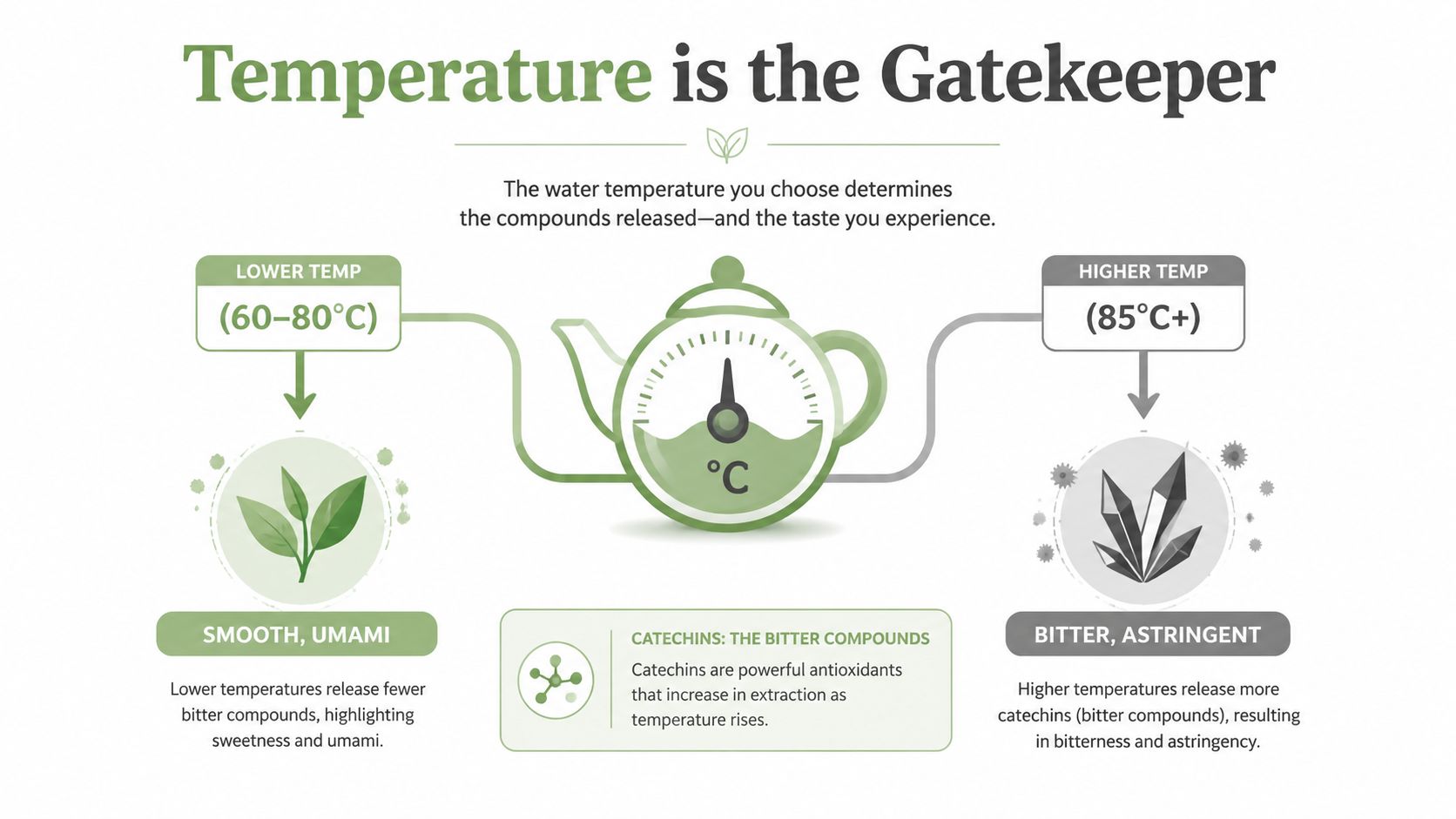
Think of the matcha powder as a small kitchen with two groups of cooks. The L-theanine and other amino acids are the gentle chefs, bringing sweetness, savoury depth and a calm, rounded character. Catechins are more like impatient outsiders. They rush into the water when the heat rises and can make the drink taste bitter and drying before the softer flavours have time to balance it.
That analogy explains the central brewing principle. Moderate warmth encourages a smoother balance, while higher heat favours faster extraction of bitter catechins. A matcha temperature guide identifies the region above 80°C as the point where catechins extract faster than amino acids, and describes 70–80°C, with 75°C as a default, as a useful balance for flavour and foam formation (Matcha What).
Matcha extracts differently from loose-leaf tea
Loose-leaf tea spends time in water before you strain the leaves. Matcha is already ground, so whisking disperses the particles almost immediately. You're not waiting for water to travel into an intact leaf. You're choosing how forcefully the water draws compounds from a fine powder that remains in the drink.
That's why temperature is such a powerful dial. A long wait won't rescue water that's too hot, and fast whisking won't remove bitterness that high heat has already extracted. Whisking controls suspension and foam. Temperature controls the balance of what comes out first and what becomes dominant.
The practical takeaway
Lower heat tends to preserve sweetness, aroma and umami. Higher heat can create a stronger, more forceful cup, but it also raises the risk of astringency. Australian guidance has settled around 70–80°C because that range gives cafés, retailers and home brewers a repeatable starting point without treating every matcha drink as identical.
The Matcha Temperature Spectrum From 60°C to 85°C
Temperature works best as a decision tool, not a rule to memorise. Start with the matcha's grade, then consider whether you are drinking it straight, whisking a thicker bowl, or adding milk. Water chemistry can shift the result as well.
| Temperature | Dominant flavour | Mouthfeel | Best use |
|---|---|---|---|
| 60–65°C | Gentle sweetness and fresh umami | Soft, delicate and restrained | Delicate ceremonial matcha or a cold-leaning straight drink |
| 65–70°C | Sweet, aromatic and lightly savoury | Smooth with a fine body | Everyday ceremonial usucha |
| 70–80°C | Balanced umami with fuller flavour | Creamier and more rounded | Daily premium matcha, most straight cups and lattes |
| 80–85°C | Bold, deeper and more noticeably astringent | Stronger, firmer and less forgiving | Culinary use or a thick milk-based drink |
The lower bands
Choose 60–65°C when the matcha is delicate and you want freshness, sweetness and umami to lead. The cooler water draws flavour more gently, making it useful for a cold-leaning straight drink too. Dispersion will be slower, so whisk patiently and expect a lighter cup.
At 65–70°C, aroma becomes clearer while the texture remains soft. This is a reliable starting band for ceremonial usucha, especially when the powder is sweet and finely aromatic.
Temperature also affects the catechin extraction window. Cooler water slows the release of these compounds, while hotter water draws them out more quickly. That matters because catechins contribute structure and astringency. Staying in the lower bands gives sweetness and amino-acid richness more room to appear before those firmer notes dominate.
The everyday range
Use 70–80°C for premium matcha that needs more body, a regular straight cup, or a latte base that must remain noticeable beside milk. Begin near the lower end for a delicate powder. Move higher when the flavour feels thin, the drink contains milk, or the matcha is intended for a stronger recipe.
Water can change the result even when the thermometer reading is identical. Strongly mineralised tap water may make the cup taste dull or harder, while filtered water can produce a cleaner impression. The Water Filter Advisor tips provide a practical starting point for assessing household water quality.
The upper boundary
Reserve 80–85°C for culinary matcha, bold recipes and thick milk-based drinks. The added heat produces a firmer, more forceful profile, but it gives delicate straight matcha less room for sweetness and aroma.
Above 85°C, treat the water as too hot for routine brewing. Cool it before whisking. If the cup already tastes sharp, lowering temperature is usually the fastest correction.
Matching Temperature to Matcha Grade and Drink Style
適合的抹茶沖泡溫度,取決於茶粉等級、飲用方式,以及其他材料的味道強度。單獨飲用的 ceremonial matcha 幾乎沒有其他味道遮掩苦味;加入牛奶、水果或甜味劑的 culinary matcha,則需要更有存在感的茶湯。先依格式選擇,再按水質和口感微調。想了解不同等級的特性,可參考 Pep Tea's guide to different grades of matcha。
| Matcha grade | Usucha, thin tea | Koicha, thick tea | Latte or milk drink | Iced or cold brew |
|---|---|---|---|---|
| Ceremonial | 65–75°C | 60–70°C | 70–75°C base | Cool or room-temperature water |
| Premium | 70–75°C | 65–70°C | 70–80°C base | Cool or room-temperature water |
| Culinary | 75–80°C | Not usually the first choice | 80–82°C | Cool or room-temperature water |
| Latte blend | Not usually used alone | Not usually used alone | 82–85°C | Follow the blend's instructions |
Ceremonial matcha
Ceremonial matcha 通常在 65–75°C 最能展現甜味、香氣和鮮味。較低的溫度會放慢兒茶素釋放,讓甜感和胺基酸風味先出現,減少澀味過早主導。Usucha 使用適量茶粉和溫水,重點是打出均勻懸浮的茶液,不必追求大量泡沫。
Koicha 的茶粉比例較高,濃稠度會放大每個味道,因此適合使用 60–70°C 的溫水。以慢慢推揉的方式混合,讓茶液變得順滑,不要像 Usucha 一樣用力打出輕盈泡沫。
Premium matcha
Premium matcha 適合日常清飲,也能支撐拿鐵。單獨飲用時,可從 70–75°C 開始。若加入牛奶後味道變薄,再在這個範圍內提高溫度,讓抹茶保留較清楚的輪廓。
Culinary matcha and latte blends
Culinary matcha 的設計,是在其他材料中仍維持明顯茶味。製作牛奶飲品時,80–82°C 能帶出較強的茶底,牛奶或植物奶則會柔化澀感。Latte blend 若本身風味較集中,可使用 82–85°C,但仍應低於沸點,避免香氣變得粗硬。
冰抹茶的重點不是直接把熱水溫度調低,而是改變混合方法。可用少量冷水或室溫水先將茶粉拌開,再放入密封罐搖勻;也可先製作溫熱濃縮茶液,冷卻後加入冰塊。水質也會改變結果,礦物質較多的水可能令茶湯顯得沉重,過濾水通常能呈現較清晰的味道。
How to Hit the Right Temperature at Home Every Time
You don't need a specialist tea setup to control your matcha brewing temperature. You need a repeatable method and a little consistency. Rank your options by precision, then choose the one you'll use.
Start with boil and rest
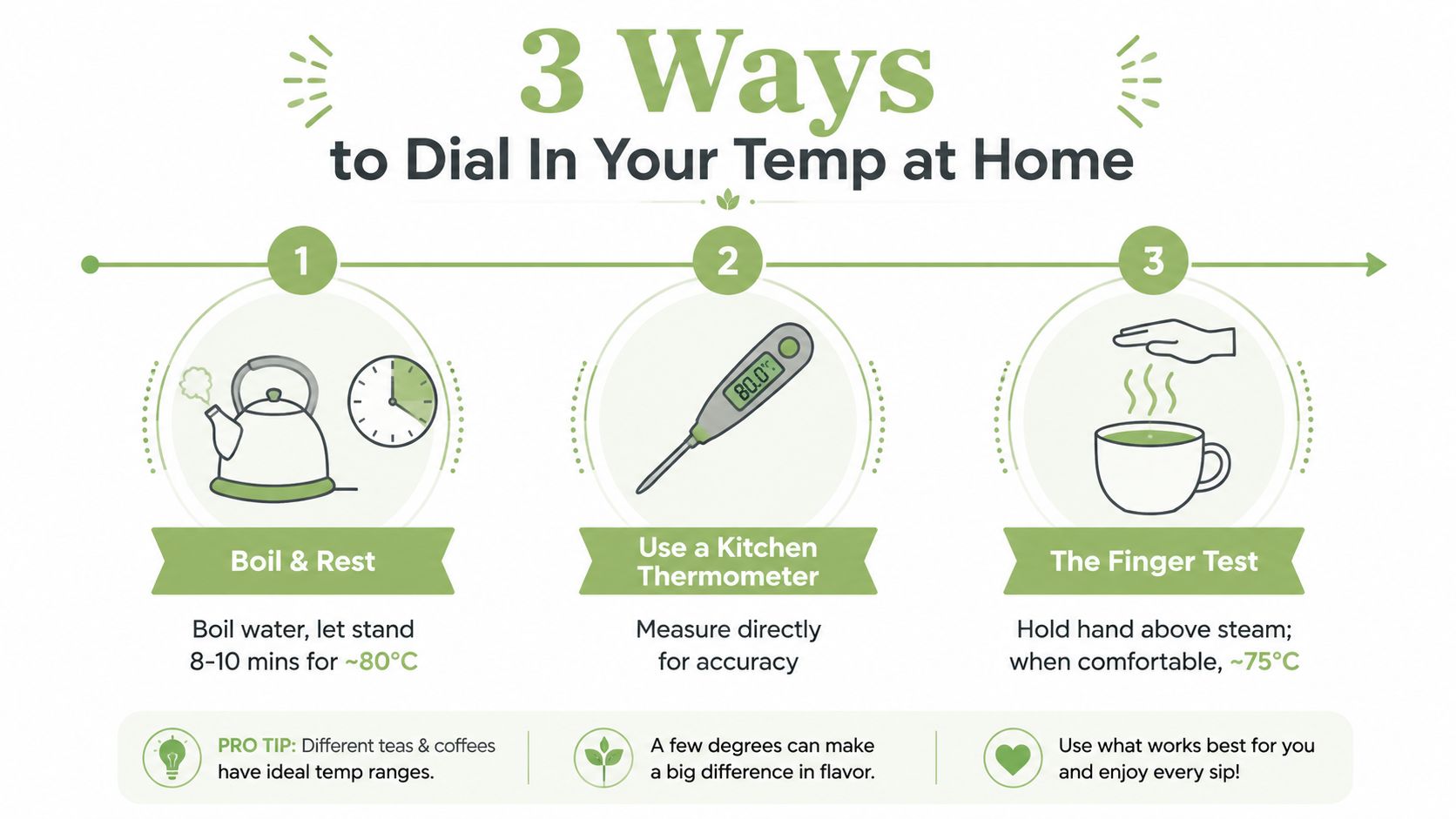
The simplest approach is to boil the water, remove it from the heat and let it cool before pouring. For a practical home routine, time the rest with your phone rather than guessing:
- For about 80°C: let boiled water stand for roughly 8–10 minutes.
- For about 75°C: let it stand for roughly 12 minutes.
- For about 70°C: let it stand for roughly 15 minutes.
These timings are a starting point, not a laboratory guarantee. A small uncovered cup cools faster than a full kettle, and room temperature, vessel shape and altitude can all change the result. If you use the same kettle and cup each day, your timing will become more reliable.
Use direct temperature control
A temperature-controlled kettle is the easiest repeatable option. Set it to your target, then pour into a pre-warmed bowl. A kettle such as the Pep Tea electric tea kettle with temperature control can make this process more straightforward for anyone who prepares matcha regularly.
A kitchen thermometer works too. Measure the water in the vessel you'll pour from, because transferring it between containers changes the temperature. You can also use a thermometer to calibrate your boil-and-rest routine, then return to the timer once you know how your equipment behaves.
Mix hot and cool water
When you don't have a thermometer, mixing boiled water with cool water can bring the blend near the lower end of the useful range. A rough 1:2 or 1:3 ratio of boiling water to cool water can land near 70°C, depending on the starting temperatures and the size of each pour. Add the hot water first, then the cool water, and keep the ratio consistent.
Pre-warm your bowl before whisking. A cold ceramic bowl can pull heat from the brew as soon as the water touches it, so swirl warm water around the bowl, discard it, and dry the inside. Finally, sift the powder and whisk promptly. Temperature control works best when clumps aren't slowing down dispersion.
What Happens When You Brew Too Hot or Too Cold
Water near 85°C can make a matcha latte look bright while leaving the base flat, astringent and sharply green. Milk rounds off some of those edges, yet it cannot fully restore aroma or sweetness once excessive heat has overwhelmed them.
The same powder prepared around 65°C usually gives a rounder, gently sweet cup, with savoury depth that may recall seaweed or broth. Lower heat does not automatically make matcha weak. It slows extraction enough to keep the flavour balanced.
Why the two cups diverge
Temperature changes the order in which compounds move into the water. Above 80°C, catechins extract faster than amino acids, so bitterness and astringency can take the lead, particularly when you drink the matcha without milk. The 70–80°C range is a useful starting point for a balanced cup, but the right choice still depends on the powder, format and water.
A very cool brew creates a different issue. The powder disperses slowly, leaving clumps and visible specks that hold back flavour. Cold matcha can still taste pleasant and refreshing, but thorough shaking or whisking becomes more important, and the result will not resemble a warm bowl.
The catechin window matters when choosing your correction. If heat has pushed bitterness forward, lowering the temperature protects the sweeter, savoury balance. If a cold preparation feels uneven, improve dispersion before assuming the powder needs more heat.
Diagnose the cup before changing the powder
Harsh flavour calls for cooler water first. Thin texture or stubborn clumps point to better sifting and whisking before a large temperature increase. A muted latte usually needs a more concentrated base or a matcha made for milk, not boiling water. Small changes reveal whether temperature, technique or drink style is responsible.
Common Matcha Temperature Myths Worth Forgetting
Myth one, boiling water is fine if you whisk fast
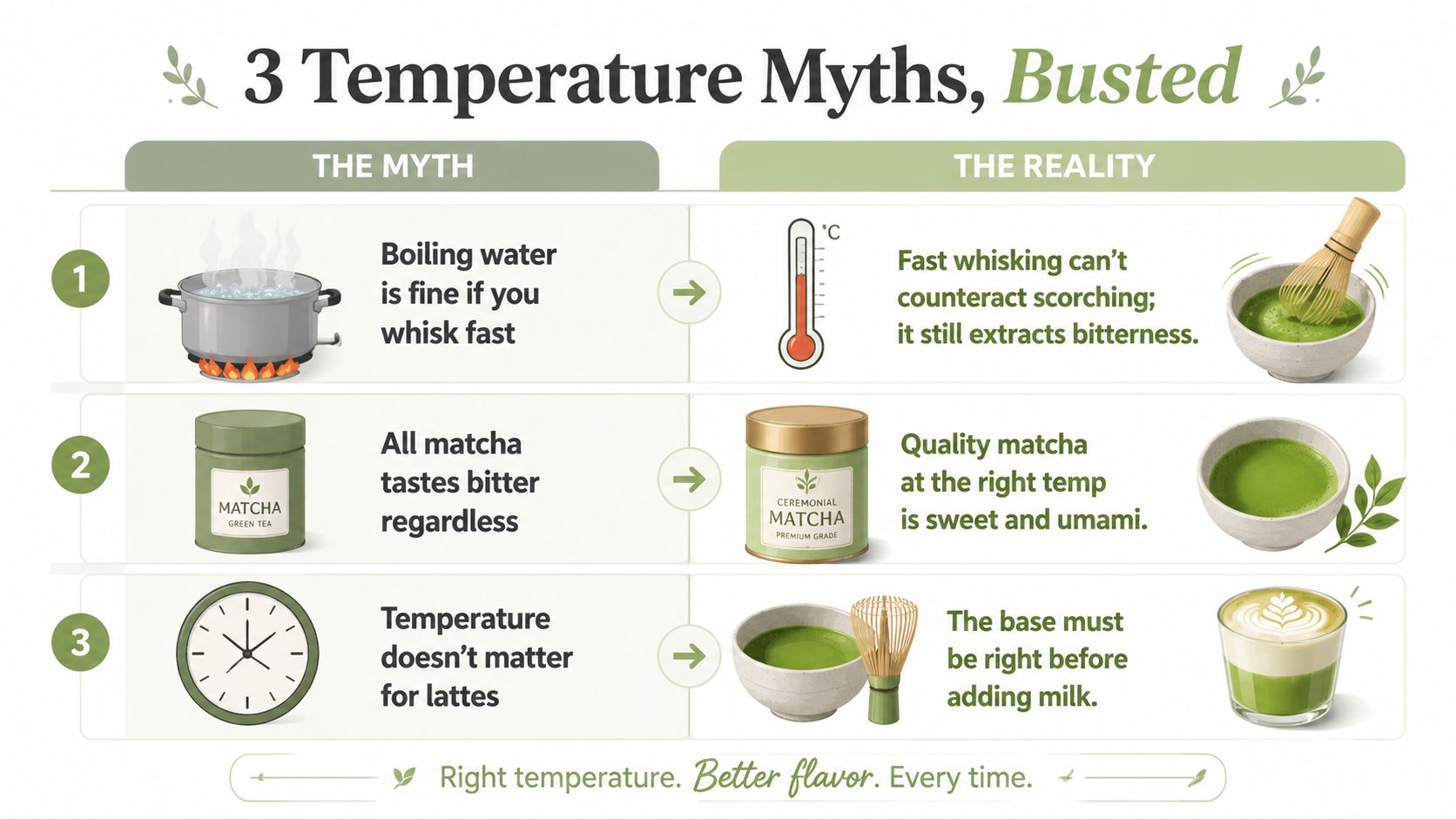
Fast whisking can break up clumps and create foam, but it can't reverse what very hot water has already extracted. Australian guidance repeatedly keeps matcha below boiling and generally within 70–80°C, because warmer water tends to increase bitterness while cooler water preserves smoothness (Pure Matcha Australia).
Letting the water cool is the better correction. Whisk with energy, but treat the whisk as a tool for suspension, not a way to cancel excessive heat.
Myth two, all matcha tastes bitter
Bitterness is not automatically a sign that matcha is poor quality. It can come from water that's too hot, a powder that has clumped, or a drink ratio that concentrates more powder than the water and milk can balance.
Prepare a fresh sample at a gentler temperature, sift it and whisk it thoroughly. If the flavour becomes sweeter and more savoury, your original problem was probably preparation rather than an unavoidable characteristic of matcha.
Myth three, cold brew extracts nothing worthwhile
Cold matcha can produce a smooth, refreshing drink with attractive colour and a gentler flavour. It's a different preparation, not a failed hot brew. Cold water changes how quickly compounds disperse and extract, so shaking or blending matters more than leaving powder in a glass.
For an iced drink, make a smooth cold base first, then add chilled water, ice or milk. Don't assume that a drink must be hot to be enjoyable. Test these assumptions in your own kitchen and keep the settings that suit your palate.
Your Quick Reference and Where to Brew Better Matcha
The right temperature is a decision, not a fixed rule. Use the table as a starting point, then adjust for matcha grade, drink format, water and flavour. A repeatable 75°C bowl is more useful than chasing a setting you cannot reproduce.
| Matcha grade or drink style | Target temperature |
|---|---|
| Cold-extracted drink | 60–65°C |
| Ceremonial matcha | 70–75°C |
| Daily premium matcha | 75–80°C |
| Culinary matcha | 80–85°C |
| Matcha latte | 75–80°C base, adjusted to taste |
Use the table as a simple decision tree. Start at 70–80°C for a straight bowl, choosing the lower end for delicate ceremonial matcha and the higher end for fuller daily or culinary powders. For a latte, judge the base before adding milk. If the cup tastes sharp or drying, lower the temperature. If it tastes thin, move slightly higher.
Cold-extracted matcha sits outside the usual hot-brew routine. Cooler water gives a gentler profile, while thorough shaking or whisking helps the powder disperse. Water chemistry matters too: mineral-heavy water can make the cup taste flatter or harsher, so try filtered water before changing the temperature dramatically.
Keep the rest of the process steady. Warm the bowl, sift the powder and whisk until the suspension is smooth. The Pep Tea guide to whisking matcha explains that technique clearly. Record your kettle setting and flavour for a week, and the best range for your matcha will become easier to repeat.
Pep Tea offers organic Japanese matcha in ceremonial and culinary grades for straight bowls, lattes and recipes. Visit Pep Tea to explore options suited to your brewing style.