
Tag: matcha bowls australia
T2 Matcha Bowl Compared to Traditional Chawan Alternatives
The most common advice about a T2 matcha bowl is to choose the one that looks best on the kitchen shelf. That's backwards. A matcha bowl is preparation equipment first and serveware second: its shape needs to give a bamboo whisk room to move, while its capacity and care requirements need to suit the way you'll make matcha.
T2's Australian range treats the bowl as a contemporary take on the Japanese chawan, with options in porcelain, stoneware, handmade stoneware and borosilicate glass. The right choice depends less on colour than on practical questions: Can you whisk without splashing? Does the bowl sit securely? Can you clean it without guesswork? And is its size right for a traditional serving, a latte or iced matcha?
| Bowl choice | Best suited to | What to check |
|---|---|---|
| 300 ml stoneware | Traditional single-serve preparation and a gift set | Whether the form feels comfortable for your whisking style |
| 500 ml borosilicate glass | Flexible home or café preparation, including iced drinks | Confirmed dishwasher and microwave suitability |
| 500 ml handmade stoneware | A design-led bowl with room to whisk | Care details and how the bowl feels in daily use |
| Traditional chawan | Buyers prioritising a particular Japanese craft tradition | Shape, stability, finish and care instructions from the maker |
Why a T2 Matcha Bowl Is Really Just a Modern Chawan
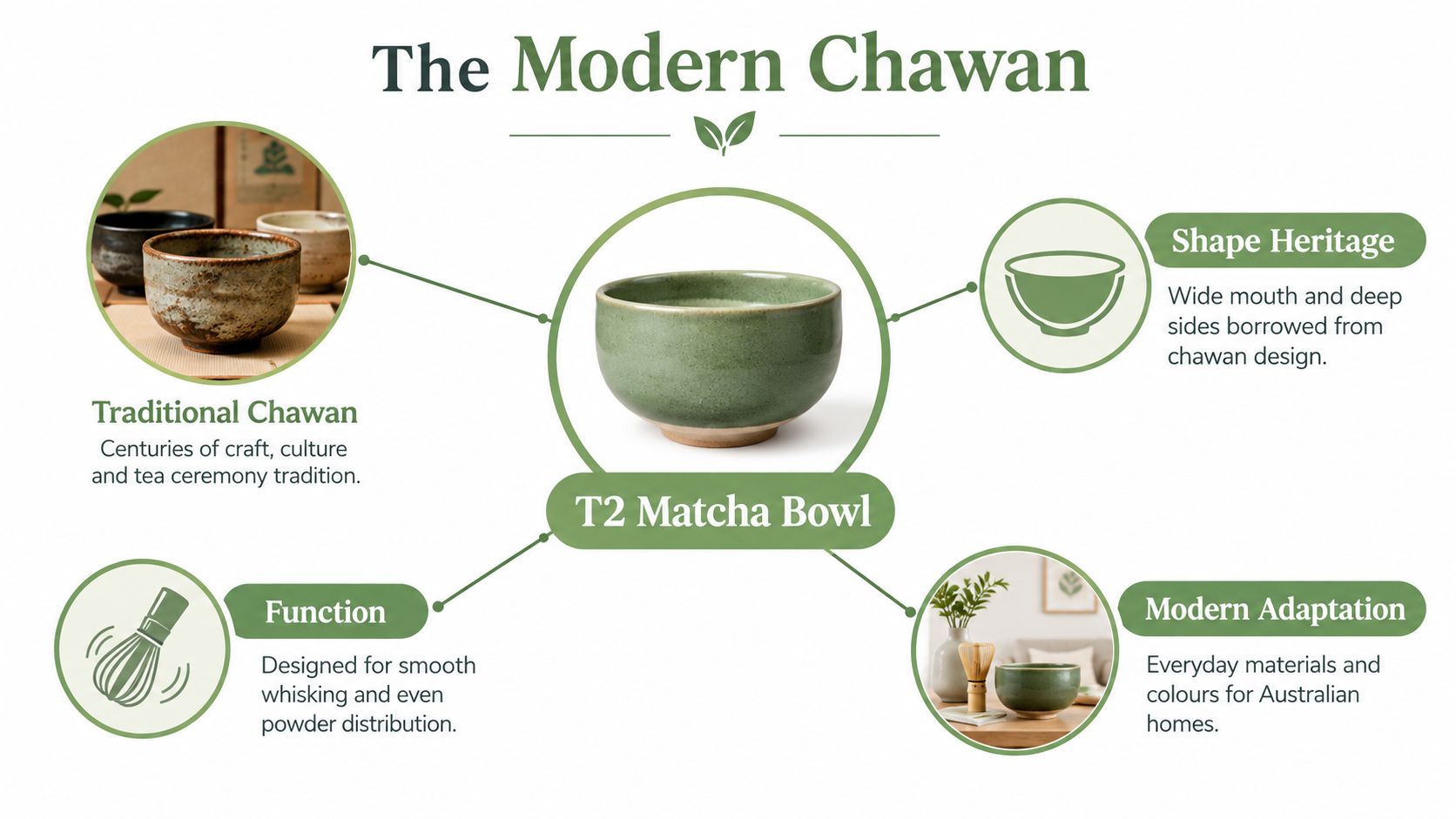
A T2 matcha bowl isn't merely a branded mug with a pleasant colour. It's best understood as a modern chawan, a bowl shaped around the practical demands of whisked matcha. That distinction matters because matcha isn't brewed like ordinary leaf tea, where the leaves steep and are removed. The powder remains in the drink, so the whisk has to disperse it evenly in water.
A chawan's broad opening gives the chasen, or bamboo whisk, space to move across the surface. Its sides also help contain the liquid as you whisk. A narrow mug can hold matcha, but it makes the whisking action cramped and awkward. If you're choosing a vessel for regular preparation, the working shape deserves more attention than the pattern.
Bowl shape is part of the brewing method
The T2 range brings that chawan-inspired function into a contemporary Australian retail setting, with different materials and finishes rather than one fixed ceremonial style. The useful question isn't whether a modern bowl is identical to a traditional Japanese bowl. It's whether the bowl gives you enough room to whisk comfortably and feels right for your routine.
That's the standard I'd use when comparing a T2 bowl with a traditional chawan: function, stability, capacity and care come before decoration. A beautiful finish is a bonus, not a substitute for a bowl that lets you prepare matcha properly.
If you're comparing customised drinkware for a café or event alongside tea equipment, promotional coffee mugs are a separate serveware option. They're not a replacement for a wide matcha bowl, where free movement of the whisk is central to preparation.
What a Chawan Actually Is and Where the T2 Range Sits
Chawan is the Japanese term for a tea bowl. In matcha preparation, it refers to the open vessel in which powder and water are whisked together. The bowl isn't just a cup that happens to be wide. Its shape supports the movement of a chasen and gives the prepared tea room to develop a smooth texture.
T2's Australian matcha-tool collection places its bowls within a coordinated set of traditional implements: a chawan bowl, a chasen whisk and a chashaku scoop. That's a sensible starting point for a newcomer. The bowl holds the preparation, the whisk disperses the powder, and the scoop helps measure it.
A retail range built for everyday use
The Matcha Method Gift Pack gives a clear example of T2's approach. It includes a 300 ml stoneware bowl handmade in Portugal, 30 g of certified-organic matcha, an everyday chasen and a preparation guide, with a listed price of $129 AUD (T2 Matcha Method Gift Pack). It's a bundled introduction to making matcha at home, rather than a specialist tea-ceremony set.
T2's Australian range also shows how broad the contemporary chawan category can be. The listed bowls include porcelain, stoneware, borosilicate glass and handmade stoneware. The T2 x SoCA Kalamata bowl is handmade in Brunswick, Australia, using historical tea-ware techniques. It has a 500 ml capacity and measures 12 cm × 8 cm × 12 cm (T2 x SoCA Matcha Bowl).
That mix makes T2 a mainstream Australian source for chawan-style preparation: the equipment reflects traditional use, while the materials, retail formats and designs suit everyday kitchens. For a plain-language guide to the utensils and preparation ritual, Pep Tea's matcha tea ceremony guide offers useful background.
Comparing Materials Across the T2 and Traditional Bowl Range
Material changes how a bowl feels in the hand, how it behaves around heat and how much care you can safely assume. But product names alone don't tell you everything. A handmade finish may be appealing, while a glass bowl may offer clearer visibility of the mixture. Neither automatically wins on daily practicality.
T2 lists bowls across porcelain, stoneware, borosilicate glass and handmade stoneware. Its Contour Glass Matcha Bowl is artisan-made, hand-blown and hand-detailed, while the SoCA Kalamata is handmade stoneware. The Matcha Method Gift Pack includes a stoneware bowl handmade in Portugal. These are concrete examples, but the listings don't provide a full side-by-side set of performance or care specifications for every material.
Matcha bowl materials at a glance
| Material | Heat retention | Weight in hand | Care | Typical T2 example |
|---|---|---|---|---|
| Porcelain | Exact performance isn't specified in the available T2 listing | Product-specific; no comparative weight is stated | Check the individual product instructions | T2 porcelain matcha bowls |
| Stoneware | No comparative heat-retention data is listed | Depends on the bowl's form and build | Don't assume dishwasher or microwave suitability without confirmation | Matcha Method Gift Pack bowl |
| Borosilicate glass | The listing describes heat-safe use but gives no comparative retention figure | Product-specific; exact weight isn't stated | Contour Glass is listed as microwave- and dishwasher-safe | T2 Contour Glass Matcha Bowl |
| Handmade stoneware | No performance figure is listed | Handmade construction can feel distinctive, but weight isn't specified | Confirm care instructions for the exact bowl | T2 x SoCA Kalamata |
Choose for the job, not the material label
For a low-guesswork routine, the Contour Glass stands out because T2 confirms that it's microwave- and dishwasher-safe. Its borosilicate construction and hand-blown finish make it a practical option when you want glass, but don't buy it expecting published data on whisking speed or superior heat retention. Those claims aren't established by the product details.
Choose handmade stoneware when tactile character and a local design story matter to you, but ask for the maker's care advice before treating it as a daily-use workhorse. For travel, don't assume any bowl is durable just because it feels substantial. The listings don't provide comparative impact testing, so a bowl you'd be unhappy to chip belongs at home, not loose in a bag.
Size and Capacity for Single-Serves, Lattes and Iced Matcha
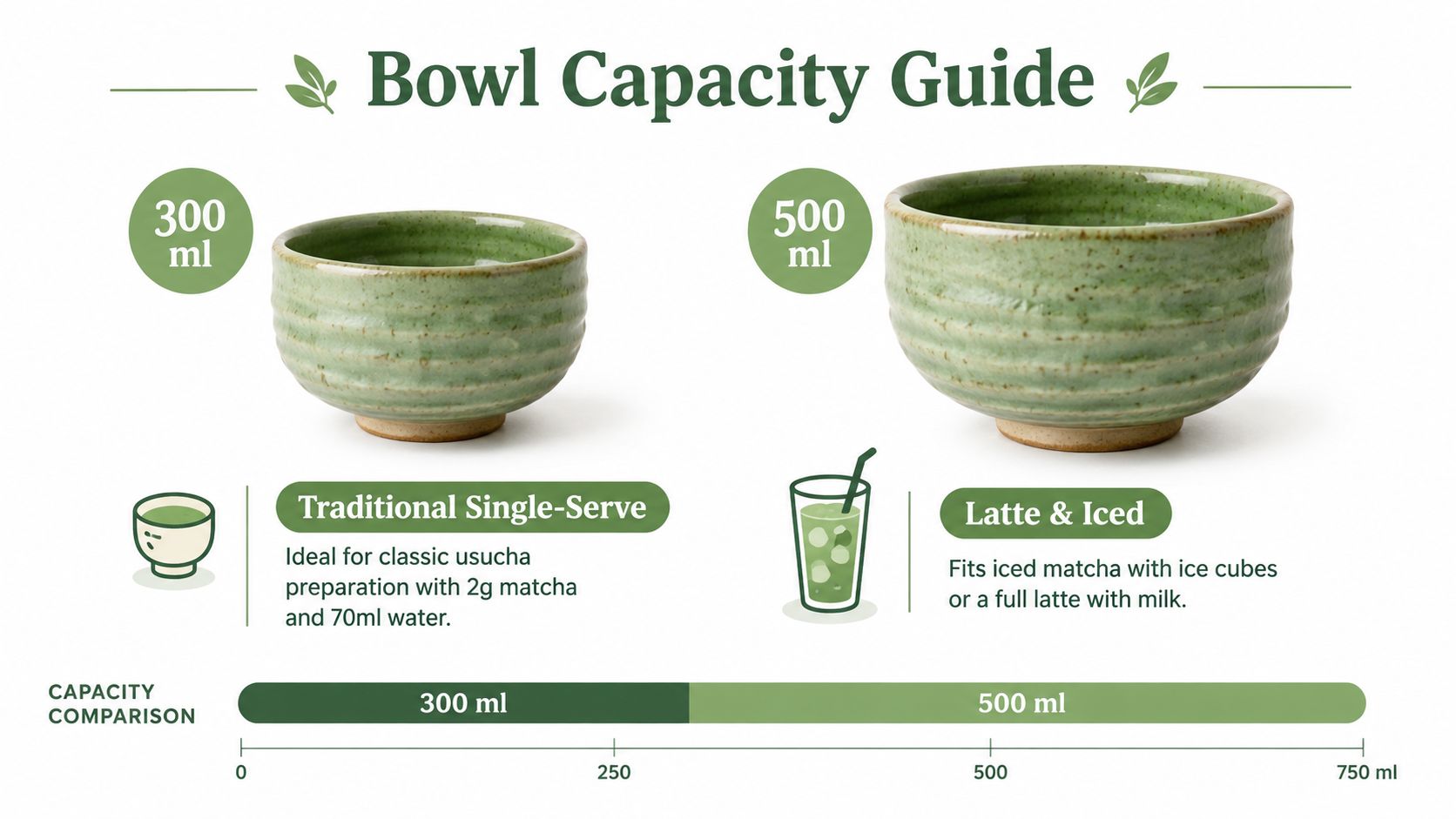
Capacity is a working feature, not a sales detail. A smaller bowl can feel natural for a single serving of whisked matcha, while a larger one gives you more room to move the whisk or add ingredients. Neither is automatically better. Pick the size that suits the drink you make most often.
T2's Matcha Method Gift Pack includes a 300 ml stoneware bowl, a compact format for a traditional single-serving routine. It's a deliberate size for preparing matcha in the bowl, not a signal that you should fill the vessel to the top. The purpose is to leave space for whisking.
When a larger bowl earns its place
The T2 Contour Glass Matcha Bowl has a 500 mL working capacity and measures 8.4 cm × 12 cm × 8.4 cm. T2 presents it as suitable for microwave and dishwasher use, and its larger volume gives you room for whisking and for iced matcha preparation. The bowl is hand-blown and hand-detailed, so visual or dimensional variation may occur between pieces (T2 Contour Glass Matcha Bowl).
The SoCA Kalamata is also 500 ml, with dimensions of 12 cm × 8 cm × 12 cm. Its size makes it a larger-format option, though its handmade stoneware form is a different proposition from glass. Choose between them by considering the finish you want and what the maker confirms about care.
Practical rule: Leave headroom. A bowl designed for whisk movement isn't meant to be filled to the rim, especially when you're working in ice or milk.
For a classic whisked serving, the smaller bowl is the straightforward choice. For a full latte or iced drink, a larger bowl gives ingredients and whisk more space before you pour into a glass. Pep Tea's iced matcha latte guide can help you match the bowl to your preferred preparation.
Price Bands and Where T2 Sits in the Australian Market
Pay for a bowl's usefulness before its styling. T2 sits in a mid-range, design-led retail tier, with individual Australian matcha bowls listed at $35, $40 and $50 AUD (T2 matcha bowls). Those prices cover different materials, finishes and capacities, so compare the individual products rather than treating the range as one bowl in different colours.
A contemporary T2 chawan deserves the same practical scrutiny as a traditional Japanese bowl. Does the shape support comfortable whisking? Does the glaze suit your preferences, and are the cleaning requirements manageable? Buy the bowl that fits your routine.
Mass-market bowls can be a sensible starting point for someone trying matcha. A handmade Japanese chawan from a specialist workshop offers a different craft proposition, which deserves consideration on its own terms. Neither category earns a recommendation on price alone. Compare the actual vessel, and decide how much its workmanship and daily usefulness are worth to you.
What the price buys
The Matcha Method Gift Pack combines a bowl with matcha, a whisk and a preparation guide. Judge that bundle by how much of it you'll use. For a beginner who needs the full setup, it offers a packaged introduction; for someone who already owns a whisk, a standalone bowl is the more focused purchase.
T2's Australian site also advertises purchase incentives, including a selected free matcha bowl with a $100 purchase and free delivery at a $50 threshold (T2 current offers). Check the current terms before ordering. Treat any offer as a saving on a purchase you already need, rather than a reason to add unwanted items.
My recommendation: pay for the size, material and care profile you'll use, then choose the finish you enjoy. Ceremonial styling alone doesn't justify spending more.
Care, Hygiene and Daily Durability Reality Check
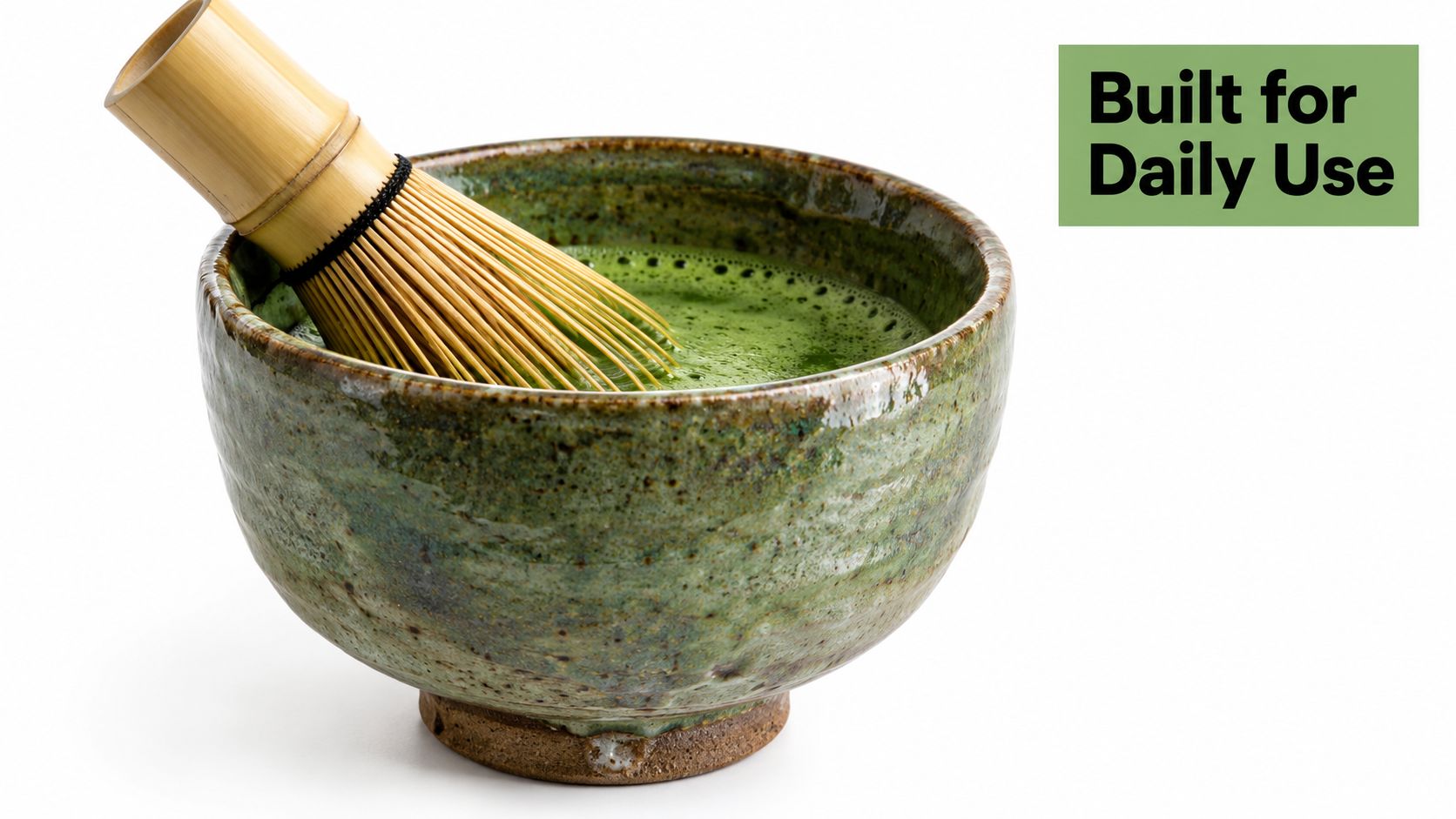
A bowl can look excellent and still frustrate you every morning. Before buying, check whether the base sits steadily while you whisk, whether the interior is easy to rinse, and whether the maker has confirmed dishwasher and microwave suitability. Don't infer food-safety, stain-resistance or heat limits from appearance alone.
T2 confirms that the Contour Glass Matcha Bowl is microwave- and dishwasher-safe. The available T2 listings don't establish those same specifications for every stoneware or handmade stoneware bowl, nor do they confirm glaze composition or stain resistance across the range. If those details matter to your routine, check the product's current care instructions or ask the retailer before purchase.
A simple daily-use check
Try this routine with any bowl before committing to it as your everyday vessel:
- Test the base: Set the bowl on a dry, level bench and whisk gently. If it shifts, hold it securely or choose a more stable form.
- Check the interior: Look for an opening that lets the whisk move freely without striking the sides.
- Rinse promptly: Matcha residue is easier to remove before it dries. Rinse the bowl after use, then wash it according to the maker's instructions.
- Follow confirmed care advice: Use a dishwasher or microwave only when the product listing or maker specifically confirms it's suitable.
The practical question matters more as matcha becomes part of a regular home routine. Tastewise's Australian consumer-panel reporting says matcha interest was up 53% in the preceding year, with convenience-first formats among the leading trends (Tastewise's Australia food trends). That trend doesn't prove a particular bowl will withstand daily wear. It does make a clear care check more useful than choosing on appearance alone.
For the whisking side of the routine, Pep Tea's guide to the T2 matcha whisk is a relevant companion. Keep the bowl clean, dry it appropriately for its material, and avoid guessing about care instructions.
Best Use Scenarios for Cafes, Home Baristas and Gift Buyers
A café needs repeatable preparation and quick cleaning. A home barista may care more about the feel of a bowl used every morning. A gift buyer usually wants the recipient to have the essential tools without sourcing each piece separately. Those are different jobs, so they shouldn't lead to the same recommendation.
Café service
For a café adding matcha to a brunch menu, start with workflow. The Contour Glass Matcha Bowl is a practical candidate because its 500 mL capacity gives room to whisk, and T2 confirms microwave and dishwasher suitability. That doesn't make it a guaranteed commercial solution: test the bowl on your own bench, check how staff handle it, and confirm the manufacturer's instructions meet your service needs.
If your menu includes iced matcha or lattes, the larger format is more flexible than a small single-serve bowl. Keep the preparation steps consistent and make sure staff know not to overfill during whisking.
Home ritual and gifting
For a home barista who wants a locally made, design-led bowl, the T2 x SoCA Kalamata offers handmade stoneware and a generous working capacity. It's the choice I'd consider when the bowl itself is part of the daily ritual, provided its care instructions fit your habits.
For a first-time matcha drinker, the Matcha Method Gift Pack is the cleanest starting point because it brings together a bowl, whisk, matcha and preparation guide. If you're also choosing a culturally meaningful gift, useful advice on selecting an appropriate item can be found in HD Asian Art's Buddha gift guide. A gift should be chosen with the recipient and context in mind, not just the packaging.
Choosing the Right Matcha Bowl for Your Setup
My recommendations are straightforward. For a café or home routine that prioritises a dishwasher-safe workflow, consider the T2 Contour Glass Matcha Bowl, then confirm it fits your bench and recipe. For a handmade bowl with a design focus, look at the SoCA Kalamata, but check its care requirements before making it your everyday choice.
If you're buying an introduction set, the Matcha Method Gift Pack makes sense when the recipient wants the bowl, whisk and matcha together. For a smaller traditional serving, its 300 ml bowl is the more focused option; for lattes and iced preparations, choose a larger bowl with enough headroom for whisking.
The bowl is only half the preparation. Powder quality and the amount you use shape the drink, so match your bowl to the kind of matcha you plan to whisk. For a clearer explanation of what ceremonial grade means, see ceremonial grade matcha explained.
Pep Tea offers certified-organic Japanese matcha for whisked bowls, lattes and everyday recipes, alongside sugar-free organic kombucha brewed in the Hunter Valley, NSW. Explore the Pep Tea range to choose matcha that suits the bowl and the way you like to drink it.