
Tag: crock sizes
Fermentation Crock Australia: Sizes and Buying Guide

Does the pot make the sauerkraut safe, or does your kitchen do that job?
Most buying guides treat a fermentation crock as kitchen décor with a capacity printed on the box. That framing skips the two things that decide whether a batch turns out crunchy and stable or soft and spoiled: the temperature of the room it sits in, and how quickly the brine drops below the acidity threshold that stops dangerous bacteria.
A crock is food-safety equipment. It holds vegetables under brine, keeps oxygen out and lets gas escape. That's the whole job. Everything else, from salt ratio to the overnight minimum in a Canberra winter, sits with you.
Sizing, material and placement are the decisions that matter for any fermentation crock Australia sells, and all three depend on where you cook. Here's how to work through them in order.
What a Fermentation Crock Is
What makes a crock different from an ordinary storage pot? It is designed to hold vegetables under brine while lactic-acid bacteria ferment them. Its broad opening lets you pack and remove produce, while the cover helps manage airflow and keep debris out. The crock supports fermentation, but safe results also depend on clean equipment and keeping the vegetables submerged.
Three parts do the practical work:
- The vessel. Stoneware or glazed earthenware provides a sturdy container with a wide opening for packing and cleaning.
- The weight. It holds vegetables beneath the brine, limiting their exposure to air.
- The lid or water-seal channel. A water seal lets fermentation gases escape while helping keep outside air and dust away.
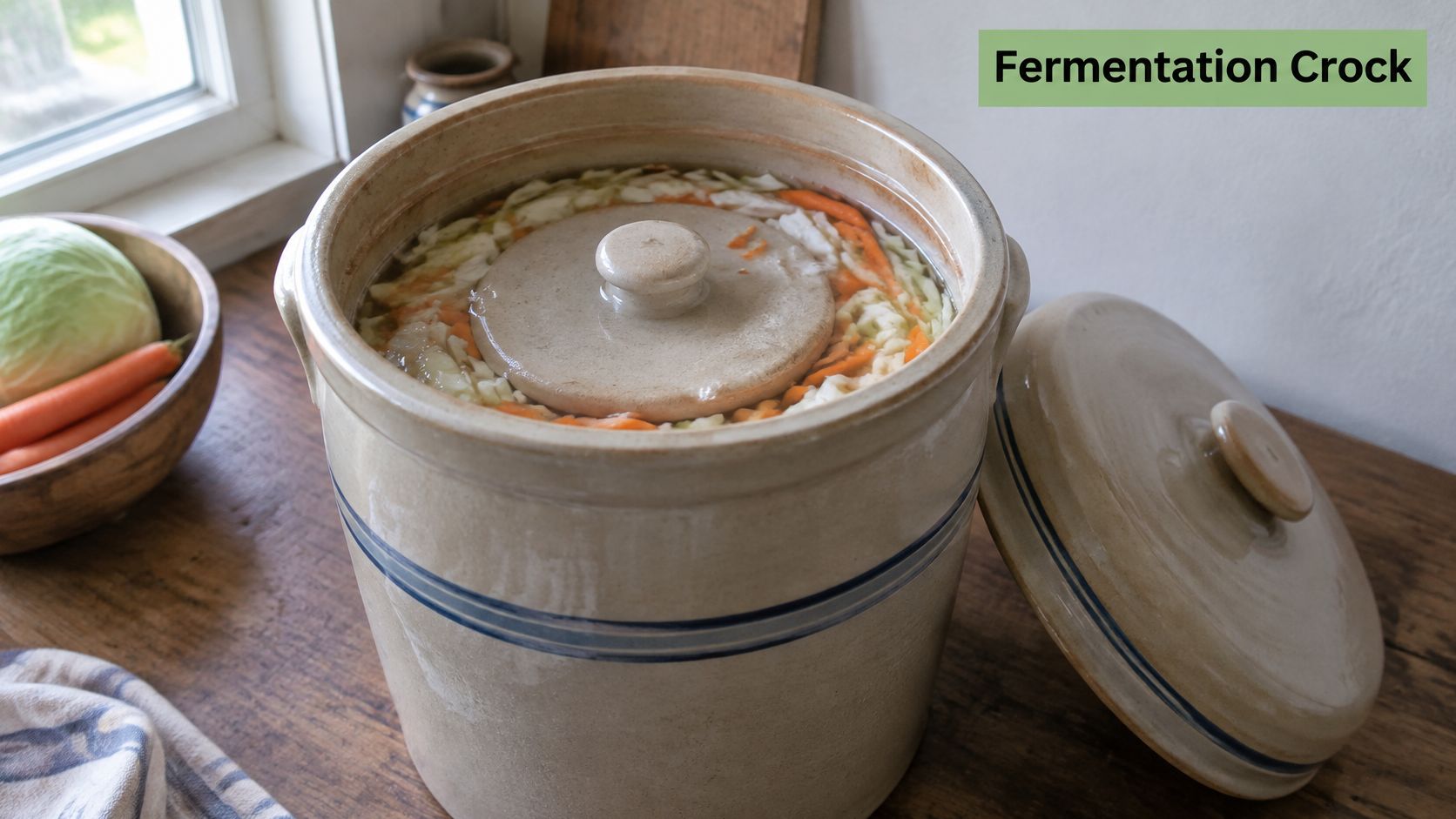
Ceramic vessels have a long place in Australian kitchens. Before refrigeration, covered stoneware and earthenware were common household vessels for storing and preserving food. A Western Australian Museum pottery collection record provides an example of the domestic pottery preserved in Australia.
Fermentation traditions also include native ingredients. Cider gum is a eucalyptus native to Tasmania, and its sap can ferment into a cider-like drink. A Western Australian Museum object record about historical Aboriginal fermentations offers a related historical reference, rather than evidence for a specific research project.
Today, Australian home cooks commonly use crocks for vegetables such as sauerkraut and kimchi. Kombucha is a brewed drink and uses a different vessel, although clean equipment matters for both.
First identify what you want to ferment. A crock suits vegetables held under brine; it is not a universal container for every fermented food or drink. That distinction helps you choose equipment for the job, rather than treating a crock as kitchen décor.
Crock Sizes and Capacities Compared
Capacity is printed in litres, which tells you nothing about how much cabbage fits once you've packed it down and added a weight. The table converts capacity into a working batch weight at about 80 per cent fill, using roughly 1 kg of cabbage per litre of crock.
| Crock capacity | Approx. vegetable weight at 80% fill | Best suited to |
|---|---|---|
| 1 to 2 litres | 0.8 to 1.6 kg | Trial batches and single jars |
| 3 to 5 litres | 2.5 to 4 kg | Couples and small households |
| 10 litres | 8 kg | Families who ferment weekly |
| 20 litres | 16 kg | Cafés, markets and bulk pickles |
How to size one from your own batch
Say you've bought 2 kg of cabbage. Salt it at 2 per cent of the vegetable weight, which is 40 g, and massage until it wilts and releases brine. Two kilos of packed cabbage needs a crock that holds it at 80 per cent full, so divide by 0.8 and you land on 2.5 litres. The 3 litre crock is the right buy. A 2 litre crock looks close enough on paper and then fights you the moment the weight goes in.
Rule of thumb: the 80 per cent figure covers rising brine, foaming during the first days, and the space the weight takes up. Fill to the brim and you'll be mopping the bench by day three.
Weight per litre shifts with what you're fermenting. Leafy cabbage compresses hard and packs heavy, while grated root vegetables and whole cucumbers leave more gaps, so a 5 litre crock holds less cucumber by weight than it holds cabbage. Weigh your produce rather than trusting the litre rating alone.
Two shapes cause trouble. Very wide crocks expose more brine surface, and a bigger surface is more room for mould to take hold. Very deep crocks acidify more slowly at the bottom, where the salt and culture take longer to reach. And a full 20 litre crock is heavy enough that you'll want it on a trolley or a fixed spot before you fill it, not after.
Choosing a Crock Material and Checking It Before You Buy
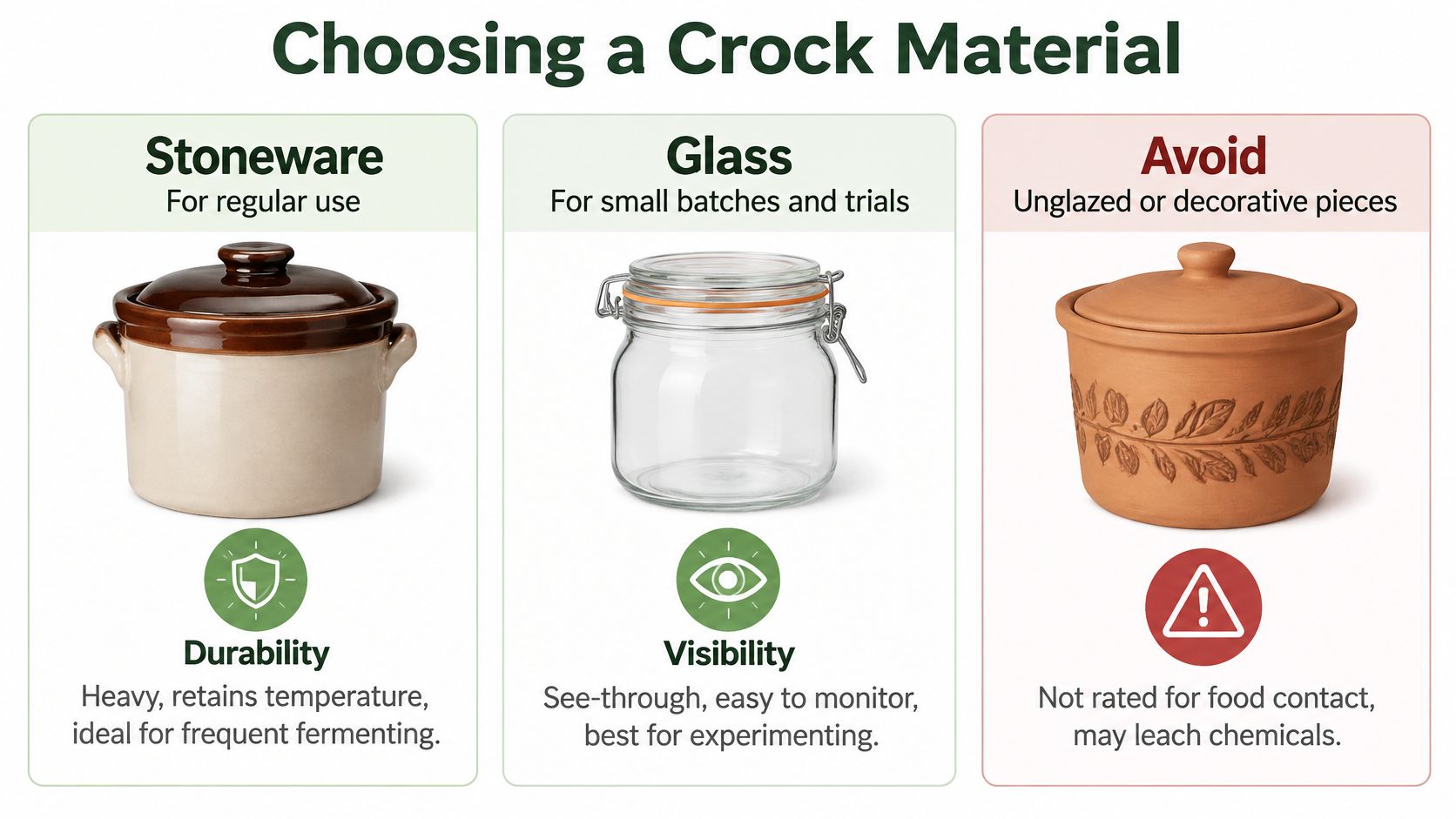
Stoneware for regular use, glass for small batches and trials, and nothing unglazed or decorative unless the maker states it's rated for food contact. That's the short version, and the table below shows why the trade-offs land that way.
| Material | Main advantage | Main drawback | Best use |
|---|---|---|---|
| Stoneware | Dense, low porosity, durable | Heavier and pricier | Regular sauerkraut, kimchi and pickles |
| Glazed earthenware | Light and affordable | Porous if glaze is chipped or crazed | Occasional batches with a sound glaze |
| Glass jar or vessel | Easy to inspect and sanitise | Fragile and needs separate weights | Small batches and trials |
| Food-grade plastic bucket | Light and inexpensive | Scratches can harbour residue | Bulk work where the bucket is rated for food |
Stoneware earns the top spot because low porosity means brine doesn't seep into the wall and linger between batches. The trade-off is weight and price, and a full 10 litre pot is not something you shift around the kitchen on a whim.
Glazed earthenware is lighter and cheaper, and it's fine while the glaze is sound. Hold it to the light and look for crazing, the fine web of surface cracks that opens the body of the pot to brine. A chipped rim does the same thing.
Glass gives you the one thing ceramic can't: a clear view of what's happening. Keep it for trials, and remember a jar doesn't come with a weight, so you'll need a clean glass weight or a brine-filled bag.
Unglazed stoneware is porous by design, which is exactly what makes it useful in a homemade clay crock filtration setup and exactly why it's the wrong choice for kraut.
The buying checklist
- Match capacity to batch weight with about 20 per cent headspace. A crock filled to the shoulder overflows brine and lifts the weight out of position.
- Confirm the glaze is labelled food safe and lead free, then run your hand around the inside. A smooth interior tells you the surface is intact; grit or roughness usually means a decorative finish.
- Reject chips and hairline cracks, even a small one on the rim. Cracks hold residue that no amount of washing reaches.
- Check the base sits flat and the weight can be lifted when the crock is full. A wobbly base on a wet bench is how pots get dropped.
- Seat the lid or water-seal channel before you pay. A channel that spills as you fill it defeats the point of a water seal.
- Confirm the weights are food grade and sit below the rim. Ceramic weights with exposed unglazed edges can shed grit into the brine.
- Ask for care instructions and a written return policy. A pot that arrives cracked is a freight problem, not a fermentation problem.
The rest of the kit
A crock by itself won't tell you whether a batch is safe. Budget for a calibrated pH meter or reliable strips, a room thermometer, a dated notebook, and fridge space for the finished product. If you're brewing rather than pickling, the vessel logic changes, and our guide to choosing a kombucha brewing container covers glass, taps and batch size.
Get warranties and glaze claims confirmed in writing with the seller before buying.
How to Keep a Crock Ferment Safe
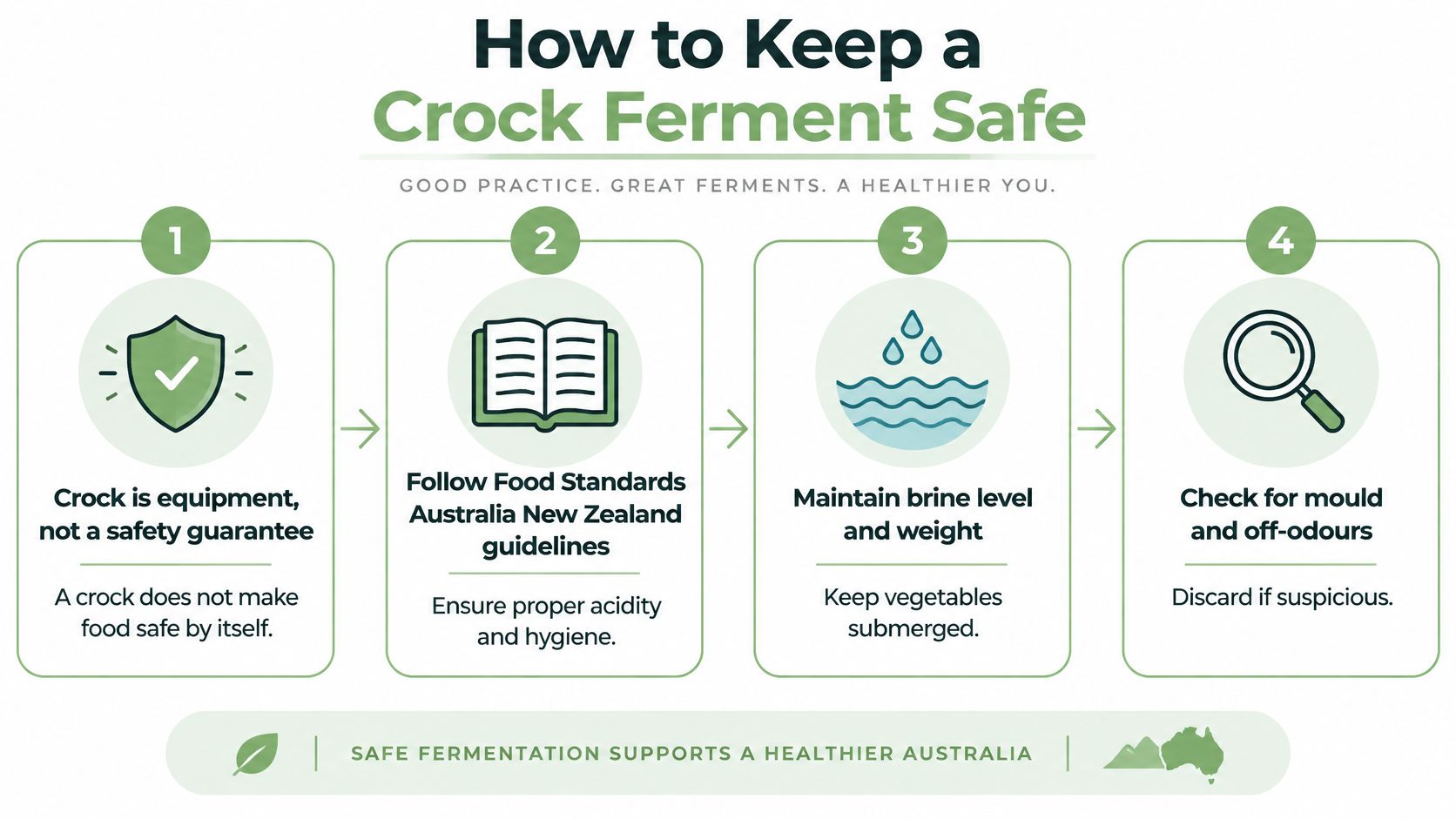
A crock is food-safety equipment, not just a pot. Salt, acidity, temperature and time work together to control a ferment, so use measured checks rather than relying on appearance or taste alone.
Food Standards Australia New Zealand gives pH 4.6 as a threshold for preventing growth of major anaerobic pathogens such as Clostridium botulinum and Bacillus cereus in vegetables held in brine, water, oil or vinegar. Fermentation may still require additional controls, such as reduced water activity or refrigeration, as described in Safe Food Australia. Aim for the pH target early, then check again at the expected endpoint. Warm conditions can speed microbial activity, but they do not guarantee even acid production.
The six steps that actually control the batch
- Sanitise the crock, lid and weights before packing. Remove detergent residue and any biofilm, which can interfere with the culture you want to grow.
- Weigh the vegetables and salt. Use around 2 per cent salt by vegetable weight to favour salt-tolerant lactic-acid bacteria. Weighing gives you a repeatable amount instead of relying on a guess.
- Pack firmly and keep every solid below the brine. Exposed vegetables meet air, creating conditions where mould can begin.
- Set the weights and fill the water seal. The weights hold the vegetables under brine, while the filled channel lets gas escape and limits air entering the crock.
- Measure pH during fermentation and at the expected endpoint. A calibrated digital pH meter gives a reading; taste and smell describe flavour, not pathogen safety.
- Refrigerate the finished ferment at 5°C or below. FSANZ guidance on potentially hazardous food sets cold holding at 5°C or colder. Salt helps select which microbes grow, but it does not replace refrigeration.
What doesn't prove safety
Bubbles show that gas is escaping, while sourness suggests acid is forming. Neither confirms that the batch has reached a safe pH. A clear-looking surface also cannot establish safety. Discard a batch with fuzzy mould, slimy vegetables or a rotten smell. A thin white film of kahm yeast is different and can be skimmed off.
The right acidity depends on the recipe. FSANZ process guidance notes that pH limits vary with the food and starter culture, and that refrigeration or water-activity controls may also be needed to keep a product stable. Fermented meat needs controls beyond ordinary home preparation, so keep meat out of a home vegetable-fermentation routine.
The FSANZ new and emerging foods report reported that 44 to 56 per cent of respondents rated their confidence below the midpoint for assessed new foods or technologies. For a home ferment, measured checks turn uncertainty into a reading you can act on.
Adjusting Ferments to Australian Temperatures
Fermentation works most predictably at 21 to 24°C. It stalls below about 15°C, and vegetables can turn soft above 24°C. Those figures come from Queensland Health's fermented foods guidance, and they explain why a single seven-day instruction falls apart in an Australian kitchen.
The working range: 21 to 24°C. Below 15°C the culture slows to a crawl and the batch sits vulnerable for longer. Above 24°C you get soft, slippery vegetables.
| City | Typical temperature risk | Where to place the crock | Timing adjustment |
|---|---|---|---|
| Brisbane | Above 24°C for months | Cool, shaded larder away from the oven | Check pH earlier and shorten the ferment |
| Darwin | Above 24°C for much of the year | Air-conditioned room or the coolest interior spot | Check pH earlier and taste daily |
| Perth | Above 24°C through summer | Shaded, cool cupboard | Shorten summer ferments |
| Hobart | Below 15°C overnight in winter | Warm cupboard or heated bench mat | Expect longer timelines |
| Canberra | Below 15°C overnight in winter | Warm, draught-free corner | Expect longer timelines and test more often |
When the kitchen runs hot
Brisbane, Darwin and Perth kitchens can sit above 24°C for months at a stretch. Move the crock away from the oven, the dishwasher and any window that catches afternoon sun, and start checking at the 24 hour mark rather than waiting for a calendar date.
When the kitchen runs cold
Hobart and Canberra can drop below 15°C overnight in winter. A warm cupboard, a draught-free corner or a heated bench mat keeps the culture moving, and you should expect the batch to take noticeably longer than a recipe written in a temperate climate suggests.
Why the water seal doesn't rescue you
The channel limits oxygen exposure. It cannot correct temperature. Queensland Health warns that fluctuating temperatures can either kill desirable bacteria or encourage unwanted bacteria and mould, which is a serious risk in a kitchen that's warm by day and cold overnight. Split the difference by insulating the crock with a folded towel and moving it to the most stable spot in the house, then trust your log over the recipe.
Replace any fixed "ferment for seven days" instruction with a three-line check: temperature logged, taste tested, pH measured. Brewed ferments feel the same swings, and our Australian kombucha recipe guide applies the same temperature thinking to a liquid batch.
Confirm Your Setup Before Your First Batch
Three decisions, in order, and then you're fermenting.
- Size the crock to your batch weight and household. Work backwards from the produce you bought, not from the shelf label.
- Pick a food-safe material and check the lid, weights and seal. Stoneware for a regular habit, glass for experiments, and a written confirmation on the glaze.
- Choose a placement for your city and season, then start small. A 1 to 2 litre crock is cheap insurance while you learn how your kitchen behaves.
For a first test, weigh 1.5 kg of cabbage and 30 g of salt, pack it under its own brine, and keep a dated notebook with the ambient temperature and pH readings beside it. That notebook does more for your second batch than any recipe will.
A first batch is a test, not a performance. If it goes soft or smells wrong, you've learned what your kitchen does, and that's worth more than a perfect jar you can't repeat.
If you'd rather enjoy a fermented drink without managing a crock at all, our sugar free organic kombucha is brewed and bottled in the Hunter Valley of NSW, in an HACCP accredited, purpose built kombucha brewery. It's a simple way to keep something fermented in the fridge while you get your kraut technique sorted. Cafés and shops can ask us about wholesale enquiries, and home cooks can browse the range online whenever it suits.
Fermenting vegetables is a skill worth building, and a fermented drink is a good place to start while you learn your kitchen's rhythms. Pep Tea brews sugar free organic kombucha in the Hunter Valley, NSW, using organic green tea and live cultures in an HACCP accredited brewery, with ginger, mango, lime and ginger, and apple pomegranate flavours in 350ml boxes of 12. If you'd like a probiotic drink in the fridge without weighing cabbage and watching a pH meter, visit Pep Tea to see the range and have it delivered.