
Tag: cafe suppliers
Non-Alcoholic Cafe Menu: Why Gen Z Changed the Game
The story that has been circulating for a few years now — that Gen Z have stopped drinking — is not quite right. And the correction matters more for your non-alcoholic cafe menu than the original claim ever did.
Australian café culture is in the middle of a genuine generational shift in drinking behaviour, but it is not a shift toward abstinence. It is a shift toward intentionality. Understanding that distinction is one of the more useful things a café operator can do with their menu in 2026, because the commercial opportunity it opens up has nothing to do with catering to people who don’t drink and everything to do with what happens when a customer wants something worth ordering.
The Reality Is More Nuanced Than the Headline
The vast majority of Gen Z drink alcohol. The difference between this generation and the ones before it is not abstinence. It is how, when, and why they drink.
What Has Actually Changed
Gen Z prioritise experience over volume. They choose concept-led venues, make value-conscious decisions about when a drink is worth it, and are considerably more likely than previous generations to simply not drink on a given occasion without it being a statement. Research from Flinders University points to digital socialising, rising living costs, and health awareness as the forces reshaping how young Australians spend their time and money. The result is a generation that drinks less frequently but thinks more carefully about what it orders when it does.
What This Is Not
This is not a generation in revolt against alcohol culture. It is a generation that has grown up with more choices, more information, and a different relationship with social occasions than the generations before them. Non-alcoholic does not mean anti-social. It means different social, and cafés are better placed than almost any other venue type to meet that need.
How Big Is the Non-Alcoholic Market in Australia?
The non-alcoholic beverages market in Australia has grown to a scale that makes it impossible to treat as a niche, with kombucha, alcohol-free beer, and botanical drinks now accounting for significant and growing shares of what Australians consume at cafés, restaurants, and bars. The commercial case does not rest on generational data alone.
A Mainstream Shift, Not a Niche One
What has changed most noticeably is where the growth is coming from. It is no longer driven by people who never drank. It is driven by people who drink and are choosing not to on an increasing number of occasions. That is a fundamentally different customer, and one who will judge a non-alcoholic cafe menu option by the same standard they apply to everything else: is it worth ordering, or is it an afterthought?
The Behaviour Worth Understanding: Zebra Striping
The most practically useful concept to come out of the research on generational drinking behaviour is not sobriety. It is zebra striping: the practice of alternating between alcoholic and non-alcoholic drinks within a single social occasion.
Why This Changes the Menu Conversation
Zebra striping has become mainstream behaviour among younger Australians, and it reframes the non-alcoholic opportunity entirely. The customer is not choosing between drinking and not drinking. They want both options available across the course of an occasion, and they want the non-alcoholic choice to feel equally considered, equally interesting, and equally worth paying for.
That is a fundamentally different brief to “provide an option for people who don’t drink.” It means the non-alcoholic drink on your menu is not a concession. It is competing directly for attention, and it will be judged by the same standard as everything else: does it taste interesting, does it look worth ordering, and does it create a moment?
What Winning That Competition Looks Like
A well-crafted non-alcoholic signature drink is not a lesser option. It is a different kind of drink with its own flavour story, its own visual identity, and its own reasons to be chosen — whether that is a kombucha with fruit and botanicals, a cold coffee mocktail with a seasonal twist, or a warm cacao or matcha-based drink that gives a customer something to come back for. The café that builds across this full spectrum deliberately is offering something that competes on its own terms rather than existing as an apology for the absence of alcohol.
What Is Actually Appearing on Non-Alcoholic Cafe Menus?
Three categories are emerging as permanent fixtures in forward-thinking Australian cafés in 2026, each reflecting a different dimension of the non-alcoholic shift. The best non-alcoholic cafe menus draw from all three rather than defaulting to a single format.
Coffee Mocktails
Complex, non-alcoholic drinks using espresso or cold brew as a base, mixed with botanical syrups, fresh juices, and artisanal sodas, are becoming a signature category in their own right. Leading café groups have already declared 2026 the year of the signature drink, with drinks like coconut cloud strawberry matcha, dragon lychee coffee mocktails, and banana bread matcha appearing on menus. These drinks sit at the intersection of coffee culture and the non-alcoholic movement, offering cafés high-margin, experience-driven products that customers talk about and photograph.
Tea-Based Alternatives
With matcha supply remaining tight through 2026, leading cafés are developing a new wave of tea-driven beverages: hojicha lattes, strawberry sencha spritzes, roasted genmaicha shakes, and botanicals with citrus, rose, or yuzu notes. These create a playground for colour, theatre, and visual identity, borrowing directly from cocktail bar techniques while remaining entirely within the café’s existing equipment and skill set.
Crafted Kombucha and Botanical Infusions
Kombucha has completed its journey from health food aisle to bar menu. The direction of travel across all three categories is the same: less sugar, more balance, and juice-led bases rather than syrup-heavy constructions. Younger customers in particular are increasingly sensitive to over-sweetness, and a drink that feels balanced and adult will consistently outperform one that feels like a soft drink with ambitions.
The Commercial Case for a Considered Non-Alcoholic Cafe Menu
Non-alcoholic signature drinks built around functional ingredients carry a margin profile that is difficult to match elsewhere on a café menu. A cacao-based drink with maca and cinnamon, a spiced matcha latte, and a hojicha and honey drink: each costs a fraction of what a cocktail does to produce but sits comfortably at a speciality coffee price point.
Loyalty and Differentiation
Beyond the margin, the loyalty argument is compelling. A customer who visits specifically for a drink they cannot find elsewhere has a fundamentally different relationship with a venue than one who orders a standard flat white. Signature non-alcoholic drinks create occasions — morning rituals, afternoon treat moments, the kind of drink someone describes to a friend — that drive frequency without requiring a food order every time.
Most Australian café menus still treat non-alcoholic options as an afterthought: a few soft drinks, a sparkling water, perhaps a kombucha from the fridge. Cafés that build this category deliberately are, right now, the exception. That will not last, but it is a genuine competitive advantage whilst it does.
If kombucha is the category you want to start with, it is one of the more straightforward ways to signal that your non-alcoholic range has been thought about. Browse the Opera Foods kombucha range to find the right fit for your menu.
This article was reproduced on this site with permission from operafoods.com.au the “Wholesale Café Suppliers”.
See original article:- Non-Alcoholic Cafe Menu: Why Gen Z Changed the Game
Making Kombucha Granita: Texture That Transforms
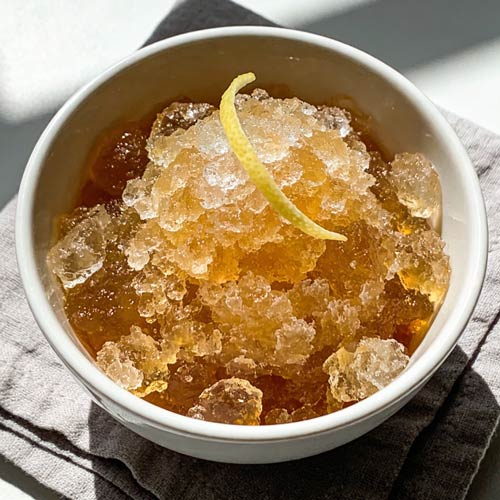
Simple to make and surprisingly impressive, the magic of kombucha granita lies in its texture. Frozen kombucha isn’t sorbet, it’s granita, which means visible ice crystals that crunch delightfully against smooth ice cream or silky mousse. Elegant, Instagram-worthy, and undeniably sophisticated, it reads as high-effort even though anyone can master it in a weekend.
This isn’t complicated cooking. It’s one ingredient, a fork, and an understanding of when to pause.
What You’ll Need
For the Granita
- 350ml kombucha (try PepTea lime and ginger organic sugar-free kombucha)
- 1 tablespoon caster sugar
- 1 teaspoon fresh citrus zest
For Making It
- One shallow tray, roughly 20cm square
- A fork
- An ice cream scoop
Time Investment: Five minutes of actual work, spread across two to three hours of freezing (with four quick scrapes in between).
How to Make Kombucha Granita
Pour and Freeze
Pour your kombucha into the tray. Add the sugar and stir thoroughly. It will dissolve more slowly in cold liquid, but the fork scraping during freezing helps the process along. If you prefer fully dissolved sugar from the start, warm the kombucha first to about 40°C, dissolve the sugar, then cool completely before freezing. Add a scrape of citrus zest and slide it into the freezer immediately.
The Scraping (This Is Everything)
At 30 minutes, remove the tray. Run your fork across the entire surface, scraping gently. You’re not being aggressive here. You’re breaking up the ice crystals that want to form a solid block around the edges. The mixture should look like wet sand now, not ice.
At 60 minutes, scrape again. Push slightly deeper this time, bringing the fork through the centre. You’ll notice the whole thing shifting from liquid to something granular, almost snowy.
At 90 minutes, scrape one final time. It should feel distinctly icy now. Push through any chunks that have started bonding together. Return it to the freezer for 30 minutes.
Serve It
At 120 minutes total, remove the tray for a final gentle scrape if needed. Scoop directly into bowls or straight onto your finished desserts. Granita should move easily with the scoop, not fight you. If it’s become too hard, leave it on the bench for two or three minutes to soften slightly.
How Kombucha Granita Works
The sugar lowers the freezing point, which is why it freezes at a lower temperature than pure water and creates smaller ice crystals when frozen. This means smaller ice crystals form, and those smaller crystals are what give granita its signature feel in your mouth: crunchy without being harsh.
When you scrape every 30 minutes, you’re interrupting the freezing process deliberately. Without scraping, one solid block would form. With it, thousands of small crystals suspend themselves in the kombucha liquid. Freeze that, and you have a texture that works.
Carbonation disappears when kombucha freezes into granita. The CO2 gas escapes as ice crystals form, so your finished granita won’t be fizzy like a kombucha drink. But here’s what’s surprising: when the granita melts on your tongue, you still experience a pleasant tingle, just like drinking kombucha with its bubbles intact. That sensation isn’t from carbonation—it’s from the fermented compounds in kombucha itself. The acids, probiotics, and fermentation byproducts that define kombucha’s character persist in the granita. You lose the fizz, but you keep the feeling.
Three Ways to Serve This
First: Dark Chocolate Foundation
Build this from dark chocolate mousse or ice cream as your base. Top it with 30ml of granita. Finish with sesame seeds or a dusting of cocoa powder.
Why it works: Bitter chocolate and fermented tang create contrasting flavours, whilst the cold, crunchy granita against smooth creamy mousse gives textural contrast. The sour edge and citric tang cut through richness.
Second: Vanilla Canvas
Begin with vanilla ice cream or panna cotta. Top with kombucha granita. Finish with fresh citrus zest or an edible flower.
Why it works: It is just sheer simplicity, and somewhere that kombucha granita can really shine. A story of contrasts in motion.
Third: Granita Alone
Scoop granita into a clean glass bowl. A single garnish only: fresh herb, citrus zest, or edible flower. Nothing else.
Why it works: You’re letting the granita speak entirely for itself. No other ingredients to hide behind. This is not about contrast but the granita itself. Minimal elements mean texture and flavour become everything.
In Italy, granita is often served with a small spoonful of whipped cream on top for that tiny touch of contrast.
The Practical Side
Finished granita keeps frozen for two to three days. After that, ice crystals start bonding together, and the texture suffers. Make fresh batches every two to three days rather than trying to freeze ahead for a week. Store it in a covered tray so frost doesn’t build up, and flavours from other frozen items don’t travel.
When Things Don’t Go Quite Right
Your granita froze solid: Set phone reminders for each 30-minute scrape. If this happens, leave it on the bench for three to five minutes, then scrape gently. It’ll soften enough to scoop.
It’s too wet: You either added too much sugar or started with warm kombucha. Return it to the freezer for 30 minutes. Next time, use just 1 tablespoon of sugar and take kombucha straight from the fridge.
Crystals feel too fine: You froze it without scraping, or your freezer is extremely cold. Add 2 tablespoons of water and refreeze with regular scraping every 30 minutes. Larger crystals will form.
Getting Started This Week
This weekend: Make one batch. Taste it. Understand the texture and flavour without any pressure.
Next week: Make two batches. Serve one in-house during service. Taste every dessert your team makes with it. Notice what customers respond to.
The week after: Based on what you’ve learned and how sales are tracking, decide on batch frequency. Most operators settle on one batch per service once they find their rhythm.
The Real Value
Kombucha granita is simple cooking. One ingredient. A fork. Four pauses over two hours. Technique rather than complexity. It also taps nicely into the trend for tangy desserts.
But perception is different. Customers see granita and recognise sophistication immediately. They taste textural novelty. So they photograph it and share it with friends. Then they come back asking for it specifically.
This is what elevates a dessert menu. Not more ingredients or more labour. Intentionality. Texture. Understanding what makes something memorable in a customer’s mouth.
Looking for quality kombucha? Pep Tea kombucha from Opera Foods is organic, sugar-free, and shelf-stable. Available to order online wholesale today.
This article was reproduced on this site with permission from operafoods.com.au the “Wholesale Café Suppliers”.
See original article:- Making Kombucha Granita: Texture That Transforms