
How to Make Matcha Without Milk: Hot, Iced and Non-Dairy
It's a Tuesday morning, the kettle has just clicked off, and you're standing there with a tin of matcha and an empty milk carton. Maybe you've cut dairy out. Maybe someone in the house can't have it. Maybe you've decided a drink you make four times a week shouldn't need three ingredients before it tastes good.
Matcha was whisked into water for centuries before anyone poured milk into it. Learning how to make matcha without milk isn't a workaround for a missing ingredient. It's the original method, and it's far more forgiving than most recipes admit.
What changes when the milk goes is worth naming plainly. You lose a calcium source. You lose the fat and protein that carried the texture. And you gain nothing back on caffeine, because caffeine was never in the milk to begin with. Sort those three out separately and the drink stands on its own.
Milk-Free Matcha Ratios at a Glance
The short answer is 1–2 g of sifted matcha whisked into 15–30 mL of water at 70–80°C, then topped up with another 120–180 mL. The small first volume stops clumps forming. The top-up sets the strength.
| Preparation | Matcha | First water | Finish with | Best for |
|---|---|---|---|---|
| Hot, water only | 1–2 g | 15–30 mL at 70–80°C | 120–180 mL hot or cold water | Lightest flavour and the traditional cup |
| Iced, water only | 1–2 g | 20–30 mL at 70–80°C | 150–200 mL cold water and ice | A refreshing, unsweetened iced matcha |
| Hot, calcium-fortified soy or oat | 1–2 g | 15–30 mL at 70–80°C | 120–180 mL warmed fortified drink | A creamier cup without dairy |
| Iced, calcium-fortified soy or oat | 1–2 g | 20–30 mL at 70–80°C | 150–200 mL chilled fortified drink and ice | A creamy iced drink for warm days |
Read the table left to right and each column has a job. The first water is deliberately small: it turns powder into a paste you can work smooth, rather than a bowl of floating green specks. The finishing volume is where you decide between a light, grassy cup and something with more grip.
You'll often see 60–80 mL of warm water recommended for that first whisk. It works, but with only 1–2 g of powder in that much liquid you spend the next minute chasing clumps around the bowl. Start smaller and dilute.
Water-first preparation also matches how Australian households drink. The Australian Bureau of Statistics reported that in 2023 Australians consumed an average of 153 grams of tea per person per day, and that water accounted for 1,352 grams of the 1,926 grams of non-alcoholic beverage consumed daily, about 70.2% of the total.
Starting point: 1 g of powder, 20 mL of 80°C water, 150 mL to finish. Adjust one number at a time from there.
A good cup shows a fine, even foam with no dry pockets, and a colour that's deep green rather than grey. If you'd happily drink it again, your ratio is right for you.
Choosing a Non-Dairy Liquid for a Creamier Cup
Taking milk out of a cup takes a calcium source with it. The Australian Dietary Guidelines point people avoiding dairy towards calcium-enriched milk alternatives, and advise checking that a product contains at least 100 mg of calcium per 100 mL. That number is the difference between a substitute and a drink that only looks like one.
| Liquid | Calcium | Flavour and texture | Watch for |
|---|---|---|---|
| Water | None | Clean and grassy, the most traditional cup | No calcium and no creaminess |
| Calcium-fortified soy | At least 100 mg per 100 mL if fortified (check the label) | Creamy with a slight beany note | Choose unsweetened and check protein per serve |
| Calcium-fortified oat | At least 100 mg per 100 mL if fortified (check the label) | Mild and naturally sweet | Barista blends can contain added sugar |
| Almond | Only if fortified, so look for at least 100 mg per 100 mL on the label | Light and nutty | Often lower in protein and calcium varies by brand |
What each liquid does to the cup
Soy is the closest match to dairy in body, and it carries matcha's bitterness without smothering it. It also usually brings more protein per serve than the other plant options. Buy unsweetened, or you're drinking sugar you didn't order.
Oat reads as sweet even when it isn't, which makes it a gentle first step for someone who finds matcha grassy. Watch barista blends in particular: they're formulated to foam, and many carry added sugar and oil. Plain unsweetened versions make a better everyday drink.
Almond stays light and lets the tea through. If that's your preference, vegan-friendly unsweetened almond milk is the style to look for, because unsweetened means the matcha is doing the talking.
Three checks before you buy
- The calcium line: at least 100 mg per 100 mL, or it isn't replacing anything.
- The sugar line: read per 100 mL rather than per serve, since serve sizes vary wildly.
- The protein line: soy is usually highest, almond usually lowest.
Plant-based doesn't automatically mean nutritionally equivalent, and dropping milk isn't healthier on its own. The better question is whether the liquid suits your nutrition needs, your sugar target and your taste. If you want more richness than a fortified plant milk gives you, matcha with coconut milk is the other route worth trying.
How to Whisk Matcha Hot or Iced Without Milk
Everything comes back to two controls: how much water the powder meets first, and how hot that water is.
Start with the water itself. Fill the kettle from the cold tap rather than the hot tap, because Australian drinking water guidance recommends cold tap water for drinking and food preparation, since temperature and plumbing conditions can affect chemical corrosion and microbial survival. Heat it, then let it settle.
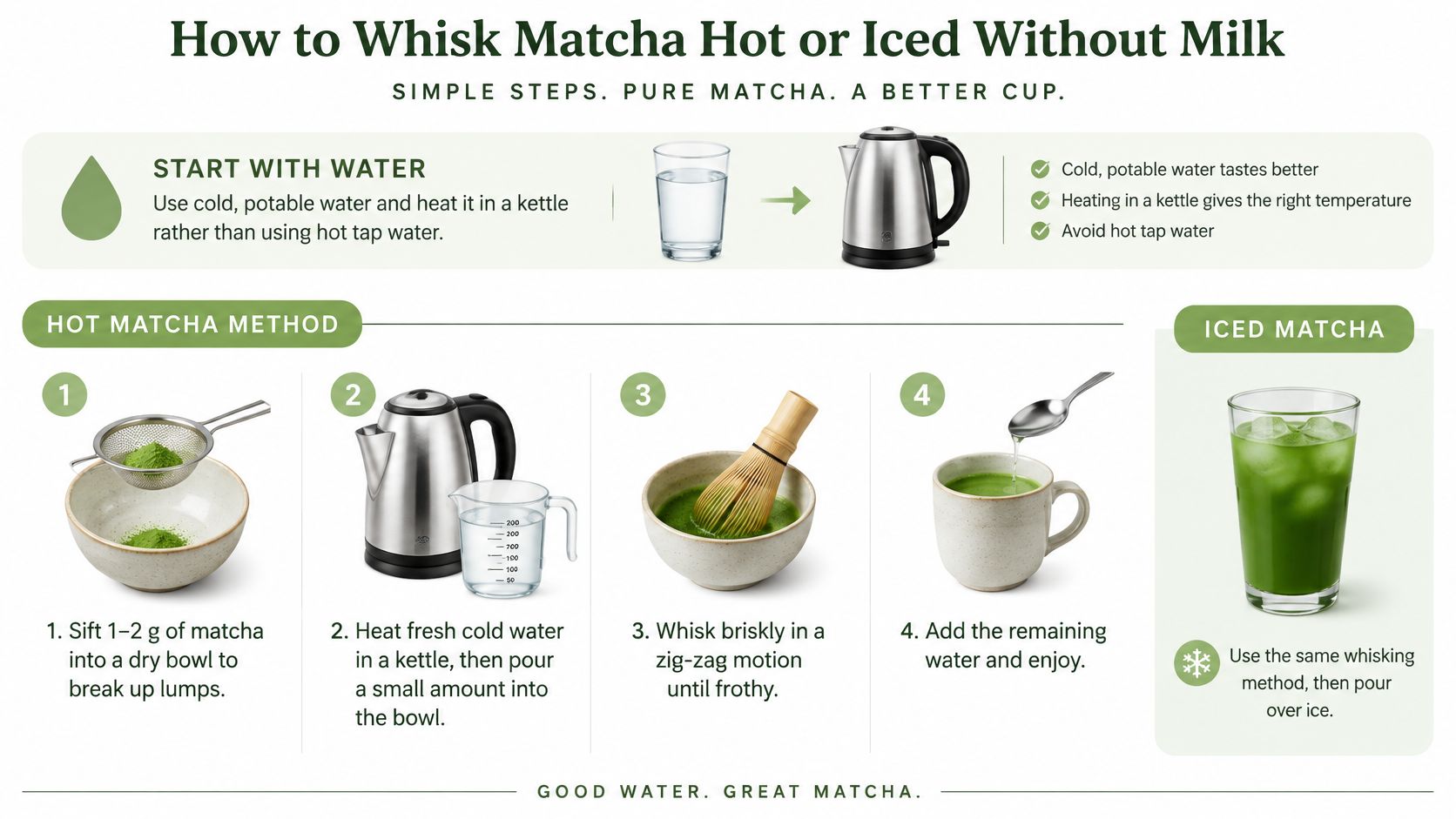
Hot matcha, six steps
- Sift 1–2 g into a dry bowl. A fine sieve breaks up the lumps that turn into clumps later, and it takes ten seconds.
- Heat water to 70–80°C. If the kettle has just boiled, wait a few minutes rather than pouring straight from the switch.
- Add 15–30 mL to the powder. This is the paste stage. You want a thick, glossy concentrate, not soup.
- Whisk side to side or in a W. Rapid back-and-forth motion adds air; a vertical stir just moves liquid around.
- Top up with 120–180 mL of hot water for a hot cup, or cold water if you want it drinkable straight away.
- Taste it and change one thing next time. More powder for a stronger cup, less for a lighter one.
Boiling water pulls out more bitterness and makes clumping more obvious, so 70–80°C is the working range: hot enough to disperse the powder, cool enough to keep the cup sweet.
Temperature rule: boil the kettle, then let it stand three or four minutes before it touches the powder.
Iced matcha, the same idea in two stages
Sift 1–2 g, build a slurry with 20–30 mL of 70–80°C water, and whisk until no dry particles remain. Then add 150–200 mL cold water and ice and stir briefly. The FSANZ food safety guidance matters here if you're making several: potentially hazardous foods need to be held at 5°C or colder or 60°C or hotter, and preparation should be as brief as practical.
In practice that means making each iced matcha close to service rather than leaving a jug sitting in the warm middle of the range. Wash and dry whisks, jugs and frothers between uses. A wet whisk left on the bench is the likeliest source of contamination in a drink that's otherwise very low risk.
If you'd rather see the wrist action than read about it, this short demonstration covers the same steps:
The two tools worth owning are a bamboo whisk and a fine kitchen frother. A spoon will stir the powder into the water, but it won't build foam.
Flavour Ideas That Keep the Matcha Tasting Like Matcha
Adding flavour without milk is easy. Adding so much that the matcha vanishes is the trap. Aim for something you can smell but can't immediately name, and add it at the end, in small amounts, once the powder is already smooth.
Vanilla. A few drops of pure extract whisked into the first slurry. It rounds off bitterness without adding sweetness, and it suits a fortified soy or oat base particularly well.
Cinnamon. A pinch of ground cinnamon stirred through a hot cup, or dusted on top. This is the winter option, and it makes a plain water-based matcha feel less austere without any sugar at all.
Mint. For the iced version, bruise five or six fresh leaves and steep them in the cold water for a few minutes before pouring it over the slurry. Strain if you'd rather not catch leaves.
Lime zest or ginger. A thin strip of zest, or three or four slices of fresh ginger, steeped briefly in the hot water before it meets the powder. Citrus lifts matcha's grassy notes; ginger gives a heat that plays against its savoury edge.
Vanilla doesn't sweeten a cup. It softens the edges so you notice the sweetness that was already there.
Keep every one of these sugar-free. A pinch of spice or a strip of zest costs nothing, whereas flavoured syrups, honey and sweetened barista blends turn a light drink into something closer to a soft drink. Add flavour last, taste, and stop before the tea disappears.
Grade matters more than flavour here. Ceremonial-grade matcha is ground fine, sifts easily and drinks well with nothing added. Culinary grade is bolder and cheaper per gram, and it holds its own once you're adding vanilla, building a latte or baking. Neither grade will rescue a tin that's been open since last summer.
How Much Caffeine Is in Your Milk-Free Matcha
There's no caffeine in milk, so leaving it out removes none. Matcha is the whole leaf, stone-ground, and you drink all of it. The dose in your cup is set by how much powder you measured, which means a heaped teaspoon and a level half teaspoon are distinctly different drinks.
A milk-free matcha and a matcha latte made with the same amount of powder carry the same caffeine. What milk changes is texture and calcium, not the stimulant. So the question worth asking here isn't "does water make it stronger" but "how much powder is going in".
| Group | Daily caffeine guidance |
|---|---|
| Healthy adults | Up to 400 mg a day (FSANZ recommended maximum) |
| Pregnant or breastfeeding | Up to 200 mg a day (FSANZ recommended maximum) |
| Females aged 16–44 | 200 mg a day recorded in the FSANZ dietary assessment (an observed intake, not a recommended limit) |
| Children and adolescents | Weight-based limits; FSANZ reports anxiety effects at roughly 3 mg per kg of body weight per day |
The FSANZ caffeine assessment identifies 400 mg per day as the recommended maximum habitual intake for healthy adults. Its dietary assessment records 200 mg per day for females aged 16 to 44, a measured intake that works as a yardstick rather than a target.
For pregnancy and breastfeeding, FSANZ guidance on caffeine powders and high-caffeine foods sets a recommended maximum of 200 mg per day. For children, FSANZ reports that caffeine-related anxiety effects were observed at approximately 3 mg per kilogram of body weight per day, which is why any sensible limit for kids has to be worked out per child rather than read off a single number.
Keeping the dose where you want it
- Measure, don't scoop by feel. Powders vary, and so do teaspoons, so a scale or a level spoon turns "about a gram" into an actual gram.
- Count everything. Coffee, cola, chocolate and energy drinks all sit in the same daily total.
- Time it deliberately. Morning is straightforward; a smaller serving after 2pm saves your sleep.
- Take sensitivity at face value. Matcha's caffeine is still caffeine, and nothing about the water version makes it gentler.
If you want the detail on what's in the powder, how much caffeine matcha contains is worth five minutes. None of this is a reason to skip the drink. It's a reason to know what's in it, which is more than most café menus will tell you.
Fix Clumps, Bitterness and Thin Foam Before Your Next Cup
Clumps are the giveaway. When green powder floats on top in dry islands, either it wasn't sifted or the first water was too much or too cool to hydrate it. Most other problems have a single cause too.
| Symptom | Likely cause | Fix |
|---|---|---|
| Clumps floating on top | Powder not sifted, or first water too much or too cold | Sift first, then make a 15–30 mL slurry at 70–80°C before adding more water |
| Bitter or harsh taste | Water near boiling or too much powder | Use 70–80°C water and start with 1 g |
| Thin or bubble-free foam | Vertical whisking or too little first water | Whisk in a quick back-and-forth or W motion until fine foam forms |
| Gritty sediment at the bottom | Diluted matcha left to stand, often overnight | Make it fresh and drink it within the same session |
| Weak, watery cup | Too much final water | Reduce the final water toward 120 mL or add a little more powder |
Some fixes take one cup. Swapping boiling water for 70–80°C water solves bitterness immediately. Others take a week of practice: a decent foam is a wrist skill, and beginners whisk vertically at first because it feels like stirring. Whisk side to side, fast enough that the bowl rocks.
One change at a time: adjust the powder, the water volume and the temperature in separate cups, or you'll never learn which one worked.
Sediment is the one problem you can't fix, only prevent. Matcha doesn't stay suspended forever, and a cup made at 7am and drunk at 10am will have settled and started to taste flat. If the foam is the part that keeps failing, the step-by-step guide to how to whisk matcha breaks the motion down properly.
Grade is the last lever. Ceremonial-grade matcha is ground fine enough to drink with water alone, and it's what to buy when the cup itself is the point. Culinary grade is bolder and more forgiving of added flavour, which is why it belongs in lattes and baking. Pep Tea sells organic matcha in both grades, so the choice comes down to how you'll use the tin.
Pep Tea stocks organic Japanese matcha in ceremonial and culinary grades, plus sugar-free organic kombucha brewed in the Hunter Valley, so you can build a dairy-free drink around either. If you're ready to stop improvising with whatever tin is in the cupboard, browse the Pep Tea range and match the grade to the way you drink it, whether that's a plain whisked bowl at 7am or an iced glass on a hot afternoon.