
Kombucha Tea Mother: What It Is and How to Care for It
A kombucha tea mother, also called a SCOBY (symbiotic culture of bacteria and yeast), is the living starter that turns sweetened tea into kombucha, producing acetic acid and alcohol during fermentation. Brewers monitor acidification towards pH 4.2 or below, but a visible mother alone doesn't prove the drink is safe or alcohol-free.
If that rubbery sheet looks healthy, why can't you trust what's underneath it? Because the part you can see is only part of the culture, and appearance can't tell you the drink's acidity, residual sugar or alcohol content.
Understanding those differences makes caring for a mother much less mysterious. You don't need a laboratory vocabulary, but you do need clean equipment, a reliable starter and a habit of checking rather than guessing.
What a Kombucha Tea Mother Really Is
Think of a kombucha tea mother as a sourdough starter for tea. You transfer a living community into fresh food, then manage the conditions that let it ferment.
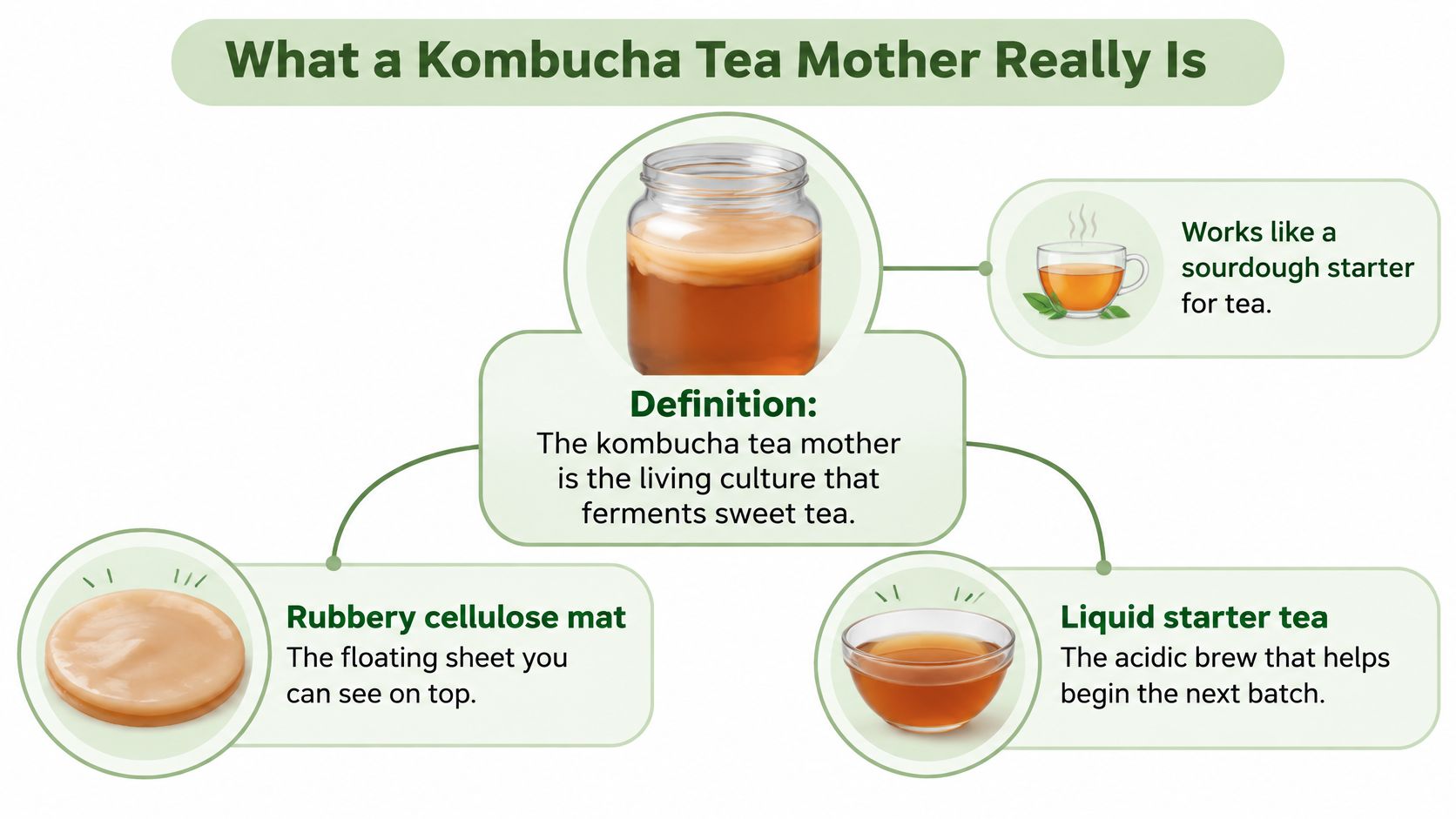
A working culture has two connected parts. The rubbery, cellulose-based sheet, called the pellicle, provides a microbial habitat, while the cloudy starter liquid carries active organisms and acids into the next batch. Passing on a dry-looking mat without sufficient liquid misses an important part of the starter.
The diagram separates the visible sheet from the liquid culture.
Why it isn't a tea mushroom
The nickname describes its unusual appearance, not what it is. A mother isn't a mushroom, and its thickness isn't a measure of brewing skill. Tea colour, age and fermentation conditions all affect its appearance.
A young pellicle often looks pale, translucent and uneven before becoming cream or light tan. A moist, smooth or gently wrinkled surface can be normal, but appearance remains a screening check rather than proof of safety.
What brewers actually monitor
The Food Standards Australia New Zealand fermentation guidance describes freshly prepared tea at approximately pH 5, cooling from 60°C to 20°C within 2 hours, acidification to pH 4.2 or below, and a typical finished pH of at least 2.5. Those stages are laid out in the fermentation table below.
The mother isn't the finished drink. Brewers remove the mat when the beverage reaches the intended endpoint, reserving suitable starter liquid for future brewing.
Practical rule: A handsome pellicle isn't a substitute for a measured fermentation process.
How the Mother Drives Fermentation
The culture uses sugar as food, but fermentation isn't just sugar disappearing. Yeasts produce ethanol and carbon dioxide, while acetic-acid bacteria help convert ethanol into acetic acid when oxygen is available. Other organic acids also contribute to the finished flavour.
A conveyor-belt analogy helps: sugar enters the process, microorganisms transform it, and the drink becomes progressively more acidic. However, reaching the target doesn't automatically switch the conveyor off. The brewer has to manage what happens next through processing, bottling and storage.
pH stages during kombucha fermentation
| Stage | Approximate pH | What Is Happening |
|---|---|---|
| Sweetened tea just brewed | About pH 5 | Tea can support contaminants, so add the starter promptly after cooling |
| Cooling from 60°C to 20°C | Within 2 hours, a cooling window rather than a pH reading | Prompt cooling limits time for unwanted growth before adding the mother |
| Active fermentation | Falling steadily | Microbes transform sugars into acetic acid and other organic acids |
| Ready to remove the mother | 4.2 or below | Acidity reaches the guidance threshold for preventing pathogen growth and toxin production |
| Typical finished drink | Around 2.5 or higher | Brewers avoid excessive acidity, which can make the drink harsh or unpalatable |
The cooling row records time and temperature rather than acidity. Keeping those measurements separate matters: cool tea isn't necessarily acidic tea, and acidic tea isn't necessarily free from every other hazard.
Why timing alone doesn't work
A warmer room generally encourages faster microbial activity, while a cooler room slows it. A longer fermentation usually produces a more acidic drink with less residual sugar, but it doesn't establish a precise sugar content or guarantee that alcohol has disappeared.
Acidity is an important safety barrier, not a way to rescue dirty equipment or a contaminated starter. Nor does a pleasantly tart flavour prove that the correct endpoint has been reached.
Use taste to judge flavour only after the batch has passed your safety checks. Use pH to track acidification, and remember that pH doesn't measure alcohol, sugar or bottle pressure.
Getting Your First Mother
Where does a mother come from? The most straightforward option is a brewing starter from a trusted supplier or an experienced home brewer who can explain how the culture has been maintained.
Ask for the pellicle with its acidic starter liquid, not just the rubbery sheet. A café or brewery may also share cultures, but don't assume every venue's culture is suitable because it serves kombucha.
A sensible start-up routine
- Choose a documented recipe. Use plain black or green tea and the specified sugar and starter quantities. Don't combine ingredient ratios from unrelated recipes.
- Brew the tea with potable water, dissolve the sugar and remove the leaves. Sugar feeds fermentation, so replacing it with a non-fermentable sweetener changes the process.
- Cool promptly before adding the culture. Use a clean glass vessel, and keep utensils and hands clean.
- Add the starter liquid and mother, then secure a tightly woven breathable cover over the jar. Keep it out of direct sunlight.
- Record the batch. Note the recipe, start date, temperature conditions and pH readings, then verify the endpoint before bottling.
Plain, unpasteurised kombucha can sometimes supply a living starter, but not every retail bottle is suitable. Pasteurised products won't provide the same live culture, and flavour additions complicate a beginner's first batch.
Choose a starter for its known brewing history, not for the size of its mat.
How to Care for and Store Your Mother
Good SCOBY care is mostly about consistency. Keep the workspace clean, protect the culture from heat and contamination, and retain enough suitable starter liquid for the next recipe.
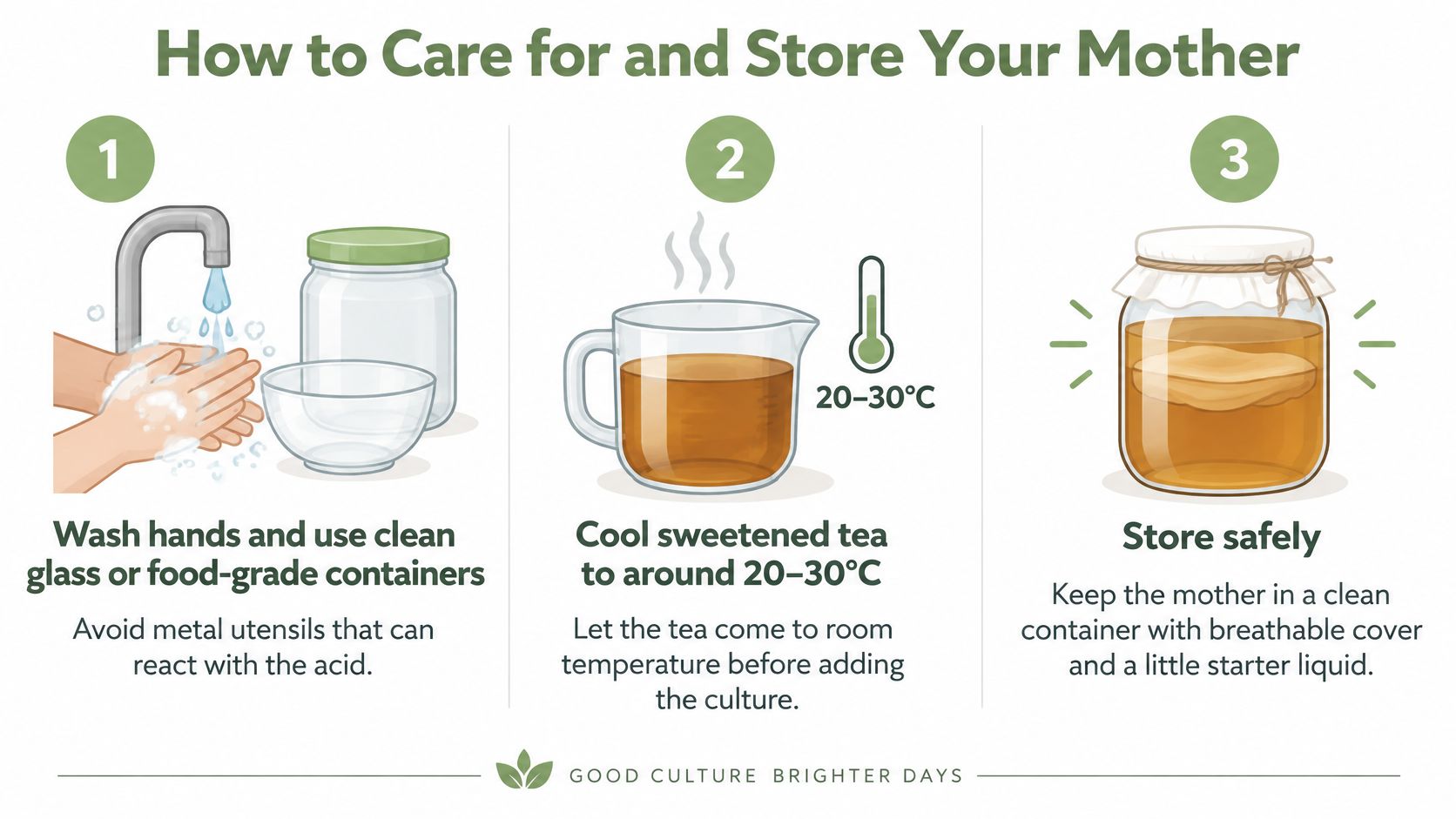
The care essentials are straightforward.
During regular brewing
- Clean before handling. Wash your hands and use clean glass or food-grade equipment, because every transfer creates an opportunity to introduce unwanted organisms.
- Let freshly brewed tea cool completely before adding the culture. Hot tea can damage the microorganisms you're trying to maintain.
- Reserve starter liquid deliberately. Follow your established recipe rather than estimating a small splash, because the liquid supplies both organisms and acidity.
- Cover the jar with tightly woven breathable material secured by a band. This allows airflow while keeping insects and dust out.
- Choose a stable location. Keep the jar away from direct sunlight, cleaning sprays and strong odours, with enough space to inspect it without constantly moving it.
- Refresh the culture through planned batches, using measured progress rather than a rigid calendar. A kitchen that changes with the seasons won't always produce the same fermentation speed.
Use utensils compatible with acidic foods. Stainless steel is suitable for brief handling, but avoid reactive metals and containers that aren't intended for food contact.
When you're taking a brewing break
Keep the mother submerged in suitable starter liquid in a clean container, following the starter supplier's storage guidance. Label it clearly so nobody mistakes the contents for a ready-to-drink beverage.
Refrigeration slows activity, but it doesn't sterilise the culture or guarantee that fermentation has stopped. If your storage method uses a lid, don't assume a tightly sealed jar can be left unattended without pressure management.
Before restarting, inspect the stored culture and its liquid. Discard anything suspicious rather than trying to revive it with fresh tea, and verify that the next batch acidifies properly before treating it as drinkable kombucha.
A mother benefits from organised, regular care. Keeping spare cultures doesn't remove the need to monitor them.
Common Problems and How to Fix Them
Fuzzy mould means discard the mother and the whole batch. Many other odd-looking features are normal, but don't let that reassurance override clear contamination signs.
Raised, fuzzy coloured growth is different from a wet, translucent film. A rotten or putrid smell is also different from the clean sourness of fermentation. Don't scrape away suspicious patches and reuse what remains.
Kombucha mother symptoms, causes and fixes
| Symptom | Likely Cause | What to Do |
|---|---|---|
| Fuzzy green, blue, black or pink patches | Mould or other contamination | Discard the mother and batch, never scrape and reuse |
| Unusual slimy patches or rotten smell | Contamination or spoilage | Discard the mother and batch |
| Brown, stringy strands hanging below | Yeast strands, usually normal | Strain or remove them before drinking if preferred |
| Floating, sinking or wrinkled mother | Normal positioning and changes associated with gas, handling or age | No corrective action if the batch is otherwise healthy and acidifying |
| Thin, translucent or patchy mother | Young or recently transferred culture | Allow it to develop through subsequent properly managed batches |
| Slow or no fermentation | Cold conditions, weak starter or insufficient starter liquid | Check temperature and recipe, then restart with reliable starter if acidification is inadequate |
| Vinegar-sharp taste | Fermentation ran too long or too warm | Adjust the next batch's timing or location after checking its measurements |
Slippery isn't automatically spoiled
A healthy cellulose mat is naturally wet and slippery. The warning sign is an unfamiliar change, especially localised discolouration, abnormal patches or an offensive smell, rather than the ordinary gelatinous feel of a pellicle.
Likewise, a brown strand underneath the mat isn't the same as a fuzzy patch growing on its surface. Look at the location, texture and overall condition rather than judging by colour alone.
When in doubt, discard. Losing a batch is preferable to experimenting with a potentially contaminated drink.
Don't taste a questionable batch to diagnose it. Clean the equipment thoroughly and replace the starter before brewing again.
Keeping Home Kombucha Safe to Drink
Start with clean equipment, potable water and a trustworthy culture. If you filter your water, maintain the filter properly, then brew and cool the tea hygienically. An unknown mother from an unclean container isn't a useful shortcut.
The Australian fermented beverages issues paper discusses Macquarie University work in NSW describing communities of acetic-acid bacteria, fermenting yeasts and sometimes lactic-acid bacteria. This mixed ecosystem explains why transferring a culture doesn't guarantee identical chemistry in the next batch.
Check acidity with the right tool
Use strips designed for acidic food measurements, following their reading instructions and checking whether tea colour makes the result difficult to interpret. A calibrated digital pH meter can make repeated checks easier, provided you maintain and calibrate it correctly.
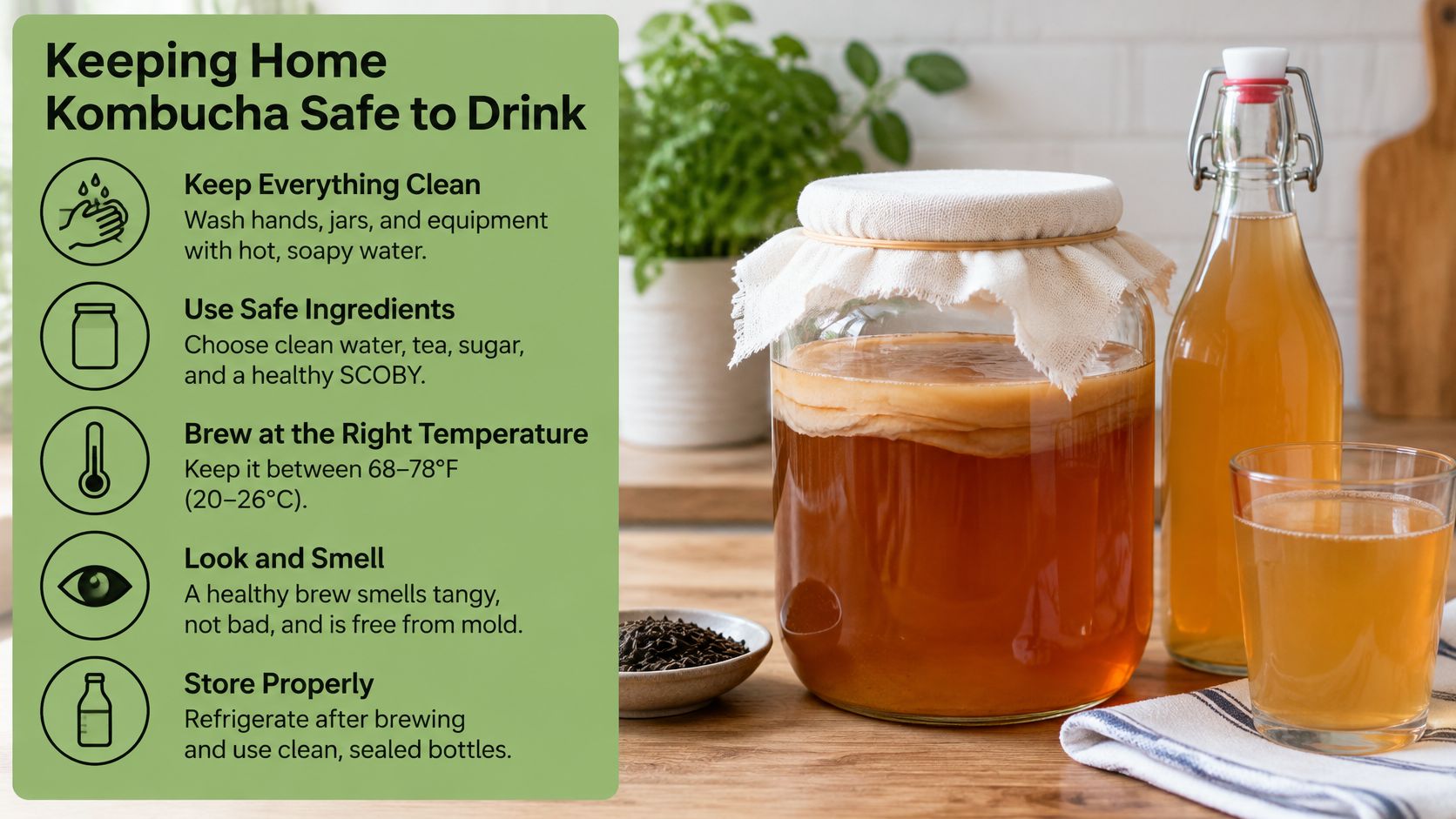
These practical reminders belong beside the brewing jar.
Low alcohol isn't zero alcohol
The FSANZ 2025 fermented soft drinks survey found excess or undeclared alcohol in a proportion of samples and reported that alcohol increased during shelf life in some kombucha and water-kefir samples.
Added fruit, residual sugar and warm storage can support further fermentation after bottling. Taste can't distinguish reliably between low alcohol and zero alcohol, and neither fizz nor a pH reading answers that question.
- Refrigerate finished kombucha. Cold storage slows further activity but doesn't establish an alcohol result.
- Manage pressure cautiously. Use pressure-rated bottles and open chilled bottles carefully. Burping isn't a substitute for controlled fermentation or suitable packaging.
- Match the drink to the person. Drivers, pregnant people, children and people in recovery shouldn't rely on assumptions about homemade alcohol content.
If avoiding alcohol is essential, choose a product with appropriate verified alcohol information rather than treating homemade kombucha as alcohol-free.
Safety Rules for Cafés and Hospitality Venues
Alcohol content bands and labelling actions
| ABV Band | Labelling Requirement | Venue Action |
|---|---|---|
| Below 0.5% ABV | The declaration bands below don't establish a zero-alcohol claim | For a non-alcoholic offering, keep batch records and confirm current NSW guidance |
| 0.5% to 1.15% ABV | Wording that the drink contains no more than the stated percentage of alcohol by volume | Obtain compliant labelling, retain testing information and rotate stock cold |
| Above 1.15% ABV | Alcohol stated as % ABV, mL/100 mL or mL/100 g | Don't present it as a non-alcoholic menu item |
The FSANZ alcohol-content and labelling summary sets out the declaration wording for beverages containing 0.5% to 1.15% ABV and alcohol-content statements for beverages above 1.15% ABV. These are labelling bands, not permission to call a drink zero alcohol.
Build checks into receiving and service
Ask suppliers how they verify alcohol throughout shelf life, not just immediately after brewing. Retain relevant batch records, follow storage instructions and rotate stock so older bottles aren't forgotten behind newer deliveries.
For NSW service, confirm the current requirements for marketing kombucha as non-alcoholic with the relevant food authority. Don't assume a general labelling table resolves every menu claim.
- Check the finished product. Residual sugar and secondary fermentation can change the bottle after its initial test.
- Separate mixers from alcoholic serves. If staff add spirits, make that clear in the menu description.
- Treat on-site brewing as food production. A suitable kombucha brewing container helps organise equipment, but it doesn't replace a validated process or testing.
Manufacturers need controls across production and shelf life, while venues must maintain appropriate receiving, storage and service practices. A living mother isn't compliance evidence.
Choose Between Growing Your Own and Buying Tested Kombucha
Home brewing suits people who enjoy tending a culture and keeping records. Buying a clearly labelled, tested product is often more practical when consistency matters more than the brewing experience.
The choice starts with whether you want to manage the process yourself.
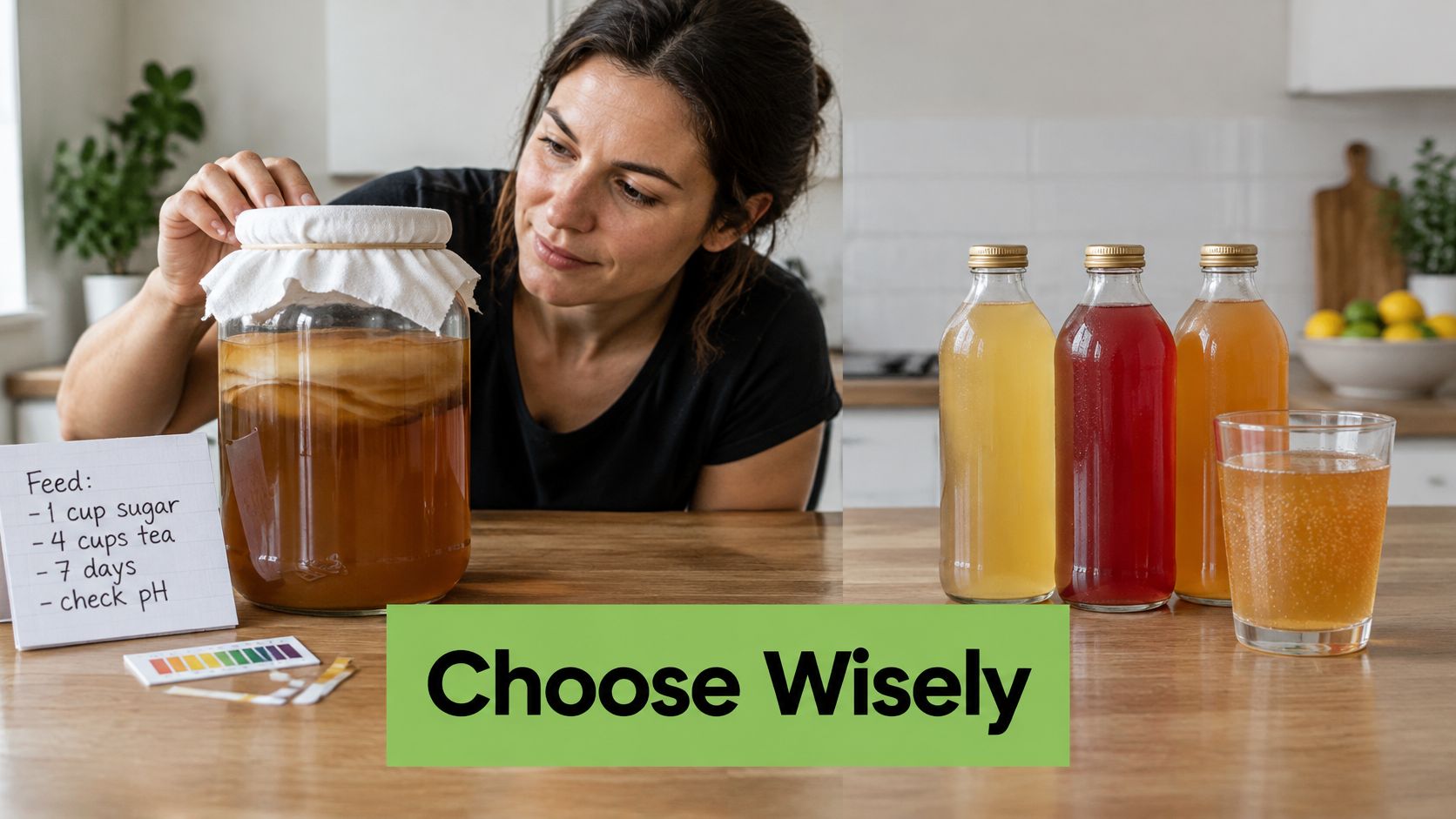
- Time and attention. Can you clean equipment, maintain the starter and record each batch?
- Alcohol requirements. Does your household or menu need verified alcohol information?
- Serving volume. Can your process meet café demand without shortcuts?
- Sugar goals. Do you need a labelled sugar result rather than an estimate based on tartness?
Our store-bought kombucha versus homemade guide can help you compare the practical trade-offs. For another perspective on checking wellness claims, GutRx explains independent verification for gut health supplements. Supplement testing isn't a kombucha safety standard, but the useful question is similar: what was tested?
This brewing video offers another way to explore the process.
Whichever route you choose, judge the finished drink by its process, measurements and labelling, not by the presence of an impressive mother. Live cultures alone don't establish a specific probiotic benefit or guarantee a suitable drink for everyone.
Pep Tea offers sugar-free organic kombucha brewed in the Hunter Valley, NSW, with flavours including Ginger, Lime & Ginger and Mango. Visit Pep Tea to explore the range and ask about product information for your household or café, including storage guidance and alcohol verification relevant to your needs.