
No Sugar Added Apple Juice: What the Label Really Means
“No added sugar” sounds like a health upgrade. On a bottle of apple juice, it often isn't. The phrase tells you what the manufacturer didn't put in, not how much sugar the apples contributed. A juice can contain no added sugar and still deliver a concentrated dose of the fruit's natural sugars, with very little of the fibre that makes a whole apple filling.
That distinction matters in Australia, where a small amount of unsweetened fruit juice can count as fruit, but juice isn't treated as an unlimited substitute for eating fruit. It also matters if you're choosing drinks for children, managing your weight, comparing café options, or trying to reduce sugar without falling for a reassuring front label.
What No Sugar Added Really Means on Your Juice Bottle
No sugar added apple juice isn't sugar-free. It's juice made without added sugars or certain sweetening ingredients. The apples still bring their own naturally occurring sugars, including fructose and sucrose, and pressing removes much of the fruit's original structure.
Think of the label as an ingredients statement, not a nutrition guarantee. “No added sugar” answers one question: Was extra sugar added during production? It doesn't answer another important question: How much total sugar is already in the finished drink?
The café test
Suppose a café pours a generous glass of apple juice from a bottle labelled “no added sugar”. The drink may taste fresh and less obviously sweet than a soft drink, but the total sugar still comes from the apples. If the glass is large, the serving can contain a substantial amount of sugar, even though nobody added a spoonful of table sugar behind the counter.
That's where the popular advice goes wrong. Shoppers often compare the front labels of juice and soft drink, then assume the juice is automatically the healthier everyday choice. A more useful comparison includes total sugars, energy, fibre and portion size, not just the absence of added sugar.
The label describes the recipe. The Nutrition Information Panel describes what you're drinking.
What can change the claim
A manufacturer can make a no-added-sugar claim when the product contains natural sugars from its fruit and no disallowed sweeteners have been added. But ingredients that increase sweetness, such as sugar, syrup or a sweetened concentrate, change the formulation and may prevent the claim.
The details matter because fruit-derived ingredients aren't all interpreted in the same way when they're added to a product. An apple juice made from apples is different from an apple drink sweetened with another fruit concentrate. Reading the ingredients list helps you spot that distinction.
The rest of the bottle deserves attention too. “Natural”, “pure” and “100% juice” can describe the product's composition or positioning, but none of those phrases means the drink has the fibre, chewing time or satiety of a whole apple.
The Australian Rules Behind the No Added Sugar Claim
In Australia, “no added sugar” is a regulated claim about ingredients. FSANZ materials explain that a singular fruit product, such as apple juice sold as the food itself, may use the claim when no added sugars or other disallowed ingredients have been included. The key issue is whether sweetness has been added, not whether the finished drink contains sugar.
Ingredients that can disqualify the claim
The formulation generally needs to avoid added sweetening ingredients such as:
- Refined sugar: This includes the familiar forms used to sweeten beverages.
- Honey and syrups: These add sugar even when the marketing language sounds natural.
- Malt-based sweeteners: Malt can contribute sweetness and affect eligibility.
- Fruit concentrate used as a sweetener: Grape or pear juice concentrate added to make apple juice sweeter isn't the same as the natural sugar already present in the pressed apples.
FSANZ proposal materials also distinguish a singular fruit juice from a blend containing fruit juice and fruit purée. That distinction shows why the product's full ingredient description matters, rather than relying on the front panel alone. You can read more about the practical difference between sugar-free drinks and products that avoid added sugar in this guide to no-sugar soft drinks.
A simple supermarket check
Start with the ingredients list. If you see sugar, honey, syrup, malt or another sweetening ingredient, the product isn't the straightforward no-added-sugar formulation shoppers usually expect.
Then check the Nutrition Information Panel. A compliant claim doesn't require the total sugars line to be zero, because natural sugars from apples remain in the drink. That's the point many shoppers miss.
Australian labelling rules also distinguish “low sugar” from “no added sugar”. For packaged drinks, a low-sugar or percentage-sugar-free claim requires no more than 2.5 g of sugars per 100 mL, according to the national sugar-labelling policy paper. Apple juice with natural fruit sugars is generally nowhere near that threshold, so no added sugar and low sugar shouldn't be treated as interchangeable descriptions.
How Much Sugar Is Actually in No Added Sugar Apple Juice
Australian retail examples show why the front-of-pack wording can create a misleading health halo. Typical apple juices sit around 10.1 to 12.7 g of sugars per 100 mL, with examples including Daily Juice Company Apple No Added Sugar at 10.1 g per 100 mL and Nudie 100% Apple Juice at 12.2 g per 100 mL. These figures come from Australian product and retail information compiled for apple juice comparisons, including the Golden Circle apple fruit juice listing.
Energy follows the same pattern. No-added-sugar retail apple juices commonly provide around 184 to 211 kJ per 100 mL, which makes them closer to standard apple juice than to a reduced-sugar drink. A Nudie Nothing But Apple Juice product listing provides a useful Australian retail benchmark.
The serving size changes the picture
A 500 mL serve can contain roughly 50.5 g of sugar and about 920 kJ, based on the Australian retail benchmark cited above. That's a large amount for a drink that many people consume quickly and don't experience as a full snack.
The Australian Beverages Council's summary of juice research gives broader population context. Fruit juice contributes 0% of added sugar intake, because its sugars occur naturally, while contributing 3.5% of total sugar intake and about 1% of energy in the population, as described in the FSANZ consumer evidence material. Those figures don't make juice sugar-free. They show why added sugar and total sugar are separate nutrition questions.
| Product type | Total sugars (g/100 mL) | Energy (kJ/100 mL) | Ingredient sweetener |
|---|---|---|---|
| No-added-sugar apple juice examples | 10.1 to 12.7 | 184 to 211 | No added sweetener, natural apple sugars remain |
| Low-sugar packaged drink threshold | No more than 2.5 | Not specified | Claim threshold, not an apple juice profile |
A no-added-sugar claim can therefore be accurate while the drink remains high in natural sugar. The absence of added sugar doesn't reduce the sugar density created by pressing apples.
How to Read a Juice Label Without Getting Misled
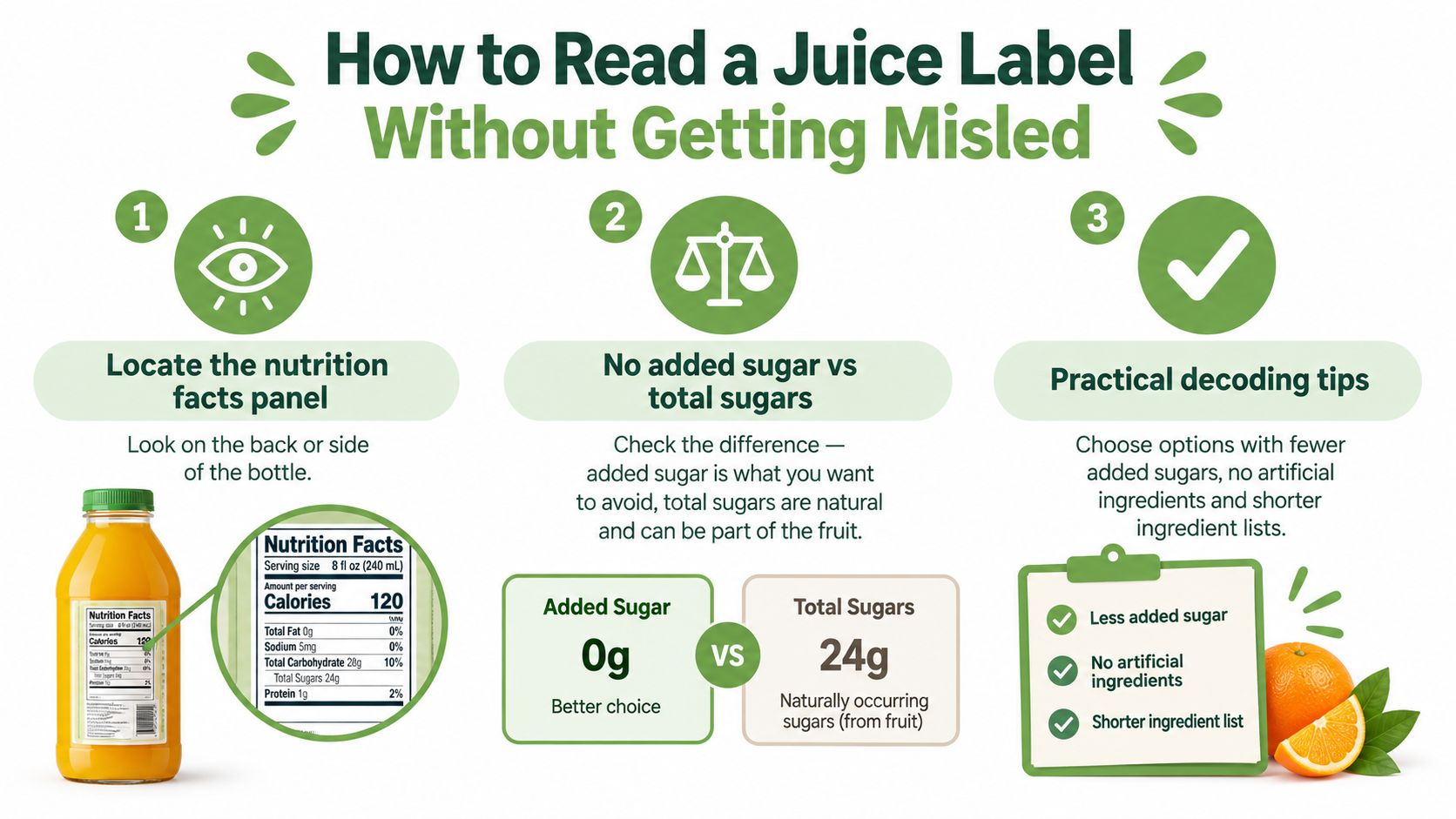
The most reliable place to start isn't the front of the bottle. Turn it around and work through the information in a fixed order.
Use this three-part check
- Locate the Nutrition Information Panel. Look for total sugars per 100 mL. This lets you compare products on the same basis, even when brands use different serving sizes.
- Separate “no added sugar” from total sugars. The claim describes added ingredients. The sugars line includes the naturally occurring sugar remaining in the juice.
- Read the ingredients statement. Look for apple juice, concentrate, purée, flavouring and other additions. A product may be marketed with orchard imagery while its formulation is more complicated than the picture suggests.
Calculate your actual pour
The panel may list a neat serving size, but your glass might hold considerably more. Multiply the sugar per 100 mL by the amount you pour, then divide by 100. This calculation is more useful than comparing bottle fronts.
Health stars and similar front-of-pack devices can help with quick scanning, but they don't replace the detailed panel. Use them as a starting point, then verify the total sugars and serving size yourself. If you're comparing juice with other non-alcoholic options, the same habit works when choosing sugar-free carbonated drinks.
Practical rule: Check total sugars per 100 mL, multiply by your real pour, and treat “natural” imagery as marketing rather than nutrition evidence.
No Added Sugar Juice Against Sweetened Juice and Whole Apples
No-added-sugar apple juice has one clear advantage over sweetened apple juice: the manufacturer hasn't added sugar to the recipe. It doesn't automatically beat a whole apple, because the pressing process changes the way the fruit is consumed.
A whole apple requires chewing and retains its fibre. Juice delivers the fruit's sugars in a form that's easier to drink quickly, while the pulp and much of the original structure are absent. LiveLighter's Australian analysis highlighted that a 500 mL bottle of branded apple juice marketed with no added sugar can provide energy equivalent to around 4.3 to 5 apples, while supplying less than 1 g of fibre. The comparison is a useful warning against treating juice as nutritionally identical to whole fruit.
Kombucha sits in a different category. A sparkling kombucha blend can offer acidity, carbonation and fermentation-derived flavour, but you still need to check the individual product's Nutrition Information Panel. It shouldn't be assumed that every kombucha is sugar-free or that every apple-flavoured drink has the same sugar profile.
| Drink or food | Serve size | Total sugars (g) | Energy (kJ) | Fibre (g) |
|---|---|---|---|---|
| No-added-sugar apple juice | 500 mL | Roughly 50.5 | About 920 | Less than 1 |
| Sweetened apple juice | Varies | Product-dependent | Product-dependent | Product-dependent |
| Whole apples | Comparable fruit amount varies | Product-dependent | Product-dependent | Retained in the whole fruit |
| Apple-flavoured kombucha | Product serving | Check the product label | Check the product label | Check the product label |
The table's missing values are deliberate. Without a verified label for a specific sweetened juice, whole apple size or kombucha product, assigning a number would create false precision.
The practical conclusion is context-dependent. No-added-sugar apple juice may be a preferable choice to a sugar-sweetened drink, but it isn't a free pass against soft drink alternatives, and it doesn't offer the same fibre and satiety as eating an apple. For a café, it can work as a small menu serve or mixer. For an everyday drink, water remains simpler.
Where Apple Juice Fits in Australian Dietary Guidance
Australian guidance treats unsweetened fruit juice as a limited fruit serve, not as an unlimited beverage. The Australian Dietary Guidelines guidance cited by the Australian Beverages Council says an occasional 125 mL glass of fruit juice with no added sugar counts as one serve of fruit, while the Australian Bureau of Statistics explains that half a cup can occasionally count as one fruit serve in the relevant dietary guidance. You can review the ABS material on consumption of food groups under the Australian Dietary Guidelines.
That serving rule gives shoppers a useful reality check. A 250 mL glass is twice the cited occasional serving volume, so it shouldn't be mentally filed as “just one piece of fruit”. The drink may come from apples, but it lacks the whole-fruit experience that slows eating and supports fullness.
Juice intake is changing
The ABS reports that fruit and vegetable juices fell to 32.5 mL per capita per day in the year to June 2024, down 2.5 mL, or 7.1%, from the prior year. That decline suggests Australians are drinking less juice overall, while sparkling water, tea-based drinks and kombucha provide other ways to add variety.
Most individuals find that no-added-sugar apple juice makes more sense as an occasional option than a daily hydration staple. If you're managing diabetes, body weight or blood-glucose responses, treat the juice as a concentrated carbohydrate source and discuss your individual approach with your healthcare professional. Pairing a small serve with a meal containing protein or fibre may be more satisfying than drinking it alone, but it doesn't erase the juice's sugar.
Cafés and restaurants also need to think beyond marketing language. Serving guidance, accurate menu descriptions and safe handling all matter, so businesses can use resources such as food safety compliance for restaurants when reviewing their broader beverage practices.
Using No Added Sugar Apple Juice in Kombucha and Recipes
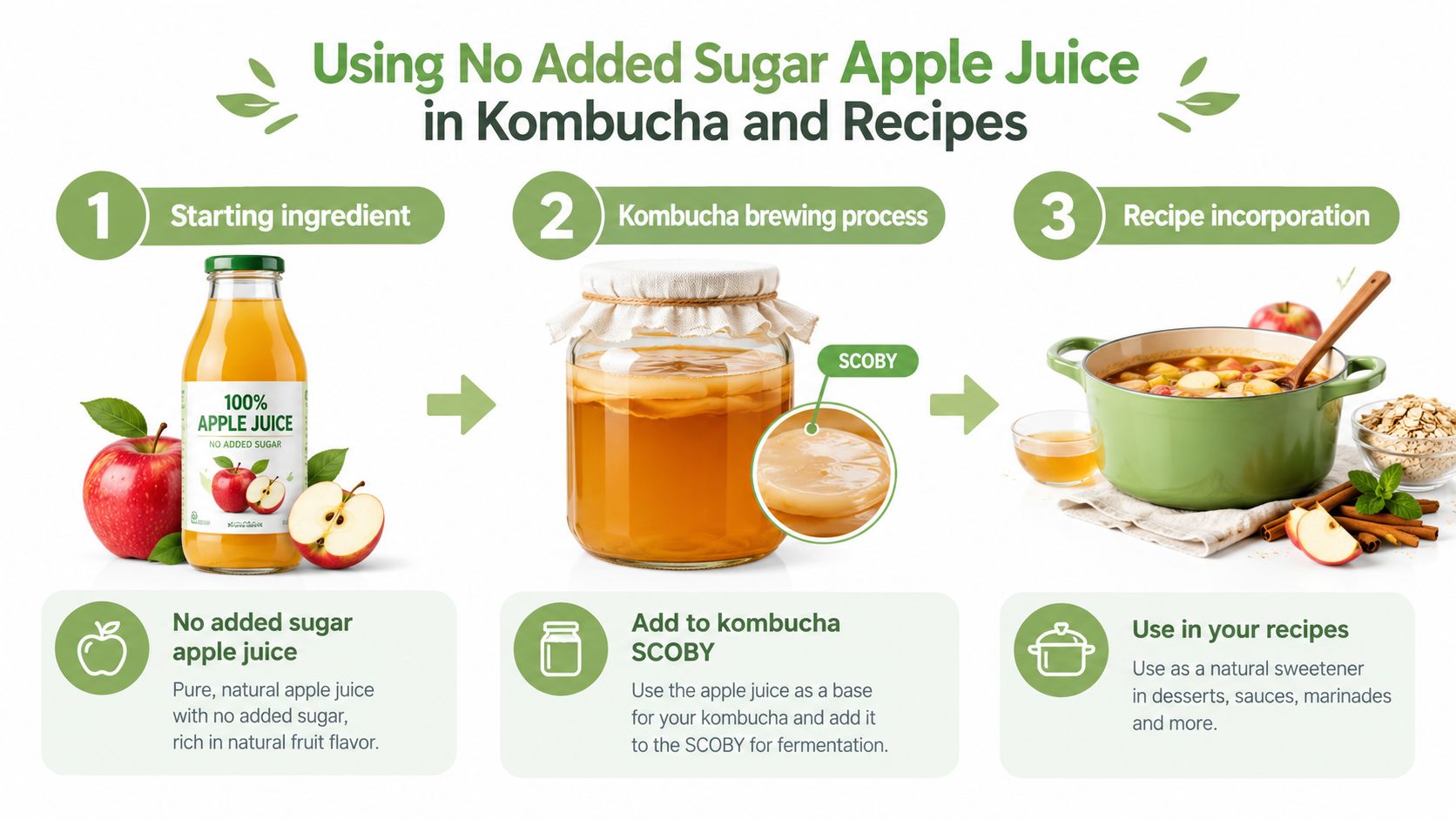
Apple juice can be useful in the kitchen when you treat it as a sweet ingredient rather than a free drink. Its natural sugars can support fermentation, add acidity and apple character to dressings, or bring moisture and flavour to a glaze.
For a secondary kombucha ferment, a home brewer might combine 250 mL apple juice with 750 mL green tea starter, then ferment the sealed mixture for 3 to 5 days at 22 to 25°C. Those figures are a practical recipe ratio, not a universal safety guarantee. Fermentation depends on the culture, acidity, temperature, bottle pressure and hygiene, so use suitable equipment and follow a tested method. Pep Tea's guide to kombucha second fermentation can help with the process.
Recipe uses beyond the glass
Try a modest amount in food:
- Glaze: Reduce 60 to 80 mL with savoury ingredients for pork or roasted vegetables.
- Vinaigrette: Whisk a splash into mustard and oil to balance bitter greens.
- Spritzers: Freeze juice into ice cubes and use one cube to add apple flavour gradually.
The “no added” part still doesn't make the ingredient sugar-free. If you use 125 mL in a recipe or drink, that amount fits the occasional fruit-serve guidance and displaces the equivalent fruit serve elsewhere in the day.
For a visual introduction to the process, this fermentation demonstration may help:
Keep batches small, label the date, and refrigerate finished drinks when the flavour and carbonation suit you. Never assume that a naturally fermented beverage is automatically low in sugar or safe without attention to hygiene and storage.
Lower Sugar Alternatives You Can Make at Home
You can keep apple flavour without making juice the main ingredient. The simplest option is a 50/50 spritzer: combine 100 mL no-added-sugar apple juice with 100 mL sparkling water and add lime. That creates two serves, so each glass contains half the sugar of the undiluted juice used in the recipe.
Build flavour with less juice
A cold apple infusion uses aroma rather than a full juice load. Place chopped Granny Smith skins and cores in 1 L of cold water overnight, then strain and serve chilled. The result is faintly apple-flavoured and contains only a fraction of the sugar found in juice, although the exact amount depends on the fruit and how much dissolves into the water.
For a sharper drink, combine celery with a smaller amount of apple in a home juicer. Celery dilutes the apple's natural sugars and adds a savoury note, but it doesn't turn the drink into a fibre-rich whole-food replacement. A pinch of salt, fresh ginger, a cinnamon stick or a few drops of apple cider vinegar can make a diluted drink taste fuller without adding sugar.
| Drink (250 mL serve) | Total sugar (g) | Energy (kJ) | Fruit serves |
|---|---|---|---|
| Undiluted no-added-sugar apple juice | Product-dependent | Product-dependent | Depends on the amount used |
| 50/50 apple juice and sparkling water | Approximately half the juice recipe's sugar | Approximately half the juice recipe's energy | Depends on the amount of juice |
| Cold apple skin and core infusion | Qualitatively low compared with juice | Qualitatively low compared with juice | Not equivalent to eating whole fruit |
| Apple and celery juice | Recipe-dependent | Recipe-dependent | Depends on the apple quantity |
Freeze measured portions in 30 mL silicone moulds for smoothies, dressings or kombucha starters. Portioning before you need the ingredient prevents a generous pour from becoming the default.
For a ready-made alternative with a different flavour profile, Pep Tea offers organic kombucha options including Apple Pomegranate, described by the brand as sugar free. Check the product information and serving guidance for the specific drink you choose, then explore the wider Pep Tea range for organic tea and kombucha options that can replace sweet drinks without confusing “no added sugar” with “no sugar”.