
Tag: can kids drink kombucha
Can Kids Drink Kombucha? Age Guide, Caffeine and Safety
There's no official age limit for kombucha in Australia, but the workable answer is conditional: healthy school-age children and teenagers can generally try small, occasional serves of sealed commercial kombucha that's clearly labelled non-alcoholic, around 100 to 125 ml for a primary-schooler and up to 250 ml for a teen. Babies, toddlers and preschoolers shouldn't be given it at all, home-brewed batches stay off the kids' table, and a GP should be asked first if a child is immunocompromised or has anxiety, sleep, reflux or heart concerns.
The question usually lands at the kitchen bench on a Saturday, or across a café table when an eight-year-old points at the sweating bottle in your hand and asks for a taste. You're holding something that looks like a soft drink, reads like a health product and ferments like a beer, and you've got about three seconds to answer.
The practical rule: a small, occasional serve of a sealed, labelled commercial bottle for a healthy school-age child or teen. Water and milk for babies, toddlers and preschoolers. Nothing home-brewed for children. A GP conversation first if there's any health condition in play.
The answer can't be a plain yes. Kombucha is fermented tea, so every bottle carries a little caffeine from the leaves, a trace of alcohol from the yeast, organic acids that give it the sour bite, live cultures and, in many brands, added sugar or juice. A 30 kg child doesn't process any of that the way a 75 kg adult does.
We brew kombucha in the Hunter Valley, so this question reaches us most weeks, usually with a photo of a bottle attached. What follows is the version we'd give you in person: an age-by-age serving table, the caffeine maths you can run in your head, what the alcohol ceiling on a "non-alcoholic" label permits, the sugar and live-culture story, and the point where a health professional should be making the call instead of a blog.
Kombucha Guidance by Age Group
Find your child's row first. The rest of the guide explains why the line sits where it does.
| Age group | Verdict | Practical guidance |
|---|---|---|
| Under 12 months | No | Breast milk, formula and water only |
| 1-4 years | Not recommended | Bodies this small handle caffeine poorly; offer water or milk |
| 5-9 years | Small occasional serve | 100-125 ml with food, from a sealed labelled bottle |
| 10-13 years | Up to 125 ml | Keep it occasional and count other caffeine that day |
| 14-18 years | Up to 250 ml | Pour into a glass, drink with food, count cola, iced coffee and chocolate |
| Any age with a health condition | Ask first | Immunocompromised, anxious, reflux-prone or heart-sensitive children need GP advice first |
What a serve looks like at two ages
Body weight works like a measuring cup here: the same pour is a large dose for a small child and a smaller one for a teen. Say your nine-year-old weighs 30 kg and wants a glass at Sunday dinner. A 125 ml pour from a sealed, labelled bottle carries roughly 5 to 10 mg of caffeine, a small share of the daily ceiling that body weight sets for a child that size. Sugar stays low if you've checked the panel, and serving it with food slows the whole thing down.
Now the harder one. A 14-year-old wants the full 350 ml bottle after school. That's more than the 250 ml teen serve, so share it with a sibling or pour 250 ml into a glass with a meal, then count the cola, iced coffee or chocolate that follows. Two caffeinated drinks in one afternoon is where sleep starts to suffer.
These serves are practical guidance, not an official standard. No Australian food rule sets an age for kombucha, so the numbers come from caffeine limits and food-safety advice rather than a line in a statute.
What the food-safety rules add
A labelled bottle matters more than the brand. For shop-bought kombucha, the useful baseline is a sealed product clearly labelled as non-alcoholic and made under controlled food-safety procedures, as Safe Food Australia sets out. If a bottle is vague about alcohol, ingredients or storage, it fails the parent test before taste even enters the argument.
Australian food-safety guidance treats too much acid, too much alcohol and unwanted microbes as the main kombucha hazards. For a commercial brewer, that means checking the finished batch rather than trusting the recipe, because fermentation can keep moving in a warm bottle.
That's the commercial side. A home batch has none of that checking, and yeast activity, temperature, sugar concentration, storage time and refrigeration all change what ends up in the glass.
- Buy sealed and labelled: a stated alcohol status, an ingredient list and a use-by date.
- Keep it cold: refrigerate as directed, including the trip home from the shop.
- Skip the home brew: unverified alcohol, acidity and contamination risk.
- Treat it as a sometimes drink: not a daily health necessity.
Children with medically reduced immunity are the caution group, whatever their age. Watch the first serve for tummy upset, jitteriness or broken sleep over the next 24 hours before you offer a second.
What Kombucha Is, Alcohol and Acidity
Kombucha is to tea what yoghurt is to milk. Milk plus cultures becomes something thicker, tangier and alive; sweet brewed tea plus a culture becomes something sour, lightly fizzy and biologically busy. Understanding that shift explains almost every safety question a parent has.
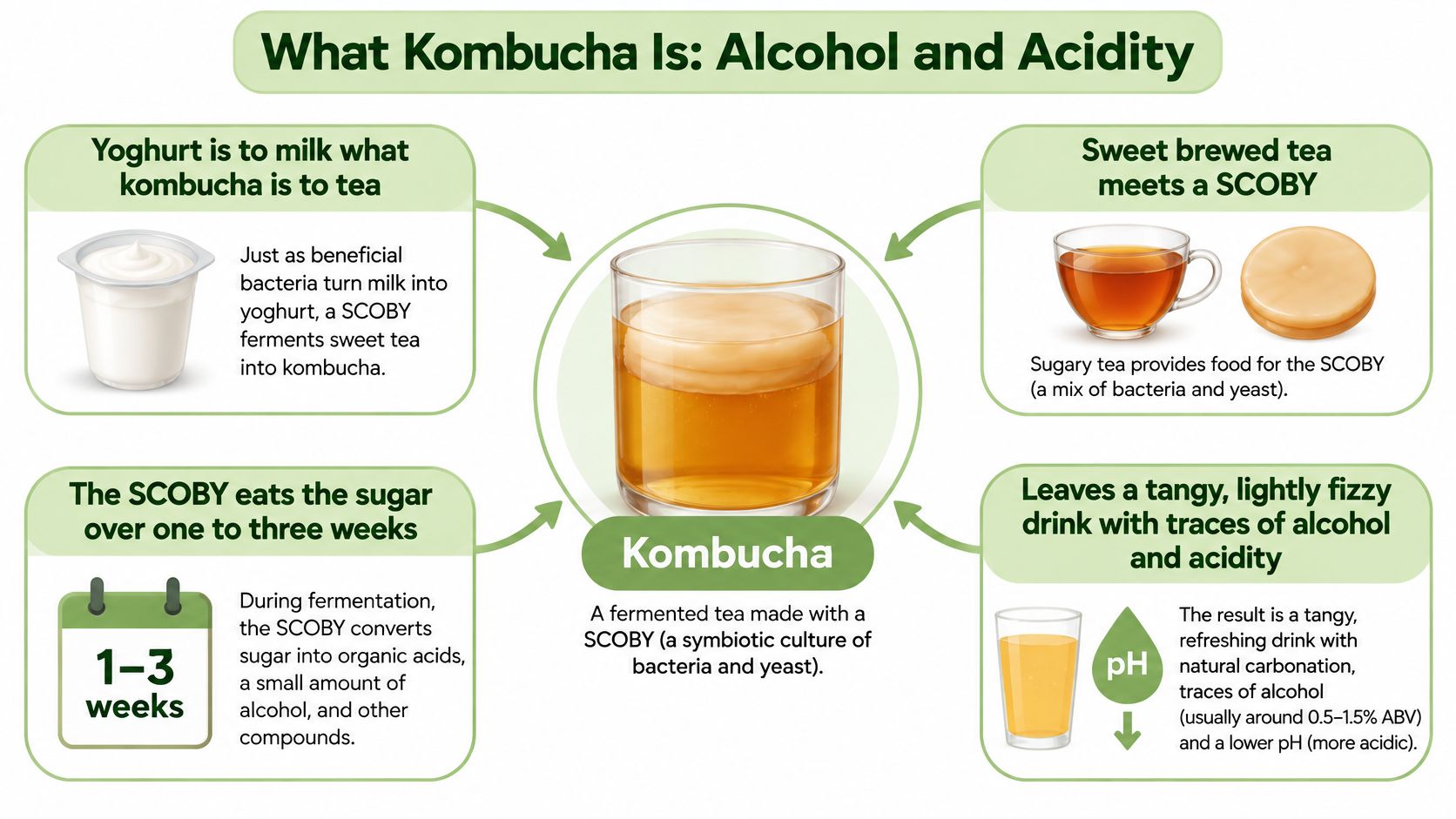
The culture is called a SCOBY, a rubbery disc of bacteria and yeast that sits on top of the brew. Sweetened tea goes underneath it, the yeast eats the sugar, and over one to three weeks you end up with a tangy, gently sparkling drink. Lift the disc off and what's left is very different from what went in.
What fermentation leaves in the bottle
Five things, and four of them are why this is a drink for older kids rather than toddlers. Organic acids create the sour edge and drop the pH. Carbon dioxide creates the bubbles. A trace of alcohol comes from the yeast. Live cultures remain in an unpasteurised brew. And the caffeine from the original tea is still there, because caffeine doesn't ferment away.
FSANZ treats kombucha as a traditional food rather than a novel one, which is why it sits on the shelf rather than behind a counter, but the same Food Standards Australia New Zealand guidance notes that the drink can develop alcohol and become increasingly acidic during fermentation, and that poor hygiene can allow contamination, including mould.
Why non-alcoholic on the label isn't the same as alcohol-free
Australian food rules for non-alcoholic and brewed soft drinks set a maximum of 1.15% alcohol by volume. That figure surprises most parents, and it's the single most useful thing to understand about the bottle in your hand. A drink can legally be called non-alcoholic and still contain alcohol.
The level at purchase isn't the whole story either. Fermentation can keep going after bottling, especially if the bottle sits warm or carries residual sugar, so a product stored badly can drift upward between the brewery and your fridge. A guide to kombucha and Australian kids makes the same point about home batches, which lack the process control, testing, refrigeration and expiry oversight of a commercial product.
Acidity, teeth and why kids aren't small adults
That low pH is doing something to more than your tastebuds. Acidic drinks soften tooth enamel, so serve kombucha with food rather than sipped slowly over an afternoon, and follow it with water. A child who nurses a bottle for two hours is bathing their teeth in acid for two hours.
Children also aren't scaled-down adults. The same glass delivers more caffeine and more acid per kilogram of body weight, their digestive and immune systems are still developing, and the sharp sourness of a properly fermented brew often pushes them towards the sweetest brand on the shelf, which defeats the purpose.
| Check | Commercial, labelled non-alcoholic | Home-brew or over-fermented |
|---|---|---|
| Alcohol | Tested and within the 1.15% non-alcoholic cap | Unverified; can keep rising in the bottle |
| Acidity | pH controlled at bottling | Varies batch to batch; a vinegary, sharp taste signals drift |
| Contamination | Hygiene controls and sealed bottles | Mould and wild organisms possible with poor hygiene |
| Labelling | Ingredients, nutrition, alcohol status, use-by date | Usually none |
| Storage | Refrigerate as directed | Often stored warm or for unknown periods |
| For children | Occasional small serve may be reasonable | Not recommended |
The verdict for children is narrow. Sealed, commercially made bottles that are labelled non-alcoholic, kept refrigerated and drunk inside their date. Home brew stays off the kids' table, because no parent can verify alcohol, pH or contamination at the kitchen bench. If you want to see how a fully fermented, properly labelled bottle reads, our non-alcoholic kombucha range lists the full panel on every bottle.
Caffeine in Kombucha and the Numbers That Matter
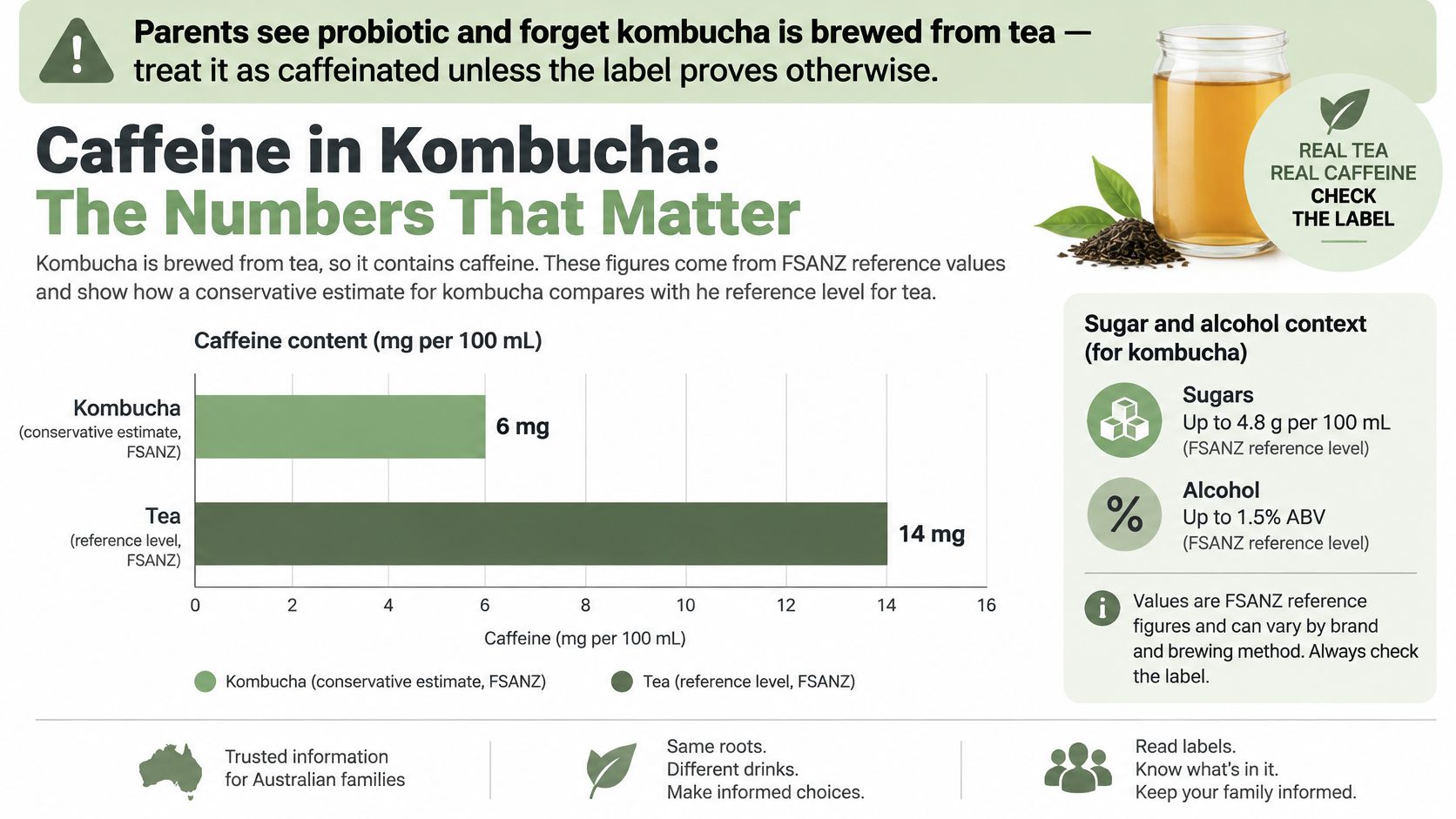
Parents read the word probiotic and mentally file kombucha next to yoghurt. It's brewed from tea, so it carries caffeine, and the label often doesn't say how much.
The body-weight maths
Body weight is the reason children feel caffeine faster than adults do. FSANZ's caffeine review links caffeine intakes of around 3 mg per kilogram of body weight per day to anxiety-type effects in children, extrapolated from adult data, and warns that infants and preschool children are especially vulnerable to acute caffeine poisoning because of their low body weights. The review also places tea, coffee and soft drinks among the leading caffeine sources in Australian studies.
Run the sum. A 15 kg child reaches that level at about 45 mg per day, a 20 kg child at about 60 mg, and a 30 kg child at about 90 mg. Treat those figures as ceilings for planning, arrived at well before you count a single sip.
| Child or group | Approximate daily ceiling or serve |
|---|---|
| 15 kg child | About 45 mg per day |
| 20 kg child | About 60 mg per day |
| 30 kg child | About 90 mg per day |
| Adolescent | Scales with body weight; weight in kg × 3 mg |
| Tea-based kombucha, 250 ml | Small and variable by brand; check the label |
How much caffeine one glass contributes depends on the tea base, how long it brewed, the serve size and the manufacturer's process, which is why the label, or a direct question to the brand, is the only reliable reference for a specific bottle. Green tea bases generally sit lower, while a strongly brewed black tea base sits higher. For a 30 kg nine-year-old, one glass is a modest share of that 90 mg level, but the share grows fast once a Milo, a cola and a square of dark chocolate join the same afternoon.
If you'd like the deeper explanation of why the tea base matters, our guide on does kombucha have caffeine walks through tea type and fermentation.
This short video covers the same ground for anyone who prefers watching to reading.
Why the label often stays silent
Don't count on finding a caffeine figure. Many bottles don't declare one, so the sensible default is to assume a tea-based kombucha contains caffeine unless the label explicitly says otherwise, and to ask the brand if you need a number.
Then apply the counting rule: the number that matters is the daily total across everything a child eats and drinks. Kombucha, ordinary tea, milk chocolate, dark chocolate, cola, iced coffee, energy drinks and supplements all go into the same bucket. A child who has already had a cola at lunch has less room left in the afternoon.
Treat kombucha as a weak iced tea, and assume it contains caffeine unless the label says otherwise.
Sugar and Live Cultures in Kombucha
Two more questions land right after the caffeine one. How much sugar is in it, and are the live cultures good for a child?
Read the sugar line before the front label
Fermentation eats most of the brewing sugar, which is why a well-made kombucha tastes dry rather than syrupy. Many brands then add fruit juice, concentrate, sweetener or flavour after fermentation, and that's where the sugar returns. The front of the bottle won't tell you; the nutrition panel will.
Get into the habit of comparing sugars per 100 ml against a soft drink before you decide whether this belongs in a child's week. Australian dietary advice already steers children towards water and milk instead of sweetened drinks, and a kombucha with 8 g of sugar per 100 ml is a sweetened drink wearing a wellness label.
Sugar-free bottled kombucha is available for families who want the flavour and the cultures without the sugar load. Ours is sugar free across all four flavours, which is the version most parents are looking for.
Are the live cultures good for kids
In ordinary food amounts, fermented foods such as yoghurt, sauerkraut, miso and kombucha are generally fine for healthy children. Kombucha is a food, though, not a treatment. Don't use it to fix a tummy bug, constipation or a child's immunity, and don't swap it for a prescribed probiotic. If you're weighing up live cultures more broadly, this guide to choosing the right live culture supplement explains what matters in a product, and why food sources come first for children.
For the fermentation side of that story, our explainer on live cultures in kombucha covers what survives in the bottle and what doesn't.
The practical serve: 100 to 125 ml over ice with a meal for a school-age child. If they find straight kombucha too sharp, top it with sparkling water and a squeeze of citrus. You've halved the acidity and doubled the volume, and most kids will drink it without negotiation.
Parent FAQs on Kombucha and Kids
Is a sip off my glass a problem? An occasional sip from a sealed, labelled bottle is a different act from a regular serve, and the risk scales with volume and frequency. Babies and preschoolers shouldn't have any, even a taste. For older kids, a sip is fine and often settles the curiosity faster than a refusal.
Is there a caffeine-free kombucha? Don't assume it. Read the label, and if caffeine isn't declared, treat a tea-based brew as caffeinated and ask the brand directly. A rooibos or herbal base behaves differently from a green tea base, but you need the maker to confirm.
Can it go in a lunchbox? Yes, if it stays chilled with an ice pack. Warmth speeds up the fermentation that lifts alcohol and acidity, so a bottle that sits in a school bag on a hot day isn't the same drink you packed. A chilled insulated bottle works; a warm one doesn't.
What should kids drink instead? Water and milk come first, as Australian dietary guidance recommends. Diluted kombucha over ice is an option for older children, not a substitute for the water bottle.
Is kombucha a probiotic treatment for kids? No. It's a food. Use it for flavour and enjoyment, not for tummy bugs, constipation or immunity problems, and get medical advice for those.
Check the label before you buy, every time, because recipes change between batches. And for any health question about your own child, the GP is the first call, not a blog post.
When to Ask a Health Professional First
A small occasional serve suits most healthy school-age kids and teens, but some children need a conversation with the GP or pharmacist before the first glass, not after it.
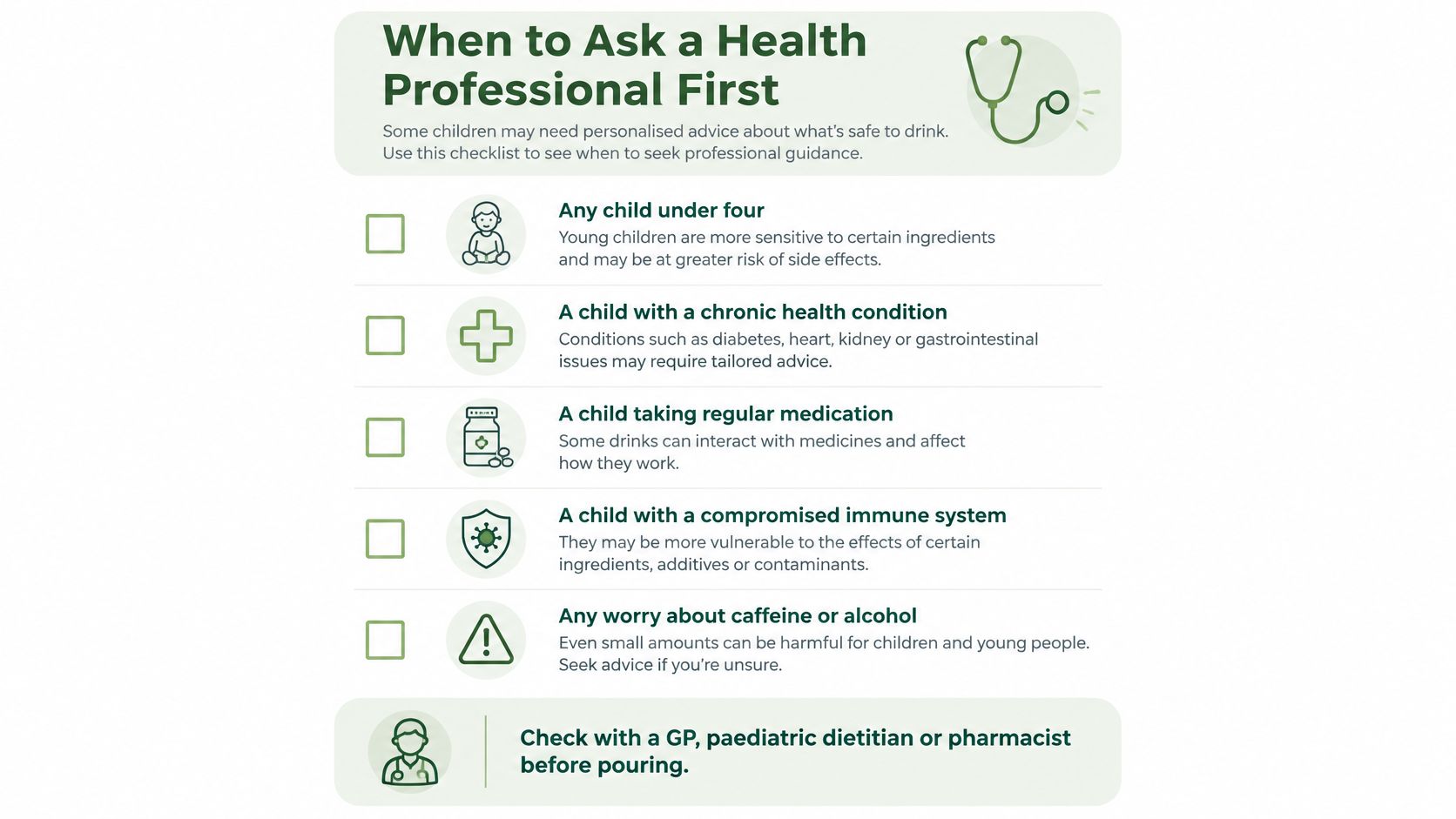
- Any child under four: low body weight turns a modest caffeine amount into a bigger dose per kilo, and the acidity is hard on small stomachs.
- Immunocompromised children, including those on chemotherapy or immune-suppressing treatment, where live cultures and contamination risk need a medical view.
- Anxiety, broken sleep, palpitations or a known caffeine sensitivity, where even a small serve can tip a child over.
- Reflux, gastritis or a sensitive tummy, where the acid bites before the cultures help.
- Diabetes or a low-sugar eating plan, where the nutrition panel decides whether the bottle fits.
- Any child on regular medication, where a pharmacist can check for interactions.
FSANZ's consumer guidance and expert review of caffeine states there is no recognised health-based acceptable daily intake for caffeine, and the review found evidence of increased anxiety in children at approximately 3 mg per kilogram of body weight per day. Do the maths once and it sticks: at 3 mg/kg, a 30 kg child reaches that level at around 90 mg in a day, which is why a child who is already anxious, sleeping badly or wired after school belongs on the checklist above. The same review recommends stronger protection for children, notes that the Australian Dietary Guidelines treat caffeinated drinks such as energy drinks as unsuitable for them, and points out that mandatory caffeine warnings mainly target formulated caffeinated beverages rather than ordinary tea-based kombucha. That gap in the labelling rules is why the panel check falls to you.
For everyone else, three steps cover it.
- Read the label. Non-alcoholic status, any caffeine figure, sugars per 100 ml, the use-by date and the keep-refrigerated instruction.
- Pour small. 100-125 ml with food for a school-age child, up to 250 ml for a teen, then watch the next 24 hours for tummy upset, jitteriness or broken sleep.
- Ask before the second serve. If anything felt off, or you're unsure, put the question to your GP rather than testing it again.
A properly made Australian kombucha, brewed under food-safety controls with a full label and a stated alcohol status, gives you the numbers to work with in a way a jar on a friend's bench never will.
Our own kombucha is brewed and bottled in the Hunter Valley, NSW, in a HACCP accredited, purpose-built brewery, and every bottle is 100% organic, sugar free and shelf-stable, which makes the label check easy: Ginger, Mango, Apple Pomegranate and Lime & Ginger, all in 350 ml sugar-free bottles. If you want a drink you can pour a small glass of with confidence, you can compare the range and order a box of 12 at Pep Tea.