
How Long to Soak Matcha Whisk: Times, Water and Care
A brand-new bamboo matcha whisk needs 1–2 minutes in warm water at 70–80°C, not boiling; a routine whisk needs 30–60 seconds before each bowl. If you've just watched dry tines snap against the bowl, a short soak is the simple preparation step that can help them flex.
The soak has one job: soften the bamboo before whisking. It isn't a cleaning or sanitising step, and leaving the whisk underwater longer won't replace careful rinsing and drying afterwards.
How Long to Soak a Matcha Whisk at a Glance
A new whisk can feel stiff, and whisking vigorously before the tines soften puts them under unnecessary strain. The practical guide is simple: give a new whisk the longer soak, then use a brief soak for regular bowls. T2 Tea Australia recommends 2 minutes before first use and 30–60 seconds before each use in water at 70–80°C. Those are retailer care recommendations, not lab-tested benchmarks.
| Situation | Water temperature | Soak time | Basis |
|---|---|---|---|
| First use of a new bamboo whisk | 70–80°C, warm not boiling | 1–2 minutes, 2 minutes per T2 Tea Australia | Goodness, Maison Matcha Australia, Inglewood Coffee Roasters, T2 Tea Australia |
| Every session after first use | 70–80°C, warm not boiling | 30–60 seconds | T2 Tea Australia |
| Minimum soak in Australian matcha-care guides | About 80°C | At least 30 seconds | Pure Matcha's Australian care guide |
| Whisk left dry after a break | Warm water, not boiling | 1–2 minutes | Practical extension of the first-use rule, not a published figure |
The table's figures come from Australian retailer and care guidance. For everyday preparation, soak just the bamboo tines, not the handle. If you're adjusting water for the tea as well, see our guide to matcha brewing temperature.
Lift the whisk out and check the tines: they should feel a little springy and separate easily, rather than remaining stiff or clumped together. The point is to prepare the whisk for use, not to leave it soaking while you make your bowl.
Soak and Whisk Matcha Step by Step
Set up the whisk and bowl before you start. A chawan gives the tines room to move, but a wide cup can work too. Keep the soak short and focused on the bamboo head.
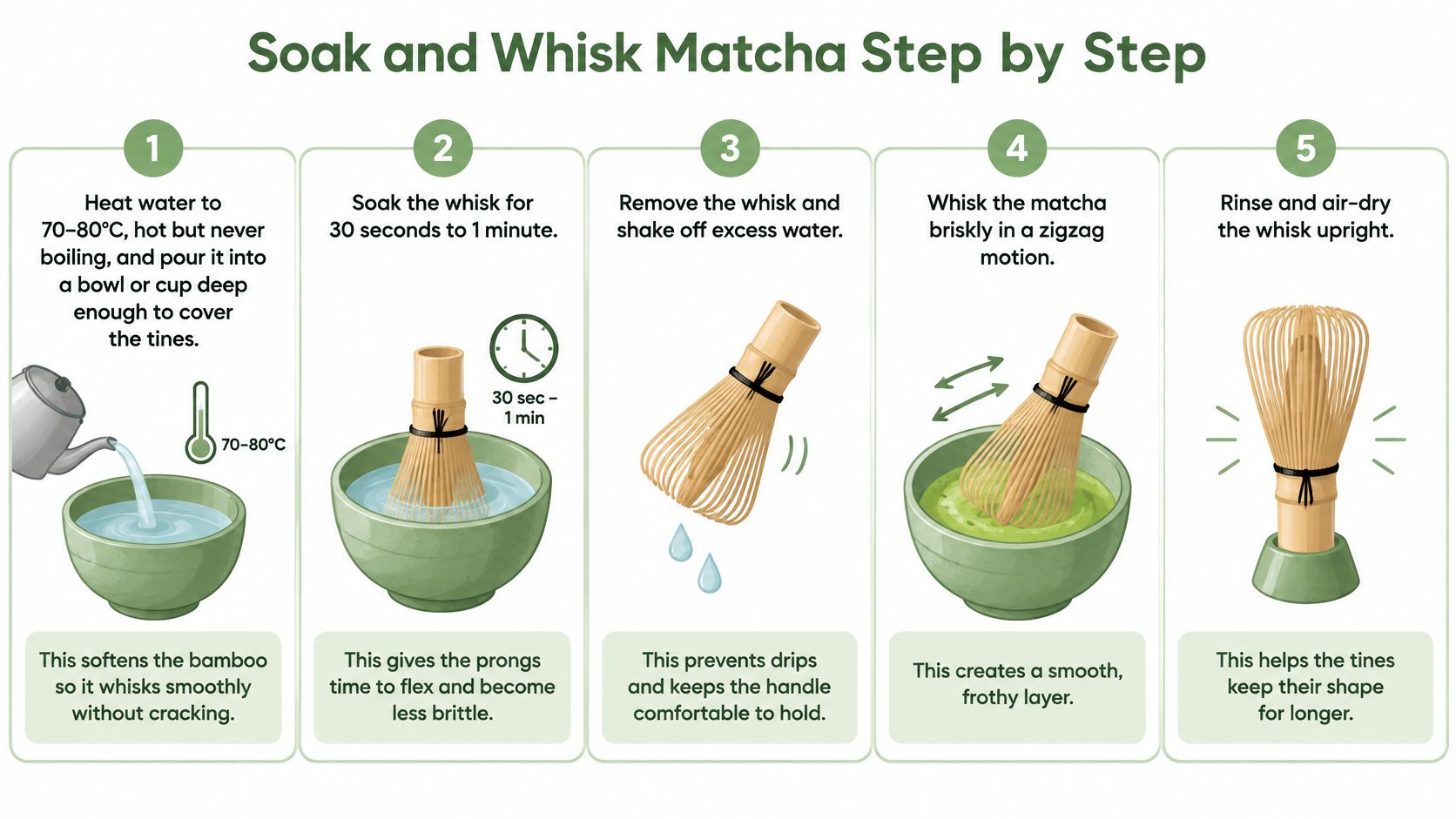
Heat the water. Use water at 70–80°C, hot but not boiling, and pour it into a bowl or cup deep enough to cover the tines. Warm water softens the bamboo; boiling water can put unnecessary stress on its fibres.
Soak the tines. Give a new whisk 1–2 minutes, or a routine whisk 30–60 seconds. Hydrated tines flex during whisking instead of resisting the motion while dry.
Lift and shake. Remove the whisk and shake off excess water while you sift matcha into the bowl. This avoids carrying a drip into the powder and keeps the handle comfortable to hold.
Add water and whisk. Add a little hot water to the sifted matcha, then whisk briskly in an M or W motion for 15–30 seconds until fine foam forms without dry clumps. Organic Merchant's bamboo-whisk guide also describes this rapid whisking motion.
Rinse straight away. Once you've made your bowl, rinse the whisk promptly rather than leaving matcha to dry on the tines.
Keep the soak purposeful
Longer isn't automatically better. A whisk left in water for an extended stretch can become waterlogged and take longer to dry, so lift it out once the tines have softened. Submerge only the bamboo head; keeping the handle out of the water makes it easier to dry the whole whisk thoroughly.
Your kitchen conditions can change how the whisk feels between sessions. In a dry, heated home, a whisk left unused for a while may feel stiff again, so check the tines and use the longer first-use soak as a practical guide. In a humid summer kitchen, the whisk may take longer to dry after use, making an airy drying spot especially important.
For more detail on bowl technique and the whisking motion, follow our guide to how to whisk matcha. A well-made bowl has a smooth surface with a fine, even layer of foam, not streaks of powder or a scattering of large bubbles.
Here's the full process in motion:
Rinse, Dry and Fix Your Whisk
Rinse the chasen in clean warm water as soon as you finish whisking. Swirl the tines gently or use your fingertips to release any matcha caught between them. Avoid twisting, squeezing, abrasive scrubbing, routine soap and the dishwasher, which can damage the delicate bamboo.
Shake off excess water, then let the whisk air-dry fully in a ventilated spot or on a holder. Don't lean it against a mug or leave it sitting in the sink, where the tines can stay damp or lose their shape. Organic Merchant's care guide recommends rinsing promptly and drying thoroughly, with good airflow before reuse. For a useful overview of general kitchen sanitising advice from BacteriaFAQ, remember that a bamboo whisk still needs care suited to its material.
| Problem | Likely cause | Fix |
|---|---|---|
| Tines snap while whisking | Dry, brittle bamboo or water that's too hot | Before the next session, soak in 70–80°C water for 30–60 seconds. |
| Tines splay or stay flattened | Twisting, squeezing or scrubbing | Gently reshape as the tines dry; replace the whisk if its shape doesn't recover. |
| Mould or musty smell | Stored damp or dried too slowly | Dry fully in moving air; replace it if mould returns. |
| Matcha dried onto the tines | The whisk wasn't rinsed promptly | Rinse in warm water straight away and swirl gently. |
| Cracks in the bamboo | Wear, heat or a dropped whisk | Replace it. A cracked whisk can't be reliably cleaned and dried. |
Some problems respond to a change in routine: a prompt rinse, gentler handling and better airflow can help prevent dried matcha and damp-storage issues. Cracks, recurring mould and tines that stay flattened are signs to replace the whisk, not to try to repair it. A matcha whisk stand gives the whisk a dedicated place to dry without resting on a surface.
Shared Café Whisks and Food-Safety Rules
A warm pre-use soak prepares bamboo for whisking. It doesn't sanitise a shared café whisk. Australian food-safety requirements say eating and drinking utensils must be clean and sanitary immediately before use, and describe cleaning as washing, rinsing, sanitising where required, and drying. See the Australian food-safety standards for the relevant requirements.
The decision changes with the way a whisk is used. One person using one whisk at home is not the same as staff using one whisk across customers or different drinks. Matcha-only service also differs from drinks involving dairy or flavourings, where the venue's cleaning procedure must account for what has contacted the utensil.
| Setting | Is a pre-use soak enough? | What is needed |
|---|---|---|
| Home, one person, one whisk | Usually, with a prompt rinse | Full air-drying after every session |
| Café, shared or used across drinks | No, a soak isn't sanitising | Documented cleaning and sanitising under the venue food-safety plan |
| Café, dairy or flavoured drinks | No | Documented procedure, plus checks for cracks, mould and odour |
Don't blindly apply commercial utensil methods to bamboo: heat, detergent or prolonged immersion may damage the whisk. Follow the venue's food-safety plan and local requirements, inspect the whisk, and replace it when it can't be reliably cleaned and dried. For broader workplace context, Opus Safety's health and safety essentials for employers can help frame the responsibilities around safe work practices.
Common Soaking Questions Answered
Can I use cold water?
Cold water won't soften the tines as effectively as warm water, so use warm water in the 70–80°C range. If your kettle has just boiled, let the water stand briefly before pouring it over the whisk.
Can I leave the whisk in overnight?
No. Lift the whisk out after its preparation soak, then rinse it after use and let it dry fully. Long immersion can leave bamboo waterlogged and slower to dry.
Do I soak it again between bowls in one sitting?
Yes, give it a brief soak before each subsequent bowl if the tines feel stiff. T2 Tea Australia's care guidance specifies a 30–60-second soak before every use.
Does tap water matter?
Use clean drinking water, just as you would for preparing matcha. There's no need to use a special kind of water for the whisk soak.
How long does a whisk last?
The care guides cited here don't provide a reliable lifespan, so judge the whisk by its condition instead. Replace it if it cracks, mould returns, or the tines stop recovering their shape.
Confirm Your Next Soak and Take the Next Step
Before your next bowl, check the whisk rather than reaching for it on autopilot. If it's been sitting dry for a while, use the first-use guidance in the table; if you see cracks, returning mould or tines that stay splayed, replace it before whisking.
A well-kept chasen pairs nicely with good matcha, and the grade you choose, ceremonial or culinary, shapes the bowl too. When you're ready to restock, explore Pep Tea's organic matcha range without any pressure. A small care habit can make the daily matcha ritual easier and more enjoyable.
Pep Tea offers organic matcha for whisked bowls, lattes and recipes, alongside Australian-brewed organic kombucha. Visit Pep Tea to explore the range and find a matcha that suits your next bowl.