
The Best Counter Top Water Filter for Tea & Kombucha

You buy a beautiful tin of ceremonial matcha, warm the bowl, whisk carefully, and take that first sip expecting sweetness, creaminess, and that soft green finish. Instead, the cup tastes flat. Or slightly metallic. Or oddly sharp. The same thing happens with homemade kombucha. Your brew looks lively, but the flavour feels muddy, not bright.
That disappointment often comes down to water.
Tea drinkers talk a lot about leaf quality, whisking, temperature, fermentation, and timing. All of that matters. But if the water itself tastes harsh or carries lingering treatment chemicals, it can dull delicate flavours before your brew even has a chance.
Why Your Tap Water Is Letting Your Best Brews Down
A lot of Australians are doing the right things already. They're buying better tea, using nicer kettles, paying attention to brew temperature, and trying to get café-quality drinks at home. But the water coming from the tap can compromise all that effort.

Take matcha as the easiest example. It isn't steeped and discarded like loose-leaf tea. You drink the whole leaf. That means the water's aroma, mineral feel, and aftertaste sit right alongside the matcha's grassy sweetness and umami. If your tap water smells like a swimming pool, your bowl will too.
Kombucha has its own issues. During brewing, chlorine and similar disinfectants can interfere with the clean flavour you want from tea, fruit, and fermentation. During drinking, hard or stale-tasting water can make a finished kombucha seem rougher than it really is.
The flavour problem most people miss
Water is the foundation of the drink. If the base tastes off, the final cup rarely tastes better than “fine”.
A counter top water filter can be a practical fix because it doesn't ask you to renovate your kitchen or call a plumber. It sits on the bench, treats the water you drink, and gives you more control over flavour. For anyone trying to make a smoother matcha or cleaner-tasting kombucha at home, that matters.
Practical rule: If your tea tastes better at a good café than it does at home using the same style of tea, water is one of the first things to question.
If you're curious about what might be in your local supply, this guide to Sydney water quality is a useful starting point because it helps translate “safe to drink” into what that might mean for taste. If you like checking the finer details of your brew setup, a digital pH meter can also be handy when you're tracking water behaviour in tea or fermentation.
What Is a Counter Top Water Filter
A counter top water filter is a compact filtration system that sits on your kitchen bench and cleans water where you use it. Some connect directly to a tap. Others are fill-and-dispense units with their own tank. Either way, the idea is simple. Water goes in, passes through one or more filter stages, and comes out cleaner for drinking, brewing, and cooking.
Consider it a coffee machine for water quality. You don't need to rebuild the kitchen. You just need a dedicated appliance that improves one part of your daily routine.
Why Australians are choosing them
Countertop systems have become a big category locally for a reason. The Australia water purifier market was valued at USD 245.34 Million in 2024 and is projected to reach USD 338.75 Million by 2030, with counter-top water purifiers identified as the dominating segment due to their ease of installation, portability, and affordability.
That popularity makes sense in real kitchens.
- Renters like them because there's little or no permanent installation.
- Busy households keep them because setup is usually straightforward.
- Tea and coffee drinkers prefer them because the water quality upgrade is immediate and easy to taste.
If you're comparing formats, this overview of a PureHQ water filter jug is useful because it shows where a jug can suit lighter needs and where a bench unit may be the stronger option.
What they do well
Countertop filters sit in a sweet spot between convenience and performance. They're usually a step up from basic jugs when you want stronger filtration, but they're far less committed than under-sink systems.
For home brewers, that balance is appealing:
| Format | Best for | Trade-off |
|---|---|---|
| Water jug | Simplicity and small volumes | Often limited filtration depth |
| Counter top water filter | Daily drinking and brewing without major install | Takes up bench space |
| Under-sink system | Permanent kitchen setup | More involved installation |
The big win is control. You can choose a system based on what bothers you in your water. Taste. chlorine. chloramine. fluoride. heavy metals. Or a combination of those.
Decoding The Four Main Filter Technologies
The phrase “filtered water” sounds simple, but the technology inside can be very different. Two units can look almost identical on the bench and produce water with very different flavour, mineral balance, and contaminant reduction.
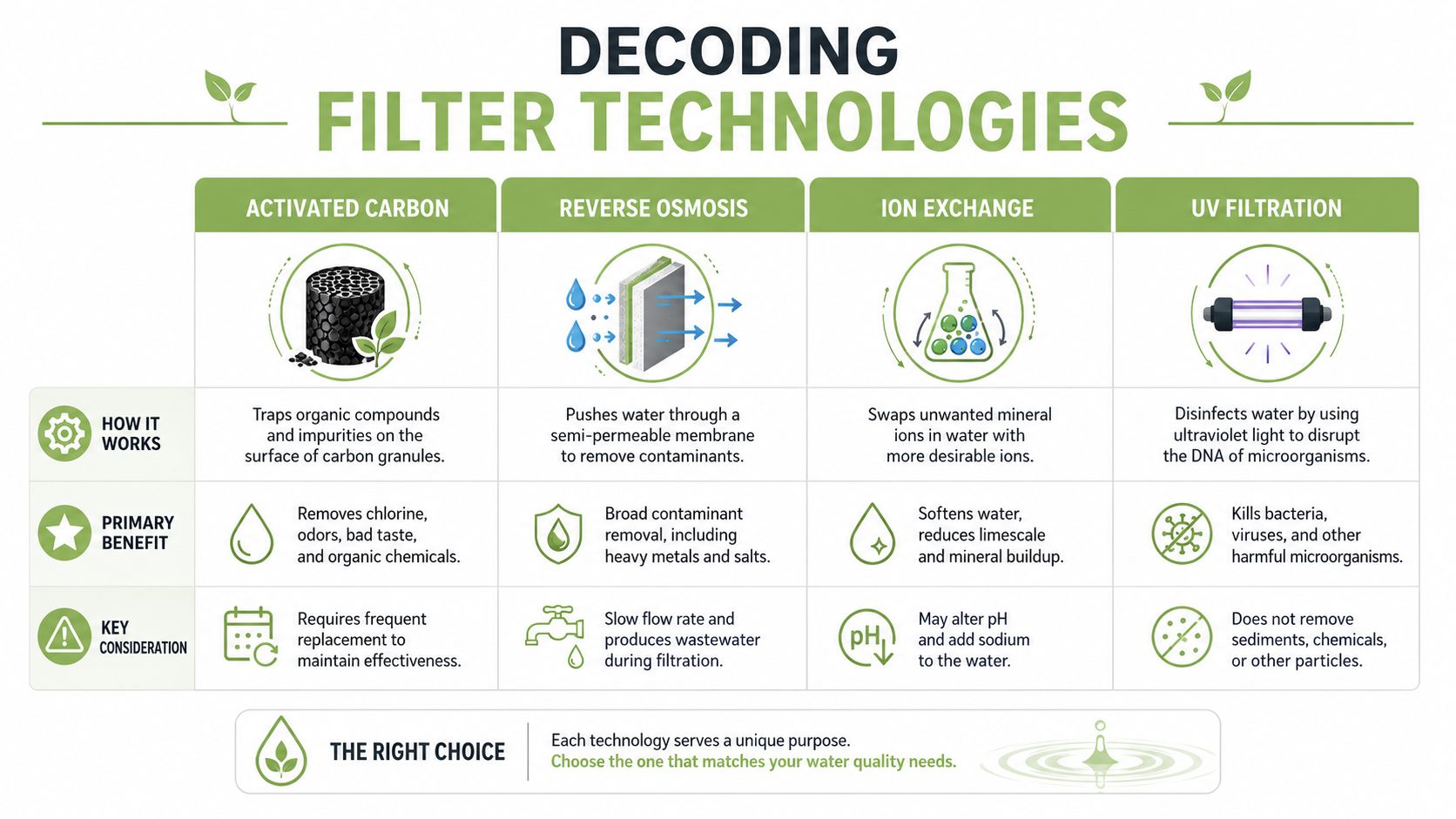
Activated carbon
Activated carbon is the most familiar option. It works a bit like a sponge with a huge internal surface area, grabbing onto chlorine and many compounds that cause unpleasant smell and taste.
For tea drinkers, that can be a noticeable improvement. Water often tastes fresher and less chemical. Some advanced countertop systems with Claryum® technology are certified to remove 99% of lead and 97% of chlorine while retaining beneficial minerals like calcium and magnesium, which matters for flavour extraction in premium teas, according to Aquasana's countertop filter specifications.
That last point is important. Carbon-based systems often leave useful minerals in place, so the water can still taste lively rather than stripped.
Ceramic
Ceramic filters act more like a physical barrier. Water passes through tiny pores that catch sediment, rust, and some microorganisms. They're good at dealing with visible particles and can improve clarity and mouthfeel when your tap water looks or feels rough.
They're less about flavour finesse on their own. In practice, ceramic is often best when paired with another stage, especially carbon.
Ion exchange
Ion exchange uses resin to swap unwanted dissolved ions for others. In plain language, it's often used to soften water or reduce certain metals.
This can help if your kettle scales up quickly or your water feels hard on the palate. For tea, softer water can improve extraction. But there's a balance. Water that's too altered can make a brew taste hollow.
Reverse osmosis
Reverse osmosis, usually shortened to RO, is the heavy-duty option. It pushes water through an extremely fine membrane that blocks a very broad range of contaminants. If carbon is a sponge, RO is a microscopic sieve.
Some countertop RO systems go much further than general taste improvement. The AquaTru Classic countertop reverse osmosis purifier is described as certified by IAPMO to NSF standards to remove 84 distinct contaminants, including lead, fluoride, PFAS, chlorine, chloramines, nitrates, arsenic, and chromium-6.
Carbon often improves taste. RO aims for deep purification.
Which technology suits brewing best
There isn't one universal winner. It depends on your water and what you care about most in the cup.
- If chlorine taste is your main issue, carbon can be a very satisfying upgrade.
- If sediment or rust shows up, ceramic can help as part of a multi-stage setup.
- If hardness is frustrating your kettle and flattening flavour, ion exchange may play a role.
- If you're targeting fluoride, chloramine, PFAS, or a broader range of contaminants, RO becomes much more relevant.
For matcha and fine tea, many people prefer water that is clean but not lifeless. That's why the mineral-retention question matters almost as much as the contaminant list.
Contaminants That Ruin a Perfect Brew
Some water problems are obvious. You smell chlorine the moment the kettle fills. Others are sneakier. The water looks clear, but the tea tastes harsh, dull, chalky, or strangely metallic.
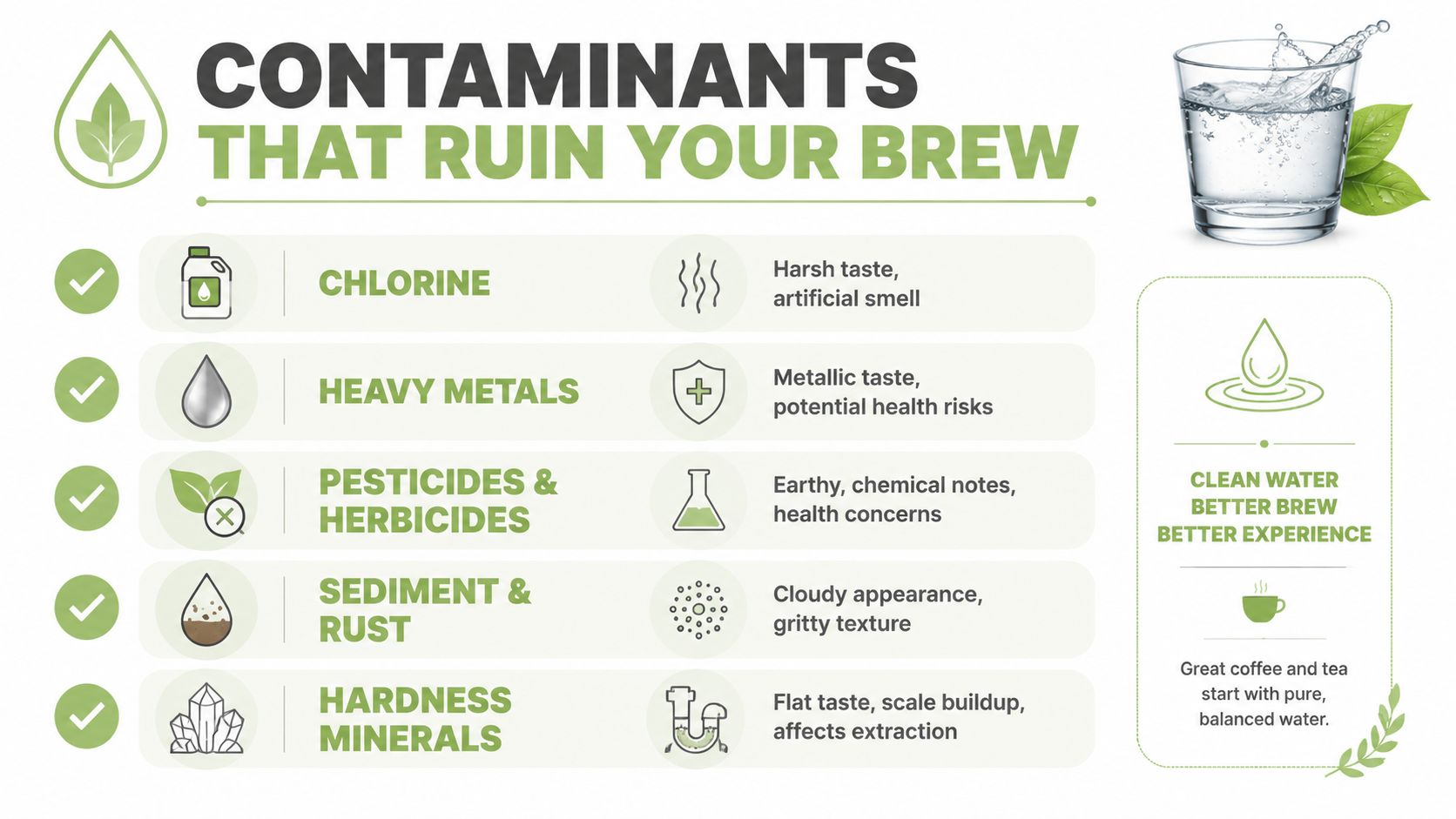
Chlorine and chloramine
Chlorine gets most of the blame because it has that unmistakable pool-like smell. In tea, it can sit on top of delicate aromatics and make everything feel artificial. In kombucha, it can interfere with the clean, bright impression you want from the finished drink.
Chloramine deserves more attention than it gets. In Australia, 94-97% of capital cities use chloramine for disinfection, and standard activated carbon filters struggle to remove it. According to this analysis of countertop water filter choices in Australia, only Reverse Osmosis reliably removes both chloramine and fluoride.
That matters if your water seems “chemically” off even after using a basic filter.
Heavy metals and trace chemicals
Lead, arsenic, chromium, and similar contaminants don't always announce themselves with a dramatic smell. Sometimes what you notice is a metallic edge or a slightly unpleasant finish that muddies tea sweetness.
PFAS and other trace chemicals are a different concern. These contaminants won't be identified by taste alone, but many shoppers still want a filter that addresses them because they're choosing water for both flavour and peace of mind.
If you brew fermented drinks at home, cleaner water can also support a more consistent base tea. Anyone building a SCOBY from scratch will already know that water quality affects the whole process. This kombucha SCOBY guide is a useful companion if you're pairing filtration with home fermentation.
Sediment hardness and flavour interference
Not every problem is a “danger” problem. Some are purely brew killers.
| Contaminant or issue | What you notice in the cup |
|---|---|
| Chlorine | Sharp smell, artificial taste |
| Chloramine | Persistent chemical note that basic filters may miss |
| Heavy metals | Metallic edge, harsher finish |
| Sediment or rust | Cloudiness, gritty feel |
| Excess hardness minerals | Flat extraction, scale, muddled flavour |
If a tea tastes muted and dusty rather than clear and sweet, the water often needs attention before the tea does.
For matcha in particular, flavour is exposed. There's nowhere for poor water to hide. The whole bowl is water plus finely ground tea, so every off-note becomes more obvious.
How to Choose Your Filter The PepTea Way
Choosing a counter top water filter gets easier once you stop asking, “What's the most advanced unit?” and start asking, “What water will make my drinks taste best in my kitchen?”
Start with the flavour goal
For tea and kombucha, flavour should lead the decision.
If your tap water mainly smells unpleasant, a mineral-retaining carbon system may be enough. If your issue is broader, especially where chloramine or fluoride are concerns, you may need RO. But there's a trade-off. As outlined in this practical water filter advice, stronger filtration isn't automatically better for every person or every kitchen. It has to suit your water and your routine.
Know the RO trade-off
RO removes a very wide range of contaminants, but it changes the character of the water too. According to Waterdrop's Australian buyer guide on water filtration options, reverse osmosis removes 99% of contaminants, but it also strips all minerals and can waste up to 60% of water. The same source notes that post-filtration remineralisation cartridges can create taste instability and even bacterial growth risks in warm Australian conditions.
That doesn't mean RO is wrong. It means you should choose it for a clear reason.
Brew-first mindset: If a filter gives you technically pure water but your matcha tastes flat, it hasn't solved the whole problem.
Use a simple shortlist
When I'd narrow it down for brewing, I'd ask these questions in this order:
What taste issue am I fixing first
Chlorine smell, harshness, metallic notes, muddiness, or visible sediment?Do I need deep contaminant removal
If chloramine and fluoride are both on your concern list, your shortlist shrinks quickly.Do I want mineral retention or near-total purification
This question affects flavour more than many buyers expect.Will I enjoy using it daily
Tank size, refill effort, bench footprint, and dispensing speed all matter.
A practical setup also includes good heating control. If you're making tea often, a variable-temperature kettle like the Fellow Stagg EKG electric kettle pairs well with filtered water because it lets you control two major flavour variables at once.
Think about your kitchen not just the spec sheet
A perfect filter on paper can still annoy you in real life if it's bulky, slow, or awkward to refill. That's especially true in smaller Australian kitchens.
This short video gives a useful visual sense of how bench systems fit into everyday use.
For most tea drinkers, the sweet spot is simple. Choose the strongest filtration that still gives you water you enjoy drinking plain. If it tastes good on its own, it's far more likely to make a good bowl of matcha and a cleaner glass of kombucha.
Maintenance Lifespan and Long-Term Costs
The purchase price is only the beginning. A counter top water filter is really a small ongoing habit. If you keep the filters fresh and the unit clean, the water stays consistent. If you ignore maintenance, flavour usually tells on you before anything else does.
In Australia, CHOICE notes that counter-top water filters can range from $60 to $350 upfront, while replacement filters typically cost $100–$200 annually. More advanced systems may cost more to buy but can have longer filter lifespans.
What to budget for
A cheap unit with frequent cartridge changes may cost more over time than a better-built system with slower replacement cycles.
Here's the practical way to look at it:
- Upfront cost matters if you're testing the waters and want a simple upgrade.
- Annual replacement cost matters more if you're using filtered water every day for drinking, kettles, tea, and cooking.
- System complexity usually affects upkeep. More stages can mean better filtration, but also more parts to monitor.
Signs your filter needs attention
You don't need to wait for a reminder light.
Watch for:
- Taste drift where your tea starts tasting sharper or duller again
- Slower flow from the dispenser or tap attachment
- Odour returning after a period of improvement
- Visible residue in tanks, fittings, or around seals
Clean water systems still need cleaning. Filter media and water reservoirs both benefit from regular care.
A simple ownership routine
For most households, the easiest approach is to tie maintenance to another regular kitchen habit.
| Task | Why it matters |
|---|---|
| Rinse and wipe the unit | Helps avoid stale odours and residue build-up |
| Replace cartridges on schedule | Maintains the contaminant reduction the unit was bought for |
| Taste the water plain | Your palate often notices decline before you see it |
| Check fittings and seals | Prevents leaks and keeps dispensing clean |
The best filter is rarely the one with the flashiest box. It's the one you'll maintain properly because it fits your kitchen, your budget, and your routine.
Frequently Asked Questions About Water Filters
Will filtered water help my kombucha SCOBY
In many homes, yes. Water that tastes cleaner usually gives you a cleaner base tea to ferment with. If your tap water carries obvious chlorine or chemical notes, filtration can make home brewing more predictable and more pleasant.
Is filtered water always better than bottled water for tea
Often, yes for everyday use. A good home filter gives you consistency without lugging bottles home, and you can make water fresh as needed for the kettle. It's also simpler to build into a daily tea ritual.
Can I use filtered water for coffee too
Absolutely. If your coffee machine suffers from scale or your espresso tastes blunt, filtered water can help there as well. The same principles apply. Better water usually means clearer flavour and a tidier finish.
Will a stronger filter always make tea taste better
Not always. Some highly purified water can taste too empty for delicate teas. That's why mineral balance matters. The best brewing water is clean, pleasant, and suited to the style of drink you make most often.
Is a counter top water filter a good option for renters
Usually, yes. That's one of the biggest advantages. You can improve your drinking and brewing water without committing to under-sink installation or permanent plumbing changes.
If you're refining your daily brew ritual, Pep Tea is a great place to explore premium organic matcha, sugar-free organic kombucha, and practical tea tools that help every cup taste the way it should.